Overcoming the Cold-Start Problem in Chemogenomic Target Prediction: AI Strategies for Novel Drug and Target Discovery
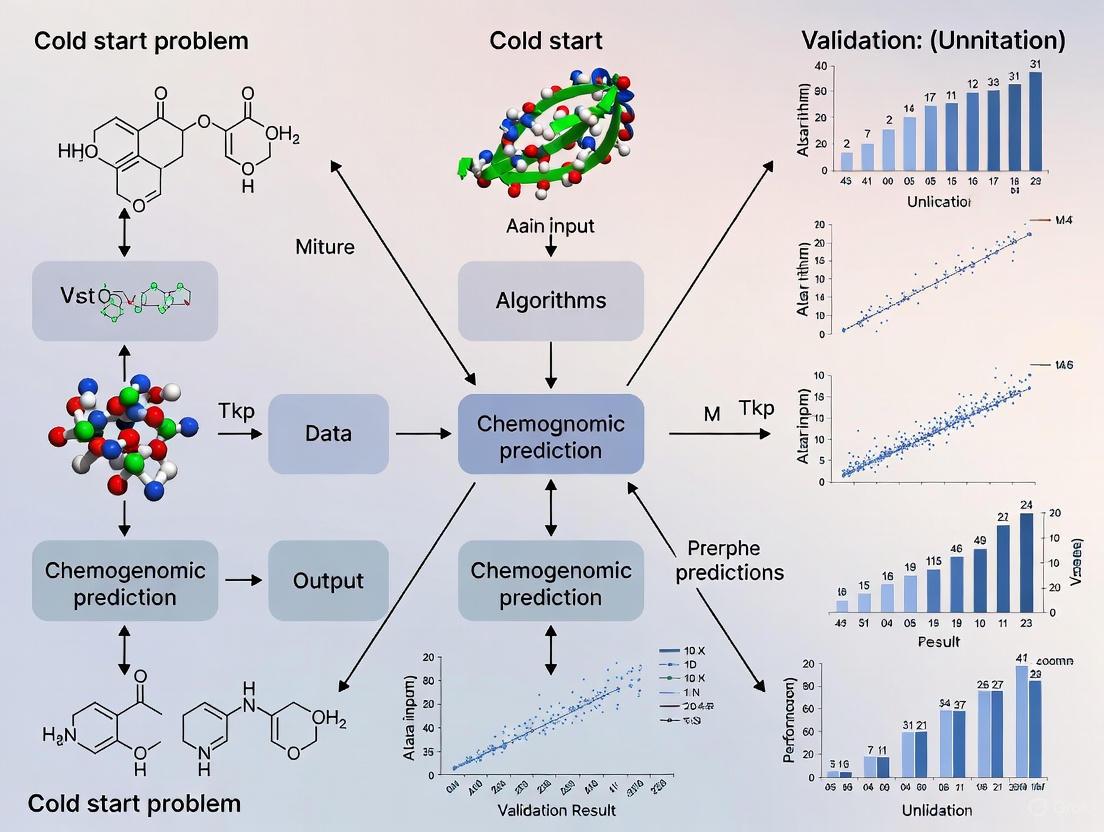
Accurately predicting interactions between novel drugs and targets—the 'cold-start problem'—is a major bottleneck in AI-driven drug discovery.
Overcoming the Cold-Start Problem in Chemogenomic Target Prediction: AI Strategies for Novel Drug and Target Discovery
Abstract
Accurately predicting interactions between novel drugs and targets—the 'cold-start problem'—is a major bottleneck in AI-driven drug discovery. This article provides a comprehensive overview for researchers and drug development professionals, exploring the foundational causes of this challenge and its impact on predictive models. We detail cutting-edge methodological solutions, from transfer learning and biological large language models to advanced data handling techniques. The content further offers practical troubleshooting and optimization strategies, and concludes with a critical evaluation of validation frameworks and performance benchmarks for real-world application, synthesizing key insights to guide future research and development efforts.
Understanding the Cold-Start Challenge: Why Novel Drugs and Targets Stump AI Models
Frequently Asked Questions (FAQs)
Q1: What exactly is the "cold-start problem" in chemogenomics? The cold-start problem refers to the significant drop in model performance when predicting interactions for novel drugs or novel targets that were not present in the training data [1] [2]. This is a major challenge in drug discovery and repurposing, as the primary goal is often to find targets for new drug compounds or to repurpose existing drugs for new proteins [3] [4].
Q2: What are the different types of cold-start scenarios? Research typically defines four main scenarios based on the novelty of the entities involved [5] [6]:
- Warm Start: Predicting interactions for drug-target pairs where both the drug and target have known interactions in the training data.
- Compound Cold Start (Novel Drug): Predicting interactions for a new drug compound against known targets.
- Protein Cold Start (Novel Target): Predicting interactions for known drugs against a new target protein.
- Blind Start (Two Novel Entities): Predicting interactions for a completely new drug against a completely new target.
Q3: Why do traditional similarity-based methods fail for cold-start problems? Traditional methods often rely on the "guilt-by-association" principle, which assumes that similar drugs bind similar targets. However, this principle can break down for novel entities with no prior interaction data, and it may not produce serendipitous discoveries [3]. Furthermore, some network-based inference methods are inherently biased and cannot predict for new drugs or targets [3].
Q4: Which cold-start scenario is the most challenging for predictive models? The "Blind Start" scenario, involving both a novel drug and a novel target, is generally the most challenging because the model has no prior interaction data for either entity to learn from [5]. However, studies have shown that the "Protein Cold Start" (novel target) can also be particularly difficult for many state-of-the-art methods [4].
Troubleshooting Guides
Issue 1: Poor Performance on Novel Drug Predictions
Problem: Your model performs well on known drugs but fails to generalize to novel drug compounds.
Solution: Integrate external chemical knowledge to build a robust representation for new compounds.
- Step 1: Employ unsupervised pre-training on large, unlabeled chemical databases (e.g., PubChem) using language models on SMILES sequences or graph neural networks on molecular graphs [1]. This helps the model learn the fundamental "grammar" of chemistry.
- Step 2: Utilize transfer learning from related tasks. For example, pre-train your model on Chemical-Chemical Interaction (CCI) data. The interaction patterns learned from CCI can be transferred to the drug-target interaction task, providing the model with crucial inter-molecule interaction information it wouldn't get from drug structures alone [1] [2].
- Step 3: Represent novel drugs using pre-trained features like Mol2Vec [5]. These embeddings capture semantic features of drug substructures and provide a meaningful input representation even for previously unseen compounds.
Issue 2: Poor Performance on Novel Target Predictions
Problem: Your model cannot accurately predict interactions for novel target proteins.
Solution: Enhance protein representation with structural and functional context.
- Step 1: Use protein language models (e.g., ProtTrans) trained on millions of protein sequences to generate feature representations for novel targets [5]. These models capture evolutionary and structural information directly from the amino acid sequence.
- Step 2: Apply transfer learning from Protein-Protein Interaction (PPI) networks [1] [2]. Since the protein interface in PPI can reveal effective drug-target binding modes, this knowledge helps the model understand how a protein might interact with a drug.
- Step 3: If available, incorporate predicted or experimental protein structures. A protein can be represented as a graph where nodes are residues and edges represent contacts or distances, providing a simplified yet informative 2D structural representation [1].
Issue 3: Model Failure in a Complete Cold-Start (Blind) Setting
Problem: Your model is ineffective when both the drug and target are novel.
Solution: Adopt a framework specifically designed for this hardest case, leveraging flexible molecular representations.
- Step 1: Move beyond the rigid "lock-and-key" theory. Implement models inspired by the induced-fit theory, where compounds and proteins are treated as flexible molecules [5]. This aligns better with biological reality and can improve generalization.
- Step 2: Use a framework like ColdstartCPI [5]. This involves:
- Generating features for the novel compound and protein using Mol2Vec and ProtTrans.
- Using a Transformer module to learn compound and protein features by extracting inter- and intra-molecular interaction characteristics, allowing the features of one molecule to adapt based on the other.
- Step 3: Combine knowledge graph embeddings with a recommendation system approach (e.g., KGE_NFM) [4]. The knowledge graph integrates multi-omics data, providing a rich context for both drugs and targets, while the recommendation system paradigm is naturally suited to predicting new links.
Experimental Protocols & Data
| Method Name | Core Approach | Best Suited For Cold-Start Scenario | Key Advantage |
|---|---|---|---|
| C2P2 [1] [2] | Transfer Learning from CCI & PPI | Novel Drugs & Novel Targets | Incorporates critical inter-molecule interaction information. |
| KGE_NFM [4] | Knowledge Graph & Recommendation System | Novel Proteins (Protein Cold Start) | Integrates heterogeneous data; does not rely on similarity matrices. |
| ColdstartCPI [5] | Pre-training & Induced-Fit Theory | Blind Start (Novel Drug & Target) | Models molecular flexibility; performs well in data-sparse conditions. |
| Ensemble Chemogenomic Model [7] | Multi-scale Descriptors & Ensemble Learning | Novel Drugs & Novel Targets | Combines multiple protein and compound descriptors for robustness. |
Protocol: Implementing a C2P2-Inspired Framework
This protocol outlines a transfer learning procedure to mitigate cold-start problems by leveraging interaction data [1].
1. Pre-training on Auxiliary Tasks
- Objective: Learn generalized representations for chemicals and proteins from related interaction tasks.
- Chemical-Chemical Interaction (CCI) Pre-training:
- Data Source: Gather CCI data from pathway databases or via text mining [1].
- Model Training: Train a model to predict CCI. The goal is to learn a representation function that encodes chemical structures in a way that reflects their interaction potential.
- Protein-Protein Interaction (PPI) Pre-training:
- Data Source: Obtain PPI data from curated biological databases.
- Model Training: Train a model to predict PPI. This helps the model learn representations that capture the properties of protein interfaces involved in binding.
2. Transfer Learning to Drug-Target Affinity (DTA)
- Objective: Transfer the learned knowledge to the main DTA prediction task.
- Model Architecture: Use the pre-trained models from Step 1 as the foundation (encoder) for your DTA model.
- Fine-tuning: Train the entire model on your DTA dataset. The pre-trained weights provide a head start, as they are already tuned to understand molecular interactions, making the model more robust to novel drugs and targets.
Visualization: Knowledge Graph Framework for Cold-Start Problems
The diagram below illustrates how a knowledge graph (KG) integrates diverse data to address cold-start issues.
The Scientist's Toolkit: Research Reagent Solutions
Table 2: Essential Computational Tools and Databases
| Item Name | Type | Function in Cold-Start Research |
|---|---|---|
| ChEMBL [7] | Database | Provides curated bioactivity data for known drug-target interactions, used for model training and benchmarking. |
| BindingDB [7] [5] | Database | A public database of measured binding affinities, essential for training and validating affinity prediction models. |
| UniProt [7] | Database | Provides comprehensive protein sequence and functional annotation data (e.g., Gene Ontology terms) for generating protein descriptors. |
| PubChem [1] | Database | A vast repository of chemical structures and properties, used for unsupervised pre-training of compound representation models. |
| Mol2Vec [5] | Pre-trained Model | Generates numerical representations (embeddings) for compounds based on their chemical substructures, useful for novel drugs. |
| ProtTrans [5] | Pre-trained Model | A suite of protein language models that generate state-of-the-art feature representations from amino acid sequences, crucial for novel targets. |
| Knowledge Graph (e.g., PharmKG) [4] | Data Framework | Integates diverse biological data (drugs, targets, diseases, pathways) into a unified graph, providing rich context for new entities. |
Frequently Asked Questions (FAQs)
FAQ 1: What is the "cold-start problem" in drug-target prediction? The cold-start problem refers to the significant drop in machine learning model performance when predicting interactions for novel drugs or target proteins that were not present in the training data. This is a critical challenge in drug discovery and repurposing, as it directly limits the ability to identify new therapeutic uses for existing drugs or predict targets for novel compounds. The problem manifests in three main scenarios: compound cold start (predicting for new drugs), protein cold start (predicting for new targets), and blind start (predicting for both new drugs and new targets simultaneously) [1] [5].
FAQ 2: Why do traditional computational methods fail with novel drugs or targets? Many traditional methods rely heavily on similarity principles or existing network data. When a new drug or target has no known interactions or close analogs in the training set, these methods have no basis for making predictions. Furthermore, models based solely on lock-and-key theory or rigid docking treat molecular features as fixed, failing to account for the flexible nature of actual binding interactions, which is especially problematic for novel entities [5].
FAQ 3: What advanced computational strategies can mitigate the cold-start problem? Several advanced strategies have shown promise:
- Transfer Learning: Knowledge gained from predicting chemical-chemical interactions (CCI) and protein-protein interactions (PPI) can be transferred to the drug-target affinity (DTA) task, as the underlying interaction principles are similar [1] [8].
- Knowledge Graph Embeddings (KGE): Representing diverse biological data (e.g., drug-disease associations, side-effects, pathways) as a knowledge graph allows models to learn robust representations of drugs and targets, improving generalization to new entities [4] [9].
- Unsupervised Pre-training: Using large, unlabeled datasets of chemical structures (e.g., SMILES) and protein sequences to pre-train models helps them learn fundamental biochemical "grammar," creating a better starting point for specific prediction tasks [1] [5].
- Induced-Fit Theory Models: Frameworks like ColdstartCPI treat proteins and compounds as flexible molecules, using Transformer modules to learn interaction characteristics. This aligns with biological reality and improves prediction for unseen compounds and proteins [5].
FAQ 4: How can I evaluate if my model is robust to cold-start scenarios? It is essential to evaluate models using realistic data splits that simulate real-world conditions. Instead of random cross-validation, set up experiments where all interactions for specific drugs or proteins are held out from the training set to create compound cold-start, protein cold-start, and blind start test sets. Performance on these dedicated test sets is the true indicator of a model's utility in drug repurposing and de novo discovery [4] [5].
Troubleshooting Guides
Problem: Poor Model Generalization on Novel Drugs or Targets Symptoms: High accuracy during training and random cross-validation, but a dramatic performance drop when predicting interactions for molecules or proteins not seen during training.
| Possible Cause | Diagnostic Steps | Solution |
|---|---|---|
| Insufficient Feature Generalization | Check if your model relies only on simplistic or fixed molecular descriptors. | Integrate pre-trained features from large-scale models (e.g., ProtTrans for proteins, Mol2Vec for compounds) to capture deeper semantic and functional information [5]. |
| Data Sparsity | Analyze the training data for new entities; if they have no similar neighbors in the training set, similarity-based methods will fail. | Employ knowledge graph frameworks (e.g., KGE_NFM) that leverage heterogeneous data (like drug-disease networks) to infer relationships beyond direct similarity [4]. |
| Lock-and-Key Assumption | Review the model architecture; if features for a protein are static regardless of the compound it is paired with, it may be too rigid. | Implement models inspired by induced-fit theory, like ColdstartCPI, which use attention mechanisms to allow molecular features to adapt contextually during binding prediction [5]. |
Problem: Instability in Cold-Start Prediction Training Symptoms: Large fluctuations in validation loss or failure to converge when training models designed for cold-start scenarios, such as those using adversarial learning.
| Possible Cause | Diagnostic Steps | Solution |
|---|---|---|
| Adversarial Training Instability | Monitor the loss of the feature extractor and domain classifier in adversarial networks like DrugBAN_CDAN. If one overwhelms the other, training fails. | Use gradient reversal layers with a careful scheduling strategy and consider using Wasserstein distance or other stabilization techniques for Generative Adversarial Networks (GANs) [5]. |
| Information Leakage | Perform rigorous data separation to ensure no information from the "cold" test entities leaks into the training process, which can inflate performance. | Ensure a strict separation where all interactions for cold-start drugs/targets are completely absent from training. Use dedicated knowledge graph splits that withhold entire entities [5]. |
Quantitative Performance Data
The following table summarizes the performance of various state-of-the-art models under different cold-start conditions, as measured by the Area Under the Curve (AUC). Higher values indicate better performance.
Table 1: Model Performance (AUC) in Cold-Start Scenarios on Benchmark Datasets [5]
| Model | Warm Start | Compound Cold Start | Protein Cold Start | Blind Start |
|---|---|---|---|---|
| ColdstartCPI | 0.989 | 0.912 | 0.917 | 0.879 |
| DeepDTA | 0.984 | 0.802 | 0.821 | 0.701 |
| GraphDTA | 0.985 | 0.811 | 0.823 | 0.712 |
| KGE_NFM | 0.978 | 0.842 | 0.855 | 0.768 |
| DrugBAN_CDAN | 0.986 | 0.861 | 0.869 | 0.785 |
Table 2: Impact of Transfer Learning on Cold-Start Performance (AUC) [1]
| Training Strategy | Cold-Drug AUC | Cold-Target AUC |
|---|---|---|
| C2P2 (with CCI/PPI Transfer) | 0.892 | 0.901 |
| Standard Pre-training | 0.843 | 0.855 |
| From Scratch (No Pre-training) | 0.791 | 0.802 |
Experimental Protocols
Protocol 1: Implementing a CCI/PPI Transfer Learning Framework (C2P2)
Principle: Enhance drug-target affinity (DTA) prediction by first pre-training models on related tasks with abundant data—Chemical-Chemical Interaction (CCI) and Protein-Protein Interaction (PPI)—to learn generalized interaction knowledge [1].
Workflow:
- CCI Pre-training:
- Data Collection: Gather a large-scale CCI dataset from databases like STITCH or PubChem.
- Model Training: Train a graph neural network (GNN) or sequence model (e.g., on SMILES strings) to predict chemical-chemical interactions. The objective is to learn a robust representation that captures how molecules interact with one another.
- PPI Pre-training:
- Data Collection: Obtain a comprehensive PPI dataset from a source like BioGRID or STRING.
- Model Training: Train a model (e.g., a Transformer on amino acid sequences) to predict protein-protein interactions. This teaches the model the grammar of protein interfaces and binding.
- Knowledge Transfer & DTA Model Fine-tuning:
- Feature Extraction: Use the pre-trained CCI and PPI models to generate initial feature representations for drugs and targets in your DTA dataset.
- Fine-tuning: Integrate these features into a DTA prediction model (e.g., a neural network) and fine-tune the entire model on the specific DTA task, allowing the transferred knowledge to be adapted and refined.
Protocol 2: Building a Knowledge Graph Embedding Framework (KGE_NFM)
Principle: Overcome data sparsity and cold-start by learning low-dimensional representations of drugs and targets from a rich knowledge graph (KG) that integrates multiple data types (e.g., drug-disease, target-pathway, drug-side-effect associations) [4].
Workflow:
- Knowledge Graph Construction:
- Integrate data from multiple biomedical databases (e.g., DrugBank, UniProt, DisGeNET) to build a heterogeneous graph where nodes represent entities (drugs, targets, diseases, etc.) and edges represent their relationships (interacts-with, treats, causes, etc.).
- Knowledge Graph Embedding (KGE):
- Use a KGE model (e.g., TransE, DistMult, or PairRE) to encode all entities and relations into a continuous vector space. The model learns to preserve the graph's structure, so similar entities have similar embeddings.
- Neural Factorization Machine (NFM) Integration:
- For a given drug-target pair, retrieve their pre-trained KG embeddings.
- Feed these embeddings into an NFM, which is a recommendation system algorithm. The NFM learns to model the complex, non-linear feature interactions between the drug and target embeddings to predict the likelihood of interaction.
The Scientist's Toolkit: Research Reagent Solutions
Table 3: Essential Computational Tools and Databases for Cold-Start Research
| Item Name | Type | Function & Explanation |
|---|---|---|
| ProtTrans | Pre-trained Model | Provides deep learning-based protein language model embeddings. Used to generate high-quality, functional representations of protein sequences, crucial for cold-start targets [5]. |
| Mol2Vec | Pre-trained Model | Generates vector representations for molecular substructures from SMILES strings. Captures chemical context and similarity, aiding in representing novel compounds [5]. |
| BindingDB | Database | A public, web-accessible database of measured binding affinities, focusing chiefly on the interactions of proteins considered to be drug targets. Essential for training and benchmarking DTA models [5]. |
| DrugBank | Database | A comprehensive knowledgebase for drug and drug-target information. Serves as a key data source for building knowledge graphs and validating predictions [4]. |
| BioKG | Knowledge Graph | A publicly available knowledge graph that integrates data from multiple biomedical sources. Provides a ready-made resource for KGE pre-training to mitigate cold-start problems [4]. |
| Transformer Module | Algorithm | A deep learning architecture using self-attention. In frameworks like ColdstartCPI, it is used to model flexible, context-dependent interactions between compounds and proteins, mimicking induced-fit binding [5]. |
Frequently Asked Questions (FAQs)
FAQ 1: What are the most common cold-start scenarios in chemogenomic prediction? Cold-start problems occur when a model must make predictions for drugs or targets that were not present in the training data. These scenarios are formally categorized as follows [1] [5]:
- Compound Cold Start: Predicting interactions for novel drugs against known protein targets.
- Protein Cold Start: Predicting interactions for known drugs against novel protein targets.
- Blind Start: The most challenging scenario, requiring prediction of interactions between completely novel drugs and novel proteins.
FAQ 2: Why do models fail with novel molecular structures, even when pre-trained? Model failure often stems from a representation gap. While unsupervised pre-training on large molecular datasets helps learn internal structural patterns (intra-molecule interaction), it may lack specific information about how molecules interact with each other (inter-molecule interaction), which is critical for binding affinity prediction [1]. Furthermore, models trained on biased data or simplified assumptions (like the rigid "key-lock" theory) struggle to generalize to the flexible nature of real-world binding events [5].
FAQ 3: How can I assess the generalizability of my DTI model beyond standard metrics? Beyond standard metrics like AUC, use data splitting strategies that simulate real-world challenges [10]. Instead of random splits, employ:
- Scaffold Splits: Test the model's performance on entirely new molecular scaffolds.
- Temporal Splits: Train on older data and test on newer data to simulate a real discovery pipeline.
- Stratified Cold Splits: Explicitly hold out specific drugs or proteins during training to test cold-start performance [5]. Reporting performance on these splits provides a more realistic view of generalizability.
FAQ 4: What practical strategies can mitigate data sparsity?
- Leverage Auxiliary Data: Use transfer learning from related tasks, such as Chemical-Chemical Interaction (CCI) and Protein-Protein Interaction (PPI), to incorporate valuable inter-molecule interaction knowledge into your DTI model [1].
- Data Augmentation: Techniques that generate valid variations of existing data can help, though their effectiveness varies [10].
- Multi-Task Learning: Training a model on several related prediction tasks simultaneously can help it learn more robust representations, although this does not always solve core generalization issues [10].
FAQ 5: Are deep learning models always superior to traditional methods for DTI prediction? No. The performance advantage is highly context-dependent. On small datasets, traditional machine learning methods (e.g., Random Forests, SVM) with expert-designed descriptors often outperform deep learning models [11] [12]. Deep learning methods typically require large amounts of high-quality data to excel and become competitive on larger datasets [11] [12].
Troubleshooting Guides
Issue 1: Poor Performance on Novel Drugs or Targets (Cold-Start Problem)
Problem: Your model performs well on known drug-target pairs but fails to generalize to new entities.
Solution Checklist:
Implement Transfer Learning:
- Action: Pre-train your drug and target encoders on large, auxiliary datasets before fine-tuning on your specific DTI task.
- Protocol: The C2P2 framework suggests this workflow [1]:
- Step 1: Learn a general protein representation by pre-training on a Protein-Protein Interaction (PPI) prediction task.
- Step 2: Learn a general chemical representation by pre-training on a Chemical-Chemical Interaction (CCI) prediction task.
- Step 3: Integrate these pre-trained encoders into your DTA model, allowing it to leverage prior knowledge of molecular interactions.
Adopt an Induced-Fit Theory Approach:
- Action: Move beyond the rigid "key-lock" model. Use architectures that allow the representations of compounds and proteins to adapt to each other.
- Protocol: The ColdstartCPI framework provides a methodology [5]:
- Step 1: Encode proteins and compounds using pre-trained models (e.g., ProtTrans for proteins, Mol2vec for compounds) to get initial feature matrices.
- Step 2: Construct a joint representation of the compound-protein pair.
- Step 3: Process this joint matrix through a Transformer module. The attention mechanism allows the model to learn flexible, context-dependent features for both molecules, mimicking the biological induced-fit effect.
Validate with Rigorous Splitting:
Issue 2: Model Fails to Learn Meaningful Molecular Representations
Problem: Your model does not capture the essential features required for accurate interaction prediction, leading to low performance.
Solution Checklist:
Fuse Multiple Representation Types:
- Action: Combine different molecular representations to capture both structural and functional characteristics.
- Protocol: [13] [11]
- Step 1 (Graph Representation): Use a Graph Neural Network (GNN) to process the molecular graph, capturing topological information.
- Step 2 (Sequence Representation): Use a language model (e.g., Transformer) to process the SMILES string of a drug or the amino acid sequence of a protein, capturing sequential context.
- Step 3 (Feature Combination): Combine the learned embeddings from both representations (e.g., via concatenation or a learned weighted sum) before the final prediction layer.
Incorporate Domain Knowledge via Features:
- Action: Augment learned features with expert-designed descriptors or fingerprints.
- Protocol: This multi-view learning approach can be implemented as follows [11]:
- Step 1: Generate traditional descriptors (e.g., ECFP fingerprints for drugs, composition/transition/distribution descriptors for proteins).
- Step 2: Learn data-driven descriptors using a deep learning encoder (e.g., GNN).
- Step 3: Concatenate both the traditional and learned descriptors to create a enriched feature vector for the prediction task.
Issue 3: High-Variance Results and Unreducible Error Metrics
Problem: Model performance is inconsistent across different data splits or random seeds, and error metrics seem to have hit a ceiling.
Solution Checklist:
Diagnose Data Sparsity and Quality:
- Action: Quantify the sparsity of your dataset and check for experimental noise.
- Protocol: Calculate the sparsity value as the ratio of known interactions to all possible drug-target pairs in your dataset [14]. Benchmark datasets often have sparsity values below 0.07, meaning over 93% of possible interactions are unknown [14]. Be aware that a '0' in the interaction matrix may indicate a lack of data rather than a true non-interaction [14].
Address Extreme Class Imbalance:
- Action: If framing DTI prediction as a classification task, use metrics that are robust to class imbalance.
- Protocol: [14] [12] Prioritize the Area Under the Precision-Recall Curve (AUPR) over the Area Under the ROC Curve (AUC) for a more realistic performance assessment on imbalanced datasets where positive interactions are the minority class.
Experimental Protocols & Data
Key Benchmark Dataset Statistics
The Yamanishi benchmark is a widely used gold-standard data set for comparing DTI prediction algorithms. Its statistics are summarized below [14].
Table 1: Benchmark Data Set for DTI Prediction
| Data Set | Number of Drugs | Number of Targets | Number of Known Interactions | Sparsity Value |
|---|---|---|---|---|
| Enzyme | 445 | 664 | 2,926 | 0.010 |
| Ion Channel (IC) | 210 | 204 | 1,476 | 0.034 |
| GPCR | 223 | 95 | 635 | 0.030 |
| Nuclear Receptor (NR) | 54 | 26 | 90 | 0.064 |
Protocol: Implementing a Transfer Learning Workflow for Cold-Start Mitigation
This protocol is based on the C2P2 framework described in [1].
Objective: Improve DTA prediction for novel drugs/targets by transferring knowledge from CCI and PPI tasks.
Materials:
- Software: Python, deep learning library (e.g., PyTorch, TensorFlow).
- Data:
- Source DTI Data: e.g., BindingDB, BIO-SNAP [5].
- Auxiliary PPI Data: e.g., from BioGRID or STRING databases.
- Auxiliary CCI Data: e.g., from STITCH or pathway databases.
Method:
- Pre-training Phase (Knowledge Transfer):
- PPI Task: Train a protein encoder model (e.g., a Transformer) to predict whether two protein sequences interact. Use a large dataset of known PPIs.
- CCI Task: Train a drug encoder model (e.g., a GNN) to predict the interaction between two chemical compounds. Use a large dataset of known CCIs.
- Fine-Tuning Phase (DTA Prediction):
- Initialization: Use the pre-trained protein and drug encoders from Step 1 to initialize the encoders in your DTA model.
- Training: Train the entire DTA model on your specific drug-target affinity data. The model starts with robust general-purpose representations and fine-tunes them for the specific task of affinity prediction.
Validation: Compare the performance of the model with pre-trained encoders against a model with randomly initialized encoders. Use a strict cold-start test set where all drugs or all targets are unseen [5].
Research Reagent Solutions
Table 2: Key Computational Tools for DTI Research
| Tool / Resource | Type | Primary Function | Reference/Source |
|---|---|---|---|
| Mol2vec | Molecular Representation | Generates unsupervised numerical representations for chemical compounds based on their substructures. | [5] |
| ProtTrans | Protein Representation | Learns protein language models from millions of protein sequences, providing powerful feature extraction. | [5] |
| SIMCOMP | Cheminformatics Tool | Computes structural similarity scores between drug molecules, used to build drug similarity matrices. | [14] |
| KEGG LIGAND & GENES | Database | Provides curated data on drugs, targets, and their interactions for building benchmark datasets. | [14] |
| ECFP (Extended-Connectivity Fingerprints) | Molecular Descriptor | Creates a fixed-length binary bit string representing the presence of molecular substructures. | [13] |
| SMILES | Molecular Representation | A string-based notation for representing the structure of chemical molecules. | [13] |
Workflow Diagrams
Diagram 1: C2P2 Transfer Learning Framework
Diagram 1: Knowledge transfer from PPI and CCI tasks enhances DTA model performance on cold-start problems.
Diagram 2: ColdstartCPI Induced-Fit Workflow
Diagram 2: The ColdstartCPI framework uses a Transformer to model flexible molecular interactions.
FAQ: Understanding the Cold-Start Problem
What is the "cold-start" problem in Drug-Target Affinity (DTA) prediction? The cold-start problem refers to the significant drop in machine learning model performance when predicting interactions for novel drugs or target proteins that were not present in the training data. This is a major challenge in real-world drug discovery and repurposing, where researchers often work with new molecular entities [1].
Why do traditional models fail in cold-start scenarios? Traditional computational methods often rely heavily on the chemogenomic properties of drugs and proteins. When a new drug or target with a novel structure is introduced, these models lack the specific interaction data needed to make accurate predictions, as they cannot effectively generalize from their training set to these unseen entities [15].
What strategies can mitigate the cold-start problem? Advanced strategies focus on learning more generalized representations. Key approaches include:
- Transfer Learning: Leveraging knowledge from related tasks, such as Chemical-Chemical Interaction (CCI) and Protein-Protein Interaction (PPI), to inform the DTA model [1].
- Topology-Preserving Embeddings: Creating molecular representations that maintain the structural and functional relationships from a heterogeneous network, adhering to the "guilt-by-association" principle [16].
- Heterogeneous Network Integration: Using diverse biological and pharmacological data (e.g., from side effects, diseases, gene expression) to build robust features for drugs and targets, reducing reliance on a single data type [15].
Troubleshooting Guide: Addressing Common Experimental Issues
Problem: Model performance is poor on new drugs (cold-drug scenario).
- Potential Cause 1: The drug encoder has not learned a generalized representation that captures meaningful chemical features transferable to novel structures.
Solution:
- Apply Pre-training: Use a language model (like Transformer) pre-trained on large-scale, unlabeled SMILES sequences (e.g., from PubChem) to learn the intrinsic "grammar" of chemical compounds [1].
- Incorporate CCI Knowledge: Fine-tune the pre-trained encoder using chemical-chemical interaction data. This teaches the model how molecules interact with each other, providing valuable information for predicting how they might interact with proteins [1].
- Use Graph Representations: Represent drugs as graphs (atoms as nodes, bonds as edges) and employ graph neural networks pre-trained on tasks like attribute masking. This captures both local atom environments and global molecular topology [1].
Potential Cause 2: The model is overfitting to the specific drugs in the training set and cannot generalize.
- Solution:
- Implement Topology-Aware Loss: As in the GLDPI model, use a prior loss function that forces the embeddings of similar drugs (based on network similarity) to be close in the latent space. This ensures the model respects the "guilt-by-association" principle, even for unseen drugs that are similar to known ones [16].
- Leverage Heterogeneous Networks: Integrate multiple drug-related networks (e.g., based on side-effects, therapy domains) using a graph attention network (GAT) to learn a comprehensive and robust drug representation [15].
Problem: Model performance is poor on new target proteins (cold-target scenario).
- Potential Cause 1: The protein encoder lacks a fundamental understanding of protein sequence and function.
Solution:
- Utilize Protein Language Models: Employ a pre-trained protein language model (e.g., ProtTrans, which uses BERT or T5 architectures) on massive protein sequence databases (like UniRef). This helps the model understand evolutionary and structural constraints in protein sequences [1].
- Incorporate PPI Knowledge: Transfer learning from protein-protein interaction tasks can be highly beneficial. PPI data teaches the model about residues and regions critical for binding at protein interfaces, which often overlap with drug-target binding sites [1].
Potential Cause 2: The protein representation is not informed by diverse functional data.
- Solution: Use an integration framework like BIONIC to learn protein representations from multiple heterogeneous networks (e.g., genetic interactions, pathway co-membership). A Graph Attention Network (GAT) can encode each network, and features are combined through a weighted, stochastically masked summation to create a comprehensive profile [15].
Problem: The overall model struggles with severe class imbalance in real-world DTI data.
- Potential Cause: Known interactions (positive samples) are vastly outnumbered by unknown pairs (negative samples), causing the model to be biased towards predicting "no interaction."
- Solution:
- Avoid 1:1 Negative Sampling in Evaluation: During testing, use imbalanced test sets (e.g., 1:10, 1:100, or 1:1000 positive-to-negative ratios) to simulate real-world conditions and properly evaluate model robustness [16].
- Use AUPR as the Primary Metric: The Area Under the Precision-Recall curve is more informative than AUROC for imbalanced datasets, as it focuses on the performance of the minority (positive) class [16].
- Adopt a Similarity-Based Architecture: Implement models like GLDPI that use cosine similarity between drug and protein embeddings to predict interactions. This design, combined with a topology-preserving loss, inherently leverages the "guilt-by-association" principle, which is robust to data imbalance [16].
Experimental Data & Performance Comparison
Table 1: Cold-Start Performance of Advanced DTA Models
This table summarizes the reported performance of models specifically designed to address cold-start challenges. AUPR (Area Under the Precision-Recall Curve) is highlighted as a key metric for imbalanced data.
| Model / Feature | Cold-Start Scenario Tested | Key Methodology | Reported Performance Gain |
|---|---|---|---|
| C2P2 [1] | Cold-Drug, Cold-Target | Transfer Learning from CCI & PPI tasks. | Shows advantage over other pre-training methods in cold-start DTA tasks. |
| GLDPI [16] | Cold-Drug, Cold-Target | Topology-preserving embeddings with prior loss; cosine similarity for prediction. | >100% improvement in AUPR on imbalanced benchmarks; >30% improvement in AUROC/AUPR in cold-start experiments. |
| DrugMAN [15] | Cold-Drug, Cold-Target, Both-Cold | Integration of heterogeneous networks with a Mutual Attention Network. | Smallest performance drop from warm-start to Both-cold scenario; best overall performance in real-world scenarios. |
Table 2: Essential Research Reagents & Computational Tools
This toolkit lists key resources mentioned in the cited research for building robust, cold-start-resistant DTA models.
| Research Reagent / Tool | Function in the Experiment | Key Implementation Details |
|---|---|---|
| Protein Language Model (e.g., ProtTrans) [1] | Learns generalized sequence representations for proteins. | Pre-trained on billions of sequences (e.g., UniRef); can be based on BERT or T5 architectures. |
| Chemical Language Model (e.g., SMILES Transformer) [1] | Learns generalized sequence representations for drugs from SMILES strings. | Pre-trained on millions of compounds (e.g., from PubChem) using Transformer architectures. |
| Graph Attention Network (GAT) [15] | Integrates multiple heterogeneous biological networks for drugs or proteins. | Uses multi-head attention to weight the importance of neighboring nodes; outputs low-dimensional node features. |
| Mutual Attention Network (MAN) [15] | Captures interaction information between drug and target representations. | Built with Transformer encoder layers; takes concatenated drug and target features to learn pairwise interactions. |
| Topology-Preserving Prior Loss [16] | Ensures molecular embeddings reflect the structure of the drug-protein network. | A loss function based on "guilt-by-association," aligning embedding distances with network similarity. |
Experimental Workflow Visualization
The following diagram illustrates the integrated workflow of the C2P2 and DrugMAN frameworks, combining transfer learning and heterogeneous data integration to tackle the cold-start problem.
Diagram 1: A unified workflow to overcome cold-start challenges in DTA prediction.
Advanced AI Methodologies to Solve Cold-Start Prediction
Frequently Asked Questions (FAQs)
Q1: What is the core principle behind using CCI and PPI for Drug-Target Affinity (DTA) prediction? The core principle is transfer learning. Instead of learning drug and protein representations from scratch on often limited DTA data, the model first learns the fundamental principles of molecular and protein interaction from large, related databases of Chemical-Chemical Interactions (CCI) and Protein-Protein Interactions (PPI). This learned "interaction knowledge" is then transferred and fine-tuned for the specific task of predicting drug-target binding affinity, making the model more robust, especially for novel drugs or targets [1] [2].
Q2: Why does the cold-start problem occur in DTA prediction, and how does C2P2 address it? The cold-start problem occurs because standard machine learning models perform poorly when predicting interactions for new drugs or targets that were not present in the training data. The C2P2 framework tackles this by pre-training on CCI and PPI tasks. This provides the model with a generalized understanding of biochemical interaction patterns before it even sees DTA data, leading to better generalization on novel entities [1].
Q3: What kind of data and features are needed to implement this approach? The implementation leverages multiple data types and feature representations for both drugs and targets [1] [17]:
| Entity | Data Source Examples | Feature Representation Methods |
|---|---|---|
| Drug/Chemical | PubChem [1], DrugBank [18] | SMILES Sequences (for language models) [1], Molecular Graphs (for GNNs) [1], MACCS Keys/Structural Fingerprints [17] |
| Protein/Target | UniProt [18], Pfam [1] | Amino Acid Sequences (for language models like Transformer, ESM-2) [1] [18], Amino Acid/Dipeptide Composition [17], Protein Graphs (from contact maps) [1] |
| Interaction Data | CCI databases, PPI databases [1] | Labeled interaction pairs for pre-training tasks. |
Q4: My model performs well in pre-training but poorly on the DTA task. What could be wrong? This is often a issue of negative transfer, where the pre-trained knowledge is not properly adapted to the new task. Ensure your fine-tuning dataset is relevant and of high quality. Also, experiment with different fine-tuning strategies; you may need to "unfreeze" and train more layers of the pre-trained model or adjust the learning rate to be lower than in pre-training to avoid overwriting the valuable pre-trained weights too quickly.
Troubleshooting Guides
Problem 1: Poor Performance on Novel Drugs/Targets (Cold-Start Scenario) Even with transfer learning, your model might struggle with true cold-start cases.
| Possible Cause | Solution | Related Experimental Protocol |
|---|---|---|
| Insufficient interaction diversity in pre-training data. | Curate more comprehensive CCI/PPI datasets that cover a wider range of interaction types and molecular scaffolds. | Use databases like BindingDB for DTA data, and dedicated CCI/PPI databases for pre-training. Always rigorously define cold-start splits (new drugs or new proteins not in training) for evaluation [1] [17]. |
| The transferred features are not effectively integrated for the DTA task. | Implement a cross-attention mechanism between the transferred drug and protein representations. This allows the model to focus on the most relevant parts of the molecule and protein for their specific interaction [17]. | In your model architecture, after obtaining pre-trained features for drug (D) and target (T), use a cross-attention layer to compute a context-aware representation of T conditioned on D, and vice-versa, before the final affinity prediction layer. |
| Simple fine-tuning is causing catastrophic forgetting of pre-trained knowledge. | Use a multi-task learning approach during fine-tuning. Jointly train the model on the main DTA prediction task and an auxiliary task like Masked Language Modeling (MLM) on the drug and protein sequences. This helps retain the generalized knowledge [17]. | During the DTA model training phase, add a loss term that also predicts masked tokens in the SMILES and protein sequences based on their context. |
Problem 2: Model Training is Unstable or Slow Issues related to the practical aspects of training complex models.
| Possible Cause | Solution | Related Experimental Protocol |
|---|---|---|
| Class or data imbalance in the DTA dataset. | Apply data balancing techniques. Use Generative Adversarial Networks (GANs) to generate synthetic data for the minority class (e.g., interacting pairs) to reduce false negatives [17]. | On a dataset like BindingDB, analyze the distribution of positive and negative interactions. Train a GAN (e.g., with a Generator and Discriminator network) to create plausible synthetic positive interaction pairs and add them to the training set. |
| High-dimensional feature space leading to noisy gradients. | Employ robust feature selection. Use algorithms like Genetic Algorithms (GA) with Roulette Wheel Selection to identify and use only the most predictive 85-90 features from a larger set of 180+, improving accuracy and stability [18]. | From your initial feature set (e.g., 183 features from UniProt/DrugBank), run a Genetic Algorithm to evolve a subset of features that maximizes the model's performance on a validation set. |
Experimental Protocols for Key Scenarios
Protocol 1: Pre-training a Graph Neural Network (GNN) on CCI Data
- Data Collection: Obtain a large dataset of chemical-chemical interactions, including the SMILES representation for each molecule.
- Graph Representation: Convert each molecule from its SMILES string into a molecular graph. Atoms become nodes (with features like atom type, charge), and bonds become edges (with features like bond type).
- Pre-training Task: Use a context prediction task. Mask a part of the molecular graph and train the GNN to predict the surrounding context of the missing subgraph. This teaches the model about the intra-molecular interactions and functional groups that dictate how chemicals interact [1].
- Model Output: The trained model provides a powerful molecular encoder that can convert any new molecule (represented as a graph) into a meaningful numerical vector (embedding).
Protocol 2: Fine-tuning a Pre-trained Model for DTA Prediction
- Model Architecture: Construct a DTA model that uses your pre-trained encoders. For example:
- A GNN (pre-trained on CCI) to process the drug molecule.
- A Transformer-based protein language model (pre-trained on PPI) to process the target protein sequence.
- The final embeddings from both encoders are then fused (e.g., concatenated) and passed through a few fully connected layers to predict the binding affinity value.
- Training Procedure:
- Initialize your drug and protein encoders with the pre-trained weights.
- Use a loss function like Mean Squared Error (MSE) for the affinity value.
- You can choose to freeze the encoder weights initially and only train the final layers, or unfreeze all parameters and use a very low learning rate for the pre-trained parts to gently adapt them to the DTA task.
The Scientist's Toolkit: Research Reagent Solutions
| Reagent / Resource | Function in the Experiment |
|---|---|
| ESM-2 (Evolutionary Scale Modeling) [18] | A state-of-the-art protein language model. Used to generate deep, context-aware numerical representations (embeddings) of protein sequences from primary structure alone, capturing evolutionary and structural information. |
| MACCS Keys [17] | A type of molecular fingerprint. Provides a fixed-length bit-vector representation of a molecule's structure based on the presence or absence of 166 predefined chemical substructures. Useful for fast similarity searching and as input features for ML models. |
| Random Forest / XGBoost Classifiers [17] [18] | Powerful ensemble machine learning algorithms. Often used for classification tasks (e.g., interaction yes/no) and for interpretability studies via feature importance analysis, especially on tabular data derived from features like fingerprints and protein descriptors. |
| SHAP (SHapley Additive exPlanations) [18] | A game-theoretic method for model interpretability. It quantifies the contribution of each input feature (e.g., a specific protein property or molecular descriptor) to the final prediction, helping to identify key predictors of druggability or binding. |
| Generative Adversarial Network (GAN) [17] | A deep learning framework consisting of two neural networks (Generator and Discriminator) trained adversarially. Used in DTI prediction to generate synthetic minority-class data to address dataset imbalance and improve model sensitivity. |
Workflow and Architecture Diagrams
Diagram 1: C2P2 Transfer Learning Workflow
Diagram 2: Cold-Start Problem Troubleshooting Guide
Core Concepts & FAQs
FAQ 1: What are the primary advantages of using ESM-2 and Mol2Vec for cold start target prediction?
ESM-2 and Mol2Vec provide powerful, sequence-based representations that bypass the need for historical interaction data, which is the core challenge of the cold start problem. The key advantages are summarized in the table below.
Table 1: Advantages of ESM-2 and Mol2Vec for Cold Start Scenarios
| Model | Input Data | Key Advantage for Cold Start | Underlying Principle |
|---|---|---|---|
| ESM-2 | Protein amino acid sequences | Generates structural and functional insights without Multiple Sequence Alignments (MSAs) or 3D structure data for new proteins [19]. | Learns evolutionary patterns and residue-residue contacts via masked language modeling on millions of sequences [19] [20]. |
| Mol2Vec | Compound SMILES strings | Creates meaningful molecular embeddings based on chemical intuition, without requiring known binding partners [21]. | An unsupervised machine learning approach that treats chemical substructures as "words" in a molecular "sentence" [21]. |
FAQ 2: My model fails to predict any interactions for a newly discovered protein. How can I improve its performance?
This is a classic cold start problem. Instead of relying on interaction-based models, leverage the intrinsic information captured by the biological language models.
- Strategy 1: Utilize Pre-trained Embeddings. Use a pre-trained ESM-2 model to generate a feature vector for your new protein sequence. Similarly, use Mol2Vec to create an embedding for your compound. These embeddings can be used as input to a simple classifier like Random Forest, as demonstrated in a recent study [21].
- Strategy 2: Leverage Transfer Learning. Fine-tune a pre-trained ESM-2 model on a related, larger dataset of protein-ligand interactions if available. This can help the model adapt its general protein knowledge to the specific task of binding prediction.
- Strategy 3: Analyze Attention Maps. For ESM-2, examine the model's self-attention maps. Specific attention patterns can correspond to residue-residue contact maps, potentially revealing binding pockets or functional sites even for novel proteins [19].
FAQ 3: How does a language model-based approach compare to traditional network-based methods for cold start problems?
Traditional network-based methods often suffer from the cold start problem, as they rely heavily on the connectivity and similarity within an interaction network [3]. The table below outlines the key differences.
Table 2: Language Models vs. Network-Based Methods for Cold Start
| Feature | Language Models (ESM-2 & Mol2Vec) | Traditional Network-Based Methods |
|---|---|---|
| Data Requirement | Primary sequence (protein or compound) | Existing network of interactions and similarities |
| Cold Start Capability | High; designed for zero-shot inference on new sequences [19] | Low; biased towards high-degree nodes and fail on new entities [3] |
| Information Source | Evolutionary patterns and chemical intuition from pre-training [19] [21] | Topology of the existing interaction network [3] |
| Interpretability | Moderate; can analyze attention weights [19] | High; predictions are often based on "wisdom of the crowd" [3] |
Experimental Protocols & Workflows
Protocol: Predicting Drug-Target Binding Using ESM-2 and Mol2Vec
This protocol is based on a study that combined ESM-2 and Mol2Vec embeddings with a Random Forest classifier for robust prediction of protein-ligand binding [21].
1. Data Preparation
- Proteins: Obtain the amino acid sequences of your target proteins in FASTA format.
- Compounds: Obtain the SMILES strings of your candidate drug compounds.
- Ground Truth: Compile a labeled dataset of known binding interactions (positive examples) and non-interactions (negative examples) for model training.
2. Feature Vector Generation
- Protein Embeddings:
- Use a pre-trained ESM-2 model (e.g.,
esm2_t30_150M_UR50Dfrom Hugging Face). - Pass each protein sequence through the model and extract the per-residue embeddings.
- Generate a single fixed-size representation for the entire protein by performing mean pooling over the sequence dimension.
- Use a pre-trained ESM-2 model (e.g.,
- Compound Embeddings:
- Use a pre-trained Mol2Vec model.
- Input the SMILES string of each compound to generate a 200-dimensional molecular embedding vector [21].
3. Model Training and Prediction
- Feature Concatenation: For each protein-compound pair, concatenate the ESM-2 protein vector and the Mol2Vec compound vector to create a unified feature representation.
- Classifier Training: Train a Random Forest classifier on the concatenated features using the labeled interaction data. The Random Forest model is noted for providing robust predictive performance and a conservative strategy that minimizes false positives [21].
- Binding Prediction: Use the trained model to predict the interaction probability for novel protein-compound pairs.
Workflow Visualization
Diagram 1: ESM2 & Mol2Vec Prediction Workflow
The Scientist's Toolkit: Research Reagent Solutions
Table 3: Essential Tools and Resources for ESM-2 and Mol2Vec Experiments
| Resource Name | Type | Function | Access Link / Reference |
|---|---|---|---|
| ESM-2 Pre-trained Models | Protein Language Model | Generates contextual embeddings from protein sequences; available in various sizes (8M to 15B parameters). | GitHub: facebookresearch/esm [20] |
| Mol2Vec | Molecular Embedding Model | Converts SMILES strings into numerical vectors capturing chemical substructures. | [21] |
| Hugging Face Transformers | Python Library | Provides easy access to ESM-2 and other transformer models for fine-tuning and inference. | https://huggingface.co/docs/transformers/index |
| OpenProtein.AI | Commercial Platform | Offers cloud-based access to ESM and other foundation models for protein engineering tasks with minimal coding. | [20] |
| Random Forest (scikit-learn) | Machine Learning Classifier | A robust model for integrating ESM-2 and Mol2Vec embeddings to predict interactions. | [21] |
| BioKG / PharmKG | Knowledge Graph | Curated biomedical databases that can be used for pre-training or as an additional data source to enrich predictions. | [4] |
Troubleshooting Advanced Scenarios
FAQ 4: The perplexity of ESM-2 for my protein of interest is high. What does this indicate and how should I proceed?
High perplexity indicates that the protein sequence is "surprising" or out-of-distribution for the ESM-2 model. This is common for proteins with few evolutionary relatives or novel, engineered sequences [19].
- Interpretation: The model's representation for this protein may be less reliable, which could lead to lower accuracy in downstream tasks like structure or interaction prediction. A strong negative correlation exists between perplexity and structure prediction accuracy (TM-Score) [19].
- Actionable Steps:
- Validate with Alternative Methods: Do not rely solely on ESM-2-based predictions. Use molecular docking or other homology-based methods if a remotely related structure exists.
- Seek Similar Sequences: Check if any similar sequences exist in metagenomic databases, as ESM-2 was trained on a vast dataset that includes metagenomic proteins [19].
- Proceed with Caution: Acknowledge the higher uncertainty in your results for this specific target.
FAQ 5: How can I visualize the model's reasoning to build trust in its predictions for a novel target?
Interpretability is a known challenge for deep learning models [3]. However, you can use the following techniques:
- For ESM-2: Extract Attention Maps. The self-attention weights in the transformer layers can be visualized. Specific attention heads often learn to capture residue-residue contacts, which can highlight potential binding sites or functional domains on your novel protein [19]. The following diagram illustrates this analytical process.
Diagram 2: Analysis of ESM2 Attention Maps
- For the Overall Pipeline: Analyze Feature Importance. After training your Random Forest (or other) classifier, you can perform permutation importance or SHAP analysis to determine which features—from either the ESM-2 embedding or the Mol2Vec embedding—were most critical for the prediction. This can reveal whether the model is "reasoning" based on protein characteristics, compound characteristics, or both.
Troubleshooting Guides and FAQs
Q1: My model's performance drops significantly when predicting interactions for novel drugs or targets not seen during training. What fusion strategies can mitigate this "cold start" problem?
A: The cold-start problem is common when your training set lacks examples of new molecular entities. Address this by using transfer learning from related interaction tasks to infuse crucial "inter-action" knowledge into your representations [1].
- Problem Detail: Models often rely solely on intra-molecule information (e.g., from language model pre-training on SMILES or protein sequences). This lacks the inter-molecule interaction information critical for binding affinity prediction [1].
- Recommended Solution: Implement a framework like C2P2 (Chemical-Chemical Protein-Protein Transferred DTA). This approach transfers knowledge learned from predicting Chemical-Chemical Interactions (CCI) and Protein-Protein Interactions (PPI) to the Drug-Target Affinity (DTA) task [1].
- Methodology:
- Pre-training for Inter-Molecule Knowledge: First, train separate models on large CCI and PPI datasets. This teaches the model the "grammar" of how molecules and proteins interact with each other.
- Feature Integration: Integrate these learned representations into your primary DTA model. This can be done by:
- Using the pre-trained models as feature extractors.
- Adding specific fusion layers that combine the CCI/PPI-derived features with sequence or graph representations.
- Expected Outcome: This transfer learning approach provides a more robust and generalized representation for drugs and proteins, leading to improved prediction accuracy for novel entities [1].
Q2: How can I effectively represent and fuse highly heterogeneous data types (like sequences, graphs, and knowledge graphs) for a unified prediction?
A: A unified framework that combines Knowledge Graph Embeddings (KGE) with a powerful fusion model like a Neural Factorization Machine (NFM) has proven effective [4].
- Problem Detail: Simple feature concatenation or early fusion can lead to suboptimal performance due to the complex, non-linear relationships between different data modalities [22].
- Recommended Solution: Adopt a two-stage framework such as KGE_NFM [4].
- Methodology:
- Knowledge Graph Embedding (KGE): Construct a knowledge graph containing various entities (drugs, targets, diseases, side-effects) and their relationships. Use a KGE model (e.g., TransE, DistMult) to learn low-dimensional vector representations for all entities. This step integrates heterogeneous information into a unified semantic space.
- Neural Factorization Machine (NFM) for Fusion: Feed the learned KGE representations (along with other features) into an NFM. The NFM excels at modeling second-order and higher-order feature interactions, allowing for deep and effective fusion of the multimodal inputs for the final DTA prediction [4].
- Expected Outcome: This framework captures complex, multi-relational data from various sources, leading to more accurate and robust predictions, especially in challenging scenarios like cold-start for new proteins [4].
Q3: The features from my different modalities (e.g., sequence and graph) are not semantically aligned, leading to poor fusion. How can I improve alignment?
A: This is a core challenge in multimodal learning. Instead of directly fusing features, project them into a common latent space where semantically similar concepts are close.
- Problem Detail: When features from images and text are derived from separate, modality-specific models, they may not be semantically aligned. Directly passing them to a fusion module yields suboptimal results [22].
- Recommended Solution: Utilize models or layers designed for implicit alignment.
- Methodology:
- Shared Encoders: Employ a shared encoder or an integrated encoding-decoding process to handle multimodal inputs simultaneously. This allows different data types to be transformed into a common representation space [22].
- Attention-Based Alignment: Implement cross-modal attention mechanisms. This allows features from one modality (e.g., a molecular graph) to directly attend to and influence the representation of another (e.g., a protein sequence), dynamically aligning relevant parts of the inputs.
- Expected Outcome: Improved semantic coherence between modalities, which allows the subsequent fusion module to more effectively leverage complementary information [22].
Experimental Protocols and Data
Table 1: Key Performance Metrics of Multimodal Fusion Frameworks on Cold-Start Scenarios
| Model / Framework | Core Fusion Strategy | Cold-Start Scenario Tested | Key Metric (e.g., AUPR) | Performance Highlight |
|---|---|---|---|---|
| C2P2 [1] | Transfer Learning from CCI & PPI | Cold-Drug, Cold-Target | AUPR | Shows advantage over other pre-training methods in DTA tasks. |
| KGE_NFM [4] | KGE + Neural Factorization Machine | Cold Start for Proteins | AUPR | Achieves accurate and robust predictions, outperforming baseline methods. |
| G2MF [23] | Graph-based feature-level fusion | Generalization to new cities (Geographic Isolation) | Overall Accuracy (88.5%) | Exhibits good generalization ability on data with geographic isolation. |
Detailed Methodology for C2P2 Transfer Learning Experiment [1]:
- Objective: Incorporate inter-molecule interaction information into drug and target representations to mitigate the cold-start problem in DTA prediction.
- Pre-training Tasks:
- Chemical-Chemical Interaction (CCI): Train a model to predict interactions between two chemical entities. The data can be derived from pathway databases, text mining, or structure/activity similarity.
- Protein-Protein Interaction (PPI): Train a model to predict physical interactions between two protein macromolecules.
- Representation Learning:
- For Proteins: Learn representations via language modeling on protein sequences (e.g., using Transformer models) or by constructing protein graphs based on contact maps.
- For Molecules (Drugs): Learn representations via language modeling on SMILES sequences or via Graph Neural Networks on molecular graphs.
- Knowledge Transfer & Fusion:
- The knowledge (model weights or features) learned from the CCI and PPI tasks is transferred to the main DTA model.
- The final DTA model fuses the intra-molecule information (from sequence/graphs) with the inter-molecule information (from CCI/PPI) to predict the binding affinity value.
The Scientist's Toolkit
Table 2: Essential Research Reagent Solutions for Multimodal Fusion Experiments
| Item / Resource | Function in Multimodal Fusion Experiments |
|---|---|
| Knowledge Graphs (e.g., PharmKG, BioKG) [4] | Provides structured, multi-relational biological data for learning robust entity representations via KGE. |
| Interaction Datasets (CCI, PPI) [1] | Serves as a source for transfer learning, providing critical inter-molecule interaction knowledge to combat the cold-start problem. |
| Pre-trained Language Models (e.g., ProtTrans for proteins) [1] | Provides high-quality initial sequence representations for proteins and drugs (SMILES), capturing intra-molecule contextual information. |
| Graph Neural Networks (GNNs) | The core architecture for processing naturally graph-structured data like molecules (atoms/bonds) and proteins (residue contact maps). |
| Neural Factorization Machine (NFM) [4] | A powerful fusion component that models second-order and higher-order feature interactions between combined multimodal embeddings. |
Architectural Visualizations
Diagram 1: Unified KGE and NFM Fusion Workflow
Diagram 2: C2P2 Transfer Learning for Cold-Start Problem
Diagram 3: Graph-Based Multimodal Fusion (G2MF) for Complex Data
Frequently Asked Questions (FAQs)
Q1: What are the most common failure modes when training GANs on imbalanced chemogenomic data, and how can I identify them?
GAN training is inherently unstable, and several common failure modes can be identified by monitoring the loss functions and generated outputs [24] [25].
- Vanishing Gradients: This occurs when the discriminator becomes too good and provides no useful gradient information for the generator to learn. The generator's loss decreases rapidly, but it fails to produce realistic data [24] [25].
- Mode Collapse: The generator produces the same or a very limited variety of plausible outputs (e.g., generating nearly identical molecular structures) instead of a diverse set. This is often visible in the generated samples and can be reflected in oscillating loss values [24] [25].
- Failure to Converge: The generator and discriminator loss values oscillate wildly without stabilizing, indicating that the two models have not found an equilibrium. The quality of the generated samples does not improve over time [24] [25].
Q2: My GAN for generating synthetic minority-class drug candidates suffers from mode collapse. What are the proven solutions?
Mode collapse, where the generator produces limited varieties, can be addressed with specific architectural and loss function modifications.
- Use Wasserstein Loss with Gradient Penalty (WGAN-GP): This loss function provides more stable training and smoother gradients, preventing the discriminator from becoming too strong and allowing the generator to learn more effectively. It has been successfully applied in network intrusion detection to generate diverse minority attack samples [26].
- Implement Unrolled GANs: This technique optimizes the generator against future states of the discriminator, preventing it from over-optimizing for a single, fixed discriminator and encouraging diversity in the output [24].
- Employ a Conditional GAN (CGAN): By providing class labels as input to both the generator and discriminator, you can guide the data generation process. The CE-GAN model uses conditional constraints to ensure both the balance and diversity of generated network intrusion samples [26].
Q3: How can I evaluate the quality and effectiveness of synthetic data generated for cold-start drug-target interaction (DTI) prediction?
Beyond standard machine learning metrics, specific evaluation methods are required for generative models.
- Fréchet Inception Distance (FID) and Inception Score (IS): These are standard metrics for evaluating the quality and diversity of generated images. Lower FID and higher IS scores indicate generated data that is closer to the real data distribution. They were used to validate the performance of the Damage GAN model on imbalanced image datasets [27].
- Downstream Model Performance: The most critical test is to use your generated synthetic data to augment the training set for your primary DTI prediction model. If the synthetic data is effective, you should see a significant improvement in the predictive accuracy for the minority class (e.g., novel drugs or targets) without degrading the performance on the majority class. Studies in DTI prediction have shown that GAN-augmented data can lead to high sensitivity and specificity on benchmark datasets like BindingDB [17].
- Analysis of Chemical Space: For chemogenomic data, you can analyze the distribution of the generated molecules in a chemical descriptor space (e.g., using t-SNE) to ensure they occupy a similar region to the real minority class molecules and do not just replicate existing samples.
Q4: Are there specific GAN architectures better suited for handling complex, structured data like molecular graphs or protein sequences?
Yes, standard GANs are often designed for images, but variants exist for structured data.
- Graph Neural Network-based GANs: Since molecules can be natively represented as graphs (atoms as nodes, bonds as edges), using a GAN where the generator and discriminator are built with Graph Neural Networks (GNNs) is a promising approach. Pre-training GNNs on related tasks can also provide a robust starting point [1].
- Conditional GANs (CGAN): As mentioned, CGANs are highly adaptable. For DTI, you can condition the generation on specific target protein features, guiding the generator to create drug-like molecules that are more likely to interact with that target, which is directly relevant to mitigating the cold-start problem [28].
- Knowledge Graph Embedding Models: While not a GAN, frameworks like KGE_NFM integrate knowledge graphs to learn low-dimensional representations of drugs, targets, and their interactions from heterogeneous data. This approach has shown advantages in cold-start scenarios for DTI prediction [4].
Troubleshooting Guide
This guide addresses specific error messages and performance issues.
| Problem/Symptom | Possible Cause | Solution |
|---|---|---|
| Generator loss drops to zero while discriminator loss remains high. | Vanishing gradients; the discriminator fails to learn. | Switch to a Wasserstein loss (WGAN-GP) to ensure the discriminator provides useful gradients [24] [26]. |
| Generated samples have low diversity (e.g., same molecular scaffold). | Mode collapse. | Implement unrolled GANs or use mini-batch discrimination to encourage diversity [24]. |
| Loss values for generator and discriminator oscillate wildly without convergence. | The models are not reaching an equilibrium (Nash equilibrium). | Apply regularization techniques, such as adding noise to the discriminator's input or penalizing the discriminator's weights [24]. |
| Synthetic data does not improve cold-start DTI model performance. | Poor quality or non-representative synthetic data. | Use a conditional GAN (CGAN) to tightly control the generation based on protein or drug features [26] [28]. Validate with FID/IS and t-SNE plots [27]. |
| Training is unstable and slow on high-dimensional data. | Model architecture is too simple or learning rate is poorly tuned. | Use a deep convolutional architecture (DCGAN) with best practices (e.g., strided convolutions, Adam optimizer with tuned LR) [27] [25]. |
Experimental Protocols & Data
Summary of GAN Performance in Imbalanced Learning
The table below summarizes quantitative results from recent studies that employed GANs to address data imbalance.
| Study/Model | Application Domain | Key Metric | Performance with GAN | Baseline Performance |
|---|---|---|---|---|
| GAN + Random Forest (RFC) [17] | Drug-Target Interaction (BindingDB-Kd) | Sensitivity (Recall) | 97.46% | Not Reported |
| Specificity | 98.82% | Not Reported | ||
| ROC-AUC | 99.42% | Not Reported | ||
| Damage GAN [27] | Image Generation (Imbalanced CIFAR-10) | FID (Lower is better) | Outperformed DCGAN & ContraD GAN | DCGAN (Higher FID) |
| CE-GAN [26] | Network Intrusion Detection (NSL-KDD) | Minority Class Detection | Significant improvement | Poor detection of rare attacks |
Detailed Methodology: GAN-based Oversampling for DTI Prediction
This protocol is adapted from studies that successfully used GANs for data augmentation in drug-target affinity prediction [17].
Data Preparation and Feature Engineering:
- Drug Features: Encode drug molecules using molecular fingerprints such as MACCS keys to create fixed-length bit-vectors that represent structural features [17].
- Target Features: Encode protein sequences using composition-based descriptors like amino acid composition (AAC) and dipeptide composition (DPC) to create a fixed-length numerical representation [17].
- Formulate Pairs: Create feature vectors for drug-target pairs by concatenating the drug and target feature vectors.
- Split Data: Separate the pairs into interacting (positive/minority class) and non-interacting (negative/majority class). Further split the data into training and testing sets, ensuring that novel drugs or targets are held out in the test set to simulate a cold-start scenario.
GAN Training for Synthetic Data Generation:
- Model Selection: Choose a GAN architecture suitable for your data type. For vector-based representations, a fully connected GAN or a Conditional GAN (CGAN) can be effective. For graph-based data, consider a Graph GAN.
- Train on Minority Class: Train the GAN only on the feature vectors of the minority class (the interacting pairs) from the training set.
- Generate Synthetic Samples: After training, use the generator to create a sufficient number of synthetic minority-class samples to balance the class distribution in the training set.
Model Training and Evaluation:
- Augment Training Set: Combine the original training data with the generated synthetic samples.
- Train Predictor: Train your DTI prediction model (e.g., a Random Forest classifier) on the augmented dataset.
- Evaluate on Cold-Start Test: Evaluate the model's performance on the held-out test set containing novel drugs or targets. Key metrics to report include Sensitivity (Recall) to measure the detection of true interactions, Specificity, and ROC-AUC [17].
The Scientist's Toolkit: Research Reagent Solutions
| Item | Function in the Experiment |
|---|---|
| MACCS Keys | A standardized set of 166 molecular substructures used to convert a drug's chemical structure into a fixed-length binary fingerprint for feature representation [17]. |
| Amino Acid Composition (AAC) | A simple protein sequence descriptor that calculates the fraction of each amino acid type in the sequence, providing a fundamental feature vector for target proteins [17]. |
| Conditional GAN (CGAN) | A GAN variant where both the generator and discriminator are conditioned on auxiliary information (e.g., class labels or protein features), allowing for targeted generation of specific data classes [26] [28]. |
| Wasserstein GAN with Gradient Penalty (WGAN-GP) | A stable GAN architecture that uses the Earth-Mover distance and a gradient penalty term to overcome issues like vanishing gradients and mode collapse, leading to more reliable training [26]. |
| Fréchet Inception Distance (FID) | A metric for assessing the quality of generated images by calculating the distance between feature distributions of real and generated data in a pre-trained neural network's feature space [27]. |
Workflow and Architecture Diagrams
Frequently Asked Questions
What is the cold-start problem in chemogenomics? The cold-start problem occurs when a machine learning model for Drug-Target Affinity (DTA) or Compound-Protein Interaction (CPI) prediction performs poorly on novel drugs or targets that were not present in the training data. This is a major challenge in drug discovery and repurposing, where predicting interactions for new entities is the primary goal [1] [5].
How can pre-trained feature extractors help with this issue? Pre-trained models learn robust and generalized representations of molecules and proteins from vast, unlabeled datasets. By leveraging this pre-existing knowledge, your DTA/CPI model does not start from scratch. This provides a foundational understanding of biochemical properties and internal structures (intra-molecule interactions), which improves the model's ability to generalize to unseen compounds and proteins [1] [5].
What are some common pre-trained models for drugs and proteins? For proteins, models like ProtTrans [5] are used. For drug-like compounds, common models include Mol2vec [5]. These models can convert raw input sequences (e.g., amino acid sequences for proteins, SMILES strings for compounds) into informative feature matrices that capture structural and functional characteristics [5].
My model performs well on training data but poorly on novel compounds. What could be wrong? This is a classic sign of overfitting and insufficient generalization. Ensure you are using features from a model pre-trained on a large and diverse chemical library. Also, consider incorporating interaction information during training, not just the static features of the compounds and proteins. Frameworks inspired by induced-fit theory, which treat molecules as flexible entities, can enhance performance on unseen data [5].
What is the difference between intra- and inter-molecule interaction information?
- Intra-molecule interactions refer to the internal structural relationships within a single molecule or protein, such as the bonds between atoms in a drug or the sequence of amino acids in a protein. This is what language model pre-training primarily learns [1].
- Inter-molecule interactions refer to the binding characteristics between a drug and its target. While critical for accurate prediction, this information is absent from standard pre-training [1]. Advanced methods use transfer learning from related tasks like Protein-Protein Interaction (PPI) or Chemical-Chemical Interaction (CCI) to incorporate this knowledge [1].
Troubleshooting Guides
Problem: Poor Generalization to Unseen Targets (Cold-Target)
Potential Causes and Solutions:
- Cause 1: The protein feature extractor lacks robust biological knowledge.
- Solution: Use a protein model pre-trained on a massive dataset. For example, replace a basic encoder with ProtTrans, which was trained on billions of protein sequences and captures structural and functional information more effectively [5].
- Cause 2: The model treats protein features as rigid and unchangeable.
- Solution: Implement a flexible feature learning approach. Use a Transformer module that allows the protein's feature representation to adapt based on the compound it is interacting with, aligning with the induced-fit theory of binding [5].
Problem: Model Performance is Low on Sparse Data
Potential Causes and Solutions:
- Cause: The model cannot learn meaningful patterns from the limited available labeled data.
- Solution: Leverage transfer learning. Initialize your model with features from pre-trained extractors (Mol2vec, ProtTrans). This provides a strong prior knowledge base, reducing the amount of task-specific labeled data needed for effective learning [5].
Problem: Inability to Identify Key Binding Substructure
Potential Causes and Solutions:
- Cause: The model uses only global molecule representations, losing fine-grained, localized information.
- Solution: Use feature extractors that output a sequence or matrix of features for the input.
- For a protein, use ProtTrans to get a feature vector for each amino acid [5].
- For a compound, use Mol2vec to get a feature vector for each substructure [5].
- Feed these feature matrices into an attention-based module (e.g., Transformer) that can learn to weigh the importance of different substructures and amino acids in the interaction [5].
- Solution: Use feature extractors that output a sequence or matrix of features for the input.
Experimental Protocols & Data
Protocol: Implementing the ColdstartCPI Framework
The following workflow, based on the ColdstartCPI framework, is designed to achieve robust performance under cold-start conditions [5].
Input:
- Compounds: SMILES strings.
- Proteins: Amino acid sequences.
Pre-trained Feature Extraction:
- Compound Features: Process SMILES strings with Mol2vec to generate a feature matrix where each row corresponds to a molecular substructure.
- Protein Features: Process amino acid sequences with ProtTrans to generate a feature matrix where each row corresponds to an amino acid.
- Global Representation: Apply a pooling operation (e.g., mean pooling) to the feature matrices to create a single, global feature vector for each compound and each protein.
Feature Decoupling:
- Pass the global and sequential features through four separate Multi-Layer Perceptrons (MLPs). This step unifies the feature space and decouples the feature extraction process from the final CPI prediction, improving flexibility and stability [5].
Interaction Learning with Transformer:
- Construct a joint representation of the compound-protein pair.
- Feed this joint representation into a Transformer module. The self-attention mechanism allows the model to learn the inter- and intra-molecular interaction characteristics, effectively simulating flexible binding as per the induced-fit theory.
Prediction:
- The output features from the Transformer are concatenated and passed through a three-layer fully connected neural network with dropout to predict the final interaction probability.
Performance Data: ColdstartCPI vs. Baselines
The table below summarizes the performance (Area Under the Curve - AUC) of ColdstartCPI compared to other state-of-the-art methods across different experimental settings on large-scale public datasets (e.g., BindingDB, BioSNAP) [5].
Table: Model Performance Under Warm and Cold-Start Conditions
| Model / Setting | Warm Start | Cold-Drug | Cold-Protein | Blind (Both Cold) |
|---|---|---|---|---|
| ColdstartCPI | 0.989 | 0.849 | 0.872 | 0.802 |
| DeepDTA | 0.938 | 0.763 | 0.791 | 0.701 |
| DeepCPI | 0.927 | 0.749 | 0.776 | 0.688 |
| MONN | 0.945 | 0.778 | 0.803 | 0.722 |
| DrugBAN | 0.974 | 0.812 | 0.831 | 0.761 |
| KGE_NFM | 0.951 | 0.795 | 0.819 | 0.745 |
The Scientist's Toolkit: Essential Research Reagents
Table: Key Resources for Pre-Trained Feature Extraction
| Item | Function | Example in Protocol |
|---|---|---|
| ProtTrans Model | Pre-trained protein language model. Converts amino acid sequences into feature vectors capturing structural and functional information. | Generating feature matrices for input protein sequences [5]. |
| Mol2Vec Model | Pre-trained chemical language model. Converts SMILES strings into feature vectors representing molecular substructures. | Generating feature matrices for input compound structures [5]. |
| Transformer Module | Neural network architecture using self-attention. Learns the complex inter- and intra-molecular interactions between compounds and proteins. | The core component for learning flexible binding features [5]. |
| Pooling Layer | An operation (e.g., mean, max) that reduces a sequence of feature vectors into a single, global feature vector. | Creating a global molecular representation from substructure/amino-acid features [5]. |
| Multi-Layer Perceptron (MLP) | A fully connected neural network. Used for non-linear transformation and unification of feature spaces. | Decoupling feature extraction from prediction in the framework [5]. |
Optimizing Model Performance and Overcoming Practical Pitfalls
Mitigating Data Heterogeneity and Distribution Misalignments with Tools like AssayInspector
Frequently Asked Questions
Q: What are the most common causes of high background in an assay? A: High background is frequently caused by insufficient washing, which fails to remove unbound reagents. Other common sources include substrate exposure to light, longer-than-recommended incubation times, and contamination of buffers or plasticware with enzymes like HRP [29] [30] [31].
Q: My assay shows poor reproducibility between experiments. What should I investigate? A: Focus on factors that vary between runs. Key areas to check include:
- Protocol Consistency: Adhere strictly to the same incubation times, temperatures, and reagent preparations for every run [29] [30].
- Reagent Quality: Use fresh buffers and reagents for each experiment to avoid contamination or degradation [30] [31].
- Washing Efficiency: Ensure your washing procedure is robust and consistent. If using an automated washer, check that all ports are clean and unobstructed [30].
Q: I have a weak or absent signal, but my standard curve looks fine. What does this indicate? A: This typically points to an issue specific to your sample. The likely causes are that the sample matrix is interfering with detection (masking the signal) or that the analyte is absent from the sample. Try diluting your sample or spiking it with a known concentration of the analyte to check for recovery [30].
Q: What does the "cold start" problem refer to in chemogenomic research? A: The "cold start" problem describes the significant challenge of predicting interactions for novel drugs or target proteins that are not present in the training data. Since these new entities have no known interactions, models struggle to learn their behavior and make accurate predictions [32] [33] [34].
Troubleshooting Guide
The table below outlines common experimental issues, their potential causes, and recommended solutions.
| Problem | Possible Cause | Recommended Solution |
|---|---|---|
| Weak or No Signal | Reagents not at room temperature [29] [31] | Allow all reagents to sit on the bench for 15-20 minutes before starting the assay [29]. |
| Incorrect reagent storage or expired reagents [29] | Double-check storage conditions (often 2-8°C) and confirm all reagents are within their expiration dates [29]. | |
| Capture antibody didn't bind to plate [29] [31] | Ensure you are using an ELISA plate (not a tissue culture plate) and that the coating procedure (buffer, time) was followed correctly [29] [31]. | |
| Incompatible antibody pair (for sandwich assays) [31] | Verify that the capture and detection antibodies recognize distinct, non-overlapping epitopes on the target [31]. | |
| High Background | Insufficient washing [29] [30] [31] | Increase the number or duration of washes. Add a 30-second soak step between washes to improve removal of unbound material [29] [30] [31]. |
| Contamination with HRP enzyme [30] | Use fresh plate sealers and reagent reservoirs for each step. Prepare fresh buffers to avoid contamination [30]. | |
| Substrate exposed to light [29] | Store substrate in the dark and limit its exposure to light during the assay [29]. | |
| Antibody concentration too high [31] | Titrate the primary and/or secondary antibody to find the optimal concentration that minimizes non-specific binding [31]. | |
| Poor Replicate Data (High Variability) | Insufficient washing [29] [31] | Follow a strict washing procedure. Ensure no residual fluid remains in wells between steps [29] [31]. |
| Inconsistent pipetting or mixing [31] | Calibrate pipettes and ensure all solutions are thoroughly mixed before addition. Use plate sealers to prevent evaporation [31]. | |
| Bubbles in wells during reading [31] | Centrifuge the plate briefly before reading to remove bubbles [31]. | |
| Edge Effects | Uneven temperature across the plate [29] [31] | Avoid stacking plates during incubation. Place the plate in the center of the incubator and use plate sealers [29] [31]. |
| Evaporation from edge wells [29] | Use a proper plate sealer to prevent evaporation during all incubation steps [29]. | |
| Poor Standard Curve | Incorrect serial dilution calculations [29] [30] | Double-check pipetting technique and recalculate dilution series. Prepare a new standard curve [29] [30]. |
| Issues with standard integrity [30] [31] | Confirm the standard was reconstituted and handled according to instructions. Use a new vial if degradation is suspected [30] [31]. |
The Scientist's Toolkit: Research Reagent Solutions
The following table details essential materials and reagents commonly used in assay development and chemogenomic research.
| Item | Function / Explanation |
|---|---|
| ELISA Plate | A specialized plate with high protein-binding capacity, distinct from tissue culture plates, designed to immobilize capture antibodies or antigens effectively [29] [31]. |
| Blocking Buffer (e.g., BSA, Casein) | A protein-rich solution (containing BSA, casein, or gelatin) used to coat all unoccupied binding sites on the plate after coating, thereby minimizing non-specific binding of detection antibodies [31]. |
| Wash Buffer (with Tween-20) | A buffered solution containing a small percentage (0.01-0.1%) of a non-ionic detergent like Tween-20. This helps reduce non-specific binding by washing away loosely adhered proteins [31]. |
| HRP (Horseradish Peroxidase) Conjugate | A common enzyme linked to a detection antibody. In the presence of a substrate like TMB, it produces a measurable colorimetric, chemiluminescent, or fluorescent signal [30]. |
| TMB (3,3',5,5'-Tetramethylbenzidine) Substrate | A chromogenic substrate for HRP. It produces a soluble blue color when oxidized by HRP. The reaction is stopped with an acid, turning the solution yellow for measurement [30] [31]. |
| Knowledge Graphs (e.g., Gene Ontology, DrugBank) | Structured databases that organize biological knowledge. They can be used as a form of "reagent" in computational models to infuse biological context, improve predictions, and help overcome data sparsity issues [33]. |
Experimental Protocols & Computational Strategies
Protocol: Standardized Assay Development and Validation
This methodology outlines key steps to ensure robust and reproducible assay performance, which is critical for generating high-quality data to feed computational models.
- Coating: Dilute the capture antibody in a recommended buffer such as PBS. Add an equal volume to each well of an ELISA plate to ensure even coating. Incubate for the specified time and temperature, or overnight at 4°C for optimal binding [31].
- Blocking: After washing, add an excess of blocking buffer (e.g., 1-5% BSA or casein) to all wells. Incubate for 1-2 hours at room temperature to block any remaining protein-binding sites [31].
- Sample & Detection Incubation: Add samples and standards to the plate. Follow with the detection antibody. Use plate sealers during all incubations to prevent evaporation and contamination [29] [30].
- Washing: Perform multiple wash cycles (typically 3-5) after each incubation step. Invert the plate and tap forcefully on absorbent tissue to remove all residual fluid. For automated washers, include a soak step and ensure tips are clean and calibrated to avoid scratching wells [29] [30] [31].
- Signal Detection & Validation: Develop the signal with substrate for the recommended time. Read the plate immediately after stopping the reaction. Include internal controls in each run and perform a series of dilutions to check for matrix interference and ensure proper recovery [30] [31].
Protocol: Addressing the Cold-Start Problem with Multitask Learning
This computational strategy leverages shared feature learning to make predictions for novel entities with no prior interaction data.
- Feature Representation:
- Drugs: Represent molecular structures as graphs or Simplified Molecular Input Line Entry System (SMILES) strings to capture atomic-level features and structural properties [32] [33].
- Targets: Represent protein sequences or use predicted/published 3D structures (e.g., from AlphaFold) to model conformational dynamics and functional motifs [32] [33] [34].
- Multitask Learning Framework: A model like DeepDTAGen can be employed, which uses a shared feature space to simultaneously perform two interconnected tasks: predicting drug-target binding affinity and generating novel, target-aware drug variants. This shared learning ensures that the features are informative for both understanding and creating interactions [32].
- Knowledge Integration: Integrate prior biological knowledge from sources like Gene Ontology (GO) and DrugBank into the model. This acts as a regularization strategy, guiding the learning process to produce more biologically plausible predictions for novel drugs or targets, thereby mitigating the cold-start challenge [33].
- Validation: Evaluate model performance using rigorous cold-start tests, where drugs or targets in the test set are completely absent from the training data. This provides a realistic assessment of the model's utility in true discovery scenarios [32] [34].
Workflow and Strategy Visualizations
Assay Troubleshooting Logic
Cold-Start Mitigation Strategy
Advanced DTI Prediction Model
Frequently Asked Questions
1. What are the key differences between Morgan and MACCS fingerprints? Morgan (ECFP) and MACCS fingerprints differ fundamentally in their design and the type of structural information they capture. MACCS keys are a structural key fingerprint with a fixed size of 166 bits. Each bit represents the presence or absence of a specific, pre-defined chemical substructure or feature [35] [36]. In contrast, the Morgan fingerprint is a circular fingerprint that generates a bit string based on the local environment around each atom out to a defined radius (typically radius=2 for ECFP4). It does not rely on a pre-defined fragment dictionary, making it more adaptable to novel chemistries [36] [37].
2. For cold start problems in target prediction, which fingerprint is generally more effective? For cold start scenarios, where predictions must be made for new drugs or targets with no prior interaction data, Morgan fingerprints often demonstrate superior performance. A 2025 systematic comparison of target prediction methods found that "for MolTarPred, Morgan fingerprints with Tanimoto scores outperform MACCS fingerprints with Dice scores" [38]. This superior performance in a ligand-centric approach, which is inherently suited for cold start problems, makes Morgan fingerprints a robust initial choice.
3. Which similarity coefficient should I use with these fingerprints? While the Tanimoto (Jaccard) coefficient is the most widely used and is a reliable default choice [35], research indicates that the optimal coefficient can depend on the fingerprint. The Braun-Blanquet similarity coefficient has been shown to provide superior and robust performance when paired with certain fingerprint types, such as the all-shortest path fingerprint [35]. It is advisable to test multiple coefficients during model optimization.
4. My model performance is poor. Could the fingerprint choice be the issue? Yes. If your model is underperforming, especially with MACCS keys, it might be due to their lower resolution and inability to capture nuanced structural differences. We recommend switching to Morgan fingerprints for a more detailed molecular representation. Furthermore, ensure you are using the correct parameters, such as a radius of 2 for ECFP4-equivalent features, and validate your similarity calculations with known active and inactive compounds [38] [37].
5. How do I implement and generate these fingerprints in code? The RDKit toolkit offers a consistent API for generating both fingerprint types. The following code snippet demonstrates how to create generators and calculate fingerprints [37]:
Troubleshooting Guides
Problem: Low Retrieval of Biologically Active Compounds in Similarity Search
- Symptoms: Similarity searches using a known active compound as a query are failing to retrieve other active compounds from the database.
- Diagnosis: This is a core challenge in chemogenomics, where structural similarity does not always translate to biological similarity. The chosen molecular fingerprint may not be capturing the relevant chemical features for the specific target.
- Solution:
- Re-evaluate Fingerprint Choice: Move from a substructure-based fingerprint (MACCS) to a more nuanced circular fingerprint (Morgan). Morgan fingerprints are less reliant on pre-defined fragments and can better capture novel pharmacophores [38] [36].
- Benchmark Similarity Coefficients: Do not rely solely on Tanimoto coefficient. Implement a benchmarking protocol using a set of known actives and inactives to test the performance of different fingerprint and similarity coefficient pairs. The Braun-Blanquet coefficient has shown promising results in some studies [35].
- Implement a Hybrid Approach: For critical applications, do not rely on a single fingerprint. Use an ensemble approach where compounds are ranked based on their average similarity score across multiple fingerprint types (e.g., Morgan and MACCS) to improve robustness [39].
Problem: Handling New, Structurally Unique Compounds (Cold Start)
- Symptoms: Your model performs poorly when predicting targets for a compound that is structurally distinct from any molecule in your training set.
- Diagnosis: This is the classic "cold start" problem. Ligand-centric methods that depend on chemical similarity to known actives will fail if no good analogues exist in the database.
- Solution:
- Prioritize High-Resolution Fingerprints: Use Morgan fingerprints with a sufficient bit length (e.g., 2048) to maximize the discriminative power and increase the chance of finding distant structural relationships [40] [37].
- Leverage External Knowledge Graphs: Integrate your analysis with biological knowledge graphs (e.g., from ChEMBL, DrugBank). Frameworks like KGE_NFM combine knowledge graph embeddings with chemical fingerprints to make predictions even when direct chemical similarity is low, effectively mitigating the cold start problem [4].
- Shift to a Machine Learning Model: For a more powerful solution, use the fingerprints as input features for a supervised machine learning model like a Support Vector Machine (SVM). One study found that an SVM pipeline offered a fivefold improvement in predicting biological function from chemical structure compared to the best unsupervised fingerprint similarity approach [35].
Experimental Protocols & Data
Protocol 1: Benchmarking Fingerprint and Similarity Coefficient Pairs
This protocol is adapted from a systematic benchmark study that used chemical-genetic interaction profiles as a proxy for biological activity [35].
- Dataset Curation: Compile a set of compounds with known biological activities (e.g., from ChEMBL). Select the top 10% of compound pairs with the most similar biological profiles as the gold standard for true positives.
- Fingerprint Generation: For each compound, generate multiple molecular representations, including MACCS keys and Morgan fingerprints (radius 2, 2048 bits).
- Similarity Calculation: For each fingerprint type, calculate the pairwise structural similarity using multiple coefficients (e.g., Tanimoto, Dice, Cosine, Braun-Blanquet).
- Performance Evaluation: For each fingerprint-coefficient pair, calculate precision and recall by retrieving the top-N most structurally similar compounds for each query and checking for matches in the gold standard biological similarity set.
- Analysis: Compare the performance of different combinations to identify the optimal pair for your specific dataset or target class.
Protocol 2: Target Prediction for a Novel Compound using MolTarPred
This protocol is based on a 2025 precise comparison of target prediction methods [38].
- Database Preparation: Host a local copy of the ChEMBL database (e.g., version 34) containing compound structures and associated target annotations.
- Query Input: Provide the SMILES string of your query compound.
- Fingerprint Calculation and Similarity Search: The method will generate a fingerprint (optimized implementation uses Morgan fingerprints) for the query and compute its similarity to all compounds in the database using the Tanimoto coefficient.
- Target Ranking: Retrieve the known targets of the most similar database compounds. Rank these targets based on the similarity scores of their associated ligands.
- Result: Generate a list of predicted protein targets for the query compound, ordered by the likelihood of interaction.
Table 1: Comparison of Molecular Fingerprints for Similarity Search
| Feature | MACCS Keys | Morgan (ECFP) |
|---|---|---|
| Type | Structural Key | Circular |
| Bit Length | 166 bits [35] [36] | Configurable (e.g., 2048 bits) [40] [37] |
| Description | Pre-defined list of 166 substructural fragments [36] | Atom environments within a given radius [36] |
| Optimized Similarity Coefficient | Tanimoto (General use), Dice (with MolTarPred) [38] | Tanimoto (Robust default), Braun-Blanquet (High performance in benchmarks) [35] |
| Best Use Case | Rapid pre-screening, substructure-based searching | Cold start scenarios, identifying novel chemotypes, general-purpose QSAR [38] |
| Key Advantage | Fast, easily interpretable bits | High resolution, captures novel features |
Table 2: Essential Research Reagent Solutions
| Item | Function in Context |
|---|---|
| RDKit | An open-source cheminformatics toolkit used to generate molecular fingerprints (Morgan, MACCS, etc.), calculate similarities, and handle chemical data [37]. |
| ChEMBL Database | A manually curated database of bioactive molecules with drug-like properties. It provides the essential annotated compound-target interaction data for building and validating prediction models [38]. |
| Knowledge Graphs (e.g., Hetionet, BioKG) | Integrated graphs combining multiple biological data sources (drugs, targets, diseases, pathways). Used by advanced frameworks like KGE_NFM to overcome data sparsity and cold start problems by incorporating biological context [4]. |
| Molecular Similarity Coefficients (Tanimoto, Braun-Blanquet) | Mathematical formulas used to quantify the degree of similarity between two molecular fingerprints, which is the core operation in ligand-centric virtual screening [35]. |
Workflow Visualization
The following diagram illustrates a systematic workflow for selecting and optimizing molecular fingerprints, particularly for addressing cold start challenges in target prediction.
Diagram 1: A workflow for selecting and optimizing molecular fingerprints for similarity searches, with pathways for handling cold start problems.
Frequently Asked Questions (FAQs)
Q1: What is the fundamental difference between Virtual Screening (VS) and Leave-One-Out (LO) splitting, and why does it matter for my model's real-world performance?
A1: The core difference lies in the type of bias each method introduces or mitigates.
- VS (Vertical) Splitting: The dataset is split randomly by compound-target pairs. This can lead to label leakage, where highly similar compounds (or the same compound) appear in both training and test sets. Models trained on such data learn to recognize "easy" similarities rather than generalizable rules, performing well on paper but poorly in real-world scenarios where novel chemotypes are targeted.
- LO (Horizontal) Splitting: Entire targets (or entire scaffolds) are held out for testing. This creates a cold-start scenario, simulating the real-world challenge of predicting ligands for a protein with no known binders in the training data. It is a more rigorous, realistic, and challenging benchmark.
Q2: My model achieves >90% AUC with random splitting but fails miserably with LO splitting. What is the most likely cause and how can I diagnose it?
A2: This performance drop is a classic symptom of dataset bias and overfitting. Your model has likely memorized simple chemical patterns from over-represented scaffolds or assay artifacts instead of learning the underlying structure-activity relationships.
Diagnosis Steps:
- Calculate the Tanimoto Similarity between training and test set compounds. A high average similarity in a VS split explains the inflated performance.
- Perform a "nearest neighbor" analysis. For each test compound, find the most similar compound in the training set and plot the similarity score against the prediction accuracy. High accuracy only for high-similarity pairs indicates a lack of generalization.
- Analyze the chemical space coverage using a tool like t-SNE or UMAP. A LO split will show clear spatial separation between training and test clusters, while a VS split will show heavy intermingling.
Q3: What are the best practices for constructing a real-world benchmark dataset to validate my target prediction model?
A3: A robust benchmark should be diverse, unbiased, and functionally relevant.
Key Practices:
- Source Data from Multiple Assays: Combine data from different sources (e.g., ChEMBL, BindingDB) to avoid single-assay bias.
- Employ Strict LO Splitting: Hold out all data for specific protein targets (or at the protein family level) to simulate true cold-start prediction.
- Include Functionally Diverse Targets: Ensure the benchmark covers various protein families (GPCRs, kinases, ion channels) to assess broad applicability.
- Incorporate Negative Data: Carefully curate and include confirmed inactive compounds to prevent models from learning trivial property filters.
Benchmark Dataset Composition Example
| Dataset Component | Description | Purpose |
|---|---|---|
| Primary Source | ChEMBL, BindingDB | Provides a large volume of bioactivity data. |
| Curation | pChEMBL value ≥ 6.0 (for actives); confirmed inactives | Ensures data quality and reliable labels. |
| Splitting Strategy | Leave-One-Target-Out (LOTO) | Simulates real-world cold-start prediction. |
| Diversity Metric | Protein family coverage (e.g., from GPCRs to Proteases) | Tests model generalizability across target space. |
Troubleshooting Guides
Problem: Model Performance is Artificially Inflated in Internal Validation
Symptoms:
- High AUC (>0.9) with random/VS splits.
- Drastic performance drop (>30% AUC reduction) when switching to a strict LO split.
- Model predictions are highly correlated with simple molecular weight or logP.
Investigation & Resolution:
| Step | Action | Expected Outcome |
|---|---|---|
| 1. Diagnose Bias | Calculate the maximum Tanimoto similarity between any test compound and the training set. | In a proper LO split, this value should be low (<0.7 for most pairs). |
| 2. Validate Splitting | Visualize the chemical space of your training and test sets using a molecular fingerprint (e.g., ECFP4) and t-SNE. | The test set clusters should be distinct from, not embedded within, the training clusters. |
| 3. Implement Rigorous Splitting | Re-split your data using a Leave-One-Cluster-Out (LOCO) or Scaffold Split based on Bemis-Murcko scaffolds. | This creates a more realistic and challenging evaluation setup. |
| 4. Apply Regularization | Increase dropout rates, use L1/L2 regularization, or simplify the model architecture. | Prevents the model from overfitting to spurious correlations in the training data. |
Problem: Handling the "Cold Start" for a New Target with No Known Ligands
Symptoms:
- Inability to generate any meaningful predictions for a target absent from the training data.
- Model requires retraining with new target data, which is computationally expensive.
Investigation & Resolution:
| Step | Action | Expected Outcome |
|---|---|---|
| 1. Leverage Protein Descriptors | Move beyond a simple target ID. Encode the held-out target using sequence-based features (e.g., from UniProt) or structure-based features (e.g., from AlphaFold DB). | Allows the model to reason about novel targets by their intrinsic properties. |
| 2. Use a Transferable Model Architecture | Implement a ProtBERT or ESM-2 model for protein sequence encoding, paired with a GNN for compounds. | The model learns a joint, generalized representation of protein and chemical space, enabling zero-shot prediction. |
| 3. Perform Few-Shot Learning | If a handful of actives for the new target are discovered, use them to fine-tune the pre-trained model with a very low learning rate. | Rapidly adapts the general model to the specific nuances of the new target with minimal data. |
Experimental Protocols
Protocol 1: Implementing a Rigorous Leave-One-Out (LO) Benchmark
Objective: To evaluate a chemogenomic model's ability to generalize to novel targets without label leakage.
Materials:
- Hardware: Standard workstation or HPC cluster.
- Software: Python (with RDKit, Scikit-learn, DeepChem, or PyTorch), Jupyter Notebook.
- Data: Curated bioactivity dataset (e.g., from ChEMBL).
Methodology:
- Data Curation:
- Download bioactivity data from a trusted source.
- Filter for high-confidence data (e.g.,
pChEMBL_value >= 6.0for actives,pChEMBL_value < 5.0for inactives). - Standardize compounds (neutralize, remove salts, canonicalize SMILES).
- Target Selection:
- Select all protein targets with a minimum number of active compounds (e.g., ≥ 50) to ensure a meaningful test set.
- LO Splitting:
- For each target
T_iin the selected target list:- Assign all compounds active against
T_ito the test set. - Assign all compounds active against all other targets to the training set.
- Ensure no target
T_iappears in the training set during its test cycle.
- Assign all compounds active against
- For each target
- Model Training & Evaluation:
- Train the model on the training set.
- Predict activity for the held-out target
T_itest set. - Record performance metrics (AUC-ROC, AUC-PR, etc.).
- Repeat for all targets
T_1 ... T_n.
- Analysis:
- Report the mean and standard deviation of the performance metrics across all held-out targets.
LO Benchmarking Workflow
Protocol 2: Generating a Protein Sequence Descriptor for Cold-Start Prediction
Objective: To create a numerical representation of a protein target for models to handle targets unseen during training.
Materials:
- Software: Python, Biopython, Pre-trained protein language model (e.g., ESM-2 via Hugging Face
transformers). - Data: Target protein sequence in FASTA format.
Methodology:
- Sequence Retrieval:
- Obtain the canonical protein sequence for the target from UniProt.
- Tokenization:
- Use the tokenizer from the pre-trained ESM-2 model to convert the amino acid sequence into tokens.
- Embedding Generation:
- Feed the tokenized sequence into the ESM-2 model.
- Extract the hidden state representations from the last layer.
- Pooling:
- Apply a mean pooling operation across the sequence length dimension on the hidden states. This results in a fixed-length vector (e.g., 1280 dimensions for ESM-2) for the entire protein.
- Integration:
- Use this protein descriptor vector as the input feature for the target side of your chemogenomic model.
The Scientist's Toolkit
Research Reagent Solutions for Robust Chemogenomic Benchmarking
| Item | Function & Rationale |
|---|---|
| ChEMBL Database | A manually curated database of bioactive molecules with drug-like properties. Serves as the primary source for standardized bioactivity data. |
| RDKit | Open-source cheminformatics toolkit. Used for compound standardization, descriptor calculation, fingerprint generation (ECFP), and scaffold analysis. |
| ESM-2 (Evolutionary Scale Modeling) | A large protein language model. Generates context-aware, numerical representations of protein sequences from sequence alone, enabling cold-start prediction. |
| DeepChem Library | An open-source toolkit for deep learning in drug discovery. Provides high-level implementations for graph neural networks and dataset splitting routines (e.g., scaffold split). |
| t-SNE/UMAP | Dimensionality reduction algorithms. Critical for visualizing the chemical space and verifying the separation between training and test sets after a LO split. |
FAQ: Hyperparameter Tuning for Robust Chemogenomic Models
What is the relationship between sparse data, cold start problems, and overfitting in drug-target interaction (DTI) prediction?
In chemogenomic prediction, these three concepts are deeply intertwined. Sparse datasets, common in DTI research, have a high number of features but limited observations, making it easy for models to memorize noise instead of learning generalizable patterns [41]. The cold start problem—the challenge of predicting interactions for novel compounds or proteins—is exacerbated by this sparsity, as there is little to no prior interaction data for the model to learn from [42] [4]. When combined with default hyperparameters that are often designed for large, dense datasets, the risk of overfitting increases significantly, leading to models that fail to generalize to new, unseen drug or protein candidates [42] [41].
When should I prioritize hyperparameter tuning over using default settings?
You should prioritize tuning in the following scenarios specific to chemogenomics:
- Before Virtual Screening: When preparing a model for screening novel drug compounds or new protein targets (a cold start scenario) [42] [4].
- High Dataset Sparsity: When the ratio of zero values in your DTI matrix is very high [41] [43].
- Using Pre-trained Features: When integrating pre-trained molecular features (e.g., from Mol2vec or ProtTrans), as their optimal interaction with your model's architecture requires careful configuration [42].
- Model Performance Plateau: When a model with default parameters shows a large gap between training accuracy and validation/ test accuracy [44].
Which hyperparameters are most critical to tune for preventing overfitting on sparse, small datasets?
The most critical hyperparameters are those that control model complexity and learning. The table below summarizes these key parameters.
| Hyperparameter Category | Specific Parameters | Tuning Objective for Sparse Data |
|---|---|---|
| Regularization | L1 (Lasso) and L2 (Ridge) penalty strengths [41] [43]. | Increase these values to force a simpler model, penalizing complex coefficient weights that likely fit noise. |
| Model Architecture | Number of layers, number of units per layer, dropout rate [41] [44]. | Reduce network size (depth/width) and increase dropout rate to prevent the network from memorizing the sparse training data. |
| Training Process | Learning rate, batch size, number of epochs (with early stopping) [44]. | Use a lower learning rate for stability and employ early stopping to halt training once validation performance stops improving. |
What are the best-practice experimental protocols for tuning in a resource-constrained environment?
For a rigorous yet efficient tuning process, follow this protocol:
- Define the Search Space: Start with a broad search space based on literature and domain knowledge, then refine it in subsequent rounds [45].
- Choose a Tuning Method:
- Validate Using Nested Cross-Validation: Use an inner loop for hyperparameter tuning and an outer loop for performance estimation. This prevents data leakage and provides an unbiased estimate of model performance on small datasets [44].
- Incorporate Early Stopping: During model training, use a hold-out validation set to monitor performance and stop training when overfitting is detected, saving computational resources [44].
The following workflow diagram illustrates this iterative tuning and validation process.
Troubleshooting Guide: Common Experimental Issues
Problem: Model performance is perfect on training data but poor on validation data, especially for novel compounds.
- Diagnosis: Clear overfitting. The model has memorized the training interactions but cannot generalize, which is critical for cold-start predictions [42] [41].
- Solution:
- Increase Regularization: Systematically increase the strength of L1 or L2 regularization in your model [41] [43].
- Simplify the Model: Reduce the number of layers or units in your neural network. For cold-start scenarios, simpler models often generalize better [42].
- Expand Data via Augmentation: If possible, use domain knowledge to augment your data. For sequences, this could include adding similar but non-identical protein sequences to bolster training [44].
Problem: The hyperparameter tuning process is too slow and computationally expensive.
- Diagnosis: The search space is too large, or the tuning method is inefficient for the model and dataset size [46] [45].
- Solution:
- Start with a Coarse Search: Begin with a wide-ranging but low-resolution search (e.g., fewer trials with RandomizedSearchCV) to identify promising regions of the hyperparameter space [45].
- Refine with a Fine Search: Perform a second, more focused tuning round in the promising regions identified, potentially using Bayesian optimization for efficiency [45].
- Leverage Transfer Learning: Use pre-trained feature extractors (e.g., ProtTrans for proteins) to reduce the burden on your DTI model, requiring less intensive tuning [42].
Problem: Tuned hyperparameters do not lead to significant improvement over defaults.
- Diagnosis: The model's capacity or architecture might be fundamentally mismatched to the sparsity and size of the dataset [41].
- Solution:
- Feature Selection: The problem may lie with the features, not the hyperparameters. Apply feature selection techniques (e.g., low variance filter, mutual information) to remove non-informative features before tuning [43].
- Algorithm Switch: Consider switching to an algorithm known to be more robust to sparsity, such as models leveraging knowledge graphs (KG) or specific matrix factorization techniques, which can mitigate cold-start issues [42] [4].
The Scientist's Toolkit: Research Reagent Solutions
The following table details key computational tools and techniques for building robust DTI prediction models.
| Tool / Technique | Function in Experiment | Relevance to Sparse Data & Cold Start |
|---|---|---|
| L1 (Lasso) Regularization | Adds a penalty equal to the absolute value of coefficient magnitudes, forcing weak features to zero [41] [43]. | Performs automatic feature selection, creating simpler models that are less prone to overfitting on sparse data. |
| Mol2Vec & ProtTrans | Pre-trained models that convert SMILES strings and amino acid sequences into numerical feature vectors [42]. | Provides rich, unsupervised pre-trained features that help models make better predictions for novel compounds/proteins (cold start). |
| Knowledge Graph (KG) Embeddings | Represents drugs, targets, and their relationships in a low-dimensional space by integrating heterogeneous data sources [4]. | Uses network topology and multi-modal data to infer interactions for new entities, directly addressing the cold start problem [4]. |
| Transformer / Attention Modules | Allows the model to dynamically weigh the importance of different molecular substructures and amino acids during interaction prediction [42]. | Mimics the induced-fit theory in biology, allowing flexible feature representation that can adapt to new binding partners [42]. |
| Elastic Net | A hybrid regularization method that combines the penalties of both L1 and L2 regression [41]. | Balances feature selection (L1) and coefficient shrinkage (L2), offering stability and robustness for high-dimensional sparse data. |
Advanced Framework: ColdstartCPI Workflow
For researchers tackling the most challenging cold-start predictions, the ColdstartCPI framework demonstrates how to integrate several of these tools. It uses pre-trained features (Mol2Vec, ProtTrans) and a Transformer module to learn flexible, interaction-specific representations for compounds and proteins, aligning with the induced-fit theory [42]. The diagram below outlines its core architecture.
In chemogenomic target prediction research, the cold-start problem represents a significant challenge: how to make accurate and, just as importantly, interpretable predictions for novel compounds or targets for which no prior interaction data exists [1] [6]. As machine learning and deep learning models become more complex, their black-box nature makes it difficult to evaluate their decision-making processes, raising concerns about reliability and trust in high-stakes drug discovery applications [47]. Explainable Artificial Intelligence (XAI) provides a crucial suite of techniques to address this opacity, offering insights into model predictions and ensuring that scientific discovery remains transparent and actionable [48].
This technical support center guide addresses the specific interpretability challenges that arise within cold-start scenarios, providing troubleshooting guides, FAQs, and methodological protocols to help researchers validate and understand their model's predictions for novel compound-target pairs.
The Scientist's Toolkit: Research Reagent Solutions
The following table details key computational tools and data resources essential for developing explainable chemogenomic prediction models.
Table 1: Essential Research Reagents for Explainable Chemogenomics
| Resource Category | Specific Tool / Database | Primary Function in Explainable Research |
|---|---|---|
| XAI Software Libraries | SHAP (SHapley Additive exPlanations) | Quantifies the contribution of each input feature (e.g., molecular descriptor) to a single prediction [47] [48]. |
| XAI Software Libraries | LIME (Local Interpretable Model-agnostic Explanations) | Creates a local, interpretable model to approximate the predictions of a complex black-box model for a specific instance [48]. |
| Interaction Databases | DrugBank, KEGG, ChEMBL, STITCH | Provides known drug-target interaction data for model training and validation; serves as ground truth for explanation accuracy [49]. |
| Protein Data Sources | UniRef, Pfam | Offers large-scale protein sequence data for pre-training protein language models, mitigating target-side cold-start [1]. |
| Chemical Data Sources | PubChem | Provides vast collections of chemical structures (e.g., SMILES) and properties for pre-training chemical models, mitigating drug-side cold-start [1]. |
| Pre-trained Models | ProtTrans, Chemical SMILES Transformers | Deliver generalized sequence representations that embed biochemical knowledge, providing a robust starting point for cold-start prediction [1]. |
Troubleshooting Guides for Common Experimental Issues
Problem 1: Poor Explanation Quality for Novel Compounds
- Symptoms: Explanations from SHAP/LIME are nonsensical, point to irrelevant molecular sub-structures, or have low consistency across similar compounds.
- Possible Causes and Solutions:
- Cause: Inadequate Feature Representation. The model uses fingerprints or descriptors that are not informative for the binding task.
- Solution: Employ pre-trained deep learning models that learn meaningful representations from chemical structures (e.g., SMILES) or protein sequences directly. Transfer learning from related tasks like Chemical-Chemical Interaction (CCI) can infuse crucial interaction information [1].
- Cause: Model Over-reliance on Spurious Correlations.
- Solution: Use model-agnostic explainers to audit the model. If it uses incorrect features (e.g., predicts "wolf" based on snow in an image), you must refine the training data or incorporate constraints that guide the model toward biochemically relevant features [50].
- Cause: Inadequate Feature Representation. The model uses fingerprints or descriptors that are not informative for the binding task.
Problem 2: Failure to Detect Model Bias
- Symptoms: The model performs well on validation sets but fails in real-world deployment, potentially discriminating against certain molecular classes or protein families.
- Possible Causes and Solutions:
- Cause: Biased Training Data. The training data over-represents certain target families (e.g., kinases) and under-represents others (e.g., GPCRs).
- Solution: Actively use interpretability as a debugging tool [50]. Analyze explanations across different target classes to identify if the model is using legitimate binding signals or historical bias. Apply techniques like fairness-aware learning to mitigate discovered biases.
- Cause: Biased Training Data. The training data over-represents certain target families (e.g., kinases) and under-represents others (e.g., GPCRs).
Problem 3: Unexplainable Predictions in Full Cold-Start Scenarios
- Symptoms: The model provides a prediction for two entirely new entities (a
d^d^etask [6]) but cannot generate a credible explanation. - Possible Causes and Solutions:
- Cause: Lack of Integration of Inter-Molecule Interaction Knowledge.
- Solution: Move beyond basic language model pre-training. Implement a framework like C2P2 (Chemical-Chemical Protein-Protein Transfer), which transfers knowledge from related tasks like Protein-Protein Interaction (PPI) and CCI. This incorporates critical inter-molecule interaction information into the drug and target representations, providing a biochemical basis for explanations [1].
- Cause: Lack of Integration of Inter-Molecule Interaction Knowledge.
Frequently Asked Questions (FAQs)
Q1: What is the fundamental difference between interpretability and explainability in this context?
A1: While the terms are often used interchangeably, a common distinction is:
- Interpretability is about mapping an abstract concept from a model into a human-understandable form [50]. It is the degree to which a human can understand the cause of a model's decision [50]. For example, a linear model's coefficients are inherently interpretable.
- Explainability is a stronger term that requires interpretability plus additional context [50]. It involves answering the "why" behind a specific prediction, often using post-hoc techniques like SHAP or LIME to generate local, instance-specific reasons [48]. In drug discovery, explainability justifies a prediction by highlighting the molecular fragments and protein residues believed to be critical for binding.
Q2: Why is the cold-start problem particularly challenging for explainability?
A2: The cold-start problem involves predicting interactions for new drugs or targets absent from the training data (cold-drug or cold-target tasks) [1]. This is challenging because:
- Data Scarcity: There is no direct historical data on which to base predictions or explanations.
- Feature Reliability: Standard feature-based models may not generalize well to new chemical or biological spaces. Explainability methods rely on the model's reasoning being sound; if the model performs poorly in cold-start settings, its explanations will be unreliable.
- Validation Difficulty: It is harder to trust an explanation for a novel compound without wet-lab validation, increasing the reliance on robust and biochemically plausible explanation methods.
Q3: My deep learning model for DTI prediction has high accuracy. Why should I sacrifice performance for explainability?
A3: High accuracy on a benchmark dataset is an incomplete description of a real-world task [50]. In drug discovery, understanding why a prediction was made is critical for:
- Building Trust: Scientists are unlikely to base costly experimental decisions on a black-box prediction [47] [48].
- Scientific Learning: Explanations can reveal novel structure-activity relationships or unexpected binding mechanisms, advancing scientific knowledge [50].
- Safety and Debugging: Interpretability is a vital tool for detecting model biases, ensuring fairness, and identifying when a model has learned spurious correlations that could lead to failure or unsafe recommendations [50].
Q4: Which machine learning approaches for DTI prediction offer the best balance of performance and inherent interpretability?
A4: Different chemogenomic methods have varying advantages and trade-offs regarding interpretability, as summarized in the table below.
Table 2: Interpretability Comparison of Chemogenomic Methods
| Method Category | Key Advantage | Interpretability Disadvantage |
|---|---|---|
| Similarity Inference | High interpretability based on the "wisdom of the crowd" principle; predictions are justified by similar drugs/targets [3]. | May not produce novel ("serendipic") results and can be misled by similarity assumptions that don't hold for binding [3]. |
| Network-Based (e.g., NBI) | Does not require 3D structures or negative samples [3]. | Suffers from cold-start problems and is biased towards well-connected nodes; explanations are limited to network proximity [3]. |
| Feature-Based ML | Can handle new drugs/targets via their features and can be paired with SHAP/LIME for explanations [3]. | Manual feature extraction is labor-intensive, and the selected features may not be optimal for prediction [3]. |
| Matrix Factorization | Does not require negative samples [3]. | Models linear relationships well but struggles with non-linearity; latent factors are often not biologically interpretable [3]. |
| Deep Learning | Automates feature extraction from raw data (e.g., sequences, graphs) [3]. | Low inherent interpretability; it is difficult to justify model results without additional XAI tools [3]. |
Experimental Protocols for Explainable Cold-Start Prediction
Protocol 1: Implementing a Transfer Learning Workflow with C2P2
This protocol is designed to improve both the accuracy and explainability of predictions for novel compounds and targets by incorporating interaction knowledge from related tasks [1].
Pre-training for Intra-Molecule Information:
- Proteins: Start with a protein language model (e.g., ProtTrans) pre-trained on a large corpus like UniRef. This model learns the internal "grammar" of protein sequences.
- Compounds: Start with a chemical language model pre-trained on a large dataset like PubChem from SMILES sequences. This model learns the internal structural patterns of molecules.
Knowledge Transfer from Inter-Molecule Tasks:
- Protein-Protein Interaction (PPI) Fine-tuning: Take the pre-trained protein model and further fine-tune it on a curated PPI dataset. This teaches the model the principles of how proteins interact with each other.
- Chemical-Chemical Interaction (CCI) Fine-tuning: Take the pre-trained compound model and further fine-tune it on a CCI dataset. This teaches the model about the reactive and binding tendencies of chemical entities.
Drug-Target Affinity (DTA) Model Training:
- Use the PTI- and CCI-informed models as the foundation encoders for your DTA prediction model.
- Train the overall model on your specific DTA dataset. The encoders now start with a rich understanding of both internal structure and external interaction principles.
Explanation Generation:
- Apply XAI tools like SHAP to the final model. The explanations (e.g., important protein residues or molecular fragments) will now be informed by genuine interaction knowledge, making them more reliable and biochemically plausible.
The following workflow diagram visualizes this protocol:
Protocol 2: Validating Explanations in Cold-Start Scenarios
Proper validation is crucial when ground truth for novel compounds is unavailable.
Define Cold-Start Tasks Explicitly [6]:
- Task
cold-drug: Test on drugs not in the training set, using the same proteins. - Task
cold-target: Test on targets not in the training set, using the same drugs. - Task
d^d^e: Test on both new drugs and new targets (the hardest task).
- Task
Use Strict Splitting: Ensure no information from the test drugs/targets leaks into the training set during cross-validation.
Evaluate Explanation Plausibility:
- Expert Review: Have domain experts assess whether the highlighted molecular substructures and protein residues are biochemically plausible for binding.
- Consistency Check: For a new drug, check if its explanation aligns with known mechanisms of similar drugs. A sharp divergence may indicate an error or a novel, serendipitous finding.
- Literature Validation: Perform retrospective validation by checking if model explanations for a recently discovered interaction align with the subsequent wet-lab findings reported in the literature.
Visualizing the Explanation Generation Workflow
The following diagram outlines the general process of generating and validating an explanation for a novel compound-target pair, integrating the concepts from the troubleshooting guides and protocols.
Benchmarking Cold-Start Models: From Accuracy to Real-World Utility
Frequently Asked Questions (FAQs)
Q1: What is the CARA benchmark and how does it specifically address the cold-start problem in drug discovery?
CARA (Compound Activity benchmark for Real-world Applications) is a carefully curated benchmark designed to evaluate computational models for predicting compound activity against target proteins. It specifically addresses the cold-start problem—where models must make predictions for new targets or compounds with little to no existing interaction data—through its structured train-test splitting schemes. For the Virtual Screening (VS) task, it employs a new-protein splitting scheme where protein targets in the test assays are completely unseen during training. For the Lead Optimization (LO) task, it uses a new-assay scheme where the congeneric compounds in the test assays are unseen, effectively simulating real-world cold-start scenarios for both novel targets and novel compound series [51] [52].
Q2: What are the key differences between Virtual Screening (VS) and Lead Optimization (LO) tasks in CARA, and why are they evaluated differently?
The VS and LO tasks in CARA reflect two distinct stages in the drug discovery pipeline and possess fundamentally different data characteristics and goals [51]:
- Virtual Screening (VS): This early-stage task aims to identify initial "hit" compounds from large, diverse chemical libraries. The compound distribution in VS assays is "diffused and widespread" with low pairwise similarities. The primary goal is to correctly identify the very few active compounds from a large pool of inactives.
- Lead Optimization (LO): This later-stage task involves optimizing a discovered hit compound. The compound distribution in LO assays is "aggregated and concentrated," consisting of a series of structurally similar (congeneric) compounds with high pairwise similarities. The goal is to accurately rank these analogous compounds by their activity.
Because of these different objectives, CARA evaluates them with different metrics [52]:
- VS Tasks use Enrichment Factors (EF@1% and EF@5%) and Success Rates (SR@1% and SR@5%), which focus on the accuracy of identifying the top-ranking active compounds.
- LO Tasks use Correlation Coefficients, which assess the model's ability to correctly rank the entire series of similar compounds by their activity.
Q3: My model performs well on traditional bulk evaluation datasets but poorly on CARA's assay-level evaluation. What could be the reason?
This is a common issue that highlights the core strength of the CARA benchmark. Traditional bulk evaluations, which pool all test samples together, can mask significant performance variations across different individual assays (each representing a unique experimental setting). CARA's assay-level evaluation prevents this by assessing model performance on each assay separately before aggregating the results, thus providing a more realistic and granular view of a model's capabilities and limitations in diverse real-world scenarios. A performance drop likely indicates that your model, while generally powerful, may not generalize well to specific new proteins or novel chemical series, which is a key challenge the benchmark is designed to uncover [51] [53].
Q4: What few-shot training strategies are recommended for cold-start scenarios on the CARA benchmark?
Evaluations on CARA have shown that the effectiveness of few-shot training strategies is task-dependent [51]:
- For VS tasks, strategies that leverage cross-assay information, such as meta-learning and multi-task learning, have been demonstrated to be more effective. These approaches allow the model to leverage knowledge from previously seen assays to quickly adapt to new, unseen targets.
- For LO tasks, training a separate model for each assay (single-task learning) often yields decent performance. This is likely because the congeneric compounds within a single LO assay provide a coherent, self-contained structure-activity relationship to learn from.
Troubleshooting Guide
Problem: Model Performance is Unacceptably Low in Cold-Start (Zero-Shot) Scenarios
Possible Causes and Solutions:
Cause 1: Inadequate representation learning for novel entities.
- Solution: Incorporate transfer learning from related tasks. For example, pre-train your model's protein encoder on a large corpus of protein sequences (e.g., using language modeling) or protein-protein interaction (PPI) data. Similarly, pre-train the compound encoder on large-scale chemical databases or chemical-chemical interaction (CCI) data. This helps the model learn robust, general-purpose representations that are valuable even for unseen proteins or drugs [1] [54].
- Solution: Utilize graph-based representations. Represent drugs and proteins as graphs (molecular graphs for drugs, contact maps or feature graphs for proteins) and use Graph Neural Networks (GNNs) to learn structural features. Techniques like graph transformers can help capture long-range dependencies within these structures [1] [54].
Cause 2: Over-reliance on simplistic similarity measures.
- Solution: Move beyond traditional chemical fingerprint or sequence similarity. Integrate multiple sources of information by building or using knowledge graphs that combine data from various biological sources (e.g., drug-disease associations, side-effects, pathways). Frameworks that combine Knowledge Graph Embeddings (KGE) with powerful classifiers have shown superior performance in cold-start scenarios [4].
Problem: High Performance Variance Across Different Assays in the Benchmark
Possible Causes and Solutions:
Cause 1: The model is overfitting to the specific data distribution of the most common targets in the training set.
- Solution: Apply regularization techniques more aggressively during training, such as dropout, weight decay, and early stopping. This can encourage the model to learn more generalizable features rather than memorizing target-specific patterns.
- Solution: Ensure your training data is balanced and covers a diverse range of protein families. If certain target types are over-represented, consider stratified sampling during training.
Cause 2: The model architecture is not suited for both VS and LO task types.
- Solution: Acknowledge that a one-size-fits-all model may not be optimal. Consider developing specialized model heads or even separate architectures for the VS task (which requires identifying needles in a haystack) versus the LO task (which requires fine-grained ranking of highly similar compounds) [51].
Problem: Difficulty in Reproducing Published Baseline Results on CARA
Possible Causes and Solutions:
Cause 1: Incorrect data preprocessing or train-test split.
- Solution: Meticulously follow the data curation steps outlined in the CARA paper and code repository. This includes filtering for single protein targets, handling molecular weight, combining replicates with median values, and most importantly, strictly adhering to the assay-level splitting schemes (new-protein for VS, new-assay for LO) to prevent data leakage [51] [52].
- Solution: Directly use the pre-processed data and splitting scripts provided in the official CARA GitHub repository to ensure consistency [52].
Cause 2: Differences in evaluation protocol.
- Solution: Confirm that you are performing assay-level evaluation and then aggregating the results, rather than a bulk evaluation of all test samples pooled together. Calculate the correct metrics (EF/SR for VS, correlation for LO) for each assay individually [52].
Experimental Protocols & Data
CARA Benchmark Dataset Curation
The following table summarizes the key data sources and curation steps for constructing the CARA benchmark.
| Item | Description |
|---|---|
| Primary Data Source | ChEMBL database [51] [53] |
| Data Unit | Assays (groups of activity data for a specific target under consistent conditions) [51] |
| Key Curation Steps | 1. Filter for single protein targets & small-molecule ligands (<1000 Da). 2. Remove poorly annotated samples and missing values. 3. Organize by measurement type; combine replicates using median values. 4. Classify assays as VS (diffused compound pattern) or LO (aggregated, congeneric compounds) [51]. |
| Target Focus | Representative targets to counter long-tailed distribution; includes Kinase and GPCR-specific subsets [52]. |
Defined Prediction Tasks and Evaluation Metrics
CARA defines six tasks based on task type and target type. The table below outlines the core tasks and how they are evaluated.
| Task Name | Task Type | Target Type | Key Evaluation Metrics | Train-Test Splitting Scheme |
|---|---|---|---|---|
| VS-All | Virtual Screening | All Proteins | Enrichment Factor (EF@1%, EF@5%), Success Rate (SR@1%, SR@5%) [52] | New-Protein [52] |
| LO-All | Lead Optimization | All Proteins | Correlation Coefficients [52] | New-Assay [52] |
| VS-Kinase | Virtual Screening | Kinases | As above for VS | New-Protein |
| LO-Kinase | Lead Optimization | Kinases | As above for LO | New-Assay |
| VS-GPCR | Virtual Screening | GPCRs | As above for VS | New-Protein |
| LO-GPCR | Lead Optimization | GPCRs | As above for LO | New-Assay |
Workflow for a Cold-Start Evaluation on CARA
This diagram illustrates the logical workflow for training and evaluating a model under CARA's cold-start conditions.
The Scientist's Toolkit: Research Reagent Solutions
The table below lists key computational tools and data resources relevant for developing models for the CARA benchmark and addressing cold-start problems.
| Tool / Resource | Type | Primary Function | Relevance to Cold-Start |
|---|---|---|---|
| CARA GitHub Repo [52] | Benchmark & Code | Provides the dataset, data loaders, and evaluation scripts. | Essential for standardized training and evaluation; ensures correct assay-level splits and metric calculation. |
| Pre-trained Language Models (e.g., for proteins [1]) | Algorithm / Representation | Learns generalized representations of protein sequences from massive unlabeled datasets (e.g., UniRef). | Provides rich, contextual feature embeddings for novel protein targets that lack interaction data. |
| Graph Neural Networks (GNNs) [1] [54] | Algorithm / Architecture | Models molecular structure as graphs and learns features from atom/bond arrangements. | Learns structural features that are transferable to new compounds, mitigating cold-start for drugs. |
| Meta-Learning Frameworks [54] | Training Strategy | Trains a model on a variety of tasks so it can quickly adapt to new tasks with few examples. | Directly targets cold-start by simulating few-shot learning scenarios during training. |
| Knowledge Graphs (e.g., PharmKG, Hetionet) [4] | Data Integration / Framework | Integrates heterogeneous biological data (DTIs, PPIs, diseases, etc.) into a unified graph. | Allows models to infer links for new drugs/targets based on their proximity to other entities in the graph. |
| Similarity Matrices (Drug-Drug, Target-Target) [54] | Data / Feature | Provides pairwise similarity scores used by many network-based and similarity-based models. | Can be used to infer properties of new entities based on their similarity to known ones, a classic approach to cold-start. |
Technical Support Center: Troubleshooting & FAQs
Framing Thesis Context: This support center is designed to assist researchers in overcoming the "cold start" problem—predicting targets for novel compounds with no known interactions—using the latest computational tools. The following guides address common experimental pitfalls.
Frequently Asked Questions (FAQs)
Q1: My model performance is poor when evaluating novel compounds (Cold Start Scenario). What steps can I take? A1: This is a classic cold start problem. Ensure your data split strategy isolates truly novel compounds.
- LLMDTA: Verify that the SMILES strings of your test compounds are not present in the training set's language model corpus. Use a time-split or cluster-based split.
- C2P2 & DeepTarget: For novel targets, confirm that the protein sequence similarity between training and test sets is below your defined threshold (e.g., <30%).
- MolTarPred: When using its graph-based approach, check that the molecular scaffolds in your test set are not represented in the training data.
Q2: I encounter a "CUDA out of memory" error during training. How can I resolve this? A2: This is a hardware limitation. Implement the following:
- Reduce the batch size in the training configuration file (e.g., from 64 to 16).
- Use gradient accumulation to simulate a larger batch size.
- For LLMDTA and DeepTarget, try using a smaller pre-trained model variant if available.
- Utilize mixed-precision training (FP16) if supported by the tool.
Q3: The tool fails to generate a prediction for my input molecule. What is the cause? A3: This is often an input formatting issue.
- For all tools: Validate the structure of your input file (e.g., CSV, SDF). Ensure there are no missing values or extraneous headers.
- LLMDTA & MolTarPred: Check that your SMILES string is valid and canonicalized using a library like RDKit.
- C2P2: Verify that the protein sequence contains only standard amino acid letters and is of a reasonable length.
Experimental Protocol: Benchmarking Cold Start Performance
Objective: To evaluate the target prediction accuracy of LLMDTA, C2P2, MolTarPred, and DeepTarget under a cold start scenario for novel compounds.
Methodology:
- Data Curation: Use a benchmark dataset like BindingDB.
- Data Splitting: Implement a temporal split or scaffold-based split to isolate novel compounds in the test set, ensuring no structural overlap with the training set.
- Model Training: Train each model on the training split using its default hyperparameters.
- Model Evaluation: Predict interactions for the novel compounds in the test set.
- Performance Metrics: Calculate Area Under the Precision-Recall Curve (AUPR) and Area Under the ROC Curve (AUC) to quantify performance.
Quantitative Performance Comparison
Table 1: Cold Start Performance on Novel Compounds (AUPR / AUC)
| Tool | Temporal Split (AUPR/AUC) | Scaffold Split (AUPR/AUC) | Key Strength |
|---|---|---|---|
| LLMDTA | 0.68 / 0.85 | 0.55 / 0.78 | Leverages vast chemical language corpus |
| C2P2 | 0.71 / 0.87 | 0.59 / 0.80 | Integrates protein-protein interaction networks |
| MolTarPred | 0.65 / 0.83 | 0.62 / 0.81 | Excels with novel molecular scaffolds |
| DeepTarget | 0.69 / 0.86 | 0.57 / 0.79 | Effective with sequential compound data |
Workflow Diagram: Cold Start Evaluation
The Scientist's Toolkit: Essential Research Reagents
Table 2: Key Resources for Chemogenomic Target Prediction
| Item | Function |
|---|---|
| BindingDB | Primary public database of drug-target binding data for training and benchmarking. |
| ChEMBL | Manually curated database of bioactive molecules with drug-like properties. |
| RDKit | Open-source cheminformatics library for processing SMILES strings and molecular fingerprints. |
| UniProt | Comprehensive resource for protein sequence and functional information. |
| STRING Database | Source of known and predicted Protein-Protein Interaction (PPI) networks for context. |
Frequently Asked Questions (FAQs)
Q1: Why should I look beyond ROC-AUC when evaluating my cold-start DTI model? ROC-AUC can be misleading when dealing with the high class imbalance typical in cold-start scenarios, where novel drugs or targets without known interactions are the minority. It overestimates performance on the majority class (non-interactions) and is insensitive to false negatives. For a more robust assessment, you should combine ROC-AUC with metrics like the Area Under the Precision-Recall Curve (AUPRC), F1-score, and sensitivity (recall). The AUPRC is especially critical as it provides a more accurate picture of model performance when the positive class (interactions) is rare [55] [56].
Q2: My model performs well on existing targets but fails on novel ones. What metrics reveal this "cold-start" problem? This is a classic cold-target scenario. To diagnose it, you need to use a stratified evaluation protocol. Instead of reporting overall metrics, evaluate your model's performance separately on:
- Warm-start pairs: Drugs and targets both present in the training set.
- Cold-drug pairs: Novel drugs not in the training set, paired with known targets.
- Cold-target pairs: Novel targets not in the training set, paired with known drugs [4]. A significant performance drop (e.g., in AUPRC or F1-score) on the cold-drug or cold-target sets, compared to the warm-start set, confirms the cold-start problem. For example, one study showed a more than 10% drop in AUPR for feature-based methods in such cold scenarios [4].
Q3: What are the most effective computational strategies to improve robustness in few-shot DTI prediction? Several advanced strategies have proven effective:
- Transfer Learning from Related Tasks: Leverage knowledge from related biological tasks. For instance, pre-training your model on Protein-Protein Interaction (PPI) and Chemical-Chemical Interaction (CCI) data can incorporate crucial inter-molecule interaction information, making the model more robust for DTI prediction with novel entities [1].
- Knowledge Graph Embeddings: Integrate diverse biological information (e.g., drug-disease associations, protein pathways) into a knowledge graph. Models like KGE_NFM learn low-dimensional representations for all entities, which helps make more accurate predictions for drugs or targets with sparse interaction data [4].
- Advanced Data Balancing: Use Generative Adversarial Networks (GANs) to synthetically generate data for the minority class (positive interactions), effectively reducing false negatives and improving sensitivity in predictions [55].
Troubleshooting Guides
Issue 1: Poor Performance on Novel Drugs or Targets (Cold-Start Problem)
Observation: Your model's accuracy and recall are high for known drug-target pairs but drop significantly when predicting interactions for newly identified drugs or proteins.
| Potential Cause | Diagnostic Check | Recommended Solution |
|---|---|---|
| Lack of generalized representations | Check if the model relies solely on sequence or fingerprint similarity, which fails for novel entities with low similarity to training data. | Adopt a transfer learning approach. Pre-train your protein encoder on a large-scale PPI dataset and your drug encoder on a CCI dataset before fine-tuning on your specific DTI task. This teaches the model fundamental interaction principles [1]. |
| Isolated data modeling | Verify if your model is trained only on DTI pairs without leveraging broader biological networks. | Implement a knowledge graph framework. Incorporate heterogeneous data (e.g., from PharmKG or Hetionet) to create connected representations of drugs, targets, diseases, and side effects. This provides contextual clues for novel entities [4]. |
| Over-reliance on supervised signals | Determine if the model performance is highly correlated with the amount of labeled data available for a specific drug/target. | Utilize unsupervised pre-training. Employ protein language models (e.g., ProtTrans) and chemical language models trained on millions of unlabeled sequences and SMILES strings to learn robust, general-purpose representations before fine-tuning on your small, labeled DTI dataset [1] [11]. |
Issue 2: Model Performance is Unreliable with Limited Labeled Data (Few-Shot Setting)
Observation: With a small number of positive interaction examples, model performance is volatile and varies greatly with different training data samples.
| Potential Cause | Diagnostic Check | Recommended Solution |
|---|---|---|
| Data imbalance | Calculate the ratio of positive to negative examples in your dataset. A highly imbalanced set will bias the model. | Apply data augmentation with GANs. Generate high-quality synthetic positive interaction samples to balance the dataset. One study used this method to achieve a sensitivity of 97.46% and an F1-score of 97.46% on a benchmark dataset [55]. |
| Inefficient feature combination | Check if the model uses a simple concatenation of drug and target features, which may not capture complex interactions. | Implement a neural factorization machine (NFM). This component effectively models second-order and higher-order feature interactions between the drug and target representations, leading to more informative pairwise features for prediction [4]. |
| Inadequate base architecture | Compare performance of deep vs. shallow models on your small dataset. | Consider using shallow methods like kronSVM or matrix factorization for very small datasets, as they can be more robust and perform better than deep learning models in low-data regimes [11]. |
Performance Metrics Table
The following table summarizes key performance metrics beyond ROC-AUC that are essential for a comprehensive evaluation of your DTI models, especially in challenging few-shot and zero-shot settings.
| Metric | Formula / Principle | Ideal Value | Why it Matters for Cold-Start |
|---|---|---|---|
| AUPRC (Area Under the Precision-Recall Curve) | Plots Precision vs. Recall at various thresholds. | Closer to 1.0 | Superior to ROC-AUC for imbalanced data; directly shows how well the model finds true interactions among many non-interactions [56]. |
| F1-Score | ( F1 = 2 \times \frac{Precision \times Recall}{Precision + Recall} ) | Closer to 1.0 | The harmonic mean of precision and recall; provides a single balanced measure for model accuracy [55]. |
| Sensitivity (Recall) | ( Recall = \frac{TP}{TP + FN} ) | Closer to 1.0 | Critical for ensuring that true drug-target interactions are not missed (minimizing false negatives) [55]. |
| Specificity | ( Specificity = \frac{TN}{TN + FP} ) | Closer to 1.0 | Measures the ability to correctly identify non-interacting pairs, reducing false positives [55]. |
| Spearman's Rank Correlation | Measures monotonic relationship between predicted and actual values. | Closer to 1.0 | Used in zero-shot mutational effect prediction (e.g., with ProMEP); assesses how well the model ranks variants without task-specific training [57]. |
Experimental Protocols
Protocol 1: Evaluating Cold-Start Performance using Stratified Cross-Validation
Purpose: To rigorously assess the robustness of a DTI prediction model under cold-start conditions for novel drugs or targets.
Workflow:
- Data Partitioning: Split the dataset into training and test sets, ensuring that all interactions for specific drugs (cold-drug) or specific targets (cold-target) are exclusively in the test set.
- Model Training: Train the DTI model on the training set, which contains no information from the held-out cold entities.
- Stratified Evaluation: Evaluate the model on three separate test subsets:
- Warm-start: Pairs where both drug and target were in the training data.
- Cold-drug: Pairs involving drugs not seen during training.
- Cold-target: Pairs involving targets not seen during training.
- Metric Calculation: Report performance metrics (AUPRC, F1-score, Sensitivity) for each subset to identify specific weaknesses [4].
Protocol 2: Implementing a Transfer Learning Framework for Robust DTI Prediction
Purpose: To improve DTI prediction robustness for novel entities by leveraging knowledge from related tasks like protein-protein and chemical-chemical interactions.
Workflow:
- Pre-training Phase:
- Protein Encoder: Train an encoder (e.g., a Transformer) on a large-scale Protein-Protein Interaction (PPI) dataset to learn representations that encapsulate inter-protein interaction patterns.
- Drug Encoder: Train an encoder (e.g., a Graph Neural Network) on a Chemical-Chemical Interaction (CCI) dataset to learn representations that capture inter-chemical relationships [1].
- Feature Integration: The knowledge from both pre-trained encoders is combined, often through a fusion layer or a joint architecture, to create enriched representations for drugs and proteins.
- Fine-tuning Phase: The combined model is then fine-tuned on the specific, smaller DTI dataset, allowing it to apply the general interaction knowledge to the precise task of drug-target binding prediction [1].
The Scientist's Toolkit: Research Reagent Solutions
This table details key computational "reagents" and resources essential for building robust cold-start DTI prediction models.
| Item | Function in Experiment | Example / Source |
|---|---|---|
| BindingDB Datasets | Provides benchmark data (Kd, Ki, IC50) for training and evaluating DTI models. | BindingDB-Kd, BindingDB-Ki, BindingDB-IC50 [55] |
| Knowledge Graphs (KGs) | Integrates heterogeneous biological data (drugs, targets, diseases) to provide context and mitigate cold-start. | PharmKG, BioKG, Hetionet [4] |
| Pre-trained Protein Language Models | Provides generalized, sequence-based protein representations that are useful even for novel targets with no known structures. | ProtTrans, ESM (Evolutionary Scale Modeling) [1] [57] |
| Pre-trained Chemical Models | Provides robust molecular representations learned from large chemical databases, useful for novel drug compounds. | Models trained on PubChem SMILES sequences or molecular graphs [1] |
| Generative Adversarial Network (GAN) | Used for data augmentation to generate synthetic minority-class samples and address data imbalance. | Framework for generating synthetic positive DTI pairs [55] |
| Neural Factorization Machine (NFM) | A recommendation system component that effectively models feature interactions for better prediction on sparse data. | Used in the KGE_NFM framework [4] |
FAQs: Addressing Core Research Challenges
Q1: What computational strategies can effectively mitigate the 'cold start' problem for novel targets with no known ligands? Multitask and few-shot learning frameworks are particularly effective. The DeepDTAGen model uses a shared feature space to simultaneously predict drug-target affinity and generate novel drugs; its performance in cold-start tests demonstrates robustness for targets with limited data [32]. For a unified approach across multiple association types (like drug-target and drug-disease), the MGPT framework uses pre-training and prompt-tuning on a heterogeneous graph of entity pairs, enabling robust predictions in few-shot scenarios [58].
Q2: How can we validate computational predictions of drug repurposing with high confidence? A strong validation pipeline integrates both in silico and experimental methods. For a DTI prediction, this involves [33] [59]:
- Computational Validation: Use molecular docking and absolute binding free energy (ABFE) simulations to assess binding mode and affinity.
- In Vitro Assays: Conduct binding assays or functional cellular assays to confirm bioactivity.
- Clinical Correlation: Compare predictions against real-world evidence, such as electronic health records, where available.
Q3: What are the advantages of graph-based models over traditional machine learning for DTI prediction? Graph-based models, such as Graph Neural Networks (GCNs, GATs), directly learn from the inherent graph structure of biological data (e.g., molecular structures of drugs, protein-protein interaction networks) [33] [59]. They excel at capturing complex topological relationships and, when combined with knowledge integration from sources like Gene Ontology and DrugBank, lead to more biologically plausible and interpretable predictions, as seen in the Hetero-KGraphDTI framework [33] [59].
Q4: How can generative AI be directed to create synthesizable and target-specific drug molecules? Integrating generative AI with physics-based active learning cycles addresses this. One effective workflow uses a Variational Autoencoder (VAE) nested within active learning cycles [60]. The model is iteratively refined using oracles for drug-likeness and synthetic accessibility (chemoinformatics) and for predicted affinity (molecular docking). This guides the generation toward novel, synthesizable molecules with high predicted target engagement, as validated for targets like CDK2 and KRAS [60].
Troubleshooting Guides
Issue 1: Poor Model Performance on Novel Targets (Cold Start)
| Symptom | Possible Cause | Solution |
|---|---|---|
| Low prediction accuracy for targets with few or no known interactions. | Model relies too heavily on ligand similarity and cannot handle unseen targets. | Implement a multitask learning framework (e.g., DeepDTAGen [32]) or a few-shot learning approach (e.g., MGPT [58]) that leverages transfer learning from related tasks or targets with abundant data. |
| Inability to generate plausible ligands for a new target. | Generative model's latent space is not conditioned on target-specific information. | Use a target-aware generative model and employ an active learning loop that uses physics-based oracles (e.g., docking scores) to iteratively fine-tune the model for the specific target [60]. |
Issue 2: High False Positive Rates in DTI Prediction
| Symptom | Possible Cause | Solution |
|---|---|---|
| Many predicted interactions fail experimental validation. | Underlying dataset has a strong bias, and unobserved pairs are incorrectly treated as true negatives. | Adopt an enhanced negative sampling strategy that acknowledges the Positive-Unlabeled (PU) nature of DTI data. Use sophisticated sampling to generate more reliable negative examples for model training [59]. |
| Model fails to generalize to new chemical spaces. | Over-reliance on predefined similarity networks that do not capture relevant bioactivity. | Use a framework like Hetero-KGraphDTI that employs a data-driven approach to graph construction and integrates prior biological knowledge to regularize the learned representations [33] [59]. |
Issue 3: Generated Molecules are Not Chemically Viable or Synthesizable
| Symptom | Possible Cause | Solution |
|---|---|---|
| Generated molecular structures are invalid or have poor drug-likeness. | The generative model is optimized primarily for affinity without chemical constraints. | Incorporate chemoinformatics oracles within the generative workflow to explicitly filter or reward molecules based on validity, drug-likeness (e.g., QED), and synthetic accessibility (SA) scores [60]. |
| Molecules are chemically valid but synthetically complex. | The model's training data may be biased toward complex, patented molecules. | Confine the generation to regions of chemical space near known synthesizable compounds or use reinforcement learning with a synthetic accessibility estimator [60]. |
Quantitative Performance Data
Table 1: Performance of DeepDTAGen on Benchmark Datasets for Drug-Target Affinity (DTA) Prediction [32]
| Dataset | MSE (↓) | Concordance Index (CI) (↑) | (r_{m}^{2}) (↑) |
|---|---|---|---|
| KIBA | 0.146 | 0.897 | 0.765 |
| Davis | 0.214 | 0.890 | 0.705 |
| BindingDB | 0.458 | 0.876 | 0.760 |
Table 2: Few-Shot Learning Performance of MGPT on Drug Association Prediction Tasks (Average Accuracy) [58]
| Model | Drug-Target Interaction | Drug-Side Effect | Drug-Disease |
|---|---|---|---|
| MGPT | 92.5% | 89.8% | 91.2% |
| GraphControl | 84.9% | 83.1% | 84.4% |
| GCN | 78.3% | 75.6% | 77.1% |
Experimental Protocols
Protocol 1:In SilicoValidation of Repurposing Candidates
Purpose: To computationally prioritize and validate drug repurposing candidates for a novel target. Workflow:
- Candidate Sourcing: Use a predictive model (e.g., Hetero-KGraphDTI [33] [59]) to score interactions between a library of approved drugs and the new target.
- Molecular Docking: Perform docking simulations for top-ranked candidates to predict binding poses and scores [60].
- Free Energy Calculation: For the most promising candidates, run more rigorous Absolute Binding Free Energy (ABFE) simulations to obtain a quantitative affinity estimate [60].
- Analysis: Select candidates based on a combination of high prediction scores, favorable docking poses, and low (negative) predicted binding free energy.
In Silico Validation Workflow
Protocol 2: Experimental Affinity and Selectivity Testing
Purpose: To experimentally confirm the binding and selectivity of repurposed drugs. Workflow:
- Assay Development: Establish a binding assay (e.g., SPR - Surface Plasmon Resonance) or a functional enzymatic assay for the target protein.
- Affinity Measurement: Test the repurposing candidates in the assay to determine experimental binding affinity (e.g., Kd, IC50 values).
- Selectivity Profiling: Test the candidates against a panel of related off-targets (e.g., kinases from the same family) to assess selectivity and minimize potential side effects [32].
- Dose-Response: Generate full dose-response curves for the most selective and potent compounds.
Research Reagent Solutions
Table 3: Essential Materials and Tools for DTI Prediction and Validation
| Item | Function/Description | Example/Tool |
|---|---|---|
| Bioinformatics Platforms | Integrate diverse biological data for network-based drug repurposing. | NeDRex, STITCH [61] |
| Target Prediction Tools | Predict protein targets for small bioactive molecules. | SwissTargetPrediction [61] |
| Benchmark Datasets | Standardized datasets for training and benchmarking DTA/DTI models. | KIBA, Davis, BindingDB [32] |
| Molecular Modeling Software | Perform docking simulations and binding free energy calculations. | Used in VAE-AL workflow [60] |
| Graph Neural Network Libraries | Build models for graph-based representation learning of drugs and targets. | GCN, GAT [33] [58] [59] |
Knowledge-Enhanced DTI Prediction
Gaps in Current Benchmarks and the Path Towards Standardized, Clinically-Relevant Validation
Frequently Asked Questions
FAQ 1: What is the "cold-start" problem in chemogenomic research? The cold-start problem refers to the significant drop in machine learning model performance when predicting interactions for novel drugs or protein targets that were not present in the training data. This is a major challenge in drug discovery and repurposing, as it limits the ability to predict affinities for new chemical or biological entities. The problem is formally defined as two scenarios: cold-drug (predicting for new drugs on known targets) and cold-target (predicting for new targets with known drugs) [1].
FAQ 2: Why are common benchmarks like MoleculeNet sometimes inadequate? Widely used public benchmarks can contain several flaws that inflate model performance and reduce real-world applicability. Common issues include:
- Invalid or Ambiguous Structures: Presence of chemically invalid SMILES strings or molecules with undefined stereocenters, making it unclear what structure is being modeled [62].
- Inconsistent Data: Aggregation of experimental results from multiple labs under different conditions, introducing noise and inconsistency. For example, identical molecules in the BBB dataset have been found with conflicting labels [62].
- Non-Standardized Splits: Lack of a clear, universally accepted convention for splitting data into training, validation, and test sets, which can lead to data leakage and over-optimistic performance [62].
- Low Clinical Relevance: Some benchmark tasks, such as predicting quantum chemical properties, have limited direct relevance to the multi-parameter optimization required in actual drug discovery projects [62].
FAQ 3: What is a more realistic way to validate a generative model? A more realistic, though challenging, validation strategy is to mimic the human drug design process through time-split validation. This involves training a generative model on early-stage project compounds and evaluating its ability to generate middle- or late-stage compounds de novo. This tests the model's capacity for sample-efficient optimization in a way that reflects a real project timeline. Studies have shown that while this is feasible with some public datasets, the rediscovery rate for late-stage compounds from real-world, in-house projects can be very low, highlighting the gap between algorithmic design and practical drug discovery [63].
FAQ 4: How can transfer learning address the cold-start problem? Transfer learning incorporates valuable interaction information from related tasks to improve generalization for new drugs or targets. For instance, the C2P2 framework transfers knowledge learned from predicting Chemical-Chemical Interactions (CCI) and Protein-Protein Interactions (PPI) to the Drug-Target Affinity (DTA) task. Because the nature of these interactions is similar, the learned representations provide a better starting point for predicting interactions involving novel entities, thereby mitigating the cold-start problem [1].
Table 1: A list of key resources for conducting and validating chemogenomic research.
| Item | Function & Relevance |
|---|---|
| REINVENT | A widely used RNN-based generative model for de novo molecular design. It is often employed as a baseline in benchmarking studies due to its flexibility and availability [63]. |
| OPERA | An open-source battery of QSAR models for predicting physicochemical properties and environmental fate parameters. It includes applicability domain assessment to identify reliable predictions [64]. |
| RDKit | An open-source cheminformatics toolkit essential for standardizing chemical structures, calculating descriptors, and curating datasets (e.g., canonicalizing SMILES, handling salts) [64] [63]. |
| Hetero-KGraphDTI | A novel framework that combines graph neural networks with knowledge integration from biomedical ontologies (e.g., Gene Ontology, DrugBank) for DTI prediction, demonstrating state-of-the-art performance [33]. |
| Adjusted Rand Index (ARI) | A metric for evaluating clustering algorithms when a ground truth is known. It measures the similarity between two clusterings (e.g., calculated vs. known clusters), corrected for chance [65]. |
| Applicability Domain (AD) | A concept in QSAR modeling that defines the chemical space where the model's predictions are considered reliable. Assessing the AD is crucial for interpreting prediction results confidently [64]. |
Benchmarking Performance: A Quantitative Comparison
Table 2: Summary of external validation performance for selected QSAR tools predicting physicochemical (PC) and toxicokinetic (TK) properties. Data adapted from a comprehensive benchmarking study [64].
| Property Category | Average Performance (R²) | Number of Models Evaluated | Key Finding |
|---|---|---|---|
| Physicochemical (PC) | 0.717 | 21 datasets | Models for PC properties generally outperformed those for TK properties. |
| Toxicokinetic (TK) | 0.639 (Regression) | 20 datasets | TK classification models achieved an average balanced accuracy of 0.780. |
Detailed Experimental Protocols
Protocol 1: Implementing a Time-Split Validation for Generative Models
This protocol is designed to realistically assess a generative model's ability to recapitulate a drug discovery project's progression [63].
Dataset Curation:
- Obtain a time-stamped dataset from an in-house drug discovery project or a public source (e.g., ExCAPE-DB).
- For public data without true timestamps, map compounds onto a pseudo-time axis. This can be done by: a. Calculating molecular fingerprints (e.g., FragFp) for all compounds. b. Performing Principal Component Analysis (PCA) on the fingerprints combined with activity values (e.g., pXC50). c. Calculating the Euclidean distance in PCA space from the lowest-activity compound to all others, creating an ordered list.
- Split the dataset into "early," "middle," and "late"-stage compounds based on this ordering and activity thresholds.
Model Training:
- Train your generative model (e.g., REINVENT) exclusively on the "early-stage" compounds.
Model Evaluation (Rediscovery):
- Generate a large set of novel molecules (e.g., 10,000) from the trained model.
- Score the generated set and evaluate the top-ranked compounds (e.g., top 100, 500, 5000) for their similarity to the held-out "middle" and "late"-stage compounds.
- The primary metric is the rediscovery rate—the percentage of generated compounds that are identical to or very close analogs of the actual late-stage project compounds.
Protocol 2: External Validation of QSAR Models with Applicability Domain
This protocol ensures a rigorous and unbiased assessment of a QSAR model's predictive power on new data [64].
Data Collection and Curation:
- Collect one or more external validation datasets from the literature with experimental data for the property of interest.
- Standardize all chemical structures using a toolkit like RDKit: neutralize salts, remove duplicates, and check for invalid structures.
- Identify and remove "inter-outliers"—compounds that appear in multiple datasets with inconsistent property values.
Chemical Space Analysis:
- To understand the context of your validation, project your curated dataset onto a reference chemical space. This space should include diverse chemical categories such as industrial chemicals (e.g., from ECHA), approved drugs (e.g., from DrugBank), and natural products.
- Use circular fingerprints (e.g., FCFP) and PCA to create a 2D visualization, confirming your dataset's coverage of relevant chemistries.
Prediction and Filtering:
- Use the selected software (e.g., OPERA) to generate predictions for the entire curated external dataset.
- For each prediction, determine if the compound falls within the model's Applicability Domain (AD). Predictions for compounds outside the AD should be treated as less reliable.
Performance Calculation:
- Calculate performance metrics (e.g., R² for regression, balanced accuracy for classification) only on the subset of compounds that fall within the model's AD. This provides a more realistic estimate of the model's performance in a real-world setting.
Workflow and Conceptual Diagrams
Diagram: C2P2 Framework for Cold-Start Problem
This diagram illustrates the transfer learning approach of the C2P2 framework, which leverages related interaction tasks to improve predictions for novel drugs and targets [1].
Diagram: Realistic Generative Model Validation Workflow
This workflow outlines the key steps for a time-split validation, which tests a model's ability to mimic a real drug discovery project [63].
Diagram: Heterogeneous Graph Framework for DTI Prediction
This diagram shows the architecture of a modern DTI prediction model that integrates multiple data types and knowledge to create robust representations [33].
Conclusion
The cold-start problem in chemogenomics is being systematically addressed through a powerful convergence of transfer learning, biological LLMs, and more sophisticated data handling practices. The key takeaway is that no single method is a silver bullet; instead, robust solutions integrate knowledge from related interaction tasks, leverage pre-trained foundational models, and are rigorously validated against realistic, application-oriented benchmarks. Future progress hinges on developing more standardized and clinically-grounded evaluation datasets, improving model explainability to build researcher trust, and creating agile frameworks that can continuously learn from newly generated experimental data. These advancements are poised to significantly accelerate the identification of novel therapeutic targets and the repurposing of existing drugs, ultimately shortening the timeline from discovery to clinical impact.
References
- 1. Mitigating cold-start problems in drug-target affinity ... [https://pmc.ncbi.nlm.nih.gov/articles/PMC9353967/]
- 2. [2202.01195] Mitigating cold start problems in drug-target ... [https://arxiv.org/abs/2202.01195]
- 3. Chemogenomic Approaches for Revealing Drug Target ... [https://pmc.ncbi.nlm.nih.gov/articles/PMC8844939/]
- 4. A unified drug–target interaction prediction framework ... [https://www.nature.com/articles/s41467-021-27137-3]
- 5. ColdstartCPI: Induced-fit theory-guided DTI predictive ... [https://www.nature.com/articles/s41467-025-61745-7]
- 6. Cold-Start Problems in Data-Driven Prediction of Drug– ... [https://www.mdpi.com/1424-8247/14/5/429]
- 7. In-silico target prediction by ensemble chemogenomic model ... [https://jcheminf.biomedcentral.com/articles/10.1186/s13321-023-00720-0]
- 8. Mitigating cold-start problems in drug-target affinity ... [https://pubmed.ncbi.nlm.nih.gov/35788823/]
- 9. A fused deep learning approach to transform drug ... [https://www.nature.com/articles/s42004-025-01712-x]
- 10. On the robustness of generalization of drug–drug interaction ... [https://bmcbioinformatics.biomedcentral.com/articles/10.1186/s12859-021-04398-9]
- 11. Evaluation of deep and shallow learning methods in ... [https://jcheminf.biomedcentral.com/articles/10.1186/s13321-020-0413-0]
- 12. Limitations of representation learning in small molecule ... [https://pmc.ncbi.nlm.nih.gov/articles/PMC10575963/]
- 13. Recent advances in molecular representation methods and ... [https://www.nature.com/articles/s44386-025-00017-2]
- 14. Open-source chemogenomic data-driven algorithms for ... [https://pmc.ncbi.nlm.nih.gov/articles/PMC6781586/]
- 15. Drug–target interaction prediction by integrating ... [https://bmcbioinformatics.biomedcentral.com/articles/10.1186/s12859-024-05976-3]
- 16. Accurate prediction of drug-protein interactions by ... [https://pmc.ncbi.nlm.nih.gov/articles/PMC12326672/]
- 17. Predicting drug-target interactions using machine learning ... [https://www.nature.com/articles/s41598-025-03932-6]
- 18. DrugProtAI - PubMed Central - NIH [https://pmc.ncbi.nlm.nih.gov/articles/PMC12236430/]
- 19. ESM-2 (evolutionary-scale prediction of atomic level protein ... [https://ramith.fyi/esm-2-evolutionary-scale-prediction-of-atomic-level-protein-structure-with-a-language-model/]
- 20. Getting started with Protein Language Models - Elisa G. de Lope [https://elisagdelope.rbind.io/post/plms/]
- 21. Efficient Prediction of Protein-Ligand Binding Using ESM-2 ... [https://www.semanticscholar.org/paper/Efficient-Prediction-of-Protein-Ligand-Binding-and-Gurung-Rayamajhi/bd15f9a4024be9fd1068adc9a9f54cb1a9458d0d]
- 22. Multimodal Alignment and Fusion: A Survey [https://arxiv.org/html/2411.17040v1]
- 23. A graph-based multimodal data fusion framework for ... [https://www.sciencedirect.com/science/article/pii/S1569843224007118]
- 24. Common Problems | Machine Learning [https://developers.google.com/machine-learning/gan/problems]
- 25. How to Identify and Diagnose GAN Failure Modes [https://www.machinelearningmastery.com/practical-guide-to-gan-failure-modes/]
- 26. A CE-GAN based approach to address data imbalance in ... [https://www.nature.com/articles/s41598-025-90815-5]
- 27. Damage GAN: A Generative Model for Imbalanced Data [https://arxiv.org/html/2312.04862v1]
- 28. Relevant Applications of Generative Adversarial Networks ... [https://pmc.ncbi.nlm.nih.gov/articles/PMC7397124/]
- 29. ELISA Troubleshooting Guide [https://www.thermofisher.com/us/en/home/life-science/protein-biology/protein-biology-learning-center/protein-biology-resource-library/pierce-protein-methods/overview-elisa/elisa-troubleshooting-guide.html]
- 30. Troubleshooting Guide: ELISA [https://www.rndsystems.com/resources/troubleshooting-guide-elisa-development]
- 31. ELISA Troubleshooting Guide [https://www.bio-techne.com/resources/protocols-troubleshooting/elisa-troubleshooting]
- 32. DeepDTAGen: a multitask deep learning framework for ... [https://www.nature.com/articles/s41467-025-59917-6]
- 33. Enhancing drug-target interaction prediction with graph ... [https://www.frontiersin.org/journals/bioinformatics/articles/10.3389/fbinf.2025.1649337/full]
- 34. In silico methods for drug-target interaction prediction - PMC [https://pmc.ncbi.nlm.nih.gov/articles/PMC12570315/]
- 35. Improving Measures of Chemical Structural Similarity Using ... [https://pmc.ncbi.nlm.nih.gov/articles/PMC8479812/]
- 36. Molecular Similarity - MACCS keys [https://www.notebookarchive.org/06-molecular-similarity--2020-10-ebo6m3k/]
- 37. FingerprintGenerator tutorial – RDKit blog - GitHub Pages [https://greglandrum.github.io/rdkit-blog/posts/2023-01-18-fingerprint-generator-tutorial.html]
- 38. A precise comparison of molecular target prediction methods [https://pubs.rsc.org/en/content/articlehtml/2025/dd/d5dd00199d]
- 39. Comparison of Descriptor- and Fingerprint Sets in Machine ... [https://www.frontiersin.org/journals/chemistry/articles/10.3389/fchem.2022.852893/full]
- 40. Morgan fingerprint bit statistics [http://rdkit.blogspot.com/2016/02/morgan-fingerprint-bit-statistics.html]
- 41. Overfitting In Sparse Models [https://www.meegle.com/en_us/topics/overfitting/overfitting-in-sparse-models]
- 42. ColdstartCPI: Induced-fit theory-guided DTI predictive model ... [https://pmc.ncbi.nlm.nih.gov/articles/PMC12254244/]
- 43. Dealing with Sparse Datasets in Machine Learning - [https://www.analyticsvidhya.com/blog/2022/10/dealing-with-sparse-datasets-in-machine-learning/]
- 44. How do you handle overfitting in small datasets? [https://milvus.io/ai-quick-reference/how-do-you-handle-overfitting-in-small-datasets]
- 45. Hyperparameter Tuning [https://www.geeksforgeeks.org/machine-learning/hyperparameter-tuning/]
- 46. Why Most People Get Hyperparameter Tuning Wrong (and ... [https://medium.com/@matiasmaquieira96/why-most-people-get-hyperparameter-tuning-wrong-and-how-to-fix-it-with-optuna-visualizations-d6c9de6a2b03]
- 47. Explainable Artificial Intelligence in the Field of Drug Research [https://pmc.ncbi.nlm.nih.gov/articles/PMC12129466/]
- 48. ML and AI Model Explainability and Interpretability [https://www.analyticsvidhya.com/blog/2025/01/explainability-and-interpretability/]
- 49. A comparative chemogenic analysis for predicting Drug ... [https://www.nature.com/articles/s41598-020-63842-7]
- 50. 2 Interpretability – Interpretable Machine Learning [https://christophm.github.io/interpretable-ml-book/interpretability.html]
- 51. Benchmarking compound activity prediction for real-world ... [https://www.nature.com/articles/s42004-024-01204-4]
- 52. tiantz17/CARA: Benchmarking compound activity ... [https://github.com/tiantz17/CARA]
- 53. CARA Benchmark Set to Revolutionize Data-Driven Drug ... [https://www.azolifesciences.com/news/20240611/CARA-Benchmark-Set-to-Revolutionize-Data-Driven-Drug-Discovery-Methods.aspx]
- 54. Exploring drug-target interaction prediction on cold-start ... [https://www.sciencedirect.com/science/article/abs/pii/S1046202324002470]
- 55. Predicting drug-target interactions using machine learning ... [https://pmc.ncbi.nlm.nih.gov/articles/PMC12134243/]
- 56. Assessment of a zero-shot large language model in ... - PMC [https://pmc.ncbi.nlm.nih.gov/articles/PMC12140542/]
- 57. Zero-shot prediction of mutation effects with multimodal ... [https://www.nature.com/articles/s41422-024-00989-2]
- 58. MGPT: A Multi‐task Graph Prompt Learning Framework for ... [https://pmc.ncbi.nlm.nih.gov/articles/PMC12442687/]
- 59. Enhancing drug-target interaction prediction with graph ... [https://pmc.ncbi.nlm.nih.gov/articles/PMC12583218/]
- 60. Optimizing drug design by merging generative AI with a ... [https://www.nature.com/articles/s42004-025-01635-7]
- 61. Bioinformatics tools for drug repurposing: a tutorial using ... [https://www.sciencedirect.com/science/article/pii/S2772976125001795]
- 62. We Need Better Benchmarks for Machine Learning in Drug ... [http://practicalcheminformatics.blogspot.com/2023/08/we-need-better-benchmarks-for-machine.html]
- 63. On the difficulty of validating molecular generative models ... [https://jcheminf.biomedcentral.com/articles/10.1186/s13321-023-00781-1]
- 64. Comprehensive benchmarking of computational tools for ... [https://jcheminf.biomedcentral.com/articles/10.1186/s13321-024-00931-z]
- 65. A review of model evaluation metrics for machine learning in ... [https://pmc.ncbi.nlm.nih.gov/articles/PMC11420621/]