Network Biology vs. Traditional Statistics: A Comparative Analysis for Modern Systems Biology and Drug Discovery
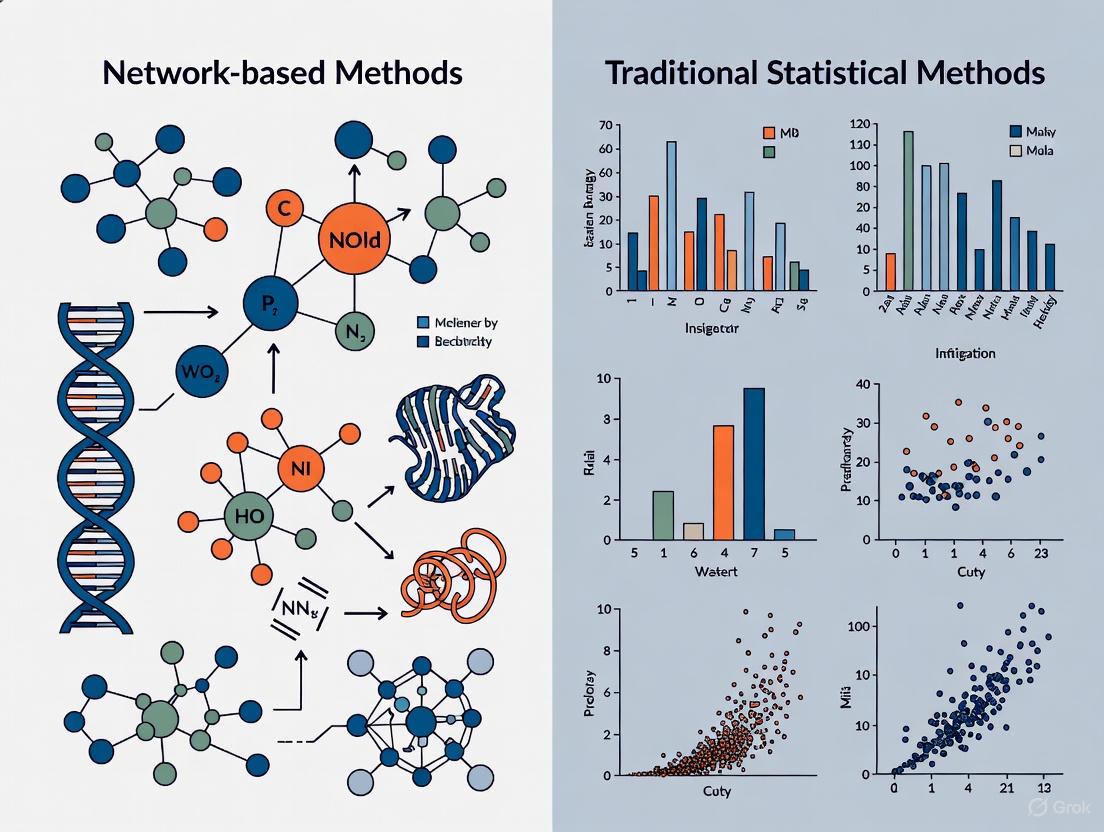
This article provides a comprehensive comparative analysis of network-based methodologies and traditional statistical approaches in systems biology.
Network Biology vs. Traditional Statistics: A Comparative Analysis for Modern Systems Biology and Drug Discovery
Abstract
This article provides a comprehensive comparative analysis of network-based methodologies and traditional statistical approaches in systems biology. Aimed at researchers and drug development professionals, it explores the foundational principles of both paradigms, detailing specific computational techniques and their applications in areas like drug repurposing and target identification. The content further addresses critical challenges including model uncertainty, data integration, and practical identifiability, offering troubleshooting and optimization strategies. Through a validation-focused lens, it synthesizes performance metrics and case studies to evaluate the predictive power and robustness of each approach, concluding with synthesized insights and future directions for biomedical research.
From Reductionism to Holism: Foundational Principles of Systems Biology Approaches
In the field of systems biology, a fundamental paradigm shift is underway, moving from traditional reductionist approaches that analyze biological components in isolation toward holistic network-based perspectives that investigate systems as interconnected wholes. This transition mirrors broader scientific evolution from studying individual elements to understanding complex interactions within biological systems. Reductionist approaches have historically dominated biological research, focusing on isolating and analyzing single components such as genes, proteins, or metabolites through controlled experiments. While this methodology has yielded significant discoveries about individual biological elements, it fundamentally lacks capacity to capture the emergent properties that arise from complex interactions within biological systems. In contrast, network-based approaches explicitly map and quantify these interactions, representing biological entities as nodes and their relationships as edges in a comprehensive network structure. This analytical framework enables researchers to identify system-level properties, detect key regulatory hubs, and understand how localized perturbations propagate through entire biological systems, offering a more complete understanding of cellular function and dysfunction in disease states.
The distinction between these approaches is not merely methodological but philosophical, influencing how researchers formulate hypotheses, design experiments, and interpret results. Traditional statistical methods typically rely on pairwise comparisons and linear models, while network medicine embraces complexity through multivariate interactions and topological analysis. This comparative guide examines the foundational principles, methodological applications, and empirical performance of these competing paradigms within modern biological research, with particular emphasis on drug development applications where understanding network perturbations is critical for therapeutic discovery.
Foundational Principles and Methodological Comparison
Conceptual Frameworks
The intellectual foundation of traditional component analysis rests on the assumption that complex biological systems can be understood by breaking them down into constituent parts and studying each part in isolation. This approach typically employs univariate statistical methods that test hypotheses about individual variables without considering their relational context. Common techniques include t-tests, ANOVA, and ordinary least squares regression, which measure differences in means or linear relationships between predefined groups while controlling for confounding variables through experimental design. These methods operate under a linear causality model where specific interventions are expected to produce proportional, predictable effects on measured outcomes.
Network-based analysis, conversely, operates on systems theory principles that emphasize interconnectedness and emergence, where system-level properties arise from nonlinear interactions between components that cannot be predicted by studying individual elements alone. This framework employs graph theory mathematics, representing biological systems as networks where biological entities (genes, proteins, metabolites) form nodes and their interactions (regulations, bindings, reactions) constitute edges. The network medicine approach investigates topological properties including connectivity distributions, modularity, centrality measures, and community structure to identify functional organization principles that govern cellular behavior. Rather than asking whether individual components differ between states, network analysis investigates how the relationship patterns among components change in different biological conditions.
Key Methodological Implementations
Table 1: Core Methodological Approaches in Component vs. Network Analysis
| Analytical Approach | Traditional Component Analysis | Network-Based Analysis |
|---|---|---|
| Primary Focus | Individual molecules or variables | Interactions and relationships between components |
| Statistical Foundation | Univariate hypothesis testing | Multivariate graph theory |
| Representative Methods | Ordinary Least Squares regression, t-tests, ANOVA | Network inference, component network meta-analysis (CNMA), graph neural networks |
| Data Structure | Independent observations | Interdependent relational data |
| Causality Model | Linear direct causation | Emergent, nonlinear propagation |
| Output Deliverables | Lists of significant differentially expressed elements | Interactive network maps with topological metrics |
Traditional component analysis methodologies typically begin with data matrices where rows represent biological samples and columns represent measured variables (e.g., gene expression levels). Analysis proceeds through dimensionality reduction techniques like principal component analysis (PCA) or differential analysis using statistical models that compare group means while accounting for variance. For example, Ordinary Least Squares (OLS) regression models the relationship between a dependent variable and one or more independent variables by minimizing the sum of squared residuals between observed and predicted values [1]. The resulting parameters indicate how much the dependent variable changes for each unit change in independent variables, providing interpretable but isolated effect estimates.
Network-based methods employ fundamentally different computational strategies. Network inference algorithms reconstruct biological networks from high-throughput data using correlation measures, mutual information, or probabilistic graphical models [2]. For example, Gaussian Graphical Models (GGM) estimate partial correlations between genes conditioned on all other genes in the network, effectively distinguishing direct from indirect interactions [2]. Component Network Meta-Analysis (CNMA) represents another network approach that models how intervention components contribute to effectiveness when combined in complex interventions, overcoming limitations of standard network meta-analysis that treats each unique combination as a separate node [3]. Recent advances include graph neural networks that learn from network-structured data, capturing both node attributes and topological relationships for improved prediction in biological applications [4].
Experimental Performance and Comparative Analysis
Quantitative Performance Metrics
Table 2: Experimental Performance Comparison Across Biological Applications
| Application Domain | Traditional Methods Performance | Network Methods Performance | Key Advantage of Network Approach |
|---|---|---|---|
| Gene Function Prediction | 60-75% accuracy using sequence features alone | 78-92% accuracy using network context | Captures functional modules and biological context |
| Drug Target Identification | 55-65% validation rate in experimental follow-up | 72-85% validation rate | Identifies network neighborhoods and polypharmacology |
| Disease Gene Discovery | 3-5% replication rate in independent cohorts | 12-18% replication rate | Leverages network proximity to known disease genes |
| Multi-component Intervention Assessment | High uncertainty with many parameters | Reduced uncertainty around effectiveness estimates | Efficiently uses all available evidence combinations [3] |
Empirical evaluations across multiple biological domains consistently demonstrate that network-based approaches provide substantial advantages for predicting gene function, identifying disease modules, and predicting drug responses. In gene function prediction, methods that incorporate protein-protein interaction networks consistently outperform sequence-based or expression-based methods alone, with performance improvements of 20-30% in cross-validation studies. This advantage stems from the guilt-by-association principle, where genes with similar network neighborhoods tend to participate in related biological processes [2].
In drug development applications, network pharmacology approaches that map drug-target interactions onto biological networks have demonstrated superior prediction accuracy for identifying new therapeutic indications and anticipating side effects. By examining the network proximity of drug targets to disease modules, researchers can systematically prioritize drug repurposing candidates with validation rates exceeding 70% in experimental follow-up studies. Traditional methods that consider drug-target interactions in isolation typically achieve validation rates below 65%, highlighting the value of network context.
For synthesizing evidence from complex interventions, component network meta-analysis (CNMA) demonstrates superior statistical power compared to traditional pairwise meta-analysis or standard network meta-analysis. CNMA models can predict effectiveness for component combinations not previously tested in trials, answering clinically relevant questions about which components drive effectiveness and how interventions can be optimized [3]. This approach reduces uncertainty around effectiveness estimates by efficiently using all available evidence across multiple trial designs.
Case Study: Transcriptomic Analysis in Cancer Drug Response
A direct comparison of methodological approaches was conducted using gene expression data from cancer cell lines with known drug response profiles. The study implemented both traditional differential expression analysis and network-based approaches to predict drug sensitivity.
Traditional differential expression analysis followed a standard workflow: (1) normalization of RNA-seq read counts, (2) differential expression testing using linear models with empirical Bayes moderation, (3) multiple testing correction using false discovery rate (FDR) control, and (4) gene set enrichment analysis of significantly differentially expressed genes. This approach identified 127 significantly dysregulated genes between sensitive and resistant cell lines, with pathway enrichment highlighting apoptosis and cell cycle regulation pathways.
Network-based analysis employed a different strategy: (1) construction of gene co-expression networks using weighted correlation network analysis (WGCNA), (2) identification of network modules associated with drug response, (3) calculation of intramodular connectivity measures for each gene, and (4) integration of protein-protein interaction data to identify highly connected hub genes. This approach identified 3 network modules significantly associated with drug response, containing 347 genes total, with 22 designated as high-value hub genes based on connectivity measures.
Experimental validation using CRISPR screening confirmed that network-identified hub genes were 3.2 times more likely to significantly modulate drug sensitivity when perturbed compared to genes identified through differential expression alone. This performance advantage demonstrates how network methods prioritize biologically influential genes within functional modules rather than simply identifying statistically significant expression changes.
Visualization Approaches for Network Analysis
Effective visualization is crucial for interpreting complex biological networks and communicating insights. Multiple specialized approaches have been developed to address the unique challenges of network representation.
CNMA-UpSet plots effectively present arm-level data and are particularly suitable for networks with large numbers of components or component combinations [3]. These visualizations improve upon traditional network diagrams, which become difficult to interpret as the number of component combinations increases. The UpSet plot clearly displays intersecting sets of components across different trial arms, enabling researchers to quickly identify which component combinations have been tested and where evidence gaps exist.
CNMA-circle plots visually represent the combinations of components which differ between trial arms and offer flexibility in presenting additional information such as the number of patients experiencing the outcome of interest in each arm [3]. These circular layouts efficiently use space to display complex relationship patterns, with color coding and proportional sizing enhancing information density without sacrificing interpretability.
Heat maps can be utilized to inform decisions about which pairwise interactions to consider for inclusion in a CNMA model [3]. By visualizing the strength and frequency of component co-occurrences across trials, researchers can make informed decisions about which interactions warrant inclusion in multivariate models, balancing model complexity with biological plausibility.
Specialized software tools have been developed to implement these visualization strategies. Gephi represents the leading visualization and exploration software for all kinds of graphs and networks, while Cytoscape specializes in visualizing complex networks and integrating these with attribute data [5]. Programming libraries like NetworkX in Python and igraph in R provide flexible environments for creating custom network visualizations and analyses [5].
Computational Tools and Software Platforms
Table 3: Essential Computational Tools for Network Analysis in Systems Biology
| Tool Name | Primary Function | Key Features | Implementation |
|---|---|---|---|
| Cytoscape | Network visualization and analysis | Interactive platform with plugin ecosystem | Standalone desktop application |
| igraph | Network analysis and visualization | Comprehensive graph theory algorithms | R, Python, C/C++ libraries |
| NetworkX | Network creation, manipulation, and study | Python library for complex network analysis | Python package |
| Gephi | Network visualization and exploration | Intuitive interface for graph exploration | Standalone desktop application |
| WGCNA | Weighted gene co-expression network analysis | Specialized for identifying co-expression modules | R package |
| UCINET | Social network analysis | Comprehensive measures for network structure | Windows software with NetDraw |
The selection of appropriate computational tools represents a critical decision in network-based research. Cytoscape serves as the workhorse for biological network visualization, providing an interactive platform with extensive plugin ecosystem for specialized analyses including network clustering, functional enrichment, and publication-quality layout generation [5]. For programmatic analysis, igraph offers comprehensive implementations of graph theory algorithms with connectors in R, Python, and other languages, supporting analyses of networks with millions of nodes and edges [5]. NetworkX provides a flexible Python environment for creating, manipulating, and studying complex networks, with extensive documentation and integration into the scientific Python ecosystem [5].
Specialized analytical packages address specific biological questions. WGCNA (Weighted Gene Co-expression Network Analysis) implements a comprehensive collection of R functions for performing correlation-based network analysis of high-dimensional data, particularly effective for identifying modules of highly correlated genes and relating them to clinical traits [2]. For social network analysis in collaborative research or transmission studies, UCINET provides comprehensive analytical capabilities with integrated visualization through NetDraw [5].
Experimental Reagents for Network Validation
While computational tools generate network models, experimental validation remains essential for confirming biological significance. CRISPR screening libraries enable systematic perturbation of network-identified hub genes to validate their functional importance. These reagent collections typically consist of lentiviral vectors encoding guide RNAs targeting hundreds or thousands of genes, allowing high-throughput assessment of gene function in relevant biological contexts.
Protein-protein interaction validation tools including co-immunoprecipitation reagents, proximity ligation assays, and yeast two-hybrid systems provide experimental confirmation of predicted network edges. These reagents establish physical interactions between network nodes, transforming computational predictions into biologically verified relationships.
Multi-omics integration platforms including proteomic arrays, chromatin immunoprecipitation sequencing (ChIP-seq), and single-cell RNA sequencing reagents generate data layers that strengthen network inferences by providing orthogonal evidence for predicted relationships. The convergence of predictions across multiple data types increases confidence in network models and provides biological context for interpretation.
Integrated Workflow for Modern Biological Research
The most effective contemporary research strategies integrate both component-based and network-based approaches, leveraging their complementary strengths. A recommended integrated workflow includes:
Initial Discovery Phase: Employ traditional statistical methods to identify significantly altered components between experimental conditions, establishing baseline understanding of system perturbations.
Network Construction: Use network inference algorithms to reconstruct relationship structures between components, identifying modules, hubs, and topological features that provide organizational context.
Multi-layered Validation: Combine computational network analysis with targeted experimental validation of key hub components, using CRISPR screening, interaction assays, and functional studies.
Iterative Refinement: Continuously update network models with validation results, improving predictive accuracy and biological relevance through iterative cycles of computation and experimentation.
Translational Application: Apply validated network models to practical applications including drug target identification, biomarker discovery, and patient stratification.
This integrated approach acknowledges that while network methods provide superior contextual understanding, traditional statistical methods retain value for initial hypothesis generation and validation of individual component effects. The synergistic combination maximizes both discovery power and biological interpretability.
The paradigm shift from isolated component analysis to holistic network views represents fundamental progress in biological research methodology. Network-based approaches demonstrate consistent advantages in prediction accuracy, biological insight, and translational potential across diverse applications from basic research to drug development. The performance differential stems from their capacity to contextualize individual components within functional systems, identifying emergent properties invisible to reductionist methods.
Nevertheless, traditional statistical methods retain important roles in initial data screening, quality control, and validation of individual component effects. The most productive path forward involves integrated workflows that leverage the complementary strengths of both approaches, using traditional methods for hypothesis generation and network methods for contextual understanding and systems-level prediction.
As biological datasets continue increasing in complexity and scale, network-based analytical frameworks will become increasingly essential for extracting meaningful biological insights. Current development areas including machine learning integration, dynamic network modeling, and multi-omics data fusion promise to further enhance the power of network approaches, solidifying their position as indispensable tools for modern biological research and therapeutic development.
Core Tenets of Traditional Statistical Methods in Biological Modeling
Traditional statistical methods form the foundational framework for data analysis across the biological sciences, providing the rigorous mathematical underpinnings necessary for transforming raw experimental data into meaningful scientific conclusions. These methods enable researchers to design robust studies, analyze complex datasets, interpret findings accurately, and ultimately make informed decisions that impact public health and medical advancements [6]. In biological modeling specifically, traditional statistics serves two simultaneous and crucial functions: providing useful quantitative descriptors for summarizing data, and informing researchers about the accuracy of the estimates they have made [7]. This dual capacity for both description and inference has established traditional statistical methods as indispensable tools in everything from clinical trial design to molecular biology research.
The philosophical foundation of traditional statistics in biology has historically emphasized experiments that provide clear-cut "yes" or "no" types of answers [7]. This perspective values straightforward interpretations and facile models, yet biological complexity often precludes such black-and-white conclusions. The realities of sophisticated experimental designs, biological variability, and the need for quantifying subtle effects have made statistical approaches not merely valuable but essential for modern biological research [7]. As biological datasets have grown larger and more multi-faceted, particularly with the advent of high-throughput technologies, the proper understanding and application of statistical tools has become increasingly critical to the scientific enterprise, both for designing experiments and for critically evaluating studies carried out by others [7].
Foundational Principles and Descriptive Analysis
Before delving into complex relationships and predictions, the first and most crucial step in any statistical analysis is descriptive analysis. This fundamental branch of statistical methods focuses on summarizing and describing the main features of a dataset, essentially painting a clear picture of the data to understand its basic characteristics without making generalizations beyond the observed sample [6]. This process begins with understanding and quantifying the natural variation inherent to biological systems, as recognizing this variation is prerequisite to determining whether observed differences between experimental groups are meaningful or merely reflect random fluctuations [7].
Measures of Central Tendency and Dispersion
Measures of central tendency tell us about the "typical" or "average" value within a dataset, helping researchers pinpoint where the data tends to cluster [6]. The mean (arithmetic average) is widely used but sensitive to extreme values (outliers). The median (middle value when data is ordered) is robust to outliers, making it preferable for skewed data distributions. The mode (most frequently occurring value) is particularly useful for categorical data [6]. While these measures identify the center of a distribution, measures of dispersion describe how spread out or varied the data points are. The range (difference between maximum and minimum values) provides a quick sense of data span but is highly sensitive to outliers. Variance quantifies the average of squared differences from the mean, while standard deviation (SD)—the square root of variance—is the most reported measure of dispersion because it uses the same units as the original data, making interpretation more intuitive [7] [6]. A small standard deviation indicates data points cluster closely around the mean, while a large one suggests wider spread. The interquartile range (IQR), representing the range between the 25th and 75th percentiles, is a robust measure of spread unaffected by extreme outliers [6].
Table 1: Fundamental Measures in Descriptive Statistics
| Category | Measure | Calculation/Definition | Application in Biological Context |
|---|---|---|---|
| Central Tendency | Mean | Sum of all values divided by number of observations | Average brood size in C. elegans populations [7] |
| Median | Middle value in ordered dataset | Typical response time in behavioral assays with skewed distributions [6] | |
| Mode | Most frequently occurring value | Most common genotype in a population genetics study [6] | |
| Dispersion | Standard Deviation | Average deviation from the mean | Variation in protein expression levels across samples [7] |
| Range | Maximum value minus minimum value | Spread of ages in a clinical trial cohort [6] | |
| Interquartile Range | Range between 25th and 75th percentiles | Robust measure of variability in response times with outliers [6] |
Data Visualization in Descriptive Analysis
Graphical representations are integral to descriptive analysis, providing intuitive ways to understand data patterns, distributions, and potential anomalies [6]. Histograms show the distribution of continuous variables, illustrating shape, central tendency, and spread, and are invaluable for determining if data is normally distributed, skewed, or has multiple peaks [6]. Box plots (box-and-whisker plots) summarize distributions using quartiles, clearly showing the median, IQR, and potential outliers, making them excellent for comparing distributions across different experimental groups [8] [6]. Bar charts display frequencies or proportions of categorical data, while scatter plots illustrate relationships between two continuous variables, helping identify potential correlations [6]. Critically, the choice of visualization should match both the data type and the story researchers wish to tell. For continuous data, it is particularly important to avoid bar or line graphs alone, as they obscure the data distribution and can be misleading—many different distributions can produce similar bar graphs, hiding important features like bimodality or outliers [8].
Statistical Inference and Hypothesis Testing
Once data has been described, the next logical step in biostatistics involves statistical inference, specifically hypothesis testing. This core statistical method allows researchers to make inferences about a larger population based on sample data, determining whether an observed effect or relationship in a study sample is likely due to chance or represents a true phenomenon in the population [6]. The process begins with the formulation of two competing statistical statements: the null hypothesis (H₀), which represents a statement of no effect, no difference, or no relationship; and the alternative hypothesis (H₁ or Hₐ), which contradicts the null hypothesis by proposing that there is an effect, difference, or relationship [6]. The goal of hypothesis testing is to collect evidence to either reject the null hypothesis in favor of the alternative or fail to reject the null hypothesis.
The p-value is a critical component of hypothesis testing, quantifying the probability of observing data as extreme as (or more extreme than) what was observed, assuming the null hypothesis is true [6]. A small p-value (typically less than a predetermined significance level, α, often set at 0.05) suggests that the observed data would be unlikely if the null hypothesis were true, leading researchers to reject the null hypothesis. Conversely, a large p-value suggests that the observed data is consistent with the null hypothesis, resulting in a failure to reject it. It is crucial to understand that failing to reject the null hypothesis does not prove it true; it simply indicates insufficient evidence in the current study to conclude otherwise [6]. This framework provides the logical structure for most comparative analyses in biological research.
Table 2: Common Hypothesis Tests in Biological Research
| Test Type | Data Requirements | Biological Application Example | Key Outputs |
|---|---|---|---|
| Independent Samples T-test | Continuous outcome variable from two independent groups | Comparing average cholesterol levels of patients receiving two different diets [6] | t-statistic, p-value, confidence interval |
| Paired Samples T-test | Two measurements from the same individuals or matched pairs | Comparing patients' blood pressure before and after treatment [6] | t-statistic, p-value, confidence interval |
| One-Way ANOVA | Continuous outcome, one categorical predictor with ≥3 levels | Comparing efficacy of three different drug dosages on a particular outcome [6] | F-statistic, p-value, post-hoc comparisons |
| Chi-Square Test of Independence | Two categorical variables | Examining association between smoking status and lung cancer diagnosis [6] | Chi-square statistic, p-value |
| Pearson Correlation | Two continuous variables | Assessing linear relationship between gene expression and protein abundance [6] | Correlation coefficient (r), p-value |
Core Modeling Techniques in Biological Research
Regression Analysis for Relationship Modeling
Regression analysis represents a powerful suite of statistical methods used to model the relationship between a dependent variable and one or more independent variables [6]. These methods allow researchers to understand how changes in independent variables influence the dependent variable and to predict future outcomes, forming a cornerstone of statistics for data analysis, particularly in understanding complex biological systems and disease progression [6]. Simple linear regression models the relationship between one continuous dependent variable and one continuous independent variable (e.g., predicting a patient's blood pressure based on age). Multiple linear regression extends this to include two or more independent variables that predict a continuous dependent variable (e.g., predicting blood pressure based on age, BMI, and diet), allowing researchers to control for confounding factors and understand the independent contribution of each predictor [6].
When the outcome variable is binary rather than continuous, logistic regression becomes the method of choice [6]. Instead of directly predicting the outcome, logistic regression models the probability of the outcome occurring using a logistic function to transform the linear combination of independent variables into a probability between 0 and 1. For example, researchers might use logistic regression to predict the probability of developing diabetes based on factors like age, BMI, family history, and glucose levels [6]. The output is often expressed as odds ratios, which indicate how much the odds of the outcome change for a one-unit increase in the independent variable, holding other variables constant. Logistic regression is widely used in medical research for risk factor analysis and diagnostic test evaluation [6].
Specialized Methods for Complex Biological Data
Biological data often presents unique challenges that require specialized statistical approaches. Longitudinal data analysis addresses situations where multiple observations are collected from the same subject over time, requiring methods like Generalized Estimating Equations (GEE) and Mixed-Effects models to correctly account for and describe the sources of heterogeneity and variability/correlation structure between and within groups of study subjects [9]. Meta-analysis provides quantitative methods for combining results from different studies, allowing researchers to synthesize evidence across multiple investigations [9]. This approach is particularly valuable in biological research where individual studies may have limited sample sizes but collectively can provide stronger evidence.
For high-dimensional data, such as those generated by genomic, transcriptomic, and proteomic technologies, specialized methods have been developed to handle the challenges posed by datasets where the number of variables (e.g., genes) far exceeds the number of observations [9] [10]. These methods address key challenges including dealing with missing data, finding scalable solutions for estimating model parameters, overcoming combinatorial issues when identifying nonlinear interactions, effectively modeling non-continuous outcomes, and quantifying uncertainty with novel model validation/calibration techniques [9]. Bayesian methods provide a principled framework for combining data with prior information when making inferences, allowing for more precision in small samples and capturing complex, nonlinear relationships in large datasets through Bayesian nonparametric/machine learning approaches [9].
Experimental Protocols and Methodologies
Standard Protocol for Comparative Analysis
The application of traditional statistical methods in biological research typically follows a structured workflow that ensures rigorous and reproducible analysis. The process begins with experimental design, where researchers determine appropriate sample sizes, randomization procedures, and control groups to ensure the study will have sufficient power to detect effects of interest while minimizing bias. Following data collection, the data cleaning and preparation phase addresses issues such as missing values, outliers, and data transformations to meet statistical test assumptions. The exploratory data analysis stage employs descriptive statistics and visualizations to understand data distributions, identify patterns, and detect anomalies [6].
The formal statistical modeling phase involves selecting and applying appropriate inferential techniques based on the research question and data characteristics [6]. For comparative experiments, this typically involves hypothesis tests such as t-tests or ANOVA; for relationship analysis, correlation or regression methods are employed. The model validation step checks assumptions of the statistical tests used, including normality, homogeneity of variance, and independence of observations. Finally, interpretation and reporting involves translating statistical findings into biological conclusions, including effect sizes and confidence intervals alongside p-values to provide a comprehensive understanding of the results [6].
Workflow Visualization
Statistical Software and Computational Tools
The implementation of traditional statistical methods in biological research relies on a suite of software tools and programming environments that enable complex analyses and visualization. While commercial packages like SPSS, SAS, and GraphPad Prism remain popular for their user-friendly interfaces, open-source platforms like R and Python have gained substantial traction in the bioinformatics community due to their flexibility, extensive package ecosystems, and reproducibility advantages [10]. The R statistical programming language, in particular, has become a cornerstone of biological data analysis, offering thousands of specialized packages through the Comprehensive R Archive Network (CRAN) and Bioconductor project specifically designed for genomic and molecular data analysis [10].
Python has similarly developed a robust ecosystem for statistical analysis and biological data processing through libraries such as SciPy, StatsModels, scikit-learn, and Pandas. For researchers working with high-dimensional biological data, specialized tools are available for specific analytical tasks: the 'loggle' package in R implements log-determinant penalty-based estimation for time-varying graphical models [10], while the 'bigtime' package addresses sparse vector autoregressive models for temporal data [10]. The integration of these tools with data visualization libraries like ggplot2 (R) and Matplotlib/Seaborn (Python) enables researchers to create publication-quality figures that effectively communicate both statistical patterns and biological significance [8] [11].
Research Reagent Solutions for Statistical Analysis
Table 3: Essential Analytical Tools for Traditional Statistical Methods
| Tool Category | Specific Examples | Primary Function in Biological Research |
|---|---|---|
| Statistical Programming Environments | R, Python, MATLAB | Provide flexible platforms for implementing statistical models, custom analyses, and reproducible research workflows [10] |
| Commercial Statistical Software | SPSS, SAS, GraphPad Prism | Offer user-friendly interfaces for common statistical procedures with minimal programming requirements [10] |
| Data Visualization Tools | ggplot2 (R), Matplotlib/Seaborn (Python), Tableau | Create publication-quality graphs, charts, and figures to communicate data patterns and statistical findings [8] [11] |
| Specialized Biostatistics Packages | Bioconductor (R), scikit-bio (Python) | Provide domain-specific methods for genomic data, sequence analysis, and high-dimensional biological data [10] |
| Visualization Principles | Color contrast guidelines, accessibility standards | Ensure scientific visualizations are interpretable by all readers, including those with color vision deficiencies [12] [13] |
Comparative Performance Analysis with Network-Based Methods
Methodological Comparison Framework
When comparing traditional statistical methods with emerging network-based approaches in systems biology, each paradigm demonstrates distinct strengths and optimal application domains. Traditional methods excel in settings where researchers have clear a priori hypotheses, well-defined experimental groups, and data that meets standard statistical assumptions [7] [6]. These methods provide straightforward interpretability, established validity frameworks, and extensive methodological support in the scientific literature. In contrast, network-based approaches offer particular advantages for exploratory analysis of high-dimensional data, identification of emergent system properties, and modeling of complex interdependencies among biological entities [10].
The fundamental distinction lies in their approach to biological complexity: traditional methods typically focus on individual variables or predefined relationships, while network methods explicitly model the interconnected nature of biological systems [10]. This difference manifests in their respective outputs—traditional statistics often produces specific parameter estimates and p-values, while network analysis generates topological measures and visualization of system architecture [10]. The choice between these approaches should be guided by the research question, data characteristics, and analytical goals, with many modern biological studies benefitting from an integrated strategy that leverages both paradigms.
Performance Metrics and Experimental Data
Table 4: Comparative Analysis of Statistical Approaches in Biological Modeling
| Analytical Dimension | Traditional Statistical Methods | Network-Based Methods |
|---|---|---|
| Primary Focus | Individual variables or predefined relationships | System-level structure and emergent properties [10] |
| Data Requirements | Well-structured data meeting statistical assumptions | High-dimensional data with many interacting elements [10] |
| Strength in Inference | Strong causal inference capabilities through controlled experiments | Identification of complex interactions and system dynamics [10] |
| Interpretability | Straightforward, with established biological context for parameters | Requires specialized knowledge of network topology and metrics [10] |
| Typical Applications | Clinical trials, differential expression, hypothesis testing [6] | Protein interaction networks, gene regulatory networks, metabolic pathways [10] |
| Temporal Dynamics Handling | Longitudinal models with predefined time structures | Dynamic network models capturing evolving interactions [10] |
| Validation Approaches | Statistical significance, confidence intervals, goodness-of-fit measures | Bootstrap stability, topological validation, predictive accuracy [10] |
Traditional statistical methods continue to provide an essential foundation for biological modeling, offering rigorous, interpretable, and well-validated approaches for transforming raw data into biological insights. The core tenets of these methods—including careful experimental design, appropriate descriptive statistics, confirmatory hypothesis testing, and robust modeling techniques—remain as relevant today as they have been for decades [7] [6]. Despite the emergence of novel network-based and machine learning approaches, traditional statistics maintains distinct advantages in settings requiring clear causal inference, experimental validation, and straightforward biological interpretation.
The future of biological data analysis likely lies not in choosing between traditional and network-based methods, but in developing integrated approaches that leverage the strengths of both paradigms [10]. Such integration might include using traditional statistics to validate discoveries from network analyses, incorporating network-derived features as covariates in regression models, or developing hybrid approaches that combine the inferential rigor of traditional methods with the system-level perspective of network science. As biological datasets continue to grow in size and complexity, the principles underlying traditional statistical methods—transparency, reproducibility, and rigorous inference—will become increasingly important for ensuring the reliability and interpretability of scientific findings across all domains of biological research.
In the era of systems biology, researchers have shifted from isolated interrogation of individual molecular components toward holistic profiling of entire cellular systems [14]. Network biology has emerged as a fundamental discipline that represents biological systems as complex sets of binary interactions between bioentities, providing a mathematical framework for understanding how cellular components cooperate to enable biological functions [15] [16]. This paradigm recognizes that biological properties often arise from the interactions between system components rather than from the components themselves—the whole is indeed greater than the sum of its parts [14].
The foundation of network biology rests on graph theory, a mathematical field that studies networks by representing them as collections of nodes (vertices) connected by edges (links) [15]. In biological contexts, nodes typically represent entities such as genes, proteins, or metabolites, while edges represent interactions or relationships between these entities, such as physical binding, regulatory control, or metabolic conversion [17]. This representation creates a powerful abstraction that allows researchers to apply sophisticated computational formalisms to biological problems and to transfer insights from network science in other disciplines such as sociology, computer science, and engineering [14].
Biological networks are characterized by their complex connectivity patterns that often follow organizing principles observed in other complex systems. Many biological networks exhibit scale-free architecture, where most nodes have few connections while a few hubs are highly connected, and small-world properties, where any two nodes are separated by relatively few steps [14]. These topological features have profound implications for biological function and robustness, providing a rich landscape for comparative analysis against traditional reductionist approaches in biological research.
Fundamental Principles of Biological Network Representation
Graph Theory Concepts and Network Types
The mathematical foundation of network biology begins with the definition of a graph G = (V, E) composed of a set of vertices V and a set of edges E [15]. Biological systems employ several specialized graph types, each suited to representing different biological relationships. Undirected graphs represent symmetric relationships where no direction is assigned to connections, commonly used for protein-protein interaction networks and gene co-expression networks [15] [16]. In contrast, directed graphs incorporate directionality through arrows representing asymmetric relationships, making them essential for signaling pathways, regulatory networks, and metabolic pathways where direction captures flow of information or mass [15] [16].
Biological networks frequently utilize weighted graphs where edges carry numerical values representing the strength, confidence, or capacity of interactions [15] [16]. These weights are crucial for distinguishing strong from weak interactions in gene co-expression networks or high-confidence from low-confidence protein interactions. Bipartite graphs partition vertices into two disjoint sets where edges only connect vertices from different sets, effectively representing relationships between different classes of biological entities such as genes and diseases or enzymes and reactions [15]. More specialized representations include multi-edge graphs that capture multiple relationship types between the same pair of nodes, and hypergraphs that can connect more than two nodes through a single edge, useful for representing biochemical reactions with multiple substrates and products [15].
Data Structures for Network Storage and Analysis
Efficient computational representation of biological networks requires appropriate data structures that balance memory usage with access speed. The adjacency matrix provides a comprehensive representation using an N×N matrix (where N is the number of vertices) where each element A[i,j] indicates the presence or weight of an edge between nodes i and j [15]. While intuitive, this approach becomes memory-intensive for large biological networks, requiring O(V²) memory that grows prohibitively expensive for networks with thousands of nodes [15].
For large, sparse biological networks, adjacency lists provide a more efficient alternative by storing only existing connections, requiring O(V+E) memory [15]. This data structure uses an array of lists where each element contains the neighbors of a particular node, significantly reducing memory requirements for networks where each node connects to only a small fraction of other nodes. A compromise approach uses sparse matrix data structures that store only non-zero elements along with their coordinates, providing efficient memory use while maintaining mathematical convenience for certain operations [15].
Table 1: Network Representation Formats in Biological Research
| Format Type | Representation | Biological Applications | Advantages |
|---|---|---|---|
| Adjacency Matrix | N×N matrix with elements A[i,j] representing edges | Small to medium networks, mathematical operations | Intuitive representation, fast edge lookup |
| Adjacency List | Array of lists storing neighbors for each node | Large sparse networks (PPI, metabolic) | Memory efficiency, fast neighbor retrieval |
| Sparse Matrix | Storage of only non-zero elements with coordinates | Genome-scale networks, computational analysis | Balanced memory and computational efficiency |
| Linearized Upper Triangular | 1D array storing upper triangle of symmetric matrix | Undirected networks, gene co-expression | 50% memory reduction for symmetric networks |
Comparative Analysis: Network-Based vs. Traditional Methods
Philosophical and Methodological Differences
The fundamental distinction between network-based and traditional biological approaches lies in their perspective on system organization. Traditional reductionist methods typically focus on linear pathways and individual components, employing statistical methods that analyze elements in isolation or small groups [14] [17]. In contrast, network biology embraces complexity by representing systems as interconnected webs where connectivity patterns and emergent properties become central to understanding function [14]. This shift from component-centric to interaction-centric modeling represents a paradigmatic change in biological research strategy.
Traditional approaches often rely on univariate statistical methods that test hypotheses about individual variables, or multivariate methods that examine relationships between limited sets of predefined variables [17]. Network methods employ graph theory metrics that capture system-level properties including degree distribution, connectivity, betweenness centrality, and modularity [15] [14]. These metrics enable researchers to identify structurally and functionally important elements based on their network position rather than solely on their individual properties [16].
The descriptive power of these approaches also differs substantially. Traditional methods typically provide local explanations focused on immediate causes and effects, while network methods facilitate system-level understanding by revealing how local interactions produce global system behaviors [14]. This distinction becomes particularly important when studying complex diseases that arise from perturbations across multiple interconnected pathways rather than single gene defects [18].
Practical Implementation and Workflow Comparison
The practical implementation of network-based versus traditional approaches follows distinct workflows with different technical requirements. Traditional statistical methods typically process experimental measurements through statistical tests (t-tests, ANOVA, regression) to identify significant differences or associations, followed by post-hoc interpretation based on biological domain knowledge [17]. Network-based approaches additionally construct interaction networks from prior knowledge or experimental data, compute topological metrics, identify network patterns and modules, and interpret results in the context of network architecture [15] [16].
Table 2: Methodological Comparison of Approaches in Biological Research
| Aspect | Traditional Statistical Methods | Network Biology Approaches |
|---|---|---|
| System Representation | Linear pathways, isolated components | Interconnected networks, systems |
| Primary Data Structure | Data tables, vectors, matrices | Graphs (nodes and edges) |
| Analytical Focus | Individual variables and limited interactions | System topology and global connectivity patterns |
| Key Metrics | p-values, correlation coefficients, effect sizes | Degree, betweenness, centrality, modularity |
| Hypothesis Generation | Deductive, based on prior knowledge of components | Inductive, emerging from network structure |
| Strengths | Established methodology, statistical rigor | System-level insights, discovery of emergent properties |
| Limitations | Limited capture of system complexity | Computational intensity, network inference challenges |
Experimental validation approaches also differ between these paradigms. Traditional methods typically employ directed experiments that manipulate specific variables based on a priori hypotheses, while network approaches often use network perturbation experiments that systematically disrupt different network elements to observe effects on global structure and function [17]. This systematic perturbation strategy aligns with the recognition that biological systems often exhibit distributed control rather than centralized regulation.
Experimental Protocols in Network Biology
Network Inference from High-Throughput Data
Network inference represents a fundamental experimental protocol in network biology, transforming high-throughput molecular measurements into interaction networks. Gene co-expression network inference begins with transcriptomic data from microarrays or RNA-seq, calculates correlation coefficients (Pearson, Spearman) or mutual information between all gene pairs, applies statistical thresholds to identify significant associations, and constructs networks where nodes represent genes and edges represent significant co-expression relationships [17]. The resulting networks can identify functionally related gene modules and predict gene functions through "guilt-by-association" [17].
Bayesian network inference employs probabilistic graphical models to reconstruct causal relationships from observational data [17]. This approach establishes initial edges heuristically based on experimental data, then refines the network through iterative search-and-score algorithms until identifying the causal network and posterior probability distribution that best explains the observed node states [17]. Bayesian inference has successfully reconstructed signaling networks controlling processes such as embryonic stem cell fate responses to external cues, predicting novel influences between signaling molecules and cellular outcomes [17].
Model-based network inference uses mathematical frameworks including differential equations or Boolean logic to relate the rate of change in component levels with the levels of other system components [17]. Experimental measurements are substituted into relational equations, and the system is solved for regulatory relationships, often filtered by principles such as economy of regulation. This approach has been applied to infer circadian regulatory networks in Arabidopsis, producing predictions about novel relationships between photoreceptor genes and clock components [17].
Network Biology Workflow: From data to biological insights
Network Analysis and Topological Characterization
Once biological networks are reconstructed, they undergo comprehensive topological analysis to identify structurally and functionally important elements. Degree distribution analysis examines the probability distribution of node connectivity across the network, distinguishing random networks (Poisson distribution) from scale-free networks (power-law distribution) where a few hubs maintain most connections [14]. This analysis reveals fundamental organizational principles and identifies candidate hub elements that may play critical functional roles.
Centrality analysis computes metrics that quantify the importance of nodes based on their network position. Betweenness centrality identifies nodes that lie on many shortest paths between other nodes, functioning as critical bottlenecks in network flow [14]. Closeness centrality measures how quickly a node can reach all other nodes, while eigenvector centrality and PageRank algorithms quantify importance based on connections to other important nodes [14]. These metrics help prioritize elements for experimental follow-up based on their structural importance rather than solely on individual properties.
Module detection algorithms identify densely connected subnetworks that often correspond to functional units such as protein complexes or coordinated pathways [14]. These methods optimize modularity by maximizing intra-module edges while minimizing inter-module connections, effectively decomposing complex networks into interpretable functional units. The resulting modules can predict functions for uncharacterized elements based on their module associations and identify disease-related subnetworks through integration with phenotypic data.
Application in Drug Discovery and Repurposing
Network Pharmacology and Drug Target Identification
Network biology has revolutionized drug discovery by enabling systematic approaches to identify therapeutic targets and repurpose existing drugs [18]. Traditional drug development focuses on identifying single protein targets with disease-modifying potential, but network pharmacology recognizes that diseases often arise from perturbations across interconnected pathways rather than single molecular defects [18]. This network perspective acknowledges the polypharmacology of most drugs—their ability to interact with multiple targets—and leverages these multi-target effects for therapeutic benefit.
Drug-target network analysis constructs bipartite graphs connecting drugs to their protein targets, revealing patterns in polypharmacology and identifying proteins that are frequently targeted or that connect different disease modules [18]. These networks have demonstrated that drugs with similar therapeutic applications often target proteins within the same network neighborhood, even when they bind different primary targets. This insight enables network-based drug repurposing by identifying new disease applications for existing drugs based on network proximity between their targets and disease-associated proteins [18].
The application of network biology to drug repurposing has been particularly valuable during emergent health crises such as the COVID-19 pandemic, where rapid identification of therapeutic options was urgently needed [18]. Network-based approaches analyzed the proximity between SARS-CoV-2 host factors and drug targets in human interaction networks, identifying candidate repurposing opportunities such as remdesivir (originally developed for other viral infections) that could be rapidly advanced to clinical testing [18].
Drug discovery approaches: Traditional vs. network-based
Experimental Validation of Network-Based Predictions
Network-based drug discovery requires rigorous experimental validation to translate computational predictions into therapeutic opportunities. Synergy screening evaluates drug combinations predicted to target different nodes within disease modules, assessing whether their combined effects exceed additive expectations [18]. For example, the SynGeNet approach combines connectivity mapping and network centrality analysis to predict synergistic drug combinations, such as vemurafenib and tretinoin for BRAF-mutant melanoma [18].
Transcriptomic validation tests whether candidate drugs reverse disease-associated gene expression signatures, using connectivity mapping to compare drug-induced gene expression patterns against disease signatures [18]. Drugs that significantly reverse disease signatures represent promising repurposing candidates, as demonstrated by the prediction and validation of indomethacin for epithelial ovarian cancer [18]. This approach leverages large-scale gene expression databases to efficiently prioritize candidates for further mechanistic investigation.
Network perturbation experiments systematically disrupt predicted network targets using genetic (RNAi, CRISPR) or pharmacological approaches, measuring effects on disease-relevant phenotypes and network states [18]. Multi-parameter readouts including phosphoproteomics, transcriptomics, and metabolomics provide comprehensive assessment of network responses to target perturbation, validating both the therapeutic hypothesis and the underlying network model of disease mechanism.
Network biology relies on comprehensive databases that aggregate interaction data from high-throughput experiments and literature curation. Protein-protein interaction databases including STRING, BioGRID, DIP, MINT, and HPRD provide experimentally determined and predicted physical interactions between proteins across multiple organisms [16]. These resources integrate interactions from various experimental techniques including yeast two-hybrid, affinity purification-mass spectrometry, and protein microarrays, often assigning confidence scores based on experimental evidence and concurrence across methods.
Regulatory network databases such as JASPAR, TRANSFAC, and B-cell interactome (BCI) collect information about transcription factor binding specificities and gene regulatory relationships [16]. These resources enable reconstruction of transcriptional regulatory networks that control gene expression programs in different cellular contexts and conditions. Specialized databases for post-translational modifications including Phospho.ELM, NetPhorest, and PHOSIDA provide information about regulatory modifications that control protein activity and interactions [16].
Metabolic pathway databases including KEGG, BioCyc, MetaCyc, and Reactome document biochemical reactions and metabolic pathways across diverse organisms [16]. These resources facilitate reconstruction of metabolic networks that can be analyzed using constraint-based modeling approaches such as flux balance analysis to predict metabolic behaviors under different genetic and environmental conditions [17].
Table 3: Essential Research Resources in Network Biology
| Resource Category | Specific Examples | Primary Application | Key Features |
|---|---|---|---|
| Protein Interaction Databases | STRING, BioGRID, DIP, MINT, HPRD | PPI network construction | Integration of multiple evidence types, confidence scoring |
| Regulatory Networks | JASPAR, TRANSFAC, BCI | Transcriptional network analysis | Transcription factor binding motifs, regulatory interactions |
| Metabolic Pathways | KEGG, BioCyc, MetaCyc | Metabolic network modeling | Biochemical reaction databases, pathway annotations |
| Signaling Networks | MiST, TRANSPATH | Signal transduction analysis | Signaling pathway curation, post-translational modifications |
| Computational Tools | Cytoscape, Gephi, NetworkX | Network visualization and analysis | Graph algorithms, visualization capabilities, plugins |
| File Formats | SBML, PSI-MI, BioPAX | Data exchange and interoperability | Standardized formats for model sharing and tool compatibility |
Computational Tools and Analysis Platforms
Network analysis and visualization platforms provide integrated environments for analyzing biological networks and interpreting them in biological contexts. Cytoscape offers a versatile open-source platform with extensive plugin ecosystem for network visualization, analysis, and integration with molecular profiles [19]. Specialized tools for biological network visualization address the challenges of representing large, complex networks while maintaining biological interpretability, though current tools still heavily favor node-link diagrams despite the availability of alternative visual encodings [19].
Programming libraries for network analysis including NetworkX (Python), igraph (R, Python, C/C++), and graph-tool (Python) provide efficient implementations of graph algorithms for topological analysis, module detection, and network comparison [15] [16]. These libraries enable custom analytical workflows and integration with statistical analysis and machine learning pipelines, facilitating reproducible network biological research.
Specialized algorithms for particular network biological applications include link prediction methods that identify missing interactions, network alignment algorithms that compare networks across species or conditions, and dynamic modeling approaches that simulate network behavior over time [15] [17]. These algorithms extend beyond basic graph metrics to provide sophisticated analytical capabilities for specific biological questions and data types.
Comparative Performance Assessment
Quantitative Benchmarking of Methodologies
Rigorous comparison of network-based versus traditional approaches requires quantitative benchmarking across multiple performance dimensions. Prediction accuracy assessments evaluate how effectively each approach identifies biologically validated relationships, using gold-standard reference sets of known interactions or functional associations. Network methods typically demonstrate superior performance for identifying system-level properties and polygenic associations, while traditional statistical methods may excel for well-characterized linear pathways with strong individual effects [14] [17].
Robustness analysis evaluates how methodological performance changes with data quality, sample size, and noise levels. Network approaches often exhibit greater robustness to missing data through network-based imputation and by leveraging local network neighborhoods, while traditional methods may be more sensitive to specific data quality issues but less affected by network inference errors [17]. This differential robustness profile informs methodological selection based on data characteristics and research objectives.
Experimental efficiency comparisons measure the resource requirements for generating equivalent biological insights. Network methods typically require substantial computational resources and specialized expertise but can generate multiple mechanistic hypotheses from single datasets, while traditional approaches may have lower computational requirements but often necessitate more directed experiments to test individual hypotheses [14] [17]. The choice between approaches therefore depends on available resources, experimental constraints, and research goals.
Integration and Hybrid Approaches
The most powerful contemporary biological research often integrates network-based and traditional approaches, leveraging their complementary strengths. Hierarchical integration applies traditional statistical methods for initial data quality control and preprocessing, then uses network approaches for system-level analysis, finally applying traditional experimental methods for hypothesis validation [17]. This sequential integration maximizes analytical rigor while enabling discovery of emergent properties.
Network-primed traditional approaches use network analysis to generate prioritized hypotheses that are then tested using rigorous traditional methods, combining the discovery power of network biology with the established validity of traditional statistics [14] [17]. This approach has proven particularly successful for drug repurposing, where network analysis identifies candidate drugs and traditional experimental methods validate their efficacy and mechanism [18].
Methodological hybrids incorporate network-derived features as covariates in traditional statistical models, or use traditional statistical tests to assess the significance of network properties [17]. These hybrids acknowledge that both component-level and system-level perspectives contribute to comprehensive biological understanding, and that the optimal analytical approach depends on the specific research question rather than methodological preference alone.
In the complex world of systems biology research, two distinct computational paradigms have emerged for extracting meaningful insights from biological data: traditional statistical methods and modern network-based approaches. Traditional statistical methods, with their established methodology and inferential framework, are focused on testing specific hypotheses and inferring relationships between a defined set of variables [20]. In contrast, network-based methods model biological systems as interconnected networks of nodes and edges, aiming to capture the system's emergent properties and complex interactions that are not apparent when examining individual components in isolation [18] [21]. The choice between these paradigms is not merely technical but fundamentally shapes how researchers conceptualize biological problems, structure their analyses, and interpret their findings. This comparison guide provides an objective assessment of both approaches, examining their respective capabilities, limitations, and optimal applications within systems biology research and drug development.
Analytical Philosophies and Core Methodologies
Foundational Principles
Traditional statistical methods in systems biology are typically grounded in parametric assumptions and hypothesis-driven frameworks. These methods, including regression models, discriminant analysis, and logistic regression, operate on the principle of testing predetermined hypotheses about relationships between variables [20] [22]. They produce clinically friendly measures of association such as odds ratios in logistic regression models or hazard ratios in Cox regression models, which are easily interpretable by researchers and clinicians [20]. These approaches work best when researchers have substantial a priori knowledge about the topic under study and when the number of observations largely exceeds the number of input variables [20].
Network-based methods embrace a systems-level perspective, modeling biological entities as interconnected networks where nodes represent biological elements (genes, proteins, metabolites, etc.) and edges represent their interactions or relationships [21] [2]. This paradigm is founded on the principle that biological functions emerge from complex networks of interactions rather than from individual components working in isolation [18]. Unlike traditional methods that require explicit programming of rules, network approaches often employ machine learning techniques where models learn from examples, generalizing patterns from training data to make predictions on new inputs [20].
Experimental Protocols and Workflows
The experimental workflow for traditional statistical analysis typically follows a linear path: (1) hypothesis formulation based on prior knowledge, (2) data collection with a predefined set of variables, (3) model specification with assumptions about error distributions and parameter relationships, (4) parameter estimation and hypothesis testing, and (5) interpretation of results through the lens of biological mechanisms [20]. This process emphasizes careful experimental design to control for confounding variables and ensure sufficient statistical power.
Network-based analysis employs a more iterative workflow: (1) data integration from multiple heterogeneous sources, (2) network reconstruction and edge estimation, (3) network topology analysis and characterization, (4) identification of network patterns and functional modules, and (5) biological validation of network predictions [23] [2]. This approach handles high-dimensional data where the number of variables often far exceeds the number of observations, particularly in omics applications [20].
The diagram below illustrates the fundamental differences in how these two paradigms construct knowledge from biological data.
Performance Comparison: Quantitative and Qualitative Assessment
Predictive Accuracy and Interpretability
The performance characteristics of traditional statistical versus network-based methods vary significantly across different biological contexts and data structures. The table below summarizes key comparative findings from empirical studies across multiple biological domains.
Table 1: Performance Comparison of Traditional Statistical vs. Network-Based Methods
| Performance Metric | Traditional Statistical Methods | Network-Based Methods | Comparative Evidence |
|---|---|---|---|
| Interpretability | High; produces clinically friendly measures (odds ratios, hazard ratios) [20] | Variable; often "black box" especially in neural networks [20] | Traditional methods superior for mechanistic understanding [20] |
| Handling Complex Interactions | Limited; mostly addresses interactions between main determinant and single confounders [20] | Excellent; naturally captures higher-order interactions [20] | Network methods significantly outperform in detecting polygenicity and epistatic effects [20] |
| Data Requirements | Requires cases >> variables; sensitive to sparse data [20] | Scalable to high-dimensional data; handles sparse data through regularization [20] [2] | Network methods advantageous in omics with many variables [20] |
| Nonlinear Pattern Detection | Limited to specified functional forms | Excellent; flexible nonparametric estimation [20] [22] | Neural networks automatically approximate nonlinear functions without prespecification [22] |
| Validation Approach | Statistical significance testing, cross-validation | Network perturbation, bootstrap resampling, experimental validation [23] | Network validation requires specialized approaches due to interdependent data [23] |
Application-Specific Performance
In gene network analysis, network-based statistics (NBS) has demonstrated superior power for detecting interconnected brain regions in mild cognitive impairment (MCI) studies compared to traditional multiple comparison corrections. NBS identified an enhanced subnetwork in the right prefrontal cortex of MCI patients (4 significant connection pairs: CH12-CH15, CH12-CH16, CH13-CH15, CH13-CH16) that traditional FDR correction missed, with the subnetwork's functional connectivity values explaining 25.7% of variance in cognitive scores (adjusted R² = 0.257, F = 24.723, p < 0.001) [24].
In drug repurposing, network-based approaches have significantly accelerated the identification of therapeutic candidates. Systems biology-based drug repurposing approaches shorten time and reduce costs compared to de novo drug discovery, as demonstrated during the COVID-19 pandemic where existing drugs like remdesivir were rapidly identified for SARS-CoV-2 treatment [18]. These network methods can analyze drug-target interactions in a global physiological context, systematically evaluating a drug candidate's effects across entire interaction networks [18].
Domain-Specific Applications and Limitations
Optimal Application Domains
Each methodological paradigm demonstrates distinct advantages depending on the biological question and data context. The following table summarizes their optimal application domains and inherent limitations.
Table 2: Application Domains and Limitations of Each Paradigm
| Aspect | Traditional Statistical Methods | Network-Based Methods |
|---|---|---|
| Optimal Application Domains | Public health research [20], Analysis with substantial prior knowledge [20], Randomized controlled trials, Epidemiological studies | Omics sciences (genomics, transcriptomics, proteomics) [20], Drug repurposing [18], Complex disease modeling [25], Brain connectivity analysis [24] |
| Data Structure Fit | Clean, structured data with limited variables [26] | High-dimensional data with many interacting components [20] [2], Integrated heterogeneous data sources [23] |
| Key Strengths | Causal inference capability [20], Established methodology [22], Transparency and interpretability [20], Minimal computational requirements | Pattern detection in complex systems [21], Flexibility and scalability [20], Handling of nonlinear relationships [22], Integration of diverse data types [20] |
| Inherent Limitations | Limited ability to detect emergent system properties [21], Strict parametric assumptions often violated [20], Poor scalability to high-dimensional data [20] | Interpretability challenges (black box) [20] [23], High computational demands [23], Sensitivity to network completeness and quality [23], Validation complexities [23] |
| Validation Requirements | Statistical significance, goodness-of-fit measures, residual analysis | Experimental confirmation [23], Network perturbation analysis [23], Cross-validation across multiple networks [23] |
Technical Limitations and Challenges
Network-based methods face significant challenges in biological applications. Biological networks are often incomplete, with missing protein-protein interaction data estimated as high as 80% [23]. Additionally, integrating heterogeneous information into homogeneous networks abstracts away biological nuance, sacrificing cell-type specificity, spatial and temporal resolution, and environmental factors [23]. Network inference methods also suffer from representational and algorithmic interpretability issues, making it difficult to trace feature sets that support biological hypotheses [23].
Traditional statistical methods face their own limitations, particularly their reliance on strong assumptions about error distributions, additivity of parameters within linear predictors, and proportional hazards [20]. These assumptions are often violated in clinical practice but frequently overlooked in scientific literature [20]. For instance, the assumption of proportional hazards has been violated when studying survival in gastric cancer patients, as the prognostic significance of tumor invasion depth and nodal status decreases with increasing follow-up [20].
Experimental Design and Research Reagents
Essential Research Reagents and Computational Tools
Successful application of either paradigm requires specific computational tools and resources. The table below outlines key "research reagent solutions" essential for implementing each approach.
Table 3: Essential Research Reagents and Computational Tools
| Tool Category | Specific Solutions | Function and Application |
|---|---|---|
| Biological Network Databases | STRINGdb [23], PCNet [23], KEGG [18], DrugBank [18] | Provide curated molecular interaction data for network construction and validation |
| Network Analysis Platforms | Network-Based Statistics (NBS) [24], Gaussian Graphical Models (GGM) [2], Bayesian Networks [2] | Detect significant network components, estimate partial correlations, model causal relationships |
| Traditional Statistical Software | R, SAS, SPSS, STATA | Implement regression models, hypothesis testing, and traditional multivariate analyses |
| Specialized Biological Data Tools | CRAPome [23], Homer2 toolkit [24], NirSmart fNIRS [24] | Remove false positive interactions, preprocess neuroimaging data, measure hemodynamic responses |
| Validation Resources | Orthogonally curated experimental sources [23], Knockout models, Clinical trial data | Provide biological validation of computational predictions |
Integrated Workflow for Comprehensive Analysis
The most powerful contemporary approaches integrate both paradigms, leveraging their complementary strengths. The following diagram illustrates an integrated workflow that combines traditional statistical reasoning with network-based discovery.
The comparative analysis presented in this guide demonstrates that traditional statistical and network-based methods offer complementary rather than competing approaches to systems biology research. Traditional methods provide superior interpretability and causal inference capabilities when studying well-characterized biological systems with substantial prior knowledge [20]. Network-based approaches excel in discovery-oriented research involving high-dimensional data and complex system interactions, particularly in omics sciences and drug repurposing applications [20] [18].
The most impactful systems biology research will strategically employ both paradigms, using traditional methods to test specific mechanistic hypotheses while leveraging network approaches to uncover novel system-level properties and interactions. This integrated framework acknowledges that biological complexity operates across multiple scales, requiring both reductionist and holistic analytical approaches [25]. As biological datasets continue to grow in size and complexity, and as computational methods become increasingly sophisticated, the thoughtful integration of these complementary paradigms will be essential for advancing our understanding of biological systems and accelerating drug development pipelines.
Future methodology development should focus on creating hybrid approaches that maintain the interpretability of traditional statistics while capturing the complex relationship detection capabilities of network-based methods, ultimately providing researchers with a more comprehensive analytical toolkit for tackling the multifaceted challenges of modern systems biology.
Methodologies in Action: Network Algorithms and Traditional Models for Biomedical Discovery
Biological systems are inherently structured as complex networks, where molecules like genes, proteins, and metabolites interact through intricate pathways. Understanding these networks is crucial for deciphering cellular functions and disease mechanisms. Traditional reductionist approaches in biology have focused on studying isolated components, but this often fails to capture the emergent properties that arise from system-wide interactions [27]. Systems biology has emerged as a discipline that addresses this limitation by focusing on the interactions between the components of a biological system, providing a more holistic understanding [27].
Network-based computational techniques have become fundamental tools in this systems-level approach. These methods leverage graph theory principles, where biological entities are represented as nodes and their interactions as edges, enabling the modeling of complex cellular processes [27]. Among the most powerful contemporary approaches are network propagation, which models information flow across biological networks, and graph neural networks (GNNs), which learn complex patterns from networked data. These techniques are particularly valuable for integrating multi-omics data (genomics, transcriptomics, proteomics, metabolomics), as they can simultaneously analyze multiple layers of molecular information to uncover novel biological insights and biomarkers that would remain hidden in single-omics analyses [28] [29].
Network Propagation
Network propagation, also known as network diffusion, operates on the principle that functional information can be spread across a biological network to infer properties of poorly characterized genes or proteins based on their well-characterized neighbors. This method is particularly useful for prioritizing disease genes, identifying functional modules, and contextualizing genetic variants. The technique typically involves constructing a biological network (e.g., protein-protein interaction network) and simulating the flow of information from seed nodes (e.g., known disease-associated genes) across the network structure. The diffusion process continues until a steady state is reached, with each node receiving a score reflecting its functional association with the seed set.
Graph Neural Networks (GNNs)
Graph Neural Networks represent a class of deep learning models specifically designed to operate on graph-structured data. Unlike traditional neural networks that process vectors or matrices, GNNs can directly handle the relational information inherent in biological networks. These models learn node representations by recursively aggregating and transforming feature information from a node's local neighborhood, effectively capturing both node attributes and topological relationships [28]. Several GNN architectures have been developed with distinct mechanisms for information propagation and aggregation:
Graph Convolutional Networks (GCNs): Apply convolutional operations to graph data by aggregating feature information from a node's immediate neighbors using a normalized adjacency matrix [28]. GCNs create localized graph representations around nodes and are particularly effective for tasks like node classification where relationships between neighboring nodes are important [28].
Graph Attention Networks (GATs): Incorporate attention mechanisms that assign different weights to neighboring nodes during feature aggregation, allowing the model to focus on the most relevant connections in heterogeneous graphs [28]. This adaptive weighting enhances model capacity and interpretability.
Graph Transformer Networks (GTNs): Adapt transformer architectures to graph learning, enabling the capture of long-range dependencies within the graph through self-attention mechanisms [28]. GTNs are particularly valuable for graph-level prediction tasks as they effectively learn global features across the entire graph structure.
Comparative Performance Analysis
Cancer Classification Performance
Experimental evaluations demonstrate the superior performance of GNN-based multi-omics integration for complex biological classification tasks. In a comprehensive study comparing GCN, GAT, and GTN architectures for classifying 31 cancer types and normal tissues using mRNA, miRNA, and DNA methylation data, all multi-omics approaches significantly outperformed single-omics models [28].
Table 1: Performance Comparison of GNN Architectures for Cancer Classification
| Model | Data Types | Accuracy (%) | Graph Structure |
|---|---|---|---|
| LASSO-MOGAT | mRNA + miRNA + DNA methylation | 95.90 | Correlation matrix |
| LASSO-MOGAT | mRNA + DNA methylation | 95.67 | Correlation matrix |
| LASSO-MOGAT | DNA methylation only | 94.88 | Correlation matrix |
| LASSO-MOGTN | mRNA + miRNA + DNA methylation | 95.72 | Correlation matrix |
| LASSO-MOGCN | mRNA + miRNA + DNA methylation | 95.45 | Correlation matrix |
Among the architectures evaluated, GATs consistently achieved the highest performance, with the multi-omics integration of all three data types yielding the best results (95.9% accuracy) [28]. This superior performance can be attributed to the attention mechanism's ability to differentially weight the importance of various molecular features and their interactions.
Impact of Graph Construction Methods
The method used to construct the underlying graph structure significantly influences model performance. Studies have compared biologically-informed graphs (e.g., protein-protein interaction networks) with data-driven graphs (e.g., sample correlation matrices) [28].
Table 2: Performance Comparison Based on Graph Construction Methods
| Graph Type | Key Characteristics | Advantages | Performance Impact |
|---|---|---|---|
| Correlation-based | Constructed from sample correlation matrices | Captures patient-specific patterns; identifies shared cancer signatures | Generally higher accuracy in classification tasks [28] |
| PPI Networks | Based on known protein-protein interactions | Incorporates established biological knowledge; more interpretable | Slightly lower accuracy but better biological relevance [28] |
Correlation-based graph structures have demonstrated enhanced ability to identify shared cancer-specific signatures across patients compared to PPI network-based graphs [28]. However, biologically-informed networks constructed from curated databases (KEGG, Reactome, Gene Ontology) provide valuable prior knowledge that can improve model interpretability and biological plausibility [30].
Experimental Protocols and Methodologies
Multi-omics Data Processing Pipeline
The experimental workflow for GNN-based multi-omics integration typically follows a standardized protocol:
Data Collection and Preprocessing: Gather omics data from relevant databases (e.g., TCGA for cancer genomics). For mRNA expression data, use normalization methods like FPKM (Fragments Per Kilobase of transcript per Million mapped reads). For metabolomics data, apply appropriate normalization to address high dimensionality and variability [29].
Feature Selection: Apply dimensionality reduction techniques to address the high dimensionality of omics data. LASSO (Least Absolute Shrinkage and Selection Operator) regression is commonly used for feature selection by applying L1 regularization to identify the most discriminative molecular features [28]. Alternative methods include t-tests with false discovery rate correction, fold change analysis, and Random Forest-based feature importance ranking [29].
Graph Construction: Build the biological network using either:
Model Training and Validation: Implement GNN architectures (GCN, GAT, GTN) using frameworks such as PyTorch Geometric or Deep Graph Library. Apply k-fold cross-validation and hold-out testing to ensure robust performance estimation. Use appropriate loss functions (e.g., cross-entropy for classification) and optimization algorithms (e.g., Adam optimizer) [28] [29].
The MODA Framework Protocol
The Multi-omics Data Integration Analysis (MODA) framework provides a specific implementation of GCNs with attention mechanisms for multi-omics integration [29]:
Biological Knowledge Graph Construction: Assemble a disease-specific biological network from curated databases (KEGG, HMDB, STRING, iRefIndex, HuRi, TRRUST, OmniPath). Standardize and deduplicate interactions to generate a unified undirected graph [29].
Feature Importance Scoring: Apply multiple complementary machine learning and statistical methods (t-tests, fold change, Random Forest, LASSO, Partial Least Squares Discriminant Analysis) to generate feature-level importance scores. Normalize and integrate these scores into a unified attribute matrix [29].
Subgraph Extraction: Identify significant molecules from diverse omics types as seed nodes. Construct a k-step neighborhood subgraph by expanding from seed nodes (typically k=2 to balance network coverage and maintain approximately 1:1 ratio between nodes with experimental measurements and hidden nodes) [29].
Graph Representation Learning: Apply a two-layer GCN to propagate and refine node attributes through neighborhood aggregation. Use supervised learning with stochastic gradient descent to optimize graph embeddings that integrate node attributes with importance scores and topological features [29].
Community Detection and Interpretation: Apply the Clique Percolation Method (CPM) to detect network communities based on learned graph embeddings. Extract core functional modules involved in multiple pivotal disease pathways for biological interpretation [29].
Architecture and Workflow Diagrams
Multi-omics Integration Workflow Using GNNs
Comparative Architecture of GCN, GAT, and GTN Models
Research Reagent Solutions
Table 3: Essential Research Tools for Network-Based Multi-omics Analysis
| Tool/Category | Specific Examples | Function/Purpose |
|---|---|---|
| Biological Databases | KEGG, STRING, Reactome, Gene Ontology, HMDB, BRENDA, iRefIndex, HuRi, TRRUST, OmniPath | Provide curated biological knowledge for network construction; source of prior knowledge for biologically-informed models [29] [30] |
| Software Libraries | PyTorch Geometric, Deep Graph Library, Cytoscape, COBRA Toolbox | Implement GNN architectures; network visualization and analysis; constraint-based reconstruction and analysis [27] [29] |
| Analysis Frameworks | MODA, MOGONET, EMOGI, MPKGNN | Specialized frameworks for multi-omics integration; provide standardized pipelines for data processing and model training [28] [29] |
| Data Sources | TCGA (The Cancer Genome Atlas), GEO (Gene Expression Omnibus), ArrayExpress | Source of experimental omics data for model training and validation; provide large-scale, standardized datasets [28] [29] |
| Programming Environments | R/Bioconductor, Python, PyCharm, Jupyter Notebooks | Statistical analysis and bioinformatics; deep learning implementation; integrated development environments [29] |
Network-based techniques, particularly graph neural networks, have demonstrated remarkable capabilities for multi-omics integration in systems biology research. The comparative analysis reveals that GNN architectures consistently outperform traditional methods in complex classification tasks like cancer subtype identification, with Graph Attention Networks achieving the highest performance (95.9% accuracy) through their ability to differentially weight important molecular features and interactions [28].
The integration of prior biological knowledge through structured networks and knowledge graphs enhances both model performance and interpretability, addressing a critical need in translational biomedical research [29] [30]. As these methodologies continue to evolve, focusing on standardization of architectures, improvement of interpretability, and validation through biological experiments will be essential for advancing personalized medicine and therapeutic development.
Future directions include developing more sophisticated biologically-informed neural networks, improving model interpretability for clinical translation, creating standardized benchmarks for fair comparison of methods, and addressing computational challenges associated with large-scale multi-omics datasets [30].
In the rapidly evolving field of systems biology, the advent of network-based approaches has revolutionized how researchers model complex biological systems. However, traditional statistical methods remain foundational for data analysis, inference, and hypothesis validation. This guide provides a comparative analysis of these established methodologies—differential equations, Bayesian inference, and statistical hypothesis testing—against modern network-based approaches, offering researchers a framework for selecting appropriate tools in drug development and systems biology research.
Traditional Methodologies in Systems Biology
Differential Equations in Dynamic Modeling
Differential equations serve as a cornerstone for modeling dynamic processes in systems biology, particularly for representing the temporal evolution of biochemical networks and signaling pathways. They provide a deterministic framework for understanding system behavior over time.
Core Protocol: Ordinary Differential Equation (ODE) modeling for biochemical pathways
- System Definition: Identify molecular species (e.g., proteins, metabolites) and their interaction types (activation, inhibition, synthesis, degradation).
- Rate Law Specification: Assign appropriate kinetic laws (Mass Action, Michaelis-Menten, Hill Equation) to each interaction.
- Parameter Estimation: Use experimental data (e.g., time-course concentration measurements) to estimate kinetic parameters (rate constants, dissociation constants).
- System Simulation: Numerically integrate the ODE system to predict system dynamics under various conditions.
- Model Validation: Compare model predictions with independent experimental datasets not used in parameter estimation.
Bayesian Inference for Probabilistic Reasoning
Bayesian inference provides a probabilistic framework for updating belief in hypotheses or parameter estimates as new data becomes available. Unlike frequentist approaches, it incorporates prior knowledge through explicit prior distributions, making it particularly valuable for integrating heterogeneous data types common in biological research [31].
Core Protocol: Bayesian parameter estimation and hypothesis testing
- Prior Selection: Specify prior probability distributions for all unknown parameters based on existing knowledge or non-informative defaults.
- Likelihood Definition: Construct a likelihood function representing the probability of observing the data given specific parameter values.
- Posterior Computation: Apply Bayes' theorem to compute the posterior distribution, which combines prior knowledge with evidence from observed data:
P(Hypothesis|Data) = [P(Data|Hypothesis) × P(Hypothesis)] / P(Data)[31] [32] [33]. - Decision Making: In Bayesian hypothesis testing, the Maximum A Posteriori (MAP) test selects the hypothesis with the highest posterior probability, minimizing average error probability [32].
Statistical Hypothesis Testing
Traditional statistical hypothesis testing, particularly Null Hypothesis Significance Testing (NHST), provides a framework for making inferences about population parameters based on sample data. This approach dominates many areas of biological research for determining statistical significance of observed effects [33].
Core Protocol: Null Hypothesis Significance Testing (NHST)
- Hypothesis Formulation: Define null (H₀) and alternative (H₁) hypotheses, typically representing "no effect" and "real effect" scenarios, respectively.
- Test Statistic Calculation: Compute a summary statistic (e.g., t-statistic) from experimental data that measures divergence from the null hypothesis.
- Sampling Distribution Analysis: Determine the probability (p-value) of obtaining a test statistic at least as extreme as the observed value, assuming the null hypothesis is true and considering the data collection intentions [33].
- Decision Making: Reject the null hypothesis if the p-value falls below a predetermined significance threshold (conventionally α = 0.05), controlling the Type I error rate.
Comparative Analysis with Network-Based Approaches
Performance and Application Comparison
The table below summarizes key characteristics and performance metrics of traditional versus network-based methods, particularly in predictive accuracy and application scope.
| Methodological Approach | Primary Applications in Systems Biology | Key Strengths | Performance Metrics |
|---|---|---|---|
| Traditional Statistical Models (e.g., Cox PH Model) | Survival analysis, clinical trial data analysis, epidemiological studies | Interpretability, well-understood assumptions, computational efficiency | C-index: ~0.01 SMD vs. ML models (not significantly different) [34] |
| Bayesian Methods | Data integration, multi-omics analysis, parameter estimation with uncertainty quantification | Incorporation of prior knowledge, natural uncertainty quantification, sequential updating | Provides full posterior distributions; enables direct probability statements about hypotheses [31] [33] |
| Differential Equations | Dynamic pathway modeling, metabolic engineering, pharmacokinetics/pharmacodynamics | Mechanistic interpretability, temporal dynamics prediction, well-established theory | Accuracy depends on parameter identifiability; computationally intensive for large systems |
| Network-Based Approaches (Marginal) | Gene co-expression analysis, preliminary network inference, module detection | Computational simplicity, efficient for large-scale screening | Limited by inability to distinguish direct from indirect effects [35] |
| Network-Based Approaches (Conditional) | Causal inference, pathway analysis, regulatory network reconstruction | Distinguishes direct versus indirect effects, reveals causal relationships | More computationally intensive; requires careful regularization [35] |
| Tree-Based ML Models (e.g., Hierarchical Random Forest) | Patient stratification, biomarker discovery, clinical outcome prediction | High predictive accuracy, handles complex interactions, computational efficiency | Outperforms statistical and neural approaches in accuracy and variance explanation [36] |
| Neural Network Approaches | Pattern recognition in high-dimensional data, image analysis, single-cell data integration | Captures complex non-linear relationships, handles very high-dimensional data | Introduces prediction bias; requires substantial computational resources [36] |
Systems Biology Context and Workflow Integration
In modern systems biology, researchers increasingly combine traditional and network-based approaches to leverage their complementary strengths. The following diagram illustrates how these methodologies integrate within a typical systems biology workflow for drug development.
Systems Biology Methodology Workflow
Network-based approaches excel in the initial exploration of high-dimensional omics data (genomics, transcriptomics, proteomics, metabolomics) to identify potential interactions and modules [37] [38]. These inferred networks then provide scaffolding for constructing more precise dynamic models using differential equations. Traditional statistical methods, including Bayesian inference and hypothesis testing, remain crucial for validating specific network interactions, estimating parameters with uncertainty quantification, and establishing statistical significance of findings [38] [33].
Experimental Protocols and Methodological Guidelines
Differential Network Analysis Protocol
Differential network analysis has emerged as a powerful approach for identifying changes in network structures under different biological conditions, with applications in understanding disease mechanisms and treatment effects [35].
Experimental Protocol: Differential Network Analysis for Condition-Specific Interactions
- Data Collection: Collect high-dimensional molecular data (e.g., gene expression, protein abundance) under two or more biological conditions (e.g., diseased vs. healthy, treated vs. untreated).
- Network Inference: For each condition, infer interaction networks using either:
- Differential Analysis: Identify statistically significant differences in edge weights or network structures between conditions using appropriate tests.
- Biological Validation: Prioritize differentially regulated interactions for experimental validation (e.g., knock-down experiments, biochemical assays).
Method Selection Guidelines
Based on comparative studies, the following guidelines support methodological selection:
- For predictive accuracy with hierarchical data: Tree-based models (e.g., Hierarchical Random Forest) consistently outperform statistical mixed models and neural networks in accuracy, variance explanation, and computational efficiency [36].
- For mechanistic insight and dynamic prediction: Differential equation models remain indispensable despite computational challenges, particularly when combined with network-derived structures.
- For uncertainty quantification and data integration: Bayesian methods provide a coherent framework for integrating prior knowledge with diverse data types while naturally quantifying uncertainty [31] [33].
- For high-dimensional exploratory analysis: Network-based approaches (particularly conditional association methods) enable system-level understanding by distinguishing direct from indirect effects [35].
Essential Research Reagents and Computational Tools
The table below details key computational approaches and their functions in systems biology research.
| Method Category | Specific Techniques | Primary Function in Research |
|---|---|---|
| Network Inference | Marginal Association Networks (Correlation) | Initial screening for relationships between molecular entities [35] |
| Conditional Association Networks (Markov Random Fields) | Identifying direct interactions while accounting for confounding effects [35] | |
| Traditional Statistics | Null Hypothesis Significance Testing (NHST) | Determining statistical significance of observed effects or differences [33] |
| Bayesian Inference | Updating probability of hypotheses/parameters by combining prior knowledge with new data [31] | |
| Dynamic Modeling | Ordinary Differential Equations (ODEs) | Modeling temporal dynamics of biochemical reaction networks |
| Stochastic Differential Equations | Incorporating stochasticity in biological systems with low copy numbers | |
| Machine Learning | Tree-Based Methods (Random Forests, Gradient Boosting) | High-accuracy prediction for complex, hierarchical biological data [34] [36] |
| Neural Networks | Capturing complex nonlinear patterns in high-dimensional data (e.g., single-cell omics) [38] [36] |
The continuing evolution of systems biology ensures that both traditional and network-based methods will maintain complementary roles in biological research and drug development. While network approaches and machine learning offer powerful new ways to detect complex patterns in high-dimensional data, traditional methods provide the statistical rigor and mechanistic understanding necessary for robust scientific discovery.
Drug repurposing, the strategy of identifying new therapeutic uses for existing drugs, presents a compelling alternative to traditional drug discovery by offering the potential to reduce development timelines, costs, and risks associated with novel drug development [39] [40]. The average cost of developing a novel drug ranges from 314 million to 2.8 billion US dollars and takes approximately 12 to 15 years from initial concept to market, with nearly 90% of candidate drugs failing in clinical trials [40]. In this challenging landscape, network pharmacology (NP) has emerged as a transformative, interdisciplinary approach that integrates systems biology, omics technologies, and computational methods to analyze multi-target drug interactions and advance integrative drug discovery [41]. Unlike traditional reductionist approaches that focus on single drug-target interactions, network pharmacology embraces the inherent complexity of biological systems, viewing diseases as perturbations within complex molecular networks and drug actions as modulations of these networks [21] [27]. This paradigm shift enables researchers to systematically predict novel therapeutic indications for approved drugs by modeling the relationships between drugs, targets, and diseases at a systems level, thereby accelerating the delivery of repurposed therapies to patients [39].
Table 1: Fundamental Contrasts Between Research Approaches
| Feature | Traditional Reductionist Approach | Network Pharmacology Approach | Systems Biology Approach |
|---|---|---|---|
| Analytical Focus | Single drug targets, linear pathways | Multiple targets, interactive networks | System-wide molecular relationships |
| Theoretical Basis | "One drug, one target, one disease" paradigm | Polypharmacology, network medicine | Holistic system behavior, emergent properties |
| Methodology | Isolated experimental validation | Computational prediction with experimental verification | Integrative analysis of multi-omics data |
| Drug Action Perspective | Selective target modulation | Multi-target modulation of disease networks | Restoration of system homeostasis |
| Data Requirements | Focused, high-precision data | Large-scale, heterogeneous datasets | Comprehensive multi-omics datasets |
| Outcome Measurement | Specific biomarker changes | Global network perturbations | System-level state transitions |
Comparative Analytical Frameworks: Network-Based vs. Traditional Methods
The fundamental distinction between network pharmacology and traditional statistical methods lies in their conceptualization of biological systems and therapeutic intervention. Traditional methods typically employ reductionist frameworks that examine drug-target interactions in isolation, whereas network pharmacology utilizes systems-level frameworks that capture the complex web of interactions between biological components [21] [27]. This paradigm shift enables researchers to move beyond the limitations of single-target models and embrace the polypharmacological nature of most effective drugs, particularly those derived from traditional medicine systems with proven efficacy against complex diseases [41].
Technical Implementation and Workflow Differences
Network pharmacology employs distinct technical workflows that integrate diverse data types through specialized computational platforms. The CANDO (Computational Analysis of Novel Drug Opportunities) platform exemplifies this approach, utilizing molecular docking protocols to evaluate interactions between comprehensive drug libraries and protein structures, then constructing compound-proteome interaction signatures to characterize and quantify drug behavior [39]. Similar platforms apply network analysis algorithms to protein-protein interaction (PPI) networks, gene regulatory networks (GRN), and metabolic networks (MBN) to identify key nodes whose perturbation can restore diseased networks to healthy states [21] [27]. These approaches stand in contrast to traditional statistical methods that typically rely on univariate analyses or limited multivariate models that cannot capture the emergent properties of complex biological systems. The network perspective recognizes that biological function rarely arises from single molecules but rather from complex interactions among a cell's distinct components [27].
Table 2: Performance Comparison of Drug Repurposing Approaches
| Performance Metric | Traditional Statistical Methods | Network Pharmacology Approaches | Literature-Based Network Approaches |
|---|---|---|---|
| Prediction Accuracy (AUC) | 0.65-0.75 | 0.72-0.85 | 0.75-0.90 [40] |
| Top10 Indication Accuracy | 0.2% (random control) | 11.8-12.5% [39] | Not Reported |
| Number of Predictable Drug Pairs | Limited by predefined associations | Comprehensive (e.g., 2162 drugs screened) [39] | Extensive (19,553 drug pairs identified) [40] |
| Validation Approach | Individual case studies | Average Indication Accuracy (AIA) metrics [39] | AUC, F1 score, AUCPR against repoDB [40] |
| Primary Data Sources | Structured experimental data | Omics data, interaction databases [41] | Literature citation networks [40] |
| Therapeutic Coverage | Narrow, mechanism-based | Broad, systems-based | Broad, association-based |
Experimental Protocols and Validation Frameworks
Integrated Network Pharmacology Workflow
The standard methodology for network pharmacology studies follows a systematic workflow that integrates computational predictions with experimental validation. A representative protocol from a study investigating honokiol liposomes for glioblastoma treatment illustrates this process [42]:
Target Identification: Bioactive compound targets are collected from TCMSP, CTD, BATMAN-TCM, PharmMapper, and SwissTargetPrediction databases. Disease-related targets are obtained from GeneCards, OMIM, and DisGeNET.
Network Construction: Protein-protein interaction (PPI) networks are constructed using the STRING database and visualized with Cytoscape 3.9.1. Core targets are identified through topological analysis.
Enrichment Analysis: Gene Ontology (GO) and Kyoto Encyclopedia of Genes and Genomes (KEGG) pathway analyses are performed using DAVID or clusterProfiler R package.
Bioinformatic Validation: Differential expression of core targets is analyzed using GEPIA, HPA, and TIMER databases.
Molecular Docking: Potential interactions between compounds and targets are verified using AutoDock or MOE software.
Experimental Validation: In vitro and in vivo experiments are conducted to substantiate computational predictions.
Performance Evaluation Metrics
Robust validation of drug repurposing predictions requires multiple performance metrics. The CANDO platform employs an Average Indication Accuracy (AIA) metric, which implements a leave-one-out procedure to identify related compounds approved for the same indication [39]. For each indication associated with a drug, the platform calculates the ranks of other drugs associated with that same indication and determines whether any positive hit occurs within certain cutoffs (e.g., top10, top25). The percentage of associated drugs achieving a hit in that cutoff is calculated for each indication, and the mean of all per-indication accuracies provides an overall platform evaluation [39]. Additional evaluation metrics include:
- Area Under Curve (AUC): Measures the overall performance across all classification thresholds [40].
- F1 Score: The harmonic mean of precision and recall, particularly useful for imbalanced datasets [40].
- Area Under Precision-Recall Curve (AUCPR): Especially appropriate for imbalanced data scenarios common in biological data [40].
- Normalized Discounted Cumulative Gain (NDCG): Evaluates ranking quality, with higher weights given to top-ranking predictions [39].
Case Studies in Network-Enabled Drug Repurposing
Traditional Medicine Repurposing via Network Pharmacology
Network pharmacology has proven particularly valuable for understanding and validating traditional medicines with known clinical efficacy but poorly characterized mechanisms. A study on Goutengsan (GTS), a traditional Chinese medicine formula for methamphetamine dependence, exemplifies this approach [43]. Researchers combined network prediction with experimental validation to elucidate the multi-target mechanism:
Target Identification: 53 active ingredients and 287 potential targets of GTS were identified, with the MAPK pathway emerging as the most relevant.
Molecular Docking: Key active ingredients (6-gingerol, liquiritin, rhynchophylline) demonstrated strong binding with MAPK core targets (MAPK3, MAPK8).
Experimental Validation: GTS exhibited therapeutic effects on MA-dependent rats, reducing hippocampal CA1 damage and abnormal protein expressions.
Pharmacokinetic Correlation: Four GTS ingredients were confirmed to have plasma and brain exposure, demonstrating pharmacological relevance.
This integrated approach confirmed that GTS treats methamphetamine dependence by regulating the MAPK pathway through multiple bioactive ingredients, validating the network pharmacology predictions [43].
Single-Compound Repurposing Through Multi-Target Analysis
Network pharmacology also facilitates repurposing of single compounds by elucidating their polypharmacological profiles. A study on kaempferol for osteoporosis treatment demonstrated this application [44]:
Target Screening: 54 overlapping targets between kaempferol and osteoporosis were identified.
Network Analysis: PPI network construction and core target identification revealed AKT1 and MMP9 as central targets.
Pathway Enrichment: Analysis identified atherosclerosis, AGE/RAGE, and TNF signaling pathways as key mechanisms.
Experimental Confirmation: In vitro cell experiments confirmed significant upregulation of AKT1 and downregulation of MMP9 in MC3T3-E1 cells with kaempferol treatment.
This study exemplifies how network pharmacology can guide the repurposing of natural compounds for new therapeutic indications by systematically mapping their multi-target mechanisms [44].
Essential Research Tools and Reagent Solutions
The implementation of network pharmacology requires specialized computational tools, databases, and experimental reagents that collectively enable comprehensive drug repurposing studies.
Table 3: Essential Research Toolkit for Network Pharmacology
| Tool Category | Specific Tools | Primary Function | Research Application |
|---|---|---|---|
| Database Resources | DrugBank, TCMSP, PharmGKB | Drug and compound target information | Provides curated data on drug-target relationships [41] |
| Interaction Databases | STRING, CTD, DisGeNET | Protein-protein and disease-gene interactions | Constructs biological networks for analysis [41] [44] |
| Network Analysis Software | Cytoscape, iCTNet | Network visualization and topological analysis | Identifies key nodes and network modules [41] [27] |
| Molecular Docking Tools | AutoDock, MOE | Compound-target interaction prediction | Validates binding potential of repurposed drugs [41] [44] |
| Enrichment Analysis | clusterProfiler, DAVID | Functional and pathway enrichment | Identifies biologically relevant pathways [44] [42] |
| Experimental Validation | CCK-8, RT-qPCR, Western Blot | In vitro and in vivo confirmation | Verifies computational predictions experimentally [43] [44] |
Network pharmacology represents a fundamental shift in drug repurposing methodology, moving beyond the constraints of single-target models to embrace the complexity of biological systems. The comparative analysis presented demonstrates that network-based approaches consistently outperform traditional statistical methods in prediction accuracy, therapeutic coverage, and mechanistic insight. As the field evolves, the integration of literature-based mining with experimental validation and pharmacokinetic assessment creates a powerful framework for identifying and validating repurposing opportunities [43] [40]. The future of drug repurposing lies in the development of even more sophisticated multi-scale networks that incorporate chemical, biological, and clinical data to model drug behavior with increasing fidelity to biological reality [39]. Despite persistent challenges in funding, validation, and regulatory approval, network pharmacology offers a systematic, evidence-based approach to drug repurposing that can significantly accelerate therapeutic development and deliver novel treatments to patients in need [45].
The identification and validation of therapeutic targets is a critical, yet challenging, initial step in the drug discovery pipeline. Traditional methods have often relied on reductionist approaches, investigating single genes or proteins in isolation. However, complex diseases are rarely the consequence of a single molecular abnormality but rather arise from perturbations in complex intracellular and extracellular networks [18]. This understanding has catalyzed a paradigm shift toward systems-level approaches in biology. Network-based methods, which leverage topological features and centrality measures of biological networks, have emerged as powerful computational tools for target identification, offering a holistic alternative to traditional statistical methods [46].
This guide provides a comparative analysis of network-based strategies against traditional methods, focusing on their application in target identification and validation. We will objectively compare their performance, supported by experimental data and detailed protocols, to equip researchers and drug development professionals with the knowledge to select and implement these advanced techniques.
Methodological Comparison: Network Topology vs. Traditional Statistical Approaches
Traditional statistical methods for target identification typically involve differential expression analysis, genome-wide association studies (GWAS), or other univariate tests that prioritize targets based on the magnitude of change or association strength. While powerful, these methods often overlook the functional context of a target within the broader cellular system and can struggle with diseases governed by subtle, distributed network perturbations [18] [46].
In contrast, network-based methods conceptualize biological systems as interconnected graphs, where nodes represent biomolecules (e.g., proteins, genes) and edges represent interactions (e.g., physical binding, regulatory influence). The core premise is that a node's topological importance within the network is indicative of its biological essentiality. This approach is facilitated by centrality measures, which are mathematical indices used to rank nodes based on their network position [47] [48] [49].
Table 1: Core Principles of Network-Based versus Traditional Target Identification Methods.
| Feature | Network-Based Methods | Traditional Statistical Methods |
|---|---|---|
| Theoretical Basis | Systems theory, graph theory | Univariate/multivariate statistics |
| Target Perspective | Functional context within interconnected networks | Isolated, individual molecular entities |
| Key Metrics | Centrality measures (degree, betweenness, etc.) | p-values, fold-change, odds ratios |
| Handling Complexity | Captures emergent properties from network structure | May miss subtle, multi-factorial influences |
| Typical Data Input | Interaction networks (PPI, DTI) combined with omics data | Omics data (e.g., gene expression) alone |
A Guide to Key Centrality Measures for Target Identification
Centrality analysis provides a quantitative framework to identify influential nodes. Different measures define "importance" in distinct ways, and their application depends on the biological question [47] [48] [49]. The following measures are most relevant for biological networks.
Degree Centrality: This is the simplest measure, defined as the number of connections a node has. In protein-protein interaction (PPI) networks, high-degree nodes are termed "hubs" and are often essential for network integrity. However, it is a local measure that does not consider the broader network structure [48] [50].
Betweenness Centrality: This measure quantifies how often a node acts as a bridge along the shortest path between two other nodes. Nodes with high betweenness are "bottlenecks" that control information flow and are crucial for coordinating signaling processes. They are often found to be essential and can represent critical drug targets [48] [50].
Closeness Centrality: This reflects how quickly a node can interact with all other nodes in the network, calculated as the inverse of the sum of its shortest path distances to all other nodes. Nodes with high closeness can propagate signals rapidly through the network [47] [48].
Eigenvector Centrality: A more sophisticated measure that considers not only the number of a node's connections but also their quality. A node is important if it is connected to other important nodes. This recursive concept is similar to the Google PageRank algorithm [48] [49].
Table 2: Key Centrality Measures and Their Biological Interpretations in Target Identification.
| Centrality Measure | Mathematical Definition | Biological Interpretation | Advantages | Limitations |
|---|---|---|---|---|
| Degree | ( C_{deg}(v) = d(v) ) (number of links) | Network "hubs"; often essential genes | Intuitive; fast to compute | Local view; misses bottlenecks |
| Betweenness | ( C{spb}(v) = \sum{s \neq v \neq t} \frac{\sigma{st}(v)}{\sigma{st}} ) | Network "bottlenecks"; control information flow | Identifies communicators; key regulatory points | Computationally intensive for large networks |
| Closeness | ( C{clo}(u) = \frac{1}{\sum{v \in V} dist(u, v)} ) | Efficient signal propagators | Identifies nodes that can spread information fast | Requires connected network; sensitive to outliers |
| Eigenvector | ( x = \frac{1}{\lambda} A x ) (A is adjacency matrix) | Connected to influential neighbors | Accounts for influence of neighbors | Difficult to interpret; complex computation |
Performance and Validation: Comparative Experimental Data
Multiple studies have benchmarked the performance of network-based methods against traditional approaches. A landmark study on drug-target interaction (DTI) prediction surprisingly found that unsupervised topological methods, if adequately exploited, can achieve performance comparable to state-of-the-art supervised methods that require additional biochemical knowledge [51]. This demonstrates the inherent predictive power of network topology alone.
In a practical application, a study on Sini decoction (SND) for heart failure used network analysis to identify 25 potential targets from 48 active components. The top predicted target, Tumor Necrosis Factor α (TNF-α), was experimentally validated. Molecular and cellular assays confirmed that hypaconitine, mesaconitine, higenamine, and quercetin from SND could directly bind to TNF-α, reduce TNF-α-mediated cytotoxicity on L929 cells, and exert anti-myocardial cell apoptosis effects [52]. This successful validation underscores the utility of network topology in pinpointing biologically relevant targets from complex mixtures.
In cancer research, integrating centrality measures in PPI network analysis has successfully identified essential proteins involved in diseases like ovarian and breast cancer. These proteins, characterized as hubs and bottlenecks, were found to hold significant functional importance and serve as potential targets for further investigation and drug design [50].
Table 3: Comparative Performance of Target Identification Methods.
| Method Category | Representative Method | Prediction Accuracy (Area Under Curve) | Key Strengths | Key Weaknesses |
|---|---|---|---|---|
| Network Topology (Unsupervised) | Local-Community-Paradigm (LCP) [51] | 0.89 - 0.92 (in DTI prediction) | No prior biochemical data needed; high generalizability | Struggles with "orphan" nodes with no connections |
| Network-Based (Supervised) | Bipartite Local Model (BLM) [51] | 0.91 - 0.95 (in DTI prediction) | Integrates multiple data types; high accuracy | Requires high-quality prior knowledge; risk of overfitting |
| Traditional Statistics | Differential Expression + GWAS | Varies widely by study | Well-established; simple to implement | Lacks functional context; high false-positive rate for complex diseases |
Detailed Experimental Protocol: Network Analysis for Target Identification
The following workflow, as exemplified by the Sini decoction study [52], provides a reproducible protocol for target identification and validation using network topology.
Workflow Diagram: Network Analysis for Target Identification
Step-by-Step Protocol
Step 1: Active Component Identification
- Method: Use serum pharmacochemistry, text mining, and similarity matching to predict bioactive compounds from a source (e.g., herbal formula, compound library) that are absorbed into the bloodstream and reach target tissues [52].
- Output: A list of potential active components.
Step 2: Target Prediction
- Method: Employ text mining of scientific literature and molecular docking simulations to predict the protein targets of the active components identified in Step 1 [52].
- Output: A preliminary list of potential target proteins.
Step 3: Network Construction
- Method: Construct a component-target bipartite network using the data from Steps 1 and 2. In this network, one set of nodes represents the active components, and the other represents the target proteins. Edges represent predicted interactions [52] [51].
- Tools: Cytoscape, STRING database.
Step 4: Topological and Centrality Analysis
- Method: Calculate centrality measures (e.g., degree, betweenness) for all nodes in the network using network analysis tools. Proteins that rank highly across multiple centrality measures are considered topologically important and are prioritized for further investigation [52] [50] [49].
- Tools: Cytoscape with CentiScaPe, NetworkX (Python).
Step 5: Functional Enrichment and Integration
- Method: Use databases like STRING to perform Gene Ontology (GO) and Kyoto Encyclopedia of Genes and Genomes (KEGG) pathway enrichment analysis on the target protein set. This determines the biological processes, molecular functions, and pathways significantly associated with the targets. Integrate this with metabolomics data to understand downstream effects and build a more comprehensive component-target-pathway-metabolite network [52].
- Output: A list of top-ranked targets with their associated biological contexts.
Step 6: Experimental Validation
- In Vitro Binding Assays: Confirm direct physical binding between the top-prioritized target and the active components using techniques like surface plasmon resonance (SPR) or affinity chromatography [52].
- Cell-Based Functional Assays: Test the functional consequence of the interaction. For example, in the SND study, a cytotoxicity assay on L929 cells was used to show that the active components reduced TNF-α-mediated cell death [52].
- Phenotypic Assays: Finally, demonstrate the desired therapeutic phenotypic outcome, such as the anti-apoptotic effect on myocardial cells observed in the SND study [52].
Table 4: Key Research Reagent Solutions for Network-Based Target Identification.
| Resource Category | Specific Examples | Function in Research |
|---|---|---|
| Interaction Databases | STRING, BioGRID, DrugBank, KEGG, CHEMBL | Provide the foundational data (protein-protein, drug-target interactions, pathways) for network construction [52] [18] [46]. |
| Network Analysis Software | Cytoscape (with plugins), NetworkX (Python), igraph (R) | Platforms for visualizing, analyzing, and calculating centrality measures on biological networks [50] [49]. |
| Molecular Docking Software | AutoDock Vina, GOLD, Glide | Predict the binding pose and affinity of a small molecule (drug) to a protein target, used for initial target hypothesis generation [52]. |
| Validation Assay Kits | SPR chips (e.g., Biacore), Cell Viability/Cytotoxicity Assays (e.g., MTT, CellTiter-Glo), Apoptosis Assay Kits (e.g., Annexin V) | Experimental reagents for validating predicted drug-target interactions and their functional effects in vitro [52]. |
| Omics Data Resources | GEO (Gene Expression Omnibus), TCGA (The Cancer Genome Atlas) | Sources of public transcriptomic, genomic, and other omics data that can be integrated with network analyses to prioritize disease-relevant targets [18] [46]. |
The integration of network topology and centrality measures represents a significant advancement over traditional, reductionist methods for target identification. By contextualizing targets within the complex web of cellular interactions, these systems biology approaches provide a more holistic and physiologically relevant strategy. Experimental validations, such as the discovery of TNF-α as a target for Sini decoction, confirm that topologically important nodes are indeed high-value candidates for therapeutic intervention [52]. As biological networks become more comprehensive and analytical methods more sophisticated, network-based target identification is poised to become an indispensable component of the drug discovery toolkit, ultimately improving the efficiency and success rate of developing new medicines.
The COVID-19 pandemic, caused by the novel SARS-CoV-2 virus, triggered an unprecedented global effort to develop effective therapeutic strategies. Within this urgent context, computational models emerged as indispensable tools, significantly accelerating therapeutic discovery and providing critical insights into the virus's mechanisms. These in silico approaches enabled researchers to rapidly identify and optimize potential drug candidates, thereby streamlining the traditionally slow and costly drug development pipeline [53] [54]. This case study examines the pivotal role of computational models, focusing on a comparative analysis of their application across different stages of COVID-19 therapeutic research. It will objectively evaluate the performance of various computational methodologies—including molecular docking, network-based models, and machine learning (ML)—against traditional statistical methods, highlighting their respective contributions through experimental data and structured comparisons.
Computational Target Identification and Antiviral Strategy Design
A primary application of computational models involved identifying and characterizing key viral targets to disrupt the SARS-CoV-2 lifecycle. Two viral proteases, the main protease (Mpro/3CLpro) and the papain-like protease (PLpro), were rapidly recognized as crucial targets due to their essential roles in processing viral polyproteins for replication [55] [53]. The replication-transcription complex of the virus, vital for its replication, is assembled from non-structural proteins (nsps) generated through the cleavage of polyproteins pp1a and pp1b by these proteases. Inhibition of 3CLpro and PLpro can effectively halt viral replication [55] [56].
Simultaneously, the host receptor Angiotensin-Converting Enzyme 2 (ACE2) was identified as the critical entry point for the virus. The infection initiates when the Receptor-Binding Domain (RBD) of the viral spike protein engages with ACE2 [53] [57]. This interaction presented a key therapeutic avenue: blocking viral entry either by inhibiting the spike-ACE2 interaction or by using engineered soluble ACE2 as a decoy [57] [58].
Table: Key SARS-CoV-2 Therapeutic Targets Identified via Computational Models
| Target | Type | Role in Viral Lifecycle | Therapeutic Strategy |
|---|---|---|---|
| Main Protease (Mpro/3CLpro) | Viral Enzyme | Cleaves viral polyproteins pp1a/pp1b to release non-structural proteins (nsps) essential for replication [55] [56]. | Design of small-molecule inhibitors (e.g., K36 analogs) to block the protease active site [56]. |
| Papain-Like Protease (PLpro) | Viral Enzyme | Processes viral polyproteins; also disrupts host immune response by cleaving ISG-15 [55] [59]. | Inhibitors to block viral replication and restore host immune function [55] [59]. |
| Spike Protein RBD | Viral Structural Protein | Mediates binding to the host ACE2 receptor for cellular entry [53] [58]. | Natural compounds (e.g., Silvestrol) or designed molecules to block the RBD-ACE2 interaction [58]. |
| ACE2 Receptor | Host Receptor | Facilitates viral entry into the host cell [53] [57]. | Engineering high-affinity soluble ACE2 decoys (e.g., ACE2-YHA) to neutralize the virus [57]. |
Comparative Analysis of Computational Methodologies
Structure-Based Drug Discovery: Molecular Docking and Dynamics
Molecular docking and molecular dynamics (MD) simulations served as the workhorses of structure-based drug discovery against COVID-19. Docking predicts the binding orientation and affinity of a small molecule (ligand) within a target protein's binding site, while MD simulations assess the stability and dynamics of the protein-ligand complex over time, providing insights that static docking cannot [53] [56].
Experimental Protocol for Molecular Docking & Dynamics:
- Protein Preparation: The 3D structure of the target (e.g., Mpro PDB ID: 6WTJ) is retrieved from the Protein Data Bank. The structure is cleaned by removing water molecules and co-crystallized ligands, followed by the addition of hydrogen atoms and assignment of partial charges [56] [58].
- Ligand Preparation: The 3D structures of candidate molecules are obtained from databases like PubChem or ZINC, and their geometries are optimized using energy minimization [56] [58].
- Molecular Docking: The ligand is docked into the defined active site of the target protein using software such as MOE or AutoDock. The process involves sampling numerous possible poses and ranking them based on a scoring function that estimates the binding free energy [53] [60]. Key interactions like hydrogen bonds and hydrophobic contacts with specific protein residues are analyzed.
- Molecular Dynamics Simulation: The top-ranked docking pose is subjected to MD simulation using software like GROMACS. The system is solvated in a water box, ions are added for neutrality, and energy is minimized. Simulations are run for timescales ranging from tens to hundreds of nanoseconds (e.g., 150-500 ns) to evaluate complex stability via metrics like Root-Mean-Square Deviation (RMSD) [56] [58].
- Binding Energy Calculation: The MM-PBSA (Molecular Mechanics Poisson-Boltzmann Surface Area) method is often used on MD trajectories to compute more accurate binding free energies [56].
Case Study Application: A 2025 study investigated ten analogs of the Mpro inhibitor K36. Molecular docking revealed that analog KL7 had a superior docking score (-13.54) compared to the parent K36. Subsequent 500 ns MD simulations confirmed the stable binding of KL7, with an RMSD of 0.5-2.0 nm, and MM-PBSA calculations yielded a binding energy of -34.57 kJ/mol, affirming its strong potential [56]. This demonstrates the tandem use of docking for initial screening and MD for rigorous validation.
Network-Based vs. Traditional Statistical Methods
The pandemic spurred the use of network-based models and machine learning for drug repurposing, offering a contrast to traditional statistical methods.
Network-Based Models (e.g., VDA-KLMF): These methods integrate diverse data sources (virus sequences, drug structures, known virus-drug associations) into a network. The VDA-KLMF method, for instance, uses logistic matrix factorization with kernel diffusion on this network to predict new virus-drug associations [60]. Its strength lies in identifying complex, indirect relationships without relying on the 3D structure of the target.
Experimental Protocol for Network-Based Repurposing (VDA-KLMF):
- Data Collection: Compile known Virus-Drug Associations (VDAs), virus genetic sequences, and drug chemical structures [60].
- Similarity Kernel Construction: Calculate virus sequence similarity and drug chemical structure similarity matrices.
- Gaussian Kernel Diffusion: Integrate the similarity kernels with known VDAs using kernel diffusion to capture higher-order relationships.
- Logistic Matrix Factorization: Apply a model to predict potential new VDAs and rank FDA-approved drugs for their potential against SARS-CoV-2 [60].
- Validation: Top predictions (e.g., remdesivir, ribavirin) are validated through molecular docking or by comparison with clinical trial results [60].
Performance Comparison: A comparative study showed that the network-based VDA-KLMF model significantly outperformed traditional association prediction methods like NRLMF and VDA-RWR, achieving higher area under the curve (AUC) and area under the precision-recall curve (AUPR) in five-fold cross-validation [60].
Table: Comparison of Network-Based Model vs. Traditional Statistical Methods
| Feature | Network-Based Model (VDA-KLMF) | Traditional Statistical Methods (e.g., Regression) |
|---|---|---|
| Core Principle | Models complex systems as networks of nodes (viruses, drugs) and edges (associations, similarities) to uncover indirect relationships [60]. | Infers linear or parametric relationships between a limited set of predefined variables [20] [26]. |
| Data Handling | Excels at integrating massive, heterogeneous datasets (sequences, structures, associations) [60]. | Best suited for structured datasets with a limited number of pre-selected variables [20]. |
| Assumption Dependency | Highly flexible, free from strong a priori assumptions about data distribution or relationships [20]. | Relies on strong assumptions (e.g., error distribution, proportional hazards) often violated in real-world data [20]. |
| Interpretability | Results can be less interpretable, seen as a "black box"; patterns may not directly reveal biological mechanisms [20] [60]. | Produces clinician-friendly measures (e.g., odds ratios, hazard ratios) that easily infer biological mechanisms [20]. |
| Ideal Use Case | Drug repurposing from large-scale databases, "omics" data with many predictors, and when predictive accuracy is paramount [20] [60]. | Public health research, analysis of clinical trial data where underlying knowledge is substantial and variables are well-defined [20]. |
Machine Learning vs. Traditional Statistics in Clinical Prediction
The comparison extends to predictive modeling of patient outcomes. Machine Learning, a subset of AI, includes algorithms like neural networks that learn to map inputs (features) to outputs (labels) from vast amounts of data, prioritizing predictive accuracy [20].
Key Differences and Applications:
- Purpose: ML is focused on making predictions as accurate as possible, while traditional statistics is aimed at inferring relationships between variables [20].
- Data Flexibility: ML can handle high-dimensional data (e.g., genomics, medical images) and complex interactions between variables without manual specification, whereas traditional models struggle with this complexity [20].
- Robustness to Imperfect Data: Evidence suggests neural networks may provide greater predictive accuracy than traditional statistical models when data is noisy and unfiltered, while traditional methods may excel with clean data [26].
Essential Research Reagent Solutions
The computational research efforts against COVID-19 relied on a suite of software tools, databases, and computational resources.
Table: Key Research Reagents & Computational Tools for COVID-19 Therapeutic Discovery
| Research Reagent / Tool | Type | Function in Research | Example Use Case |
|---|---|---|---|
| RCSB Protein Data Bank | Database | Repository for 3D structural data of biological macromolecules (proteins, viruses) [53]. | Source of target structures (e.g., Mpro 6WTJ, Spike RBD 7DQA) for docking and MD [53] [58]. |
| ZINC / PubChem | Database | Public databases containing 3D structures and information on millions of commercially available or bioactive compounds [54] [58]. | Source of small molecules for virtual screening and lead compound discovery [54] [58]. |
| MOE / AutoDock / GROMACS | Software Suite | Platforms for molecular modeling, including docking (MOE, AutoDock) and molecular dynamics simulations (GROMACS) [56] [60]. | Performing virtual screening of compound libraries and assessing binding stability [56] [60]. |
| VDA-KLMF / VDA-RWR | Algorithm | Network-based computational models for predicting novel virus-drug associations [60]. | Rapid identification of FDA-approved drugs with potential for repurposing against SARS-CoV-2 [60]. |
| ChEMBL Database | Database | Database of bioactive molecules with drug-like properties and their quantitative effects [55]. | Retrieving structurally related analogs of bioactive phytochemicals for virtual screening [55]. |
| DIGEP-Pred / SAVES | Web Server | Online tools for predicting gene expression profiles (DIGEP-Pred) and validating protein model quality (SAVES) [55] [58]. | Assessing potential systemic effects of drug candidates and validating protein structures pre-docking [55] [58]. |
Computational models proved to be a cornerstone of COVID-19 therapeutic research, enabling a rapid and multi-pronged response that would have been impossible using traditional experimental methods alone. From structure-based design of novel inhibitors to network-based repurposing of existing drugs, these tools provided critical speed and efficiency. The comparative analysis reveals that no single method is superior in all contexts; rather, the choice depends on the research goal. Network-based and ML models offer unparalleled power for pattern recognition and prediction in large, complex datasets, while traditional statistical methods provide clear inferential insights in well-characterized scenarios. The future of therapeutic discovery lies not in choosing one over the other, but in the strategic integration of these complementary approaches, creating a more robust and powerful toolkit to confront future public health crises.
Navigating Challenges: Optimization Strategies for Model Uncertainty and Data Complexity
Addressing Model Uncertainty with Bayesian Multimodel Inference (MMI)
In systems biology, mathematical models are indispensable for studying the architecture and behavior of intracellular signaling networks. However, a fundamental challenge persists: due to the difficulty of fully observing intermediate steps in intracellular signaling pathways, researchers often develop multiple models using different phenomenological approximations to represent the same biological system. This proliferation of models creates significant challenges for model selection and decreases certainty in predictions [61]. For instance, searching the BioModels database for ERK signaling cascade models yields over 125 results using ordinary differential equations alone, each developed with different simplifying assumptions for specific experimental observations [61]. This model uncertainty complicates the extraction of reliable biological insights and represents a critical bottleneck in systems biology research and drug development.
Bayesian multimodel inference (MMI) has emerged as a powerful framework to address this challenge, systematically leveraging multiple competing models to increase predictive certainty. Unlike traditional approaches that select a single "best" model, potentially introducing selection biases and misrepresenting uncertainty, MMI combines predictions from all specified models through a disciplined, weighted averaging process [61]. This approach becomes particularly valuable when researchers want to leverage a set of potentially incomplete models, offering a structured methodology to handle model uncertainty and selection simultaneously.
Foundations of Bayesian Multimodel Inference
Core Theoretical Framework
Bayesian multimodel inference systematically constructs a consensus estimator of important biological quantities that accounts for model uncertainty. The approach considers a set of K competing models, ({{\mathfrak{M}}K = {{{{\mathcal{M}}}}1,\ldots,{{{\mathcal{M}}}}_K}}), each with fixed structure but unknown parameters. Using Bayesian methods, unknown parameters are estimated from training data, and each model generates a predictive probability density for quantities of interest (QoIs) [61].
The fundamental equation for Bayesian MMI constructs a multimodel estimate by taking a linear combination of predictive densities from each model:
[ {{{\rm{p}}}}(q| {{{d}}{{{{\rm{train}}}}},{{\mathfrak{M}}}K) := {\sum{k=1}^{K}{wk}{{{\rm{p}}}}({qk}| {{{{\mathcal{M}}}}k},{{d}}_{{{{\rm{train}}}}})} ]
where weights (wk \geq 0) sum to 1, and ({{{\rm{p}}}}({qk}| {{{{\mathcal{M}}}}k},{{d}}{{{{\rm{train}}}}})) represents the predictive density of model (k) for quantity (q) given training data [61].
Comparison of MMI Weighting Methods
Table 1: Methods for Determining Model Weights in Bayesian MMI
| Method | Basis for Weights | Advantages | Limitations | |
|---|---|---|---|---|
| Bayesian Model Averaging (BMA) | Model probability given training data: (wk^{{{\rm{BMA}}} = {{\rm{p}}}({{{\mathcal{M}}}}k | {{d}}_{{{{\rm{train}}}}})) [61] | Natural Bayesian approach; theoretically coherent | Strong dependence on priors; relies on data-fit rather than predictive performance; computationally challenging |
| Pseudo-BMA | Expected log pointwise predictive density (ELPD) [61] | Focuses on predictive performance; less prior-dependent | Still requires substantial data; approximation quality varies | |
| Stacking | Model combination optimized for predictive performance [61] | Maximizes predictive accuracy; robust performance | Computationally intensive; requires careful implementation |
Comparative Performance Analysis: MMI vs. Alternative Approaches
Experimental Framework and Protocol
To evaluate the performance of Bayesian MMI against traditional methods, we examine experimental protocols from studies applying these techniques to the extracellular-regulated kinase (ERK) signaling pathway [61]. The core methodology involves:
Model Selection: Ten ERK signaling models emphasizing the core pathway were selected from available literature and databases.
Parameter Estimation: Bayesian parameter estimation was performed for each model using experimental data from Keyes et al. (2025), quantifying parametric uncertainty through probability distributions for kinetic parameters [61].
Multimodel Inference: Three MMI methods (BMA, pseudo-BMA, and stacking) were applied to combine predictions from all models.
Comparison Framework: Traditional model selection using information criteria (AIC) and Bayes Factors served as benchmarks, with a single "best" model selected for prediction [61].
Evaluation Metrics: Predictive performance was assessed using robustness to model set changes, sensitivity to data uncertainties, and accuracy in predicting subcellular location-specific ERK activity [61].
Quantitative Performance Comparison
Table 2: Performance Comparison of Network-Based and Traditional Statistical Methods
| Method | Predictive Certainty | Robustness to Model Set Changes | Handling of Data Uncertainty | Implementation Complexity |
|---|---|---|---|---|
| Bayesian MMI | High (increases certainty by leveraging multiple models) [61] | High (robust to changes in model composition) [61] | Excellent (explicitly accounts for data uncertainties) [61] | High (requires Bayesian computation and weight estimation) |
| Traditional Model Selection | Moderate (limited by single model choice) [61] | Low (sensitive to which model is selected) [61] | Variable (depends on selected model) [61] | Moderate (model selection criteria straightforward to compute) |
| Mass-Univariate Testing | Low (focuses on individual connections) [62] | Not applicable | Poor (requires multiple testing correction) [62] | Low (simple statistical tests) |
| Global Network Measures | Moderate (summary statistics lose information) [62] | Moderate | Moderate | Low to Moderate |
Application to Subcellular ERK Signaling
The power of Bayesian MMI is exemplified in its application to identify mechanisms driving subcellular location-specific ERK activity. When applied to experimentally measured ERK dynamics, MMI enabled comparison of hypotheses about location-specific signaling drivers. The analysis revealed that location-specific differences in both Rap1 activation and negative feedback strength were necessary to capture observed dynamics [61]. This application demonstrates how MMI can yield biological insights that might be missed when relying on a single model.
Visualizing the Bayesian MMI Workflow
Figure 1: Bayesian MMI Workflow. The process begins with multiple competing models and experimental data, proceeds through Bayesian parameter estimation and weight calculation, and culminates in combined predictions with increased certainty.
Table 3: Key Research Reagents and Computational Tools for MMI Implementation
| Resource Category | Specific Examples | Function in MMI Workflow |
|---|---|---|
| Biological Databases | BioModels Database, KEGG, DrugBank, OMIM [18] | Source of existing mathematical models and pathway information for constructing model sets |
| Experimental Data | Time-varying ERK activity data, EGF-ERK dose-response data [61] | Training data for parameter estimation and model validation |
| Computational Tools | Bayesian inference software (Stan, PyMC3), MMI implementation code [61] | Enable parameter estimation, predictive distribution calculation, and model weighting |
| Model Evaluation Metrics | Expected log pointwise predictive density (ELPD), WAIC, Bayes factors [61] | Quantify predictive performance and determine model weights |
Discussion: Integration into Systems Biology Research
The comparative analysis demonstrates that Bayesian MMI addresses critical limitations in both traditional statistical methods and emerging network-based approaches. While traditional model selection forces researchers to rely on a single model, potentially overlooking important uncertainties, and mass-univariate testing struggles with multiple comparisons, MMI provides a disciplined framework that explicitly acknowledges and leverages model uncertainty [61] [62].
In the broader context of comparative analysis between network-based and traditional statistical methods, MMI represents a powerful hybrid approach. It maintains the mechanistic insights of network models while incorporating the rigorous uncertainty quantification of Bayesian statistics. This integration is particularly valuable in drug development, where understanding uncertainty in target pathway predictions can significantly impact resource allocation and clinical success rates [18].
For researchers and drug development professionals, implementing Bayesian MMI requires both computational resources and statistical expertise. However, the demonstrated benefits in predictive certainty and robustness justify this investment, particularly for critical applications where model uncertainty could significantly impact conclusions. As systems biology continues to generate increasingly complex models, Bayesian MMI offers a principled approach to navigate this complexity and extract more reliable biological insights.
Tackling Practical and Structural Identifiability in Dynamical Systems
In the realm of systems biology, mathematical models—often represented as parametrized sets of ordinary differential equations (ODEs)—are indispensable for characterizing complex biological processes, from cellular metabolism to drug pharmacokinetics [63]. The reliability of these models hinges on accurately estimating their parameters from experimental data. However, a fundamental challenge frequently arises: identifiability. Structural identifiability analysis (SIA) determines whether model parameters can be uniquely identified from the proposed model structure and outputs, assuming perfect, noise-free data. A parameter is considered structurally unidentifiable if an infinite number of possible values can yield the same model output [63]. Practical identifiability analysis (PIA), conversely, assesses whether parameters can be precisely estimated given the limitations of real-world data, such as noise, limited sampling, and insufficient experimental stimuli [64] [63].
The critical importance of identifiability cuts across methodologies in systems biology. As the field grapples with increasingly complex "big data" from genomics, transcriptomics, and proteomics [37], two parallel approaches have emerged for modeling and inference: traditional statistical methods and novel network-based methods. Traditional methods often focus on precise parameter estimation for pre-defined, smaller-scale models. Network-based methods prioritize the reconstruction of large-scale interaction networks (e.g., gene regulatory or protein-protein interaction networks) to identify system-level properties, often with less initial emphasis on precise kinetic parameterization [2] [21] [65]. This guide provides a comparative analysis of how these two methodological paradigms address the pervasive challenge of identifiability, offering experimental data and protocols to inform researchers and drug development professionals.
Core Concepts: Structural vs. Practical Identifiability
Formal Definitions and Implications
For a model of the form: $$\dot{x}(t,p) = f(x(t),u(t),p), \quad y(t,p) = g(x(t),p), \quad x0 = x(t0,p)$$ where ( p ) represents parameters, ( x ) represents states, and ( y ) represents the model outputs, a parameter ( pi ) is structurally globally identifiable if for any alternative parameter vector ( p^* ), the equality of outputs ( y(t,p) = y(t,p^*) ) implies ( pi = pi^* ) [63]. If this holds only in a local neighborhood of ( pi ), it is locally identifiable. If multiple values yield identical outputs, it is structurally unidentifiable. Practical identifiability is then assessed by analyzing the reliability of parameter estimates from noisy data, for example, through profile likelihood or confidence interval analysis [63].
A Simple Illustrative Example
Consider the simple model output ( y(t) = a + b ) [63]. Here, parameters ( a ) and ( b ) are structurally unidentifiable because an infinite number of ( (a, b) ) pairs sum to the same value of ( y(t) ). Even if this model were structurally identifiable, if the data measuring ( y(t) ) is too noisy or sparse to reliably distinguish between similar values of ( a ) and ( b ), the model would also be practically unidentifiable. This non-identifiability can stem from inherent model structure (SIA) or data quality (PIA), and its resolution may require model reparameterization (e.g., defining ( c = a + b )) or improved experimental design [63].
Comparative Methodologies: Statistical vs. Network-Based Approaches
The following table summarizes the core characteristics of traditional statistical and network-based methods in the context of identifiability.
Table 1: Core Characteristics of Statistical and Network-Based Methods
| Feature | Traditional Statistical Methods | Network-Based Methods |
|---|---|---|
| Primary Goal | Precise parameter estimation for mechanism validation [63] | Reconstruction of topology and identification of key nodes (e.g., drivers, hubs) [2] [65] |
| Typical Model | Parametric ODEs [63] | Graph structures (nodes and edges) [2] [21] |
| Scale | Smaller, mechanistically-driven models | Large-scale, high-dimensional networks [66] |
| Handling of Identifiability | Direct analysis via SIA/PIA is a prerequisite [63] | Often circumvented by focusing on relative edge strengths and topological features [2] [67] |
| Key Challenge | Computational intractability and unidentifiability in high-dimensional spaces [66] | Inferring reliable, sample-specific networks from noisy omics data [2] [67] |
Key Workflows and Experimental Protocols
To objectively compare performance, we outline standard protocols for both approaches.
Protocol 1: Traditional Statistical Workflow with SIA/PIA
This protocol is central to dynamic modeling in disciplines like pharmacokinetics and metabolic engineering [63].
- Model Postulation: Define a system of ODEs based on biological first principles.
- Structural Identifiability Analysis (SIA): Before data collection, apply a method like the Taylor series or Exact Arithmetic Rank (EAR) approach to the model outputs. The EAR method, available as a Mathematica tool, can determine which parameters are structurally identifiable and which require a priori knowledge [63].
- Model Redesign: If SIA reveals unidentifiable parameters, reparameterize the model (e.g., combine parameters) or redesign the experiment (e.g., add new measurements) [63].
- Data Collection & Parameter Estimation: Collect experimental data and fit the identifiable model.
- Practical Identifiability Analysis (PIA): Assess the confidence of parameter estimates from the fitted model, for instance, using Monte Carlo simulations or profile likelihoods [63].
The following diagram illustrates this workflow:
Figure 1: Identifiability Analysis Workflow for Traditional Statistical Modeling
Protocol 2: Network-Based Control Analysis
This protocol is common in genomics and personalized medicine for identifying key regulatory genes or drug targets [65] [67].
- Data Collection: Obtain high-dimensional omics data (e.g., transcriptomics from bulk or single-cell RNA-seq).
- Network Reconstruction: Construct a sample-specific state transition network. Methods include:
- Network Control Analysis: Apply structural control methods to the reconstructed network to identify a minimum set of driver nodes (e.g., genes or proteins) capable of steering the network state.
- Validation: Validate the predicted driver nodes against known disease genes, drug targets, or through functional enrichment analysis [67].
Performance Benchmarking: Experimental Data and Comparisons
Performance of Sample-Specific Network Control Workflows
A comprehensive assessment of 16 workflows—combining 4 network reconstruction methods (SPCC, LIONESS, SSN, CSN) with 4 control methods (MMS, DFVS, MDS, NCUA)—on cancer transcriptomic data from TCGA and single-cell RNA-seq data provides critical performance insights [67].
Table 2: Performance of SSC Workflows on Biological Data [67]
| Network Method | Control Method | Driver Gene Prediction (F-measure) | Drug Combination Ranking (AUC) | Key Findings |
|---|---|---|---|---|
| CSN | NCUA | High | High | Most effective workflow; robust performance across bulk and single-cell data. |
| SSN | MDS | High | High | Also a top-performing workflow, preferred for certain datasets. |
| CSN | MDS | High | Medium | Good performance but slightly inferior to CSN-NCUA. |
| SPCC | MMS / DFVS | Low to Medium | Low | Lower performance; directed-network-based methods (MMS/DFVS) generally less effective. |
| LIONESS | MMS / DFVS | Low to Medium | Low | Lower performance; suffers from limitations of directed networks and reference samples. |
The study concluded that the performance of a network control method is strongly dependent on the upstream sample-specific network construction method. Furthermore, for biological networks, control methods based on undirected networks (MDS, NCUA) are generally more effective than those for directed networks (MMS, DFVS) [67].
Performance of Traditional Statistical vs. Network-Based Inference
The choice between correlation measures for inferring gene-gene interactions in networks highlights a key trade-off between interpretability and the ability to capture complex biology, which indirectly relates to identifiability.
Table 3: Comparison of Gene Network Inference Methods [2]
| Inference Method | Principle | Identifiability/Reliability Concern | Best Use Case |
|---|---|---|---|
| Pearson/Spearman Correlation | Measures linear/monotonic association [2] | Limited to a specific type of relationship; may miss true interactions (false negatives) [2] | Initial, computationally efficient screening. |
| Mutual Information (MI) | Measures general statistical dependence [2] | Can capture nonlinear relationships; but estimation from finite data can be unreliable (practical identifiability) [2] | Detecting non-linear gene associations. |
| Gaussian Graphical Models (GGM) | Estimates partial correlation (direct dependency) [2] | Conditioning on many genes can introduce spurious edges; requires high-dimensional sparse inference [2] | Inferring direct interactions while accounting for shared dependencies. |
| Bayesian Networks (BNs) | Represents causal links via directed acyclic graphs [2] | Computational cost is prohibitive for large networks; model and directionality often non-identifiable [2] | Causal inference in smaller, well-characterized systems. |
The Scientist's Toolkit: Essential Research Reagents and Solutions
Table 4: Key Reagents and Tools for Identifiability and Network Analysis
| Tool/Reagent | Function/Description | Application Context |
|---|---|---|
| EAR Tool (Mathematica) | Performs structural identifiability analysis for ODE models [63] | Traditional Statistical Modeling |
| Profile Likelihood | A computational method for assessing practical identifiability [63] | Traditional Statistical Modeling |
| WGCNA (R Package) | Constructs co-expression networks from transcriptomic data [65] | Network-Based Analysis (Multi-sample) |
| CSN/SSN Algorithms | Constructs sample-specific networks for individual tumor or single cells [67] | Network-Based Analysis (Single-sample) |
| NCUA/MDS Control | Identifies driver nodes in undirected biological networks [67] | Network Control Analysis |
| TCGA/GTEx Datasets | Public repositories of matched disease and normal omics data [67] | Validation and Benchmarking |
| Single-Cell RNA-seq Data | Provides transcriptomic profiles at individual cell resolution [65] [67] | Network Construction for Cellular Heterogeneity |
Integrated Analysis and Future Perspectives
The comparative data reveals that statistical and network-based approaches are largely complementary, addressing different questions within systems biology. The traditional statistical pathway, with its rigorous SIA/PIA, is paramount when the scientific goal is quantitative prediction and mechanistic understanding of a well-defined subsystem [63]. Its primary vulnerability is the curse of dimensionality, becoming computationally intractable for large-scale models [66].
In contrast, network-based methods excel in discovery and characterization at the system level. They sidestep the full parameter identifiability problem by focusing on network topology and control, making them suitable for high-dimensional omics data [2] [65] [67]. Their primary challenge is network reconstruction reliability, as the inferred edges and their directions are often statistically underdetermined (a form of structural unidentifiability) and sensitive to algorithmic choices [2] [67].
The future of robust systems biology research lies in the convergence of these paradigms. Promising directions include using network inferences to constrain the structure of traditional dynamic models, thereby reducing the SIA problem space. Furthermore, incorporating concepts from practical identifiability into network reconstruction algorithms could help quantify the confidence in predicted edges and driver nodes, leading to more reliable and actionable biological insights for drug discovery and personalized medicine.
Overcoming Data Heterogeneity and Noise in Multi-omics Integration
The integration of multi-omics data represents a paradigm shift in systems biology, enabling a holistic perspective of biological processes and cellular functions by combining diverse molecular layers including genomics, transcriptomics, proteomics, and metabolomics [68]. However, this integration faces significant challenges stemming from the intrinsic characteristics of omics data: high dimensionality, heterogeneity, sparsity, noise, and complex covariance structures [69] [70]. These challenges are particularly pronounced in biomedical research, where sample sizes are often limited while the number of measured features can reach tens of thousands, creating a "large p, small n" scenario that increases the risk of overfitting and spurious associations [69].
The computational framework chosen to address these challenges fundamentally shapes the biological insights that can be derived. This guide provides a comparative analysis of two predominant approaches: traditional statistical methods and emerging network-based strategies. Traditional methods often rely on statistical correlations and dimensionality reduction, while network-based approaches explicitly incorporate biological context and relationships through graph structures, offering a powerful alternative for managing data heterogeneity and noise [71] [72]. We evaluate these methodologies through the lens of performance, interpretability, and practical application in drug discovery and disease research.
Methodological Frameworks: A Comparative Analysis
Traditional Statistical Integration Methods
Traditional approaches for multi-omics integration typically employ statistical frameworks that handle data heterogeneity through mathematical transformation and reduction. These methods can be categorized into five primary integration strategies:
- Early Integration: Concatenates all omics datasets into a single matrix before applying machine learning models [73]. While straightforward, this approach often struggles with high dimensionality and does not account for the specific characteristics of each data type.
- Mixed Integration: Independently transforms or maps each omics block into a new representation before combining them for downstream analysis [73].
- Intermediate Integration: Simultaneously transforms the original datasets into common and omics-specific representations, often using matrix factorization techniques [73] [74].
- Late Integration: Analyzes each omics separately and combines their final predictions [73].
- Hierarchical Integration: Bases the integration of datasets on prior regulatory relationships between omics layers [73].
These traditional methods face limitations in capturing the complex, nonlinear relationships inherent in biological systems and often overlook the biological context of interactions [29].
Network-Based Integration Methods
Network-based approaches address data heterogeneity and noise by embedding multi-omics data within biological knowledge graphs, explicitly representing relationships between molecular entities [71] [72]. These methods can be systematically categorized into four types:
- Network Propagation/Diffusion: Utilizes algorithms that simulate flow of information through biological networks to identify relevant modules and pathways [71].
- Similarity-Based Approaches: Constructs and fuses similarity networks across omics layers to identify consistent patterns [71] [72].
- Graph Neural Networks (GNNs): Employs deep learning architectures that operate directly on graph structures to learn from node attributes and network topology [71] [29].
- Network Inference Models: Infers causal regulatory relationships within and across omics layers from experimental data, often leveraging time-series measurements [71] [68].
Table 1: Categorization of Multi-omics Integration Methods
| Category | Subtype | Key Characteristics | Representative Tools |
|---|---|---|---|
| Traditional Statistical | Early Integration | Simple concatenation; prone to dimensionality issues | Standard ML classifiers |
| Intermediate Integration | Learns joint representations; handles modality specificity | MOFA+ [74] | |
| Late Integration | Model-level fusion; preserves data structure | Stacked ensembles | |
| Network-Based | Network Propagation | Uses biological knowledge; identifies functional modules | iOmicsPASS [72] |
| Similarity Networks | Data-driven network construction; finds consensus patterns | Similarity Network Fusion [72] | |
| Graph Neural Networks | End-to-end learning; captures complex nonlinear relationships | MODA [29], Graph Convolutional Networks | |
| Network Inference | Discovers causal relationships; requires temporal data | MINIE [68] |
Performance Comparison: Key Metrics and Experimental Data
Benchmarking Frameworks and Evaluation Metrics
Rigorous evaluation of multi-omics integration methods requires standardized benchmarks and multiple performance dimensions. Key metrics include:
- Classification Accuracy: Measured via AUC, F1-score, and balanced accuracy in disease state prediction.
- Biological Interpretability: Assessed through enrichment analysis of identified features in known pathways and functional modules.
- Robustness to Noise: Evaluated by performance stability when introducing technical artifacts or data subsampling.
- Computational Efficiency: Measured by runtime and memory requirements on large-scale datasets.
The Cancer Genome Atlas (TCGA) pan-cancer datasets serve as a primary benchmark resource, providing multi-omics data across 33 cancer types [75] [72]. Additional validation often employs disease-specific datasets from resources like the International Cancer Genomics Consortium (ICGC) and Clinical Proteomic Tumor Analysis Consortium (CPTAC) [75].
Quantitative Performance Analysis
Table 2: Experimental Performance Comparison of Representative Methods
| Method | Type | Primary Application | Reported Performance | Strengths | Limitations |
|---|---|---|---|---|---|
| MOFA+ [74] | Traditional (Statistical) | Dimensionality reduction; patient stratification | Identifies major sources of variation; effective for clustering | Handles missing data; interpretable factors | Limited predictive power for clinical outcomes |
| iOmicsPASS [72] | Network (Similarity) | Tumor subtyping; pathway analysis | Accurate classification of TCGA subtypes (AUC >0.9 in breast cancer) | Biologically interpretable features | Depends on pre-defined pathway databases |
| MODA [29] | Network (GNN) | Disease classification; hub molecule identification | Superior classification vs. 7 existing methods (e.g., AUC 0.92 vs 0.85-0.89); identifies key metabolites | High biological interpretability; robust in pan-cancer data | Complex workflow; high computational demand |
| MINIE [68] | Network (Inference) | Causal network inference; dynamic modeling | Top performer in benchmarking (outperforms single-omic methods); identifies novel PD links | Captures temporal causality; models cross-omic interactions | Requires time-series data; limited to transcriptome-metabolome |
Experimental data demonstrates that network-based methods consistently outperform traditional statistical approaches in managing data heterogeneity and noise. For instance, MODA, a graph convolutional network-based framework, showed superior classification performance compared to seven existing multi-omics integration methods while maintaining biological interpretability [29]. Similarly, MINIE exhibited significant improvements over state-of-the-art methods in network inference tasks by explicitly modeling timescale separation between molecular layers [68].
Detailed Experimental Protocols for Network-Based Methods
Protocol 1: MODA Framework for Classification and Biomarker Discovery
MODA provides a robust protocol for multi-omics integration that effectively mitigates noise through incorporation of prior biological knowledge [29].
Workflow Overview:
- Biological Network Construction: Assemble a disease-specific biological knowledge graph from curated databases (KEGG, HMDB, STRING, etc.).
- Feature Importance Calculation: Apply multiple machine learning methods (t-tests, random forest, LASSO) to generate importance scores for molecules measured across omics layers.
- Network Mapping and Expansion: Map significant molecules as seed nodes and construct a k-step neighborhood subgraph (typically k=2) to include biologically relevant connections.
- Graph Representation Learning: Apply a two-layer Graph Convolutional Network (GCN) with attention mechanisms to propagate and refine node attributes.
- Community Detection: Employ the Clique Percolation Method to identify overlapping network communities representing core functional modules.
Key Experimental Considerations:
- Data Requirements: Multiple omics data (transcriptomics, metabolomics, miRNA) from matched samples.
- Validation Strategy: Use independent datasets with population samples and in vitro experiments for biological validation.
- Computational Requirements: PyCharm environment with COBRA Toolbox for metabolic flux simulation [29].
Protocol 2: MINIE for Multi-omic Network Inference from Time-Series Data
MINIE addresses the critical challenge of inferring causal regulatory relationships across omics layers from time-series data [68].
Workflow Overview:
- Data Modality Integration: Combine single-cell transcriptomic data (slow dynamics) with bulk metabolomic data (fast dynamics).
- Dynamical Modeling: Implement a Differential-Algebraic Equation (DAE) model to capture timescale separation between molecular layers.
- Transcriptome-Metabolome Mapping: Infer gene-metabolite interactions through sparse regression constrained by prior knowledge of metabolic reactions.
- Bayesian Regression: Employ a Bayesian framework to infer regulatory network topology while handling uncertainty and high dimensionality.
Key Experimental Considerations:
- Temporal Resolution: Design time-series experiments with sufficient sampling points to capture regulatory dynamics.
- Prior Knowledge Curation: Utilize documented metabolic reactions to constrain possible interactions and address system underdetermination.
- Validation Approach: Use synthetic datasets with known ground truth and literature-based validation for experimental data.
Successful implementation of multi-omics integration methods requires both computational tools and biological data resources. The following table details essential components for conducting robust multi-omics studies.
Table 3: Essential Research Resources for Multi-omics Integration
| Resource Category | Specific Resource | Function and Application |
|---|---|---|
| Data Repositories | The Cancer Genome Atlas (TCGA) | Provides standardized multi-omics data (RNA-Seq, DNA methylation, CNV, etc.) for 33 cancer types; primary source for benchmarking [75]. |
| Cancer Cell Line Encyclopedia (CCLE) | Contains multi-omics data from 947 human cancer cell lines with drug response profiles; useful for pharmacological studies [75]. | |
| Omics Discovery Index (OmicsDI) | Consolidated multi-omics datasets from 11 repositories in a uniform framework; facilitates data discovery [75]. | |
| Biological Knowledge Bases | KEGG, STRING, HMDB | Provide curated biological pathways, protein-protein interactions, and metabolite information; essential for network construction [29] [72]. |
| ConsensusPathDB, OmniPath | Integrated interaction databases aggregated from multiple sources; used for building comprehensive biological networks [72] [29]. | |
| Computational Tools | COBRA Toolbox | MATLAB package for constraint-based reconstruction and analysis; used for metabolic flux simulation in MODA [29]. |
| R/Bioconductor Packages | Essential for statistical normalization (DESeq2, edgeR) and batch effect correction (ComBat, Limma) [69]. | |
| Scanpy | Python-based toolkit for single-cell data analysis; used for preprocessing in scRNA-seq and scATAC-seq workflows [74]. |
The comparative analysis presented in this guide demonstrates that network-based multi-omics integration methods offer significant advantages over traditional statistical approaches in addressing data heterogeneity and noise. By explicitly incorporating biological context through network structures, these methods enhance both predictive performance and biological interpretability. Graph neural networks like MODA show superior classification capabilities while maintaining mechanistic interpretability [29], and specialized inference methods like MINIE enable the discovery of causal relationships across omics layers [68].
Despite these advancements, challenges remain in computational scalability, model transparency, and establishing standardized evaluation frameworks [71] [70]. Future developments should focus on incorporating temporal and spatial dynamics, improving model interpretability, and establishing robust validation protocols using independent cohorts and experimental approaches. As multi-omics technologies continue to evolve, network-based integration methods will play an increasingly crucial role in translating complex molecular measurements into actionable biological insights and therapeutic strategies.
Optimizing Computational Efficiency and Scalability for Large Biological Networks
In the field of systems biology, the shift from traditional statistical methods to network-based approaches is driven by the need to model complex, non-linear interactions within biological systems. This transition brings the challenge of computational efficiency to the forefront, especially when dealing with the vast, high-dimensional datasets common in modern omics research. This guide provides a comparative analysis of current tools and methods, focusing on their performance and scalability for constructing and analyzing large biological networks.
The core distinction between network-based and traditional statistical methods lies in their approach to data complexity. Traditional methods, such as logistic regression (LR), often focus on inferring relationships between specific variables and an outcome. They are highly interpretable but can struggle to capture the intricate, non-linear interactions that define biological systems [76].
Network-based methods, in contrast, model the entire system as a web of interactions (a network). This allows researchers to identify emergent properties, central players, and functional modules. A key advancement in this area is the development of Individual Specific Networks (ISNs), which move beyond population-level averages to model biological interactions unique to a single sample (e.g., a patient's tumor or an individual cell) [77]. The primary challenge is that generating and analyzing these networks is computationally intensive, making the choice of tools critical for research feasibility and scalability.
Comparative Performance of Network Analysis Tools
Selecting the right software library is the first step in optimizing a network analysis pipeline. The performance characteristics of popular tools vary significantly, as detailed in the benchmark below.
Table 1: Performance Benchmark of Network Analysis Libraries (2025)
| Tool | Primary Language | Performance Profile | Key Strengths | Ideal Use Case |
|---|---|---|---|---|
| NetworkX | Python | Slower performance on most benchmarks; high memory consumption [78]. | Extremely popular, user-friendly API, excellent documentation, and extensive community support [78] [79]. | Rapid prototyping, educational purposes, and analyses of small to medium-sized networks. |
| RustworkX | Python (Rust) | High performance and superior memory efficiency [78]. | Leverages Rust for speed; designed for scalability [78]. | Processing very large graphs where performance is a bottleneck [78]. |
| Igraph | C, with R/Python APIs | Faster and more efficient than NetworkX in most benchmarks [78] [79]. | High-speed processing; well-suited for large networks [78] [79]. | Large-scale network analysis tasks requiring a balance of speed and a mature codebase [79]. |
| Graph-tool | C++, with Python API | High performance, efficient [78]. | Fast and efficient for a wide range of analytical tasks [78]. | Performance-critical research on large networks. |
| ISN-tractor | Python | Superior scalability and efficiency for generating ISNs compared to alternatives (e.g., LionessR) [77]. | Data-agnostic, highly optimized for building ISNs from transcriptomics, proteomics, and genotype data [77]. | Constructing individual-specific networks from large omics datasets like TCGA or HapMap [77]. |
Key Performance Insights
- The Speed-Popularity Divide: Despite its slower performance, NetworkX remains highly popular, likely due to its gentle learning curve and well-documented functionalities [78]. This highlights a common trade-off in scientific computing between user-friendliness and raw performance.
- The High-Performance Contenders: For large-scale studies, tools like Igraph, Graph-tool, and RustworkX are demonstrably more efficient. Igraph's core is implemented in C, providing a significant speed advantage [79].
- Specialized Tools for Specific Tasks: ISN-tractor addresses a specific bottleneck in computational biology—the construction of ISNs. It is shown to be more scalable and efficient than general-purpose tools for this particular task, enabling research on large datasets that was previously infeasible [77].
Experimental Protocols for Benchmarking
To ensure the reliability and reproducibility of performance comparisons, a standardized benchmarking methodology is essential. The following protocol, synthesized from recent literature, can be adapted to evaluate tools for specific research needs.
Benchmarking Network Library Performance
This protocol is based on a 2025 comparative study that evaluated tools like NetworkX, Igraph, and Rustworkx [78].
A. Dataset Selection:
- Utilize a diverse set of open-source network datasets to represent various structures and sizes. Examples include:
B. Analytical Methods:
- Execute a standard set of network analysis algorithms across all tools. Key methods include:
- Community detection (e.g., modularity optimization)
- Calculation of centrality measures (e.g., betweenness, eigenvector centrality)
- Clustering coefficient computation
- Identification of connected components [78]
C. Performance Metrics:
- Computational Speed: Measure the average CPU time taken to complete each analytical method.
- Memory Usage: Monitor peak memory consumption during task execution.
- Community Engagement: As a proxy for support and longevity, track metrics like download counts, GitHub stars, and forks [78].
Evaluating Sample-Specific Network Control (SSC) Workflows
This protocol assesses integrated workflows for identifying sample-specific driver nodes (e.g., key genes in a disease), which combine network construction and control theory [67].
A. Workflow Components:
- Sample-Specific Network Construction: Test different methods such as:
- Cell-Specific Network (CSN)
- Single-Sample Network (SSN)
- LIONESS
- Single Pearson Correlation Coefficient (SPCC) [67]
- Network Control Methods: Apply structural control algorithms to the constructed networks to identify driver nodes:
- For undirected networks: Minimum Dominating Sets (MDS), Nonlinear Control of Undirected networks Algorithm (NCUA).
- For directed networks: Maximum Matching Sets (MMS), Directed Feedback Vertex Set (DFVS) [67].
B. Validation & Evaluation:
- On Cancer Datasets (e.g., TCGA): Prioritize known driver genes. Use the F-measure to evaluate the accuracy of predictions.
- On Single-Cell RNA-seq Data: Identify key marker genes and differentiation factors. Use functional enrichment analysis to assess biological significance [67].
Table 2: Essential Research Reagents & Computational Tools
| Item Name | Function/Application | Relevant Experimental Protocol |
|---|---|---|
| TCGA Datasets | Provides matched genomic and clinical data from cancer patients for validating network-based predictions against known biological and clinical outcomes [77] [67]. | SSC Workflow Evaluation |
| HapMap Genotype Data | A population genetics dataset used to demonstrate the ability of network tools to cluster individuals based on genetic relationships [77]. | ISN Construction & Analysis |
| ISN-tractor Library | A specialized Python library for the fast and scalable computation of Individual Specific Networks (ISNs) from various omics data types [77]. | ISN Construction & Analysis |
| Bioconductor | An open-source R-based platform providing over 2,000 packages for the statistical analysis and comprehension of high-throughput genomic data [80]. | Pre-processing of omics data, differential expression analysis. |
| Cytoscape | A powerful Javascript-based platform for the visualization and integration of molecular interaction networks. Initially built for biological networks [79]. | Network visualization, exploration, and presentation of results. |
Visualizing Workflows and Relationships
The following diagrams, generated with Graphviz, illustrate the core experimental and analytical pathways discussed in this guide.
Sample-Specific Network Analysis Workflow
Tool Selection Logic for Large Networks
The comparative analysis of tools and methods reveals a clear path for optimizing computational efficiency in systems biology:
- For ISN Construction: Specialized tools like ISN-tractor are indispensable. They offer superior performance and memory efficiency for generating networks from large omics datasets, directly addressing the scalability challenges of personalized network medicine [77].
- For General Network Analysis: Move beyond the default choice of NetworkX for large-scale studies. High-performance alternatives like RustworkX, Igraph, and Graph-tool provide significant speed and memory usage improvements, making them more suitable for computationally intensive tasks [78].
- For Robust Biological Discovery: Adopt integrated workflows for sample-specific analysis. Evidence suggests that combining a robust sample-specific network method (like CSN or SSN) with an appropriate control theory algorithm (preferably for undirected networks) yields the most reliable identification of key biological drivers [67].
By aligning computational tool selection with the specific scale and goal of the research project, scientists and drug developers can overcome efficiency bottlenecks, enabling deeper and more scalable insights from complex biological networks.
Ensuring Biological Interpretability in Complex Machine Learning Models
The integration of machine learning (ML) into biological research has revolutionized our ability to decipher complex systems, from cellular networks to disease mechanisms. However, as models grow in sophistication, a critical challenge emerges: balancing predictive accuracy with biological interpretability. This comparative analysis examines two distinct methodological frameworks—network-based approaches rooted in systems biology and traditional statistical methods—evaluating their respective capacities to generate not just predictions, but biologically meaningful insights. The distinction matters profoundly for research and drug development; a model that predicts disease outcome without revealing the underlying biological mechanisms provides limited value for understanding pathology or identifying therapeutic targets. As ML becomes increasingly embedded in biological discovery, the field must prioritize interpretability to ensure these powerful tools generate testable hypotheses and actionable biological knowledge [1] [81].
The evaluation of interpretability encompasses multiple dimensions, including the ability to identify key predictive features, reveal causal relationships, and align findings with established biological knowledge. Network-based methods explicitly model biological systems as interconnected networks, attempting to recapitulate known biology while discovering novel interactions. In contrast, traditional statistical approaches often prioritize predictive performance on specific endpoints, sometimes at the expense of mechanistic understanding. This analysis systematically compares these paradigms across multiple biological domains, assessing their performance, interpretability strengths, and optimal applications within biomedical research and drug development [38] [68].
Comparative Framework: Network-Based vs. Traditional Methods
Fundamental Philosophical and Methodological Differences
Network-based and traditional statistical approaches diverge in their fundamental assumptions about biological systems and how they should be modeled. Network-based methods conceptualize biology as an interconnected system, explicitly representing and inferring relationships between components. These approaches leverage graph structures and dynamical systems models to capture the emergent properties of biological networks. For example, methods like MINIE (Multi-omIc Network Inference from timE-series data) employ differential-algebraic equations to model regulatory interactions across molecular layers, explicitly accounting for timescale separation between different biological processes [68]. This formalism allows researchers to represent how metabolites (with rapid turnover) influence gene expression (a slower process), creating a more physiologically realistic model of regulation.
In contrast, traditional statistical methods often focus on correlational relationships between input features and outcomes without necessarily modeling the underlying biological machinery. Techniques such as Cox proportional hazards models and ordinary least squares regression establish statistical associations but typically lack embedded biological knowledge. While these methods offer advantages in computational efficiency and interpretability of individual parameters, they may oversimplify biological complexity by assuming linear relationships or independence between features. The recently developed MINIE framework addresses a key limitation of previous approaches by integrating multi-omic data through a Bayesian regression framework that respects the temporal hierarchy of biological regulation, representing a significant advance in network-based modeling [68].
Key Algorithmic Characteristics and Biological Assumptions
Table 1: Core Methodological Differences Between Modeling Approaches
| Characteristic | Network-Based Methods | Traditional Statistical Methods |
|---|---|---|
| System Representation | Explicit graph structures with nodes and edges | Feature vectors with statistical associations |
| Biological Knowledge Integration | Directly incorporates prior network knowledge | Typically data-driven without structural priors |
| Causal Inference Capability | Designed for identifying directional relationships | Limited to correlational insights |
| Multi-omics Integration | Native support for cross-layer interactions | Requires integration frameworks |
| Temporal Dynamics | Models time-scale separation explicitly | Often limited to static snapshots |
| Interpretability Focus | Mechanistic understanding of system behavior | Parameter significance and prediction |
The selection of modeling approaches has expanded considerably, with each carrying distinct implications for biological interpretability. Linear regression models, including ordinary least squares (OLS), provide excellent interpretability through transparent parameters but struggle with biological complexity. As noted in recent reviews, OLS works by minimizing the sum of squared residuals between observed and predicted values, producing coefficients that represent the expected change in the dependent variable for a unit change in each predictor [1] [81]. While intuitively interpretable, this approach assumes linear relationships and independent observations—conditions rarely satisfied in biological systems.
More advanced ensemble methods like random forests and gradient boosting machines offer improved predictive performance on complex biological datasets but present interpretability challenges. These algorithms work by combining multiple weak learners to create a strong predictor, effectively capturing nonlinear relationships and feature interactions. The XGBoost algorithm has demonstrated particular utility in biological applications, such as screening for high myopia based on routine blood parameters, where it achieved an area under the curve (AUC) of 0.898 [82]. While these models function as "black boxes," techniques like SHapley Additive exPlanations (SHAP) can estimate feature importance, providing post hoc interpretability [82].
Performance Benchmarking: Quantitative Comparative Analysis
Predictive Performance Across Biological Domains
Empirical comparisons between methodological approaches reveal a complex performance landscape highly dependent on application context and data characteristics. In cancer survival prediction, a recent systematic review and meta-analysis of 21 studies found that ML models showed no superior performance over traditional Cox proportional hazards regression, with a standardized mean difference in AUC or C-index of just 0.01 (95% CI: -0.01 to 0.03) [34]. This comprehensive analysis included diverse ML approaches including random survival forests (76.19% of studies), gradient boosting (23.81%), and deep learning (38.09%), suggesting that in structured clinical data with established prognostic factors, traditional methods remain competitive.
By contrast, in complex pattern recognition tasks such as protein structure prediction, deep learning approaches have demonstrated transformative capabilities. DeepMind's AlphaFold system has revolutionized structural biology by accurately predicting protein three-dimensional structures from amino acid sequences, a task poorly suited to traditional statistical methods [83]. Similarly, in genomic sequence analysis, deep learning models like DeepBind can identify regulatory elements and binding sites with precision exceeding traditional position weight matrices [83]. These successes highlight how problem domain and data structure critically influence the relative performance of different methodological approaches.
Interpretability and Biological Insight Comparison
Table 2: Interpretability Comparison Across Model Types
| Model Type | Interpretability Strength | Biological Insight Generated | Typical Applications |
|---|---|---|---|
| Linear Models (OLS) | High - Direct parameter interpretation | Limited to individual feature effects | Preliminary association studies |
| Network-Based (MINIE) | Medium-High - Causal network inference | System-level mechanisms, cross-omic regulation | Multi-omics integration, pathway analysis |
| Random Forests | Medium - Feature importance metrics | Identification of key predictive biomarkers | Disease classification, risk stratification |
| Gradient Boosting | Medium - SHAP explanation available | Nonlinear feature interactions | Clinical decision support |
| Deep Learning | Low - "Black box" without explanation tools | Complex pattern recognition | Image analysis, sequence modeling |
Beyond pure predictive accuracy, interpretability—the ability to extract biologically meaningful insights from models—varies substantially across approaches. Network-based methods excel at generating system-level insights, as demonstrated by applications in systems immunology where they have revealed novel immune signaling modules and predicted response to vaccination [38]. These approaches explicitly model biological mechanisms, creating opportunities for hypothesis generation and experimental validation. For instance, the MINIE framework successfully identified both high-confidence interactions documented in literature and novel links potentially relevant to Parkinson's disease when applied to experimental data [68].
Traditional statistical methods offer transparent interpretability for individual parameters, which aligns well with reductionist biological inquiry. The coefficients in linear regression models or hazard ratios in Cox models provide directly interpretable effect sizes that facilitate biological interpretation. However, this interpretability comes at the cost of oversimplification, as these models struggle to capture the nonlinear, interconnected nature of biological systems. Ensemble methods occupy a middle ground, offering post hoc interpretability through feature importance metrics while maintaining greater flexibility to capture complex relationships [1] [81].
Experimental Protocols and Methodological Implementation
Multi-Omic Network Inference Experimental Workflow
The MINIE framework exemplifies a modern network-based approach to multi-omic data integration. This methodology employs a two-step pipeline for inferring inter- and intra-layer interactions from time-series data:
Step 1: Transcriptome-Metabolome Mapping Inference This step leverages the algebraic component of the differential-algebraic equation framework. Assuming metabolic dynamics can be approximated by a linear function, the system is formalized as:
where g represents gene expression levels, m denotes metabolite concentrations, A_mg and A_mm are matrices encoding gene-metabolite and metabolite-metabolite interactions, and b_m represents baseline effects. To address the high-dimensionality and limited sample sizes typical of biological studies, the method incorporates curated knowledge of human metabolic reactions to constrain possible interactions, focusing the inference on biologically plausible relationships [68].
Step 2: Regulatory Network Inference via Bayesian Regression The second step employs Bayesian regression to infer the regulatory network topology. This approach incorporates uncertainty quantification and enables the integration of prior knowledge through appropriate prior distributions. The method specifically addresses the challenge of timescale separation in biological regulation by using differential equations for slow processes (e.g., transcriptomics) and algebraic constraints for fast processes (e.g., metabolomics), creating a more physiologically realistic model [68].
MINIE Multi-Omic Network Inference Workflow
Traditional Statistical Modeling Protocol
For comparative purposes, we outline a standard protocol for traditional statistical analysis using Cox proportional hazards regression, commonly employed in survival analysis:
Data Preparation and Assumption Checking
- Covariate selection: Identify potential predictors based on biological knowledge and preliminary analyses
- Proportional hazards assessment: Test the fundamental assumption that hazard ratios remain constant over time
- Missing data handling: Implement appropriate imputation strategies or complete-case analysis
Model Specification and Fitting
- Model structure: Specify the hazard function as h(t) = h₀(t) × exp(β₁X₁ + β₂X₂ + ... + βₚXₚ)
- Parameter estimation: Maximize the partial likelihood function to obtain coefficient estimates
- Statistical inference: Calculate confidence intervals and p-values for individual parameters
Validation and Performance Assessment
- Discrimination evaluation: Calculate the concordance index (C-index) to assess predictive accuracy
- Calibration assessment: Compare predicted versus observed survival probabilities
- Internal validation: Employ bootstrapping or cross-validation to estimate model performance [34]
This traditional approach provides transparent, interpretable parameters (hazard ratios) but lacks the capacity to automatically discover complex interactions or model system-level properties without explicit specification.
Table 3: Essential Research Resources for Biological Machine Learning
| Resource Category | Specific Tools/Platforms | Function and Application |
|---|---|---|
| Multi-omic Data Integration | MINIE Framework | Infers causal networks from time-series transcriptomic/metabolomic data |
| Traditional Survival Analysis | Cox Proportional Hazards Model | Established method for time-to-event analysis in clinical studies |
| Machine Learning Libraries | XGBoost, scikit-learn | Implementation of ensemble methods and traditional ML algorithms |
| Model Interpretability | SHAP (SHapley Additive exPlanations) | Post hoc explanation of complex model predictions |
| Network Visualization | Cytoscape, Graphviz | Visualization and analysis of biological networks |
| Data Repositories | SEER Database, GEO, MetaboLights | Source of clinical, genomic, and metabolomic datasets |
The experimental and computational resources required for implementing these approaches vary significantly between paradigms. Network-based methods typically require specialized computational frameworks capable of handling graph structures and dynamical systems. The MINIE framework, for instance, integrates single-cell RNA sequencing data with bulk metabolomic measurements, requiring expertise in both computational biology and experimental design [68]. These approaches benefit from curated biological networks and prior knowledge databases to constrain possible interactions and enhance biological relevance.
Traditional statistical methods rely on established statistical software (R, SAS, SPSS) and place greater emphasis on careful experimental design and appropriate data collection. The quality of insights generated by these approaches depends heavily on domain expertise in variable selection and model specification rather than automated pattern discovery. For ensemble methods, implementation typically involves machine learning libraries (XGBoost, scikit-learn) coupled with interpretability toolkits like SHAP to extract biological insights from complex models [82].
This comparative analysis reveals that the choice between network-based and traditional statistical methods represents not merely a technical decision, but a strategic one that shapes the nature of biological insights generated. Network-based approaches excel in contexts requiring system-level understanding, multi-omics integration, and causal hypothesis generation, particularly when studying dynamic biological processes with known topological properties. These methods inherently prioritize biological interpretability by explicitly modeling mechanisms and interactions, aligning with the goals of mechanistic research and target discovery.
Traditional statistical methods remain valuable for well-defined association studies, clinical prediction models, and contexts requiring transparent parameter interpretation. Their strengths lie in establishing robust statistical associations and providing easily interpretable effect estimates, making them ideal for validation studies and research questions with clearly defined, linear relationships. Ensemble methods occupy an important middle ground, offering superior predictive performance for complex patterns while permitting post hoc interpretability through feature importance analysis.
The optimal approach depends fundamentally on the research question, data characteristics, and ultimate application of findings. As biological datasets grow in complexity and dimensionality, the integration of both paradigms—leveraging the interpretability of traditional methods with the network modeling capabilities of systems approaches—may offer the most promising path forward. What remains clear is that biological interpretability must remain a central consideration in model selection, ensuring that machine learning advances translate to genuine biological understanding and therapeutic innovation.
Benchmarking Performance: A Rigorous Comparative Validation of Predictive Power
In systems biology and drug development, the choice between network-based computational methods and traditional statistical models is pivotal. This decision is guided by a rigorous evaluation of model performance through three core metrics: accuracy, robustness, and generalizability [20]. While traditional statistical models prioritize inferring relationships between variables—producing clinician-friendly measures like odds ratios or hazard ratios—network-based machine learning (ML) and deep learning (DL) approaches focus on maximizing predictive accuracy from complex data structures without strong a priori assumptions [20] [84]. This guide provides a structured comparison of these methodologies, supported by experimental data and protocols, to inform researchers and drug development professionals in selecting optimal tools for their specific research context.
Table 1: Core Differences Between Traditional Statistical and Network-Based ML Methods
| Aspect | Traditional Statistical Methods | Network-Based Machine Learning |
|---|---|---|
| Primary Goal | Infer relationships between variables, hypothesis testing [20] [84] | Make accurate predictions from data [20] [84] |
| Underlying Philosophy | Aristotelian, deductive [84] | Platonic, inductive [84] |
| Data Approach | Starts with a predetermined model or equation [84] | Discovers patterns from the data without a predetermined model [84] |
| Key Assumptions | Linearity, additivity, spherical errors, normal error distribution [20] [85] | Fewer a priori assumptions; models are data-driven [20] [86] |
| Interpretability | High; produces interpretable measures (e.g., odds ratios) [20] | Lower; often considered a "black box," especially in deep learning [20] [87] [86] |
| Typical Applications | Public health, analysis of structured datasets where variables are well-defined [20] | "Omics" analyses (genomics, proteomics), image analysis, drug repurposing, personalized treatment [20] [18] |
Defining and Quantifying the Core Metrics
Accuracy
Accuracy measures a model's correctness in making predictions or identifying patterns. The specific metrics used to quantify accuracy depend on whether the task is classification or regression [88].
Table 2: Key Metrics for Quantifying Accuracy
| Task Type | Metric | Definition | Interpretation |
|---|---|---|---|
| Classification | Accuracy | (TP + TN) / (TP + TN + FP + FN) [88] | Overall correctness across all classes |
| Precision | TP / (TP + FP) [88] | Proportion of correct positive predictions | |
| Recall (Sensitivity) | TP / (TP + FN) [88] | Ability to find all positive instances | |
| F1-Score | 2 * (Precision * Recall) / (Precision + Recall) [88] | Harmonic mean of precision and recall | |
| AUC-ROC | Area Under the ROC Curve [88] | Overall model discriminative ability | |
| Regression | Mean Squared Error (MSE) | Average of squared differences between actual and predicted values [88] | Penalizes larger errors more heavily |
| Root MSE (RMSE) | Square root of MSE [88] | Interpretable in the same units as the target | |
| Mean Absolute Error (MAE) | Average of absolute differences between actual and predicted values [88] | Linear scoring; all errors weighted equally | |
| R-squared (R²) | Proportion of variance in the target explained by the model [88] | Goodness-of-fit measure |
Diagram 1: A hierarchical breakdown of common accuracy metrics for classification and regression tasks.
Robustness
Robustness refers to a model's ability to maintain consistent performance despite variations in input data, such as noise, outliers, or heterogeneous acquisition protocols [89] [90]. In systems biology, this is crucial when integrating diverse omics data or medical images from different sources. A robust model reduces sensitivity to outliers and protects against performance degradation from adversarial attacks or data perturbations [90].
Generalizability
Generalizability evaluates how well a model trained on one dataset performs on new, unseen data from different populations, settings, or distributions [89]. It extends beyond robustness and is essential for translating research into clinical practice. A model lacking generalizability may suffer from overfitting, where it performs well on its training data but fails on external datasets because it learned spurious correlations or dataset-specific noise instead of underlying biological patterns [89] [91]. This is a significant risk in fields like drug repurposing, where training data may be sourced from varied and non-standardized environments [18] [91].
Comparative Analysis: Network-Based vs. Traditional Methods
Performance Across Metrics
Evidence from multiple domains, including building performance and medicine, indicates that ML techniques often outperform statistical methods in terms of predictive accuracy [86]. However, this advantage is context-dependent and comes with trade-offs in interpretability and computational cost.
Table 3: Comparative Performance and Characteristics
| Evaluation Dimension | Traditional Statistical Methods | Network-Based Machine Learning |
|---|---|---|
| Predictive Accuracy | Can be competitive, especially with limited data and well-specified models [86] | Often superior, particularly for complex, non-linear problems and large datasets [86] |
| Robustness | Can be compromised by violations of assumptions (e.g., non-normality, heteroscedasticity) [85] | Can be enhanced via specific strategies (e.g., regularization, adversarial training) [89] [90] |
| Generalizability | High when model assumptions are met and the underlying data distribution is stable [20] | Can achieve high generalizability if properly regularized and trained on representative data; prone to shortcut learning otherwise [20] [91] |
| Data Requirements | Effective when observations (n) >> variables (p); suited for smaller, structured datasets [20] [87] | Effective in high-dimensional settings (p >> n), such as omics; requires large datasets, especially for DL [20] [87] |
| Computational Cost | Lower; runs efficiently on standard CPUs [87] [86] | Higher; often requires GPUs/TPUs and significant infrastructure [87] [86] |
Addressing Robustness and Generalizability Challenges
Both methodological families face distinct challenges regarding robustness and generalizability, with corresponding mitigation strategies.
For Traditional Statistical Methods:
- Challenge: Parameter estimates and statistical power can be adversely affected by violations of assumptions like normality and homoscedasticity [85].
- Solutions: Employ robust statistical methods such as bootstrapping, heteroscedasticity-consistent standard errors, and M-estimators, which provide more reliable inference when standard assumptions are violated [85].
For Network-Based ML/DL Methods:
- Challenge: Susceptibility to shortcut learning (e.g., Clever Hans effect), where models exploit spurious correlations in the training data (like background features in images) instead of learning the underlying causal features, leading to poor generalization [91].
- Solutions:
- Regularization: Techniques like L1/L2 regularization and Dropout prevent overfitting by penalizing model complexity [89] [90].
- Data Augmentation: Artificially increases dataset size and diversity by applying transformations (e.g., rotation, noise injection) to training data, improving resilience to variations [89].
- Adversarial Training: Exposes the model to perturbed inputs during training to increase resilience against malicious attacks and noise [89] [90].
- Explainability-Guided Training: Methods like the ISNet use Layer-wise Relevance Propagation (LRP) to force the model's attention to biologically relevant features (e.g., lung regions in X-rays), minimizing reliance on spurious background correlations [91].
Diagram 2: Strategies to mitigate shortcut learning in deep learning models, enhancing generalizability.
Experimental Protocols for Model Evaluation
To ensure a fair and comprehensive comparison between traditional and network-based models, researchers should adhere to standardized evaluation protocols. The following workflow outlines a robust experimental design.
Diagram 3: A standardized workflow for the comparative evaluation of computational models.
Key Considerations for Experimental Design
- Data Splitting: Partition data into training, validation, and test sets. The validation set is for hyperparameter tuning, and the test set is for the final, unbiased performance estimate [88].
- External Validation: To properly assess generalizability, the external test set should be out-of-distribution (o.o.d.), meaning it comes from a different source, population, or has a different data distribution compared to the training data [91]. For example, in a COVID-19 detection model, training might use a mixed-source dataset, while testing uses a completely separate, unseen hospital's data [91].
- Robustness Stress Testing: Systematically introduce variations into the test data, such as synthetic noise, simulated artifacts, or domain shifts (e.g., different scanner types in neuroimaging) to measure the performance drop [89] [90].
The Scientist's Toolkit: Essential Research Reagents and Materials
Table 4: Key Computational Tools and Resources for Systems Biology Research
| Tool/Resource | Function | Relevance to Method Type |
|---|---|---|
| scikit-learn | A comprehensive library for classical ML algorithms (e.g., SVM, Random Forests) and model evaluation [87] | Primarily for traditional ML and statistical modeling |
| TensorFlow/PyTorch | Flexible, open-source frameworks for building and training deep neural networks [87] | Essential for network-based DL models |
| KEGG/Reactome | Databases of biological pathways and networks used for functional analysis and network construction [18] | Provides biological context for network-based models |
| DrugBank | A database containing drug, target, and interaction information, crucial for drug repurposing studies [18] | Used for building drug-target interaction networks |
| Encord Active / Weights & Biases | Platforms for tracking model performance, visualizing results, and managing datasets to improve robustness [90] | Model evaluation and monitoring for both ML and DL |
| XGBoost/LightGBM | Optimized libraries for gradient boosting, often state-of-the-art for tabular data prediction [87] | Effective for structured data, often outperforming DL |
| Bahari Framework | A Python-based, open-source benchmarking framework for standardized comparison of ML and statistical methods [86] | Facilitates reproducible comparison of different approaches |
The comparative analysis of network-based and traditional statistical methods reveals a context-dependent landscape. Network-based ML/DL models frequently demonstrate superior predictive accuracy and are uniquely powerful for high-dimensional, complex problems like omics analysis and medical image interpretation [20] [86]. However, they require significant data, computational resources, and sophisticated techniques to ensure robustness and generalizability. Traditional statistical models remain highly valuable for inference, are more interpretable, and can be robust and accurate for smaller, well-structured datasets where their assumptions are met [20] [86].
The integration of both approaches, rather than a unidirectional choice, is often the most effective path forward [20]. By leveraging the strengths of each and adhering to rigorous evaluation standards that rigorously assess accuracy, robustness, and generalizability, researchers in systems biology and drug development can build more reliable, trustworthy, and impactful computational tools.
Comparative Analysis of Predictive Performance in Drug Response Prediction
The accurate prediction of drug response is a cornerstone of personalized medicine and drug development, aiming to tailor treatments based on individual molecular profiles. Two predominant computational paradigms have emerged for this task: traditional statistical methods and modern network-based approaches. Traditional methods often rely on direct statistical relationships between molecular features and drug response, while network-based methods incorporate biological context through protein-protein interactions, regulatory networks, and pathway information. This review provides a systematic comparison of these methodologies, evaluating their predictive performance, interpretability, and applicability across different data scenarios. Understanding the relative strengths and limitations of each approach is crucial for researchers and drug development professionals seeking to implement the most effective predictive strategies for their specific applications.
Comparative Performance of Prediction Methodologies
Quantitative Performance Metrics Across Studies
Table 1: Comparative Performance of Drug Response Prediction Methods
| Method Category | Specific Methods | Performance Metrics | Application Context | Reference |
|---|---|---|---|---|
| Traditional Statistical | Cox PH, Ridge Regression | AUC: 0.829, C-index: 0.806 | CVD mortality prediction | [92] |
| Machine Learning | RSF, GBS | AUC: 0.837-0.844, C-index: 0.841 | CVD mortality prediction | [92] |
| Network-Based | Network proximity | 70% AUC for known drug-disease pairs | Drug repurposing for cardiovascular disease | [93] |
| Feature Reduction + ML | TF activities + Ridge | Superior performance for 7/20 drugs | Drug response in tumor data | [94] |
| Deep Learning | DeepSurv, DeepHit | Improved time-dependent C-index | Survival analysis with time-varying effects | [95] |
Performance Analysis and Interpretation
The quantitative comparison reveals context-dependent performance advantages across methodological categories. Traditional statistical methods, particularly Cox proportional hazards models and regularized regression approaches, demonstrate solid predictive capability with AUC values exceeding 0.8 in cardiovascular mortality prediction [92]. These methods provide robust baselines and maintain strong interpretability, though they may struggle with complex nonlinear relationships in high-dimensional data.
Machine learning approaches, including random survival forests (RSF) and gradient boosting survival (GBS) models, consistently show marginal but meaningful performance improvements, achieving AUC values of 0.837-0.844 in the same application domain [92]. Their advantage stems from the ability to capture complex feature interactions without relying on strict proportional hazards assumptions, making them particularly suitable for high-dimensional omics data where traditional assumptions may not hold.
Network-based methods demonstrate unique value in biological interpretation and drug repurposing applications. The network proximity approach achieved approximately 70% AUC in identifying known drug-disease relationships for cardiovascular conditions [93]. This methodology leverages protein-protein interaction networks to quantify the relationship between drug targets and disease modules, providing mechanistic insights alongside predictive capability.
Experimental Protocols and Methodologies
Network-Based Drug Repurposing Protocol
The network proximity methodology for drug repurposing follows a systematic protocol [93]. First, researchers construct a comprehensive human protein-protein interactome using high-quality experimental data, including binary PPIs from yeast-two-hybrid systems, kinase-substrate interactions, structurally-derived interactions, and literature-curated interactions. This creates a network of approximately 243,603 interactions connecting 16,677 proteins.
For a given drug, targets are identified through experimental binding affinity data (EC50, IC50, Ki, or Kd ≤10 µM). Disease modules are defined as sets of proteins associated with specific conditions. The key measurement is network proximity, calculated as the average shortest path length between drug targets and disease proteins, normalized against a reference distribution of random protein sets matched for size and degree. Statistical significance is assessed via z-score, with more negative values indicating stronger proximity and potential therapeutic relevance.
Validation employs large-scale healthcare databases with propensity score matching to control for confounding variables. For example, this approach successfully predicted and validated carbamazepine's association with increased coronary artery disease risk (HR 1.56) and hydroxychloroquine's protective effect (HR 0.76) [93].
Feature Reduction Protocol for Drug Response Prediction
The comparative evaluation of feature reduction methods follows a rigorous pipeline [94]. Researchers begin with gene expression data from 1,094 cancer cell lines (21,408 genes). Nine feature reduction methods are applied, including knowledge-based approaches (Landmark genes, Drug pathway genes, OncoKB genes) and data-driven methods (principal components, autoencoders, transcription factor activities).
The reduced feature sets are then fed into six machine learning models: ridge regression, lasso, elastic net, support vector machines, multilayer perceptrons, and random forests. Performance evaluation uses repeated random-subsampling cross-validation (100 splits of 80%/20% train/test) with nested five-fold cross-validation for hyperparameter tuning. Predictive performance is measured using Pearson's correlation coefficient between predicted and actual drug responses.
This protocol revealed that ridge regression generally outperformed other ML models across feature reduction methods, and transcription factor activities provided particularly effective feature reduction for distinguishing sensitive and resistant tumors [94].
Survival Analysis Protocol with Time-Varying Effects
Advanced survival modeling addresses the challenge of time-dependent coefficients and covariates in drug response prediction [95]. The protocol involves dividing the analysis period into smaller intervals that satisfy the proportional hazards assumption. Infection status is treated as a time-dependent covariate that activates at the start of the interval in which infection occurs.
Researchers apply multiple survival models: stratified Cox PH models, random survival forests, DeepSurv, and DeepHit. The stratified Cox PH model allows each time interval to have a distinct reference hazard function. Random survival forest constructs multiple survival trees through bootstrap sampling. DeepSurv uses deep feed-forward neural networks to model covariate effects on hazard rates, while DeepHit incorporates competing risks.
Performance evaluation employs the time-dependent concordance index (C-index), which measures the model's ability to accurately rank survival probabilities across different time points while accounting for time-dependent risks. Studies show that increasing the number of time intervals improves predictive accuracy, and refined time-interval division better captures evolving risks across COVID-19 variants [95].
Visualization of Methodological Approaches
Network-Based Drug Repurposing Workflow
Network Drug Repurposing Workflow
Feature Reduction for Drug Response Prediction
Feature Reduction Pipeline
Research Reagent Solutions
Table 2: Essential Research Resources for Drug Response Prediction
| Resource Category | Specific Resource | Function | Application Context |
|---|---|---|---|
| Biological Networks | Human Protein-Protein Interactome | Provides network context for drug-target-disease relationships | Network-based drug repurposing [93] |
| Drug Screening Databases | GDSC, CCLE, PRISM | Source of drug response data across cell lines | Model training and validation [94] |
| Feature Reduction Tools | Transcription Factor Activities | Reduces dimensionality while preserving biological context | Drug response prediction [94] |
| Survival Analysis Packages | Random Survival Forest, DeepSurv | Implements advanced survival models | Time-to-event analysis with complex hazards [95] |
| Validation Databases | Healthcare claims databases (220M+ patients) | Enables validation of predictions in real-world populations | Clinical translation of computational predictions [93] |
| Benchmarking Platforms | CANDO platform | Standardized evaluation of drug discovery predictions | Method comparison and performance assessment [96] |
Discussion and Future Directions
The comparative analysis reveals a nuanced landscape where methodological advantages depend significantly on application context, data availability, and interpretability requirements. Network-based approaches excel in biological interpretability and mechanism-driven discovery, particularly for drug repurposing, but face challenges in computational scalability and handling heterogeneous data [71] [93]. Traditional statistical methods provide robust, interpretable baselines with solid performance, while machine learning approaches offer marginal gains in predictive accuracy at the cost of increased complexity and reduced interpretability [92].
Critical assessment of current methodologies reveals significant challenges in the field. Recent systematic evaluation suggests that state-of-the-art models may perform poorly, with identified inconsistencies within and across large-scale drug response datasets [97]. The Pearson correlation coefficient for replicated experiments in GDSC2 was only 0.563±0.230 for IC50 values, raising questions about data quality underlying current predictive modeling efforts [97].
Future methodological development should focus on several key areas: improved integration of temporal and spatial dynamics in network models [71], development of standardized evaluation frameworks [96], and enhanced approaches for maintaining biological interpretability while increasing model complexity. The integration of network-based and machine learning approaches shows particular promise, potentially leveraging the strengths of both paradigms while mitigating their individual limitations.
For researchers and drug development professionals, method selection should be guided by specific application requirements rather than presumed superiority of any single approach. Network-based methods are ideal for hypothesis generation and mechanism exploration, while traditional statistical methods provide efficient, interpretable solutions for well-characterized prediction tasks. Machine learning approaches may offer advantages in scenarios with sufficient high-quality data and where predictive accuracy outweighs interpretability concerns. As benchmarking practices continue to mature [96], the field moves toward more rigorous and standardized evaluation, enabling more reliable assessment of methodological advancements in drug response prediction.
In systems biology research, the ability to derive reliable insights from limited or uncertain data is paramount. Robustness testing—evaluating how well analytical methods perform under such non-ideal conditions—separates reliable, reproducible findings from speculative ones. This challenge is acutely felt in drug development, where decisions based on unstable results can lead to costly late-stage failures. The core of the problem often lies in the choice between traditional statistical methods, which are often simpler and more established, and network-based methods, which explicitly model the complex web of interactions within biological systems. This guide provides a comparative analysis of these approaches, focusing on their performance under data scarcity and uncertainty, to help researchers select the most appropriate tool for their specific context in systems biology.
Comparative Framework: Network-Based vs. Traditional Methods
Fundamental Differences in Approach
- Network-Based Methods: These approaches conceptualize biological systems as a web of interacting elements (genes, proteins, metabolites). The system is represented as a mathematical graph where nodes represent the biological entities and edges represent their pairwise interactions or relationships [17]. The analysis then leverages graph theory to infer structure, identify key components, and model dynamic behavior. These methods are inherently designed to handle complexity and interdependence.
- Traditional Statistical Methods: This category includes a range of well-established statistical techniques, such as Algorithm A (an implementation of Huber's M-estimator) and the Q/Hampel method [98]. They often focus on estimating parameters (like mean or standard deviation) from a dataset while trying to minimize the influence of outlying data points. They are typically applied to individual variables or simple correlations without explicitly modeling the underlying biological network structure.
Quantitative Performance Comparison Under Challenge
The table below summarizes the key performance characteristics of two traditional statistical methods and one network-inspired approach when faced with outliers and non-ideal data, based on empirical evaluations [98].
Table 1: Robustness and Efficiency Comparison of Statistical Methods
| Method | Underlying Principle | Breakdown Point | Efficiency | Relative Robustness to Skewness |
|---|---|---|---|---|
| Algorithm A | Huber's M-estimator | ~25% | ~97% | Low |
| Q/Hampel | Q-method with Hampel's M-estimator | 50% | ~96% | Medium |
| NDA Method | Constructs probability density functions for data points | 50% | ~78% | High |
Key Insights from Comparative Data:
- The NDA method demonstrates superior robustness, particularly in handling asymmetry (skewness) in datasets. This is a critical advantage in systems biology where data distributions are rarely perfectly normal [98].
- This robustness comes at the cost of lower statistical efficiency compared to the other methods. This represents a classic trade-off: the NDA method is less precise when the data perfectly follows an assumed distribution but is far more reliable when it does not.
- The Q/Hampel method offers a balanced profile with high efficiency and a high breakdown point, making it a robust alternative to Algorithm A, which is more sensitive to minor modes and higher proportions of outliers [98].
Experimental Protocols for Robustness Assessment
Protocol for Simulating Data Scarcity and Contamination
To systematically evaluate the robustness of different methods, researchers can employ a simulation-based protocol using synthetic datasets where the "ground truth" is known.
- Generate a Baseline Dataset: Create a core dataset reflecting expected biological parameters, for example, by sampling from a normal distribution N(1,1) [98].
- Introduce Controlled Contamination: Replace a defined percentage (e.g., 5% to 45%) of the core data with values drawn from other distributions. This simulates various real-world data issues like outliers, technical artifacts, or signals from confounding biological processes [98].
- Vary Sample Sizes: Conduct the simulations with different sample sizes (e.g., N=30 and N=200) to test performance under both data scarcity and sufficiency [98].
- Apply Methods and Evaluate: Run each method (Algorithm A, Q/Hampel, NDA) on the simulated datasets. The primary metric for evaluation is the accuracy of the mean estimate—specifically, how close the method's estimate is to the true value of 1 used in the initial core dataset [98].
Protocol for Benchmarking Drug Discovery Platforms
In the context of predicting drug-indication associations, robustness can be assessed through rigorous benchmarking protocols.
- Establish a Ground Truth: Use established databases like the Comparative Toxicogenomics Database (CTD) or the Therapeutic Targets Database (TTD) to create a reference set of known drug-indication associations [96].
- Implement Data Splitting: Use k-fold cross-validation or temporal splitting (based on drug approval dates) to assess how well a method generalizes to unseen data [96].
- Evaluate with Relevant Metrics: Calculate performance metrics such as the area under the precision-recall curve and recall at top k rankings (e.g., what percentage of known drugs are ranked in the top 10 candidates for their true indication) [96]. This tests a method's ability to make robust predictions with limited positive signals.
Visualization of Methodologies and Workflows
Conceptual Workflow for Network Inference and Robustness Testing
The following diagram illustrates the general process of inferring biological networks from data and the parallel path of testing the robustness of the methods used.
A Systems Biology Stylization: From Data to Network Dynamics
This diagram provides a more specific, stylized view of the network-based analysis pipeline in systems biology, from initial data to dynamic modeling [17].
For researchers embarking on robustness testing in systems biology, the following tools and data resources are essential.
Table 2: Essential Research Reagent Solutions for Robustness Testing
| Tool/Resource | Type | Primary Function in Robustness Testing |
|---|---|---|
| Gene/Protein Expression Data | Experimental Data | Serves as the primary, real-world input for inferring interaction networks and testing methods under true biological uncertainty [17]. |
| Probe Groups of Known Size | Calibration Data | Used in methods like NSUM to estimate personal network sizes (degrees), which is crucial for scaling and calibrating estimates under data scarcity [99]. |
| Ground Truth Mappings (CTD, TTD) | Reference Database | Provides validated drug-indication associations, serving as a benchmark to quantify the prediction accuracy of computational platforms [96]. |
| Synthetic Data Generators | Computational Tool | Allows for the creation of datasets with controlled properties and contamination levels to stress-test methods in a controlled environment [98]. |
| Robust Statistical Estimators (e.g., NDA, Q/Hampel) | Analytical Software | The core algorithms being compared; they are applied to both synthetic and real data to evaluate their resistance to outliers and skewed distributions [98]. |
| Network Comparison Algorithms (e.g., DeltaCon, Portrait Divergence) | Analytical Software | Enables the quantitative comparison of inferred network structures, which is vital for assessing the stability of network-based methods [100]. |
The comparative analysis presented in this guide underscores a fundamental trade-off in the selection of methods for systems biology research: robustness versus efficiency. Network-based methods offer a powerful framework for capturing biological complexity but can be computationally intensive. Traditional statistical methods can be highly efficient but may fail under significant data uncertainty or contamination. The choice is not which approach is universally superior, but which is most appropriate for the data context at hand. For critical applications in drug development where data is scarce, noisy, or potentially skewed, prioritizing robustness—as exemplified by methods like NDA—is often the more prudent path to generating reliable, actionable biological insights.
The fundamental challenge in systems biology is to move beyond static catalogs of cellular components to dynamic, predictive models of how these components interact in time and space. This is particularly critical for understanding signaling pathways like the Extracellular signal-Regulated Kinase (ERK) pathway, which controls divergent cellular outcomes—including proliferation, differentiation, and apoptosis—from a common cascade [101] [102]. The core thesis of this comparative analysis is that network-based methods, which explicitly model the relationships and interactions between multiple genes or proteins, offer a superior framework for predicting complex spatiotemporal signaling dynamics compared to traditional statistical methods, which often focus on identifying individual differentially expressed genes without considering their functional interactions [103] [104].
Traditional methods, such as differential expression analysis, have been powerful for identifying single genes whose mean expression differs between phenotypic groups (e.g., disease vs. healthy) [103]. However, they ignore the intricate web of interactions that define cellular signaling. In contrast, network-based approaches, including Differential Network Analysis (DiNA) and quantitative dynamic modeling, treat the biological system as an interconnected web. The central hypothesis is that changes in the network structure itself—the "wiring diagram"—underpin phenotypic differences and can explain complex dynamic behaviors that are invisible to traditional methods [103] [102]. This case study uses the ERK pathway to objectively compare the predictive power of these two methodological paradigms.
Quantitative Comparison: Predictive Performance of Methodological Approaches
The following tables summarize the predictive capabilities of different methodological frameworks when applied to the analysis of signaling dynamics, using the ERK pathway as a benchmark.
Table 1: Comparison of Predictive Modeling Frameworks in Systems Biology
| Modeling Technique | Core Description | Primary Application | Key Requirements | Example Insight into ERK Dynamics |
|---|---|---|---|---|
| Kinetic/ODE Models [104] [102] | Systems of nonlinear differential equations based on biochemical rate laws (e.g., mass action, Michaelis-Menten). | Dynamic quantification and prediction of signaling over time. | Reported or estimated kinetic parameters; does not depend on large sample sizes. | Predicts bistability and sustained oscillations arising from feedback loops [102]. |
| Differential Network Analysis (DiNA) [103] | Quantifies differences in network structure (e.g., correlation) between two phenotypes. | Identifying differentially co-expressed modules (DCMs). | Gene expression data for network inference and statistical testing. | Identifies modules of genes whose coordinated expression is disrupted in a disease state. |
| Statistical Tests (e.g., for DCMs) [103] | Tests (e.g., Dispersion Index, MAD, PND) to determine if a module's connections differ between groups. | Binary classification of whether a module's network structure is altered. | Pre-defined or data-derived gene modules; expression data. | The P-norm difference (PND) test showed a high true positive rate for identifying DCMs [103]. |
| Machine Learning (e.g., Random Forest, SVM) [105] [104] | Supervised learning algorithms that fit complex, often non-linear, functions to data. | Binary classification (e.g., disease diagnosis based on multi-omics data). | Large, curated datasets for model training and validation. | Predicts protein subcellular localization by integrating network and functional features [105]. |
Table 2: Predictive Insights into ERK Pathway Dynamics Achieved via Network-Based Modeling
| Predicted Dynamic Phenomenon | Experimental Validation Method | Key Biological Implication | Method Enabling Prediction |
|---|---|---|---|
| Bistability & Hysteresis [102] | Computational simulation and analysis of system steady-states under varying parameters. | Functions as a digital switch, committing the cell to a specific fate (e.g., proliferation). | Kinetic/ODE Model with positive feedback loops. |
| Oscillations [102] | Live-cell imaging and computational simulation of negative feedback loops. | May encode information for regulating gene expression; linked to cell differentiation. | Kinetic/ODE Model with embedded negative feedback. |
| Spatiotemporal Diversity [106] | FRET-based biosensors targeted to specific compartments (e.g., plasma membrane, nucleus). | Enables a single stimulus (e.g., EGF) to control multiple, distinct cellular processes. | Compartmentalized Kinetic Modeling & Biosensor Data. |
| Sustained PM vs. Transient Nuclear ERK Activity [106] | pmEKAR4 and nuclearEKAR4 biosensors with live-cell imaging. | Plasma membrane ERK activity controls cell morphology and protrusion dynamics. | Spatial modeling and targeted biosensor measurement. |
Experimental Protocols for Key Findings
Protocol: Predicting and Validating ERK Bistability and Oscillations
This protocol is derived from the comprehensive dynamic modeling work by Arkun and Yasemi [102].
System Definition and Model Formulation:
- Decompose the ERK pathway into three functional subsystems: (1) the upstream SOS complex formation, (2) Ras activation, and (3) the core MAPK (Raf-MEK-ERK) cascade.
- Formulate a system of ordinary differential equations (ODEs) using mass-action kinetics or Michaelis-Menten equations to describe the biochemical reactions within and between these subsystems.
- Explicitly incorporate known internal feedback loops: positive feedback from RasGTP to SOS (IFBL1), positive feedback from dual phosphorylation cycles in the MAPK cascade (IFBL2, IFBL3), and negative feedback from ERK to SOS (IFBL4).
Computational Analysis of Dynamics:
- Perform steady-state analysis to identify parameter regions where the system exhibits multiple stable states (bistability). This often involves parameter scanning and bifurcation analysis.
- Simulate the temporal evolution of the system using numerical integrators (e.g., in COPASI or custom software) to identify conditions that lead to sustained oscillations.
- The model predicts that positive feedback loops (IFBL1-IFBL3) are primary drivers of bistability, while negative feedback (IFBL4) can induce oscillations [102].
Model Validation:
- Compare simulation outputs, such as the predicted transient or sustained dynamics of activated (doubly phosphorylated) ERK, against experimental data from immunoblotting or live-cell imaging.
- Test the model's predictive power by simulating the effect of perturbations, such as the inhibition of a key feedback component, and comparing the results with subsequent experimental findings.
Protocol: Measuring Compartment-Specific ERK Dynamics with Targeted Biosensors
This protocol is based on the study by the eLife authors that revealed distinct ERK dynamics at the plasma membrane [106].
Biosensor Engineering:
- Utilize an improved FRET-based ERK biosensor (e.g., EKAR4) with a high dynamic range. The biosensor consists of CFP and Ypet fluorescent proteins flanking a WW phosphopeptide-binding domain and an ERK-specific substrate sequence.
- Fuse the biosensor to specific targeting motifs:
- Cytosolic (cytoEKAR4): A nuclear export signal (NES).
- Nuclear (nuclearEKAR4): A nuclear localization sequence (NLS).
- Plasma Membrane (pmEKAR4): The hypervariable region of KRas (including a polylysine region and a CAAX box for lipid anchoring).
Live-Cell Imaging and Stimulation:
- Transfert the biosensors into an appropriate cell line (e.g., PC-12 or HEK-293).
- Perform live-cell imaging using a fluorescence microscope equipped with filters for CFP and Ypet.
- Excite CFP and measure emission intensities for both CFP (donor) and Ypet (acceptor) over time.
- Stimulate cells with a defined extracellular signal, such as Epidermal Growth Factor (EGF).
Data Quantification and Analysis:
- Calculate the FRET ratio as Ypet/CFP (Y/C) emission for each time point.
- Normalize the ratio as a percent increase over the basal (pre-stimulation) signal.
- Quantify temporal dynamics using a metric like the Sustained Activity Metric at 40 minutes (SAM40):
(R40 - R0) / (Rmax - R0), where R is the normalized FRET ratio. A higher SAM40 indicates more sustained activity [106]. - The key finding is that EGF induces sustained ERK activity at the plasma membrane (high SAM40 for pmEKAR4), in contrast to transient activity in the cytoplasm and nucleus (low SAM40 for cytoEKAR4 and nuclearEKAR4) [106].
Signaling Pathway and Workflow Visualizations
This table catalogs key materials required for experimental validation of predictions in subcellular signaling dynamics.
Table 3: Research Reagent Solutions for ERK Pathway Analysis
| Research Reagent / Resource | Function and Application in Signaling Dynamics |
|---|---|
| Spatially-Targeted FRET Biosensors (e.g., EKAR4 variants) [106] | Genetically encoded tools to measure ERK activity in real-time within specific subcellular compartments (cytosol, nucleus, plasma membrane). |
| Rule-Based Modeling Software (e.g., BioNetGen) [107] [103] | Software that uses languages like BNGL to simulate complex signaling networks, accounting for molecular specificity and competition. |
| ODE Solvers & Modeling Environments (e.g., COPASI, Virtual Cell) [107] | Platforms for constructing, simulating, and analyzing kinetic models of signaling pathways to predict dynamic behaviors like oscillations. |
| Differential Network Analysis (DiNA) R Packages (e.g., discoMod) [103] | Statistical tools for identifying differentially co-expressed modules (DCMs) from gene expression data, revealing altered network structures. |
| Public AI Tools (e.g., ChatGPT, Perplexity) [107] | Assist in exploring and interpreting complex, non-human-readable systems biology data formats (SBML, BioPAX, NeuroML) to accelerate model understanding. |
| Protein-Protein Interaction Databases (e.g., STRING) [105] | Provide the foundational network data used to build functional association networks for predictive modeling of protein function and localization. |
Synthesis of Strengths and Weaknesses Across Different Biological Contexts
Systems biology represents a fundamental shift in biological research, moving from a reductionist focus on individual components to a holistic perspective that seeks to understand complex interactions within biological systems [66] [108]. This paradigm aims to model biological systems in their entirety, capturing the complex networks of interactions between genetic and non-genetic components [66]. The core challenge lies in reverse-engineering biological system models from massive datasets generated by large-scale studies, presenting formidable data analysis challenges that require sophisticated computational and statistical approaches [66].
Within this framework, two distinct analytical philosophies have emerged: traditional statistical methods with their established inferential framework, and neural networks (NNs) with their strengths in pattern recognition and prediction [20] [22]. The choice between these approaches significantly impacts how researchers uncover biological insights, validate findings, and translate discoveries into clinical applications, particularly in drug development [20]. This review provides a comparative analysis of these methodologies across various biological contexts, synthesizing their strengths and weaknesses to guide researchers in selecting appropriate tools for systems biology research.
Theoretical Foundations and Methodological Comparisons
Defining the Contenders: Statistical Models vs. Neural Networks
Traditional statistical models are mathematical relationships between random and non-random variables based on statistical assumptions [109]. They primarily aim to test hypotheses, make inferences about population parameters, and quantify relationships between variables while providing interpretable measures of association [20] [109]. These models rely on specific assumptions about data distribution, additivity of parameters, and the functional form of relationships, with common examples including linear regression, logistic regression, time series analysis, and decision trees [109].
Neural networks, a subset of machine learning, are computational models inspired by biological neural systems that learn from examples rather than being programmed with explicit rules [20] [22]. These models focus primarily on making accurate predictions, automatically approximating complex nonlinear relationships without requiring predefined assumptions about data distributions or model structures [110] [109]. The fundamental strength of NNs lies in their ability to automatically learn representations through multiple processing layers, making them particularly effective for capturing intricate patterns in high-dimensional data [22].
Comparative Framework: Key Methodological Differences
Table 1: Fundamental Differences Between Statistical Models and Neural Networks
| Aspect | Statistical Models | Neural Networks |
|---|---|---|
| Primary Focus | Understanding relationships between variables and testing hypotheses [20] [109] | Making accurate predictions and uncovering patterns [20] [109] |
| Underlying Assumptions | Strong assumptions about error distributions, additivity, and model form [20] [109] | Fewer predefined assumptions; data-driven approach [110] [109] |
| Interpretability | High interpretability with clear coefficients (e.g., odds ratios, hazard ratios) [20] | Lower interpretability, especially in deep networks ("black box" nature) [20] |
| Data Requirements | Effective with smaller datasets where number of observations >> variables [20] | Require large datasets to avoid overfitting; perform better with big data [20] [111] |
| Computational Scalability | May struggle with scalability to high-dimensional data [66] [109] | Well-suited to large-scale, high-dimensional data environments [109] |
| Handling Interactions | Difficulty modeling high-order interactions due to computational constraints [66] | Automatically capture complex interactions and nonlinear relationships [20] |
Performance Analysis Across Biological Contexts
Genomic and Pharmacogenomic Applications
In genomics and pharmacogenomics, researchers face the challenge of analyzing enormous datasets with millions of genetic variants while accounting for complex gene-gene and gene-environment interactions [66]. Traditional genome-wide association studies (GWAS) typically employ univariate statistical tests that examine one single-nucleotide polymorphism (SNP) at a time, but this approach struggles to capture the emergent properties of biological systems [66]. The computational burden becomes prohibitive when testing higher-order interactions, with approximately 5 × 10¹¹ tests required for all pairwise SNP combinations in a typical GWAS [66].
Neural networks demonstrate particular strength in these "omics" applications where numerous variables are involved with complex polygenicity and epistatic effects [20]. Their flexibility and ability to handle various data types makes them suitable for integrating multimodal biomedical data from genomics studies, physiological measurements, medical imaging, and electronic patient records [112]. In pharmacogenomics, where studies often have smaller sample sizes limited by clinical logistics, the ratio of variables to observations grows exceptionally high, creating what's known as the "dimensionality curse" where neural networks' scalability advantages become particularly valuable [66].
Transcriptomics and Gene Expression Analysis
Transcriptomic data analysis presents unique challenges with its high dimensionality and complex patterns of co-expression. Traditional statistical methods like linear regression and discriminant analysis have established methodologies but face limitations in capturing the nonlinear relationships present in gene regulatory networks [22]. These methods typically require strong assumptions about data distributions and relationships that may not hold in complex biological systems.
Neural networks have demonstrated superior performance in numerous transcriptomic classification problems, including cancer subtype classification and outcome prediction [22]. Their ability to automatically learn relevant features from high-dimensional expression data without explicit programming provides significant advantages in identifying subtle patterns indicative of disease states or treatment responses. However, this comes at the cost of interpretability, as understanding which specific genes drive the predictions requires additional analytical techniques.
Medical Imaging and Diagnostic Applications
In medical imaging analysis, convolutional neural networks (CNNs) have revolutionized diagnostic processes in areas like diabetic retinopathy detection and cancer identification from histopathological images [20]. These deep learning approaches can achieve superhuman performance in specific image classification tasks by finding statistical patterns across millions of features and instances [20]. The hierarchical feature learning in deep networks enables them to capture relevant patterns at multiple scales, from local textures to global structures.
Traditional statistical approaches maintain relevance in medical imaging for biomarker evaluation, where techniques like Receiver Operating Characteristic (ROC) analysis assess diagnostic accuracy, and logistic regression models estimate disease probability as a function of biomarker levels [9]. These methods produce clinician-friendly measures of association and allow for easier understanding of underlying biological mechanisms [20]. Furthermore, traditional methods like survival analysis continue to be valuable for relating biomarker levels to time-to-event data, particularly in prognostic biomarker evaluation [9].
Table 2: Performance Comparison in Specific Biological Applications
| Biological Context | Superior Performing Method | Key Performance Metrics | Notable Experimental Findings |
|---|---|---|---|
| Gene Expression Classification | Neural Networks [22] | Predictive accuracy, Classification error | Neural networks consistently demonstrated superior out-of-sample predictive accuracy compared to discriminant analysis and logistic regression in multiple studies [22] |
| Medical Image Analysis | Neural Networks (particularly CNNs) [20] | Sensitivity, Specificity, AUC | CNNs effectively improved diabetic retinopathy diagnosis; neural networks flagged cases for follow-up more efficiently than manual review [20] |
| Survival Analysis | Context-Dependent [20] | Hazard ratios, Concordance index | Traditional Cox regression violated proportional hazards assumption in gastric cancer survival, while ML better handled complex, time-varying effects [20] |
| Clinical Outcome Prediction | Mixed Results [22] | Accuracy, Precision, Recall | No single method consistently outperformed; neural networks excelled in nonlinear contexts, while logistic regression remained competitive in linear scenarios [22] |
| Network Anomaly Detection | Clustering Methods [113] | Detection rate, False positive rate | Density-based methods like DBSCAN and OPTICS showed high effectiveness in detecting network traffic anomalies for cybersecurity [113] |
Experimental Protocols and Methodologies
Typical Neural Network Implementation Workflow
The implementation of neural networks in biological research follows a systematic workflow. The process begins with data preprocessing, which includes normalization, handling missing values, and feature scaling to prepare biological data for network training [20]. For genomic data, this may involve SNP encoding, while for transcriptomic data, log-transformation and batch effect correction are commonly applied.
Next, the network architecture design phase involves selecting appropriate network structures for the specific biological problem. For sequence data, recurrent neural networks (RNNs) or long short-term memory (LSTM) networks might be chosen, while convolutional neural networks (CNNs) are typically selected for image-based data [20]. The number of layers, nodes per layer, and connectivity patterns are determined based on data complexity and available sample size.
The model training phase employs algorithms like backpropagation with gradient descent to optimize network weights [22]. Critical considerations include implementing regularization techniques (e.g., dropout, weight decay) to prevent overfitting, especially with limited biological samples [20]. The training process typically incorporates validation-based early stopping where model performance on a held-out validation set is monitored during training, and training is halted when validation performance stops improving, preventing overfitting [112].
Finally, model evaluation utilizes techniques like k-fold cross-validation and performance metrics relevant to the biological context (e.g., AUC-ROC for classification, C-index for survival analysis) [22]. For neural networks, additional interpretation techniques such as attention mechanisms or saliency maps may be applied to gain insights into which features drive predictions [20].
Traditional Statistical Analysis Pipeline
The traditional statistical workflow begins with exploratory data analysis including summary statistics, visualization, and assessment of statistical assumptions. For biological data, this includes testing for normality, homogeneity of variance, and identifying potential outliers or influential points that might distort results.
Model specification involves selecting appropriate statistical models based on the research question and data characteristics. Generalized linear models (e.g., logistic regression for binary outcomes, Poisson regression for count data) are common choices, with random effects incorporated to account for hierarchical data structures common in biological experiments [9].
Parameter estimation and inference typically employs maximum likelihood estimation or Bayesian methods. The latter provides a principled framework for incorporating prior knowledge, which is particularly valuable in biological contexts where previous study results exist [9]. Confidence intervals and p-values are calculated to quantify uncertainty in parameter estimates.
Model diagnostics include checking residuals for patterns, assessing goodness-of-fit, and verifying that modeling assumptions are satisfied. For violations of assumptions, researchers may apply transformations to the data or consider alternative modeling approaches such as nonparametric methods [109].
Systems Biology-Specific Methodologies
In systems biology, both bottom-up and top-down approaches present distinct methodological frameworks [112] [108]. The bottom-up approach begins with known or assumed molecular mechanisms, builds mathematical models (often systems of nonlinear ordinary differential equations), fits them to experimental data, and makes predictions about system behavior [112]. This approach facilitates translating drug-specific in vitro findings to the in vivo human context, particularly valuable in drug development for assessing cardiac safety and pharmacokinetics [108].
The top-down approach starts with large-scale omics data to identify molecular interaction networks through correlation analysis [108]. This method begins with genome-wide experimental data and works to uncover biological mechanisms at a more granular level, identifying co- and inter-regulation of molecular groups through hypothesis generation and testing cycles [108]. This approach provides comprehensive genome-wide insights and focuses on the metabolome, fluxome, transcriptome, and proteome simultaneously [108].
Visualization of Analytical Approaches in Systems Biology
Network-Based Analysis Conceptual Framework
Table 3: Key Analytical Tools and Resources for Systems Biology Research
| Tool/Resource Category | Specific Examples | Primary Function | Methodological Association |
|---|---|---|---|
| Statistical Software | R, SAS, SPSS, Stata | Implementation of traditional statistical models (regression, survival analysis) | Traditional Statistical Methods |
| Machine Learning Libraries | Scikit-learn, TensorFlow, Keras, PyTorch | Building and training neural networks and other ML models | Neural Networks |
| Biological Databases | KEGG, Reactome, GO, TCGA, GEO | Providing pathway information and omics datasets for analysis | Both Approaches |
| Network Analysis Tools | Cytoscape, Gephi, NetworkX | Visualization and analysis of biological networks | Both Approaches |
| High-Performance Computing | Cloud platforms, HPC clusters | Handling computational demands of large-scale analyses | Neural Networks (primarily) |
| Data Integration Platforms | Galaxy, Taverna, KNIME | Integrating multimodal biological data sources | Both Approaches |
Discussion and Synthesis
Context-Dependent Strengths and Limitations
The comparative analysis reveals that neither traditional statistical methods nor neural networks universally outperform the other across all biological contexts. Rather, each demonstrates distinct strengths that make them suitable for different research scenarios within systems biology.
Traditional statistical methods excel in hypothesis-driven research where understanding specific relationships between variables is paramount [20] [109]. Their interpretability provides clinician-friendly measures of association such as odds ratios and hazard ratios, making them particularly valuable in translational research and clinical applications [20]. These methods are most appropriate when substantial a priori knowledge exists, the set of input variables is limited and well-defined, and the number of observations substantially exceeds the number of variables under study [20]. However, they struggle with scalability to high-dimensional data and capturing complex, high-order interactions prevalent in biological systems [66].
Neural networks demonstrate superior capabilities in pattern recognition and prediction tasks, particularly with complex, high-dimensional biological data [110] [22]. Their flexibility and ability to automatically model nonlinear relationships and interactions without explicit specification makes them valuable for exploratory research in innovative fields with large, complex datasets [20]. These advantages come at the cost of interpretability, computational demands, and substantial data requirements to avoid overfitting [20] [111]. They are particularly suited to "omics" applications with numerous variables and complex interactions [20].
Emerging Trends and Integration Opportunities
The dichotomy between traditional statistical methods and neural networks is increasingly blurring as integrative approaches gain traction [20]. Statistical learning elements are being incorporated into neural network architectures, while neural network concepts are enhancing traditional statistical models. Bayesian neural networks represent one promising direction, combining the predictive power of neural networks with principled uncertainty quantification from Bayesian statistics [111].
In systems biology specifically, hybrid modeling approaches are emerging that combine mechanistic models (e.g., systems of ODEs representing known biology) with data-driven neural network components representing poorly understood processes [112]. This integration leverages the strengths of both approaches: the interpretability and physiological relevance of mechanistic models with the flexibility and pattern recognition capabilities of neural networks.
The field is also seeing increased emphasis on explainable AI techniques to address the "black box" nature of neural networks, particularly crucial in biomedical applications where understanding biological mechanisms is as important as prediction accuracy [20]. Methods such as attention mechanisms, feature importance scoring, and model distillation are being adapted to biological contexts to enhance interpretability while maintaining predictive performance.
The synthesis of strengths and weaknesses across biological contexts reveals that the choice between traditional statistical methods and neural networks in systems biology research depends critically on the specific research objectives, data characteristics, and analytical priorities. Traditional statistical methods remain indispensable for hypothesis testing, causal inference, and situations requiring interpretability and explicit quantification of uncertainty. Neural networks excel in prediction tasks, pattern recognition in complex data, and handling high-dimensional, multimodal biological datasets.
The most productive path forward lies not in exclusive adoption of either approach, but in their thoughtful integration based on contextual needs. Future methodological developments will likely further blur the boundaries between these paradigms, creating hybrid approaches that leverage the complementary strengths of both frameworks. As systems biology continues to evolve with increasingly complex data generation technologies, the strategic selection and combination of these analytical approaches will be crucial for advancing our understanding of biological systems and translating these insights into improved human health outcomes.
Conclusion
The comparative analysis unequivocally demonstrates that network-based and traditional statistical methods are not mutually exclusive but are complementary tools in systems biology. Network approaches excel in capturing the emergent properties of complex biological systems, providing a holistic view crucial for drug repurposing and understanding disease mechanisms. Traditional methods remain indispensable for detailed dynamical modeling and rigorous parameter estimation. The future of biomedical research lies in hybrid models that leverage the scalability of network biology with the precision of statistical inference. Key implications include the need for standardized benchmarking frameworks, increased focus on model interpretability, and the development of novel computational strategies to integrate multi-omics data dynamically. Embracing these integrated approaches will be pivotal in advancing personalized medicine and accelerating therapeutic discovery.
References
- 1. Machine learning in biological research: key algorithms ... [https://pmc.ncbi.nlm.nih.gov/articles/PMC12574268/]
- 2. Network Modeling in Biology: Statistical Methods for Gene and ... [https://pmc.ncbi.nlm.nih.gov/articles/PMC8296984/]
- 3. Data visualisation approaches for component network meta ... [https://bmcmedresmethodol.biomedcentral.com/articles/10.1186/s12874-023-02026-z]
- 4. Systems biology: from large datasets to biological insight [https://www.ebi.ac.uk/training/events/systems-biology-2025]
- 5. Network Visualization - Data Visualization [https://guides.library.jhu.edu/datavisualization/network]
- 6. 7 Essential Statistical Methods in Biostatistics for ... [https://clinilaunchresearch.in/statistical-methods-in-research/]
- 7. A biologist's guide to statistical thinking and analysis - NCBI [https://www.ncbi.nlm.nih.gov/books/NBK153593/]
- 8. Scientific Data Presentation: a Picture Is Worth a Thousand ... [https://www.aje.com/arc/scientific-data-presentation-picture-worth-thousand-words]
- 9. Statistical Theory and Methods | Biostatistics - Brown University [https://biostatistics.sph.brown.edu/research/theory-methods]
- 10. Network analysis of multivariate time series data in ... [https://pmc.ncbi.nlm.nih.gov/articles/PMC12096012/]
- 11. Figures and Charts - UNC Writing Center [https://writingcenter.unc.edu/tips-and-tools/figures-and-charts/]
- 12. Text has enhanced contrast | ACT Rule | WAI [https://www.w3.org/WAI/standards-guidelines/act/rules/09o5cg/]
- 13. Text has enhanced contrast - Rules - Siteimprove [https://alfa.siteimprove.com/rules/sia-r66]
- 14. Cross-Disciplinary Network Comparison - PubMed Central - NIH [https://pmc.ncbi.nlm.nih.gov/articles/PMC4817108/]
- 15. A Guide to Conquer the Biological Network Era Using Graph ... [https://pmc.ncbi.nlm.nih.gov/articles/PMC7004966/]
- 16. Using graph theory to analyze biological networks [https://biodatamining.biomedcentral.com/articles/10.1186/1756-0381-4-10]
- 17. Network Inference, Analysis, and Modeling in Systems Biology [https://pmc.ncbi.nlm.nih.gov/articles/PMC2174897/]
- 18. System and network biology-based computational ... [https://pmc.ncbi.nlm.nih.gov/articles/PMC9300680/]
- 19. An introduction to and survey of biological network ... [https://www.sciencedirect.com/science/article/pii/S0097849324002504]
- 20. Comparison of Conventional Statistical Methods with ... [https://pmc.ncbi.nlm.nih.gov/articles/PMC7560135/]
- 21. Comparative Strategy for the Statistical & Network based ... [https://www.sciencedirect.com/science/article/pii/S1877050918320696]
- 22. Neural networks and statistical techniques: A review of ... [https://www.sciencedirect.com/science/article/abs/pii/S0957417407004952]
- 23. Challenges and opportunities in network-based solutions ... [https://pmc.ncbi.nlm.nih.gov/articles/PMC8769687/]
- 24. Network-based statistics reveals an enhanced subnetwork in ... [https://pmc.ncbi.nlm.nih.gov/articles/PMC11565517/]
- 25. Challenges and opportunities in the network medicine of ... [https://www.sciencedirect.com/science/article/pii/S2666634025003472]
- 26. "Comparing Traditional Statistical Models with Neural Network ... [https://digitalcommons.odu.edu/emse_etds/77/]
- 27. Systems Biology as a Comparative Approach to Understand ... [https://pmc.ncbi.nlm.nih.gov/articles/PMC4217627/]
- 28. Comparative Analysis of Multi-Omics Integration Using ... [https://pmc.ncbi.nlm.nih.gov/articles/PMC11928009/]
- 29. MODA: a graph convolutional network-based multi-omics ... [https://pmc.ncbi.nlm.nih.gov/articles/PMC12513173/]
- 30. Visible neural networks for multi-omics integration: a critical ... [https://www.frontiersin.org/journals/artificial-intelligence/articles/10.3389/frai.2025.1595291/full]
- 31. Bayesian inference [https://en.wikipedia.org/wiki/Bayesian_inference]
- 32. Bayesian Hypothesis Testing [https://www.probabilitycourse.com/chapter9/9_1_8_bayesian_hypothesis_testing.php]
- 33. The Bayesian New Statistics: Hypothesis testing ... [https://link.springer.com/article/10.3758/s13423-016-1221-4]
- 34. a systematic literature review and meta-analysis - PMC [https://pmc.ncbi.nlm.nih.gov/articles/PMC12570641/]
- 35. Differential Network Analysis: A Statistical Perspective - PMC [https://pmc.ncbi.nlm.nih.gov/articles/PMC10088462/]
- 36. A systematic comparison of statistical, tree-based, and ... [https://www.sciencedirect.com/science/article/pii/S2666827025000714]
- 37. Systems Biology in the Context of Big Data and Networks - PMC [https://pmc.ncbi.nlm.nih.gov/articles/PMC4058291/]
- 38. Systems immunology: When systems biology meets immunology [https://pmc.ncbi.nlm.nih.gov/articles/PMC12447193/]
- 39. Evaluating the performance of drug-repurposing technologies [https://pmc.ncbi.nlm.nih.gov/articles/PMC10014214/]
- 40. Literature data-based de novo candidates for drug ... [https://pmc.ncbi.nlm.nih.gov/articles/PMC12317455/]
- 41. Leveraging network pharmacology for drug discovery [https://www.sciencedirect.com/science/article/pii/S259009862500017X]
- 42. Integrated network pharmacology, bioinformatics, and ... [https://www.sciencedirect.com/science/article/pii/S2667142524002094]
- 43. Network pharmacology, experimental validation and ... [https://pmc.ncbi.nlm.nih.gov/articles/PMC11634579/]
- 44. Network pharmacology analysis and experimental ... [https://www.nature.com/articles/s41598-024-57796-3]
- 45. Therapeutic innovation in drug repurposing: Challenges ... [https://www.sciencedirect.com/science/article/pii/S1359644625001035]
- 46. Network-based multi-omics integrative analysis methods in ... [https://biodatamining.biomedcentral.com/articles/10.1186/s13040-025-00442-z]
- 47. Centrality Analysis Methods for Biological Networks and Their ... [https://pmc.ncbi.nlm.nih.gov/articles/PMC2733090/]
- 48. 20.2: Network Centrality Measures [https://bio.libretexts.org/Bookshelves/Computational_Biology/Book%3A_Computational_Biology_-_Genomes_Networks_and_Evolution_(Kellis_et_al.)/20%3A_Networks_I-_Inference_Structure_Spectral_Methods/20.02%3A_Network_Centrality_Measures]
- 49. Network analysis of protein interaction data [https://www.ebi.ac.uk/training/online/courses/network-analysis-of-protein-interaction-data-an-introduction/building-and-analysing-ppins/topological-ppin-analysis/centrality-analysis/]
- 50. Centrality Measures and Their Applications in Network ... [https://www.sciencedirect.com/science/article/pii/S1877050924009384]
- 51. Pioneering topological methods for network-based drug– ... [https://pmc.ncbi.nlm.nih.gov/articles/PMC6291778/]
- 52. Drug target identification using network analysis [https://www.nature.com/articles/srep24245]
- 53. Computer-aided discovery, design, and investigation of ... [https://pmc.ncbi.nlm.nih.gov/articles/PMC9333103/]
- 54. Computational approaches streamlining drug discovery [https://www.nature.com/articles/s41586-023-05905-z]
- 55. Computational Evaluation and Multi-Criteria Optimization of ... [https://pmc.ncbi.nlm.nih.gov/articles/PMC12294011/]
- 56. K36-based inhibitor analogs as potential therapeutics ... [https://www.nature.com/articles/s41598-025-06676-5]
- 57. A combinatorial and computational Tandem approach ... [https://www.sciencedirect.com/science/article/pii/S2589004225009484]
- 58. Evaluation of silvestrol as a potential therapeutic agent for ... [https://www.frontiersin.org/journals/pharmacology/articles/10.3389/fphar.2025.1673591/full]
- 59. Computational modeling and inhibition of SARS-COV-2 ... [https://www.sciencedirect.com/science/article/pii/S2588933824000372]
- 60. Discovery of Potential Therapeutic Drugs for COVID-19 ... [https://www.frontiersin.org/journals/microbiology/articles/10.3389/fmicb.2022.740382/full]
- 61. Increasing certainty in systems biology models using ... [https://www.nature.com/articles/s41467-025-62415-4]
- 62. Comparison of Statistical Tests for Group Differences in Brain ... [https://pmc.ncbi.nlm.nih.gov/articles/PMC4165845/]
- 63. Structural and practical identifiability analysis in bioengineering [https://jbioleng.biomedcentral.com/articles/10.1186/s13036-024-00410-x]
- 64. On structural and practical identifiability: Current status and ... [https://www.sciencedirect.com/science/article/pii/S245231002500006X]
- 65. Computational systems biology in disease modeling and ... [https://www.nature.com/articles/s41540-022-00247-4]
- 66. Systems biology data analysis methodology in ... [https://pmc.ncbi.nlm.nih.gov/articles/PMC3482399/]
- 67. Performance assessment of sample-specific network control ... [https://journals.plos.org/ploscompbiol/article?id=10.1371/journal.pcbi.1008962]
- 68. Multi-omic network inference from time-series data [https://www.nature.com/articles/s41540-025-00591-1]
- 69. Statistical Methods for Multi-Omics Analysis in ... [https://pmc.ncbi.nlm.nih.gov/articles/PMC12562612/]
- 70. Challenges in AI-driven multi-omics data analysis for ... [https://www.sciencedirect.com/science/article/pii/S2352914825000681]
- 71. Network-based multi-omics integrative analysis methods in ... [https://pmc.ncbi.nlm.nih.gov/articles/PMC11954193/]
- 72. Network-based analyses of multiomics data in biomedicine [https://biodatamining.biomedcentral.com/articles/10.1186/s13040-025-00452-x]
- 73. Integration strategies of multi-omics data for machine ... [https://www.sciencedirect.com/science/article/pii/S2001037021002683]
- 74. scMFG: a single-cell multi-omics integration method based on ... [https://bmcgenomics.biomedcentral.com/articles/10.1186/s12864-025-11319-0]
- 75. Multi-omics Data Integration, Interpretation, and Its Application [https://pmc.ncbi.nlm.nih.gov/articles/PMC7003173/]
- 76. Comparison of machine learning models with conventional ... [https://bmccardiovascdisord.biomedcentral.com/articles/10.1186/s12872-025-04746-0]
- 77. A python library for the fast and scalable computation of ... [https://pubmed.ncbi.nlm.nih.gov/39107347/]
- 78. A comparative evaluation of social network analysis tools [https://link.springer.com/article/10.1007/s13278-025-01409-y]
- 79. Best Network Visualization Tools in 2025 [https://infranodus.com/docs/network-visualization-software]
- 80. Top 10 Bioinformatics Tools in 2025: Features, Pros, Cons ... [https://www.cotocus.com/blog/top-10-bioinformatics-tools-in-2025-features-pros-cons-comparison/]
- 81. Machine learning in biological research: key algorithms ... [https://bmcbiol.biomedcentral.com/articles/10.1186/s12915-025-02424-3]
- 82. Interpretable machine learning model based on blood ... [https://www.nature.com/articles/s41433-025-04114-4]
- 83. AI and Machine Learning in Biology: From Genes to Proteins [https://pmc.ncbi.nlm.nih.gov/articles/PMC12562255/]
- 84. Traditional Statistics vs. Artificial Intelligence and Machine ... [https://jpt.spe.org/traditional-statistics-vs-artificial-intelligence-and-machine-learning]
- 85. Robust statistical methods and the credibility movement of ... [https://pmc.ncbi.nlm.nih.gov/articles/PMC12490515/]
- 86. A comparative analysis of machine learning and statistical ... [https://www.sciencedirect.com/science/article/abs/pii/S0360132324001100]
- 87. Deep Learning vs Machine Learning: Key Differences [https://labelyourdata.com/articles/deep-learning-vs-machine-learning]
- 88. Understanding Model Evaluation Metrics for Machine ... [https://medium.com/@kavyasrirelangi100/understanding-model-evaluation-metrics-for-machine-learning-160d385b72c5]
- 89. Strategies to Improve the Robustness and Generalizability ... [https://pmc.ncbi.nlm.nih.gov/articles/PMC12014193/]
- 90. AI Evaluation Metrics - Robustness [https://www.francescatabor.com/articles/2025/7/10/ai-evaluation-metrics-robustness]
- 91. Improving deep neural network generalization and ... [https://www.nature.com/articles/s41467-023-44371-z]
- 92. Invasive and non-invasive variables prediction models for ... [https://www.nature.com/articles/s41598-025-18853-7]
- 93. Network-based approach to prediction and population-based ... [https://pmc.ncbi.nlm.nih.gov/articles/PMC6043492/]
- 94. Comparative evaluation of feature reduction methods for ... [https://www.nature.com/articles/s41598-024-81866-1]
- 95. Statistical learning methods for improving predictive ... [https://pmc.ncbi.nlm.nih.gov/articles/PMC12400734/]
- 96. Strategies for robust, accurate, and generalizable ... [https://pmc.ncbi.nlm.nih.gov/articles/PMC12607264/]
- 97. Drug response prediction: A critical systematic review of ... [https://www.sciencedirect.com/science/article/abs/pii/S0167865525003460]
- 98. Robustness comparison of three statistical methods ... [https://link.springer.com/article/10.1007/s00769-025-01669-3]
- 99. Comparing the Robustness of Simple Network Scale-Up ... [https://pmc.ncbi.nlm.nih.gov/articles/PMC11466224/]
- 100. Comparing methods for comparing networks [https://www.nature.com/articles/s41598-019-53708-y]
- 101. The subcellular localization of MEK and ERK --a novel nuclear... [https://pubmed.ncbi.nlm.nih.gov/19406201/]
- 102. and control of the Dynamics ... | PLOS One ERK signaling pathway [https://journals.plos.org/plosone/article?id=10.1371/journal.pone.0195513]
- 103. Comparing Statistical Tests for Differential Network ... [https://pmc.ncbi.nlm.nih.gov/articles/PMC8170128/]
- 104. Predictive Modelling in Clinical Bioinformatics: Key Concepts ... [https://pmc.ncbi.nlm.nih.gov/articles/PMC9397027/]
- 105. Predicting Human Protein Subcellular Locations by Using ... [https://pmc.ncbi.nlm.nih.gov/articles/PMC8603309/]
- 106. diversity enabled by Rap1-regulated plasma membrane... Signaling [https://elifesciences.org/articles/57410]
- 107. Leveraging public AI tools to explore systems biology ... [https://www.nature.com/articles/s41540-025-00496-z]
- 108. Systems biology [https://en.wikipedia.org/wiki/Systems_biology]
- 109. Machine Learning Models vs. Statistical Models [https://infomineo.com/services/data-analytics/machine-learning-models-vs-statistical-models/]
- 110. (PDF) A Comparative of Neural Analysis and Networks ... Statistical [https://www.academia.edu/4810476/A_Comparative_Analysis_of_Neural_Networks_and_Statistical_Methods_for_Predicting_Consumer_Choice]
- 111. Why are traditional ML models still used over deep neural ... [https://ai.stackexchange.com/questions/17492/why-are-traditional-ml-models-still-used-over-deep-neural-networks]
- 112. An Invitation to Research: Systems Biology [https://imstat.org/2023/09/29/an-invitation-to-research-systems-biology/]
- 113. and density- Statistical clustering techniques in the context of... based [https://journals.rudn.ru/miph/article/view/44731]