Integrating KEGG and ChEMBL for Advanced Chemogenomic Analysis: A Comprehensive Guide for Drug Discovery
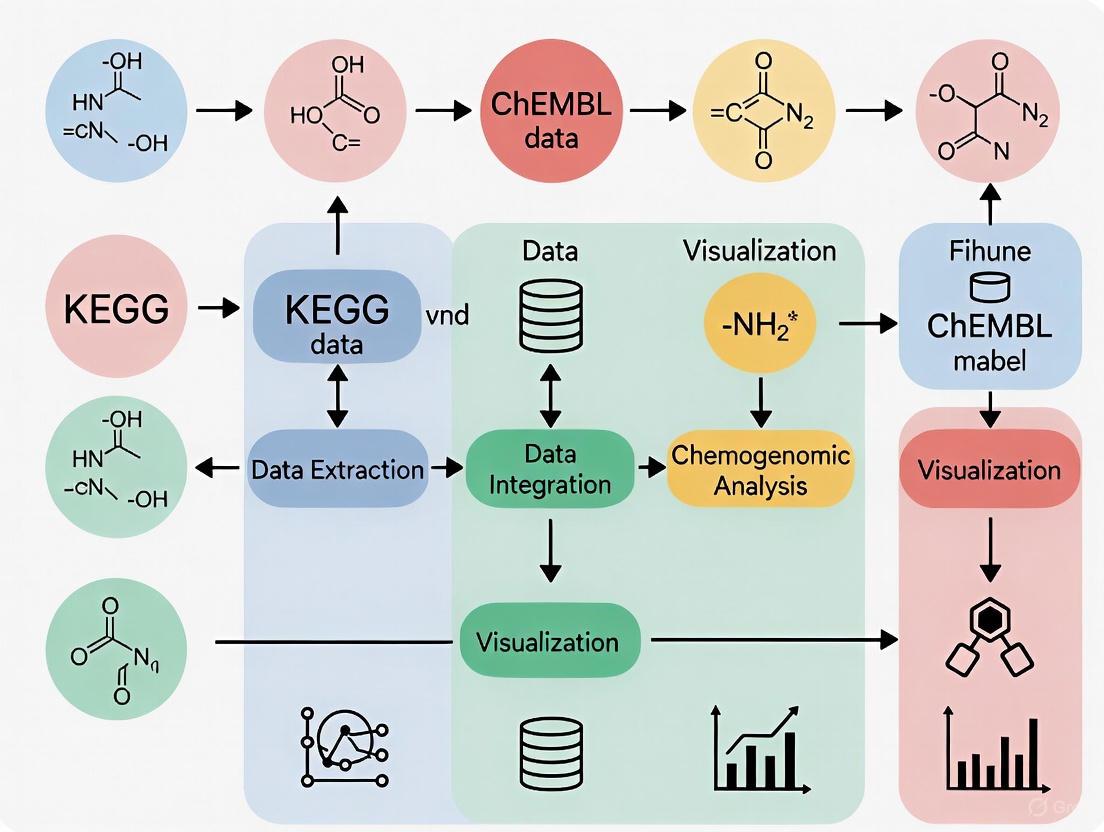
This article provides a comprehensive framework for integrating KEGG and ChEMBL databases to power modern chemogenomic analysis.
Integrating KEGG and ChEMBL for Advanced Chemogenomic Analysis: A Comprehensive Guide for Drug Discovery
Abstract
This article provides a comprehensive framework for integrating KEGG and ChEMBL databases to power modern chemogenomic analysis. Aimed at researchers and drug development professionals, it covers the foundational principles of these complementary resources, practical methodologies for data integration and network pharmacology, common troubleshooting strategies for data harmonization, and validation techniques through comparative analysis with other data sources. By synthesizing chemical, bioactivity, and pathway information, this guide enables more effective prediction of drug-target interactions, elucidation of mechanisms of action in phenotypic screening, and acceleration of multi-target drug discovery, ultimately facilitating the transition from a single-target to a systems pharmacology perspective in therapeutic development.
Understanding KEGG and ChEMBL: Complementary Foundations for Chemogenomics
ChEMBL is a manually curated, open-source database of bioactive molecules with drug-like properties, serving as a foundational resource for drug discovery and chemogenomics research [1] [2]. Maintained by the European Bioinformatics Institute (EMBL-EBI), its primary mission is to bridge genomic information and effective drug development by integrating chemical, bioactivity, and genomic data [2]. This makes it particularly valuable for researchers employing systems pharmacology approaches, which require understanding complex interactions between compounds and multiple biological targets rather than single target effects [3].
The scale of the database is substantial, with ChEMBL release 33 containing information extracted from over 88,000 publications and patents, 420 deposited datasets, and encompassing more than 20.3 million bioactivity measurements for 2.4 million unique compounds [4]. The data spans from 1974 to the present, enabling time-series analyses and trend assessments in drug discovery [4]. As a recognized Global Core Biodata Resource, ChEMBL provides the critical data infrastructure necessary for modern computational drug discovery, including target prediction, polypharmacology modeling, and machine learning applications [4].
Integration of ChEMBL with KEGG for Chemogenomic Analysis
Theoretical Foundation for Data Integration
Integrating ChEMBL with the Kyoto Encyclopedia of Genes and Genomes (KEGG) creates a powerful framework for chemogenomic analysis that connects chemical perturbations to systems-level biological responses [3]. This integration addresses a fundamental challenge in phenotypic drug discovery: deconvoluting the mechanisms of action induced by bioactive compounds by placing their protein targets within the context of broader biological pathways and disease networks [3].
The KEGG pathway database provides manually drawn pathway maps representing known molecular interactions, reactions, and relation networks across various categories including metabolism, cellular processes, genetic information processing, human diseases, and drug development [3]. When combined with ChEMBL's comprehensive repository of drug-target interactions, researchers can construct system pharmacology networks that reveal how chemical modulation of specific targets influences broader biological processes and potentially produces observable phenotypes [3].
Practical Applications of the Integrated Data
This integrated approach enables several key applications in drug discovery. For target identification and validation, researchers can map compounds with similar phenotypic profiles from ChEMBL to their protein targets and then determine if these targets cluster within specific KEGG pathways, suggesting critical nodes for therapeutic intervention [3] [5]. For drug repurposing, known drug-target interactions from ChEMBL can be connected to disease pathways in KEGG, identifying new therapeutic indications for existing drugs [5]. In mechanism of action deconvolution, morphological profiling data from phenotypic screens can be linked to both chemical structures in ChEMBL and biological pathways in KEGG to generate testable hypotheses about how compounds produce observed phenotypic effects [3]. Additionally, for side-effect prediction, understanding the network neighborhood of a drug's primary targets in KEGG pathways can help anticipate potential adverse outcomes by identifying biologically related proteins that might be inadvertently modulated [3].
Table 1: Key Data Sources for Integrated Chemogenomic Analysis
| Resource | Data Type | Role in Chemogenomic Analysis | Source |
|---|---|---|---|
| ChEMBL | Bioactive compounds, target interactions, drug-like properties | Provides chemical starting points and known biological activities | [1] [2] |
| KEGG | Pathways, diseases, functional annotations | Contextualizes targets within biological systems | [3] |
| Gene Ontology (GO) | Biological processes, molecular functions, cellular components | Adds functional annotation to protein targets | [3] |
| Disease Ontology (DO) | Human disease terms and relationships | Connects targets and pathways to human pathology | [3] |
Experimental Protocols for Chemogenomic Analysis
Protocol 1: Building an Integrated Drug-Target-Pathway Network
This protocol describes the construction of a systems pharmacology network integrating drug-target interactions from ChEMBL with pathway information from KEGG, following methodologies established in recent chemogenomics studies [3].
Materials and Reagents
- ChEMBL Database (version 33 or latest): Source of compound structures, bioactivities, and target associations [4]
- KEGG API: Programmatic access to pathway information [3]
- Neo4j Graph Database: Platform for network integration and querying [3]
- R packages: clusterProfiler (v3.14.3), DOSE (v3.12.0), org.Hs.eg.db (v3.10.0) for enrichment analysis [3]
Procedure
- Data Extraction from ChEMBL: Query the ChEMBL web services using specific filters to retrieve compounds with confirmed bioactivity data (e.g., Ki, IC50, EC50 ≤ 10 μM). Include associated protein targets and standardize activity measurements [6].
- Pathway Data Retrieval: Using the KEGG REST API, download pathway information for organisms of interest (e.g., human, mouse). Parse the data to extract gene-pathway associations [3].
- Identifier Mapping: Map ChEMBL target identifiers to standardized gene identifiers (e.g., Entrez ID, UniProt ID) using the cross-reference tables available in ChEMBL and the org.Hs.eg.db R package [3].
- Network Construction in Neo4j:
- Create nodes for: Compounds (with properties: ChEMBL ID, name, SMILES, molecular weight), Proteins (with properties: target ID, name, organism), Pathways (with properties: KEGG ID, name, category)
- Create relationships: (Compound)-[AFFECTS]->(Protein), (Protein)-[PARTICIPATES_IN]->(Pathway)
- Enrichment Analysis: For a set of compounds with similar phenotypic profiles, identify their shared targets and perform KEGG pathway enrichment analysis using the clusterProfiler R package with Bonferroni correction (p-value cutoff = 0.1) [3].
Diagram 1: Drug-Target-Pathway Network Construction Workflow
Protocol 2: Target Deconvolution for Phenotypic Screening Hits
This protocol utilizes integrated ChEMBL-KEGG data to identify potential mechanisms of action for compounds identified in phenotypic screens, adapting approaches used in pharmaceutical discovery pipelines [3] [7].
Materials and Reagents
- ChEMBL Bioactivity Data: Filtered for high-quality interactions (e.g., binding constants, pharmacology data) [2]
- Cell Painting Dataset: Morphological profiling data (e.g., BBBC022 from Broad Bioimage Benchmark Collection) [3]
- Scaffold Hunter Software: For structural analysis of bioactive compounds [3]
- CHEMGENIE or Similar Platform: Integrated chemogenomics database for polypharmacology prediction [7]
Procedure
- Phenotypic Screening: Conduct a Cell Painting or other phenotypic assay with a diverse compound library. Generate morphological profiles for each treatment condition [3].
- Similarity Searching: For each phenotypic hit, perform chemical similarity searches against ChEMBL using the web services API with a Tanimoto similarity cutoff of 80% [6].
- Target Enrichment Analysis:
- Compile all known targets for structurally similar compounds identified in step 2
- Perform statistical enrichment to identify targets over-represented among the phenotypic hits compared to the background library
- Calculate p-values using Fisher's exact test with multiple testing correction [7]
- Pathway Contextualization: Map enriched targets to KEGG pathways to identify biological processes potentially modulated by the phenotypic hits. Use the DOSE R package for disease ontology enrichment to suggest therapeutic applications [3].
- Scaffold Analysis: Using Scaffold Hunter, extract core chemical scaffolds from the active compounds and query ChEMBL for other compounds sharing these scaffolds but potentially targeting different proteins, exploring structure-activity relationships [3].
Table 2: Key Research Reagents and Tools for Chemogenomic Analysis
| Tool/Resource | Type | Function in Analysis | Source/Availability |
|---|---|---|---|
| ChEMBL Web Services | Programming interface | Programmatic access to bioactivity data | Public REST API [6] |
| Scaffold Hunter | Software | Structural decomposition and scaffold analysis | Open source [3] |
| Neo4j | Database | Graph-based data integration and querying | Commercial with free tier [3] |
| clusterProfiler | R package | Functional enrichment analysis | Bioconductor [3] |
| CellProfiler | Software | Image analysis for morphological profiling | Open source [3] |
Accessing and Utilizing ChEMBL Data
Programmatic Access and Data Retrieval
ChEMBL provides comprehensive web services that enable programmatic access to its data, facilitating integration into automated chemogenomic analysis pipelines [6]. The RESTful API supports multiple data formats including JSON, XML, and YAML, with pagination capabilities for handling large datasets [6].
Key API Endpoints for Chemogenomic Analysis:
- Molecule: Retrieve compound structures, properties, and synonyms
- Target: Access protein target information and classification
- Activity: Obtain bioactivity measurements (Ki, IC50, etc.)
- Mechanism: Explore drug mechanisms of action
- Target Component: Get sequence information for targets
Example API Queries:
- Retrieve compounds similar to aspirin:
https://www.ebi.ac.uk/chembl/api/data/molecule?molecule_structures__canonical_smiles__flexmatch=CC(=O)Oc1ccccc1C(=O)O[6] - Find kinase targets:
https://www.ebi.ac.uk/chembl/api/data/target?pref_name__contains=kinase[6] - Get bioactivities for a specific compound:
https://www.ebi.ac.uk/chembl/api/data/activity?molecule_chembl_id=CHEMBL25[6]
For large-scale analyses, the entire ChEMBL dataset can be downloaded via FTP in various formats including Oracle database dumps, PostgreSQL, and MySQL [8].
Data Filtering and Quality Considerations
When using ChEMBL data for chemogenomic analysis, several filtering strategies enhance data quality and relevance. Restrict bioactivities to specific measurement types (Ki, Kd, IC50, EC50) and apply confidence thresholds based on data provenance [4]. Consider target confidence scores provided in ChEMBL to prioritize well-annotated protein targets. Utilize the new flags for chemical probes and natural products introduced in recent releases to identify high-quality tool compounds [4]. For integration with KEGG, focus on human targets or apply orthology mapping for cross-species analyses.
Diagram 2: ChEMBL Data Analysis and Validation Workflow
The integration of ChEMBL with pathway resources like KEGG represents a powerful approach to modern chemogenomic analysis, enabling the transition from a reductionist "one target—one drug" paradigm to a systems-level understanding of polypharmacology [3]. The manually curated, high-quality data in ChEMBL provides the chemical foundation for building predictive models of drug-target interactions, while KEGG offers the biological context necessary for interpreting these interactions in disease-relevant pathways [3] [5].
As ChEMBL continues to grow—with deposited datasets now surpassing literature-extracted data in recent releases—its utility for chemogenomic applications expands accordingly [4]. Future developments will likely enhance the integration of chemical biology data with other -omics datasets, further empowering network pharmacology approaches to drug discovery and repurposing. The protocols outlined here provide a foundation for researchers to leverage these integrated resources for their own chemogenomic investigations, from target deconvolution in phenotypic screening to rational drug design based on systems-level understanding.
The Kyoto Encyclopedia of Genes and Genomes (KEGG) is a comprehensive database resource established in 1995 for understanding high-level functions and utilities of biological systems from genomic and molecular data [9]. It represents a foundational knowledge base that integrates systems, genomic, chemical, and health information into a unified framework. A primary objective of KEGG is to assign functional meanings to genes and genomes through the concept of functional orthologs, implemented via the KEGG Orthology (KO) system, enabling the reconstruction of molecular networks across diverse species [9]. This capability makes KEGG an indispensable tool for chemogenomic analysis, which seeks to understand the complex relationships between chemical compounds and their biological targets on a genome-wide scale. By integrating KEGG with bioactive molecule databases like ChEMBL, researchers can effectively bridge the gap between genomic information, pathway-level perturbations, and phenotypic effects induced by small molecules, thereby accelerating the translation of genomic data into effective new drugs [3] [1].
KEGG Database Architecture and Components
KEGG is organized as an integrated knowledge base comprising multiple interlinked databases. These can be broadly categorized into systems information, genomic information, chemical information, and health information, each playing a distinct role in biological interpretation.
Core Databases and Their Relationships
Table 1: Core Databases within the KEGG Resource
| Database Category | Database Name | Primary Content | Key Identifiers |
|---|---|---|---|
| Systems Information | KEGG PATHWAY | Molecular interaction and reaction networks | mapXXXXX |
| KEGG BRITE | Functional hierarchies | brXXXXX | |
| KEGG MODULE | Functional units | MXXXXX | |
| Genomic Information | KEGG ORTHOLOGY | Functional ortholog groups | KXXXXX |
| KEGG GENES | Gene catalogs | org:XXXXX | |
| KEGG GENOME | Organism information | TXXXXX | |
| Chemical Information | KEGG COMPOUND | Metabolites and small molecules | CXXXXX |
| KEGG GLYCAN | Glycans | GXXXXX | |
| KEGG REACTION | Biochemical reactions | RXXXXX | |
| KEGG ENZYME | Enzyme nomenclature | ECX.X.X.X | |
| Health Information | KEGG DRUG | Drug compounds | DXXXXX |
| KEGG DISEASE | Human diseases | HXXXXX | |
| KEGG NETWORK | Disease network variants | ntXXXXX |
The KEGG PATHWAY database forms the central organizing principle, containing manually drawn pathway maps representing molecular interaction, reaction, and relation networks [10]. These maps are categorized into seven broad areas: Metabolism, Genetic Information Processing, Environmental Information Processing, Cellular Processes, Organismal Systems, Human Diseases, and Drug Development [10]. Each pathway map is identified by a combination of a 2-4 letter prefix code and a 5-digit number, with prefixes indicating the type of pathway (e.g., 'map' for reference pathway, 'ko' for KO-based pathway, organism codes for species-specific pathways) [10].
The KEGG ORTHOLOGY (KO) system provides the critical linkage between genomic information and pathway knowledge. Each KO entry represents a conserved functional ortholog that serves as a node in KEGG pathway maps, BRITE hierarchies, and KEGG modules [9]. This architecture enables KEGG pathway mapping to uncover systemic features from KO-annotated genomes and metagenomes.
The chemical aspect of KEGG is represented by the KEGG LIGAND databases, which include KEGG COMPOUND for metabolic intermediates and other small molecules, KEGG GLYCAN for complex carbohydrates, KEGG REACTION for biochemical reactions, and KEGG DRUG for approved pharmaceutical compounds [11]. As of 2025, KEGG COMPOUND contained 19,541 entries, while KEGG DRUG contained 12,733 entries, with substantial cross-linking between these resources [11].
KEGG Database Architecture: This diagram illustrates the four main categories of KEGG databases and their constituent components, showing the integrated nature of the resource.
Protocols for KEGG in Chemogenomic Analysis
Protocol 1: Building an Integrated Drug-Target-Pathway Network
This protocol describes the construction of a systems pharmacology network integrating drug-target-pathway-disease relationships for chemogenomic analysis, adapted from methodologies successfully implemented in recent literature [3].
Materials and Reagents Table 2: Research Reagent Solutions for Network Pharmacology
| Item | Specification | Function in Protocol |
|---|---|---|
| ChEMBL Database | Version 22 or later | Source of bioactive molecule and target information |
| KEGG REST API | https://www.kegg.jp/kegg/rest/ | Programmatic access to KEGG data |
| Neo4j Graph Database | Community or Enterprise Edition | Storage and querying of network relationships |
| R Statistical Environment | Version 4.0 or higher | Data processing and analysis |
| clusterProfiler R package | Version 3.14.3 or higher | Functional enrichment analysis |
| ScaffoldHunter Software | Latest available version | Chemical scaffold analysis |
Procedure
Data Acquisition from ChEMBL
- Download the latest ChEMBL database release (version 22 or higher) containing standardized bioactivity data (Ki, IC50, EC50), molecular structures, and target information [3].
- Extract compounds with confirmed bioactivity measurements and their corresponding protein targets, focusing on human targets where possible.
- Filter compounds to include only those with drug-like properties based on Lipinski's Rule of Five and Veber's criteria.
KEGG Pathway and Disease Data Retrieval
- Access the KEGG PATHWAY database via the KEGG REST API to obtain pathway information, including gene-protein relationships and pathway hierarchies [10] [9].
- Retrieve KEGG DISEASE data to establish disease-gene relationships.
- Download KEGG DRUG information to identify approved pharmaceuticals and their targets.
- Use KEGG ORTHOLOGY to establish orthology relationships across species for comparative analysis.
Chemical Structure Processing
- Process chemical structures using ScaffoldHunter to decompose each molecule into representative scaffolds and fragments [3].
- Apply the following decomposition rules:
- Remove all terminal side chains preserving double bonds directly attached to a ring.
- Remove one ring at a time using deterministic rules in a stepwise fashion to retain characteristic core structures.
- Organize scaffolds into different levels based on their relationship distance from the original molecule node.
Graph Database Construction
- Implement a Neo4j graph database with the following node types: Molecule, Scaffold, Protein, Pathway, Disease, and Biological Process [3].
- Establish the following relationship types:
- (Molecule)-[HASSCAFFOLD]->(Scaffold)
- (Molecule)-[TARGETS]->(Protein)
- (Protein)-[PARTOFPATHWAY]->(Pathway)
- (Protein)-[ASSOCIATEDWITHDISEASE]->(Disease)
- (Pathway)-[ENRICHEDFOR]->(Biological Process)
- Import processed data from ChEMBL and KEGG into the appropriate nodes and relationships.
Network Validation and Enrichment Analysis
- Validate the integrated network by confirming known drug-target-pathway relationships from literature.
- Perform functional enrichment analysis using the clusterProfiler R package to identify overrepresented biological processes, molecular functions, and KEGG pathways [3].
- Conduct disease ontology enrichment using the DOSE R package with adjustment for multiple testing (Bonferroni method) and a p-value cutoff of 0.1 [3].
Expected Results Successful implementation will yield a comprehensive network typically comprising 5,000-10,000 small molecules, 1,000-2,000 protein targets, and 200-300 KEGG pathways, enabling systematic analysis of polypharmacology and drug repurposing opportunities.
Protocol 2: KEGG Mapper for Pathway-Based Transcriptomics and Chemogenomics Integration
This protocol utilizes KEGG Mapper tools to visualize and interpret transcriptomic data in the context of biological pathways, with integration of chemical perturbations.
Procedure
Data Preparation
- Generate a two-column dataset (space or tab separated) with KEGG identifiers in the first column and color specification in the second column [12].
- For gene expression data, use KEGG orthology (KO) identifiers (K numbers) or organism-specific gene identifiers.
- For chemical data, use KEGG COMPOUND (C numbers) or KEGG DRUG (D numbers) identifiers.
- Format color specification as "bgcolor,fgcolor" without spacing (e.g., "red,white" or "#ff0000,#ffffff").
Pathway Mapping with Color Tool
- Access the KEGG Mapper Color tool at https://www.kegg.jp/kegg/mapper/color.html [12].
- Select the appropriate search mode:
- Reference mode: For mapping against reference pathways using KO identifiers, EC numbers, or C/D numbers.
- Organism-specific mode: For mapping against species-specific pathways using native gene identifiers.
- Upload the prepared data file or paste directly into the input field.
- Set default background color for unmapped elements and choose whether to include aliases.
- Execute the search and review the colored pathway maps.
Interpretation and Analysis
- Identify pathways with significant enrichment of differentially expressed genes or chemical targets.
- Use the KEGG Mapper Search tool to find pathways containing specific genes or compounds of interest.
- Analyze pathway topology to identify key regulatory nodes and potential bottlenecks.
- Compare multiple conditions using different color schemes to visualize differential responses.
Integration with Chemogenomic Data
- Overlay chemical target information on transcriptomic pathway maps to identify direct and indirect effects of chemical perturbations.
- Use the KEGG NETWORK database to examine disease-associated perturbed networks and identify potential therapeutic targets [9].
- Correlate pathway enrichment patterns with chemical structure similarities identified through scaffold analysis.
KEGG Mapper Workflow: This diagram outlines the sequential steps for utilizing KEGG Mapper tools to visualize and interpret omics data in the context of biological pathways.
Application Notes and Case Studies
Case Study: Development of a Chemogenomic Library for Phenotypic Screening
Recent research demonstrates the powerful integration of KEGG with chemical biology resources for phenotypic drug discovery. A 2021 study developed a chemogenomic library of 5,000 small molecules representing a diverse panel of drug targets involved in various biological effects and diseases [3]. This library was constructed by:
Systems Pharmacology Network Construction: Integrating ChEMBL bioactivity data, KEGG pathways, Gene Ontology, Disease Ontology, and morphological profiling data from the Cell Painting assay into a Neo4j graph database [3].
Target Coverage Optimization: Ensuring representation of targets across all major KEGG pathway categories, including:
- Metabolism (Global and overview maps, Carbohydrate metabolism, Lipid metabolism)
- Environmental Information Processing (Membrane transport, Signal transduction)
- Cellular Processes (Transport and catabolism)
- Organismal Systems (Immune system, Endocrine system)
Scaffold-Based Diversity: Applying ScaffoldHunter to decompose molecules into representative scaffolds, ensuring structural diversity while maintaining coverage of the druggable genome [3].
This chemogenomic library enables target identification and mechanism deconvolution for phenotypic screening campaigns, effectively bridging target-based and phenotypic drug discovery paradigms.
Application Note: KEGG NETWORK for Analyzing Disease Perturbations
The KEGG NETWORK database, introduced more recently, provides a novel approach for representing disease-associated perturbed molecular networks [9]. This resource incorporates:
- Network Variants: Representations of perturbed molecular networks caused by human gene variants, viruses, pathogens, environmental factors, and drugs.
- Aligned Network Sets: Comparisons of how different viruses inhibit or activate specific cellular signaling pathways.
- Integration with Pathway Maps: Unified representation of reference pathways and network variation maps.
For chemogenomic analysis, KEGG NETWORK enables researchers to:
- Identify network-based biomarkers for disease stratification
- Predict drug efficacy based on network perturbation patterns
- Identify drug combination opportunities targeting complementary network nodes
- Understand resistance mechanisms through adaptive network changes
Table 3: KEGG NETWORK Cancer Type Color Codes
| Color Code | Cancer Type | Representative Subtypes |
|---|---|---|
| #ff0000 | Acute Myeloid Leukemia | H00003 |
| #ff1493 | Breast Cancer | H00031 |
| #00ffff | Prostate Cancer | H00024 |
| #ffff00 | Glioma, Neuroblastoma | H00042, H00043 |
| #0000ff | Colorectal Cancer | H00020 |
| #ffc0cb | Endometrial Cancer | H00026 |
| #00ff00 | Non-Small Cell Lung Cancer | H00014 |
| #993333 | Various Sarcomas | Multiple subtypes |
Practical Implementation
Accessing KEGG Programmatically
For large-scale chemogenomic analyses, programmatic access to KEGG is essential. The KEGG REST API provides access to all KEGG databases using simple HTTP requests:
Best Practices for Data Visualization
Effective visualization of KEGG-based analyses requires adherence to established practices:
Pathway Mapping Color Standards: Use KEGG's established color codes for consistent interpretation [13]. For example:
- Organism-specific pathways: #bfffbf to #66cc66
- Reference pathways: #bfbfff to #6666cc
- Disease genes: #ffcfff to #ff99ff
Multi-omics Integration: Use KEGG's split color mode to visualize data from multiple organisms or conditions simultaneously [13].
Network Visualization: When visualizing large networks, employ hierarchical layouts that emphasize key pathway modules and their interconnections.
Uncertainty Representation: Clearly distinguish between experimentally confirmed and predicted interactions in integrated networks, particularly when combining KEGG with predicted chemical-target interactions [14].
Quality Control and Validation
- Regularly update KEGG data extracts, as KEGG is continuously updated with new pathways and annotations [10].
- Validate KEGG-based predictions with orthogonal data sources and experimental confirmation.
- Use the manually curated portions of KEGG (pathway maps, KO definitions) as gold standards for evaluating automated predictions.
- Leverage KEGG's internal consistency checks through the use of KEGG Mapper modules that ensure proper pathway connectivity and stoichiometric consistency.
The paradigm of drug discovery has progressively shifted from a traditional "one drug–one target" approach toward a more holistic systems pharmacology perspective that acknowledges complex diseases are often caused by multiple molecular abnormalities rather than a single defect [15] [16]. Multi-target drug discovery has emerged as an essential strategy for treating complex diseases involving multiple molecular pathways, such as cancer, neurodegenerative disorders, and metabolic syndromes [15]. This transformation creates a critical need for methodologies that can effectively integrate chemical bioactivity data with pathway and disease context to enable rational polypharmacology – the deliberate design of drugs to interact with a pre-defined set of molecular targets for synergistic therapeutic effects [15].
This Application Note provides a structured framework and practical protocols for integrating chemical bioactivity data from sources like ChEMBL with pathway information from resources like KEGG to advance chemogenomic analysis in drug discovery. We present standardized workflows, data processing techniques, and visualization strategies to help researchers leverage these integrated datasets for identifying multi-target therapeutic strategies, repurposing existing drugs, and deconvoluting mechanisms of action in phenotypic screening.
Successful integration of chemical bioactivity with pathway context begins with a thorough understanding of available data resources, their coverage, and appropriate application scenarios. The following table summarizes key databases and their primary characteristics.
Table 1: Key Databases for Chemogenomic Analysis
| Database | Primary Focus | Data Content | Key Applications |
|---|---|---|---|
| ChEMBL [1] [17] | Bioactive molecules & drug-like compounds | >21 million bioactivity measurements; >2.4 million ligands; >16,000 targets [17] | Multi-target activity profiling; lead optimization; drug repurposing |
| KEGG PATHWAY [18] | Molecular interaction & reaction networks | Manually drawn pathway maps for metabolism, cellular processes, human diseases, and drug development [18] | Pathway enrichment analysis; network pharmacology; mechanistic studies |
| BindingDB [17] | Measured binding affinities | ~2.4 million binding measurements; ~1.3 million unique ligands; ~9,000 targets [17] | Binding affinity prediction; selectivity analysis; machine learning model training |
| GtoPdb [17] | Pharmacological targets & ligands | Curated data on 3,039 targets and 12,163 ligands with emphasis on drug targets [17] | Target prioritization; safety assessment; polypharmacology prediction |
The quantitative coverage and relationships between these resources reveal important patterns for research planning. Comparative analysis shows that ChEMBL, BindingDB, and GtoPdb collectively provide a robust foundation for computational pharmacology, with ChEMBL offering the most extensive compound coverage and BindingDB providing specialized binding affinity data [17]. Journal coverage analysis indicates that 2,360 articles are common to all three databases, while 38,912 are shared between ChEMBL and BindingDB, highlighting the complementary yet overlapping nature of these resources [17].
Integrated Protocol for Chemogenomic Analysis
Protocol: Building a Network Pharmacology Database
Purpose: To construct an integrated network pharmacology database that connects compounds, targets, pathways, and diseases for multi-target therapeutic discovery.
Materials and Reagents:
- Data Sources: ChEMBL database (version 22 or newer) [16], KEGG PATHWAY database [18], Disease Ontology [16], Gene Ontology [16]
- Software Tools: Neo4j graph database [16], R packages (clusterProfiler, DOSE, org.Hs.eg.db) [16], ScaffoldHunter [16]
Procedure:
- Compound and Target Collection:
- Download ChEMBL data and filter for compounds with at least one bioassay result
- Extract molecular structures (SMILES, InChIKey), bioactivity values (IC₅₀, Kᵢ, EC₅₀), and target information
- Retain only human targets or include ortholog mapping for other species
Pathway and Disease Annotation:
- Download KEGG pathway maps and create mappings between targets and pathways
- Annotate targets with Disease Ontology terms and Gene Ontology functional categories
- Integrate morphological profiling data from sources like Cell Painting if available [16]
Graph Database Construction:
- Define node types: Molecule, CompoundName, Target, Pathway, Disease, AssayResult
- Establish relationships: "TARGETS", "PARTOFPATHWAY", "ASSOCIATEDWITHDISEASE"
- Implement cross-references between entities using standardized identifiers
Scaffold Analysis:
- Process compounds using ScaffoldHunter to identify core chemical structures [16]
- Generate hierarchical scaffold trees by progressively removing terminal side chains and rings
- Incorporate scaffold nodes into the graph database with "HAS_SCAFFOLD" relationships
Enrichment Analysis Capability:
- Implement connectivity for GO, KEGG, and Disease Ontology enrichment analysis using clusterProfiler and DOSE R packages [16]
- Configure statistical parameters (Bonferroni adjustment, p-value cutoff of 0.1)
Troubleshooting Tips:
- Resolve identifier discrepancies between databases using bridge resources like UniProt
- Implement data quality filters based on confidence metrics from each source
- For large datasets, employ batch processing and index optimization in Neo4j
Protocol: Chemogenomic Library Design for Phenotypic Screening
Purpose: To design a targeted chemogenomic library for phenotypic screening that covers diverse biological pathways and enables mechanism deconvolution.
Materials and Reagents:
- Starting Compound Sets: Commercially available screening collections (e.g., NCATS MIPE, Pfizer chemogenomic library, GSK BDCS) [16]
- Annotation Resources: ChEMBL target annotations, KEGG pathway maps, GO biological processes
- Analysis Tools: Custom scripts for diversity analysis, clustering algorithms, and target coverage assessment
Procedure:
- Target Space Definition:
- Identify proteins and pathways relevant to the disease biology or phenotypic assay
- Extract compounds from ChEMBL with activity against these targets (considering potency and selectivity)
- Include compounds with known mechanisms to serve as reference tools
Diversity and Selectivity Optimization:
- Apply scaffold analysis to ensure structural diversity and reduce chemical redundancy
- Prioritize compounds with balanced polypharmacology profiles over highly selective agents for multi-target applications [19]
- Apply filters for drug-like properties (e.g., Lipinski's Rule of Five) when appropriate
Library Assembly and Annotation:
Validation and Profiling:
- Screen the library in the phenotypic assay of interest
- Use profiling data to build connectivity maps between chemical structures, targets, and observed phenotypes
- Apply enrichment analysis to identify overrepresented target classes and pathways among active compounds
Applications: This protocol has been successfully applied in precision oncology for identifying patient-specific vulnerabilities in glioblastoma and can be adapted to other disease areas [19].
Visualization and Data Integration Strategies
Effective visualization is crucial for interpreting complex chemogenomic data. The following diagram illustrates the core workflow for integrating chemical bioactivity with pathway and disease context:
Integrated Chemogenomic Analysis Workflow
For multi-target drug discovery applications, understanding the relationship between compound structures, their protein targets, and the pathways they modulate is essential. The following diagram illustrates this multi-scale relationship:
Multi-Scale Pharmacology Relationships
The Scientist's Toolkit: Research Reagent Solutions
Table 2: Essential Research Reagents and Resources for Chemogenomic Analysis
| Resource | Type | Primary Function | Application Notes |
|---|---|---|---|
| ChEMBL Database [1] [17] | Bioactivity Database | Provides curated bioactivity data for drug-like molecules | Essential for building compound-target networks; use for polypharmacology profiling |
| KEGG PATHWAY [18] | Pathway Database | Manually drawn molecular interaction and reaction networks | Critical for contextualizing targets in biological systems; use for enrichment analysis |
| Neo4j [16] | Graph Database Platform | Enables integration of heterogeneous data sources as connected networks | Ideal for representing complex drug-target-pathway-disease relationships |
| ScaffoldHunter [16] | Chemical Informatics Tool | Identifies and organizes molecular scaffolds from compound collections | Enables scaffold-based diversity analysis and chemotype-phenotype correlation |
| Cell Painting Assay [16] | Phenotypic Profiling Method | Provides high-content morphological profiles for compounds | Bridges chemical and phenotypic spaces for mechanism deconvolution |
| BindingDB [17] | Binding Affinity Database | Focuses on measured drug-target binding affinities (Kd, Ki, IC₅₀) | Superior for building quantitative structure-activity relationship models |
| clusterProfiler R Package [16] | Bioinformatics Tool | Performed GO and KEGG enrichment analysis | Statistical identification of overrepresented biological terms |
Advanced Applications and Case Studies
Machine Learning for Multi-Target Prediction
Background: Machine learning (ML) has emerged as a powerful toolkit for modeling the complex, nonlinear relationships inherent in biological systems and predicting multi-target activities [15]. ML approaches can prioritize promising drug-target pairs, predict off-target effects, and propose novel compounds with desirable polypharmacological profiles by learning from diverse data sources [15].
Methodology Overview:
- Feature Representation: Drugs can be encoded as molecular fingerprints, SMILES strings, or graph-based encodings; targets can be represented by sequences, structures, or network embeddings [15]
- Model Architectures: Approaches range from classical methods (Random Forests, SVMs) to advanced deep learning architectures (Graph Neural Networks, Transformers) [15]
- Multi-Task Learning: Frameworks that simultaneously predict activities against multiple targets to capture inherent relationships between targets [15]
Case Study: DMFF-DTA Model for Affinity Prediction The Dual Modality Feature Fused neural network for Drug-Target Affinity (DMFF-DTA) prediction exemplifies advanced ML applications [20]. This model integrates both sequence and structural information from drugs and proteins while addressing the size discrepancy between drug molecules and protein targets [20].
Key Innovations:
- Binding site-focused graph construction using AlphaFold2-predicted structures
- Dual-modality architecture that fuses sequence and graph features
- Feature balancing to handle the size imbalance between drug and protein graphs
Performance: DMFF-DTA demonstrates excellent generalization capabilities on unseen drugs and targets, achieving improvements of over 8% compared to existing methods [20]. The model has shown practical utility in pancreatic cancer drug repurposing through its accurate binding affinity predictions [20].
Drug Repurposing Through Integrated Analysis
Background: Drug repurposing offers a cost-effective and expedited alternative to traditional drug development pipelines, with the potential to address unmet clinical needs more rapidly [17]. Integrated analysis of chemical bioactivity and pathway context enables systematic identification of new therapeutic indications for existing drugs.
Methodology:
- Cross-Indication Analysis: Examine patterns of drug approvals across 28 therapeutic indication groups to identify areas with high repurposing potential [17]
- Pathway-Based Screening: Implement computational pipelines to predict repositioning opportunities based on pathway activity across disease contexts [17]
- Physicochemical Profiling: Analyze relationships between therapeutic indication groups and the physicochemical properties of their corresponding approved drugs to guide design of novel therapeutics [17]
Implementation Considerations:
- Leverage structured frameworks that map clinically approved drug indications into broader therapeutic groups (e.g., 28 groups for systematic analysis) [17]
- Manually classify targets into high-level biological families (e.g., 12 families) to facilitate therapeutic interpretation [17]
- Prioritize compounds with favorable ADMET (Absorption, Distribution, Metabolism, Excretion, and Toxicity) properties based on indication-specific profiling [17]
The integration of chemical bioactivity data from resources like ChEMBL with pathway and disease context from sources like KEGG represents a powerful approach for advancing drug discovery, particularly in the realm of multi-target therapeutics and drug repurposing. The protocols and strategies outlined in this Application Note provide researchers with practical methodologies for building integrated chemogenomic databases, designing targeted screening libraries, and applying advanced machine learning and visualization techniques.
As the field continues to evolve, promising directions include the increased incorporation of structural biology information (e.g., from AlphaFold2), application of more sophisticated deep learning architectures, and development of improved visualization tools for complex multi-scale data. By adopting these integrated approaches, researchers can more effectively navigate the complexity of biological systems and accelerate the development of safer, more effective therapeutics for complex diseases.
Modern drug discovery has shifted from the traditional "one drug, one target" paradigm toward a more holistic systems pharmacology strategy that acknowledges most complex diseases involve dysregulation of multiple molecular pathways [15]. This shift necessitates the integration of diverse, large-scale biological data to understand and exploit polypharmacology—the design of compounds to intentionally interact with multiple specific targets [15] [16]. Chemogenomics addresses this need by systematically investigating the biological effects of small molecules on a wide range of macromolecular targets [5]. The effectiveness of this approach is critically dependent on accessing and integrating high-quality, structured data describing compounds, their protein targets, the bioactivities between them, and the biological pathways in which these targets operate. Two indispensable resources for this integration are the ChEMBL database, a manually curated repository of bioactive molecules with drug-like properties, and the KEGG (Kyoto Encyclopedia of Genes and Genomes) database, a comprehensive resource representing molecular interaction and reaction networks [1] [21] [22]. This application note details the key data types and structures from these resources and provides a practical protocol for their integrated use in chemogenomic analysis.
Data Types and Structures
Compound Data (ChEMBL)
In ChEMBL, "compounds" refer to preclinical molecules with associated experimental bioactivity data, whereas "drugs" or "clinical candidate drugs" include marketed drugs and those progressing through clinical development pipelines, which may not necessarily have associated bioactivity data in ChEMBL [23]. A single molecule can exist in multiple categories; for example, an approved drug that was also extensively studied in the literature will be both an "Approved Drug" and a "Preclinical Compound" [23].
Table 1: Key Compound Data Attributes in ChEMBL
| Attribute | Description | Example Source/Calculation |
|---|---|---|
| Molecular Structure | Structural representation (e.g., SMILES, InChIKey) | Extracted from literature or deposited datasets [23] |
| Molecular Weight | Weight of the parent form of the molecule | Calculated using RDKit [23] |
| AlogP | Calculated lipophilicity (octanol/water partition coefficient) | Atomic contribution method [23] |
| PSA | Polar Surface Area | Sum of fragment-based contributions [23] |
| HBA/HBD | Hydrogen Bond Acceptor/Donor counts | SMARTS pattern matching [23] |
| RO5 Violations | Number of Lipinski's Rule of Five violations | Based on MW, AlogP, HBD, HBA [23] |
| Max Phase | Maximum clinical development phase | From sources like FDA, USAN, ClinicalTrials.gov [23] |
| Chirality Flag | Indicates if dosed as racemate, single isomer, or achiral | Curated for drugs and clinical candidates [23] |
The clinical development stage of a compound is summarized by its max_phase attribute, which ranges from 0.5 (Early Phase 1) to 4 (Approved Drug) [23]. Preclinical compounds with only bioactivity data have a null value for this field [23].
Target Data (ChEMBL and KEGG)
A "target" in ChEMBL is the entity with which a compound interacts to exert its effect. The database uses a sophisticated target model to distinguish between several target types [22]:
- SINGLE PROTEIN: For compounds interacting specifically with a monomeric protein.
- PROTEIN FAMILY: For compounds acting non-specifically on a family of proteins or when the assay cannot distinguish the specific family member.
- PROTEIN COMPLEX: For compounds interacting with a defined complex of proteins [22].
The KEGG database provides complementary target information by placing proteins within the context of broader biological systems. The KEGG Orthology (KO) system uses generic identifiers (K numbers) to represent functional orthologs, which serve as nodes in KEGG pathway maps [21]. This allows for the reconstruction of organism-specific molecular networks from genomic information [21].
Bioactivity Data (ChEMBL)
Bioactivity data in ChEMBL is extracted from the medicinal chemistry literature and other deposited data sources. It quantitatively describes the interaction between a compound and a target under specific assay conditions.
Table 2: Core Bioactivity Data in ChEMBL
| Data Type | Description | Significance |
|---|---|---|
| IC₅₀ | Half-maximal inhibitory concentration | Measures compound's potency to inhibit a target's function. |
| Kᵢ | Inhibition constant | Quantifies binding affinity for an inhibitor. |
| EC₅₀ | Half-maximal effective concentration | Measures potency for an agonist or activator. |
| Assay Type | Classification (e.g., binding, functional, ADMET) | Provides context for interpreting the activity value. |
| Target Mapping | Link to the specific protein, family, or complex | Defines the pharmacological context of the activity [22]. |
As of a recent update, ChEMBL contained over 1.3 million distinct compound structures and 12 million bioactivity data points mapped to more than 9,000 targets [22]. This data is essential for building predictive models for drug-target interactions (DTIs) and for investigating the selectivity and off-target effects of drugs [22] [5].
Pathway Data (KEGG)
KEGG PATHWAY is a collection of manually drawn pathway maps representing knowledge on molecular interaction, reaction, and relation networks [18] [21]. These maps are systematically categorized, providing a hierarchical organization of biological knowledge.
Table 3: KEGG PATHWAY Database Categories
| Category | Description | Example Pathways |
|---|---|---|
| Metabolism | Global and overview maps, carbohydrate, energy, lipid metabolism, etc. | map01100: Metabolic pathways; map00010: Glycolysis / Gluconeogenesis |
| Genetic Information Processing | Transcription, translation, replication, repair | map03010: Ribosome |
| Environmental Information Processing | Membrane transport, signal transduction | map04010: MAPK signaling pathway; map04020: Calcium signaling pathway |
| Cellular Processes | Transport, catabolism, cell growth, death | map04150: mTOR signaling pathway |
| Organismal Systems | Immune, endocrine, nervous, circulatory systems | map04630: JAK-STAT signaling pathway |
| Human Diseases | Cancers, infectious, substance dependence | map05200: Pathways in cancer |
| Drug Development | Chronology of anti-infectives, chemical structure maps | map07010: Chronology: Antiinfectives |
Each pathway map is identified by a unique identifier combining a 2-4 letter prefix and a 5-digit number (e.g., map05200 for a reference pathway, hsa05200 for the human-specific version) [18] [24]. In these maps, rectangular boxes typically represent genes or enzymes, while circles represent metabolites [24]. This structured visualization helps researchers interpret complex biological processes and place drug targets within their functional context.
Successful chemogenomic analysis relies on a suite of public databases and software tools.
Table 4: Essential Research Reagents and Resources for Chemogenomic Analysis
| Resource Name | Type | Function in Chemogenomic Analysis |
|---|---|---|
| ChEMBL | Database | Provides curated chemical structures, bioactivities (IC₅₀, Kᵢ, EC₅₀), and drug-target linkage data [1] [22]. |
| KEGG PATHWAY | Database | Supplies manually drawn pathway maps for contextualizing targets within biological systems [18] [21]. |
| KEGG ORTHOLOGY (KO) | Database | Provides a system of functional ortholog identifiers for linking genes/proteins to pathways and networks [21]. |
| Neo4j | Software Tool | A graph database platform ideal for integrating and querying heterogeneous network pharmacology data [16]. |
| RDKit | Software Tool | Cheminformatics library used for calculating compound properties like molecular weight, AlogP, and PSA [23]. |
| Cell Painting | Assay/Method | A high-content imaging assay that generates morphological profiles for connecting chemical perturbations to phenotypes [16]. |
| ScaffoldHunter | Software Tool | Used for analyzing and organizing chemical libraries based on their molecular scaffold hierarchies [16]. |
Integrated Data Schema and Relationship Diagram
The power of chemogenomics emerges from the integration of these discrete data types. The following diagram illustrates the logical relationships and workflow for integrating compound, target, bioactivity, and pathway data into a unified chemogenomic network.
Application Protocol: Building an Integrated Chemogenomic Network
This protocol outlines the steps for constructing a chemogenomic network by integrating ChEMBL and KEGG data, adapted from published research [16]. The goal is to create a system that links drugs, targets, pathways, and diseases, which can be used for target identification and mechanism of action deconvolution in phenotypic screening.
- ChEMBL Database: Download the latest version of the ChEMBL database (e.g., via FTP or web interface) [16] [22].
- KEGG PATHWAY & KO Data: Access the KEGG database via its REST API or dedicated FTP server [18] [21].
- Gene Ontology (GO) & Disease Ontology (DO): Obtain these resources from their official websites for functional and disease annotation [16].
- Software Tools:
Step-by-Step Procedure
Step 1: Data Acquisition and Preprocessing
- From ChEMBL, extract molecules with associated bioassay data. Retain key information including InChIKey, SMILES, standard type (e.g., IC₅₀, Kᵢ), standard value, and target information [16] [23].
- From KEGG, download pathway information and the KO to gene identifier mappings for your organism of interest (e.g., human) [16] [21].
Step 2: Building the Graph Database with Neo4j
- Create nodes in Neo4j for the following entities [16]:
Molecule: With properties likeinchi_key,smiles.Target: With properties liketarget_id,name,type(e.g., SINGLE PROTEIN).Pathway: With properties likepathway_id(e.g., hsa05200),name.Assay: With properties likeassay_type,standard_type,standard_value.Disease: From the Disease Ontology.Scaffold: Generated using ScaffoldHunter to represent core molecular structures [16].
- Create relationships between these nodes to capture biological and chemical logic [16]:
(Molecule)-[HAS_ACTIVITY {value: 5.2, type: "pIC50"}]->(Assay)(Assay)-[TARGETS]->(Target)(Target)-[PART_OF_PATHWAY]->(Pathway)(Molecule)-[HAS_SCAFFOLD]->(Scaffold)(Target)-[ASSOCIATED_WITH_DISEASE]->(Disease)
Step 3: Library Design and Scaffold Analysis
- To create a targeted screening library, filter compounds based on criteria such as cellular activity, chemical diversity, and target selectivity [19].
- Use ScaffoldHunter to organize the selected compounds by their hierarchical scaffold trees. This helps ensure coverage of diverse chemotypes and identifies representative core structures for the library [16].
Step 4: Functional Enrichment Analysis
- For a set of targets identified from a phenotypic screen (e.g., via Cell Painting), use the R package
clusterProfilerto perform KEGG pathway enrichment analysis. This identifies biological pathways that are statistically over-represented in your target list [16] [24]. - Similarly, use the
DOSEpackage to perform Disease Ontology enrichment analysis to uncover potential disease associations [16].
Step 5: Querying and Visualization
- Use Cypher (Neo4j's query language) to extract sub-networks of interest. For example, to find all compounds active against a specific pathway:
- Visualize the resulting networks directly in Neo4j Browser or export for further analysis to identify key network nodes and relationships.
Expected Results and Interpretation
Upon completion, you will have a unified graph database that allows for complex queries across chemical and biological spaces. For instance, you can:
- Identify Multi-Target Compounds: Find molecules that are annotated to hit multiple proteins within a disease-relevant pathway, suggesting potential as multi-target agents [15].
- Deconvolute Phenotypic Screens: Input a list of "hit" compounds from a phenotypic screen (like Cell Painting) into the network to identify which of their known protein targets are clustered in specific pathways, thereby proposing a mechanism of action [16].
- Propose Drug Repurposing: Discover existing drugs (with high
max_phase) that hit targets associated with a new disease pathway, suggesting new therapeutic indications [5].
The following diagram visualizes the multi-step workflow of this protocol, from data collection to application.
The integration of chemogenomics data is a cornerstone of modern drug discovery and chemical biology research, enabling the systematic study of interactions between small molecules and biological targets. Two of the most critical public resources in this domain are the Kyoto Encyclopedia of Genes and Genomes (KEGG) and the ChEMBL database. KEGG is an integrated database resource that incorporates genomic, chemical, and systemic functional information, particularly through its pathway maps, BRITE functional hierarchies, and KEGG modules [25]. ChEMBL is a manually curated database of bioactive molecules with drug-like properties, bringing together chemical, bioactivity, and genomic data to aid the translation of genomic information into effective new drugs [1]. Together, these resources provide complementary data types that, when integrated, offer a powerful platform for understanding complex chemical-biological interactions and facilitating drug discovery efforts.
For researchers in chemogenomics, understanding how to programmatically access and combine data from these resources is essential for building comprehensive datasets that link compound structures with their biological activities, molecular targets, and pathway contexts. This application note provides detailed protocols for accessing KEGG and ChEMBL data through their public APIs and download options, with a specific focus on integration methodologies for chemogenomic analysis.
KEGG Database Structure
KEGG is organized as a set of interconnected databases that can be broadly categorized into four main areas [25] [24]:
- Systems Information: Includes PATHWAY, MODULE, and BRITE databases
- Genomic Information: Includes GENES, GENOME, and ORTHOLOGY databases
- Chemical Information: Includes COMPOUND, GLYCAN, REACTION, and ENZYME databases
- Health Information: Includes DISEASE and DRUG databases
The most core databases are KEGG PATHWAY and KEGG ORTHOLOGY (KO). KEGG PATHWAY contains manually drawn pathway maps representing molecular interaction and reaction networks, while KO provides a classification of orthologous gene groups that serve as functional units in pathway maps [24]. Each pathway in KEGG is encoded with 2-4 prefixes and 5 numbers (e.g., map00010 for metabolic pathways, hsa04110 for human cell cycle) [24].
ChEMBL Database Structure
ChEMBL is a bioactivity database focused on drug-like small molecules, containing 2D structures, calculated properties, and abstracted bioactivities (e.g., binding constants, pharmacology, and ADMET data) [26]. The data is curated from selected articles in more than 200 journals and patents, with releases occurring approximately 2-3 times per year [26]. Each entity in ChEMBL (compounds, targets, assays, documents) is assigned a unique ChEMBL ID, while an internal compound identifier (molregno) is also maintained [26].
Comparative Database Analysis
Table 1: Key Characteristics of KEGG and ChEMBL Databases
| Characteristic | KEGG | ChEMBL |
|---|---|---|
| Primary Focus | Biological pathways and systemic functions | Bioactive molecules and drug discovery data |
| Core Content | Pathway maps, ortholog groups, compounds, diseases | Compound structures, bioactivities, target annotations |
| Data Curation | Manually created reference datasets with computationally generated organism-specific datasets | Manually curated from literature and deposited datasets |
| Update Frequency | Regular updates | 2-3 times per year [26] |
| Licensing | Custom license | Creative Commons Attribution-Share Alike 3.0 Unported [26] |
| Unique Identifiers | K numbers (KO), C numbers (compounds), D numbers (drugs) | ChEMBL IDs, molregno [26] |
KEGG Data Access Protocols
KEGG REST API
KEGG provides a REST-style API that offers direct programmatic access to its databases. The general form of the API URL is:
where <operation> specifies the action to be performed, and <argument> provides the specific parameters for that operation [27].
Core API Operations
The KEGG API supports several key operations [27]:
- info: Retrieves database release information and statistics
- list: Obtains a list of entry identifiers and associated names
- find: Searches for entries matching query keywords
- get: Retrieves full database entries in flat file format
- conv: Converts between KEGG and external identifiers
- link: Finds related entries across databases
Practical API Usage Examples
Table 2: Key KEGG API Operations and Examples
| Operation | URL Format | Example | Output |
|---|---|---|---|
| info | /info/<database> |
/info/kegg |
Database statistics |
| list | /list/<database> |
/list/pathway/hsa |
List of human pathways |
| find | /find/<database>/<query> |
/find/compound/glucose |
Compounds related to glucose |
| get | /get/<entry> |
/get/hsa:7535 |
Full entry for human gene ZAP70 |
| conv | /conv/<target_db>/<source_db> |
/conv/uniprot/hsa:7535 |
UniProt IDs for KEGG gene |
Code Implementation: Accessing KEGG Data
The following Python code demonstrates how to use the KEGG API to retrieve and parse pathway information:
KEGG Flat File Downloads
For large-scale analyses, KEGG provides complete database downloads in flat file format via its FTP server (https://www.kegg.jp/kegg/download/). These downloads are particularly useful for building local databases or performing comprehensive analyses that would be inefficient via API calls.
ChEMBL Data Access Protocols
ChEMBL Web Services
ChEMBL provides comprehensive web services that allow programmatic access to its data. The base URL for ChEMBL web services is https://www.ebi.ac.uk/chembl/ws. Unlike KEGG's REST-style API, ChEMBL's web services return data in JSON format, making it easily parseable in various programming environments [26].
Key ChEMBL Web Service Endpoints
- Compound Data:
/chembl/api/data/molecule?molecule_chembl_id__in=[CHEMBL_ID] - Bioactivity Data:
/chembl/api/data/activity?molecule_chembl_id__in=[CHEMBL_ID] - Target Information:
/chembl/api/data/target?target_chembl_id__in=[CHEMBL_ID] - Assay Details:
/chembl/api/data/assay?assay_chembl_id__in=[CHEMBL_ID]
Code Implementation: Accessing ChEMBL Data
ChEMBL Database Downloads
For large-scale analyses, the complete ChEMBL database is available for download via MySQL dumps from the ChEMBL FTP site [26]. This is the recommended approach for applications requiring extensive data mining or integration with local databases. The database follows a relational model with multiple tables connecting compounds, assays, targets, and activities.
Integrated Data Access Workflow for Chemogenomic Analysis
Protocol: KEGG and ChEMBL Data Integration
This protocol describes a systematic approach for integrating KEGG and ChEMBL data to enable comprehensive chemogenomic analysis.
Materials and Software Requirements
Table 3: Research Reagent Solutions for Data Integration
| Item | Function | Example/Note |
|---|---|---|
| KEGG API Access | Programmatic retrieval of pathway and compound data | REST-style interface [27] |
| ChEMBL Web Services | Programmatic retrieval of bioactivity data | JSON-based web services [26] |
| Python requests library | HTTP requests for API calls | Alternative: urllib |
| Python pandas library | Data manipulation and analysis | For structuring integrated data |
| Identifier mapping table | Cross-referencing between databases | UniProt IDs common bridge |
| Local database (optional) | Storing integrated dataset | SQLite, MySQL, or PostgreSQL |
Step-by-Step Procedure
Define Research Question and Scope
- Identify specific biological pathways, target classes, or compound families of interest
- Determine the required data types from each database
Retrieve Pathway Information from KEGG
- Use KEGG
listoperation to identify relevant pathways:list(pathway/<org>) - Use KEGG
getoperation to retrieve detailed pathway information - Extract gene/protein identifiers and compound information from pathway data
- Use KEGG
Retrieve Compound and Bioactivity Data from ChEMBL
- Use ChEMBL web services to find compounds targeting pathway components
- Retrieve bioactivity data (IC50, Ki, EC50) for these compounds
- Obtain compound structures and properties
Cross-Reference Identifiers
- Map KEGG gene identifiers to UniProt IDs using KEGG
convoperation - Use UniProt IDs as bridge to ChEMBL target information
- Map KEGG compound IDs to ChEMBL IDs using structure or identifier mapping
- Map KEGG gene identifiers to UniProt IDs using KEGG
Integrate Datasets
- Create unified data structure linking compounds, targets, activities, and pathways
- Resolve any identifier inconsistencies or missing data
- Apply quality filters based on data confidence levels
Validate and Curate Integrated Dataset
- Check for consistency between sources
- Resolve conflicts based on data quality metrics
- Annotate data with source information for traceability
Workflow Visualization
Workflow for KEGG-ChEMBL Data Integration
Example Application: Kinase Inhibitor Profiling
To illustrate the integrated data access approach, consider a research scenario focused on kinase inhibitors and their pathways:
Troubleshooting and Best Practices
Common Data Access Issues
Table 4: Troubleshooting Common Data Access Problems
| Problem | Possible Cause | Solution |
|---|---|---|
| KEGG API returns 400 error | Invalid database name or syntax error | Check database names in KEGG API documentation [27] |
| ChEMBL web service timeout | Large query or server issues | Implement pagination and retry logic |
| Identifier mapping failures | Different identifier systems | Use bridge databases like UniProt for cross-referencing |
| Missing bioactivity data | Limited compound coverage in ChEMBL | Expand search to related compounds or targets |
| Pathway gene missing in ChEMBL | Species-specific data limitations | Check orthologous targets or expand species scope |
Performance Optimization
- Batch Operations: Combine multiple requests when possible to reduce API calls
- Local Caching: Store frequently accessed data locally to minimize repeated queries
- Selective Retrieval: Request only needed data fields to improve response times
- Error Handling: Implement robust error handling for network issues or API limits
Data Quality Considerations
- Source Prioritization: Resolve conflicts between data sources based on reliability metrics
- Confidence Scoring: Implement scoring systems for integrated data quality
- Provenance Tracking: Maintain records of data sources and processing steps
- Regular Updates: Establish processes to refresh integrated datasets with new releases
The integration of KEGG and ChEMBL data through their public APIs and download options provides a powerful foundation for chemogenomic research. By following the protocols outlined in this application note, researchers can efficiently access, integrate, and analyze diverse data types spanning biological pathways, compound structures, and bioactivity profiles. The workflow described enables the construction of comprehensive datasets that support target identification, mechanism of action studies, and chemical biology exploration. As both resources continue to evolve, maintaining flexible data access strategies and staying informed about API updates will be essential for maximizing the value of these rich public resources in drug discovery and chemical biology research.
Practical Integration Strategies and Network Pharmacology Applications
In modern chemogenomic research, the integration of disparate biological and chemical data sources is paramount for uncovering new therapeutic insights. Data harmonization—the practice of combining data from different sources and transforming it into a compatible and comparable format—is essential for overcoming the challenges posed by heterogeneous datasets [28]. Within the context of integrating KEGG (Kyoto Encyclopedia of Genes and Genomes) and ChEMBL, harmonization primarily addresses syntactic (format), structural (schema), and semantic (meaning) inconsistencies [28]. This process enables researchers to create a unified view of compound-target-pathway relationships, facilitating large-scale analysis for drug discovery and target identification.
The integration of KEGG's rich pathway and disease information with ChEMBL's comprehensive bioactivity data for drug-like molecules creates a powerful resource for understanding complex biological systems [29] [30]. However, this integration presents significant challenges, particularly in reconciling different identifier systems and standardizing bioactivity measurements. This protocol provides detailed methodologies for mapping identifiers and standardizing bioactivity data, framed within a broader thesis on chemogenomic analysis.
Successful data harmonization between KEGG and ChEMBL relies on a collection of essential data resources and computational tools that constitute the researcher's toolkit. The table below catalogues these core components with their specific functions in the harmonization workflow.
Table 1: Essential Research Reagents and Resources for KEGG-ChEMBL Integration
| Resource Name | Type | Primary Function in Harmonization |
|---|---|---|
| ChEMBL Database [30] | Bioactivity Database | Provides curated bioactivity data (e.g., IC₅₀, Ki) for drug-like molecules and their targets, including approved drugs and clinical candidates. |
| KEGG DISEASE [31] | Pathway/Disease Database | Offers disease entries with associated genes, pathogens, and pathway maps, representing diseases as perturbed molecular network states. |
| KEGG PATHWAY [29] | Pathway Database | Contains molecular interaction and reaction networks for systemic cellular functions, used for pathway mapping and enrichment analysis. |
| SMILES (Simplified Molecular Input Line Entry System) [32] | Chemical Notation | A linear string notation describing chemical structure, used as a canonical identifier for cross-database chemical mapping. |
| RDKit [32] | Cheminformatics Toolkit | Converts SMILES to canonical form and generates molecular fingerprints for chemical similarity calculations and structure validation. |
| Tanimoto Coefficient [32] | Similarity Metric | Quantifies the chemical similarity between molecular fingerprints (e.g., Morgan fingerprints), enabling analog search and structure-based mapping. |
| LOINC (Logical Observation Identifiers Names and Codes) [33] | Terminology Standard | Provides standardized codes for identifying laboratory and clinical observations, supporting semantic harmonization. |
| SNOMED CT (Systematized Nomenclature of Medicine Clinical Terms) [33] | Clinical Terminology | Offers a comprehensive clinical vocabulary for accurate documentation and communication, facilitating semantic alignment. |
Protocol 1: Mapping Compound Identifiers Across KEGG and ChEMBL
Background and Principle
The first critical step in data harmonization is establishing reliable cross-references between compound identifiers in KEGG DRUG (D numbers) and ChEMBL (CHEMBL IDs). This is challenging due to differing database-specific identifiers, multiple chemical name synonyms, and varied structural representations [32] [30]. This protocol uses structural standardization and chemical similarity searching to create a robust mapping table.
Materials and Reagents
- Data Sources: KEGG DRUG database, ChEMBL database (via REST API)
- Software: RDKit (v.2024.03.1 or higher) for cheminformatics operations
- Programming Environment: Python or R scripting environment with necessary chemical informatics libraries
Experimental Procedure
Data Acquisition and Initial Processing
- Download KEGG DRUG Compounds: Use the KEGG API to retrieve all drug entries, including their D numbers, common names, and chemical structures in SMILES format.
- Extract ChEMBL Compounds: Query the ChEMBL database via its REST API to obtain CHEMBL IDs, preferred names, synonyms, and canonical SMILES for all approved drugs and clinical candidate drugs [30].
Chemical Structure Standardization
- Convert to Canonical SMILES: For each compound from both sources, use RDKit to parse the initial SMILES and generate a canonical, standardized SMILES string. This process ensures a uniform representation of the same chemical structure, resolving notational differences (e.g., 'CCO' vs. 'OCC' for ethanol) [32].
- Validate Chemical Structures: Apply RDKit's chemical validation functions to identify and flag any structures with chemical correctness issues.
Identifier Mapping Through Exact and Similarity Matching
- Exact Structure Match: Perform an exact match on the canonical SMILES between KEGG DRUG and ChEMBL compounds. Pairs with identical canonical SMILES receive the highest confidence mapping.
- Similarity-Based Mapping: For unmapped compounds, calculate chemical similarity using the following sub-steps:
- Generate Molecular Fingerprints: Using RDKit, create Morgan fingerprints (circular fingerprints with radius 2) for each compound.
- Calculate Tanimoto Similarity: Compute the Tanimoto coefficient (T) between fingerprint pairs using the formula: where NA and NB are the number of bits set in fingerprints A and B, respectively, and N_AB is the number of common bits set in both [32].
- Establish Similarity Threshold: Define a Tanimoto coefficient threshold of ≥0.85 to identify high-confidence structural analogs [32].
- Synonym-Based Cross-Reference: Augment structural mapping by comparing name synonyms from both databases. Filter synonyms by removing numerical identifiers without source context and standardizing case and punctuation.
Data Analysis and Quality Control
The results of the mapping procedure should be compiled into a comprehensive compound mapping table, with metrics to evaluate mapping quality.
Table 2: Compound Identifier Mapping Results Between KEGG and ChEMBL
| Mapping Method | Principle | Pairs Mapped | Confidence Level | Common Use Case |
|---|---|---|---|---|
| Exact Structure Match | Identical canonical SMILES | ~5,200 | Very High | Primary mapping for standardized compounds |
| Similarity Match | Tanimoto coefficient ≥0.85 | ~1,450 | High | Mapping salts, formulations, and close analogs |
| Synonym Match | Name-based alignment | ~850 | Medium | Resolving discrepancies in structural representation |
| Manual Curation | Expert review | ~300 | Variable | Complex natural products and biologics |
All mappings should be validated through manual inspection of a random sample (e.g., 5% of each mapping category). The final output is a harmonized compound table linking KEGG D numbers, ChEMBL IDs, canonical SMILES, and standard names.
Protocol 2: Standardizing Bioactivity Data for Pathway Analysis
Background and Principle
Bioactivity measurements in ChEMBL (e.g., IC₅₀, Ki, Kd) exhibit significant methodological variability, making direct comparison challenging [30] [34]. This protocol establishes a standardized framework for transforming heterogeneous bioactivity data into a uniform format compatible with KEGG pathway analysis, enabling meaningful cross-study comparisons and network-based modeling.
Materials and Reagents
- Data Source: ChEMBL bioactivity data (ACTIVITY table, MOLECULE_DICTIONARY, ASSAY table)
- Analytical Tools: Python/R with statistical packages (pandas, numpy, scipy)
- Reference Standards: pChEMBL value definition, BioAssay Ontology (BAO)
Experimental Procedure
Data Extraction and Categorization
Query ChEMBL Database: Extract bioactivity records linking ChEMBL compounds to specific protein targets, including:
Categorize by Assay Type: Classify assays according to the BioAssay Ontology (BAO) including:
- Binding assays (e.g., Ki, Kd)
- Functional assays (e.g., IC₅₀, EC₅₀)
- ADMET assays (Absorption, Distribution, Metabolism, Excretion, Toxicity)
Bioactivity Standardization and Transformation
- Unit Normalization: Convert all activity values to molar units (nM) using appropriate conversion factors.
- pChEMBL Transformation: Apply negative logarithmic transformation to create pChEMBL values for comparable potency/affinity measures using the formula: This transformation creates a consistent scale where higher values indicate greater potency [34].
- Measurement Type Harmonization:
- For IC₅₀ and EC₅₀ values, apply direct pChEMBL transformation.
- For Ki values (binding affinity), note the inherent relationship with IC₅₀ but maintain as distinct categories.
- For percentage inhibition/activation data at fixed concentrations, apply categorization (e.g., active: >50% inhibition, inactive: <25% inhibition).
Data Quality Filtering
Implement stringent quality controls to ensure data reliability:
- Validity Flags: Include only records marked as 'valid' in ChEMBL's data validity comments.
- Value Ranges: Filter out extreme outliers (e.g., standard_value < 0.001 or > 100,000,000)
- Specificity Filters: Prefer data from assays with known specific activity against intended targets.
Data Analysis and Integration with KEGG
The standardized bioactivity data can now be integrated with KEGG pathways for comprehensive chemogenomic analysis.
Table 3: Standardized Bioactivity Data Profile for Pathway Mapping
| Standardized Metric | Data Type | Value Range | KEGG Integration Purpose |
|---|---|---|---|
| pChEMBL Value | Continuous | 4-12 (typical) | Quantitative potency assessment for network perturbation modeling |
| Bioactivity Type | Categorical | Ki, IC₅₀, Kd, etc. | Mechanism of action classification in pathway contexts |
| Target UniProt ID | Identifier | N/A | Direct mapping to KEGG ORTHOLOGY (KO) system and pathway nodes |
| Activity Threshold | Binary | Active/Inactive | Discrete pathway perturbation analysis |
The integrated dataset enables the creation of compound-target-pathway networks where bioactivity potency (pChEMBL values) can be visualized as edge weights in KEGG pathway maps, highlighting key interactions and potential therapeutic targets.
Protocol 3: Integrated Chemogenomic Analysis
Background and Principle
This protocol combines the outputs of Protocol 1 (mapped compound identifiers) and Protocol 2 (standardized bioactivity data) to enable chemogenomic analysis within the KEGG framework. The approach treats diseases as perturbed states of molecular systems and uses drug-target interactions to understand network perturbations [31] [29].
Materials and Reagents
- Input Data: Harmonized compound mapping table (from Protocol 1), Standardized bioactivity data (from Protocol 2)
- Analysis Tools: KEGG Mapper, Pathview (R/Bioconductor), Cytoscape for network visualization
- Reference Data: KEGG PATHWAY, KEGG DISEASE, KEGG NETWORK
Experimental Procedure
Target-to-Pathway Mapping
- Identify Protein Targets: From the standardized bioactivity data, extract the UniProt identifiers for all protein targets with activity data.
- Map to KEGG Orthology: Use the KEGG Mapper tool to convert UniProt IDs to K numbers (KEGG Orthology identifiers) representing functional orthologs [29].
- Pathway Enrichment Analysis: For a set of compounds of interest (e.g., active against a specific disease), identify KEGG pathways significantly enriched with protein targets using hypergeometric testing with multiple testing correction.
Network Variation Mapping
- Create Compound-Target Networks: Construct bipartite networks connecting harmonized compounds to their protein targets, weighted by pChEMBL values (potency).
- Integrate with KEGG NETWORK: Map these compound-target interactions onto KEGG NETWORK variation maps, which illustrate how perturbants (including drugs) affect reference molecular networks [31].
- Disease Association: Link networks to specific disease entries in KEGG DISEASE (H numbers), which catalog known disease genes and pathogens [31].
Multi-Scale Data Integration
- Overlay Bioactivity on Pathway Maps: Use KEGG's coloring conventions to visualize targets on pathway maps:
- Pink: Gene product associated with a disease
- Light Blue: Gene product is a drug target
- Split Pink/Light Blue: Both a disease gene and drug target [31]
- Incorporate Additional Context: Enrich the analysis by integrating:
- Drug mechanism of action from ChEMBL's DRUG_MECHANISM table [30]
- Disease-gene associations from KEGG DISEASE
- Metabolic pathway context from KEGG PATHWAY
Data Analysis and Interpretation
The integrated analysis produces a comprehensive view of the chemogenomic landscape, highlighting key relationships between chemical compounds, their protein targets, and the biological pathways they modulate.
Table 4: KEGG-ChEMBL Integrated Analysis Output Metrics
| Analysis Type | Output Deliverable | Interpretation Guidance |
|---|---|---|
| Pathway Enrichment | Significantly enriched pathways (p-value, FDR) | Identifies biological processes most affected by compound set |
| Network Perturbation | Network variation maps with compound targets | Visualizes how compounds perturb molecular networks associated with diseases |
| Target Prioritization | Ranked target list by network centrality and bioactivity | Highlights key proteins for therapeutic intervention |
| Drug Repurposing | Existing drugs with potential new indications | Identifies approved compounds active against pathways of new diseases |
This protocol enables researchers to move beyond single target analysis to a systems-level understanding of drug action, potentially revealing new therapeutic opportunities and underlying mechanisms of drug efficacy and toxicity.
The protocols presented here provide a comprehensive framework for harmonizing data between KEGG and ChEMBL, addressing the critical challenges of identifier mapping and bioactivity standardization. By implementing these methods, researchers can leverage the complementary strengths of these resources—KEGG's systems biology context and ChEMBL's detailed compound bioactivity data—to enable powerful chemogenomic analyses. The resulting integrated datasets facilitate a systems-level understanding of drug action, potentially accelerating drug repurposing efforts and novel therapeutic discovery. As these databases continue to evolve, maintaining these harmonization pipelines will be essential for maximizing their collective value to the drug discovery community.
Systems pharmacology represents a paradigm shift in drug discovery, moving from a reductionist "one target–one drug" model to a more comprehensive "one drug–multiple targets" perspective that acknowledges the complexity of biological systems and disease pathologies [16] [35]. This approach utilizes network analysis to understand drug action within the context of the regulatory networks in which drug targets and disease gene products function [36]. By considering the interconnected nature of biological systems, systems pharmacology aims to provide a deeper understanding of both therapeutic and adverse effects of drugs, ultimately facilitating the discovery of new therapeutics for complex diseases while improving the safety and efficacy of existing medications [36] [37].
The foundation of systems pharmacology lies in the construction and analysis of biological networks that integrate heterogeneous data types, including chemical compounds, protein targets, biological pathways, and disease associations [16]. These networks allow researchers to visualize and analyze the complex relationships between pharmacological entities, enabling the identification of new drug targets, prediction of adverse events, and discovery of drug repurposing opportunities [36] [37]. The emerging field has been empowered by the vast amounts of data generated by modern high-throughput technologies and the computational tools needed to extract meaningful knowledge from these datasets [36].
Core Databases
Building a comprehensive systems pharmacology network requires the integration of data from multiple, well-curated public resources. The two foundational databases for such efforts are ChEMBL and KEGG, each providing complementary types of information essential for understanding drug-target-pathway-disease relationships.
Table 1: Core Databases for Systems Pharmacology Networks
| Database | Content Type | Key Data | Identifier System | Recent Updates |
|---|---|---|---|---|
| ChEMBL [1] [38] | Bioactive molecules | Manually curated bioactivity data (Ki, IC50, EC50); drug-target interactions; 1.6M+ molecules; 11,000+ targets | ChEMBL ID | Incorporation of deposited datasets > literature extracted data; SARS-CoV-2 screening data; natural product likeness score [38] |
| KEGG PATHWAY [18] [39] | Pathway maps | Manually drawn pathway maps representing molecular interaction, reaction, and relation networks | Map number (e.g., map04010) | Pathway maps organized by: Metabolism; Genetic Information Processing; Environmental Information Processing; Cellular Processes; Organismal Systems; Human Diseases [18] |
| KEGG BRITE [39] | Hierarchical classifications | Functional hierarchies for proteins, drugs, diseases, and other biological entities | BR number | Integration with pathway mapping; tree manipulation capabilities [39] |
| KEGG MODULE [39] | Functional units | KEGG modules representing conserved functional units, particularly in metabolism | M number | Completeness checks in pathway reconstruction [39] |
| Disease Ontology (DO) [16] | Disease classifications | Standardized human disease terms and relationships | DOID | 9,069 DOID disease terms [16] |
| Gene Ontology (GO) [16] | Gene function | Biological processes, molecular functions, cellular components | GO term | 44,500+ GO terms across 1.4M annotated gene products [16] |
Data Integration Strategy
The integration of these resources enables a multi-scale view of pharmacology that spans from molecular interactions to organism-level effects. ChEMBL provides the chemical-to-biological activity bridge, while KEGG offers the pathway context, and the ontologies (GO and DO) provide standardized functional and disease annotations [16]. This integration allows researchers to ask complex questions about how chemical perturbations affect network states and ultimately lead to therapeutic outcomes or adverse effects.
Protocol: Building an Integrated Systems Pharmacology Network
Data Acquisition and Preprocessing
Step 1: Download ChEMBL Data
- Access the ChEMBL database (version 32 or newer) via https://www.ebi.ac.uk/chembl/ [1] [38]
- Extract compounds with confirmed bioactivity data (Ki, IC50, EC50), resulting in approximately 503,000 molecules with associated assay information [16]
- Filter for drug-like properties using established criteria such as Lipinski's Rule of Five and ligand efficiency metrics [38]
- Include the newly added annotations for natural products, chemical probes, and action types where available [38]
Step 2: Retrieve KEGG Pathway Information
- Access the KEGG PATHWAY database at https://www.genome.jp/kegg/pathway.html [18]
- Download manually drawn pathway maps covering metabolism, genetic information processing, environmental information processing, cellular processes, organismal systems, and human diseases [18]
- Extract KEGG Orthology (KO) identifiers that represent functional orthologs across organisms [39]
- Obtain KEGG MODULE data for conserved functional units in metabolic pathways [39]
Step 3: Incorporate Ontologies and Additional Data
- Download Disease Ontology (release 45 or newer) containing 9,069 DOID disease terms [16]
- Acquire Gene Ontology (latest release) with approximately 44,500 GO terms across biological processes, molecular functions, and cellular components [16]
- Integrate morphological profiling data from sources such as the Broad Bioimage Benchmark Collection (BBBC022) if available, containing 1,779 morphological features from Cell Painting assays [16]
Network Construction Using Neo4j
Step 4: Database Schema Design
- Implement a node and relationship structure in Neo4j graph database [16]
- Define node types: Molecule, CompoundName, Protein, Pathway, Disease, BiologicalProcess, MorphologicalProfile [16]
- Establish relationship types: TARGETS, PARTICIPATESIN, ASSOCIATEDWITH, SIMILAR_TO, INDUCES [16]
Step 5: Data Loading and Integration
- Load preprocessed ChEMBL data with InChiKey, SMILES, and bioactivity information [16]
- Import KEGG pathways with KO identifiers and pathway hierarchies [16]
- Incorporate disease and gene ontology annotations [16]
- Create appropriate indexes on node properties for efficient querying [16]
The following diagram illustrates the overall workflow for constructing the systems pharmacology network:
Scaffold Analysis and Chemical Diversity
Step 6: Chemical Structure Processing
- Utilize ScaffoldHunter software to decompose molecules into hierarchical scaffolds and fragments [16]
- Remove terminal side chains while preserving double bonds attached to rings [16]
- Iteratively remove one ring at a time using deterministic rules to identify core structures [16]
- Organize scaffolds into different levels based on their relationship distance from the original molecule node [16]
Step 7: Network Enrichment and Validation
- Perform GO, KEGG, and Disease Ontology enrichment using clusterProfiler R package (version 3.14.3 or newer) [16]
- Apply Bonferroni correction with p-value cutoff of 0.1 for multiple testing [16]
- Use DOSE R package (version 3.12.0 or newer) for disease ontology enrichment analysis [16]
- Validate network connectivity and biological relevance through known drug-pathway-disease relationships [16]
Analytical Methods for Network Mining
Topological Analysis
Network topology provides insights into the organizational principles of biological systems and can reveal important nodes that may represent optimal drug targets.
Table 2: Key Network Topology Metrics for Systems Pharmacology
| Metric | Description | Pharmacological Significance | Analysis Tool |
|---|---|---|---|
| Degree Centrality | Number of connections a node has | Drug targets tend to have higher degree than other nodes in protein-protein interaction networks [36] | NetworkX, igraph |
| Betweenness Centrality | Number of shortest paths passing through a node | Identifies bottleneck proteins that control information flow; potential for targeted interventions [36] | NetworkX, igraph |
| Closeness Centrality | Average distance to all other nodes | Nodes with high closeness may influence the network more quickly [36] | NetworkX, igraph |
| Eigenvector Centrality | Influence of a node based on its connections to influential nodes | Identifies nodes in prestigious network positions [36] | NetworkX, igraph |
| Clustering Coefficient | Degree to which neighbors of a node connect to each other | High clustering may indicate functional modules or protein complexes [36] | NetworkX, igraph |
KEGG Mapping for Functional Interpretation
KEGG Mapper provides a suite of tools for mapping user data to KEGG reference pathways and hierarchies, enabling functional interpretation of network components.
Step 1: Reconstruct Pathway Tool
- Input: KEGG Orthology (KO) identifiers assigned to genes/proteins
- Process: Maps KOs to KEGG pathway maps, BRITE hierarchies, and KEGG modules
- Output: Organism-specific pathway reconstruction with completeness assessment [39]
Step 2: Search Pathway Tool
- Input: Various identifier types (K numbers, C numbers, D numbers, etc.)
- Process: Searches against reference and organism-specific pathways
- Output: List of pathways containing the query identifiers [39]
Step 3: Color Pathway Tool
- Input: Gene identifiers or compound/drug identifiers
- Process: Colors pathway maps based on query data
- Output: Visually enhanced pathway diagrams highlighting query elements [39]
Step 4: Join Tool
- Input: Multiple identifier types
- Process: Integrates data across BRITE hierarchies and tables
- Output: Unified view of functional classifications [39]
The following diagram illustrates the KEGG mapping process for functional annotation:
Applications in Drug Discovery
Target Identification and Validation
Systems pharmacology networks enable the identification of new drug targets through analysis of network topology and functional annotations. For example, proteins with high betweenness centrality in disease-associated modules may represent influential targets whose modulation could significantly impact disease progression [36] [37]. The integration of chemogenomic libraries with phenotypic screening data allows for the deconvolution of mechanisms of action for compounds showing desired phenotypic effects [16].
Protocol for Target Identification:
- Identify disease-associated modules through integration of GWAS data or differential expression data
- Calculate network topology metrics for all nodes within disease modules
- Prioritize targets based on combination of topological importance and druggability predictions
- Validate candidate targets through integration with chemical probe data and knockout phenotype information [16]
Drug Repurposing
Network-based drug repurposing identifies new therapeutic indications for existing drugs by analyzing their proximity to disease modules in the network.
Protocol for Drug Repurposing:
- Construct a heterogeneous network containing drugs, targets, pathways, and diseases
- Calculate network proximity between drug targets and disease proteins
- Identify drugs with significant network proximity to disease modules but approved for other indications
- Validate predictions through integration with clinical data and electronic health records [37]
Polypharmacology Prediction
Systems pharmacology networks naturally accommodate the study of polypharmacology, where drugs interact with multiple targets to produce therapeutic effects.
Protocol for Polypharmacology Analysis:
- Extract drug-target relationships from ChEMBL and other sources
- Analyze target sets for functional coherence using KEGG pathway and GO enrichment
- Identify multi-target drugs with targets in complementary pathways
- Predict synergistic effects through analysis of network dynamics and feedback loops [35]
Table 3: Essential Research Reagents and Computational Tools
| Resource | Type | Function | Access |
|---|---|---|---|
| ChEMBL Database [1] [38] | Bioactivity Database | Provides curated drug-target bioactivity data for network construction | https://www.ebi.ac.uk/chembl/ |
| KEGG PATHWAY [18] [40] | Pathway Database | Manually drawn pathway maps for functional annotation | https://www.genome.jp/kegg/pathway.html |
| KEGG Mapper [39] | Analysis Tool Suite | Maps user data to KEGG pathways for functional interpretation | https://www.kegg.jp/kegg/mapper.html |
| Neo4j [16] | Graph Database | Stores and queries network relationships efficiently | https://neo4j.com/ |
| ScaffoldHunter [16] | Chemical Informatics | Decomposes molecules into hierarchical scaffolds for diversity analysis | Open-source software |
| Cell Painting Assay [16] | Phenotypic Screening | Provides morphological profiling data for phenotypic connections | Protocol in literature |
| clusterProfiler [16] | R Package | Performs GO, KEGG, and DO enrichment analysis | Bioconductor |
| Cypher Query Language [16] | Query Language | Queries graph databases for path analysis and pattern matching | Part of Neo4j |
| RDKit | Cheminformatics | Handles chemical structure manipulation and similarity calculations | Open-source library |
| Cytoscape | Network Visualization | Visualizes and analyzes complex networks | Desktop application |
The construction of integrated systems pharmacology networks representing drugs, targets, pathways, and diseases provides a powerful framework for addressing complex challenges in drug discovery and development. By leveraging publicly available resources including ChEMBL, KEGG, and biological ontologies, researchers can build comprehensive networks that enable the identification of new drug targets, discovery of repurposing opportunities, and prediction of polypharmacological effects. The protocols outlined in this application note provide a practical foundation for researchers to implement these approaches in their own work, contributing to the advancement of network-based approaches in pharmacology and the development of more effective and safer therapeutics for complex diseases.
Leveraging Machine Learning for Multi-Target Drug Discovery and Prediction
The paradigm of drug discovery is shifting from the traditional "one drug, one target" approach toward multi-target strategies that address the complex, multifactorial nature of diseases like cancer and neurodegenerative disorders [41]. This transition, grounded in the principles of systems pharmacology, recognizes that complex diseases involve dysregulation of multiple genes, proteins, and pathways [41]. Machine learning (ML) has emerged as a powerful tool to navigate the high-dimensional space of drug-target interactions, accelerating the identification and optimization of multi-target drug candidates [41]. Critical to this endeavor are rich data resources like ChEMBL, a manually curated database of bioactivity data, and KEGG, which provides pathway maps representing systemic functional information [25] [42] [43]. This Application Note provides detailed protocols for integrating these resources into ML workflows for multi-target drug discovery and prediction.
Effective ML for multi-target drug discovery relies on rich, well-structured data from diverse biological and chemical domains. The table below summarizes core databases used in constructing chemogenomic datasets [41].
Table 1: Essential Databases for Multi-Target Drug Discovery
| Database | Primary Content | Key Utility in ML | Sample Size (Records/Compounds) |
|---|---|---|---|
| ChEMBL [42] | Manually curated bioactivity data (e.g., IC50, Ki) | Provides structured bioactivity data for model training; accessible via REST API. | 1.6M+ compounds, 14M+ bioactivities (as of 2017) [42]. |
| KEGG [25] | Manually drawn pathway maps, genomic, chemical, and health information | Contextualizes targets within biological systems and disease pathways. | Covers ~500+ reference pathways (e.g., map04010: MAPK signaling) [18]. |
| DrugBank [43] | Drug and target information with detailed mechanism-of-action data. | Source for approved and experimental drugs with target annotations. | ~6,516 drug entries (as of 2013) [43]. |
| BindingDB [44] | Drug-target binding affinities. | Provides binding affinity data (Kd, Ki, IC50) for regression-based DTA models. | Not specified in results. |
Research Reagent Solutions
The following table details key computational tools and data resources essential for implementing the protocols described in this note.
Table 2: Research Reagent Solutions for Multi-Target ML
| Reagent / Resource | Type | Function and Application | Access |
|---|---|---|---|
| ChEMBL REST API [42] | Web Service | Programmatic access to retrieve bioactivity data for specific targets or compounds for dataset construction. | https://www.ebi.ac.uk/chembl/api/data/docs |
| KEGG PATHWAY [24] | Database | Identify key targets within disease-related pathways (e.g., Cancer, Neurodegenerative) for multi-target rationale. | https://www.genome.jp/kegg/pathway.html |
| KEGG Mapper [25] | Tool Suite | Map user-identified genes or compounds onto KEGG pathways to visualize their systemic functional context. | https://www.kegg.jp/kegg/mapper.html |
| DeepDTAGen Framework [44] | ML Model | Multitask deep learning framework for simultaneous drug-target affinity (DTA) prediction and target-aware drug generation. | Code publication expected with article. |
| PTML Models [45] | ML Model | Predict multiple biological endpoints (activity, toxicity) against diverse targets under different assay conditions. | Custom implementation based on published methodologies. |
Protocol 1: Building a Multi-Target Prediction Model
This protocol outlines the steps for constructing a machine learning model to predict drug activity against multiple protein targets.
Data Acquisition and Integration
- Define Target Set using KEGG: Identify a set of biologically relevant targets for a disease of interest (e.g., Alzheimer's disease).
- Access the KEGG PATHWAY database (
https://www.genome.jp/kegg/pathway.html) [18]. - Navigate to the relevant disease pathway map (e.g, map05010 for Alzheimer's). Analyze the pathway to identify key protein targets (e.g., kinases from the MAPK signaling pathway
map04010) [18]. Record the UniProt accession numbers for these targets [42].
- Access the KEGG PATHWAY database (
- Retrieve Bioactivity Data from ChEMBL:
- Use the ChEMBL REST API to query bioactivity data for the identified UniProt accessions [42]. An example query for a target is:
https://www.ebi.ac.uk/chembl/api/data/molecule.json?target_organism=Homo+sapiens(filtering can be applied). - For each compound-target pair, extract critical data points: Standard Type (e.g., IC50, Ki), Standard Value, Standard Relation, and Assay Description.
- Use the ChEMBL REST API to query bioactivity data for the identified UniProt accessions [42]. An example query for a target is:
- Data Preprocessing and Curation:
- Filtering: Retain only bioactivity records with exact measurement values (e.g., "=" relation) [44].
- Duplicate Handling: For duplicate compound-target measurements, calculate the mean or median affinity value, or use the most reliable assay value based on curated data flags [43].
- Labeling: For multi-target classification, label a compound as "active" against a target if its activity value (e.g., IC50) is below a predefined threshold (e.g., 1 µM). A compound's overall multi-target profile is a vector of these binary labels across all selected targets.
Feature Representation and Model Training
- Compound Featurization: Encode the chemical structure of each molecule.
- Graph Representations: Represent molecules as graphs where atoms are nodes and bonds are edges. Use this for Graph Neural Networks (GNNs) like in GraphDTA [44].
- SMILES Strings: Use 1D Convolutional Neural Networks (CNNs) to process Simplified Molecular-Input Line-Entry System strings [44].
- Molecular Fingerprints: Generate fixed-length bit vectors (e.g., ECFP4) representing molecular substructures [41].
- Target Featurization: Encode the protein targets.
- Amino Acid Sequences: Use 1D CNNs to process raw sequence data or embeddings from protein language models (e.g., ESM, ProtBERT) [41].
- Model Implementation and Training:
- Architecture Selection: For multi-target prediction, a multi-task learning framework is ideal, where a shared backbone network branches into separate output layers for each target [44] [41].
- Implementation: The
DeepDTAGenframework is an example of a multitask model that uses common features for both affinity prediction and drug generation [44]. - Training: Use a combined loss function (e.g., sum of binary cross-entropy losses for each target task). To mitigate gradient conflicts between tasks, employ algorithms like
FetterGrad[44]. Split data into training, validation, and test sets (e.g., 80/10/10). Train the model to minimize the loss on the training set and use the validation set for early stopping.
Protocol 2: A Multi-Target Workflow for an Oncology Case Study
This protocol applies a PTML (Perturbation-Theory Machine Learning) modeling approach to discover multi-target anticancer agents, integrating diverse experimental conditions directly into the model [45].
Rational Target Selection via KEGG Pathway Analysis
- Identify Relevant Pathways: On the KEGG homepage, search for "Pathways in cancer" (
map05200). Examine this overview map to identify major oncogenic signaling pathways, such as the MAPK signaling pathway (map04010) and the PI3K-Akt signaling pathway (map04151) [18]. - Select Key Targets: From these pathways, select a panel of protein targets critical for cancer progression. For this protocol, we select three kinases: EGFR, BRAF, and MEK1 (MAP2K1). Record their UniProt IDs (e.g., P00533 for EGFR).
Constructing a Multi-Condition Dataset from ChEMBL
- Data Retrieval: Using the ChEMBL API and the target UniProt IDs, programmatically retrieve all bioactivity data where the standard type is "IC50" and the target organism is "Homo sapiens" [42].
- Create a Unified Dataset: Compile a dataset where each row represents a unique compound, and columns include:
- Molecular structure (SMILES).
- Experimental IC50 values for each of the three targets (EGFR, BRAF, MEK1).
- Assay-specific metadata (e.g., assay ID, measurement type).
PTML Model Development
- Calculate Multi-Label Indices (MLIs): This is the core step of PTML that integrates chemical and experimental context.
- For each molecular descriptor (e.g., logP, molecular weight) and for each experimental condition (the specific target
ts), calculate the perturbation descriptorD[X]tsusing the Box-Jenkins approach [45]:D[X]ts = (X - avg[X]ts) / (Num * p(ts)^Y) - Here,
Xis the original descriptor value for a compound,avg[X]tsis the average ofXfor all compounds tested against that specific targettsin the training set,Numis a normalization factor (e.g., standard deviation), andp(ts)is the prior probability of a compound being tested against targetts[45].
- For each molecular descriptor (e.g., logP, molecular weight) and for each experimental condition (the specific target
- Model Training: Use the calculated MLIs as input features for a machine learning algorithm (e.g., Random Forest or Artificial Neural Network). The model's output is a vector predicting the bioactivity (pIC50 = -log10(IC50)) of a compound against all three targets simultaneously [45].
- Virtual Screening and Validation: Use the trained PTML model to screen large virtual compound libraries (e.g., from ZINC). Prioritize compounds predicted to be potent (e.g., pIC50 > 7) against all three targets. Subject the top-ranking compounds to in vitro validation in biochemical and cell-based assays.
The integration of KEGG pathway knowledge with ChEMBL bioactivity data through advanced machine learning frameworks like multi-task learning and PTML modeling provides a powerful, systematic approach for multi-target drug discovery. The protocols outlined here offer researchers a practical roadmap to construct predictive models, identify novel multi-target agents, and accelerate the development of safer and more effective therapies for complex diseases.
Phenotypic drug discovery (PDD) has re-emerged as a powerful strategy for identifying novel therapeutics, as it assesses compound efficacy in disease-relevant cellular models without requiring prior knowledge of specific molecular targets [46]. This approach is particularly valuable for complex diseases like cancer and neurological disorders, which often involve multiple molecular abnormalities rather than a single defect [16]. However, a significant challenge in PDD lies in target deconvolution—the process of identifying the precise molecular target(s) through which a hit compound exerts its phenotypic effect [47]. This application note details integrated computational and experimental protocols for deconvoluting mechanisms of action (MoA) by leveraging KEGG and ChEMBL data within a chemogenomic analysis framework, providing researchers with a structured pathway from phenotypic hit to target identification.
Effective deconvolution requires the integration of diverse, high-quality biological and chemical data. The tables below summarize the core data sources and analytical tools essential for building a robust chemogenomic network.
Table 1: Core Databases for Constructing a Chemogenomic Network
| Database Name | Data Type | Role in Target Deconvolution |
|---|---|---|
| ChEMBL [15] [16] | Bioactive compound properties, drug-target interactions, ADMET data | Provides curated bioactivity data (e.g., IC50, Ki) to link compounds to potential protein targets. |
| KEGG [15] [16] | Pathways, diseases, drugs | Contextualizes putative targets within biological pathways and disease networks. |
| Gene Ontology (GO) [16] | Biological processes, molecular functions, cellular components | Annotates targets with functional information to hypothesize MoA. |
| Disease Ontology (DO) [16] | Human disease terms & relationships | Connects target and pathway perturbations to specific disease phenotypes. |
| Cell Painting / BBBC [16] | High-content morphological profiles | Generates quantitative phenotypic fingerprints for comparing hits to reference compounds. |
Table 2: Key Computational Tools for Data Integration and Analysis
| Tool / Platform | Function | Application in Deconvolution |
|---|---|---|
| Neo4j Graph Database [16] | Integrates heterogeneous data sources (molecules, targets, pathways). | Creates a unified pharmacology network for querying complex drug-target-pathway-disease relationships. |
| ScaffoldHunter [16] | Analyzes and organizes chemical structures by molecular scaffolds. | Identifies core chemical structures related to bioactivity and informs on potential target families. |
| R package (clusterProfiler) [16] | Performs GO, KEGG, and DO enrichment analysis. | Statistically identifies over-represented biological themes in a target list from deconvolution. |
Integrated Deconvolution Workflow: From Phenotypic Hit to Mechanism of Action
The following diagram illustrates the integrated computational and experimental workflow for target deconvolution, from initial phenotypic screening to the final confirmation of a compound's mechanism of action.
Experimental Protocols for Target Deconvolution
Once a ranked list of target candidates is generated, experimental validation is crucial. The selection of the appropriate technique depends on the compound's properties and the target class. The following table outlines key methodologies.
Table 3: Experimental Target Deconvolution Techniques
| Technique | Principle | Workflow | Ideal Use Case |
|---|---|---|---|
| Affinity-Based Pull-Down [47] | Immobilized compound ("bait") captures binding proteins from a cell lysate. | 1. Synthesize a bait compound with a linker/biobin.2. Incubate with cell lysate.3. Affinity-enrich bound proteins.4. Identify targets via MS. | A "workhorse" method; requires a high-affinity probe that tolerates immobilization. |
| Photoaffinity Labeling (PAL) [47] | A photoreactive probe cross-links to its target upon UV exposure. | 1. Design trifunctional probe (compound, photogroup, handle).2. Treat live cells or lysates.3. UV irradiate to cross-link.4. Enrich and identify via MS. | Studying membrane proteins, weak/transient interactions, and tissue samples. |
| Reactivi-ty-Based Profiling [47] | A probe covalently labels active-site residues (e.g., cysteines). | 1. Treat sample with promiscuous reactivity-based probe ± compound.2. Enrich labeled proteins.3. Identify targets where labeling is reduced by compound (competition). | Identifying targets with reactive, accessible residues; mapping binding sites. |
| Label-Free Profiling (e.g., SID) [47] | Ligand binding alters protein thermal stability. | 1. Treat cell lysate with compound or DMSO.2. Apply thermal or chemical denaturation.3. Identify stabilized or destabilized proteins via MS. | Native conditions; no chemical modification of compound required. |
The Scientist's Toolkit: Essential Research Reagents and Services
Implementing the deconvolution workflow requires specialized reagents, libraries, and sometimes external services. The following toolkit compiles key resources for establishing this capability.
Table 4: Essential Research Reagent Solutions for Deconvolution
| Category / Item | Function / Description | Example / Source |
|---|---|---|
| Curated Chemogenomic Library | A focused set of compounds representing a diverse panel of drug targets for phenotypic screening and MoA comparison. | A designed library of ~1,200 compounds covering 1,386 anticancer targets [19]; Public MIPE library [16]. |
| Cell Painting Assay Kits | Fluorescent dyes for staining major cellular compartments to generate morphological profiles. | Commercially available dye sets (e.g., MitoTracker, Phalloidin, Hoechst) [16]. |
| Affinity Pull-Down Service | External service for immobilizing a compound, performing pull-downs, and identifying binders by MS. | TargetScout Service [47]. |
| Photoaffinity Labeling Service | External service providing PAL probe design, synthesis, and target identification. | PhotoTargetScout Service [47]. |
| Reactivity-Based Profiling Service | External service for proteome-wide profiling of reactive cysteine residues. | CysScout Service [47]. |
| Stability Profiling Service | External service for label-free target ID via protein thermal stability shifts. | SideScout Service [47]. |
Case Study: Deconvolution in Oncology
The utility of this integrated approach is exemplified in precision oncology. A chemogenomic library of 1,211 compounds, designed to target 1,386 anticancer proteins, was applied in a phenotypic screen against patient-derived glioblastoma (GBM) stem cells [19]. High-content imaging revealed highly heterogeneous cell survival responses across patients and GBM subtypes. Hit compounds from this screen can be entered into the deconvolution workflow. First, their morphological profiles from the Cell Painting assay are compared against reference profiles in a database linked to ChEMBL and KEGG [16]. This computational triangulation generates a ranked target candidate list, which is subsequently validated using the experimental protocols outlined above, ultimately leading to the confirmation of patient-specific therapeutic vulnerabilities.
Pathway Mapping and Biological Contextualization
A critical final step is to place the deconvoluted target within its broader biological context to fully understand the compound's mechanism and potential therapeutic implications. The diagram below illustrates how a confirmed target is mapped onto a KEGG pathway, revealing the broader network affected by the compound.
The drug discovery paradigm has significantly shifted from a reductionist, "one target—one drug" vision to a more complex systems pharmacology perspective that acknowledges a single drug often interacts with several targets [16]. This shift is crucial for addressing complex diseases such as cancers, neurological disorders, and diabetes, which are frequently caused by multiple molecular abnormalities rather than a single defect [16]. Phenotypic Drug Discovery (PDD) strategies have re-emerged as powerful approaches for identifying novel therapeutics, as they do not rely on preconceived knowledge of specific molecular targets [16].
A central challenge in PDD is target deconvolution—identifying the molecular mechanisms of action (MoA) responsible for an observed phenotypic change [48]. Chemogenomic libraries, which are collections of bioactive small molecules designed to target a wide array of proteins across the human proteome, have become indispensable tools for this purpose [16]. The integration of large-scale biological and chemical data is fundamental to constructing these libraries. This case study details the development and application of a chemogenomic library within the context of a broader research thesis focused on integrating KEGG and ChEMBL data for sophisticated chemogenomic analysis, providing a structured protocol for researchers in drug development.
Data Integration for Network Pharmacology
The foundation of a robust chemogenomic library is a systems-level network that integrates heterogeneous biological data. This protocol outlines the construction of a pharmacology network using a high-performance graph database.
- ChEMBL Database: A manually curated database of bioactive molecules with drug-like properties. It brings together chemical, bioactivity, and genomic data to aid the translation of genomic information into effective new drugs [1]. For this study, bioactivity data (e.g., Ki, IC50, EC50) for over 1.6 million molecules against more than 11,000 unique targets was extracted from ChEMBL version 22 [16].
- KEGG Pathway Database: A collection of manually drawn pathway maps representing knowledge on molecular interaction, reaction, and relation networks. Key relevant categories include metabolic pathways, genetic information processing, environmental information processing, cellular processes, organismal systems, and human diseases [18]. Pathway information was integrated to connect drug-target interactions to broader biological processes [16].
- Gene Ontology (GO): The GO resource provides computational models of biological systems at the molecular level, offering annotations for biological processes, molecular functions, and cellular components for over 1.4 million annotated gene products [16].
- Disease Ontology (DO): The DO resource provides a structured classification of human disease terms and associated data, containing over 9,000 disease identifiers (DOID) for annotation [16].
- Morphological Profiling (Cell Painting): Morphological profiling data was sourced from the Broad Bioimage Benchmark Collection (BBBC022). This dataset features profiles for 20,000 compounds, quantifying 1,779 morphological features (e.g., intensity, size, texture, shape) across different cell objects (cell, cytoplasm, nucleus) in U2OS cells treated with various compounds [16].
Network Construction Workflow
The integration of these disparate data sources was achieved using Neo4j, a NoSQL graph database, which allows for the intuitive representation of complex relationships between biological entities [16].
- Node Creation: Distinct nodes were created for the following entities:
Molecule: Containing InChiKey and SMILES information.CompoundName: Containing the chemical name and its source database.Target: Representing proteins or genes.Pathway: From KEGG.BiologicalProcess: From GO.Disease: From DO.MorphologicalProfile: From the Cell Painting assay [16].
- Relationship Establishment: Edges (relationships) were defined to connect the nodes, such as:
(Molecule)-[TARGETS]->(Target)(Target)-[PART_OF_PATHWAY]->(Pathway)(Molecule)-[HAS_PROFILE]->(MorphologicalProfile)(Pathway)-[ASSOCIATED_WITH]->(Disease)[16]
- Data Filtering: For the morphological data, features with a non-zero standard deviation and inter-feature correlation of less than 95% were retained to reduce dimensionality and multicollinearity. The average value of each feature per compound was used for subsequent analysis [16].
Chemogenomic Library Design and Assembly
With the integrated network as a foundation, a focused chemogenomic library of 5,000 small molecules was assembled. The goal was to create a diverse and target-rich library suitable for phenotypic screening [16].
Library Design Strategy
The design strategy prioritizes comprehensive target coverage, chemical diversity, and relevance to disease biology, informed by the integrated data.
- Target Space Coverage: Molecules were selected to represent a large and diverse panel of drug targets involved in a wide spectrum of biological effects and diseases, thereby covering a significant portion of the "druggable genome" [16]. In precision oncology applications, this can be refined to focus on protein targets and biological pathways implicated in various cancers [49] [19].
- Chemical Diversity and Scaffold Analysis: To ensure chemical diversity and avoid redundancy, ScaffoldHunter software was used to decompose each molecule into representative scaffolds and fragments.
- Protocol: Terminal side chains are removed, preserving double bonds attached to a ring. Subsequently, one ring is removed at a time using deterministic rules in a stepwise fashion to retain the most characteristic "core structure" until only one ring remains. This process generates a hierarchy of scaffolds distributed across different levels based on their relational distance from the original molecule node [16].
- Polypharmacology Consideration: A critical factor in library design for phenotypic screening is the inherent polypharmacology of compounds. A Polypharmacology Index (PPindex) can be derived to quantify the overall target specificity of a library. This index is based on the Boltzmann distribution of the number of known targets per compound within the library. A steeper slope (higher PPindex) indicates a more target-specific library, which is beneficial for target deconvolution in phenotypic screens [48].
Quantitative Library Characterization
The following table summarizes the target coverage and polypharmacology profile of the developed library in comparison to other known libraries, illustrating the design choices.
Table 1: Comparison of Chemogenomic Library Properties [16] [48]
| Library Name | Number of Compounds | Approx. Target Coverage | Polypharmacology Index (PPindex) | Primary Screening Utility |
|---|---|---|---|---|
| Developed Chemogenomic Library | 5,000 | Large, diverse panel of the druggable genome | Designed for optimal balance | Targeted phenotypic screening & deconvolution |
| Minimal Oncology Screening Library | 1,211 | 1,386 anticancer proteins | Not Specified | Precision oncology phenotypic profiling [19] |
| Physical Oncology Library (Pilot) | 789 | 1,320 anticancer targets | Not Specified | Patient-specific vulnerability screening [19] |
| DrugBank (Approved Drugs) | >10,000 | Broad | 0.6807 (All) / 0.3492 (Without 0/1 target bins) | Reference library [48] |
| MIPE 4.0 | 1,912 | Known mechanisms of action | 0.7102 (All) / 0.3847 (Without 0/1 target bins) | Phenotypic screening [48] |
| LSP-MoA | ~9,700 | Optimized for kinome | 0.9751 (All) / 0.3154 (Without 0/1 target bins) | Kinase-focused screening [48] |
Experimental Protocol: Phenotypic Screening and Target Deconvolution
This protocol applies the developed chemogenomic library to identify patient-specific vulnerabilities in Glioblastoma (GBM) patient-derived cells, illustrating a real-world application in precision oncology [49] [19].
Phenotypic Profiling Assay
- Cell Culture: Glioma stem cells (GSCs) are derived from glioblastoma patients and maintained under standard stem cell culture conditions. Patient cells should be stratified according to molecular subtypes if possible [19].
- Compound Treatment: The physical chemogenomic library (e.g., 789 compounds) is transferred to cell culture plates using an automated liquid handler. Cells are treated with compounds at a predetermined concentration (e.g., 1 µM) in triplicate, including DMSO-only wells as a vehicle control [19].
- Staining and Image Acquisition (Cell Painting Protocol):
- After a suitable incubation period (e.g., 48-72 hours), cells are stained with the Cell Painting staining cocktail [16].
- This typically includes:
- Hoechst 33342 (nuclei)
- Concanavalin A conjugated to Alexa Fluor 488 (endoplasmic reticulum)
- Wheat Germ Agglutinin conjugated to Alexa Fluor 555 (plasma membrane and Golgi)
- Phalloidin conjugated to Alexa Fluor 568 (actin cytoskeleton)
- SYTO 14 green fluorescent nucleic acid stain (nucleoli)
- Cells are fixed, stained, and imaged using a high-throughput microscope (e.g., a high-content imaging system with confocal capabilities) [16].
- Image Analysis and Feature Extraction:
- Images are processed using CellProfiler to identify individual cells and cellular compartments (nucleus, cytoplasm, cell body).
- ~1,700 morphological features are measured for each cell, capturing aspects of intensity, texture, shape, size, and granularity.
- Single-cell data is aggregated per well to generate an average morphological profile for each compound treatment [16].
Data Analysis and Target Identification
- Morphological Signature Analysis: The aggregated morphological profiles are analyzed using multivariate statistics (e.g., Principal Component Analysis - PCA) or machine learning to group compounds that induce similar phenotypic changes. This can reveal functional groupings of compounds and hint at shared mechanisms of action [16].
- Linking Phenotype to Target via Network Pharmacology:
- Hit Identification: Compounds that induce a significant and reproducible phenotypic change (e.g., reduced cell survival in GSCs) are selected as hits.
- Network Query: For each hit compound, the integrated Neo4j database is queried to retrieve its known protein targets from ChEMBL.
- Pathway and Disease Enrichment: The list of targets is subjected to enrichment analysis using the clusterProfiler R package (version 3.14.3) for KEGG pathways and Gene Ontology terms, and the DOSE R package (version 3.12.0) for Disease Ontology terms. The Bonferroni method is used for p-value adjustment, with a cutoff of 0.1 [16].
- Mechanism Deconvolution: The enriched pathways and processes, combined with the known target information, are synthesized to propose a mechanism of action for the phenotypic hit. For example, if a hit compound is annotated to target several kinases in the PI3K-Akt signaling pathway, and the phenotypic profile matches known pathway perturbation, this pathway is implicated as the likely MoA [16].
Table 2: Key Research Reagents and Resources for Chemogenomic Library Development and Screening
| Item Name | Function / Application | Specifications / Examples |
|---|---|---|
| ChEMBL Database | Source of bioactivity data for small molecules; links compounds to targets. | Version 22+: 1.6M+ molecules, 11k+ targets. Used for building target-compound networks [16] [1]. |
| KEGG PATHWAY | Database of biological pathways; used for pathway enrichment and network context. | Manually drawn maps for metabolism, genetic info processing, human diseases, etc. [18]. |
| Cell Profiling Assay | High-content phenotypic screening to quantify morphological changes. | Cell Painting assay; 1,779+ features measured using CellProfiler [16]. |
| Neo4j | Graph database platform for integrating and querying heterogeneous biological data. | Enables construction of network pharmacology models connecting drugs, targets, pathways, and phenotypes [16]. |
| ScaffoldHunter | Software for hierarchical scaffold analysis; ensures chemical diversity in library design. | Decomposes molecules into core scaffolds to analyze and manage chemical space [16]. |
| clusterProfiler R Package | Statistical tool for functional enrichment analysis of gene/target sets. | Identifies over-represented KEGG pathways and GO terms among hit compound targets [16]. |
| BioNSi (Cytoscape App) | Biological Network Simulator; visualizes and simulates dynamics of merged KEGG pathways. | Useful for modeling system-level responses to multi-target drug perturbations [50]. |
This application note outlines a comprehensive and reproducible protocol for developing a chemogenomic library tailored for targeted phenotypic profiling. The core innovation lies in the systematic integration of KEGG pathway and ChEMBL bioactivity data within a unified network pharmacology framework. This integrated approach directly addresses the major challenge of target deconvolution in phenotypic screening by providing a structured knowledge base to link observed morphological changes to potential molecular targets and mechanisms.
The provided workflows, from database construction and library design to experimental profiling and computational analysis, offer researchers a clear roadmap. This methodology enhances the efficiency of drug discovery for complex diseases by embracing the principles of polypharmacology and systems biology, moving beyond single-target thinking to a more holistic view of drug action in biological systems.
Overcoming Data Integration Challenges and Optimizing Workflows
Addressing Data Sparsity and Inconsistencies in Bioactivity Measurements
In chemogenomic analysis, the integration of diverse bioactivity data from public resources such as ChEMBL and KEGG is essential for building robust machine learning (ML) models and extracting meaningful biological insights [15] [16]. However, researchers consistently face two major analytical challenges: data sparsity, where many drug-target interactions remain unmeasured, and data inconsistencies, where bioactivity measurements for the same compound-target pair vary due to differences in experimental assays and conditions [51] [52]. These issues are particularly pronounced when integrating large-scale datasets for polypharmacology and systems pharmacology research, potentially leading to biased predictions and reduced model generalizability [15] [53]. This Application Note provides detailed protocols to identify, quantify, and mitigate these challenges within the context of KEGG and ChEMBL data integration, enabling more reliable chemogenomic analysis.
Background and Significance
The Chemogenomic Data Landscape
ChEMBL provides a manually curated database of bioactive molecules with drug-like properties, containing bioactivity data extracted from scientific literature [1] [16]. KEGG offers pathway information that links genomic information with higher-level functional information, including biological pathways, diseases, and drug networks [15]. When integrated, these resources enable researchers to connect compound-target interactions with their broader biological context, facilitating network pharmacology approaches that consider the system-level effects of therapeutic interventions [15] [16].
Data sparsity arises from the fundamental impracticality of testing all possible compound-target combinations, resulting in incomplete interaction matrices [15]. Inconsistencies stem from assay heterogeneity, where the same protein-ligand interaction is quantified using different experimental formats (e.g., binding vs. functional assays), detection technologies, endpoints, and biological systems [51]. These technical variations can introduce substantial noise, with one study reporting that the deviation between different measurements of the same interaction is generally higher than the deviation within assay categories (logarithmic mean absolute deviation of 0.83 vs. 0.66) [51].
Quantitative Assessment of Data Challenges
Characterizing Data Sparsity
Table 1: Metrics for Quantifying Data Sparsity in Integrated ChEMBL-KEGG Datasets
| Metric | Calculation Method | Interpretation | Typical Range in Public Data |
|---|---|---|---|
| Matrix Density | Percentage of measured drug-target pairs relative to all possible pairs | Lower values indicate higher sparsity | Often <1% for large-scale datasets [15] |
| Compounds per Target | Number of compounds tested against each target | Identifies understudied targets | Varies from single digits to thousands [15] |
| Targets per Compound | Number of targets screened for each compound | Measures compound profiling breadth | Most compounds tested against few targets [15] |
| Pathway Coverage | Percentage of pathway components with activity data | Assesses systems-level data completeness | Highly variable across pathways [16] |
Quantifying Data Inconsistencies
Table 2: Assessing Measurement Inconsistencies Across Bioactivity Datasets
| Inconsistency Source | Detection Method | Impact Metric | Recommended Threshold |
|---|---|---|---|
| Assay Type Variability | Compare measurements from binding vs. functional assays | Mean absolute deviation (MAD) between assay types | MAD >0.8 suggests significant variability [51] |
| Cross-Study Discrepancies | Analyze same cell line-drug pairs across databases (e.g., CCLE, GDSC, gCSI) | Correlation of sensitivity measures (AAC, IC50) | R<0.7 indicates substantial inconsistency [52] |
| Endpoint Differences | Compare alternative measurements (Ki, IC50, EC50) | Coefficient of variation (CV) | CV >30% requires investigation [51] |
| Temporal Effects | Evaluate time-course data normalization | Variance explained by time factor | Methods preserving time-related variance preferred [54] |
Integrated Experimental Protocols
Protocol 1: Assay-Aware Data Integration from ChEMBL and KEGG
Purpose: To create a consolidated chemogenomic dataset from ChEMBL and KEGG with explicit annotation of biological context to minimize inconsistencies.
Materials and Reagents:
- Table 3: Essential Research Reagent Solutions for Chemogenomic Analysis
| Reagent/Resource | Function/Purpose | Example Sources |
|---|---|---|
| ChEMBL Database | Provides curated bioactivity data (IC50, Ki, etc.) with assay metadata | https://www.ebi.ac.uk/chembl/ [1] |
| KEGG API | Retrieves pathway context for drug targets and biological processes | https://www.kegg.jp/ [15] |
| BioBERT Embeddings | Generates numerical representations of assay descriptions for categorization | https://github.com/naver/biobert-pretrained [51] |
| Papyrus Dataset | Preprocessed bioactivity data with quality labels | https://zenodo.org/records/15302295 [51] |
| Mol2Vec | Generates molecular representations from SMILES strings | https://github.com/samoturk/mol2vec [52] |
Procedure:
- Data Retrieval:
- Download bioactivity data from ChEMBL (version 34 or newer) focusing on binding (B) and functional (F) assays [51]
- Extract KEGG pathway annotations for all human targets using the KEGG API [15] [16]
- Filter compounds to include only those with defined InChIKey and standard activity values (IC50, Ki, EC50)
Assay Context Annotation:
Inconsistency Flagging:
- Identify compound-target pairs with multiple measurements
- Calculate within-assay-cluster and between-assay-cluster variance
- Flag pairs with between-cluster deviation >0.8 log units for manual review [51]
Data Structure Integration:
- Create a unified schema linking compounds, targets, activities, assay contexts, and KEGG pathways
- Implement in a Neo4j graph database for efficient network queries [16]
Protocol 2: Sparsity-Aware Machine Learning with Federated Learning
Purpose: To develop predictive models that handle sparse bioactivity data while accounting for inconsistencies across multiple pharmacogenomic datasets.
Materials:
- Gene expression data from CCLE, GDSC2, and gCSI [52]
- Drug structure data in SMILES format from PubChem
- Tissue type information for all cell lines
- Mutual information-based gene selection filters [52]
Procedure:
- Federated Dataset Preparation:
- Download pharmacogenomic data from PharmacoDB via the PharmacoGx R package [52]
- Filter genes based on Broad L1000 project gene set and mutual information with drug response [52]
- Generate 300-dimensional Mol2Vec embeddings from SMILES strings for all compounds [52]
- Apply one-hot encoding to tissue types to account for tissue-specific effects [52]
Federated Model Architecture:
- Implement a federated learning framework with separate data owners (CCLE, GDSC, gCSI)
- Create a central coordinator model that aggregates learning without sharing raw data [52]
- Design model inputs to concatenate gene expression, drug embeddings, and tissue type:
Federated Training:
- Train local models on each dataset (CCLE, GDSC, gCSI)
- Aggregate model parameters at the central coordinator using federated averaging
- Distribute improved parameters back to local models for next round of training [52]
- Validate on held-out samples from all datasets to ensure generalizability
Sparsity Handling:
Data Normalization Strategies for Multi-Omic Integration
Purpose: To normalize heterogeneous bioactivity data while preserving biological signal and minimizing technical artifacts.
Procedure:
- Assay-Specific Normalization Selection:
Compositional Data Analysis:
Batch Effect Correction:
Implementation Considerations and Quality Control
Validation Metrics and Acceptance Criteria
- Data Completeness: Target >70% pathway coverage for focused studies [16]
- Measurement Consistency: Within-assay cluster variance should be lower than between-cluster variance [51]
- Model Performance: Federated models should achieve R² >0.67 on held-out test sets [51] [52]
- Generalizability: Models trained on multiple datasets should outperform single-dataset models by >10% on external validation [52]
Troubleshooting Guide
- High cross-dataset variance: Implement stricter assay categorization and include assay embeddings as model inputs [51]
- Poor model performance on sparse targets: Apply transfer learning from data-rich targets with similar domains [15]
- Batch effects persisting after normalization: Utilize SERRF normalization that learns from quality control samples [54]
- Compositional artifacts in relative abundance data: Apply Aitchison distance-based methods instead of Euclidean distances [53]
Addressing data sparsity and inconsistencies in bioactivity measurements requires a multi-faceted approach combining careful data annotation, appropriate normalization strategies, and sparsity-aware machine learning techniques. The protocols outlined here for integrating ChEMBL and KEGG data with explicit assay context annotation and federated learning provide a robust framework for chemogenomic analysis that acknowledges and mitigates these fundamental data challenges. By implementing these methods, researchers can significantly enhance the reliability and translational potential of their chemogenomic predictions, ultimately accelerating the discovery of novel therapeutic interventions through more faithful representation of biological complexity.
Resolving Identifier Mismatches and Cross-Referencing Issues
Integrating data from the Kyoto Encyclopedia of Genes and Genomes (KEGG) and the ChEMBL database is a fundamental step in chemogenomic analysis, which aims to understand the complex relationships between chemical compounds and their biological targets [3]. Such integration enables researchers to build comprehensive system pharmacology networks that connect drugs, targets, pathways, and diseases [3]. However, this process is frequently hampered by identifier mismatches and challenges in cross-referencing entities across these databases, as each employs its own distinct naming conventions and identifier systems [57] [58]. This application note provides detailed protocols and solutions for effectively resolving these issues, framed within the context of a broader thesis on integrating KEGG and ChEMBL for chemogenomic research.
ChEMBL is a manually curated database of bioactive molecules with drug-like properties, containing chemical structures, bioactivity data (e.g., IC₅₀, Ki), and target information [1]. The database encompasses a vast amount of data, with one version containing 1,678,393 molecules and 11,224 unique targets [3]. Each compound in ChEMBL is assigned a unique identifier following the pattern CHEMBL[ID] (e.g., CHEMBL113).
KEGG is an integrated database resource consisting of sixteen core databases, including KEGG PATHWAY, KEGG DRUG, and KEGG COMPOUND [27]. It provides biological context by mapping molecular interactions and reactions within pathway maps. Drugs in KEGG are identified by D numbers (e.g., D00528), while compounds are identified by C numbers [27].
Common Cross-Referencing Challenges
The primary challenge in integrating these resources stems from their different identifier systems and varying levels of annotation granularity. A compound in ChEMBL may correspond to a drug entry in KEGG DRUG, a compound in KEGG COMPOUND, or might not be present in KEGG at all. Furthermore, the same chemical entity might be annotated with different levels of specificity in each database, leading to potential mismatches.
Table 1: Key Identifier Systems in KEGG and ChEMBL
| Database | Identifier Pattern | Example | Primary Content |
|---|---|---|---|
| ChEMBL | CHEMBL[ID] |
CHEMBL113 |
Bioactive molecules, activity data |
| KEGG DRUG | D[number] |
D00528 |
Approved and experimental drugs |
| KEGG COMPOUND | C[number] |
C00001 |
Metabolites and small molecules |
Protocols for Identifier Mapping
This section provides detailed, actionable protocols for mapping compound identifiers between ChEMBL and KEGG.
Protocol 1: Programmatic Mapping Using the KEGG API
The KEGG API provides a REST-style interface for programmatic access to KEGG data, including conversion operations between different identifier namespaces [27].
Materials:
- KEGG API Endpoint:
https://rest.kegg.jp/ - A list of ChEMBL IDs for which KEGG mappings are needed.
- Programming environment (e.g., Python, R) or command-line tool (e.g.,
curl).
Procedure:
- Obtain External Database Mappings: First, use the KEGG
convoperation to retrieve mappings for ChEMBL IDs. The target database for conversion should bechebi, as KEGG has direct links to ChEBI, which in turn can be linked to ChEMBL. - Parse the Response: The API returns a tab-delimited text where each line contains a KEGG ID and the corresponding external ID. For example, a successful response might look like:
dc:D00528 chebi:CHEMBL113. - Handle Multiple IDs: To convert multiple identifiers in a single request, separate them with a
+sign. The API limits batch requests to a maximum of 10 identifiers. - Error Handling: If an identifier cannot be found, the API will return a 404 status code. Implement logic in your code to log these unmappable identifiers for manual inspection.
Troubleshooting: This method may not provide complete coverage, as the mapping relies on the existence of a corresponding ChEBI identifier that bridges the two databases.
Protocol 2: Using Pre-Compiled Mapping Tables
For a more comprehensive solution, especially when working with large datasets, using a pre-compiled mapping table is highly efficient.
Materials:
- Mapping File: The
drug-mappings.tsvfile from thedrug_id_mappingGitHub repository (https://github.com/iit-Demokritos/drugidmapping) [58]. - Data Analysis Software: Software such as R, Python (with pandas), or a spreadsheet application.
Procedure:
- Acquire the Mapping Table: Download the
drug-mappings.tsvfile from the repository. Note that this resource is for academic use and requires proper citation [58]. - Load the Data: Import the TSV (Tab-Separated Values) file into your analysis environment.
- Query the Table: Filter the dataframe to find rows where the
ChEMBLcolumn matches your identifier of interest. - Data Validation: Manually verify a subset of the mappings against the official KEGG and ChEMBL websites to ensure accuracy for your specific use case.
Protocol 3: Utilizing Specialized Software Tools
Several specialized software tools and libraries can simplify the mapping process through direct function calls.
Materials:
- Cactvs Toolkit: A commercial chemical toolkit that offers a free license for academic users [58].
- bioBtree: A tool for mapping biological identifiers with available R and Python clients [58].
Procedure with Cactvs Toolkit (Python):
- Install and configure the Cactvs toolkit in your Python environment.
- Use the toolkit's function to directly access the KEGG DRUG ID associated with a ChEMBL ID.
Procedure with bioBtree (R):
- Start the bioBtree service and load the required database.
- Perform the mapping by chaining mappings through ChEBI.
Table 2: Comparison of Identifier Mapping Methods
| Method | Key Feature | Throughput | Prerequisites | Best For |
|---|---|---|---|---|
| KEGG API | Direct from source | Low to Medium | Programming knowledge | Programmatic workflows, small batches |
| Pre-compiled Table | Offline, fast lookup | High | TSV file | Large-scale dataset integration |
| Specialized Tools | User-friendly functions | Medium | Software installation | Interactive analysis, scripted pipelines |
Experimental Workflow for Integrated Chemogenomic Analysis
The following workflow integrates the mapping protocols into a complete chemogenomic analysis, from data retrieval to network construction. This workflow is adapted from studies that have successfully built system pharmacology networks by integrating ChEMBL, KEGG, and other data sources [3].
Workflow Diagram 1: Integrated Chemogenomic Analysis
Workflow Steps
- Input: The process begins with a list of ChEMBL compound IDs derived from experimental screening or literature mining.
- Parallel Mapping: Execute both Protocol 1 (KEGG API) and Protocol 2 (Pre-compiled Table) in parallel to maximize mapping coverage and provide validation through redundancy.
- Data Merging and Curation: Combine the results from both mapping protocols, resolving any conflicts by assigning higher confidence to the manually curated mapping table. Identify and log any unmapped identifiers.
- Data Enrichment: Use the successfully mapped KEGG Drug IDs (
D numbers) to query the KEGG API (kegg-getoperation) and retrieve rich biological context, including:- Target Information: Proteins the drug interacts with.
- Pathway Membership: KEGG pathway maps (e.g.,
path:hsa05200for Pathways in Cancer). - Disease Associations: Links to KEGG DISEASE entries.
- Network Construction and Analysis: Integrate the retrieved KEGG data with the original bioactivity data from ChEMBL (e.g., IC₅₀ values) into a graph database (e.g., Neo4j) or network analysis tool. This enables the visualization and analysis of complex drug-target-pathway-disease relationships, which is the cornerstone of systems pharmacology [3].
Successful integration of KEGG and ChEMBL data relies on a suite of computational tools and data resources.
Table 3: Key Research Reagents and Resources for Data Integration
| Item Name | Type | Function in Protocol | Source/Access |
|---|---|---|---|
| KEGG API | Web Service | Programmatic access to KEGG data for ID conversion and data retrieval | https://www.kegg.jp/kegg/rest/ [27] |
| ChEMBL Database | Data Repository | Source of chemical and bioactivity data; provides ChEMBL IDs | https://www.ebi.ac.uk/chembl/ [1] |
| drug-mappings.tsv | Pre-compiled Data | Lookup table for direct mapping between ChEMBL and KEGG IDs | GitHub: drugidmapping [58] |
| Cactvs Toolkit | Software Library | Direct mapping of chemical identifiers via dedicated functions | https://www.xemistry.com/academic/ [58] |
| bioBtree | Software Tool | Performing complex, chained identifier mappings across namespaces | https://github.com/bioBtree [58] |
| Neo4j | Database System | Storing and querying integrated drug-target-pathway networks | https://neo4j.com/ [3] |
Resolving identifier mismatches between KEGG and ChEMBL is a critical, surmountable challenge in chemogenomics. By applying the detailed protocols outlined in this application note—programmatic access via the KEGG API, utilization of pre-compiled mapping tables, and leveraging specialized software tools—researchers can effectively bridge these foundational databases. This integration paves the way for constructing rich, systems-level models of drug action, ultimately accelerating the discovery of multi-target therapies for complex diseases.
Handling Chemical Structure Representation Differences and Stereochemistry
The integration of KEGG and ChEMBL databases presents significant challenges in chemical structure representation, particularly regarding stereochemistry handling. These differences impact the accuracy and reliability of chemogenomic analyses in drug discovery research. KEGG COMPOUND represents molecular structures using various formats including KCF (KEGG Chemical Function) files, which store structural information for small molecules, biopolymers, and other chemically defined substances [11]. In contrast, ChEMBL utilizes canonical SMILES (Simplified Molecular Input Line Entry System) strings and InChI (International Chemical Identifier) representations for small drug-like molecules, with extensive bioactivity data curated from scientific literature [1] [42]. The fundamental challenge arises from differing approaches to stereochemical representation, database update frequencies, and structural normalization algorithms, which can lead to inconsistent compound matching and erroneous bioactivity associations in integrated analyses.
Quantitative Comparison of Structural Representation Systems
Table 1: Comparative Analysis of Chemical Structure Representation in KEGG and ChEMBL
| Representation Aspect | KEGG COMPOUND | ChEMBL Database |
|---|---|---|
| Primary Identifier System | C number (e.g., C00047) | CHEMBL ID (e.g., CHEMBL1200769) |
| Total Compound Entries | 19,541 [11] | 1.6 million distinct compounds [42] |
| Structure Format | KCF files, GIF images | SMILES, InChI, MDL MOL files |
| Stereochemistry Encoding | Relative stereochemistry in KCF | Absolute stereochemistry in SMILES |
| Glycan Representation | G numbers with tree structures | Limited coverage |
| Drug Entries | 12,729 D numbers [11] | Extensive drug annotations |
| Protein Target Associations | Pathway-based through KEGG maps | Direct bioactivity measurements |
| Update Frequency | Periodic releases | Regular version updates |
Experimental Protocol for Handling Stereochemistry Inconsistencies
Protocol: Standardized Structure Normalization and Stereochemistry Validation
Purpose: To establish a reproducible method for resolving stereochemistry discrepancies between KEGG and ChEMBL compound representations.
Materials:
- KEGG COMPOUND database entries (C numbers)
- ChEMBL API access (version 22 or higher)
- RDKit cheminformatics toolkit
- PyMOL molecular visualization software [59]
- Custom Python scripts with ChEMBL client library
Procedure:
Compound Identifier Mapping
- Query ChEMBL using UniChem API to resolve KEGG C numbers to corresponding CHEMBL IDs
- Retrieve canonical SMILES from ChEMBL using REST API calls:
https://www.ebi.ac.uk/chembl/api/data/molecule/<chembl_id>.json - Download KEGG KCF files using KEGG API:
https://rest.kegg.jp/get/<C_number>/kcf
Structure Standardization
- Apply RDKit's SanitizeMol operation to both structures
- Remove explicit hydrogens using RemoveHs parameter
- Generate canonical tautomers using MolStandardize module
- Normalize stereochemistry representation using StereoGroups
Stereochemistry Validation
- Extract chiral centers using RDKit's FindMolChiralCenters
- Compare stereo parity between KEGG and ChEMBL representations
- Validate using InChI stereo layers and SMILES parity symbols
- Cross-reference with PubChem Compound database for consensus
Discrepancy Resolution
- Flag compounds with conflicting stereo configurations
- Prioritize experimentally determined structures (X-ray crystallography)
- Apply machine learning-based stereo completion for missing configurations
- Document resolution decisions in audit trail
Expected Outcomes: A normalized compound mapping table with resolved stereochemistry, suitable for quantitative structure-activity relationship (QSAR) modeling and polypharmacology prediction in chemogenomic studies.
Visualization of Structure Integration Workflow
Figure 1: Workflow for integrating KEGG and ChEMBL chemical structures with stereochemistry validation.
Signaling Pathway Impact of Stereochemistry Differences
Figure 2: Impact of stereochemistry on protein binding and pathway activation in integrated analyses.
Research Reagent Solutions for Chemogenomic Analysis
Table 2: Essential Research Tools for Handling Chemical Structure Representations
| Tool/Resource | Function | Application in Protocol |
|---|---|---|
| RDKit | Cheminformatics toolkit | Structure normalization, stereochemistry analysis, descriptor calculation |
| ChEMBL API | Programmatic data access | Retrieving bioactivity data, compound structures, and target information |
| KEGG REST API | Pathway data retrieval | Accessing KEGG COMPOUND structures and pathway context |
| PyMOL | Molecular visualization | 3D structure analysis and stereo configuration validation [59] |
| UniChem | Identifier mapping | Cross-referencing between KEGG C numbers and CHEMBL IDs |
| KNIME Analytics | Workflow integration | Building reproducible data integration pipelines [16] |
| R ClusterProfiler | Enrichment analysis | Functional interpretation of multi-target compounds [16] |
Advanced Protocol for Multi-Target Compound Profiling
Protocol: Systems Pharmacology Profiling with Resolved Stereochemistry
Purpose: To enable accurate prediction of polypharmacology profiles while accounting for stereochemistry-dependent target interactions.
Materials:
- Normalized compound mapping table (from Protocol 3.1)
- ChEMBL bioactivity data (IC50, Ki, EC50 measurements)
- KEGG PATHWAY database maps [18]
- Neo4j graph database for network integration [16]
- ScaffoldHunter software for chemotype analysis [16]
Procedure:
Multi-Target Bioactivity Extraction
- Query ChEMBL API for all bioactivities associated with mapped compounds
- Filter results by standard measurement types (Ki, IC50, EC50) and confidence thresholds
- Associate targets with KEGG pathways using KEGG BRITE hierarchies
Stereochemistry-Aware QSAR Modeling
- Compute molecular descriptors using RDKit accounting for chiral centers
- Train random forest classifiers for target prediction using stereochemistry-enhanced features
- Validate model performance using temporal test sets
Network Pharmacology Analysis
- Construct heterogeneous networks connecting compounds, targets, and pathways
- Apply graph neural networks to predict novel polypharmacology profiles [15]
- Identify promising multi-target drug candidates for complex diseases
Experimental Validation Prioritization
- Rank compounds by polypharmacology profile diversity
- Apply drug-likeness filters (Lipinski's Rule of Five)
- Prioritize synthetically accessible stereoisomers for experimental testing
Expected Outcomes: A prioritized list of stereochemically defined multi-target compounds with predicted pathway modulations and potential therapeutic applications in complex diseases such as cancer and neurodegenerative disorders [15].
The integration of KEGG and ChEMBL data requires meticulous handling of chemical structure representations and stereochemistry to ensure biologically meaningful chemogenomic analyses. The protocols and tools presented herein provide a robust framework for resolving representation differences, validating stereochemical configurations, and enabling accurate prediction of polypharmacology profiles. As machine learning approaches increasingly dominate multi-target drug discovery [15], precise chemical structure representation becomes fundamental to developing predictive models with translational relevance. The standardized methodologies outlined in this application note will facilitate more reliable chemogenomic studies and accelerate the discovery of novel therapeutic agents addressing complex disease networks.
Optimizing Computational Performance for Large-Scale Network Analysis
The integration of large-scale biological databases is paramount for modern chemogenomic analysis, which seeks to understand the complex interactions between small molecules and their protein targets on a systems level. The shift from a traditional 'one drug, one target' paradigm to a multi-target, systems pharmacology perspective is essential for addressing complex diseases such as cancer, neurodegenerative disorders, and metabolic syndromes [15]. This approach, known as rational polypharmacology, deliberately designs drugs to interact with a pre-defined set of molecular targets to achieve a synergistic therapeutic effect, contrasting with the broad and often undesired activity of promiscuous drugs [15].
However, the integration of foundational resources like KEGG (Kyoto Encyclopedia of Genes and Genomes) for pathway information and the ChEMBL database for bioactive molecules presents significant computational challenges [16]. The combinatorial explosion of potential drug-target interactions, the complexity of biological networks, and the sheer volume of data demand scalable, high-performance computational solutions [15]. This application note provides detailed protocols and optimized strategies for managing and analyzing such large-scale integrated networks, framed within a thesis focused on KEGG and ChEMBL data integration for chemogenomic research.
Data Source Integration and Management
Effective integration of KEGG and ChEMBL is the first critical step. Below is a summary of the primary data sources and their roles in constructing a chemogenomic network.
Table 1: Essential Data Sources for Chemogenomic Network Analysis
| Database Name | Primary Data Type | Role in Network Analysis | URL/Reference |
|---|---|---|---|
| ChEMBL | Bioactive molecules, drug-like compounds, bioactivity data (IC50, Ki, etc.) | Provides chemical entities and their measured biological activities, forming the 'compound' nodes and 'binds-to' edges in the network. | https://www.ebi.ac.uk/chembl/ [1] [16] |
| KEGG | Pathways, genomes, diseases, drugs | Supplies pathway context, linking targets to biological processes and diseases, forming 'pathway' and 'disease' nodes. | https://www.genome.jp/kegg/ [15] [16] |
| DrugBank | Drug-target, chemical, pharmacological data | Enhances the network with detailed drug information, mechanisms of action, and known drug-target interactions. | https://go.drugbank.com/ [15] |
| Therapeutic Target Database (TTD) | Therapeutic targets, drugs, diseases | Provides curated information on known therapeutic protein and nucleic acid targets. | https://idrblab.org/ttd/ [15] |
| Protein Data Bank (PDB) | Protein and nucleic acid 3D structures | Useful for structure-based analysis and understanding molecular interactions. | https://www.rcsb.org/ [15] |
Protocol: Constructing an Integrated Network using Neo4j
A graph database is an ideal structure for representing the complex, interconnected relationships in chemogenomic data.
Materials:
- Software: Neo4j Graph Database (https://neo4j.com/)
- Data Sources: ChEMBL (e.g., version 22+), KEGG API, other relevant databases from Table 1.
- Programming Environment: Python with libraries such as
requests(for API calls),pandas(for data manipulation), andneo4jPython driver.
Method:
- Data Acquisition and Parsing:
- Download the latest ChEMBL database dump in SQL or CSV format.
- Use the KEGG REST API (e.g.,
http://rest.kegg.jp/list/pathway/hsa) to programmatically retrieve human pathway and gene information. - Parse and extract relevant entities: compounds from ChEMBL, and pathways, genes/proteins, and diseases from KEGG.
Node and Relationship Definition:
- Define the node types for your graph:
Molecule,Protein,Pathway,Disease,BiologicalProcess(from Gene Ontology). - Define the relationship types:
TARGETS(between Molecule and Protein),PART_OF_PATHWAY(between Protein and Pathway),INVOLVED_IN_DISEASE(between Protein and Disease),PARTICIPATES_IN(between Protein and BiologicalProcess).
- Define the node types for your graph:
Database Population (Cypher Query Language):
- Use the
LOAD CSVcommand in Neo4j to import processed data files. - Create nodes and relationships with Cypher statements. Example snippets:
- Use the
Computational Optimization Strategies
Handling the scale of integrated chemogenomic data requires optimization at every stage.
Data Representation and Feature Engineering
Molecular Representation: Move beyond simple descriptors. Utilize advanced representations such as:
- Molecular Graphs: Represent atoms as nodes and bonds as edges for input into Graph Neural Networks (GNNs) [15].
- Pre-trained Language Model Embeddings: Use models like ProtBERT or ESM to convert protein sequences into informative, dense vector representations [15]. These capture semantic biological information and are more efficient than raw sequences.
Feature Integration: Address the challenge of integrating heterogeneous features (chemical structures, protein sequences, pathway contexts) through feature fusion or co-embedding strategies to create a unified learning framework [15].
Algorithm Selection and Model Training
Machine learning, particularly deep learning, is a powerful tool for predicting multi-target activities and novel drug-target interactions from these large networks [15].
Table 2: Machine Learning Models for Multi-Target Prediction
| Model Type | Best For | Computational Considerations |
|---|---|---|
| Graph Neural Networks (GNNs) | Learning directly from molecular graph structures and protein-interaction networks. | Can be memory-intensive for very large graphs. Requires batching and sampling strategies (e.g., neighbor sampling). |
| Multi-Task Learning (MTL) | Simultaneously predicting activity against multiple targets, leveraging shared knowledge. | More efficient than training separate models per target. Requires careful tuning of loss functions to balance tasks. |
| Transformer-based Models | Processing sequential data like protein sequences or SMILES strings with attention mechanisms. | High computational cost during training. Model distillation or using pre-trained models can reduce inference time. |
| Random Forests / SVMs | Baseline models, useful with pre-computed molecular fingerprints and descriptors. | Generally faster to train than deep learning models on smaller datasets, but may not scale as well to extremely large data. |
Protocol: Training a Graph Neural Network for Drug-Target Interaction Prediction
Materials:
- Libraries: PyTorch Geometric (PyG) or Deep Graph Library (DGL)
- Hardware: GPU (NVIDIA CUDA-enabled) is highly recommended.
- Data: Integrated network from Neo4j, exported as a graph with node features and edge indices.
Method:
- Graph Sampling: For large graphs that do not fit in GPU memory, implement a sampling strategy. Use
NeighborSamplerfrom PyG to create mini-batches of subgraphs during training. - Model Definition: Define a GNN model, such as a Graph Convolutional Network (GCN) or Graph Attention Network (GAT).
- Training Loop: Implement a standard training loop with optimizers (e.g., Adam) and a suitable loss function (e.g., Cross-Entropy for classification). Ensure data is moved to the GPU.
Visualization and Interpretation
Creating clear, interpretable visualizations of large networks is a non-trivial task that requires careful design to avoid obfuscating the underlying layout and structure [60].
Diagram Specification using DOT Language
The following Graphviz (DOT) scripts adhere to the specified color palette and contrast rules. The fontcolor is explicitly set to ensure high contrast against the node's fillcolor.
Diagram 1: Integrated Chemogenomic Data Workflow
Diagram 2: Multi-Target Drug Mechanism in Oncology
Visualization Best Practices for Large Networks
When visualizing the resulting large networks (e.g., with Gephi or Cytoscape), adhere to the following rules for clarity [60]:
- Prioritize the Layout: The force-directed layout (e.g., Force Atlas 2) is the primary feature for interpreting clusters and structure. Avoid visual elements that obfuscate it.
- Contrast is Critical:
- Solution for Edges: Use very thin edges so they form a light gray texture that does not compete with nodes. Alternatively, use white edge borders to prevent edges from painting the background black in dense areas.
- Solution for Nodes: Simple black dots are often most effective. Avoid large white borders, which can create ambiguity about edge connections.
- Solution for Labels: Ensure labels have high contrast against all underlying elements (edges, nodes, background). This may require using a semi-transparent background for the text label itself.
The Scientist's Toolkit: Research Reagent Solutions
Table 3: Essential Resources for Chemogenomic Network Analysis
| Resource / Reagent | Type | Function in Analysis |
|---|---|---|
| ChEMBL Database | Manually Curated Database | Primary source for bioactive molecule data, including structures, targets, and quantitative bioactivity measurements (e.g., IC50, Ki) [1] [16]. |
| KEGG API | Programming Interface | Provides programmatic access to retrieve and integrate pathway, gene, and disease data directly into analytical workflows [16]. |
| Neo4j | Graph Database Platform | Serves as the backbone for storing, querying, and managing the integrated chemogenomic network with high performance [16]. |
| PyTorch Geometric | Machine Learning Library | A specialized library for deep learning on graphs, enabling the implementation of GNNs for link prediction (DTI) and node classification [15]. |
| ScaffoldHunter | Cheminformatics Software | Used for hierarchical scaffold decomposition of molecular libraries, aiding in the analysis of Structure-Activity Relationships (SAR) and chemogenomic library design [16]. |
| Viz Palette Tool | Accessibility Tool | Allows researchers to test color palettes for data visualizations to ensure they are interpretable by individuals with color vision deficiencies (CVD) [61]. |
Consolidated Experimental Protocol
This protocol outlines the end-to-end process for a chemogenomic network analysis project aimed at identifying novel multi-target drug candidates.
Objective: Identify a small molecule with potential polypharmacology against two kinase targets (e.g., PI3K and mTOR) in a defined oncology pathway.
Workflow:
Data Integration (Neo4j):
- Populate the graph database following the protocol in Section 2.1.
- Execute a Cypher query to find molecules in ChEMBL that have reported activity (e.g., pChEMBL value > 6) against either PI3K or mTOR.
- Further refine the query to list molecules that have activity against both targets.
Feature Extraction and Model Inference (Python):
- For the candidate molecules, extract their molecular graphs and compute their features.
- Load a pre-trained GNN model (e.g., trained to predict kinase activity broadly).
- Run the candidate molecules through the model to get predictions for a panel of kinase targets, validating the initial findings and potentially identifying additional off-targets.
Pathway and Network Contextualization:
- Using the integrated KEGG data, visualize the pathway containing PI3K and mTOR (e.g., the PI3K-Akt signaling pathway).
- Generate a network diagram using the DOT script in Section 4.1 (Diagram 2) as a template, overlaying the candidate molecule's predicted or known targets.
Visualization and Reporting:
- Export the subnetwork of the candidate molecule, its primary targets, and their immediate neighbors from Neo4j.
- Import this subnetwork into a visualization tool like Gephi.
- Apply a force-directed layout and stylize the network according to the contrast and color rules specified in Section 4.2.
- Use the Viz Palette tool to confirm the accessibility of the chosen colors [61].
Best Practices for Scaffold Analysis and Chemogenomic Library Curation
The paradigm of drug discovery has progressively shifted from the traditional "one drug, one target" approach toward a more holistic systems pharmacology perspective that acknowledges complex diseases involve dysregulation of multiple molecular pathways [15]. Within this framework, chemogenomic libraries—systematically collected sets of bioactive small molecules—have emerged as indispensable tools for interrogating biological systems and identifying novel therapeutic strategies [16]. The curation of these libraries relies fundamentally on scaffold analysis, which classifies compounds based on their core molecular frameworks to ensure chemical diversity and broad coverage of target space [16]. The integration of large-scale biological data from resources like KEGG (Kyoto Encyclopedia of Genes and Genomes) and ChEMBL is critical for advancing this field, enabling researchers to connect chemical structures with protein targets, biological pathways, and disease mechanisms in a unified analytical framework [15] [16]. This application note details standardized protocols for scaffold analysis and chemogenomic library curation, providing a practical roadmap for researchers working at the intersection of chemical biology and systems pharmacology.
Table 1: Essential Databases for Chemogenomic Library Curation
| Database Name | Data Type | Key Application in Library Curation | URL/Access |
|---|---|---|---|
| ChEMBL | Bioactive molecules, drug-target interactions, ADMET data | Primary source of chemical structures and bioactivities (IC₅₀, Kᵢ, etc.) for library assembly [15] [1] | https://www.ebi.ac.uk/chembl/ |
| KEGG | Pathways, diseases, drugs, genomic information | Contextualizing drug targets within biological pathways and disease networks [15] [40] | https://www.genome.jp/kegg/ |
| DrugBank | Drug-target, chemical, pharmacological data | Information on approved drugs and clinical candidates [15] | https://go.drugbank.com/ |
| TTD | Therapeutic targets, drugs, diseases | Information on explored therapeutic targets and pathways [15] | https://idrblab.org/ttd/ |
| PDB | Protein and nucleic acid 3D structures | Structural information for target-based library design [15] | https://www.rcsb.org/ |
Data Integration Workflow
The integration of heterogeneous data sources is fundamental to building a comprehensive network pharmacology platform. The following workflow, implemented using a graph database like Neo4j, enables seamless connection of chemical and biological data [16]:
Protocol 2.1: Constructing an Integrated Pharmacology Network
- Step 1: Data Extraction - Download latest ChEMBL release (e.g., version 36+) containing standardized bioactivity data for over 1.6 million molecules [62]. Retrieve KEGG pathway information (Release 116.0+) using the KEGG REST API [63].
- Step 2: Node Creation - Create distinct nodes for molecules (containing InChIKey and SMILES), targets (proteins with sequence and family information), pathways (KEGG maps), and diseases (Disease Ontology terms) [16].
- Step 3: Relationship Mapping - Establish directed relationships between nodes: molecule-target (bioactivity data with values like IC₅₀ or Kᵢ), target-pathway (pathway membership), and target-disease (disease association) [16].
- Step 4: Database Implementation - Implement the network using Neo4j graph database, enabling complex queries across the connected data landscape for identifying multi-target therapeutic opportunities [16].
Scaffold Analysis Methodologies
Molecular Scaffold Definition and Classification
In chemogenomics, molecular scaffolds represent the core structural frameworks of bioactive compounds, excluding peripheral substituents. Systematic scaffold analysis ensures comprehensive coverage of chemical space while avoiding redundancy [16].
Protocol 3.1: Hierarchical Scaffold Decomposition Using ScaffoldHunter
- Step 1: Initial Structure Processing - Input chemical structures in SMILES or SDF format. Remove all terminal side chains while preserving double bonds directly attached to ring systems [16].
- Step 2: Stepwise Ring Removal - Iteratively remove one ring at a time using deterministic rules to generate increasingly simplified core structures until only one ring remains [16].
- Step 3: Scaffold Level Assignment - Organize resulting scaffolds into hierarchical levels based on their topological distance from the original molecule node, creating a scaffold tree for navigation and analysis [16].
- Step 4: Diversity Analysis - Calculate molecular descriptors (e.g., molecular weight, logP, polar surface area) for each scaffold level to assess chemical space coverage and identify regions requiring additional representation [16].
Table 2: Scaffold Analysis Metrics for Library Evaluation
| Metric | Calculation Method | Target Value | Application in Library Design |
|---|---|---|---|
| Scaffold Diversity Index | Number of unique scaffolds / Total compounds | >0.3 | Measures structural diversity and redundancy [16] |
| Scaffold Recovery Rate | Scaffolds with known bioactivity / Total scaffolds | Maximize | Ensures coverage of established bioactivity space [19] |
| Target Coverage per Scaffold | Number of distinct targets per scaffold class | Disease-specific optimization | Evaluates polypharmacological potential [15] |
| Structural Redundancy Score | Compounds per scaffold / Total compounds | <30% for any single scaffold | Prevents over-representation of specific chemotypes [19] |
Chemogenomic Library Curation Protocol
Library Design Strategy
The design of a targeted chemogenomic library requires balancing multiple constraints: library size, cellular activity, chemical diversity, compound availability, and target selectivity [19].
Protocol 4.1: Rational Chemogenomic Library Curation
- Step 1: Target Space Definition - Identify protein targets implicated in the disease area of interest (e.g., 1,386 anticancer proteins for oncology [19]). Utilize KEGG pathway maps (e.g., hsa04612 for antigen processing and presentation) to ensure comprehensive pathway coverage [64].
- Step 2: Compound Prioritization - Filter ChEMBL compounds using multiple criteria: cellular activity (IC₅₀ < 10 µM), confirmed selectivity profiles, commercial availability, and drug-like properties (Lipinski's Rule of Five) [19].
- Step 3: Scaffold-Based Diversity Optimization - Apply hierarchical scaffold decomposition (Protocol 3.1) to identify over-represented chemotypes. Select representative compounds for each scaffold class to maximize structural diversity while maintaining target coverage [16] [19].
- Step 4: Multi-Target Profile Assessment - Evaluate compounds for desirable polypharmacology profiles using pre-existing bioactivity data from ChEMBL. Prioritize compounds with balanced potency against multiple disease-relevant targets while minimizing off-target interactions associated with toxicity [15].
- Step 5: Library Validation - Physically assemble the library (789-1,211 compounds for focused libraries [19]) and validate compound identity and purity (≥95% by LC-MS). Implement a pilot screening against disease-relevant cell models (e.g., glioma stem cells for glioblastoma [19]) to confirm functional activity.
Research Reagent Solutions
Table 3: Essential Research Reagents and Resources for Chemogenomic Screening
| Resource/Reagent | Function/Application | Key Features | Access Information |
|---|---|---|---|
| ChEMBL Database | Primary source of bioactive molecule data | Manually curated bioactivity data (IC₅₀, Kᵢ, etc.) for >1.6M compounds [1] | https://www.ebi.ac.uk/chembl/ |
| KEGG Pathway Database | Biological pathway context for target validation | Manually drawn pathway maps linking genes, proteins, and diseases [40] [63] | https://www.genome.jp/kegg/ |
| Cell Painting Assay | High-content morphological profiling | 1,779 morphological features for phenotypic screening [16] | BBBC022 dataset |
| ScaffoldHunter Software | Hierarchical scaffold analysis and visualization | Stepwise ring removal for scaffold tree generation [16] | Open-source tool |
| Neo4j Graph Database | Integration of heterogeneous pharmacology data | Network analysis of drug-target-pathway-disease relationships [16] | Commercial/community edition |
Application in Phenotypic Screening and Target Deconvolution
Chemogenomic libraries are particularly valuable in phenotypic drug discovery, where the molecular targets underlying observed phenotypes are initially unknown [16].
Protocol 5.1: Phenotypic Screening and Target Identification
- Step 1: Phenotypic Profiling - Screen the chemogenomic library against disease-relevant cell models using high-content imaging (e.g., Cell Painting assay) to capture multivariate morphological profiles [16].
- Step 2: Phenotype-Cluster Mapping - Apply unsupervised clustering (e.g., hierarchical clustering, t-SNE) to group compounds inducing similar morphological phenotypes, suggesting potential shared mechanisms of action [16].
- Step 3: Network-Enabled Target Hypothesis Generation - Query the integrated pharmacology network (Protocol 2.1) to identify protein targets shared among compounds within the same phenotypic cluster, generating testable target hypotheses [16].
- Step 4: Mechanistic Validation - Employ orthogonal target engagement assays (CETSA, kinobeads) and genetic approaches (CRISPR-Cas9) to validate putative targets identified through network analysis [19].
The systematic integration of KEGG and ChEMBL data provides a powerful foundation for scaffold analysis and chemogenomic library curation. The protocols outlined in this application note enable researchers to construct chemically diverse, biologically relevant compound collections optimized for both target-based and phenotypic screening approaches. As the field advances, the incorporation of machine learning methods—particularly graph neural networks and multi-task learning—will further enhance our ability to design libraries with tailored polypharmacology profiles, accelerating the discovery of effective multi-target therapeutics for complex diseases [15].
Benchmarking Performance and Comparative Analysis with Other Resources
Establishing Validation Frameworks for Predicted Drug-Target Interactions
The shift from traditional "one drug, one target" discovery to systems-level, multi-target approaches has created an urgent need for robust validation frameworks for predicted drug-target interactions (DTIs). Within chemogenomic research that integrates KEGG and ChEMBL data, validation ensures that computational predictions translate into biologically meaningful and therapeutically relevant outcomes. The complexity of polypharmacology—where single drugs intentionally modulate multiple targets—demands rigorous validation strategies that go beyond simple binding confirmation to assess network-level effects, mechanistic consequences, and therapeutic implications [15] [16].
Establishing these frameworks is particularly crucial for addressing the challenges of false positives, model overfitting, and biological irrelevance that often plague computational predictions. By implementing layered validation protocols, researchers can bridge the gap between in silico predictions and experimental confirmation, thereby accelerating the development of safer, more effective multi-target therapeutics [65] [66].
The integration of curated biological and chemical databases provides the essential foundation for rigorous DTI validation. These resources offer standardized, experimentally verified data that serve as benchmarks for evaluating prediction accuracy.
Table 1: Core Databases for DTI Validation Frameworks
| Database | Data Type | Role in Validation | Integration Use Case |
|---|---|---|---|
| ChEMBL | Bioactive molecules, drug-like properties, bioactivity data (IC50, Ki, EC50) | Provides ground truth bioactivity measurements for benchmark datasets [1] [16] | Source of known DTIs for model training and performance evaluation [67] |
| KEGG | Pathways, genomes, diseases, drugs | Contextualizes DTIs within biological pathways and disease networks [15] [68] | Enriches DTI predictions with functional annotations [16] [68] |
| STRING | Protein-protein interactions (functional, physical, regulatory) | Maps predicted DTIs onto protein networks to assess systems-level impact [69] | Identifies potential downstream effects and network perturbations |
| DrugBank | Drug-target, chemical, pharmacological data | Provides comprehensive drug information for clinical relevance assessment [15] | Cross-references predicted DTIs with known drug mechanisms |
The synergistic use of these resources enables multi-dimensional validation. For instance, a predicted DTI from a machine learning model can be validated against known bioactivities in ChEMBL, then contextualized within relevant pathways using KEGG, and finally evaluated for network effects via STRING's protein interaction maps [15] [69]. This integrated approach moves beyond simple binding confirmation to assess functional relevance within biological systems.
Experimental Validation Protocols
Tiered Experimental Confirmation Framework
A systematic, multi-tiered approach to experimental validation ensures comprehensive assessment of predicted DTIs while efficiently allocating resources.
Tier 1: In Vitro Binding Affinity Assessment
- Objective: Confirm direct physical interaction between compound and target protein
- Protocol:
- Express and purify recombinant human target protein
- Conduct radioligand binding assays or surface plasmon resonance (SPR) measurements
- Determine equilibrium dissociation constants (Kd) and inhibition constants (Ki)
- Benchmark against positive controls from ChEMBL database [16]
- Success Metrics: Kd ≤ 10 µM for primary targets; ≥10-fold selectivity over related targets
Tier 2: Functional Activity Profiling
- Objective: Characterize mechanism of action (activation/inhibition) and functional potency
- Protocol:
- Employ cell-free enzymatic assays with purified target protein
- Determine IC50 values for inhibitors or EC50 values for activators
- Utilize DTIAM framework or similar tools to distinguish activation vs. inhibition mechanisms [66]
- Compare potency ratios across related targets to assess selectivity
- Success Metrics: Functional response at physiologically relevant concentrations (<1 µM ideal)
Tier 3: Cellular Phenotypic Confirmation
- Objective: Verify target engagement and functional effects in living systems
- Protocol:
- Implement high-content imaging (e.g., Cell Painting) to capture morphological profiles [16]
- Measure downstream pathway modulation (phosphorylation, gene expression)
- Conduct gene knockdown/knockout experiments to confirm target specificity
- Correlate phenotypic responses with known chemogenomic libraries [19]
- Success Metrics: Dose-dependent phenotypic changes consistent with predicted mechanism
Tier 4: Systems-Level Validation
- Objective: Assess multi-target effects and network pharmacology
- Protocol:
- Success Metrics: Desired multi-target profile with acceptable off-target spectrum
High-Content Phenotypic Screening Protocol
Image-based phenotypic screening provides powerful validation of predicted DTIs in physiologically relevant contexts.
Table 2: Research Reagents for Phenotypic Validation
| Reagent/Tool | Function | Application in Validation |
|---|---|---|
| Cell Painting Assay | Multiparametric morphological profiling | Detects phenotypic changes resulting from target engagement [16] |
| U2OS Cell Line | Osteosarcoma-derived cellular model | Standardized system for comparative morphological profiling [16] |
| ScaffoldHunter | Scaffold analysis and structural classification | Groups compounds by core structures to assess structure-activity relationships [16] |
| Chemogenomic Library | Curated collection of targeted compounds (e.g., 5000 molecules) | Reference set for comparing phenotypic profiles [16] [19] |
Detailed Cell Painting Protocol:
- Cell Preparation: Plate U2OS cells in 384-well plates at optimized density (1,000-2,000 cells/well)
- Compound Treatment: Apply predicted compounds across concentration range (1 nM-10 µM) for 24-48 hours
- Staining: Implement 6-plex staining protocol targeting:
- Nuclei (Hoechst 33342)
- Endoplasmic reticulum (Concanavalin A)
- Mitochondria (MitoTracker)
- Golgi apparatus (Wheat Germ Agglutinin)
- F-actin (Phalloidin)
- Image Acquisition: Capture 9-16 fields/well using high-throughput microscope (20x objective)
- Feature Extraction: Quantify 1,779 morphological features using CellProfiler software
- Profile Analysis: Compare morphological profiles to chemogenomic library references using cosine similarity
- Hit Confirmation: Validate compounds that cluster with known modulators of predicted targets [16]
Computational Validation Methodologies
Benchmarking Against Established Methods
Computational validation requires systematic comparison against state-of-the-art methods using standardized datasets and evaluation metrics.
Performance Metrics for Binary DTI Prediction:
- Area Under Precision-Recall Curve (AUPRC)
- Area Under Receiver Operating Characteristic (AUROC)
- F1-score at optimal threshold
- Balanced accuracy for imbalanced datasets
Cross-Validation Strategies:
- Warm Start: Random splitting of known drug-target pairs
- Drug Cold Start: Evaluation on completely novel drugs not in training data
- Target Cold Start: Evaluation on novel targets not in training data [66]
Benchmarking Protocol:
- Dataset Curation: Compile standardized benchmark from ChEMBL and KEGG Genes [1] [68]
- Method Comparison: Evaluate against established baselines including:
- CPIGNN (graph neural networks)
- TransformerCPI (attention-based models)
- MPNNCNN (message passing networks)
- KGE_NFM (knowledge graph embeddings) [66]
- Statistical Testing: Apply McNemar's test or paired t-tests for significance
- Result Reporting: Document performance across all validation scenarios
Multi-Label and Multi-Task Validation
For multi-target drug discovery, validation must extend beyond binary interactions to capture complex polypharmacological profiles.
Anatomical Therapeutic Chemical (ATC) Classification Validation:
- Implement GraphATC framework for multi-level ATC code prediction [70]
- Validate using ATC-GRAPH benchmark encompassing all five ATC levels
- Assess performance on Polymers, Macromolecules, and Multi-Component drugs [70]
Mechanism of Action (MoA) Prediction Validation:
- Utilize DTIAM framework to distinguish activation vs. inhibition [66]
- Validate on curated datasets with known MoA annotations
- Assess generalizability through independent testing on EGFR, CDK4/6 targets [66]
Network Pharmacology Validation
Network-based validation contextualizes DTIs within biological systems, assessing their potential therapeutic value and safety implications.
Pathway Enrichment Analysis Protocol
Objective: Determine whether predicted DTIs significantly cluster in disease-relevant pathways.
Workflow:
- Pathway Mapping: Annotate predicted targets using KEGG PATHWAY database [68]
- Enrichment Analysis: Apply clusterProfiler R package with Bonferroni correction [16]
- Significance Threshold: Use adjusted p-value < 0.1 with minimum of 3 targets/pathway
- Visualization: Generate pathway maps highlighting modulated targets
Interpretation Criteria:
- High Confidence: Enrichment in pathways directly related to intended disease indication
- Medium Confidence: Enrichment in biologically related pathways
- Low Confidence: No significant enrichment or enrichment in unrelated pathways
- Safety Concern: Enrichment in toxicity-associated pathways
Protein Network Context Analysis
Objective: Evaluate the network position and functional relationships of predicted targets.
Workflow:
- Network Construction: Retrieve protein-protein interactions from STRING database [69]
- Topological Analysis: Calculate network centrality measures (degree, betweenness)
- Module Detection: Identify densely connected clusters using built-in algorithms
- Functional Annotation: Annotate modules using GO, KEGG, and OMIM resources [69]
Validation Criteria:
- Favorable Profile: Targets occupy central positions in disease-relevant modules
- Synergistic Potential: Targets belong to functionally related network neighborhoods
- Risk Assessment: Identification of potential off-target effects through network proximity
Visualization of Validation Workflows
The following diagrams illustrate key validation workflows and their conceptual foundations.
DTI Validation Workflow
Diagram 1: Comprehensive DTI validation workflow integrating computational, experimental, and network-based approaches with foundational data resources.
Network Pharmacology Validation Concept
Diagram 2: Network pharmacology validation concept illustrating how multi-target drugs modulate multiple targets within interconnected pathways and protein complexes, ultimately influencing disease-relevant network modules.
The establishment of comprehensive validation frameworks for predicted drug-target interactions represents a critical component of modern chemogenomic research. By integrating computational benchmarking, tiered experimental confirmation, and network pharmacology analysis—all leveraging integrated KEGG and ChEMBL data—researchers can significantly enhance the reliability and translational potential of DTI predictions. The protocols and methodologies outlined here provide a structured approach for verifying that computationally predicted interactions possess biological relevance, therapeutic potential, and acceptable safety profiles. As machine learning approaches continue to advance in multi-target drug discovery, these validation frameworks will play an increasingly vital role in ensuring that in silico predictions yield clinically meaningful therapeutics.
The integration of chemical and biological data is a cornerstone of modern chemogenomic analysis, which aims to understand the complex interactions between small molecules and their protein targets on a genomic scale. Within this research paradigm, the Kyoto Encyclopedia of Genes and Genomes (KEGG) and ChEMBL databases serve as critical foundational resources. KEGG provides systematically organized knowledge on biological pathways, genes, and chemicals, while ChEMBL offers a comprehensive repository of bioactive molecule data and drug-like properties [15] [1] [16]. This foundation enables researchers to explore polypharmacology and multi-target drug discovery, which are essential for addressing complex diseases [15].
However, the specialized functionalities of related databases—MetaCyc, DrugBank, and STITCH—provide complementary value that enhances research outcomes when integrated with KEGG and ChEMBL. MetaCyc contributes experimentally elucidated metabolic pathways across diverse organisms [71]. DrugBank offers integrated drug-target data with detailed pharmaceutical information [72]. STITCH specializes in chemical-protein interaction networks, aggregating data from multiple sources to predict and document interactions [73]. This application note provides a comparative analysis of these three databases and details practical protocols for their integration in chemogenomic research, framed within a broader thesis on leveraging KEGG and ChEMBL data.
Database Comparative Analysis
Quantitative Comparison of Database Contents
Table 1: Core Content Comparison of MetaCyc, DrugBank, and STITCH
| Database | Primary Focus | Content Volume | Data Sources | Unique Features |
|---|---|---|---|---|
| MetaCyc | Metabolic pathways | 3,153 pathways, 19,020 reactions, 19,372 metabolites [71] | Manually curated from experimental literature | Experimentally verified pathways only; covers all domains of life |
| DrugBank | Drug-target interactions | >7,800 drug entries (including ~2,200 FDA-approved small molecules, ~340 biotech drugs) [72] | Manually curated from scientific literature & regulatory sources | Extensive drug data: chemical, pharmacological, pharmaceutical, plus target information |
| STITCH | Chemical-protein interaction networks | 68,000 chemicals, 1.5 million genes across 373 genomes [73] | Integrated from multiple databases, text mining, experimental data | Predicts interactions from chemical structure similarity, phenotypic effects |
Functional Characteristics and Research Applications
Table 2: Functional Attributes and Integration Potential with KEGG/ChEMBL
| Attribute | MetaCyc | DrugBank | STITCH |
|---|---|---|---|
| Pathway Coverage | Primary & secondary metabolism | Drug action & metabolism pathways | Not pathway-focused, but links to pathways |
| Target Information | Enzyme-centric | Comprehensive drug targets | Protein-centric with chemical associations |
| Chemical Data | Metabolites & reaction substrates | Drugs & drug-like compounds | Broad chemicals including drugs & metabolites |
| Integration with KEGG | Comparative pathway analysis | Cross-linking drug-pathway data | Shared chemical & protein identifiers |
| Integration with ChEMBL | Complementary bioactivity data | Overlapping drug compounds | Shared bioactivity & interaction data |
| Strengths | Experimentally verified data; organism-specific pathway projections | Comprehensive drug data with mechanistic details | Broad chemical coverage & interaction prediction |
Application Notes for Chemogenomic Research
MetaCyc for Metabolic Context of Compound Activity
MetaCyc provides essential metabolic context for interpreting chemogenomic screening results from KEGG and ChEMBL integration. While KEGG offers broad pathway coverage across organisms, MetaCyc delivers manually curated, experimentally verified metabolic pathways that are invaluable for understanding the functional context of enzyme targets identified in chemogenomic screens [71]. This database is particularly useful for studying secondary metabolism and specialized biosynthetic pathways that may not be completely represented in KEGG.
Research Application: When ChEMBL bioactivity data indicates compound activity against enzymatic targets, MetaCyc can elucidate whether these targets operate in coordinated pathways, suggesting potential multi-target strategies or predicting metabolic consequences of target inhibition. The organism-specific pathway databases within the BioCyc collection (built using MetaCyc as a reference) enable researchers to project these metabolic insights onto specific organisms of interest [72] [71].
DrugBank for Pharmaceutical Profiling of Hit Compounds
DrugBank serves as a translational bridge between chemical genomics and drug development by providing integrated pharmaceutical and pharmacological data. While ChEMBL offers extensive bioactivity data, DrugBank complements it with detailed information on drug mechanisms, pharmacokinetics, adverse effects, and clinical applications [72]. This combination is particularly valuable for prioritizing and characterizing hit compounds identified through chemogenomic screening.
Research Application: Researchers can cross-reference compounds identified through KEGG pathway analysis and ChEMBL bioactivity screening with DrugBank to assess drug-likeness, understand mechanisms of action, and identify potential off-target effects. DrugBank's inclusion of FDA-approved drugs also facilitates drug repurposing opportunities based on chemogenomic profiles [15].
STITCH for Chemical-Protein Network Expansion
STITCH significantly expands the interaction network space available from KEGG and ChEMBL by integrating multiple data sources, including experimental data, database imports, text mining, and computational predictions [73]. This approach is particularly valuable for identifying novel compound-target interactions that may not be captured in more conservatively curated databases.
Research Application: STITCH enables the construction of comprehensive chemical-protein networks around lead compounds identified through KEGG-ChEMBL integration. The database's ability to transfer interactions between species based on sequence similarity allows researchers to extrapolate known interactions from model organisms to human targets [73]. Furthermore, STITCH's incorporation of chemical similarity and phenotypic effect data supports the prediction of compound mechanisms of action and the identification of structurally related compounds with potentially similar target profiles.
Experimental Protocols
Protocol 1: Multi-Database Pathway Mapping for Compound Mechanism Elucidation
This protocol integrates metabolic and drug-target information from all three databases to elucidate compound mechanisms of action within a chemogenomic framework.
Research Reagent Solutions:
Table 3: Essential Research Materials for Protocol Implementation
| Reagent/Resource | Function/Application | Example/Format |
|---|---|---|
| KEGG API | Programmatic access to pathway & compound data | REST-style web service |
| ChEMBL Web Resource Client | Access to bioactivity data | Python library |
| BioCyc Pathway Tools | Analysis of metabolic pathways | Software suite |
| STITCH Data Files | Chemical-protein interaction networks | Tab-separated value files |
| Cytoscape | Network visualization & analysis | Software platform |
| Neo4j Graph Database | Integration of heterogeneous data | NoSQL database system |
Methodology:
- Compound Identification: Start with a query compound identified from phenotypic screening or chemogenomic profiling. Obtain its canonical SMILES representation and standard identifiers.
- Target Prediction: Query STITCH using the compound identifier to retrieve interacting proteins, focusing on high-confidence interactions (score >0.7). Retrieve bioactivity data from ChEMBL for the same compound to complement STITCH predictions.
- Pathway Contextualization: For each predicted target, use KEGG Mapper to identify relevant pathways. Simultaneously, query MetaCyc to identify metabolic pathways involving these targets, focusing on experimentally verified connections.
- Multi-Database Integration: Implement a graph database using Neo4j to integrate results from all sources. Create nodes for compounds, proteins, pathways, and biological processes, with edges representing interactions, participations, and associations.
- Network Analysis: Import the integrated network into Cytoscape. Apply network clustering algorithms to identify functional modules. Prioritize targets that appear in multiple databases or connect to disease-relevant pathways.
The following workflow diagram illustrates this multi-database integration process:
Protocol 2: Polypharmacology Profiling for Multi-Target Drug Discovery
This protocol leverages the complementary strengths of DrugBank, STITCH, and KEGG to identify and optimize compounds with desired multi-target profiles, supporting the development of therapeutic agents for complex diseases.
Methodology:
- Target Selection: Based on KEGG pathway analysis of a specific disease, select 2-3 potentially synergistic molecular targets. Consider targets within the same or connected pathways.
- Compound Screening: Query DrugBank for drugs known to interact with any of the selected targets. Use STITCH to identify additional compounds with predicted activity against the target set, leveraging its chemical similarity features.
- Multi-Target Activity Assessment: For each candidate compound, compile bioactivity data (Ki, IC50) from ChEMBL against all selected targets. Use STITCH interaction scores to supplement missing experimental data.
- Selectivity Analysis: Expand the target set to include related off-targets (e.g., same protein family). Use DrugBank adverse effect data and STITCH interaction networks to identify potential toxicity concerns.
- Pathway Impact Simulation: Map the multi-target compound profile to KEGG and MetaCyc pathways to predict system-level effects. Identify potential synergistic nodes and compensatory mechanisms that might limit efficacy.
The following diagram illustrates the polypharmacology profiling workflow:
Integration with KEGG and ChEMBL for Chemogenomics
The true power of database integration emerges when MetaCyc, DrugBank, and STITCH are strategically combined with KEGG and ChEMBL within a chemogenomic research framework. This integrated approach supports the systems pharmacology perspective essential for modern drug discovery, which has shifted from a "one target—one drug" vision to a more complex understanding of polypharmacology [16].
KEGG provides the reference pathway knowledge that forms the organizational framework for understanding biological systems, while ChEMBL delivers the detailed bioactivity data that connects chemical structures to biological targets [15] [74]. MetaCyc adds value through its experimentally verified metabolic pathways, which are particularly valuable for understanding the functional context of enzyme targets in primary and secondary metabolism [71]. DrugBank contributes pharmaceutical intelligence that helps bridge the gap between chemical genomics and actual drug development [72]. STITCH expands the interaction landscape through its comprehensive integration of multiple data sources and prediction of novel interactions [73].
This integrated database strategy effectively supports machine learning approaches in multi-target drug discovery, as highlighted in recent literature [15]. By providing diverse, high-quality data on chemical structures, biological activities, protein interactions, and pathway contexts, these resources collectively enable the development of predictive models for polypharmacology and drug repurposing. The experimental protocols presented in this application note represent practical implementations of this integrative approach, demonstrating how researchers can leverage the complementary strengths of these databases to advance chemogenomic research.
Evaluating Predictive Models Using Cross-Validation and Independent Test Sets
The accurate prediction of drug-target interactions (DTIs) is a critical component of modern chemogenomics and drug discovery research. Predictive model evaluation through rigorous validation strategies ensures that computational models can reliably identify novel interactions for experimental follow-up. Within the integrated KEGG and ChEMBL data framework, these evaluation methodologies provide the statistical foundation for translating computational predictions into biologically meaningful insights.
The chemogenomics approach fundamentally relies on the principle that similar drugs tend to interact with similar target proteins, and vice versa. This principle, when applied to integrated chemical and biological data, enables the prediction of novel interactions across the drug-target interaction space. However, without proper validation techniques, these predictions remain hypothetical. Thus, the implementation of cross-validation and independent testing protocols becomes essential for distinguishing models with genuine predictive power from those that merely memorize training data.
Data Integration from KEGG and ChEMBL
Data Source Integration
The integration of KEGG and ChEMBL databases creates a powerful foundation for chemogenomic analysis by combining structural, bioactivity, and pathway information. The ChEMBL database provides manually curated bioactivity data for drug-like molecules, including quantitative binding measurements such as Ki, IC50, and EC50 values [1] [16]. These measurements serve as crucial labels for training and evaluating predictive models. Concurrently, the KEGG database offers systemic functional information, including pathway maps, disease associations, and drug development contexts, which provides the biological framework for interpreting predicted interactions [75].
When constructing a dataset for model training and evaluation, researchers must establish clear criteria for positive and negative drug-target pairs. Positive interactions are typically derived from confirmed bioactivity data in ChEMBL, often using specific activity thresholds (e.g., Ki < 10 μM) [76]. Negative interactions (non-interacting pairs) are more challenging to define, as absence of evidence is not evidence of absence; one common approach involves selecting pairs where the drug has been tested against unrelated protein families or under conditions where no activity was detected [77].
Feature Representation
The predictive performance of chemogenomic models heavily depends on how drugs and targets are represented as computational features. The table below summarizes the major feature types used in KEGG and ChEMBL integrated analyses:
Table 1: Feature Representations for Drugs and Targets in Chemogenomic Models
| Entity | Feature Type | Representation | Source |
|---|---|---|---|
| Drugs | Structural Fingerprints | Molecular fingerprints (ECFP) | ChEMBL [15] |
| Text-based | SMILES strings | ChEMBL [78] | |
| Graph-based | Molecular graphs | ChEMBL [78] | |
| Scaffold-based | Molecular frameworks | Scaffold Hunter [16] | |
| Targets | Sequence-based | Amino acid sequences | KEGG GENES [75] |
| Functional | KEGG Orthology (KO) groups | KEGG [75] | |
| Pathway | KEGG PATHWAY maps | KEGG [75] | |
| Structural | Protein domains/families | ChEMBL Target Dictionary [1] |
The integration of these diverse feature types enables a multi-view learning approach, where different aspects of drugs and targets are simultaneously considered. This heterogeneous data integration has been shown to improve prediction accuracy compared to single-view approaches [78]. For instance, combining drug chemical structures with target protein sequences and pathway contexts creates a more comprehensive representation for predicting novel interactions.
Experimental Design and Validation Protocols
Cross-Validation Strategies
Cross-validation provides a robust method for estimating model performance when limited data is available. The following protocol outlines the standard cross-validation procedure for chemogenomic models:
Protocol 1: k-Fold Cross-Validation for Chemogenomic Models
Dataset Preparation: Compile drug-target interaction pairs from ChEMBL with associated features from both ChEMBL and KEGG. Ensure each pair has a verified bioactivity measurement (e.g., Ki value) [76].
Stratified Splitting: Partition the dataset into k folds (typically k=5 or k=10) while maintaining the same distribution of interaction classes (e.g., binding vs. non-binding) in each fold. For chemogenomic data, stratification should also consider diverse drug scaffolds and target protein families to avoid bias [78].
Iterative Training and Validation: For each iteration:
- Reserve one fold as the validation set
- Use the remaining k-1 folds for model training
- Apply the trained model to predict interactions in the validation fold
- Record performance metrics for the validation predictions
Performance Aggregation: Calculate the average and standard deviation of performance metrics across all k iterations to obtain a comprehensive performance estimate.
Hyperparameter Tuning: Use an inner cross-validation loop on the training folds to optimize model hyperparameters, preventing information leakage from the validation fold.
For chemogenomic applications, cluster-based cross-validation provides a more rigorous alternative to random splitting. In this approach, drugs or targets are clustered based on similarity (chemical structure for drugs, sequence similarity for targets), and entire clusters are held out during validation. This approach better assesses a model's ability to generalize to novel chemical scaffolds or protein families, which is more reflective of real-world discovery scenarios [78].
Figure 1: k-Fold cross-validation workflow for evaluating chemogenomic models. The process involves iterative training and validation across different data partitions to obtain robust performance estimates.
Independent Test Set Validation
While cross-validation provides good performance estimates, evaluation on completely independent test sets offers the most realistic assessment of a model's predictive power for novel discoveries. The following protocol details the establishment and use of independent test sets:
Protocol 2: Independent Test Set Validation
Temporal Splitting: For datasets with temporal information, use older data for training and more recently discovered interactions for testing. This approach mimics the real-world scenario of predicting truly novel interactions [77].
Scaffold-Based Splitting: Cluster drugs based on molecular scaffolds using tools like Scaffold Hunter [16]. Reserve entire scaffold clusters for testing to evaluate performance on structurally novel compounds.
Target-Based Splitting: Group targets by protein family or functional classification. Hold out entire protein families during training to assess generalization to novel target types.
External Validation: Use completely external data sources for testing, such as:
- Recently added interactions in ChEMBL not present in the training version
- Proprietary datasets from pharmaceutical companies
- Specific therapeutic areas not represented in training data
Performance Benchmarking: Compare model performance against baseline methods and state-of-the-art approaches using consistent evaluation metrics.
The independent test set should remain completely untouched during model development and hyperparameter tuning to prevent optimistic bias. Only after the model is fully specified should it be evaluated on the test set, and this evaluation should be performed exactly once to avoid statistical overfitting [76].
Performance Metrics and Interpretation
Quantitative Evaluation Metrics
Different metrics capture various aspects of model performance for DTI prediction. The table below summarizes key metrics and their interpretation in the chemogenomics context:
Table 2: Performance Metrics for Drug-Target Interaction Prediction Models
| Metric | Calculation | Interpretation in Chemogenomics | Optimal Range |
|---|---|---|---|
| AUC-ROC | Area under Receiver Operating Characteristic curve | Overall ranking ability of interacting vs. non-interacting pairs | >0.8 [76] |
| AUC-PR | Area under Precision-Recall curve | Performance under class imbalance (rare positive interactions) | Context-dependent |
| Precision | TP / (TP + FP) | Proportion of predicted interactions that are true positives | High for experimental prioritization |
| Recall | TP / (TP + FN) | Proportion of true interactions correctly identified | High for comprehensive screening |
| F1-Score | 2 × (Precision × Recall) / (Precision + Recall) | Balance between precision and recall | Problem-dependent |
| MSE | Mean Squared Error (for continuous binding affinities) | Accuracy in predicting quantitative binding strengths | Lower values preferred |
The selection of appropriate metrics depends on the specific application. For virtual screening tasks where resources for experimental validation are limited, high precision is crucial to minimize false positives. For exploratory target identification, higher recall may be preferred to ensure comprehensive coverage of potential interactions [76].
Comparative Performance Analysis
Studies have demonstrated varying performance across different model architectures and datasets. For instance, one evaluation showed that shallow learning methods (e.g., Support Vector Machines with Kronecker product kernels) outperformed deep learning approaches on smaller datasets (<10,000 interactions) [78]. In contrast, deep learning models (e.g., Graph Neural Networks) showed superior performance on larger datasets, with AUC-ROC values exceeding 0.9 on specific target families [78] [15].
The integration of multiple data sources consistently improves prediction performance. Models using both chemical structures and protein sequences outperformed those using either modality alone. Further enhancements were observed when incorporating additional information such as drug-side effects, pharmacological data, and pathway contexts from KEGG [77] [75].
Figure 2: Model evaluation workflow comparing shallow and deep learning approaches through both cross-validation and independent testing, leading to final model selection.
Research Reagent Solutions
Successful implementation of chemogenomic model evaluation requires specific computational tools and data resources. The following table outlines essential components for establishing a robust evaluation framework:
Table 3: Essential Research Reagents for Chemogenomic Model Evaluation
| Reagent/Tool | Type | Function in Evaluation | Example Sources |
|---|---|---|---|
| ChEMBL Database | Data Resource | Provides curated bioactivity data for training and benchmarking | [1] |
| KEGG API | Data Access Tool | Programmatic retrieval of pathway, disease, and drug data | [75] |
| Scaffold Hunter | Computational Tool | Molecular scaffold analysis for cluster-based validation | [16] |
| TensorFlow/PyTorch | Deep Learning Framework | Implementation of neural network models for DTI prediction | [78] |
| Scikit-learn | Machine Learning Library | Implementation of shallow methods and evaluation metrics | [76] |
| RDKit | Cheminformatics Library | Molecular fingerprint calculation and descriptor generation | [15] |
| BioPython | Bioinformatics Library | Protein sequence handling and analysis | [78] |
| Neo4j | Graph Database | Storage and querying of network pharmacology data | [16] |
These tools collectively enable the entire pipeline from data integration through model evaluation. For researchers establishing a new chemogenomics evaluation platform, starting with ChEMBL and KEGG data access, combined with either scikit-learn for traditional machine learning or PyTorch/TensorFlow for deep learning, provides a solid foundation [78] [76].
Robust evaluation through cross-validation and independent testing is indispensable for developing reliable chemogenomic models. The integration of KEGG and ChEMBL data provides a rich foundation for these models, combining chemical, biological, and systems-level information. The protocols and metrics outlined in this document offer a standardized approach for researchers to benchmark their methods and compare performance across studies.
As the field advances, evaluation methodologies must evolve to address emerging challenges such as increasing data sparsity at the proteome scale, multi-task learning across target families, and temporal validation for drug repurposing applications. Standardized evaluation protocols will ensure that progress in algorithmic development translates to genuine improvements in predictive accuracy and, ultimately, more efficient drug discovery.
Assessing Pathway Coverage and Specificity in Different Organisms
The integration of chemical and biological data is pivotal for modern chemogenomic analysis, which systematically examines the effects of small molecules on macromolecular targets to accelerate drug discovery [79]. This application note details methodologies for assessing the coverage and specificity of molecular pathways across different organisms using the Kyoto Encyclopedia of Genes and Genomes (KEGG) and ChEMBL databases. KEGG provides a comprehensive knowledge base of molecular interaction networks, reaction networks, and relationship networks [80], while ChEMBL offers a manually curated database of bioactive molecules with drug-like properties, bringing together chemical, bioactivity, and genomic data [1]. The strategic integration of these resources enables researchers to translate genomic information into effective new drugs by understanding pathway conservation and variation across species, which is crucial for drug target identification, assessment of drug efficacy, and prediction of potential side effects.
KEGG Pathway Database Structure
The KEGG PATHWAY database is a collection of manually drawn pathway maps representing knowledge of molecular interaction, reaction, and relation networks. Pathway maps are identified by a combination of 2-4 letter prefix codes and 5-digit numbers, with the prefix indicating the pathway type. The critical pathway types include:
- map: Manually drawn reference pathway
- ko: Reference pathway highlighting KEGG Orthology (KO) groups
- ec: Reference metabolic pathway highlighting EC numbers
- rn: Reference metabolic pathway highlighting reactions
: Organism-specific pathway generated by converting KOs to gene identifiers [18]
This structured organization enables systematic analysis of pathway conservation and organism-specific adaptations. The KEGG resource computerized disease information in two primary forms: pathway maps and gene/molecule lists, where diseases are viewed as perturbed states of the molecular system and drugs as perturbants to this system [80].
ChEMBL Bioactivity Data
ChEMBL serves as a complementary resource to KEGG by providing meticulously curated bioactivity data. As of 2024, ChEMBL contained bioactivity data extracted from over 26,000 documents, covering approximately 330,000 different assays, 5,400 targets, and 440,000 chemical compounds [81]. The database has evolved significantly since its inception, now incorporating diverse data types including drug metabolism and pharmacokinetic data, drug indications for FDA-approved drugs, toxicity datasets, and mechanism of action information [81]. The introduction of the pChEMBL value allows for the comparison of roughly comparable measures of half-maximal response concentration, potency, or affinity on a negative logarithmic scale, facilitating standardized bioactivity analysis [81].
Quantitative Database Comparison
Table 1: Comparative Analysis of KEGG and MetaCyc Pathway Databases
| Database Metric | KEGG | MetaCyc |
|---|---|---|
| Total Pathways | 179 modules, 237 maps | 1,846 base pathways, 296 super pathways |
| Average Reactions per Pathway | 3.3 times more than MetaCyc | Baseline for comparison |
| Total Reactions | 8,692 | 10,262 |
| Reactions in Pathways | 6,174 | 6,348 |
| Total Compounds | 16,586 | 11,991 |
| Substrate Compounds in Reactions | 6,912 | 8,891 |
This comparative analysis reveals that KEGG contains significantly more compounds, while MetaCyc contains more reactions and pathways [82]. However, KEGG pathways are more comprehensive in terms of reactions per pathway. Understanding these distinctions helps researchers select appropriate databases for specific analysis goals and highlights the importance of database integration for comprehensive coverage.
Experimental Protocols
Protocol 1: Pathway Coverage Analysis Across Organisms
Purpose: To quantify and compare the completeness of specific metabolic or signaling pathways across multiple organism types using KEGG data.
Materials and Reagents:
- KEGG API access or flat file downloads
- Computational resources (Linux workstation or high-performance computing cluster)
- Programming environment (Python 3.8+ with Bioservices, PathwayTools, or custom scripts)
- Taxonomic classification database (NCBI Taxonomy)
Procedure:
- Pathway Selection: Identify target pathways using KEGG BRITE hierarchy browsing or keyword search via the KEGG API [18]. For this example, we will use flavonoid biosynthesis (map00941) and phenylpropanoid biosynthesis (map00940).
Organism Set Definition: Select target organisms representing diverse taxonomic groups (e.g., Homo sapiens, Mus musculus, Drosophila melanogaster, Arabidopsis thaliana, Saccharomyces cerevisiae).
Pathway Extraction: For each organism, retrieve the organism-specific pathway (e.g., ath00941 for A. thaliana) using KEGG API calls or PathwayTools software [82].
Orthology Mapping: Extract K numbers (KEGG Orthology identifiers) from the reference pathway and map to genes in each target organism using KEGG SSDB (Sequence Similarity Database) or the KOALA annotation tool [80].
Coverage Calculation: Compute pathway coverage for organism i using the formula:
Implement this calculation programmatically for high-throughput analysis.
Specificity Assessment: Identify organism-specific pathway components by comparing gene complements across organisms and flagging KOs present in only a subset of organisms.
Visualization: Generate heatmaps or bar charts representing coverage percentages across organisms and pathways to facilitate comparative analysis.
Protocol 2: Chemogenomic Integration for Drug Target Assessment
Purpose: To integrate KEGG pathway information with ChEMBL bioactivity data for identifying and evaluating potential drug targets across organisms.
Materials and Reagents:
- ChEMBL database (local installation or web services)
- KEGG DRUG and KEGG DISEASE databases
- Chemical structure visualization software (ChemAxon, RDKit)
- Protein structure databases (PDB, AlphaFold DB)
Procedure:
- Target Pathway Identification: Select a disease-relevant pathway from KEGG DISEASE (e.g., MAPK signaling pathway for cancer).
Cross-Species Conservation Analysis: Identify pathway components (proteins/enzymes) and assess their conservation across human, model organism, and pathogen proteomes using KEGG SSDB.
Bioactivity Data Retrieval: Query ChEMBL for bioactivity data (IC₅₀, Kᵢ, Kd) for compounds targeting pathway components, utilizing pChEMBL values for standardized comparison [81].
Structure-Activity Relationship (SAR) Analysis: Cluster compounds by structural similarity and map activity profiles to target proteins across species.
Targetability Assessment: Evaluate each pathway component based on:
- Conservation between model organisms and humans
- Availability of bioactive compounds with desired potency
- Presence of structural information for rational drug design
- Genetic evidence supporting target-disease association
Specificity Profiling: Identify compounds with selective activity against target orthologs from pathogens versus human proteins to assess therapeutic potential.
Experimental Validation Prioritization: Rank targets based on integrated scores from steps 5 and 6 for further experimental investigation.
Protocol 3: Metabolic Pathway Similarity Assessment Using Enzymatic Step Sequences
Purpose: To quantitatively compare metabolic pathways across organisms using a sequence-based alignment approach.
Materials and Reagents:
- KGML (KEGG Graph Markup Language) files for target pathways
- Programming environment with graph analysis libraries (NetworkX, Graph-tool)
- Dynamic programming implementation for sequence alignment
Procedure:
- Pathway Graph Construction: Retrieve KGML files for target metabolic pathways and construct directed graph representations where nodes represent enzymes or enzymatic complexes, and edges represent compounds that are products from one reaction and substrates for the next [83].
Enzymatic Step Sequence (ESS) Generation: Apply Breadth-First Search (BFS) algorithm from initialization nodes (typically substrate nodes) to generate linear ESS. From each leaf (terminal node), trace the path backward until reaching the root node with two or fewer neighbors in the graph [83].
EC Number Comparison Matrix: Implement a substitution matrix for Enzyme Commission (EC) numbers with dissimilarity values ranging from 0 (similar EC numbers) to 1 (different EC numbers), accounting for hierarchy in EC number classification.
Sequence Alignment: Perform pairwise alignment of ESS from different organisms using a dynamic programming algorithm that minimizes the global score based on the EC number substitution matrix [83].
Statistical Evaluation: Calculate alignment significance using a normalized entropy-based function, with a threshold of ≤ 0.27 considered significant for pathway similarity [83].
Evolutionary Analysis: Cluster organisms based on ESS alignment scores to infer evolutionary relationships in metabolic capabilities and identify potential horizontal gene transfer events.
Visualization and Data Integration
Pathway Coverage and Specificity Workflow
Figure 1: Integrated workflow for assessing pathway coverage and specificity using KEGG and ChEMBL data
Cross-Species Pathway Conservation
Figure 2: Conceptual diagram of KEGG Orthology (KO) mapping across different organisms
The Scientist's Toolkit
Table 2: Essential Research Reagents and Computational Tools
| Tool/Resource | Type | Function | Source/Availability |
|---|---|---|---|
| KEGG API | Computational | Programmatic access to KEGG data | https://www.kegg.jp/kegg/rest/ |
| ChEMBL Web Services | Computational | Programmatic access to bioactivity data | https://www.ebi.ac.uk/chembl/ |
| PathwayTools | Software Suite | Visualization and analysis of pathway data | http://bioinformatics.ai.sri.com/ptools/ |
| Bioservices Python Library | Computational Library | Access to multiple bioinformatics web services | https://bioservices.readthedocs.io/ |
| SOAPdenovo | Computational Tool | De novo genome assembly for metagenomic data | https://github.com/aquaskyline/SOAPdenovo2 |
| MetaGene | Computational Tool | ORF prediction in metagenomic sequences | http://metagene.cb.k.u-tokyo.ac.jp/ |
| BioNSi | Software | Biological network simulation and visualization | http://bionsi.wix.com/bionsi |
| KOALA (KEGG Orthology And Links Annotation) | Computational Tool | Automated KEGG orthology assignment | KEGG internal tool |
Application Case Study: Flavonoid Biosynthesis Pathways
To illustrate the practical application of these protocols, we present a case study analyzing the flavonoid biosynthesis pathway (map00941) across multiple organisms. This pathway was selected due to its importance in plant secondary metabolism and potential applications in human health.
Coverage Analysis Results:
- Arabidopsis thaliana: 94% coverage (23 of 24 KOs present)
- Oryza sativa: 83% coverage (20 of 24 KOs present)
- Saccharomyces cerevisiae: 0% coverage (pathway absent)
- Homo sapiens: 0% coverage (pathway absent)
Chemogenomic Integration: ChEMBL analysis revealed 1,247 bioactive compounds associated with flavonoid biosynthesis enzymes, with 78% showing selective activity against plant versus human enzymes, highlighting potential for agrochemical development.
Specificity Assessment: The pathway displayed high organism specificity, being essentially complete in plants but absent in non-plant organisms. However, individual enzymes like chalcone synthase (K00660) showed distinct orthologs in different plant species with varying substrate specificities.
The integrated use of KEGG and ChEMBL databases provides a powerful framework for assessing pathway coverage and specificity across organisms. The protocols outlined in this application note enable systematic analysis of pathway conservation, identification of organism-specific adaptations, and integration of bioactivity data for drug target assessment. As both databases continue to grow – with KEGG expanding its organism coverage and ChEMBL incorporating new data types such as chemical probes and toxicity information – these approaches will become increasingly valuable for chemogenomic research and drug discovery. The visualization and analysis workflows presented here offer researchers practical tools for leveraging these rich resources to understand evolutionary relationships, identify potential drug targets, and design specific bioactive compounds.
Drug repurposing, the identification of new therapeutic uses for existing drugs, has emerged as a pivotal strategy to accelerate drug development, reduce costs, and improve success rates [84] [17]. This approach leverages existing clinical data, thereby shortening development timelines from the typical 12-16 years for novel drugs to approximately 6 years, while simultaneously reducing costs from $1-3 billion to around $300 million [84] [17]. The foundation of modern, systematic repurposing efforts is chemogenomic analysis, which integrates chemical data of compounds with genomic data of their targets to predict novel drug-target-disease associations [16]. This application note details protocols for constructing a KEGG and ChEMBL-integrated analysis pipeline and outlines a multi-tiered validation strategy to confirm new therapeutic indications for existing drugs, providing researchers with a structured framework for their repurposing projects.
Integrated Chemogenomic Data Framework
The integration of chemical and biological data is essential for a systems pharmacology perspective, which recognizes that complex diseases often involve dysregulation across multiple molecular pathways and require multi-target intervention strategies [15] [16].
Table 1: Primary Databases for Chemogenomic Analysis
| Database | Data Type & Focus | Key Features | Utility in Repurposing |
|---|---|---|---|
| ChEMBL [1] [17] [81] | Bioactive molecules, drug-like compounds, bioactivity data (IC₅₀, Kᵢ) | >21 million bioactivity measurements; ~2.4 million ligands; ~16,000 targets; Manually curated | Provides standardized bioactivity data for predicting polypharmacology and off-target effects. |
| KEGG [15] [16] | Pathways, diseases, drugs, genomic information | Manually drawn pathway maps; Links genes to higher-order functionality | Contextualizes drug targets within biological pathways and disease networks. |
| BindingDB [17] | Experimentally determined binding affinities (Kᵢ, Kd, IC₅₀) | ~2.4 million measurements; ~1.3 million ligands; ~9,000 targets | Supplies quantitative binding data for validating target engagement. |
The Scientist's Toolkit: Essential Research Reagents
Table 2: Key Research Reagent Solutions for Drug Repurposing
| Reagent / Resource | Function in the Protocol |
|---|---|
| ChEMBL Database | Source of chemical structures and standardized bioactivity data for building predictive models. |
| KEGG Pathway Maps | Framework for understanding the biological context of drug targets and disease mechanisms. |
| Cytoscape or Neo4j | Platforms for constructing and visualizing complex drug-target-pathway-disease networks [16]. |
| Cell Painting Assay | High-content imaging technique generating morphological profiles to link compound treatment to phenotypic outcomes [16]. |
| ClinicalTrials.gov | Repository for conducting retrospective clinical analysis and checking existing trial status of predicted drug-disease pairs [84]. |
Experimental Protocols
Protocol 1: Building an Integrated KEGG-ChEMBL Network Pharmacology Database
This protocol creates a unified graph database to interconnect drugs, targets, pathways, and diseases, enabling systematic exploration of repurposing hypotheses.
Materials:
- Data Sources: Local copies of ChEMBL (e.g., version 33), KEGG PATHWAY, Gene Ontology (GO), Disease Ontology (DO).
- Software: Neo4j graph database platform, Programming environment (e.g., Python/R), ScaffoldHunter software [16].
Method:
- Data Acquisition and Curation:
- Download drug-target interaction data from ChEMBL, focusing on compounds with bioassay data (e.g., IC₅₀, Kᵢ, EC₅₀).
- Extract pathway information from KEGG, including genes involved and their hierarchical pathway classification.
- Obtain disease-gene associations from resources like the Disease Ontology.
Structural Analysis:
- Process molecules from ChEMBL using ScaffoldHunter to generate hierarchical scaffold trees. This involves iteratively removing terminal side chains and rings to identify characteristic core structures, facilitating analysis of structure-activity relationships [16].
Graph Database Population:
- In Neo4j, create node entities for:
Molecule,Scaffold,Protein(Target),Pathway,BiologicalProcess(GO), andDisease. - Establish relationships between nodes to represent:
TARGETS(Molecule→Protein),PART_OF(Protein→Pathway),INVOLVED_IN(Protein→BiologicalProcess), andASSOCIATED_WITH(Protein→Disease) [16].
- In Neo4j, create node entities for:
Hypothesis Generation:
- Query the graph to identify candidate drugs. For example, find drugs that target multiple proteins within a disease-associated KEGG pathway that are not currently annotated for that disease.
Protocol 2: Multi-Layer Computational Validation of Repurposing Candidates
This protocol outlines a rigorous computational validation workflow to prioritize the most promising candidates before experimental investment.
Materials:
- Previously identified list of repurposing candidates (from Protocol 1).
- Additional databases: BindingDB, DrugBank, EHR or insurance claims data (if accessible), ClinicalTrials.gov.
- Semantic similarity matrices: e.g., ATC classification for drugs, MeSH for diseases [85].
Method:
- Retrospective Clinical Analysis:
- Interrogate ClinicalTrials.gov to identify any ongoing or completed clinical trials investigating your candidate drug for the new indication. This provides strong supporting evidence [84].
- If available, analyze Electronic Health Records (EHR) or insurance claims data to find evidence of off-label use of the drug for the proposed disease and assess patient outcomes [84].
Literature Mining:
- Perform systematic searches in PubMed using platforms like the BioPython Entrez utilities. Manually review retrieved articles to find prior, often anecdotal, evidence connecting the drug to the disease of interest [84].
Semantic Multi-Layer Guilt-by-Association (GBA):
- Implement models like DREAMwalk, which use semantic information-guided random walks on a biomedical knowledge graph [85].
- This approach extends the GBA principle by allowing a "random walker" to teleport to semantically similar drugs (based on ATC codes) or diseases (based on MeSH terms), not just topologically connected nodes. This populates paths with more drug and disease nodes, leading to more effective association predictions in a unified embedding space [85].
Protocol 3: Experimental and Expert Validation
This final protocol covers the transition from in silico prediction to tangible validation, a critical step for translational impact.
Materials:
- Prioritized drug candidates.
- Relevant cell lines (e.g., patient-derived glioma stem cells for cancer research [19]) or animal models.
- Assay reagents for measuring cell viability, target engagement, etc.
Method:
- In Vitro Phenotypic Screening:
- Use a designed chemogenomic library [19] in a high-content phenotypic screen, such as the Cell Painting assay [16].
- Treat disease-relevant cells (e.g., patient-derived glioblastoma cells) with the candidate drugs and quantify morphological changes. Compounds inducing similar morphological profiles to known treatments may share mechanisms of action.
In Vitro Target Validation:
- Conduct binding affinity assays (e.g., Surface Plasmon Resonance - SPR) or functional enzymatic assays to confirm direct binding and modulation of the predicted off-target(s) by the drug candidate [86].
Expert Review:
- Present the accumulated evidence—computational predictions, clinical data, literature support, and initial experimental results—to a panel of clinical and pharmacological experts for review. This step assesses the feasibility and potential clinical relevance of the repurposing hypothesis [84].
Concluding Remarks
The integration of KEGG and ChEMBL data provides a powerful, systems-level foundation for generating robust drug repurposing hypotheses. The validation strategies outlined herein, progressing from comprehensive computational checks to experimental confirmation, are crucial for establishing credibility and advancing candidates toward clinical application. This multi-tiered approach effectively mitigates the risk of false positives and builds a compelling evidence package necessary for translating computational predictions into new treatments for patients.
Conclusion
The integration of KEGG and ChEMBL data provides a powerful, systems-level foundation for modern chemogenomic analysis, effectively bridging the gap between chemical bioactivity and biological pathway context. This synergy is crucial for addressing the shift from single-target to multi-target drug discovery paradigms, enabling more effective deconvolution of mechanisms in phenotypic screening and accelerating the identification of novel polypharmacological agents. Future directions will be shaped by advances in machine learning—particularly graph neural networks and multi-task learning—for predicting complex drug-target-disease relationships, the growing incorporation of real-world evidence, and the need for more dynamic, patient-specific network models. Successfully navigating the challenges of data integration and validation will ultimately translate these computational insights into safer, more effective therapeutics for complex diseases.
References
- 1. ChEMBL [https://www.ebi.ac.uk/chembl/]
- 2. What is ChEMBL? [https://www.ebi.ac.uk/training/online/courses/chembl-quick-tour/what-is-chembl/]
- 3. Development of a chemogenomics library for phenotypic ... [https://pmc.ncbi.nlm.nih.gov/articles/PMC8611952/]
- 4. The ChEMBL Database in 2023: a drug discovery platform ... [https://pmc.ncbi.nlm.nih.gov/articles/PMC10767899/]
- 5. A comparative chemogenic analysis for predicting Drug ... [https://www.nature.com/articles/s41598-020-63842-7]
- 6. ChEMBL Data Web Services [https://chembl.gitbook.io/chembl-interface-documentation/web-services/chembl-data-web-services]
- 7. CHEMGENIE: integration of chemogenomics data for ... [https://www.sciencedirect.com/science/article/abs/pii/S1359644617301022]
- 8. ChEMBL [https://en.wikipedia.org/wiki/ChEMBL]
- 9. - KEGG Commons Database [https://ngdc.cncb.ac.cn/databasecommons/database/id/184]
- 10. KEGG PATHWAY Database [https://www.kegg.jp/kegg/pathway.html]
- 11. KEGG COMPOUND Database [https://www.genome.jp/kegg/compound/]
- 12. KEGG Mapper Color [https://www.genome.jp/kegg/mapper/color.html]
- 13. KEGG Color Codes [https://www.genome.jp/kegg/kegg1c.html]
- 14. Effective data visualization strategies in untargeted ... [https://pubs.rsc.org/en/content/articlehtml/2025/np/d4np00039k]
- 15. Machine Learning for Multi-Target Drug Discovery [https://pmc.ncbi.nlm.nih.gov/articles/PMC12473769/]
- 16. Development of a chemogenomics library for phenotypic ... [https://jcheminf.biomedcentral.com/articles/10.1186/s13321-021-00569-1]
- 17. Data-driven strategies for drug repurposing - PubMed Central [https://pmc.ncbi.nlm.nih.gov/articles/PMC12641610/]
- 18. KEGG PATHWAY Database [https://www.genome.jp/kegg/pathway.html]
- 19. Chemogenomic library design strategies for precision ... [https://www.sciencedirect.com/science/article/pii/S2589004223012865]
- 20. Dual modality feature fused neural network integrating ... [https://www.nature.com/articles/s41746-025-01464-x]
- 21. KEGG: biological systems database as a model of the real ... [https://pmc.ncbi.nlm.nih.gov/articles/PMC11701520/]
- 22. The ChEMBL bioactivity database: an update - PMC [https://pmc.ncbi.nlm.nih.gov/articles/PMC3965067/]
- 23. Drug and Compound Questions [https://chembl.gitbook.io/chembl-interface-documentation/frequently-asked-questions/drug-and-compound-questions]
- 24. Beginner for KEGG Pathway Analysis: The Complete Guide [https://www.metwarebio.com/kegg-pathway-analysis-complete-guide/]
- 25. KEGG for integration and interpretation of large-scale molecular data sets - PubMed [https://pubmed.ncbi.nlm.nih.gov/22080510/]
- 26. General Questions - ChEMBL Interface Documentation - GitBook [https://chembl.gitbook.io/chembl-interface-documentation/frequently-asked-questions/general-questions]
- 27. KEGG API Manual [https://www.kegg.jp/kegg/rest/keggapi.html]
- 28. A General Primer for Data Harmonization | Scientific Data [https://www.nature.com/articles/s41597-024-02956-3]
- 29. Overview KEGG [https://www.kegg.jp/kegg/kegg1a.html]
- 30. Drug and Clinical Candidate Drug Data in ChEMBL - PMC [https://pmc.ncbi.nlm.nih.gov/articles/PMC12516679/]
- 31. KEGG DISEASE Database [https://www.genome.jp/kegg/disease/]
- 32. CACTI: an in silico chemical analysis tool through the integration of... [https://pmc.ncbi.nlm.nih.gov/articles/PMC11270953/]
- 33. New Tools for Data Harmonization and Their Potential ... [https://pmc.ncbi.nlm.nih.gov/articles/PMC11581435/]
- 34. Fifteen years of ChEMBL and its role in cheminformatics and drug... [https://jcheminf.biomedcentral.com/articles/10.1186/s13321-025-00963-z]
- 35. Systems pharmacology – Towards the modeling of network ... [https://www.sciencedirect.com/science/article/pii/S0928098716301336]
- 36. Network analyses in systems pharmacology - PMC [https://pmc.ncbi.nlm.nih.gov/articles/PMC2752618/]
- 37. Systems Pharmacology: Network Analysis to Identify ... [https://pmc.ncbi.nlm.nih.gov/articles/PMC3619403/]
- 38. The ChEMBL Database in 2023: a drug discovery platform ... [https://pubmed.ncbi.nlm.nih.gov/37933841/]
- 39. KEGG mapping tools for uncovering hidden features in ... [https://pmc.ncbi.nlm.nih.gov/articles/PMC8740838/]
- 40. KEGG: Kyoto Encyclopedia of Genes and Genomes [https://www.genome.jp/kegg/]
- 41. Machine Learning for Multi-Target Drug Discovery [https://www.mdpi.com/1999-4923/17/9/1186]
- 42. Using ChEMBL web services for building applications and ... [https://pmc.ncbi.nlm.nih.gov/articles/PMC6321761/]
- 43. Comparing the Chemical Structure and Protein Content of ChEMBL, DrugBank, Human Metabolome Database and the Therapeutic Target Database - PMC [https://pmc.ncbi.nlm.nih.gov/articles/PMC3916886/]
- 44. DeepDTAGen: a multitask deep learning framework for ... [https://www.nature.com/articles/s41467-025-59917-6]
- 45. Perturbation-Theory Machine Learning for Multi-Target ... [https://pmc.ncbi.nlm.nih.gov/articles/PMC12109642/]
- 46. Phenotypic and targeted drug discovery in immune therapeutics [https://pubs.rsc.org/en/content/articlehtml/2025/ra/d5ra03914b]
- 47. The Deconvolution Revolution: Strategies for Target ... [https://momentum.bio/content/the-deconvolution-revolution-strategies-for-target-identification/]
- 48. How polypharmacologic is each chemogenomics library? [https://pmc.ncbi.nlm.nih.gov/articles/PMC7052528/]
- 49. Chemogenomic library design strategies for precision ... [https://pubmed.ncbi.nlm.nih.gov/37485377/]
- 50. Simulation and visualization of multiple KEGG pathways ... [https://pmc.ncbi.nlm.nih.gov/articles/PMC6008849/]
- 51. Toward Assay-Aware Bioactivity Model(er)s: Getting a Grip ... [https://pmc.ncbi.nlm.nih.gov/articles/PMC12264928/]
- 52. Leveraging multi-source to resolve inconsistency across ... [https://pmc.ncbi.nlm.nih.gov/articles/PMC10274988/]
- 53. Compositionality, sparsity, spurious heterogeneity, and ... [https://pmc.ncbi.nlm.nih.gov/articles/PMC9925409/]
- 54. Evaluation of normalization strategies for mass spectrometry ... [https://pmc.ncbi.nlm.nih.gov/articles/PMC12214035/]
- 55. 8 Handling sparsity | Analysis of single cell RNA-seq data [https://biocellgen-public.svi.edu.au/mig_2019_scrnaseq-workshop/handling-sparsity.html]
- 56. Bioinformatics Pipeline For Data Normalization [https://www.meegle.com/en_us/topics/bioinformatics-pipeline/bioinformatics-pipeline-for-data-normalization]
- 57. Handling the Multitude Of Chemical Biology Data Sources [https://pmc.ncbi.nlm.nih.gov/articles/PMC4655879/]
- 58. Is there any way to map ChEMBL compound IDs to KEGG ... [https://www.biostars.org/p/410747/]
- 59. A comprehensive review on structural insights through ... [https://pubmed.ncbi.nlm.nih.gov/40423839/]
- 60. How to render a network map, part 1: black and white - Reticular [https://reticular.hypotheses.org/6381]
- 61. Best Color Palettes for Scientific Figures and Data ... [https://www.simplifiedsciencepublishing.com/resources/best-color-palettes-for-scientific-figures-and-data-visualizations]
- 62. The Organization of Drug Discovery Data [http://chembl.blogspot.com/2025/]
- 63. KEGG Release Notes [https://www.genome.jp/kegg/docs/relnote.html]
- 64. KEGG_ANTIGEN_PROCESSING... [https://www.gsea-msigdb.org/gsea/msigdb/cards/KEGG_ANTIGEN_PROCESSING_AND_PRESENTATION]
- 65. In silico methods for drug-target interaction prediction [https://www.sciencedirect.com/science/article/pii/S2667237525002206]
- 66. DTIAM: a unified framework for predicting drug-target ... [https://www.nature.com/articles/s41467-025-57828-0]
- 67. Polypharmacology Browser PPB3: A Web-based Deep ... [https://chemrxiv.org/engage/chemrxiv/article-details/68aefa76728bf9025e9acf63]
- 68. Multipath2.0: Extending Multilayer Reproducible Pathway ... [https://www.sciencedirect.com/science/article/pii/S2666990025000138]
- 69. The STRING database in 2025: protein networks with ... [https://pmc.ncbi.nlm.nih.gov/articles/PMC11701646/]
- 70. GraphATC: advancing multilevel and multi-label ... [https://pubmed.ncbi.nlm.nih.gov/40285359/]
- 71. MetaCyc: Metabolic Pathways From all Domains of Life [https://metacyc.org/]
- 72. Other Databases | DrugBank Help Center - API Portal [https://dev.drugbank.com/guides/drugbank/other_databases]
- 73. STITCH: interaction networks of chemicals and proteins [https://pmc.ncbi.nlm.nih.gov/articles/PMC2238848/]
- 74. KEGG Overview [https://www.genome.jp/kegg/kegg1a.html]
- 75. KEGG for integration and interpretation of large-scale ... [https://pmc.ncbi.nlm.nih.gov/articles/PMC3245020/]
- 76. Genome-Scale Screening of Drug-Target Associations ... [https://journals.plos.org/plosone/article?id=10.1371/journal.pone.0057680]
- 77. Predicting Drug-Target Interactions Using ... [https://pmc.ncbi.nlm.nih.gov/articles/PMC3836969/]
- 78. Evaluation of deep and shallow learning methods in ... [https://pmc.ncbi.nlm.nih.gov/articles/PMC7011501/]
- 79. A comparative chemogenic analysis for predicting Drug- ... [https://pmc.ncbi.nlm.nih.gov/articles/PMC7176722/]
- 80. KEGG for representation and analysis of molecular ... [https://pmc.ncbi.nlm.nih.gov/articles/PMC2808910/]
- 81. Fifteen years of ChEMBL and its role in cheminformatics ... [https://pmc.ncbi.nlm.nih.gov/articles/PMC11895189/]
- 82. A systematic comparison of the MetaCyc and KEGG pathway ... [https://bmcbioinformatics.biomedcentral.com/articles/10.1186/1471-2105-14-112]
- 83. Identifying similarities at metabolic pathways with a ... [https://www.sciencedirect.com/science/article/pii/S221501612300119X]
- 84. Validation approaches for computational drug repurposing [https://pmc.ncbi.nlm.nih.gov/articles/PMC10785886/]
- 85. Biomedical knowledge graph learning for drug repurposing ... [https://www.nature.com/articles/s41467-023-39301-y]
- 86. Towards a more inductive world for drug repurposing ... [https://www.nature.com/articles/s42256-025-00987-y]