Generative AI in Translational Bioinformatics: From Foundational Models to Clinical Applications
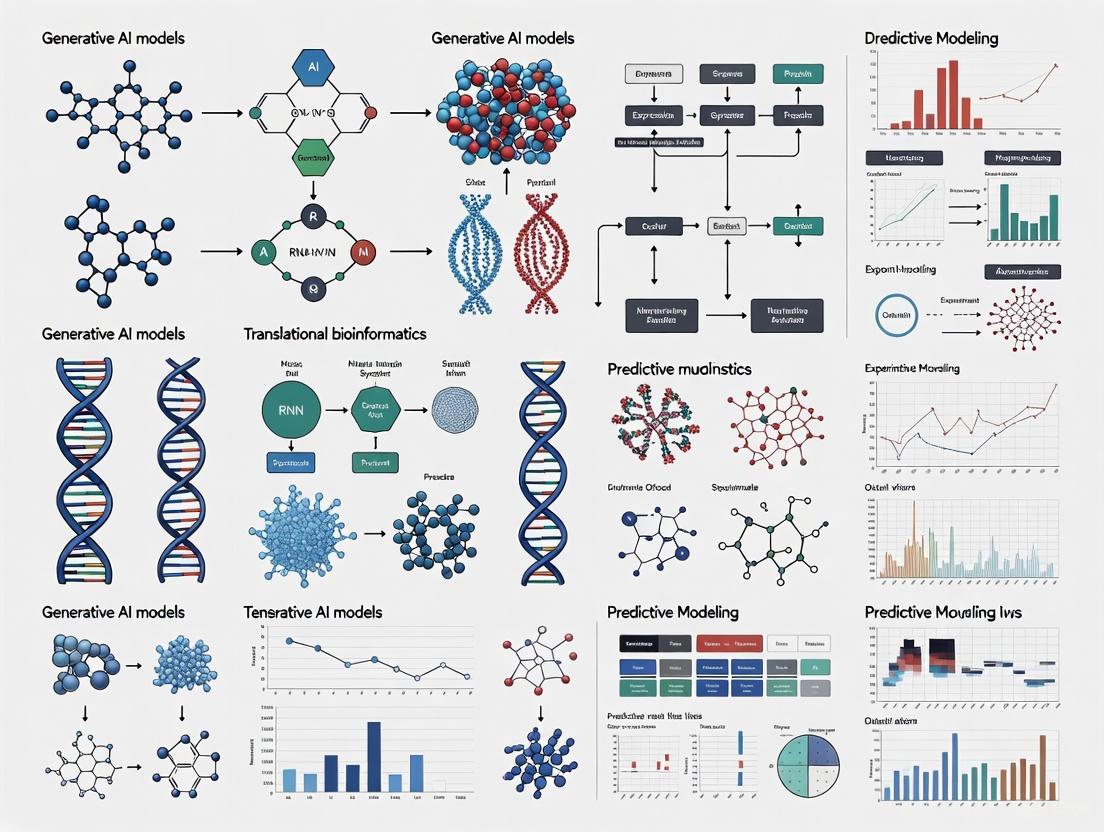
Generative artificial intelligence (GenAI) is fundamentally reshaping translational bioinformatics, enabling unprecedented capabilities from molecular design to clinical decision support.
Generative AI in Translational Bioinformatics: From Foundational Models to Clinical Applications
Abstract
Generative artificial intelligence (GenAI) is fundamentally reshaping translational bioinformatics, enabling unprecedented capabilities from molecular design to clinical decision support. This article provides a comprehensive analysis for researchers and drug development professionals, exploring the foundational models powering this revolution, including specialized architectures like AlphaFold, ESM, and ProtGPT2. We detail methodological applications in drug discovery, protein design, and multi-omics integration, while critically examining optimization strategies and persistent challenges in data quality, model interpretability, and biological integration. Through systematic validation and comparative performance analysis across clinical and molecular tasks, we assess the current landscape and future trajectory of GenAI in bridging computational discovery with clinical implementation for precision medicine.
The Generative AI Revolution in Bioinformatics: Core Concepts and Transformative Potential
Generative artificial intelligence (GenAI) has emerged as a transformative force in computational biology, fundamentally reshaping how researchers model, interpret, and engineer biological systems. Unlike traditional analytical AI that primarily classifies or predicts, GenAI creates novel biological sequences, structures, and systems that exhibit functional properties. This paradigm shift is accelerating the transition from observational biology to engineering biology, where researchers can design biological components with desired characteristics rather than merely analyzing existing ones.
The field has evolved from applying general-purpose large language models (LLMs) to developing sophisticated domain-specific architectures that incorporate deep biological knowledge. These specialized models leverage the symbolic nature of biological data—where DNA, RNA, and proteins can be represented as sequences in a four-letter (nucleotides) or twenty-letter (amino acids) alphabet—while accounting for structural, evolutionary, and functional constraints. This technical guide examines the core architectures, methodologies, and applications defining GenAI in biology, with particular emphasis on their role in translational bioinformatics research aimed at bridging basic science with therapeutic development.
Core GenAI Architectures in Biology
Biological Sequence Modeling with LLMs
Biological sequences represent a natural application domain for language model architectures, where nucleotides or amino acids substitute for tokens in linguistic models. The foundational innovation lies in treating biological sequences as texts written in "the language of life," enabling the application of transformer architectures that have revolutionized natural language processing.
Architectural Fundamentals: Biological LLMs employ encoder-only (e.g., BERT-like), decoder-only (e.g., GPT-like), or encoder-decoder transformer architectures pretrained on massive corpora of biological sequences using self-supervised objectives [1]. Key architectural adaptations include:
- Specialized Tokenization: Byte-pair encoding (BPE) and specialized biological tokenizers that handle biological sequence peculiarities, such as preserving reading frames and structural motifs [1].
- Long-Range Context Modeling: Enhanced attention mechanisms or hybrid architectures like HyenaDNA that handle extremely long biological sequences (up to 1 million nucleotides) while maintaining single-nucleotide resolution [1].
- Bidirectional Context Encoding: Models that capture evolutionary constraints by learning from multiple sequence alignments, enabling co-evolutionary signal extraction [1].
Representative Models: Evo represents a milestone in biological LLMs, trained on virtually all known living species—from bacteria to humans—totaling nearly 9 trillion nucleotides [2]. Its architecture enables generative tasks such as autocompleting gene sequences and engineering functional improvements, effectively "speeding up evolution" by steering mutations toward useful functions [2]. DNABERT and Nucleotide Transformer exemplify DNA-specific LLMs, while ProtBERT and ProtGPT2 demonstrate analogous capabilities for protein sequences [1] [3].
Domain-Specific Generative Architectures
While adapted LLMs provide powerful sequence modeling capabilities, truly domain-specific architectures incorporate deeper biological priors and structural constraints specialized for particular data types and tasks.
Structure-Aware Protein Models: Models like BoltzGen unify protein structure prediction and design through geometric deep learning architectures that respect rotational and translational symmetries [4]. These models generate novel protein binders for therapeutic targets by emulating physical constraints learned from structural biology data, ensuring generated structures obey fundamental biophysical laws [4].
Pathway-Guided Interpretable Architectures: Pathway-Guided Interpretable Deep Learning Architectures (PGI-DLA) represent a significant advancement for integrating prior biological knowledge directly into model structure [5]. These architectures use established pathway databases (KEGG, GO, Reactome, MSigDB) as blueprints for structuring neural network connectivity, ensuring model decisions align with known biological mechanisms [5]. This approach enhances interpretability while maintaining performance on complex prediction tasks across genomics, transcriptomics, and multi-omics integration.
Single-Cell Generative Models: Specialized architectures like scGPT and single-cell variational autoencoders (scVAEs) model the complex distributions of single-cell omics data, enabling generation of realistic single-cell profiles and perturbation responses [1] [3]. These models capture cell-type-specific expression patterns and can simulate cellular responses to genetic or chemical interventions.
Table 1: Comparative Analysis of Core Generative Architectures in Biology
| Architecture Type | Representative Models | Primary Biological Data | Key Capabilities | Limitations |
|---|---|---|---|---|
| Adapted Biological LLMs | Evo, DNABERT, ProtGPT2 | DNA, RNA, protein sequences | Generative sequence design, function prediction, variant effect prediction | Limited structural awareness, may generate physically implausible structures |
| Structure-Aware Models | BoltzGen, RFdiffusion | Protein structures, molecular complexes | De novo protein design, binder generation, structure prediction | Computationally intensive, requires structural data for training |
| Pathway-Guided Models | DCell, P-NET, PASNet | Multi-omics data, clinical features | Interpretable prediction, mechanism-based learning, therapeutic insight | Constrained by existing knowledge, may miss novel biology |
| Single-Cell Models | scGPT, scVAEs, CellDecoder | Single-cell RNA-seq, ATAC-seq | Cell-type specific generation, perturbation modeling, atlas-scale synthesis | Technical noise sensitivity, batch effect propagation |
Methodologies and Experimental Protocols
Training Strategies for Biological GenAI
Effective biological GenAI requires specialized training methodologies that address the distinctive characteristics of biological data and the constraints of biological systems.
Pretraining and Self-Supervised Learning: Biological LLMs typically employ self-supervised pretraining on large, unlabeled sequence corpora. Standard objectives include:
- Masked Language Modeling: Randomly masking tokens in sequences and training the model to predict them based on context [1].
- Causal Language Modeling: Training models to predict the next token in a sequence, enabling generative capabilities [1].
- Contrastive Learning: Aligning representations across modalities (e.g., sequence-structure pairs) through positive and negative example discrimination [3].
Multitask and Transfer Learning: After pretraining, models are fine-tuned on specific downstream tasks through additional supervised training. The Evo framework, for instance, demonstrates exceptional transfer learning capabilities, adapting from general sequence modeling to specialized tasks like pathogenicity prediction and functional protein design [2].
Knowledge-Guided Training: PGI-DLA architectures incorporate biological knowledge directly into the training process through structured loss functions and architectural constraints. These models use pathway topology to define neural connectivity patterns, ensuring information flow mirrors biological signaling cascades [5].
Validation and Experimental Protocols
Rigorous validation is essential for biological GenAI, requiring both computational and experimental assessment.
Computational Validation Metrics:
- Sequence-Based Metrics: Perplexity, sequence recovery rates, and evolutionary metrics like evolutionary index (Evo) for generated sequences [1].
- Structural Metrics: Root-mean-square deviation (RMSD), Template Modeling Score (TM-score), and protein-protein binding affinity (ΔG) for structural models [4].
- Functional Metrics: Enrichment scores, pathway activation scores, and phenotype prediction accuracy for functional assessments [5].
Experimental Validation Workflows: Generated biological entities must undergo rigorous experimental validation. The BoltzGen protocol exemplifies this approach:
- In Silico Generation: Design novel protein binders targeting specific disease-related proteins [4].
- Computational Filtration: Filter designs based on structural stability, binding affinity predictions, and novelty [4].
- DNA Synthesis and Cloning: Convert selected designs to DNA sequences, synthesize them, and clone into expression vectors [2].
- Protein Expression and Purification: Express proteins in cellular systems (e.g., E. coli) and purify them [2].
- Biophysical Characterization: Assess binding affinity (SPR, BLI), specificity, and structural integrity (CD, X-ray crystallography) [4].
- Functional Assays: Test therapeutic efficacy in cellular and animal models [4].
The following diagram illustrates this comprehensive validation workflow for generative protein design:
Diagram 1: Protein Design Validation Workflow (82 characters)
Key Applications in Translational Bioinformatics
Therapeutic Protein and Binder Design
Generative AI has dramatically accelerated the design of therapeutic proteins, particularly for targets previously considered "undruggable." BoltzGen exemplifies this capability, generating novel protein binders against 26 challenging therapeutic targets with experimental validation across eight independent wet labs [4]. The model's constrained generation ensures physical plausibility while exploring novel sequence spaces not accessible through natural evolution alone.
Methodology: BoltzGen employs a unified architecture that combines structure prediction and design tasks, enabling it to learn generalizable physical patterns across diverse protein families [4]. During generation, the model samples from the Boltzmann distribution of possible sequences conditioned on desired structural and functional constraints, effectively exploring the fitness landscape more efficiently than random mutation or directed evolution approaches.
Multi-Omics Data Integration and Translation
GenAI enables sophisticated integration and translation across biological modalities and experimental systems. The FDA's TranslAI initiative has developed models like TransTox that bidirectionally translate transcriptomic profiles between organs (e.g., liver and kidney) under drug treatment [6]. This capability addresses key challenges in regulatory science, including extrapolating findings across experimental models and platforms.
Architecture: TransTox employs a generative adversarial network (GAN) framework with cycle consistency constraints, learning bidirectional mappings between transcriptomic spaces while preserving toxicity mechanisms [6]. The model demonstrates robust performance across independent datasets, enabling prediction of multi-organ toxicity from single-organ data.
The following diagram illustrates this cross-domain translation approach:
Diagram 2: Cross-Organ Translation Model (65 characters)
Mutation Impact and Pathogenicity Prediction
GenAI models excel at distinguishing functional from deleterious genetic variations, a crucial capability for interpreting personal genomes and identifying disease drivers. Evo demonstrates strong performance in pathogenicity prediction by learning evolutionary constraints across billions of years of evolution [2]. The model identifies non-neutral mutations that disrupt evolved protein functions, enabling prioritization of disease-causing variants from sequencing studies.
Mechanism: These models learn evolutionary conservation patterns and structural constraints from multiple sequence alignments, enabling them to identify positions where variation is poorly tolerated and predict the functional consequences of specific mutations [2].
Single-Cell Analysis and Atlas Generation
Generative models enable the creation of comprehensive single-cell atlases and the simulation of cellular responses to perturbations. Models like scGPT leverage transformer architectures to model single-cell omics data, generating realistic cell-type profiles and predicting disease states [1]. These models support multiple analytical tasks, including cell-type annotation, batch correction, and perturbation response prediction.
The Scientist's Toolkit: Essential Research Reagents
Table 2: Key Research Reagents and Resources for Biological GenAI
| Resource Category | Specific Resources | Primary Function | Relevance to GenAI |
|---|---|---|---|
| Sequence Databases | UniProtKB, GenBank, RefSeq | Provide protein and nucleotide sequences for training | Foundational training data for biological LLMs |
| Structure Databases | Protein Data Bank (PDB), AlphaFold DB | Protein and molecular structures | Training structure-aware models, validation of generated structures |
| Pathway Databases | KEGG, Reactome, GO, MSigDB | Curated biological pathways and gene sets | Constructing knowledge-guided architectures (PGI-DLA) |
| Single-Cell Resources | CELLxGENE, Human Cell Atlas | Single-cell omics datasets | Training single-cell generative models, benchmark validation |
| Experimental Validation Tools | CRISPR systems, gene synthesis services | Biological validation of generated sequences | Essential for wet-lab confirmation of AI-generated designs |
| Specialized Software | PyTorch, TensorFlow, JAX | Deep learning frameworks | Implementing and training generative architectures |
| Model Archives | Hugging Face, ModelHub | Pretrained model repositories | Access to fine-tunable biological foundation models |
Implementation Considerations and Future Directions
Technical and Ethical Considerations
Deploying GenAI in biological research requires addressing several technical and ethical challenges:
Data Quality and Bias: Biological training data exhibits substantial biases in species representation, protein families, and experimental conditions [3]. These biases propagate through models, limiting generalizability and potentially disadvantaging understudied organisms or human populations.
Interpretability and Trust: The black-box nature of complex GenAI models raises concerns for clinical and biological applications. PGI-DLA architectures represent a promising approach for enhancing interpretability by grounding predictions in known biological mechanisms [5].
Safety and Security: Powerful generative capabilities raise dual-use concerns, particularly for pathogen engineering. Responsible development requires careful consideration of access controls and ethical guidelines, exemplified by the Evo team's exclusion of viral genomes from training data [2].
Emerging Trends and Future Outlook
The field of biological GenAI is rapidly evolving toward more integrated, multi-scale modeling approaches:
Multimodal Foundation Models: Next-generation models are incorporating diverse data types—including sequences, structures, images, and text—within unified architectures [3]. These models capture richer biological context and enable more sophisticated reasoning across biological scales.
Agentic AI Systems: Emerging frameworks deploy generative models as autonomous agents that can design experiments, interpret results, and formulate new hypotheses [1]. These systems promise to accelerate the iterative cycle of biological discovery.
Personalized Therapeutic Design: The integration of GenAI with patient-specific data is enabling design of personalized therapies, from neoantigen vaccines to customized gene therapies [7]. These approaches leverage generative design to create patient-specific therapeutic molecules.
As biological GenAI continues to mature, it promises to transform translational bioinformatics from a predominantly analytical discipline to a generative engineering paradigm, enabling the systematic design of biological solutions to address pressing challenges in human health and disease.
Generative artificial intelligence (GenAI) has emerged as a transformative paradigm in bioinformatics and computational biology, enabling the algorithmic exploration and construction of complex molecular and biological spaces through data-driven modeling [8] [7]. These models have revolutionized traditional approaches to drug discovery, protein design, and medical image analysis by providing powerful tools to generate novel, functionally relevant biological data and structures. The field has witnessed rapid evolution from early proof-of-concept demonstrations to practical tools that now augment radiology, dermatology, genetics, and drug discovery [9]. Among the diverse landscape of generative architectures, four key model families have demonstrated particular significance in biological applications: Variational Autoencoders (VAEs), Generative Adversarial Networks (GANs), Transformers, and Diffusion Models. Each offers unique advantages and faces distinct challenges when applied to biological data, which exhibits unique characteristics including high dimensionality, structural complexity, and often limited availability due to privacy concerns or experimental costs [9] [10]. This review provides a comprehensive technical analysis of these core generative architectures, their theoretical foundations, and their transformative applications across translational bioinformatics research.
Foundational Architectures and Principles
Variational Autoencoders (VAEs)
VAEs are generative neural networks that learn to encode input data into a lower-dimensional latent space and decode it back to the original data space by sampling latents, while ensuring the latent representations follow a known probability distribution [11] [12]. As a latent-variable model with an intractable posterior distribution, VAEs approximate the posterior using variational inference, optimizing a lower bound on the likelihood [11]. The encoder maps high-dimensional input data into a low-dimensional representation by predicting mean and standard deviation vectors, while the decoder attempts to reconstruct the original input data from this representation [13].
Key advantages of VAEs include their principled probabilistic modeling, which enables the generation of diverse samples and provides a relatively stable training process [10]. They employ a quantitative approach to managing uncertainty through probability distributions and comparison scores, making them valuable when training data is limited or low quality [12]. This capability is particularly useful in biological contexts where datasets are often small or contain significant variability, such as with medical images or chemical structures of drug molecules [12] [14].
However, VAEs face challenges in generating high-fidelity samples, often producing blurred outputs [13]. This limitation stems from two primary factors: first, when two inputs have overlapping latent code distributions, the optimal decoding becomes their average; second, the pixel-based reconstruction loss combined with a compressed latent space induces the model to predict averaged solutions rather than capturing fine-grained details [13]. Despite these limitations in sample quality, VAEs remain valuable for biological applications requiring diverse sample generation and stable training, including molecular design and representation learning [10] [14].
Generative Adversarial Networks (GANs)
GANs operate on an adversarial principle, consisting of two neural networks—a generator and a discriminator—that engage in a two-player minimax game [13]. The generator creates synthetic samples from random noise, while the discriminator distinguishes between real and generated samples [12] [13]. Through iterative training, the generator learns to produce increasingly realistic outputs that can fool the discriminator, while the discriminator becomes more adept at identifying synthetic samples [12].
GANs excel at producing high-fidelity, visually realistic samples, making them particularly suitable for applications requiring photorealistic output [13] [15]. Their adversarial training process, without explicit pixel-based reconstruction losses, allows them to capture fine-grained details that VAEs often miss [13]. In biological contexts, this capability has been leveraged for generating high-resolution medical images and creating realistic synthetic biological structures [9].
Significant challenges persist with GANs, including training instability, mode collapse (where the generator produces limited diversity), and difficulties in determining convergence [13] [15]. The adversarial training process requires maintaining a delicate balance between generator and discriminator, often necessitating careful tuning and monitoring [10] [13]. Additionally, GANs typically require substantial computational resources and training time to achieve optimal performance [12].
Transformers
Originally developed for natural language processing, Transformers have become foundational architectures across multiple domains, including biology [14]. Their core innovation is the self-attention mechanism, which allows the model to weigh the importance of different elements in a sequence when processing each element [12]. Input data is first broken into tokens (e.g., words in text or residues in protein sequences), and the model calculates the importance of relationships between all tokens in a sequence [12].
Transformers excel at interpreting context and identifying long-range dependencies, making connections between data points that might not be otherwise obvious [12]. This capability is particularly valuable in biological sequences where distant elements may interact functionally, such as in protein folding or genomic regulation [8]. Their parallelizable architecture also enables reduced training time compared to sequential models like RNNs [14].
Key limitations of Transformers include their requirement for large datasets for effective training, high computational demands during both training and inference, and low model explainability [12]. The self-attention mechanism has quadratic complexity with respect to sequence length, making processing of very long biological sequences computationally challenging without specialized adaptations [14].
Diffusion Models
Diffusion models represent a breakthrough in generative modeling, leveraging principles from non-equilibrium thermodynamics to generate data through a progressive denoising process [16] [10]. These models operate through two fundamental processes: a forward diffusion process that gradually adds Gaussian noise to data until it becomes completely corrupted, and a reverse diffusion process that learns to iteratively denoise the data to recover the original structure [16] [13].
The forward process is a fixed Markov chain that gradually perturbs data according to a variance schedule. Formally, given a data point (x0) from the true data distribution, the forward process produces increasingly noisy versions (x1, x2, ..., xT) through the equation: [xt = \sqrt{1 - \betat} x{t-1} + \sqrt{\betat} \cdot \epsilont] where (\betat) is the variance schedule at time step (t), and (\epsilon_t) is noise sampled from a standard normal distribution [10].
The reverse process is parameterized by a neural network that learns to predict the noise component at each step, progressively transforming pure noise into a coherent sample from the target distribution [16] [13]. The training objective can be simplified to: [\mathcal{L}{DM} = \mathbb{E}{x,\epsilon \sim \mathcal{N}(0,1),t}[\| \epsilon - \epsilon\theta(xt,t) \|_2^2]] where (t) is uniformly sampled from ({1, \ldots,T}) [10].
Diffusion models excel at generating both high-fidelity and high-diversity samples, effectively avoiding the mode collapse issues that plague GANs [10] [13]. Their iterative refinement process allows them to first establish coarse structure before adding fine details, resulting in outputs that often surpass GANs in challenging image synthesis tasks [16] [10]. In biological domains, this capability has proven valuable for generating realistic medical images, designing novel protein structures, and creating diverse molecular libraries [16] [8].
The primary drawback of diffusion models is their computational expense and slow generation speed, as they require multiple iterations (often hundreds or thousands) of neural network evaluations to produce a single sample [13] [15]. However, recent advancements such as Denoising Diffusion Implicit Models (DDIMs) and Consistency Models have addressed this limitation by enabling faster generation with fewer steps while maintaining quality [10].
Biological Applications and Experimental Protocols
Molecular Design and Drug Discovery
Generative models have revolutionized molecular design by enabling exploration of vast chemical spaces to identify compounds with desired properties [8] [14]. VAEs have been widely applied for molecular generation, typically using SMILES or SELFIES representations, where the encoder embeds molecular structures into a continuous latent space, and the decoder generates novel valid structures through sampling and decoding [14]. The training objective combines reconstruction loss with a regularization term that encourages the latent space to follow a prior distribution (typically Gaussian). GANs have been employed for molecular generation through adversarial training, where the generator produces molecular representations that are evaluated by a discriminator against real molecular datasets [14]. These models can be further refined using reinforcement learning to optimize specific pharmacological properties. Diffusion models have demonstrated state-of-the-art performance in molecular generation, particularly for designing 3D molecular structures with specific binding properties [16] [8]. These models operate by diffusing molecular coordinates into noise and learning the reverse process to generate geometrically plausible structures, often incorporating equivariant neural networks to respect rotational and translational symmetries [16].
Table 1: Molecular Design Applications of Generative Models
| Model Type | Application Examples | Key Advantages | Limitations |
|---|---|---|---|
| VAEs | Deep VAEs, InfoVAEs, GraphVAEs for molecular generation [14] | Stable training, diverse output, smooth latent space for interpolation | May generate invalid structures, blurry outputs in structure space |
| GANs | GANs with reinforcement learning for property optimization [14] | High-quality samples, fine-grained property control | Training instability, mode collapse in chemical space |
| Transformers | SMILES-based molecular generation, protein sequence design [8] [14] | Captures long-range dependencies in sequences, flexible architecture | Limited explicit 3D structure modeling, large data requirements |
| Diffusion Models | 3D molecule generation, protein-ligand complex design [16] [8] | State-of-the-art performance, explicit 3D geometry modeling | Computational intensity, slower generation speed |
Protein Engineering and Design
Protein engineering has emerged as a premier application for generative AI, with Diffusion Models particularly excelling in this domain [16] [8]. Models such as RFdiffusion and FrameDiff have demonstrated remarkable capabilities in de novo protein design by diffusing and denoising protein backbone coordinates [8]. These approaches typically employ SE(3)-equivariant architectures that respect the geometric symmetries of protein structures, ensuring that generated proteins are physically plausible [16]. The experimental protocol involves training on large datasets of protein structures (e.g., from the Protein Data Bank), with the diffusion process applied to atomic coordinates or internal degrees of freedom like torsion angles [16]. VAEs have been applied to protein sequence and structure generation, learning compressed representations of protein space that enable exploration of novel variants [14]. Transformers have revolutionized protein sequence design by treating amino acid sequences as textual data and leveraging self-attention to capture long-range interactions critical for folding and function [8] [14].
Medical Imaging and Analysis
Generative models have transformed medical imaging applications, including data augmentation, reconstruction, and synthesis [9] [10]. GANs have been extensively applied to generate synthetic medical images for data augmentation, addressing class imbalance in rare diseases [9]. For example, StyleGAN2 has been used to synthesize realistic dermatological images for melanoma detection and colorectal polyp images for segmentation model training [9]. The typical experimental protocol involves training on limited medical image datasets, with qualitative evaluation by domain experts and quantitative assessment using metrics like FID to ensure synthetic images match the distribution of real data [9]. Diffusion Models have demonstrated superior performance in medical image generation and reconstruction tasks, including MRI and PET image reconstruction, super-resolution, and denoising [10]. These models have been applied to generate high-quality synthetic medical images while preserving diagnostic relevance, though challenges remain in ensuring scientific accuracy and avoiding hallucinations of non-existent pathologies [11] [9]. VAEs have been utilized for medical image analysis through their ability to learn compact representations of normal anatomical variation, enabling anomaly detection for disease diagnosis [10].
Table 2: Medical Imaging Applications of Generative Models
| Model Type | Application Examples | Performance Characteristics | Domain-Specific Challenges |
|---|---|---|---|
| VAEs | Medical image anomaly detection, representation learning [10] | Stable training, interpretable latent spaces | Blurry reconstructions may lack diagnostic utility |
| GANs | Synthetic dermatology images, CT/MRI augmentation [9] | High visual fidelity, realistic texture generation | May overlook rare pathologies, potential artifacts |
| Diffusion Models | MRI reconstruction, PET denoising, X-ray synthesis [10] | High diversity and fidelity, state-of-the-art quantitative metrics | Computational demands, may hallucinate features |
| Transformers | Medical image classification, report generation [9] | Captures long-range dependencies in images | Large data requirements, limited spatial reasoning |
Biological Sequence Analysis
Transformers have become the dominant architecture for biological sequence analysis, applying the self-attention mechanism to DNA, RNA, and protein sequences [14]. These models process biological sequences as tokens, learning representations that capture evolutionary patterns, structural constraints, and functional determinants [8]. Pretrained on large-scale sequence databases, transformer models can be fine-tuned for specific tasks such as protein function prediction, subcellular localization, and variant effect prediction [8] [14]. Diffusion Models have been applied to biological sequence generation and design, particularly for generating functional protein sequences conditioned on desired properties or structural constraints [16]. These approaches often combine sequence-based diffusion with structural information to ensure generated sequences fold into stable, functional proteins [16].
Comparative Analysis and Performance Metrics
Theoretical and Practical Trade-offs
Each generative architecture presents distinct theoretical foundations and practical considerations that influence their suitability for biological applications. The table below provides a comprehensive comparison across multiple dimensions relevant to bioinformatics research.
Table 3: Comparative Analysis of Generative Model Architectures in Biological Applications
| Characteristic | VAEs | GANs | Transformers | Diffusion Models |
|---|---|---|---|---|
| Theoretical Foundation | Variational inference, maximum likelihood estimation [13] | Adversarial training, game theory [13] | Self-attention, autoregressive modeling [12] | Non-equilibrium thermodynamics, score matching [16] [10] |
| Training Stability | High - single tractable loss [13] | Low - requires careful balancing [13] | Moderate - stable with proper initialization | High - stable training with fixed targets [10] |
| Sample Quality | Moderate - often blurry [13] | High - sharp, realistic samples [13] | Variable - depends on task and data | Very high - state-of-the-art in many domains [16] [10] |
| Sample Diversity | High - covers data distribution [13] | Low - prone to mode collapse [13] | High - captures multimodal distributions | Very high - excellent mode coverage [10] |
| Generation Speed | Fast - single forward pass [13] | Fast - single forward pass [13] | Variable - autoregressive sampling can be slow | Slow - multiple iterations required [13] |
| Data Efficiency | Moderate - works with limited data [12] | Low - requires substantial data | Very low - requires massive datasets [12] | Low - benefits from large datasets [12] |
| Interpretability | Moderate - interpretable latent space | Low - black-box models | Low - attention weights provide limited insight | Moderate - progressive refinement visible |
| Biological Applications Strength | Molecular representation, anomaly detection [14] | Medical image synthesis, data augmentation [9] | Protein language modeling, sequence design [14] | Protein structure design, molecule generation [16] [8] |
Domain-Specific Performance Considerations
In biological applications, standard quantitative metrics often fail to capture scientific relevance, underscoring the need for domain-expert validation alongside computational metrics [11]. For medical imaging applications, metrics such as Fréchet Inception Distance (FID), Structural Similarity Index (SSIM), and domain-specific quality assessments by clinicians are essential for evaluating diagnostic utility [11] [9]. In molecular design, critical metrics include validity (chemical correctness for small molecules, structural plausibility for proteins), novelty (unprecedented structures), and diversity (coverage of chemical or structural space) [14]. Additionally, functional metrics such as target binding affinity, synthetic accessibility, and drug-likeness (QED) are crucial for assessing practical utility [14].
Experimental Protocols and Methodologies
Protocol for Molecular Generation with Diffusion Models
Diffusion models have demonstrated state-of-the-art performance in 3D molecular generation, particularly for designing molecules with specific binding properties [16] [8]. The following protocol outlines the key steps for implementing molecular diffusion models:
Data Preparation: Curate a dataset of 3D molecular structures from databases such as PDB (for proteins) or small molecule databases. Preprocess structures to ensure consistent representation of atomic coordinates and features.
Forward Process Definition: Establish a variance schedule (\betat) that determines the amount of noise added at each diffusion step. The forward process progressively adds Gaussian noise to molecular coordinates according to: (xt = \sqrt{1 - \betat} x{t-1} + \sqrt{\betat} \cdot \epsilont) [10].
Network Architecture Selection: Implement an equivariant neural network (e.g., SE(3)-Transformer) that respects the geometric symmetries of molecular structures [16]. The network should take noisy molecular coordinates and timestep embeddings as input and predict the noise component.
Training Procedure: Train the model to minimize the denoising objective: (\mathcal{L}{DM} = \mathbb{E}{x,\epsilon \sim \mathcal{N}(0,1),t}[\| \epsilon - \epsilon\theta(xt,t) \|_2^2]) [10]. Use standard deep learning optimizers (e.g., Adam) with appropriate learning rate schedules.
Sampling and Generation: To generate novel molecules, begin with random noise and iteratively apply the learned reverse process. Condition the generation on specific properties (e.g., binding pocket constraints) by incorporating guidance during the sampling process.
Validation and Analysis: Evaluate generated molecules using computational metrics (validity, novelty, diversity) and physical validation (molecular dynamics simulations, docking studies) [8].
Protocol for Medical Image Synthesis with GANs
GANs have been widely applied to generate synthetic medical images for data augmentation in scenarios with limited or imbalanced datasets [9]:
Data Preprocessing: Curate a dataset of medical images with expert annotations. Apply appropriate preprocessing including normalization, resizing, and data augmentation using traditional techniques.
Model Selection: Choose a GAN architecture appropriate for the imaging modality and resolution. StyleGAN-based architectures have demonstrated strong performance for dermatological images, while conditional GANs enable class-specific generation [9].
Training Strategy: Implement progressive training techniques if generating high-resolution images. Employ training stabilization methods such as gradient penalty, spectral normalization, or Wasserstein loss to mitigate mode collapse.
Evaluation Framework: Combine quantitative metrics (FID, SSIM) with qualitative assessment by domain experts. Ensure synthetic images preserve diagnostically relevant features without introducing artifacts.
Downstream Validation: Train diagnostic models on datasets augmented with synthetic images and evaluate performance on held-out real patient data to assess utility in clinical workflows [9].
Essential Research Reagents and Computational Tools
Table 4: Essential Research Reagents and Computational Tools for Generative Biology
| Resource Category | Specific Tools/Resources | Function and Application |
|---|---|---|
| Molecular Datasets | PDB, PubChem, ChEMBL [16] [14] | Source of 3D protein structures and small molecules for training generative models |
| Medical Imaging Datasets | SIIM-ISIC Melanoma Classification Dataset, ChestX-ray14 [9] | Curated medical image datasets for training and validating generative models |
| Representation Libraries | SMILES, SELFIES, Graph Representations [14] | Molecular representations enabling effective application of generative models |
| Software Frameworks | PyTorch, TensorFlow, JAX [16] | Deep learning frameworks for implementing and training generative models |
| Specialized Libraries | RDKit, OpenMM, BioPython [14] | Domain-specific libraries for molecular manipulation, simulation, and analysis |
| Evaluation Metrics | FID, SSIM, Validity/Novelty/Diversity [11] [14] | Quantitative metrics for assessing generated samples in scientific contexts |
| Validation Tools | Molecular docking, MD simulations, Clinical evaluation [8] [14] | Methods for validating functional properties of generated biological structures |
Architectural Diagrams and Workflows
Diffusion Model Architecture for Protein Design
Comparative Workflow: Generative Models in Drug Discovery
GAN Architecture for Medical Image Synthesis
Generative AI models have fundamentally transformed the landscape of biological research and drug development, with each architecture offering distinct advantages for specific applications. VAEs provide stable training and diverse sample generation, making them suitable for molecular representation learning and anomaly detection. GANs excel in producing high-fidelity synthetic data, particularly for medical image augmentation. Transformers capture complex long-range dependencies in biological sequences, enabling sophisticated protein language modeling. Diffusion models represent the current state-of-the-art in 3D structure generation, combining high fidelity with excellent mode coverage.
The future of generative AI in biology points toward hybrid models that combine the strengths of multiple architectures, improved sampling efficiency through techniques like distillation, and greater integration with biophysical simulations for enhanced validation [10] [14]. As these technologies mature, they promise to accelerate the transformation of biomedical research from reactive treatment to predictive, personalized, and preventive models of healthcare [7]. However, realizing this potential will require addressing persistent challenges including data quality limitations, model interpretability, and the development of robust validation frameworks that ensure scientific relevance alongside statistical performance [11] [9]. The convergence of generative AI with automated experimentation and quantum computing suggests a future where autonomous molecular design ecosystems dramatically accelerate the translation of computational discoveries to clinical applications [8] [7].
Generative Artificial Intelligence (GenAI) is fundamentally reshaping translational bioinformatics by providing powerful new capacities to decipher complex biological systems. A core strength of these models lies in their unparalleled ability to identify subtle, non-linear patterns within noisy, high-dimensional omics datasets—a task that often eludes traditional computational methods. This whitepaper details the technical mechanisms that enable this capability, showcasing through quantitative benchmarks and detailed experimental protocols how GenAI models drive advancements in genomics, proteomics, and drug discovery. By functioning as a predictive and generative engine, GenAI is accelerating the transition of biomedical research from descriptive observation to actionable, predictive science.
The advent of high-throughput sequencing and other omics technologies has unleashed a torrent of biological data, with genomic data alone projected to reach 40 exabytes by 2025 [17]. This data is characterized by its overwhelming volume, high-dimensionality (featuring thousands to millions of variables per sample), and inherent noise from both biological and technical sources. Traditional bioinformatics tools, often based on linear statistical models or manual feature engineering, struggle to distill meaningful biological signals from this complexity.
GenAI models, particularly deep learning and transformer-based architectures, are uniquely suited to this challenge. Their strength is not merely in scaling with data size, but in their fundamental ability to learn complex, hierarchical representations directly from raw sequence or structural data without relying on pre-defined features [3]. They excel at capturing the contextual relationships between biological elements—for instance, how a distant mutation might influence a gene's expression—and can generate novel, functional biological hypotheses and sequences. This capability is marking a milestone in biology, moving the field from a descriptive to a more predictive and engineering-focused discipline [2] [18].
Core Technical Capabilities in Pattern Recognition
The proficiency of GenAI in managing omics data stems from several interconnected technical strengths.
Contextual Learning and Representation
Unlike traditional models that treat data points as independent, GenAI models, especially transformers, use self-attention mechanisms to weigh the importance of all elements in a sequence. When applied to a DNA sequence, this allows the model to understand the functional context of a nucleotide based on its interactions with others, even those millions of base pairs away, as enabled by long context windows [2]. This is critical for identifying the impact of non-coding variants in regulatory regions.
Robustness to Data Noise and Sparsity
Biological data is inherently stochastic and noisy. GenAI models are trained to be robust to this noise, learning to separate true signal from background variation. For example, models like Google's DeepVariant recast variant calling as an image classification problem, using a deep neural network to distinguish true genetic variants from sequencing errors with high precision, a task prone to error with earlier methods [17]. Furthermore, generative models like Variational Autoencoders (VAEs) can be used for imputation, inferring missing values in sparse single-cell RNA-seq datasets to create a more complete picture of cellular states [19].
Multi-Modal Data Integration
Complex biological phenomena arise from interactions across genomic, transcriptomic, proteomic, and clinical domains. GenAI enables mosaic and vertical integration of these disparate data types, embedding them into a common latent space to uncover emergent relationships [20]. For instance, integrating whole genome sequencing with transcriptomics and proteomics was key to teasing apart the molecular pathway governing litter size in Tibetan sheep [20]. This multi-modal integration provides a systems-level view that is greater than the sum of its parts.
Quantitative Performance Benchmarks
The impact of GenAI is substantiated by rigorous quantitative improvements across key bioinformatics tasks. The table below summarizes landmark achievements.
Table 1: Quantitative Benchmarks of GenAI Performance in Bioinformatics Tasks
| Domain | Task | GenAI Model / Tool | Key Performance Metric | Result |
|---|---|---|---|---|
| Proteomics | Protein Structure Prediction | AlphaFold (CASP14) | Median Accuracy (Å) | 0.96 Å [21] |
| Proteomics | Protein Design | State-of-the-Art Models | Design Success Rate | Up to 92% [21] |
| Genomics | Variant Calling | NVIDIA Parabricks | Acceleration Factor | Up to 80x faster [17] |
| Clinical Diagnostics | Cancer Detection | AI Models (AUC) | Area Under Curve (AUC) | 0.93 [21] |
| Single-Cell Analysis | Cellular Modeling | Single-Cell AI Models | AvgBIO Score | 0.82 [21] |
These metrics demonstrate a consistent trend: GenAI is not only accelerating computational workflows by orders of magnitude but also achieving new heights of predictive accuracy that were previously unattainable.
Detailed Experimental Protocols
To illustrate how these capabilities are applied in practice, we outline two key experimental methodologies cited in the literature.
Protocol 1: GenAI-Driven Functional Genomics with Evo 2
Objective: To identify disease-causing genetic mutations and design novel functional genetic sequences [2].
Workflow:
- Model Prompting: Input a partial gene sequence (up to 1 million nucleotides) into the Evo 2 model.
- Sequence Generation & Completion: The model, pre-trained on nearly 9 trillion nucleotides from all domains of life, autocompletes the sequence. It can generate sequences that either match known natural variants or propose novel, "improved" sequences not seen in evolution.
- In-silico Validation: The generated sequence is analyzed by integrated machine learning models to predict its function and check for similarity to natural sequences.
- Experimental Validation (Wet-Lab): a. DNA Synthesis: The top candidate sequences are chemically synthesized. b. Cell Transfection: The synthesized DNA is inserted into living cells using gene-editing technologies like CRISPR. c. Phenotypic Assay: The cells are tested for changes in function, protein expression, or other relevant phenotypes to confirm the model's predictions.
Protocol 2: Single-Cell and Multi-Omic Analysis of Alzheimer's Disease
Objective: To unravel the genetic and immune landscape of Alzheimer's Disease (AD) by integrating GenAI, bioinformatics, and single-cell analysis [22].
Workflow:
- Gene Set Curation: Use multiple GenAI models (e.g., GPT-4o, Gemini) to identify and characterize a comprehensive set of genes associated with AD.
- Integrative Bioinformatics Analysis: Subject the curated gene list to functional enrichment analysis to identify overrepresented pathways and biological processes.
- Single-Cell RNA Sequencing: a. Cell Isolation & Sequencing: Perform single-cell RNA-seq on tissue samples from AD patients and healthy controls. b. Cell Population Identification: Use clustering algorithms to identify distinct immune cell populations (e.g., T cells, macrophages) based on their gene expression profiles.
- Data Integration & Immune Landscape Mapping: Correlate the GenAI-derived genetic signatures with the single-cell data. This reveals cell-type-specific expression patterns of AD-risk genes and shifts in immune cell populations, such as an increase in effector CD8+ T cells and a decrease in dendritic cells in AD patients.
Visualizing GenAI Workflows in Translational Bioinformatics
The following diagrams, generated with Graphviz DOT language, illustrate the logical flow of the key experimental protocols and data integration strategies described in this whitepaper.
GenAI-Driven Gene Discovery and Validation
Multi-Modal Data Integration for Disease Mapping
The Scientist's Toolkit: Essential Research Reagents & Materials
The application of GenAI in translational research relies on a ecosystem of computational and experimental resources. The following table details key reagents and tools.
Table 2: Essential Research Reagents and Solutions for GenAI-Driven Biology
| Category | Item / Resource | Function in Workflow |
|---|---|---|
| GenAI Models & Platforms | Evo 2 [2] | Generative model for predicting and designing DNA sequences across all life domains. |
| AlphaFold / AlphaFold 3 [17] [23] | Accurately predicts 3D protein structures and molecular interactions from sequence. | |
| DNABERT, Nucleotide Transformers [21] [3] | Domain-specific large language models pre-trained on genomic sequences for tasks like variant effect prediction. | |
| Computational Tools | NVIDIA Parabricks [17] | GPU-accelerated suite for genomic analysis, dramatically speeding up variant calling. |
| Google DeepVariant [17] | Deep learning-based tool for calling genetic variants from sequencing data with high accuracy. | |
| Experimental Reagents | CRISPR-Cas9 Systems [2] [17] | Gene-editing technology used to validate AI-generated DNA sequences in living cells. |
| Single-Cell RNA-Seq Kits (e.g., 10x Genomics) [22] | Enables profiling of gene expression at single-cell resolution for multi-omic analysis. | |
| DNA Oligo Synthesis Services [2] [18] | Chemical synthesis of AI-designed nucleotide sequences for experimental testing. | |
| Databases & Knowledge Bases | UniProtKB, ProteinNet [3] | Curated protein sequences and structures for model training and benchmarking. |
| CELLxGENE, GTEx [3] | Cellular atlases and gene expression resources for single-cell and tissue-specific analysis. | |
| PubMed, OMIM [3] | Textual and knowledge-based resources for grounding GenAI models in established literature. |
Generative AI has emerged as an indispensable technology for translational bioinformatics, with its capacity for sophisticated pattern recognition in noisy, high-dimensional data standing as its primary strength. By moving beyond the limitations of traditional models, GenAI enables a more nuanced, contextual, and predictive understanding of biological systems. As evidenced by rigorous benchmarks and detailed experimental protocols, these models are already accelerating the discovery of disease mechanisms, the design of novel therapeutic agents, and the development of personalized treatment strategies. The continued integration of GenAI into the research lifecycle, supported by the essential tools and reagents outlined, promises to further bridge the gap between computational prediction and clinical translation, ultimately ushering in a new era of precision medicine.
The field of bioinformatics is undergoing a profound transformation, driven by the advent of foundation models—large-scale artificial intelligence systems pretrained on extensive datasets that can be adapted to a wide range of downstream tasks [24]. These models have begun to decipher the complex language of biology, from protein sequences and structures to genomic information and cellular systems. The impact has been so significant that the 2024 Nobel Prize in Chemistry was awarded to Demis Hassabis and John Jumper of Google DeepMind for their work on AlphaFold, highlighting the revolutionary nature of these AI systems in scientific discovery [25]. This whitepaper provides an in-depth technical analysis of the current landscape of foundational models, focusing on their architectures, capabilities, and practical applications in translational bioinformatics research for drug development professionals and scientists.
Foundation models in bioinformatics address longstanding challenges in the field, including limited annotated data, data noise, and the complexity of biological systems [24]. Unlike traditional computational methods that required extensive customization for specific datasets, these models leverage self-supervised learning on massive-scale biological data, capturing fundamental patterns and relationships that transfer across diverse tasks [3]. The versatility of these models enables zero-shot, few-shot, and transfer learning scenarios, dramatically accelerating research workflows in areas ranging from protein design to drug discovery [3].
Core Model Architectures and Technical Specifications
Architectural Foundations and Evolutionary Trajectory
Foundation models in bioinformatics predominantly build upon transformer architectures, which utilize self-attention mechanisms to capture long-range dependencies and contextual relationships within biological sequences [24] [26]. The transformer's ability to weigh the importance of different parts of the input sequence has proven exceptionally valuable for biological data, where interactions between distant elements (e.g., amino acids in a protein or nucleotides in DNA) are critical for determining structure and function [27]. These models are typically trained in either a discriminative or generative manner: discriminative models like BERT-based architectures excel at classification and regression tasks by learning bidirectional context, while generative models like GPT-based architectures employ autoregressive methods to generate novel biological sequences [24].
The evolutionary trajectory of these models shows a clear progression from general-purpose architectures to specialized biological systems. Early models adapted successful NLP frameworks like BERT to biological domains, resulting in specialized variants such as BioBERT for biomedical text and DNABERT for genomic sequences [24]. The breakthrough AlphaFold 2 system utilized a transformer architecture trained on protein sequences and known structures, incorporating evolutionary information from multiple sequence alignments to achieve atomic-level accuracy in structure prediction [25] [27]. Subsequent models have continued to refine these architectures, with AlphaFold 3 expanding capabilities to predict protein-protein interactions and complexes with other biological molecules [25].
Comparative Analysis of Key Foundation Models
Table 1: Comparative Analysis of Major Foundation Models in Bioinformatics
| Model | Primary Architecture | Training Data | Key Capabilities | Limitations |
|---|---|---|---|---|
| AlphaFold 2/3 | Transformer-based | PDB structures, protein sequences [25] | Predicts 3D protein structures with atomic accuracy; in AF3, predicts protein-ligand interactions [25] [27] | Less accurate for multiple protein complexes; limited temporal dynamics [27] |
| ESM (Evolutionary Scale Modeling) | Transformer Encoder | UniProtKB (millions of protein sequences) [3] | Learns evolutionary patterns; predicts structure, function, and fitness effects of mutations [3] | Performance depends on evolutionary information in MSA |
| ProtGPT2 | GPT-2 Decoder Architecture | UniProtKB protein sequences [28] [3] | Generates novel, functional protein sequences; de novo protein design [28] | Generated sequences require experimental validation |
| ProGen | Conditional Transformer | 280M proteins across 19K families [28] | Generates functional protein sequences with controllable properties [28] | Commercial use restrictions |
| scBERT | BERT-like Encoder | Single-cell RNA-seq data (millions of cells) [29] | Cell type annotation; analysis of single-cell transcriptomics [29] | Requires deterministic gene ordering for tokenization |
Table 2: Performance Benchmarks and Real-World Impact
| Model | Key Performance Metrics | Real-World Applications | Accessibility |
|---|---|---|---|
| AlphaFold | Predicts ~36% of human proteins with high confidence; ~73% for E.coli [25] | Database of 200M+ predicted structures; used in sperm-egg interaction discovery [25] [27] | Free for academic research; restricted commercial use [25] |
| ProGen | Generated lysozymes with 31.4% sequence identity to natural proteins but similar function [28] | Design of novel functional enzymes; potential for therapeutic protein design [28] | Code and checkpoints publicly available [28] |
| ESM | State-of-the-art fitness prediction; outperforms traditional methods [3] | Prediction of mutation effects; protein engineering [3] | Open-source models available |
| OpenFold3 | Aims to match AlphaFold3 performance [30] | Open-source alternative for protein structure prediction | Fully open-source |
Experimental Protocols and Methodological Frameworks
Workflow for Protein Structure Prediction and Validation
The following Graphviz diagram illustrates the standard workflow for protein structure prediction using deep learning approaches, integrating both template-based and template-free methodologies:
Figure 1: Workflow for Protein Structure Prediction via Deep Learning
The experimental protocol for protein structure prediction begins with input preparation, where the target amino acid sequence is formatted and cleaned. For optimal results, researchers should generate a multiple sequence alignment (MSA) to capture evolutionary information, which forms critical input features for models like AlphaFold [26]. The subsequent steps involve:
- Feature Engineering: Compiling input features including the primary sequence, MSA-derived covariation data, and optional template structures when using template-based modeling approaches [26].
- Model Inference: Processing features through the deep learning model (typically transformer-based) to generate 3D atomic coordinates [26].
- Confidence Assessment: Evaluating prediction quality using model-provided confidence scores such as pLDDT (per-residue confidence) or PAE (predicted aligned error) for inter-residue confidence [25].
- Experimental Validation: For novel structures or those with low confidence scores, experimental validation using cryo-EM, X-ray crystallography, or other structural biology techniques remains essential [27].
Protocol for AI-Driven Protein Design
The following Graphviz diagram illustrates the iterative process of generative protein design, validation, and optimization:
Figure 2: AI-Driven Protein Design and Validation Workflow
The methodology for AI-driven protein design involves a recursive design-build-test cycle that integrates computational and experimental approaches. The key steps include:
- Property Specification: Clearly define target protein properties, such as catalytic activity, stability conditions, or binding specificity. For conditional models like ProGen, appropriate control tags are incorporated to guide the generation process [28].
- Sequence Generation: Utilize generative models (ProtGPT2, ProGen) to produce novel protein sequences. For ProtGPT2, this typically involves feeding a start token and sampling from the model's output distribution to generate complete sequences [28].
- In Silico Validation: Process generated sequences through structure prediction tools (AlphaFold, RoseTTAFold) to verify they fold into desired conformations. As John Jumper notes, "if AlphaFold confidently agrees with the structure you were trying to design then you make it and if AlphaFold says 'I don't know,' you don't make it. That alone was an enormous improvement" [27].
- Experimental Characterization: Express, purify, and characterize top candidates using functional assays. For enzyme designs, this involves measuring catalytic efficiency; for binding proteins, affinity measurements are essential [28].
This protocol was successfully implemented in the development of novel lysozymes using ProGen, where generated sequences with as low as 31.4% sequence identity to natural proteins demonstrated similar catalytic efficiencies, validating the approach [28].
Applications in Translational Bioinformatics and Drug Development
Revolutionizing Drug Discovery Pipelines
Foundation models are accelerating multiple stages of the drug discovery pipeline, from target identification to lead optimization. AlphaFold-predicted structures have been used to identify potential drug targets, as demonstrated by researchers who determined the structure of apoB100, a key protein in LDL cholesterol metabolism, paving the way for novel cardiovascular treatments [25]. In another breakthrough, scientists used AlphaFold to identify two existing FDA-approved drugs that could be repurposed for treating Chagas disease, potentially shortening the therapeutic development timeline significantly [25].
The application of these models extends to structure-based drug design, where accurate protein structures enable virtual screening of compound libraries. The enhanced accuracy of newer models is particularly valuable for this application, as noted by researchers at Genesis Molecular AI: "Small errors can be catastrophic for predicting how well a drug will actually bind to its target. It can go from 'They will never interact' to 'They will'" [27]. Companies like Isomorphic Labs (a DeepMind spin-off) are leveraging AlphaFold 3 and related technologies in partnerships with pharmaceutical giants including Novartis and Eli Lilly to develop novel therapeutic candidates [25].
Practical Implementation: The Scientist's Toolkit
Table 3: Essential Research Reagents and Computational Tools
| Resource Category | Specific Tools/Databases | Primary Function | Access Considerations |
|---|---|---|---|
| Protein Structure Databases | PDB, AlphaFold Protein Structure Database [25] [26] | Source of experimental structures and high-quality predictions | Free public access |
| Sequence Databases | UniProtKB, UniParc, Pfam, InterPro [28] [26] | Protein sequences, families, and domain annotations | Free public access |
| Structure Prediction | AlphaFold 2/3, RoseTTAFold, OpenFold3 [25] [27] [30] | Protein structure prediction from sequence | AlphaFold free for academics; OpenFold3 open-source |
| Generative Models | ProtGPT2, ProGen, ESM [28] [3] | De novo protein design and engineering | ProtGPT2 open-source; ProGen available with restrictions |
| Specialized Analysis | AlphaMissense, AlphaProteo [25] | Mutation impact prediction, protein design | Through DeepMind/Isomorphic |
| Single-cell Analysis | scBERT, scGPT [29] | Analysis of single-cell transcriptomics data | Open-source implementations |
Future Directions and Integration with Emerging Technologies
The next frontier for foundation models in bioinformatics involves integrating protein structure prediction with the broad capabilities of large language models. As John Jumper stated, "I'll be shocked if we don't see more and more LLM impact on science," highlighting the potential of combining these technologies for enhanced scientific reasoning and hypothesis generation [27]. Researchers are exploring the use of LLMs to analyze scientific literature and generate novel hypotheses, with DeepMind developing a prototype "AI scientist" based on Gemini that can formulate and test scientific ideas [25].
Another significant direction is the development of more sophisticated multi-scale models that can span from molecular to cellular levels. Single-cell foundation models (scFMs) are already emerging, treating "cells as sentences" and "genes as words" to learn fundamental principles of cellular organization and function [29]. These models face unique challenges, including the non-sequential nature of omics data and computational intensity, but hold promise for unifying our understanding of cellular systems [29].
The open-source movement is also gaining momentum, with initiatives like OpenFold3 aiming to provide community-developed alternatives to proprietary models [30]. This trend toward democratization could accelerate innovation and broaden access to these transformative technologies across the research community.
Foundation models have fundamentally reshaped the landscape of computational biology and translational bioinformatics. From AlphaFold's revolutionary solution to the protein folding problem to ProtGPT2's capacity for generating novel functional proteins, these AI systems have transitioned from theoretical possibilities to essential tools in biomedical research. The integration of these technologies into drug discovery pipelines is already yielding tangible advances, from target identification to drug repurposing.
As the field evolves, the convergence of protein structure prediction with large language models and single-cell analysis platforms promises to unlock even deeper insights into biological systems. For researchers and drug development professionals, staying abreast of these rapidly advancing technologies is no longer optional but essential for maintaining competitive advantage. The future of bioinformatics lies in the thoughtful integration of these powerful foundation models with experimental validation, creating a virtuous cycle of computational prediction and empirical verification that accelerates our understanding of biology and the development of novel therapeutics.
From Bench to Bedside: Methodological Advances and Real-World Applications
The field of drug discovery has long been characterized by extensive timelines, high costs, and significant risks, often taking more than a decade and billions of dollars to bring a single drug to market [31]. However, the convergence of generative artificial intelligence (AI) and big data analytics is fundamentally reshaping this landscape, particularly in the domain of de novo molecular design and optimization. This approach involves the computational design of novel molecular entities from scratch, optimized for specific therapeutic properties, moving beyond the constraints of traditional screening methods [32]. Framed within the broader context of generative AI models for translational bioinformatics, these advancements enable the translation of experimental findings across biological domains, facilitating the bridge from in vitro findings to in vivo applications and accelerating the development of personalized therapeutics [6].
The challenge of confined chemical space in drug discovery necessitates innovative approaches to explore less restricted and unexplored molecular regions [32]. Modern deep learning architectures, including transformer-based models, generative adversarial networks (GANs), and diffusion models, have been adapted for de novo design and molecular optimization, demonstrating strong potential to expand the regions of chemical space exploited therapeutically [33] [6] [32]. These technologies represent a paradigm shift from descriptive biology to predictive and engineering disciplines, advancing the domains of medicine, biotechnology, and synthetic biology [18].
Core Methodologies in AI-Driven Molecular Design
Architectural Foundations
De novo molecular design leverages several specialized deep learning architectures, each with distinct advantages for handling molecular data. Chemical language models represent molecules as textual sequences using notations such as the Simplified Molecular Input Line Entry System (SMILES), enabling the application of natural language processing techniques to generate novel molecular structures [32] [34]. These models can interpret the "languages" of biology and chemistry, with human DNA viewed as a 3-billion-letter long sequence and proteins comprising their own alphabet of 20 amino acids [34].
Transformer architectures excel at learning long-range interactions and global context through self-attention mechanisms, making them particularly effective for understanding complex biological sequences and relationships [33] [3]. Their ability to capture contextual relationships from large, unlabeled datasets has proven valuable in biological tasks where data are often noisy or unannotated [3].
Generative Adversarial Networks (GANs) and diffusion models enable the generation of synthetic biological data, facilitating tasks such as bidirectional translation of transcriptomic profiles between organs or experimental conditions [6]. These approaches have demonstrated robust performance validated across independent datasets and laboratories, with generated synthetic data functioning as "digital twins" for diagnostic applications [6].
Optimization Frameworks
Direct Preference Optimization (DPO) represents a significant advancement in molecular optimization. Originally developed in natural language processing, DPO uses molecular score-based sample pairs to maximize the likelihood difference between high- and low-quality molecules, effectively guiding the model toward better compounds [35]. This approach addresses limitations of reinforcement learning, including training efficiency, convergence, and stability issues, by directly optimizing for molecular preferences without requiring explicit reward modeling [35].
Curriculum learning integration further boosts training efficiency and accelerates convergence by systematically presenting learning examples in increasing complexity [35]. When combined with DPO, this approach has demonstrated excellent performance on standardized benchmarks, achieving a score of 0.883 on the Perindopril MPO task in the GuacaMol Benchmark, representing a 6% improvement over competing models [35].
Multi-parameter optimization frameworks address the critical challenge of balancing multiple drug properties simultaneously. ADMETrix represents one such approach, combining the generative model REINVENT with ADMET AI, a geometric deep learning architecture for predicting pharmacokinetic and toxicity properties [36]. This integration enables real-time generation of small molecules optimized across multiple ADMET endpoints, addressing a crucial limitation in traditional drug development where promising candidates often fail due to unfavorable absorption, distribution, metabolism, excretion, or toxicity profiles [36].
Table 1: Key AI Architectures for De Novo Molecular Design
| Architecture | Core Mechanism | Molecular Application | Advantages |
|---|---|---|---|
| Chemical Language Models | Sequence generation using SMILES notation | De novo molecular generation | Leverages NLP advancements; interpretable representation |
| Transformer Networks | Self-attention for context capture | Protein structure prediction; molecular optimization | Handles long-range dependencies; processes variable-length inputs |
| Generative Adversarial Networks (GANs) | Generator-discriminator competition | Transcriptomic profile translation; molecular generation | Produces highly realistic synthetic data |
| Direct Preference Optimization (DPO) | Preference-based likelihood maximization | Molecular optimization | Training efficiency; improved convergence and stability |
| Diffusion Models | Progressive denoising process | Molecular generation; data augmentation | High-quality sample generation; training stability |
Experimental Protocols and Validation
Rigorous Model Evaluation
Comprehensive validation of de novo molecular design models requires rigorous benchmarking against diverse targets and experimental verification. The BoltzGen methodology exemplifies this approach through testing on 26 targets ranging from therapeutically relevant cases to those explicitly chosen for their dissimilarity to training data [4]. This comprehensive validation process, conducted across eight wet labs in academia and industry, demonstrates the model's breadth and potential for breakthrough drug development, particularly for challenging "undruggable" targets [4].
The GuacaMol Benchmark provides a standardized framework for systematic evaluation of generative models in a multi-objective context [35] [36]. This benchmark assesses model performance across various tasks including perindopril MPO (multi-parameter optimization), scaffold hopping, and similarity optimization, enabling direct comparison between different approaches and tracking of field advancement [35].
Integrative Workflows
Successful de novo molecular design requires the integration of multiple AI components into cohesive workflows. The three-stage process encompasses target identification (analyzing genomic data to understand disease-causing genes), lead generation (screening potential chemicals or proteins that could target the identified disease), and optimization (testing drug candidates for efficacy and safety) [34]. At each stage, generative AI can significantly accelerate processes, with demonstrated capabilities such as screening over 2.8 quadrillion small molecule-target pairs in a week – a task that would have taken traditional methods 100,000 years [34].
The ADMETrix framework exemplifies an integrated approach to multi-parameter optimization, combining de novo molecular generation with real-time ADMET property prediction [36]. This methodology enables simultaneous optimization of multiple pharmacokinetic and toxicity endpoints during the molecular generation process rather than as a subsequent filtering step, resulting in molecules with higher probabilities of clinical success [36].
AI-Driven Molecular Design Workflow
Performance Metrics and Outcomes
Quantitative assessment of model performance is essential for evaluating advancement in the field. Systematic evaluation on established benchmarks demonstrates the significant progress enabled by advanced optimization techniques. The following table summarizes key performance metrics from recent studies:
Table 2: Quantitative Performance of AI Models in Molecular Design
| Model/Method | Benchmark/Task | Key Metric | Performance | Comparative Advantage |
|---|---|---|---|---|
| DPO with Curriculum Learning [35] | GuacaMol Perindopril MPO | Benchmark Score | 0.883 | 6% improvement over competing models |
| BoltzGen [4] | Binder Design for Undruggable Targets | Successfully Generated Functional Binders | 26 diverse targets validated | Unified structure prediction and design |
| AI-Driven Platform [34] | Idiopathic Pulmonary Fibrosis Drug Discovery | Time and Cost Reduction | 2.5 years (vs. 6) & 1/10th cost | Accelerated preclinical discovery |
| Generative AI Screening [34] | Small Molecule-Target Pairs | Screening Scale & Speed | 2.8 quadrillion pairs/week | 100,000x acceleration vs traditional methods |
Successful implementation of AI-driven de novo molecular design requires access to specialized computational resources, datasets, and software tools. The following essential components represent the core "research reagent solutions" for this field:
Table 3: Essential Research Reagents and Resources for AI-Driven Molecular Design
| Resource Category | Specific Examples | Function and Application |
|---|---|---|
| Benchmark Datasets | GuacaMol Benchmark [35] [36] | Standardized evaluation of generative model performance across multiple optimization tasks |
| Molecular Datasets | UniProtKB, ProteinNet12 [3] | Large-scale protein sequence and structure data for training predictive models |
| Genomic Resources | CELLxGENE, GTEx [3] | Cellular and tissue-specific gene expression data for target identification and validation |
| Software Frameworks | REINVENT (ADMETrix) [36], BoltzGen [4] | Open-source platforms for molecular generation and optimization |
| Validation Platforms | Wet Lab Screening Protocols [4] | Experimental verification of AI-generated molecules for functional activity and safety |
Future Directions and Challenges
Despite significant progress, several challenges persist in AI-driven molecular design. Data quality and diversity remain limiting factors, with biases in training data impacting model generalizability [32] [3]. There is a relative scarcity of large-scale experimental validation of designed molecules, and assessing synthetic accessibility without compromising structural novelty presents ongoing challenges [32]. Future directions focus on developing biologically grounded GenAI frameworks, including the use of LLMs as reasoning modules and grounding outputs in verifiable tools to improve reliability [3].
The emergence of multi-agent learning systems and conversational interfaces represents an important frontier for enabling seamless integration, real-time interaction, and scalable deployment of GenAI systems within bioinformatics workflows [3]. Additionally, multi-modal integration approaches that combine genomic, transcriptomic, epigenomic, and proteomic data will be essential for gaining a more thorough understanding of biological processes and generating more effective therapeutic candidates [18].
As these technologies advance, ethical considerations and responsible implementation become increasingly important. The development of explainable AI approaches is essential for securing public trust and maximizing the benefits these tools bring to drug discovery and healthcare [18]. With proper attention to these challenges, generative AI promises to usher in a new era of precision medicine and personalized therapeutics, fundamentally transforming our approach to treating disease.
The integration of generative artificial intelligence (GenAI) is fundamentally reshaping the discipline of protein engineering, transitioning it from a reliance on natural variation to a precision science capable of de novo molecular design. This evolution is a cornerstone for translational bioinformatics, where computational predictions are directly translated into tangible biological solutions for drug discovery, therapeutic development, and synthetic biology [3] [8]. The ability to accurately predict three-dimensional protein structures from amino acid sequences and, conversely, to generate functional sequences for target structures, represents a paradigm shift. AI models are now enabling the systematic design of proteins that address previously "undruggable" targets, create novel enzymes, and engineer personalized therapeutics, thereby accelerating the translation of computational research into clinical and industrial applications [4] [37].
AI-Driven Paradigms in Protein Structure Prediction
The "protein folding problem"—predicting a protein's native 3D structure from its amino acid sequence—was a grand challenge in biology for over five decades. Early approaches, such as physics-based models like Rosetta, attempted to simulate the folding process using thermodynamic principles but were computationally prohibitive given the vastness of conformational space [37]. The field underwent a revolutionary change with the advent of deep learning.
DeepMind's AlphaFold system marked this turning point. Its success is attributed to a sophisticated neural network that first creates a multiple sequence alignment (MSA) to find evolutionarily correlated residues, then generates a pairwise representation to model spatial relationships, and finally processes this information through a transformer network to output a highly accurate 3D structure [37]. The performance of AlphaFold2 in the CASP14 competition was a landmark achievement, demonstrating accuracy at near-atomic resolution (median 0.96 Å) [21]. This breakthrough has been democratized by making predictions for millions of proteins freely available, drastically accelerating research in fields ranging from fundamental biology to drug discovery [37].
Subsequent models have expanded these capabilities. ESMFold and RoseTTAFold are other prominent examples, with the latter forming the foundation for more advanced design tools [37]. A key innovation of RoseTTAFold is its three-track architecture, which simultaneously processes information at the level of sequence, distance, and 3D coordinates, allowing for iterative refinement and a more integrated understanding of sequence-structure relationships [3].
Table 1: Key AI Models for Protein Structure Prediction and Design
| Model Name | Primary Function | Key Innovation | Reported Performance |
|---|---|---|---|
| AlphaFold2/3 | Structure Prediction | Transformer network using MSAs & pairwise features | Median 0.96 Å on CASP14 [21] |
| RoseTTAFold | Structure Prediction & Design | Three-track architecture (sequence, distance, 3D) | Enables design via RFdiffusion [37] |
| BoltzGen | Binder Generation & Design | Unified structure prediction and protein design | Validated on 26 "undruggable" targets [4] |
| LigandMPNN | Sequence Design | Explicitly models small molecules, nucleotides, metals | 63.3% sequence recovery near small molecules vs. 50.4% for ProteinMPNN [38] |
| RFdiffusion | De Novo Structure Generation | Diffusion model for generating protein backbones | Solves challenges in molecular binding & oligomer design [37] |
Generative AI for Protein Sequence and Function Design
While structure prediction interprets the protein "language," generative AI models are now writing it, moving from prediction to creation. These models can be broadly categorized by their approach.
1. Protein Language Models (PLMs): Inspired by large language models like ChatGPT, PLMs are trained on vast databases of known protein sequences. They learn the underlying "grammar" and "syntax" of proteins, allowing them to generate novel, biologically plausible sequences that resemble natural proteins. These models are highly accessible and excel at generating sequences for desired properties like stability or expressibility [37]. For example, ProteinMPNN provides a robust and fast method for designing sequences that fold into a given protein backbone, significantly outperforming previous physical-based methods like Rosetta [38].
2. Structure-Conditioned Design Models: A more advanced class of models generates sequences conditioned not just on a backbone but on a full atomic context, including binding partners. LigandMPNN is a seminal advancement in this area. It extends the ProteinMPNN architecture by explicitly modeling interactions with small molecules, nucleotides, and metal ions through a graph-based network that includes protein-ligand and intra-ligand message passing [38]. This allows for the precise design of functional sites, such as enzyme active areas and binding pockets, dramatically improving the success rate for designing proteins that interact with specific molecules.
3. De Novo Structure Generation with Diffusion Models: Models like RFdiffusion leverage denoising diffusion principles—similar to AI image generators—to create entirely new protein backbone structures from scratch or based on functional constraints [8] [37]. This enables the design of proteins with completely novel shapes tailored for specific functions, such as binding to a target protein or forming specific symmetrical assemblies.
The translational impact of these generative models is profound. They are being used to design high-affinity binders for challenging disease targets, engineer enzymes with enhanced activity (e.g., PETase for plastic degradation), and create de novo antibodies and sensors, directly contributing to the development of new diagnostics and therapeutics [4] [37].
Experimental Protocols for Validating AI-Designed Proteins
The computational design of proteins must be rigorously validated through experimental assays to confirm structure, stability, and function. Below is a detailed methodology for experimental characterization.
Gene Synthesis and Cloning
- Procedure: The AI-generated protein sequences are translated into DNA sequences, which are optimized for codon usage in the expression system (e.g., E. coli). The genes are synthesized de novo and cloned into a suitable protein expression plasmid vector using restriction enzymes or Gibson assembly.
- Key Considerations: Incorporate affinity tags (e.g., His-tag, GST-tag) at the N- or C-terminus to facilitate subsequent purification.
Protein Expression and Purification
- Expression: Transform the plasmid into an expression host (e.g., BL21(DE3) E. coli cells). Grow cultures to mid-log phase and induce protein expression with Isopropyl β-d-1-thiogalactopyranoside (IPTG). Test different temperatures and induction durations to optimize soluble protein yield.
- Purification: Lyse cells and purify the protein using immobilized metal affinity chromatography (IMAC) due to the His-tag. Further purify via size-exclusion chromatography (SEC) to isolate monodisperse protein and remove aggregates.
Structural Validation
- Circular Dichroism (CD) Spectroscopy: To confirm secondary structure composition and thermal stability.
- Protocol: Record far-UV (190-250 nm) CD spectra at 20°C. Perform a thermal melt by monitoring the CD signal at 222 nm while increasing temperature from 20°C to 95°C. The melting temperature ((T_m)) indicates stability.
- X-ray Crystallography: To determine atomic-level structural accuracy.
- Protocol: Crystallize the purified protein using vapor diffusion methods. Collect X-ray diffraction data at a synchrotron source. Solve the structure by molecular replacement if a similar structure is available, or via experimental phasing. The root-mean-square deviation (RMSD) between the AI-predicted structure and the experimental electron density map is a key metric of success [38].
Functional Assays
- Surface Plasmon Resonance (SPR): To quantify binding affinity and kinetics for designed binders.
- Protocol: Immobilize the target molecule on a sensor chip. Flow the purified, AI-designed protein over the chip at a range of concentrations. Analyze the sensorgram data to determine the association rate ((k{on})), dissociation rate ((k{off})), and equilibrium dissociation constant ((K_D)). Successful designs, such as those generated by LigandMPNN, have shown up to a 100-fold increase in binding affinity over previous designs [38].
- Enzymatic Activity Assays: For designed enzymes.
- Protocol: Incubate the purified enzyme with its substrate under optimal conditions. Monitor the loss of substrate or formation of product spectrophotometrically or chromatographically. Determine kinetic parameters (k{cat}) and (KM) to benchmark performance against wild-type or other engineered variants.
Diagram 1: AI-Protein Design and Validation Workflow. This flowchart outlines the key experimental steps for validating AI-designed proteins, from gene synthesis to functional analysis, creating a feedback loop for model refinement.
The Scientist's Toolkit: Key Research Reagents and Computational Tools
A successful protein design pipeline relies on a suite of both wet-lab reagents and dry-lab computational tools.
Table 2: Essential Research Reagents and Tools for AI-Driven Protein Design
| Category | Item / Tool Name | Function / Application | Key Characteristics |
|---|---|---|---|
| Computational Models | AlphaFold3 | Predicts protein structures and complexes. | High accuracy; includes ligands, DNA, RNA [37]. |
| LigandMPNN | Designs protein sequences conditioned on small molecules, metals, etc. | 63.3% sequence recovery for small-molecule interfaces [38]. | |
| RFdiffusion | Generates de novo protein backbones based on constraints. | Powered by a diffusion model for novel scaffold design [37]. | |
| BoltzGen | Generates novel protein binders from scratch. | Unifies prediction and design; targets "undruggable" sites [4]. | |
| Wet-Lab Reagents | Cloning Vector (e.g., pET) | Plasmid for hosting the gene of interest in a host cell. | Contains origin of replication, selectable marker, and inducible promoter. |
| Expression Host (e.g., E. coli) | Cellular system for producing the target protein. | High transformation efficiency and protein yield. | |
| Affinity Chromatography Resin | Purifies recombinant protein based on a tagged fusion. | e.g., Ni-NTA resin for purifying His-tagged proteins. | |
| Analytical Techniques | CD Spectrophotometer | Analyzes secondary structure and thermal stability. | Measures dichroism in the far-UV spectrum. |
| SPR Instrument (e.g., Biacore) | Measures biomolecular binding interactions in real-time. | Provides kinetic data ((k{on}), (k{off})) and affinity ((K_D)). |
Case Study: Designing a Small-Molecule Binder with LigandMPNN
The following case study illustrates a complete workflow for designing a protein that binds a specific small molecule, demonstrating the integration of generative AI and experimental validation.
Objective: Design a high-affinity protein binder for a target small molecule (e.g., a pharmaceutical compound).
Computational Design Protocol:
- Input Definition: Define the small molecule's 3D coordinates (from crystallography or computational modeling) and a general location for the desired binding site, which can be a partial protein backbone or a completely de novo scaffold generated by RFdiffusion.
- Sequence Generation with LigandMPNN:
- Inputs: The protein backbone coordinates and the full atomic context of the small molecule.
- Process: The LigandMPNN graph neural network performs message passing between protein residues and ligand atoms. It autoregressively decodes the optimal amino acid sequence for the backbone that maximizes interactions with the ligand.
- Outputs: Multiple candidate sequences are generated, each with a likelihood score.
- Sidechain Packing: Use the integrated sidechain packing network in LigandMPNN to predict the optimal conformations (chi angles) for all sidechains in the context of the ligand. This allows for in silico evaluation of potential binding interactions like hydrogen bonds and hydrophobic contacts.
- Structure Prediction Filtering: Filter the designed sequences by using a structure prediction tool like AlphaFold2 or RoseTTAFold to verify that the predicted structure of the designed sequence matches the intended target backbone and binding pose.
Experimental Validation & Results:
- Following the experimental protocol in Section 4, researchers used this pipeline to design over 100 functional small-molecule and DNA-binding proteins [38].
- The designs were validated with high-resolution X-ray crystallography, confirming that the AI-designed structures closely matched the computational models.
- In one instance, using LigandMPNN to redesign a small-molecule binder that was initially created with Rosetta resulted in a 100-fold increase in binding affinity as measured by SPR [38].
- This case demonstrates the power of context-aware generative models like LigandMPNN to not only create functional proteins but to significantly optimize them, directly impacting the development of new sensors, enzymes, and therapeutics.
Diagram 2: LigandMPNN Design Workflow. This diagram illustrates the process of designing a protein sequence for a small molecule target, integrating backbone input, context-aware sequence generation, and structural validation.
Multi-omics data integration aims to harmonize multiple layers of biological data, such as genomics, transcriptomics, and proteomics, to provide a holistic view of biological systems [39]. Emerging research shows that complex phenotypes, including multi-factorial diseases, are associated with concurrent alterations across these molecular layers [39]. The integration of distinct molecular measurements can uncover relationships that are not detectable when analyzing each omics layer in isolation, making it uniquely powerful for uncovering disease mechanisms, identifying molecular biomarkers and novel drug targets, and aiding the development of precision medicine approaches [39] [40].
The fusion of generative artificial intelligence (GenAI) with computational biology offers unprecedented potential in understanding complex biological phenomena, drug discovery, and personalized medicine [41]. This technical guide explores the core principles, methodologies, and applications of multi-omics data integration within the context of generative AI models for translational bioinformatics research.
Core Challenges in Multi-Omics Data Integration
Harmonizing multiple omics data presents significant bioinformatics and statistical challenges that risk stalling discovery efforts, especially for those without computational expertise [39].
- Heterogeneous Data Structures: Multi-omics data originates from various technologies, each with its own unique data structure, statistical distribution, noise profiles, detection limits, and missing values [39] [42]. Technical differences mean a gene visible at the RNA level might be absent at the protein level, which without careful preprocessing, can lead to misleading conclusions [39].
- The Lack of Pre-processing Standards: The absence of standardized preprocessing protocols is a critical issue. Each omics data type has its own batch effects and measurement errors, underlining heterogeneities across omics data types and challenging harmonization [39].
- Complex Data Relationships: The correlation between different omic layers is not always straightforward. For instance, the most abundant protein may not correlate with high gene expression, and a gene detected at the RNA level may be missing in the protein dataset due to sensitivity limits [42].
- Specialized Bioinformatics Expertise Required: Multi-omics datasets often comprise large and heterogeneous data matrices. Storing, handling, and analyzing such data requires cross-disciplinary expertise in biostatistics, machine learning, programming, and biology, which remains a major bottleneck in the biomedical community [39].
Computational Frameworks and Integration Strategies
Multi-omics integration strategies can be broadly categorized based on the nature of the input data and the underlying computational approach.
Data Partnership: Matched vs. Unmatched Integration
The computational strategy is largely determined by whether the multi-omics data is matched or unmatched.
- Matched (Vertical) Integration: In this approach, multi-omics profiles are acquired concurrently from the same set of samples or even the same single cell [39] [42]. The cell itself is used as an anchor to integrate varying modalities, enabling more refined associations between often non-linear molecular modalities [39]. This is arguably more desirable as it keeps the biological context consistent.
- Unmatched (Diagonal) Integration: This involves integrating data generated from different, unpaired samples, which may come from different cells, different studies, or different experiments [39] [42]. This is a more substantial technical challenge as the cell or tissue cannot be used as an anchor. Instead, cells are projected into a co-embedded space or non-linear manifold to find commonality [42].
Table 1: Classification of Multi-Omics Integration Methods
| Integration Type | Data Partnership | Key Characteristic | Example Tools |
|---|---|---|---|
| Vertical Integration | Matched | Data from different omics from the same sample/cell; uses the cell as an anchor. | Seurat v4, MOFA+, totalVI [42] |
| Diagonal Integration | Unmatched | Data from different omics from different cells/samples; requires a computational anchor. | GLUE, Pamona, UnionCom [42] |
| Mosaic Integration | Partially Matched | Data from samples with various overlapping combinations of omics modalities. | COBOLT, MultiVI, StabMap [42] |
Methodological Approaches: From Factorization to Generative AI
A diverse set of computational methods has been developed to tackle the integration challenge.
3.2.1 Classical Statistical and Machine Learning Methods
- Factorization Methods: Tools like MOFA+ (Multi-Omics Factor Analysis) use an unsupervised Bayesian framework to infer a set of latent factors that capture principal sources of variation across data types [39] [42]. Some factors may be shared across all data types, while others may be specific to a single modality.
- Network-Based Methods: SNF (Similarity Network Fusion) fuses multiple omics data types by constructing a sample-similarity network for each dataset. These datatype-specific networks are then fused non-linearly to generate a composite network [39].
- Supervised Integration: DIABLO (Data Integration Analysis for Biomarker discovery using Latent Components) is a supervised method that uses known phenotype labels to achieve integration and feature selection, identifying latent components relevant to the phenotype [39].
3.2.2 Generative AI and Deep Learning Models
Generative AI models, particularly deep learning and reinforcement learning, have achieved groundbreaking advances in medical diagnostics, drug discovery, and genomic analyses [21]. GenAI excels at capturing contextual relationships from large, unlabeled datasets, which is particularly effective for noisy biological data [3].
- Generative Adversarial Networks (GANs): GANs learn the generative model of data distribution through adversarial methods. They can be used for data simulation, augmentation for small datasets, and style transformation [43]. The FDA's TranslAI initiative developed "TransTox," a GAN model that facilitates bidirectional translation of transcriptomic profiles between the liver and kidney under drug treatment, demonstrating robust performance validated across independent datasets [6].
- Variational Autoencoders (VAEs) and Transformers: These architectures are crucial for capturing spatial and sequential dependencies in data, such as genomic sequences or protein structures [21]. Transformer-based models, leveraging self-attention mechanisms, have revolutionized tasks like protein folding prediction and genetic sequence analysis [21]. Graph-Linked Unified Embedding (GLUE) uses a graph variational autoencoder to achieve triple-omic integration by anchoring features using prior biological knowledge [42].
Diagram 1: Multi-Omics Integration Workflow
Experimental Protocols and Workflows
Protocol: A Standard Multi-Omics Analysis Workflow
- Data Acquisition and Collection: Generate or acquire multi-omics data (e.g., from public repositories like TCGA, ICGC, CPTAC, CCLE) from the same set of samples where possible [40].
- Quality Control and Pre-processing: Perform modality-specific quality control. This step is critical due to the lack of standardized protocols and must address different data structures, distributions, and batch effects for each omics type [39].
- Data Harmonization: Use computational methods to correct for batch effects and technical variation. Advances in data harmonization are essential for unifying disparate datasets [44].
- Core Integration Analysis: Apply appropriate integration algorithms (e.g., MOFA+, DIABLO, SNF, or GenAI models like GANs) based on the data partnership (matched/unmatched) and the biological question (supervised/unsupervised) [39] [42].
- Network Integration and Biological Interpretation: Map integrated data onto shared biochemical networks to improve mechanistic understanding. Connect analytes (genes, proteins, metabolites) based on known interactions (e.g., transcription factor to transcript) [44].
- Validation and Insight Generation: Validate findings using independent datasets or laboratory experiments. Use integrated data for disease subtyping, biomarker prediction, or patient stratification [40].
Protocol: A Generative AI Approach for Cross-Domain Translation
A pilot study from the FDA's TranslAI initiative provides a template for using GenAI to translate data across biological domains [6].
- Model Selection and Training: Investigate GenAI architectures including GANs and diffusion models. For example, the TransTox model was built using a GAN method [6].
- Data Preparation: Collect transcriptomic profiles from the source and target domains (e.g., liver and kidney tissues from rats under drug treatment) [6].
- Model Training for Bidirectional Translation: Train the model (e.g., TransTox or TransOrGAN) to learn the mapping function between the two domains. This involves the adversarial training of a generator and a discriminator [6] [43].
- Generation of Synthetic Data: Use the trained generator to create synthetic 'translated' data profiles (e.g., generating kidney transcriptomic data from liver input data) [6].
- Validation: Validate the synthetic data through:
Diagram 2: GenAI Cross-Domain Translation
Table 2: Essential Public Data Repositories for Multi-Omics Research
| Resource Name | Data Types Available | Primary Focus | URL |
|---|---|---|---|
| The Cancer Genome Atlas (TCGA) | RNA-Seq, DNA-Seq, miRNA-Seq, SNV, CNV, DNA methylation, RPPA | Cancer (33+ types) | https://cancergenome.nih.gov/ [40] |
| International Cancer Genomics Consortium (ICGC) | Whole genome sequencing, somatic and germline mutations | Cancer (76 projects) | https://icgc.org/ [40] |
| Clinical Proteomic Tumor Analysis Consortium (CPTAC) | Proteomics data | Cancer (corresponding to TCGA cohorts) | https://cptac-data-portal.georgetown.edu/ [40] |
| Cancer Cell Line Encyclopedia (CCLE) | Gene expression, copy number, sequencing, drug profiles | Cancer cell lines (947 lines) | https://portals.broadinstitute.org/ccle [40] |
| Omics Discovery Index (OmicsDI) | Consolidated datasets from 11 repositories | Multi-domain, multi-omics | https://www.omicsdi.org/ [40] |
Table 3: Key Computational Tools and Platforms
| Tool/Platform | Category | Methodology | Primary Use Case |
|---|---|---|---|
| MOFA+ | Matched Integration | Unsupervised factorization (Bayesian) | Identify latent factors of variation across omics layers [39] [42] |
| DIABLO | Matched Integration | Supervised multiblock sPLS-DA | Integrate datasets in relation to a categorical outcome (e.g., disease state) [39] |
| SNF | Matched Integration | Network fusion via sample-similarity | Fuse multiple omics views to construct an overall integrated matrix [39] |
| GLUE | Unmatched Integration | Graph variational autoencoder | Integrate multiple omics (e.g., chromatin accessibility, DNA methylation, mRNA) using prior knowledge [42] |
| Omics Playground | Integrated Platform | Multiple state-of-the-art methods with GUI | Democratize multi-omics analysis via a code-free interface [39] |
| TransTox (GAN) | Generative AI | Generative Adversarial Network (GAN) | Bidirectional translation of transcriptomic profiles across organs [6] |
Multi-omics data integration is rapidly evolving from a specialized niche to a mainstream approach in biomedical research [44]. The future of this field will be shaped by several key trends:
- The Rise of Purpose-Built AI Tools: The field will see improved availability of purpose-built analysis tools that can ingest, interrogate, and integrate a variety of omics data types, moving beyond siloed analytical workflows [44].
- Enhanced Network and Clinical Integration: The application of multi-omics in clinical settings is a significant trend. Integrating molecular data with clinical measurements will improve patient stratification, predict disease progression, and optimize treatment plans, particularly in areas like oncology [44].
- Addressing Data Scalability and Standardization: Sustaining growth requires standardizing methodologies, establishing robust protocols for data integration, and developing scalable computational tools to handle the massive data output [44].
- Advancements in Generative AI: Future research will focus on developing biologically grounded GenAI frameworks, improving model interpretability, and creating new methods for multi-modal biological integration to advance scientific discovery [3]. The ability of GenAI to generate biologically consistent outputs and integrate heterogeneous modalities will substantially increase the scope of bioinformatics research [3].
By addressing the challenges of data heterogeneity through sophisticated computational methods and leveraging the power of generative AI, multi-omics integration is poised to dramatically accelerate the translation of biological insights into clinical applications, ultimately powering the next generation of personalized medicine.
The integration of artificial intelligence (AI), particularly machine learning (ML) and deep learning (DL), into clinical decision support systems is fundamentally reshaping the paradigms of disease diagnosis, prognostic assessment, and therapeutic strategy formulation. Framed within the context of translational bioinformatics, which bridges genomic discoveries with clinical applications, AI models are demonstrating remarkable capabilities in analyzing multi-scale biological data. This whitepaper provides an in-depth technical examination of current AI methodologies, their performance metrics across various clinical domains, and detailed experimental protocols for their implementation. By synthesizing evidence from recent literature (2015-2025), we highlight how generative AI and multimodal learning are advancing precision medicine, particularly in oncology, while also addressing critical challenges related to data quality, model interpretability, and clinical integration.
Clinical decision support (CDS) systems enhanced by artificial intelligence represent a transformative advancement in healthcare, enabling data-driven, personalized patient management. These systems leverage computational models to analyze complex biomedical data and provide evidence-based guidance to clinicians at the point of care. Within the framework of translational bioinformatics (TBI), which focuses on converting vast molecular and clinical datasets into actionable clinical insights, AI serves as the critical analytical engine [45]. The core promise of AI-assisted CDS lies in its ability to integrate and interpret multi-omic data (genomic, transcriptomic, proteomic), medical imaging, and electronic health records (EHRs) to support diagnostic accuracy, prognostic stratification, and personalized treatment selection [46] [47].
The evolution from rules-based expert systems to contemporary ML and DL models marks a significant shift in CDS capabilities. Early symbolic AI systems, which relied on encoding fixed human knowledge into computer programs, demonstrated limited success in complex clinical domains like oncology [47]. In contrast, modern ML approaches learn patterns directly from data, enabling them to capture subtle, non-linear relationships within high-dimensional biomedical datasets. Deep learning architectures, including convolutional neural networks (CNNs) and transformer-based models, have further expanded these capabilities, excelling in tasks such as medical image interpretation, genomic sequence analysis, and natural language processing of clinical notes [46] [48]. The recent advent of generative AI and large language models (LLMs) introduces novel opportunities for synthetic data generation, hypothesis generation, and multimodal data integration, potentially accelerating biomedical discovery and clinical translation [49] [48] [50].
Core AI Methodologies in Clinical Support
Machine Learning and Deep Learning Foundations
AI-driven CDS systems employ a diverse array of ML and DL techniques, each suited to particular data types and clinical tasks. Supervised learning algorithms, including logistic regression, support vector machines (SVM), random forests, and gradient boosting machines (e.g., XGBoost), learn from labeled datasets to make predictions on new, unseen data. These models are particularly valuable for classification tasks such as disease diagnosis, risk stratification, and treatment response prediction [46] [51]. For example, random forests effectively integrate heterogeneous clinical and genomic variables to predict cancer subtypes, while XGBoost has demonstrated high predictive accuracy for chemotherapy-induced toxicities in pediatric oncology [51].
Unsupervised learning methods, including k-means clustering and principal component analysis (PCA), identify inherent structures and patterns within unlabeled data. These approaches are invaluable for patient stratification, disease subtyping, and biomarker discovery by revealing previously unrecognized subgroups within seemingly homogeneous patient populations [46]. Reinforcement learning represents a more advanced paradigm where an AI agent learns optimal decision-making strategies through interactions with a dynamic environment, showing promise for optimizing complex treatment regimens over time [46].
Deep learning architectures have dramatically advanced capabilities for processing complex clinical data. Convolutional Neural Networks (CNNs) have revolutionized medical image analysis, enabling automated detection of abnormalities in radiology and pathology images with accuracy rivaling human experts [47] [52] [51]. Recurrent Neural Networks (RNNs) and long short-term memory (LSTM) networks model temporal dependencies in longitudinal patient data, facilitating dynamic risk prediction. More recently, transformer architectures with self-attention mechanisms have demonstrated exceptional performance in processing sequential data, including genomic sequences and clinical text, while enabling improved model interpretability [47] [51].
Generative AI and Multimodal Learning
Generative AI techniques, particularly generative adversarial networks (GANs) and diffusion models, create synthetic data that closely resembles real patient data. In medical imaging, GANs can generate realistic synthetic images to augment limited training datasets, simulate disease progression, or create digital twins for in silico treatment testing [48] [50]. For instance, Denoising Diffusion Probabilistic Models (DDPMs) have been employed to synthesize high-quality electrocardiogram (ECG) signals for myocardial infarction classification, effectively addressing class imbalance issues and improving model robustness [53].
Large Language Models (LLMs) fine-tuned on biomedical literature and clinical notes (e.g., BioMedLM, BioLinkBERT) facilitate knowledge extraction from unstructured text, automated report generation, and patient-specific literature synthesis [54]. The emerging frontier of multimodal AI integrates diverse data types—such as medical images, genomic sequences, and clinical text—within unified architectures, enabling more comprehensive patient representations [49] [47]. For translational bioinformatics, this approach allows seamless integration of molecular profiling with clinical phenotypes, creating powerful models for predicting disease behavior and therapeutic response [45] [53].
Table 1: Core AI Methodologies in Clinical Decision Support
| Methodology | Key Algorithms/Architectures | Primary Clinical Applications | Data Requirements |
|---|---|---|---|
| Supervised Learning | Logistic Regression, SVM, Random Forests, XGBoost | Disease classification, Risk stratification, Treatment response prediction | Labeled training data with clear outcome variables |
| Unsupervised Learning | K-means, Hierarchical Clustering, PCA | Patient subtyping, Biomarker discovery, Data structure exploration | Unlabeled data with multiple features |
| Deep Learning | CNNs, RNNs, LSTMs, Transformers | Medical image analysis, Genomic sequencing, Temporal modeling | Large volumes of structured or unstructured data |
| Generative AI | GANs, VAEs, Diffusion Models, LLMs | Data augmentation, Synthetic data generation, Report drafting | Extensive datasets for training generative models |
| Multimodal Learning | Cross-modal transformers, Attention mechanisms | Integrating imaging, genomics, and clinical data for holistic assessment | Multiple aligned data modalities from the same patients |
AI-Assisted Diagnosis: Techniques and Applications
Medical Imaging and Pathology
AI systems have demonstrated remarkable proficiency in analyzing medical images across multiple modalities, including radiography, computed tomography (CT), magnetic resonance imaging (MRI), and digital pathology. In radiology, deep learning algorithms can detect subtle abnormalities sometimes imperceptible to the human eye. For example, in lung cancer screening, AI systems analyzing low-dose CT scans have shown accuracy matching or exceeding expert radiologists in identifying small pulmonary nodules, enabling earlier detection and intervention [52]. Similarly, in breast cancer screening, Google Health's deep learning system demonstrated superior performance in mammogram interpretation compared to human experts, significantly reducing both false positives and false negatives [52].
In digital pathology, convolutional neural networks analyze whole-slide images (WSIs) of tissue samples to distinguish benign from malignant changes, classify cancer subtypes, and even predict molecular alterations from histomorphological patterns alone. These systems not only accelerate diagnosis but also reduce inter-observer variability among pathologists [47] [52]. For instance, AI-powered systems have been developed to automate immunohistochemistry (IHC) scoring for biomarkers such as PD-L1, HER2, and ER, standardizing assessments that are crucial for treatment selection but traditionally prone to subjective interpretation [47]. The Context-Aware Multiple Instance Learning (CAMIL) model represents a recent advancement that improves diagnostic accuracy by prioritizing relevant regions within WSIs through analysis of spatial relationships and contextual interactions between neighboring areas [47].
Genomic and Molecular Diagnostics
In genomic medicine, AI algorithms excel at identifying disease-associated patterns within high-dimensional molecular data. Transfer learning approaches, where models pre-trained on large genomic datasets are fine-tuned for specific diagnostic tasks, have proven particularly effective given the frequent challenge of limited sample sizes in clinical genomics [45] [53]. ML models can analyze next-generation sequencing (NGS) data to identify pathogenic mutations, interpret variants of uncertain significance, and detect novel gene-disease associations [52].
Network biology approaches leverage AI to model complex interactions between genes, proteins, and other molecules, providing insights into disease mechanisms that extend beyond single-gene analyses. By integrating multi-omic data within biological network frameworks, these methods can identify dysregulated pathways and molecular subsystems underlying disease pathogenesis, enabling more precise molecular classifications [45]. For example, in pediatric oncology, AI tools analyze genomic sequences to identify targetable mutations and classify tumor subtypes based on gene expression profiles, facilitating more precise diagnosis and stratification [51].
Table 2: Performance Metrics of AI Diagnostic Models Across Medical Specialties
| Clinical Domain | Diagnostic Task | AI Model | Performance Metrics | Reference |
|---|---|---|---|---|
| Breast Oncology | Mammogram interpretation | Deep Learning CNN | Reduced false negatives by 9.4%, false positives by 5.7% | [52] |
| Lung Oncology | Pulmonary nodule detection on LDCT | Deep Learning System | Accuracy matching/exceeding expert radiologists | [52] |
| Digital Pathology | PD-L1 IHC scoring | Convolutional Neural Network | High consistency with pathologists, identified more immunotherapy candidates | [47] |
| Cardiology | Myocardial infarction classification | ResNet-Transformer + DDPM | Inter-patient accuracy: 68.39% (from 61.66% baseline) | [53] |
| Pediatric Oncology | Chemotoxicity prediction | XGBoost | AUROC: 0.981 (training), 0.896 (test) | [51] |
Experimental Protocol: AI-Assisted Diagnostic Model Development
Objective: Develop and validate a deep learning model for automated detection and classification of tumors from whole-slide histopathology images.
Data Acquisition and Preprocessing:
- Data Sourcing: Collect digitized whole-slide images (WSIs) from cancer biopsies, ensuring representation of relevant disease subtypes and normal tissue. Public repositories like The Cancer Genome Atlas (TCGA) and institutional archives serve as primary sources [47].
- Data Annotation: Engage board-certified pathologists to annotate regions of interest (ROIs) including tumor regions, necrosis, and normal tissue. Implement double-blinded annotation for critical cases to ensure label quality.
- Data Preprocessing: Apply stain normalization to address variability in histological staining. Extract patches (e.g., 256×256 pixels) from WSIs at multiple magnification levels (e.g., 5x, 10x, 20x). Apply data augmentation techniques including rotation, flipping, and color jittering to increase dataset diversity and robustness.
Model Development and Training:
- Architecture Selection: Implement a convolutional neural network (CNN) with attention mechanisms, such as a Vision Transformer or Context-Aware Multiple Instance Learning (CAMIL) architecture, to prioritize diagnostically relevant regions [47].
- Training Protocol: Utilize transfer learning by initializing with weights pre-trained on natural images (e.g., ImageNet). Employ a weighted loss function (e.g., cross-entropy) to address class imbalance. Train with progressive resizing, beginning with lower-resolution images and gradually increasing to higher resolutions.
- Regularization: Apply techniques including dropout, label smoothing, and early stopping to prevent overfitting, particularly crucial with limited medical data.
Model Validation:
- Evaluation Metrics: Assess model performance using area under the receiver operating characteristic curve (AUROC), accuracy, sensitivity, specificity, and F1-score. Compute confidence intervals via bootstrapping.
- Validation Cohorts: Evaluate on held-out test sets from the same institution followed by external validation using datasets from different hospitals to assess generalizability.
- Clinical Comparison: Conduct reader studies comparing AI-assisted pathologists versus pathologists working alone to measure diagnostic accuracy and efficiency improvements.
Prognostic Stratification and Outcome Prediction
AI models significantly enhance the accuracy of prognostic predictions by integrating diverse clinical, molecular, and imaging features that collectively inform disease trajectory and treatment response. In oncology, radiomics—the quantitative extraction of subvisual features from medical images—combined with ML algorithms can predict tumor aggressiveness, metastatic potential, and survival outcomes [52]. These imaging biomarkers capture intratumoral heterogeneity, a crucial factor in disease progression that is often inadequately represented in traditional staging systems.
The integration of multiscale data represents a particular strength of AI approaches to prognostication. Multimodal learning frameworks simultaneously analyze histopathology images, genomic profiles, and clinical variables to generate composite risk scores that outperform single-modality predictions [47]. For example, in breast cancer, DL models integrating mammographic features with genomic risk scores have more accurately predicted recurrence than either modality alone [52]. Similarly, in pediatric oncology, ML models analyzing clinical data from 1,433 chemotherapy cycles achieved high accuracy (AUROC: 0.896 in test sets) in predicting severe chemotherapy-induced mucositis, enabling preemptive interventions [51].
Time-series analysis using recurrent neural networks (RNNs) and long short-term memory (LSTM) networks models disease dynamics from longitudinal patient data, predicting future complications, hospital readmissions, and disease flares. These approaches are particularly valuable for chronic disease management, where trajectories evolve over time and are influenced by complex interactions between treatments, comorbidities, and lifestyle factors [46].
Personalized Treatment Recommendations
Precision Oncology and Therapeutic Selection
AI-driven CDS systems are revolutionizing treatment personalization in oncology by matching tumor molecular characteristics with targeted therapeutic options. Network-based approaches model complex interactions within signaling pathways to identify critical nodes whose inhibition would maximally disrupt tumor proliferation while minimizing toxicity to normal tissues [45] [47]. In immuno-oncology, ML models analyze tumor microenvironment features from digital pathology images to predict response to immune checkpoint inhibitors, enabling better patient selection for these powerful but potentially toxic therapies [47].
The emerging paradigm of generative AI enables in silico modeling of therapeutic interventions through digital twins—virtual patient representations that simulate disease behavior and treatment response [47] [48]. These models can computationally screen numerous treatment combinations to identify optimal strategies before clinical implementation. For instance, generative models trained on single-cell RNA sequencing data can simulate cellular responses to perturbations, predicting how specific pathway inhibitions might alter tumor dynamics [49].
Drug Discovery and Repurposing
AI accelerates therapeutic development by identifying novel drug candidates and repurposing existing drugs for new indications. Graph neural networks model molecular structures as graphs, predicting binding affinities and bioactivity of small molecules against target proteins [45] [53]. For example, in a study targeting Stenotrophomonas maltophilia, structure-based virtual screening combined with molecular dynamics simulations identified novel dihydropteroate synthase (DHPS) inhibitors with promising binding stability and drug-like properties [53].
Knowledge graphs integrating heterogeneous data from biomedical literature, clinical trials, and molecular databases reveal previously unrecognized drug-disease relationships, suggesting candidates for drug repurposing. These approaches are particularly valuable for rare diseases and pediatric cancers, where traditional drug development is often economically challenging [45].
Experimental Protocol: Multimodal Treatment Response Prediction
Objective: Develop an AI model that integrates histopathology, genomic, and clinical data to predict patient response to cancer immunotherapy.
Data Integration Strategy:
- Multi-modal Data Collection: Acquire paired whole-slide images (WSIs) of tumor biopsies, transcriptomic profiling data (RNA-seq), and structured clinical variables (e.g., tumor stage, prior treatments, laboratory values) from patients treated with immune checkpoint inhibitors.
- Feature Extraction:
- Process WSIs using a pre-trained CNN to extract tile-level feature embeddings.
- From RNA-seq data, compute immune cell infiltration scores (e.g., using CIBERSORTx) and pathway activity scores.
- Normalize and encode clinical variables.
- Data Fusion: Employ cross-modal attention mechanisms to dynamically weight the contribution of each modality based on its predictive relevance for each patient.
Model Architecture and Training:
- Multi-branch Architecture: Implement separate encoder branches for each data modality, followed by intermediate fusion layers that enable cross-modal information exchange before final prediction.
- Training Objective: Frame as a binary classification task (responder vs. non-responder) using progression-free survival (PFS) or objective response rate (ORR) as endpoints.
- Interpretability Components: Incorporate attention visualization to identify predictive regions in WSIs and feature importance analysis for genomic and clinical variables.
Validation Framework:
- Temporal Validation: Train on earlier patient cohorts and validate on more recent patients to assess temporal generalizability.
- External Validation: Evaluate model performance on independent datasets from different institutions with varying patient demographics and practice patterns.
- Clinical Utility Assessment: Conduct decision curve analysis to quantify the net benefit of AI-guided treatment selection compared to standard approaches.
Implementation Challenges and Future Directions
Despite substantial progress, the clinical implementation of AI-assisted CDS faces several significant challenges. Data quality and heterogeneity remain fundamental obstacles, as models trained on curated research datasets often performance degradation when applied to real-world clinical data with different acquisition protocols, missing values, and documentation inconsistencies [46] [45]. Model interpretability is equally crucial for clinical adoption, as healthcare providers rightly demand understandable rationale for AI-generated recommendations rather than black-box predictions [46] [48]. Techniques such as attention visualization, surrogate models, and counterfactual explanations are actively being developed to enhance AI transparency.
Ethical considerations including algorithmic bias, patient privacy, and equitable access require ongoing attention. Models trained on non-representative datasets may perpetuate or even amplify existing healthcare disparities, necessitating rigorous fairness auditing across demographic subgroups [48] [54]. Regulatory and reimbursement frameworks continue to evolve as regulatory bodies establish pathways for software as a medical device (SaMD) while ensuring safety and efficacy [48].
Future directions include the development of foundation models specifically pre-trained on biomedical data that can be efficiently adapted to various clinical tasks with minimal fine-tuning [47]. The integration of generative AI for synthetic data generation will help address data scarcity, particularly for rare diseases, while preserving patient privacy [49] [50]. Federated learning approaches enabling model training across institutions without data sharing will facilitate the development of more robust and generalizable AI systems while maintaining data security [48].
Table 3: Essential Research Reagents and Computational Tools
| Category | Specific Tool/Resource | Primary Function | Application in AI-CDS Research |
|---|---|---|---|
| Bioinformatics Databases | The Cancer Genome Atlas (TCGA) | Repository of cancer genomics data | Training and validation datasets for oncology AI models |
| Genomic Analysis | CIBERSORTx | Digital cytometry for cell type quantification | Tumor microenvironment characterization from bulk RNA-seq |
| Medical Imaging | Whole Slide Imaging (WSI) Scanners | Digitization of pathology slides | Creating high-resolution images for deep learning analysis |
| Molecular Modeling | Molecular Dynamics Simulation | Predicting molecular interactions | Validating AI-predicted drug-target interactions |
| AI Frameworks | PyTorch, TensorFlow | Deep learning development | Implementing and training neural network architectures |
| BioML Libraries | BioLinkBERT, BioMedLM | Domain-specific language models | Processing biomedical literature and clinical notes |
| Validation Tools | Bootstrapping, Cross-validation | Model performance assessment | Statistical validation of AI model generalizability |
AI-assisted clinical decision support represents a paradigm shift in healthcare, moving toward data-driven, personalized medicine grounded in translational bioinformatics. By leveraging machine learning, deep learning, and increasingly generative AI, these systems enhance diagnostic accuracy, refine prognostic stratification, and optimize therapeutic selection. The integration of multimodal data—from medical images and genomic sequences to clinical notes—enables a holistic understanding of disease processes and treatment responses. While significant challenges remain in implementation, validation, and ethical deployment, the continued advancement of AI methodologies promises to fundamentally transform patient care, ultimately improving outcomes across diverse clinical domains.
The traditional drug discovery pipeline is notoriously protracted, expensive, and fraught with high attrition rates, often requiring over a decade and substantial financial investment to bring a single therapeutic to market [55] [56]. In this challenging landscape, drug repurposing—the systematic identification of new therapeutic uses for existing approved or investigational drugs—has emerged as a pivotal strategy. It offers a cost-effective and expedited alternative to traditional pipelines, leveraging existing safety and pharmacokinetic data to reduce development timelines and costs [55] [56]. The success of this approach, however, is critically dependent on the ability to accurately identify novel and complex relationships between drugs, their targets, and diseases.
This technical guide explores the advanced computational and experimental methodologies that are revolutionizing the mining of these biomedical relationships for drug repurposing. Framed within a broader thesis on generative AI for translational bioinformatics, we posit that the integration of data-driven strategies, sophisticated machine learning (ML), and artificial intelligence (AI) is fundamentally transforming target identification and validation. The exponential growth of high-throughput biological data, coupled with breakthroughs in AI techniques, provides an unprecedented opportunity to decode complex biological systems and uncover latent therapeutic potential in existing drug molecules [21]. This document provides researchers and drug development professionals with an in-depth analysis of the core principles, methods, and resources that underpin this modern, informatics-driven approach to drug repurposing.
Foundations of Drug Repurposing
Rationale and Historical Context
Drug repurposing capitalizes on the established pharmacological and safety profiles of existing drugs, thereby bypassing many early-stage development hurdles. This strategy can reduce risks and costs, as repurposed candidates have already undergone significant preclinical and, in many cases, clinical testing for their original indication [56]. The scientific rationale is deeply rooted in the interconnected nature of biological systems. A single molecular target implicated in one disease often exerts influence on various pathways associated with other pathologies, a concept central to polypharmacology [57] [56].
Historically, many repurposing successes were serendipitous. For instance, sildenafil (Viagra), initially developed for hypertension, was repurposed for erectile dysfunction following clinical observations, and thalidomide, a sedative withdrawn for teratogenicity, was later approved for erythema nodosum leprosum and multiple myeloma [56]. However, modern drug repurposing has evolved into a systematic, data-driven discipline, moving away from chance discoveries toward predictive computational approaches.
The effectiveness of computational repurposing hinges on the quality and scope of the underlying data. Several extensively curated resources provide critical information on drug-target interactions, biological activities, and chemical structures.
Table 1: Key Data Resources for Drug Repurposing and Target Identification
| Resource Name | Type | Key Content/Function | Application in Repurposing |
|---|---|---|---|
| ChEMBL, BindingDB, GtoPdb [55] | Drug-Target Interaction Databases | Release histories, curated methodologies, coverage of approved/investigational compounds and targets. | Comparative analysis for validating drug-target interactions; systematic profiling of drug properties. |
| Broad Repurposing Hub [58] | Data Portal / Tool Suite | Connectivity Map (CMap) for querying gene expression signatures against touchstone datasets of perturbagens. | Identifying drugs that reverse disease gene expression signatures; calculating connectivity scores between perturbations. |
| Tox21 10K Library [57] | Biological Activity Dataset | Quantitative high-throughput screening (qHTS) data for ~10,000 compounds against 78 in vitro assays. | Building ML models to predict relationships between chemicals and gene targets based on activity profiles. |
| DrugBank, PharmDB [59] | Integrated Database | Information on 3D protein structures, drugs, targets, and mechanisms of action (MoA). | Mining for novel drug-target-disease associations; bioinformatics analysis for repurposing hypotheses. |
These resources facilitate the construction of structured frameworks that enable systematic profiling of drugs across therapeutic categories. For example, analyses of resources like ChEMBL have enabled the mapping of hundreds of drug indications into broader therapeutic groups and revealed associations between physicochemical properties and therapeutic categories, providing practical guidance for indication-specific compound prioritization [55].
Target Identification Strategies
Identifying a novel biological target for an existing drug is a cornerstone of the repurposing paradigm. Current strategies leverage a multi-faceted approach, integrating computational predictions with experimental validation.
Computational Network Analysis
Cellular networks, constructed from genes, proteins, and pathways, provide a systems-level view of biology. Network-based approaches identify central nodes (proteins or genes) within these interaction webs that serve as potential drug targets. By analyzing drug-target, target-target, and disease-target interactions, researchers can identify key regulatory points whose modulation could alter disease phenotypes [59]. This approach was particularly prominent during the COVID-19 pandemic, where network bioinformatics was used to repurpose drugs by mapping the complex interactions between viral and host proteins [59].
Machine Learning for Target Prediction
Machine learning models are increasingly deployed to predict novel drug-target interactions from complex biological activity profiles. These models are trained on large-scale datasets to learn the latent patterns that associate chemical compounds with gene targets.
Table 2: Machine Learning Models for Target Identification (as demonstrated in [57])
| ML Algorithm | Model Type | Reported Accuracy | Key Advantage |
|---|---|---|---|
| Support Vector Classifier (SVC) | Supervised Learning | >0.75 | Effective in high-dimensional spaces; versatile with different kernel functions. |
| Random Forest (RF) | Ensemble Learning | >0.75 | Handles non-linear relationships; reduces overfitting through bagging. |
| K-Nearest Neighbors (KNN) | Instance-based Learning | >0.75 | Simple, intuitive; effective for similarity-based inference. |
| Extreme Gradient Boosting (XGB) | Ensemble Learning | >0.75 | High performance and speed; effectively captures complex data patterns. |
A representative study trained these models on the Tox21 dataset, using quantitative high-throughput screening (qHTS) data from over 6,000 compounds against 78 assays to predict associations with 143 gene targets [57]. The high accuracy of these models demonstrates their utility in generating high-confidence hypotheses for experimental validation.
Leveraging Transcriptional Data
The Broad Institute's Repurposing Hub and Connectivity Map (CMap) provide a powerful platform for target and drug discovery based on gene expression. This approach quantifies the similarity ("connectivity score") between the transcriptional responses elicited by a query (e.g., a disease state or a drug) and a reference database of perturbagens (e.g., drugs, genetic perturbations) [58]. A key metric used is the Transcriptional Activity Score (TAS), which incorporates signature strength and concordance across replicates to capture compound activity. A connectivity score of 1 indicates that two perturbations are more similar than 100% of other pairs, providing a robust, data-driven measure for identifying drugs that can reverse a disease signature [58].
Advanced Computational Methodologies
Artificial Intelligence and Deep Learning
The massive scale and complexity of modern biological datasets—encompassing genomics, transcriptomics, and proteomics—have made AI, particularly deep learning, an indispensable tool. AI techniques are now extensively applied from sequence prediction to 3D structural elucidation and functional annotation [21].
- Deep Learning Models: Models like convolutional neural networks (CNNs) and recurrent neural networks (RNNs) excel at processing raw, unstructured data, capturing spatial and sequential dependencies in genomic sequences or protein structures [21]. Transformer-based architectures, such as those powering AlphaFold, have revolutionized protein structure prediction, achieving median accuracy of 0.96 Å on the CASP14 benchmark, which is critical for understanding drug-target interactions at an atomic level [21].
- Reinforcement Learning: This AI paradigm is particularly effective in sequential decision-making processes, such as optimizing protein design or guiding iterative drug discovery campaigns [21].
Biomedical Literature Mining with NLP
The exponential growth of biomedical literature necessitates automated knowledge extraction. Biomedical literature mining (BLM) uses natural language processing (NLP) to structualize unstructured text. Key tasks include:
- Named Entity Recognition (NER) and Normalization (NEN): Identifying and mapping entities like genes, proteins, and diseases to controlled vocabularies [60].
- Relation Extraction (RE): Uncovering semantic relationships between entities, such as protein-protein interactions (PPI) or drug-drug interactions (DDI) [61].
Advanced models like PubMedBERT and BioBERT, pre-trained on vast biomedical text corpora, have become state-of-the-art. Furthermore, ensemble methods like SARE, which combines multiple pre-trained models using a Stacking strategy and attention mechanisms, have demonstrated improved performance, achieving gains of up to 8.7 percentage points on DDI extraction tasks [61]. This allows for large-scale, accurate construction of interaction networks from published literature, directly feeding repurposing hypotheses.
The Emergence of Generative AI
Generative AI represents a paradigm shift, moving from predictive analysis to the de novo design of biological entities. In a landmark application, researchers used a protein large language model (pLLM) called ProGen2, fine-tuned on thousands of novel PiggyBac transposase sequences, to generate synthetic gene-editing proteins [62]. The AI-designed sequences, one of which was named "Mega-PiggyBac," demonstrated significantly improved performance in both excision and targeted integration of DNA compared to naturally occurring enzymes [62]. This approach not only expands the toolkit for gene therapy but also provides a framework for designing novel therapeutic proteins and optimizing biological functions beyond natural constraints, directly impacting target identification and therapeutic modality development.
Experimental Protocols and Validation
Computational predictions require rigorous experimental validation. The following protocols outline standard methodologies for confirming novel drug-target relationships.
Protocol 1: Quantitative High-Throughput Screening (qHTS)
Objective: To empirically determine the activity of a large library of compounds against a specific biological target or pathway.
Methodology:
- Assay Design: Implement a cell-based or biochemical assay that reports on the activity of the target of interest (e.g., reporter gene, fluorescence polarization, viability).
- Compound Handling: Prepare the compound library (e.g., Tox21 10K library) in source plates. Use automated liquid handlers to serially dilute compounds across a range of concentrations (e.g., from nM to µM).
- Screening Execution: Dispense assay reagents and compounds into assay plates. Incubate under appropriate conditions for the required time.
- Data Acquisition: Read the assay signal using a plate reader (e.g., fluorescence, luminescence).
- Data Analysis: For each compound, fit a concentration-response curve. Calculate the curve rank, a metric (typically ranging from -9 to 9) that integrates potency, efficacy, and curve quality. A large positive curve rank indicates activation; a large negative value indicates inhibition [57].
This qHTS data forms the primary dataset for training machine learning models, as referenced in [57].
Protocol 2: Connectivity Map (CMap) Analysis
Objective: To identify drugs that induce gene expression signatures opposite to a disease state.
Methodology:
- Query Signature Generation: From transcriptomic data (e.g., RNA-seq of diseased vs. healthy tissue), generate a list of up-regulated and down-regulated genes (the "query signature").
- Platform Query: Submit the gene lists to the CMap platform [58]. The query can be run in "unmatched mode" (recommended) which does not incorporate cell-line information, or "matched mode" which restricts the search to specific cell types.
- Algorithm Execution: The CMap's query tool (e.g.,
sig_fastgutc_tool) compares the query signature against its Touchstone database of perturbagen signatures. - Result Interpretation: Analyze the output connectivity scores. Drugs with strongly negative scores are predicted to reverse the disease signature and are prioritized for further testing [58].
Diagram 1: CMap analysis workflow for drug repurposing.
The Scientist's Toolkit: Essential Research Reagents and Platforms
A successful drug repurposing campaign relies on a suite of computational and experimental reagents.
Table 3: Essential Research Reagent Solutions for Repurposing
| Category / Item | Specific Example | Function in Repurposing |
|---|---|---|
| Compound Libraries | Tox21 10K Library [57] | Provides a diverse set of approved drugs and bioactive compounds for experimental screening. |
| Cell Line Resources | Cancer Cell Line Encyclopedia (CCLE) [58] | Offers genetically characterized cell lines for in vitro validation across different cellular contexts. |
| Gene Expression Assays | L1000 Assay [58] | A high-throughput, low-cost gene expression profiling assay used to build the CMap database. |
| Pre-trained AI Models | PubMedBERT, BioBERT [61] | Domain-specific language models for extracting biomedical relationships from literature. |
| Protein Structure Tools | AlphaFold3 [62] | Predicts 3D protein structures and complexes, aiding in understanding binding mechanisms for target identification. |
Integrated Workflow and Pathway Analysis
A cohesive drug repurposing pipeline integrates the computational and experimental elements described. The pathway below illustrates a generalized, multi-pronged strategy for identifying and validating repurposing candidates, highlighting how different data streams and methods converge.
Diagram 2: Integrated drug repurposing and target identification workflow.
This workflow demonstrates that modern drug repurposing is not a linear process but a dynamic, iterative cycle. Predictions from AI models can be tested experimentally, and the resulting data can be fed back into the computational models to refine their accuracy, creating a virtuous cycle of discovery. The application of generative AI, as in the design of synthetic PiggyBac transposases, can further introduce entirely novel biological tools into this workflow, expanding the scope of what is therapeutically possible [62].
The field of drug repurposing is being profoundly transformed by data-driven strategies and advanced computational intelligence. The systematic mining of complex biomedical relationships—between drugs, targets, and diseases—through integrated bioinformatics, machine learning, and generative AI, is accelerating the translation of existing drugs into new therapeutic applications. This technical guide has outlined the core methodologies, from foundational data resources and ML-based target identification to cutting-edge NLP and generative models, providing a framework for researchers to navigate this complex landscape. As these technologies continue to mature and integrate, they promise to further streamline the drug development process, unlocking novel therapeutic value from existing molecules and delivering effective treatments to patients more rapidly than ever before.
Navigating Implementation Challenges: Optimization Strategies and Limitations
In translational bioinformatics, the promise of generative AI to accelerate drug discovery and personalize treatment regimens is entirely contingent on the quality and fairness of the underlying data. Models trained on flawed or biased data risk perpetuating historical inequities and generating scientifically invalid outputs, with potentially severe consequences for patient care and research validity [63]. The unique challenges of biomedical data—including its multi-modal nature (encompassing genomics, transcriptomics, proteomics, and clinical records), high dimensionality, and frequent class imbalance—demand a rigorous and systematic approach to data quality assurance [64] [65]. This technical guide outlines comprehensive strategies for assessing and mitigating these risks, providing researchers and drug development professionals with methodologies to build more robust, reliable, and equitable generative models.
The integrity of a generative AI model's output is a direct reflection of the input data's characteristics. Data quality encompasses completeness, accuracy, consistency, and reliability, while data bias refers to systematic errors that cause certain populations or attributes to be over-represented, under-represented, or misrepresented [66]. In translational bioinformatics, where models might be used to generate synthetic patient cohorts [64] or predict drug responses [63], failures in either domain can compromise research findings and ultimately patient outcomes.
Quantitative Frameworks for Data Quality Assessment
A foundational step in robust model training is the quantitative assessment of data quality. Moving beyond qualitative checks to standardized metrics allows teams to establish baselines, track improvements, and make informed decisions about data suitability.
Core Data Quality Metrics
For different data types prevalent in bioinformatics, specific quantitative measures should be calculated. The table below summarizes key metrics for foundational assessment.
Table 1: Core Quantitative Metrics for Data Quality Assessment in Bioinformatics
| Data Modality | Quality Metric | Calculation/Definition | Target Threshold |
|---|---|---|---|
| Single-Cell RNA-seq | Number of Genes/Cell | Count of genes with >0 reads per cell | Dataset-dependent; filter outliers [67] |
| Mitochondrial Gene Percentage | (Sum of counts from mitochondrial genes / Total counts) × 100 | Typically <10-20% [67] | |
| CITE-Seq | ADT Read Count | Number of detected antibody-derived tags (ADTs) per cell | Dataset-dependent; filter outliers [67] |
| RNA-ADT Correlation | Spearman's correlation between number of assayed genes and proteins per cell | Positive correlation expected [67] | |
| Clinical Tabular Data | Feature Completeness | (Non-missing values / Total values) × 100 per feature | >95% for critical features [64] |
| Class Imbalance Ratio | Ratio of samples in majority class to minority class | Varies; flags extreme skew (e.g., >100:1) [64] |
Assessing Data Quality with CITESeQC for Multi-Modal Data
For complex, multi-modal data like CITE-Seq, specialized quantitative frameworks are necessary. The CITESeQC package provides a systematic, multi-layered approach to quality control [67]. Its modules yield specific, quantifiable measures that assess quality across RNAs, surface proteins (ADTs), and their interactions.
Table 2: Selected CITESeQC Modules for Quantitative Quality Control
| CITESeQC Module | Primary Function | Quantitative Measure | Interpretation |
|---|---|---|---|
| RNAreadcorr() | Correlates molecule count with genes detected. | Spearman's Correlation Coefficient | Tests if total genes increase with sequencing depth. |
| ADTreadcorr() | Correlates ADT molecule count with ADTs detected. | Spearman's Correlation Coefficient | Tests if protein detection increases with sequencing depth. |
| RNAdist() / ADTdist() | Visualizes feature specificity across cell clusters. | Normalized Shannon Entropy: H_normalized = -1/log2(N) * Σ p_i * log2(p_i) |
Lower entropy indicates more cell-type-specific expression. |
| multiRNAhist() / multiADThist() | Displays specificity of all marker genes/ADTs. | Histogram of normalized Shannon entropy values | A peak at high entropy suggests marker genes lack specificity. |
Experimental Protocol for CITE-Seq QC:
- Data Input: Load the raw gene expression matrix (RNA count data) and the ADT count data into the R environment.
- Cluster Definition: Use the
def_clust()function to define cell clusters based on the gene expression matrix. A default clustering resolution (e.g., 0.8) can be used, or user-provided cluster definitions can be imported. - Module Execution: Run the relevant QC modules (e.g.,
RNA_read_corr(),ADT_read_corr()) to generate scatterplots and calculate correlation coefficients. - Specificity Analysis: Execute
RNA_dist()andADT_dist()for key marker genes and proteins to compute and visualize their expression specificity via Shannon entropy. - Report Generation: CITESeQC compiles results from all run modules into a complete markdown report, providing figures and quantitative assessments to guide downstream filtering and analysis [67].
A Typology of Bias and Mitigation Methodologies
Bias in AI models can originate from multiple sources, each requiring distinct mitigation strategies. Understanding this typology is the first step toward developing effective countermeasures.
Types of Bias in Biomedical AI
Table 3: Common Types of Bias in Generative AI and Biomedical Applications
| Bias Type | Definition | Manifestation in Translational Bioinformatics |
|---|---|---|
| Data Bias | Bias present in the training data itself [66]. | Models trained predominantly on genetic data from European-ancestry populations perform poorly on global cohorts [63]. |
| Representation Bias | Under-representation or misrepresentation of different groups in the data [68]. | A dataset for a rare disease may contain vastly more healthy controls than diseased cases, leading to models that ignore the disease class [64]. |
| Algorithmic Bias | Bias introduced by the model's design and optimization objectives [66]. | A generative model for molecular structures might be optimized for binding affinity alone, ignoring critical pharmacokinetic properties. |
| Evaluation Bias | Bias arising from how model performance is tested and validated [68]. | A patient stratification model is only validated on a single, geographically limited hold-out set, failing to reveal performance drops on other populations. |
Technical Mitigation Strategies: A Multi-Stage Approach
Mitigating bias is not a single-step process but a continuous effort integrated throughout the model development lifecycle. The following workflow outlines key stages and corresponding techniques.
Pre-Processing Techniques
These techniques aim to correct biases in the dataset before it is used to train the model.
- Re-sampling Techniques: For class imbalance, methods like Random Over-Sampling (ROS) can balance the model's understanding of different demographics by oversampling minority groups [68].
- Code Example (Python):
- Data Augmentation: Introduces a variety of perspectives and backgrounds into the training dataset. For text data, this can involve replacing words with synonyms using resources like WordNet [68].
- Sourcing Data Broadly: Curating training datasets from multiple trusted sources (e.g., diverse biobanks, clinical trials) to ensure they are representative of population diversity [70].
In-Processing Techniques
These methods involve modifying the training procedure itself to encourage fairness.
- Adversarial Training: A game between two neural networks where the generator tries to produce unbiased content, while a discriminator evaluates it for bias. This helps the generative model learn to avoid biased outputs [68].
- Robust Optimization (RGAN): Robust Generative Adversarial Networks (RGANs) train the generator and discriminator in a worst-case setting within a small region of the input space. This promotes better generalization and can lead to a tighter generalization upper bound compared to traditional GANs, making the model less susceptible to small perturbations and potential biases in the data [69].
Post-Processing and Governance
These strategies are applied after model training and are crucial for maintaining fairness in production.
- Output Calibration and Screening: Adjusting model outcomes after a decision is made to ensure fair treatment. For instance, a large language model may include a post-hoc screener to detect and filter out biased or harmful language [66].
- Continuous Monitoring and Human-in-the-Loop: Implementing policies that stipulate human review of AI-generated decisions, especially in high-stakes scenarios like healthcare [70]. Continuously monitoring the model's operational performance for signs of biased output due to data shift [70].
- Model Auditing and Transparency: Using explainability tools and bias metrics to understand AI model decisions and quantify bias, making the systems fairer and more transparent [68] [66].
The Scientist's Toolkit: Essential Reagents & Computational Frameworks
Implementing the strategies above requires a suite of computational tools and frameworks. This toolkit is essential for researchers aiming to build robust generative models.
Table 4: Essential Research Reagent Solutions for Robust Model Training
| Tool Category | Specific Tool / Framework | Primary Function | Application in Translational Bioinformatics |
|---|---|---|---|
| Quality Control | CITESeQC [67] | Quantitative, multi-layered QC for CITE-Seq data. | Diagnosing data quality across RNA, protein, and their interactions in immune profiling. |
| Bias Mitigation | Fairness-aware Algorithms [66] | Algorithms with built-in fairness constraints. | Ensuring equitable performance of a diagnostic model across demographic groups. |
| Synthetic Data Generation | ADS-GAN, Health-GAN [64] | Generating realistic, privacy-preserving synthetic patient data. | Creating augmented datasets for rare disease research or facilitating data sharing. |
| Robust Training | Robust GAN (RGAN) [69] | Improving model generalization via worst-case training. | Training a generator on medical images that is robust to noise and domain shifts. |
| Model Auditing | Explainable AI (XAI) Tools [66] | Interpreting model decisions and identifying influential features. | Auditing a drug response predictor to understand which genomic features drive its output. |
Addressing data quality and bias is not a peripheral concern but a central prerequisite for the successful application of generative AI in translational bioinformatics. By adopting the quantitative assessment frameworks, targeted mitigation methodologies, and essential tools outlined in this guide, researchers and drug development professionals can significantly enhance the robustness, fairness, and scientific validity of their models. A proactive, systematic, and continuous approach to these challenges is imperative to fulfill the promise of AI in delivering safe, effective, and equitable advances in biomedicine.
Generative artificial intelligence (AI) has emerged as a transformative force in drug discovery, enabling the rapid design of novel molecular structures with desired therapeutic properties [9]. However, the practical impact of these models is often limited by two critical challenges: molecular validity (the generation of chemically plausible and stable structures) and synthesizability (the feasibility of chemically producing the designed molecules in a laboratory setting) [71]. Within the broader thesis of generative AI for translational bioinformatics, this whitepaper addresses these dual challenges through the integrated application of reinforcement learning (RL) and multi-objective optimization (MOO). By framing molecular generation as an optimization problem that simultaneously balances validity, synthesizability, and activity, these approaches bridge the gap between in silico design and wet-lab synthesis, accelerating the development of viable therapeutic candidates.
Core Challenges in Molecular Generation
The Synthesizability Problem
Synthesizability remains a pressing challenge in generative molecular design [71]. Regardless of predicted therapeutic efficacy, generated molecules must be synthesizable and experimentally validated to have practical utility. Current approaches to assess synthesizability include:
- Heuristics-based metrics: Such as the Synthetic Accessibility (SA) score and SYnthetic Bayesian Accessibility (SYBA), which are based on the frequency of chemical groups in known molecular databases [71].
- Retrosynthesis models: Including template-based, graph edits-based, and sequence-to-sequence SMILES models (e.g., AiZynthFinder, SYNTHIA) that predict viable synthetic routes from commercial building blocks [71].
A significant limitation of heuristic metrics is their formulation based on known bio-active molecules; their correlation with retrosynthesis model solvability diminishes when applied to other molecular classes, such as functional materials [71].
Molecular Validity and Sample Efficiency
Deep generative models, particularly those using SMILES string representations, often struggle with producing chemically valid structures. The Practical Molecular Optimization (PMO) benchmark has highlighted sample efficiency as a critical concern, referring to the number of computationally expensive oracle calls (property predictions) required to optimize an objective function [71]. Under constrained computational budgets, this becomes a fundamental limitation for real-world deployment.
Methodological Approaches
Reinforcement Learning for Molecular Optimization
Reinforcement Learning frames molecular generation as a sequential decision-making process, where an agent learns to build molecules piece-by-piece while maximizing a reward function. The Saturn model, an autoregressive language-based molecular generative model built on the Mamba architecture, has demonstrated state-of-the-art sample efficiency using RL [71]. Its effectiveness in dense reward environments makes it particularly suited for directly optimizing complex objectives like synthesizability.
The typical RL workflow in this context involves:
- Action Space: The vocabulary of molecular building blocks (atoms, bonds, or fragments).
- State Representation: The current intermediate molecular structure.
- Reward Function: A critical component that combines multiple objectives (e.g., synthesizability score, target binding affinity, validity).
Multi-Objective Optimization Frameworks
MOO provides a mathematical framework for balancing competing objectives in molecular design. Rather than seeking a single optimal solution, MOO identifies a Pareto front of solutions representing optimal trade-offs between objectives. For drug discovery, this typically involves balancing:
- Potency (e.g., binding affinity to a target protein)
- Pharmacokinetics (e.g., solubility, metabolic stability)
- Toxicity
- Synthesizability
A common approach combines RL with multi-objective reward functions: R(molecule) = w₁·Activity(molecule) + w₂·Synthesizability(molecule) + w₃·Validity(molecule), where wᵢ are weights controlling the relative importance of each objective.
Table 1: Key Objectives in Molecular Optimization
| Objective | Typical Metric | Optimization Challenge |
|---|---|---|
| Target Activity | Docking score, IC₅₀ | Often requires complex molecular features that conflict with synthesizability |
| Synthesizability | Retrosynthesis model solvability, SA score | Binary or sparse reward signals; computationally expensive to compute |
| Drug-likeness | QED, LogP, SAS | Can be optimized with established heuristics |
| Molecular Validity | Chemical validity (e.g., valence rules), uniqueness | Prerequisite for meaningful optimization |
Direct Synthesizability Optimization
Recent work demonstrates that with sufficient sample efficiency, retrosynthesis models can be directly incorporated as oracles in the optimization loop [71]. This approach involves:
- Using a sample-efficient generative model (e.g., Saturn)
- Incorporating retrosynthesis model outputs (e.g., from AiZynthFinder) directly into the reward function
- Operating under heavily constrained computational budgets (e.g., 1000 oracle evaluations)
This method can outperform specialized synthesizability-constrained generative models on multi-parameter optimization tasks and identify promising chemical spaces that would be overlooked by heuristic metrics alone [71].
Experimental Protocols and Case Studies
Case Study: Saturn with Retrosynthesis Oracle
A 2025 study demonstrated direct synthesizability optimization using the Saturn model with various retrosynthesis oracles [71].
Experimental Protocol:
- Pre-training: Saturn was pre-trained on ChEMBL 33 or ZINC 250k datasets.
- Fine-tuning: The model was fine-tuned using RL with a multi-component reward function.
- Retrosynthesis Integration: Four different retrosynthesis models were used as oracles to provide synthesizability scores.
- Evaluation: Generated molecules were evaluated on multi-parameter drug discovery tasks under a constrained oracle budget of 1000 evaluations.
Key Findings:
- Direct optimization with retrosynthesis models generated molecules with higher desired properties and synthesizability than heuristic-based approaches.
- The approach was particularly advantageous for non-drug-like molecules (e.g., functional materials) where heuristic correlations break down.
- Optimization could be completed in under a minute of wall time, demonstrating practical feasibility.
Table 2: Performance Comparison of Synthesizability Optimization Methods
| Method | Synthesizability Metric | Sample Efficiency | Advantages | Limitations |
|---|---|---|---|---|
| Heuristic Optimization | SA score, SYBA | High | Fast computation; good for drug-like molecules | Imperfect correlation with actual synthesizability |
| Synthesizability-Constrained Generation | Pre-defined reaction templates | Medium | Guaranteed synthetic pathway | Limited chemical space exploration |
| Direct Retrosynthesis Optimization | AiZynthFinder solvability | Lower but viable with efficient models | High-confidence synthesizability assessment; broader applicability | Computationally expensive; requires efficient models |
Case Study: Genotype-to-Drug Diffusion (G2D-Diff)
The G2D-Diff model exemplifies conditional molecular generation based on cancer genotypes [72].
Experimental Protocol:
- Chemical VAE: A variational autoencoder was pre-trained on ~1.5 million compounds to create a chemical latent space.
- Conditional Diffusion: A latent diffusion model was trained to generate molecular latent vectors conditioned on somatic alteration genotypes and desired drug response.
- Contrastive Pre-training: A condition encoder was pre-trained using contrastive learning to enhance generalizability to unseen genotypes.
- Evaluation: The model was evaluated on condition fitness, diversity, and feasibility of generated compounds.
Architecture and Workflow:
Figure 1: G2D-Diff model architecture for genotype-conditioned molecular generation [72]
Key Findings:
- G2D-Diff demonstrated exceptional performance in generating diverse, feasible, condition-matching compounds.
- The model's attention mechanism provided interpretable insights into potential cancer targets and pathways.
- In triple-negative breast cancer case studies, G2D-Diff generated plausible hit-like candidates by focusing on relevant pathways [72].
The Scientist's Toolkit: Research Reagent Solutions
Table 3: Essential Research Tools for Molecular Optimization
| Tool Name | Type | Primary Function | Application in Workflow |
|---|---|---|---|
| Saturn | Generative Model | Sample-efficient molecular generation using RL | Core model for multi-parameter optimization |
| AiZynthFinder | Retrosynthesis Platform | Predicts synthetic routes for target molecules | Synthesizability oracle in optimization loop |
| SYNTHIA | Retrosynthesis Platform | Proposes viable synthetic pathways | Alternative synthesizability assessment tool |
| SA Score | Heuristic Metric | Estimates synthetic accessibility based on molecular complexity | Fast, preliminary synthesizability screening |
| Chemical VAE | Molecular Representation | Learns continuous latent representation of chemical space | Feature extraction for conditional generation |
| G2D-Diff | Conditional Generator | Generates molecules tailored to specific genotypes | Personalized drug candidate design |
Integrated Workflow for Validity and Synthesizability
A comprehensive approach to molecular optimization requires the integration of multiple components into a cohesive workflow:
Figure 2: Integrated workflow combining RL and retrosynthesis oracles [71]
This workflow illustrates how RL drives molecular generation based on a multi-objective reward function that explicitly incorporates validity checks and synthesizability assessment through retrosynthesis oracles. The iterative process progressively improves generated molecules across all objectives simultaneously.
The integration of reinforcement learning and multi-objective optimization represents a paradigm shift in addressing the dual challenges of molecular validity and synthesizability in generative AI for drug discovery. By directly incorporating retrosynthesis models into the optimization loop and leveraging sample-efficient generative architectures, researchers can significantly accelerate the design of viable, synthesizable therapeutic candidates. As these methodologies continue to mature, they promise to enhance the translational impact of generative AI in bioinformatics, bridging the critical gap between computational design and practical synthesis in the drug development pipeline. Future work should focus on improving sample efficiency further, developing more accurate synthesizability predictors, and expanding these approaches to broader chemical spaces beyond traditional drug-like molecules.
Overcoming Interpretability and Explainability Barriers in Clinical Settings
The integration of Artificial Intelligence (AI) into clinical settings represents a paradigm shift in translational bioinformatics and drug development. However, the "black box" problem—the inability to understand how complex AI models arrive at their predictions—remains a significant barrier to clinical adoption [73]. In healthcare, where decisions directly impact patient safety, explainability is not merely a technical feature but an ethical and practical necessity. Research reveals that explaining AI models can increase clinician trust in AI-driven diagnoses by up to 30%, highlighting the critical importance of transparent AI systems in medical contexts [73]. Furthermore, a systematic review found that healthcare professionals predominantly emphasize post-processing explanations and local explainability features such as case-specific outputs and visual tools like heat maps as essential enablers of trust [74]. As AI permeates critical areas including disease diagnosis, patient monitoring, and clinical decision-making, overcoming interpretability barriers becomes fundamental to realizing AI's potential in translational bioinformatics research and clinical applications.
Fundamental Concepts and Definitions
Explainable AI (XAI) in healthcare refers to a set of methods and techniques that make an algorithm's decision-making process clear, understandable, and traceable to human users [75]. Several key distinctions are essential for understanding the XAI landscape:
Transparency vs. Interpretability: While often used interchangeably, these concepts represent different aspects of understandability. Transparency refers to the ability to understand how a model works internally—its architecture, algorithms, and training data—akin to examining a car's engine to see all components. Interpretability, conversely, concerns understanding why a model makes specific decisions, similar to understanding why a navigation system chose a particular route [73].
Global vs. Local Explainability: Global explainability provides an overall understanding of how a model behaves across all data, identifying the most influential features for predictions. Local explainability focuses on individual cases, showing why a specific patient was classified as high-risk or why a particular image was labeled abnormal [75].
Intrinsic vs. Post-hoc Explainability: Intrinsic explainability characterizes models that are inherently interpretable, such as linear regression or decision trees, where each step can be logically followed. Post-hoc explainability involves explaining complex models like deep learning networks after they make predictions, balancing high performance with transparency [75].
Technical Frameworks for Explainable AI in Healthcare
Methodological Approaches for XAI
Explainable AI techniques can be categorized based on their implementation strategy and scope:
Table 1: Categories of Explainable AI Methods
| Category | Description | Common Techniques | Best Use Cases |
|---|---|---|---|
| Model-Specific | Methods designed for specific model architectures | Decision tree rules, CNN attention mechanisms | When using single, well-defined model types |
| Model-Agnostic | Can be applied to any model regardless of architecture | LIME, SHAP, Anchors | Complex ensemble models or comparing multiple approaches |
| Local Explanation | Focuses on individual predictions | LIME, SHAP, Counterfactuals | Clinical decision support for specific patients |
| Global Explanation | Explains overall model behavior | RuleFit, Partial Dependence Plots | Model validation and regulatory approval |
| Visual Explanations | Uses visual representations | Heatmaps, Saliency maps | Medical imaging, radiology, pathology |
| Example-Based | Uses similar cases from training data | Case-based reasoning, k-NN | Education and clinical validation |
Quantitative Evaluation of XAI Methods
A structured evaluation methodology is essential for comparing explainability techniques in clinical settings. Recent research has introduced frameworks for quantitative comparison of XAI methods using multiple explainability criteria [76]. The evaluation typically covers several key metrics:
Table 2: Quantitative Metrics for Evaluating XAI Methods
| Evaluation Metric | Definition | Importance in Clinical Settings |
|---|---|---|
| Fidelity | How well the explanation matches the underlying model's behavior | Ensures explanations accurately represent the AI's reasoning process |
| Stability | Consistency of explanations for similar inputs | Critical for reliable clinical use across similar patient cases |
| Completeness | Extent to which the explanation covers the model's behavior | Determines how comprehensively the explanation addresses clinical questions |
| Correctness | Accuracy of the explanation itself | Essential for patient safety and clinical decision-making |
| Compactness | Degree of explanation succinctness | Affects clinical usability and cognitive load on healthcare providers |
Research comparing five local model-agnostic methods—LIME, Contextual Importance and Utility, RuleFit, RuleMatrix, and Anchor—reveals that RuleFit and RuleMatrix consistently provide robust and interpretable global explanations across diverse healthcare tasks [76]. Local methods demonstrate varying performance depending on the evaluation dimension and dataset, highlighting important trade-offs between fidelity, stability, and complexity that must be considered for clinical applications.
Experimental Protocols and Methodologies
Standardized Workflow for XAI Implementation in Clinical Research
Implementing explainable AI in clinical settings requires a structured approach to ensure reliability and validity. The following workflow outlines a comprehensive methodology for developing and validating explainable AI systems:
Figure 1: XAI Implementation Workflow for Clinical Settings. This diagram outlines the standardized workflow for implementing explainable AI systems in clinical environments, spanning pre-implementation, implementation, and post-implementation phases.
Detailed Methodological Framework
Data Preparation and Bias Review Phase
Before model development, data must undergo rigorous examination for completeness, diversity, and potential bias. This involves:
- Data Quality Assessment: Evaluate missing data patterns, outliers, and data consistency across sources. For electronic health records (EHR), this includes assessing coding consistency and temporal alignment.
- Bias Detection and Mitigation: Implement formal bias audits to identify disparities by race, gender, age, and socioeconomic status. Techniques include fairness metrics disparity analysis and representative sampling assessment.
- Privacy Preservation: Implement privacy-preserving techniques such as federated learning or differential privacy to enable explainability without exposing raw patient data, ensuring HIPAA and GDPR compliance [75].
Model Training and Selection Phase
The selection of appropriate models involves balancing interpretability and performance:
- Model Selection Criteria: Choose models based on accuracy-interpretability tradeoffs specific to clinical context. High-stakes decisions may favor more interpretable models even with slight performance tradeoffs.
- Hybrid Modeling Approaches: Combine high-accuracy models (e.g., deep learning) with interpretable layers or surrogate models (such as decision trees or rule sets) for key outputs [75].
- Regulatory Considerations: Consider FDA documentation requirements and CE marking processes during model selection to facilitate eventual clinical approval.
Explanation Generation and Validation Phase
After model training, apply appropriate explainability methods:
- Method Selection: Choose XAI techniques based on model type, data modality, and clinical use case. For imaging applications, Grad-CAM or saliency maps; for structured data, SHAP or LIME.
- Multi-stakeholder Validation: Conduct structured reviews with clinicians, data scientists, and domain experts to confirm explanations align with medical knowledge and clinical logic.
- Usability Testing: Assess explanation clarity and clinical utility through cognitive walkthroughs with end-users to identify potential misunderstandings or information gaps.
The Scientist's Toolkit: Essential Research Reagents and Solutions
Implementing explainable AI in clinical research requires specific methodological tools and frameworks. The following table details key "research reagent solutions" essential for conducting rigorous XAI research in clinical and translational bioinformatics:
Table 3: Essential Research Reagents for XAI in Clinical Settings
| Research Reagent | Function | Application Context | Implementation Considerations |
|---|---|---|---|
| SHAP (Shapley Additive Explanations) | Quantifies feature contribution to predictions | Model-agnostic local and global explanations | Computationally intensive for large datasets; provides unified approach to interpretability |
| LIME (Local Interpretable Model-agnostic Explanations) | Creates local surrogate models to explain individual predictions | Case-specific clinical decision support | Approximation quality varies; requires careful parameter tuning |
| RuleFit | Generates rule-based explanations combining tree ensembles and linear models | Global model interpretation and regulatory documentation | Produces human-readable if-then rules; balances accuracy and interpretability |
| Grad-CAM | Visual explanation technique for convolutional neural networks | Medical imaging applications (radiology, pathology) | Requires access to model internals; provides intuitive visual heatmaps |
| Anchors | Creates high-precision rules that "anchor" predictions | Clinical decision support requiring certainty | Generates easy-to-understand decision rules; works well with tabular and text data |
| RiskSLIM | Creates scoring systems with integer coefficients | Clinical risk prediction models | Creates highly interpretable models with transparent scoring |
| AutoScore | Derives clinical scoring systems from data | Rapid development of interpretable risk models | Streamlines creation of clinically actionable scoring systems |
| Federated Learning Frameworks | Enables model training across institutions without data sharing | Multi-institutional collaborations with privacy constraints | Maintains data privacy while allowing model explanation; implementation complexity varies |
Integration Challenges and Workflow Considerations
Clinical Workflow Integration Framework
Successful integration of explainable AI into clinical practice requires addressing both technical and human-factor considerations. Research indicates that workflow adaptation, system compatibility with electronic health records, and overall ease of use are consistently identified as primary conditions for real-world adoption [74]. The following framework illustrates the key dimensions of clinical AI integration:
Figure 2: Clinical AI Integration Framework. This diagram illustrates the three key dimensions for successful AI integration in healthcare settings: technical integration, human factors, and organizational fit.
Addressing Human-Organization-Technology Challenges
A comprehensive review of AI adoption challenges from healthcare providers' perspectives identified 16 key barriers categorized using the Human-Organization-Technology (HOT) framework [77]:
Human-Related Challenges: Include insufficient AI training, provider resistance, potential for increased workload, and transparency concerns. Explainability directly addresses several of these challenges by building clinician trust and understanding.
Technology-Related Challenges: Encompass issues of accuracy, explainability, lack of contextual adaptability, data quality and bias, and infrastructure limitations. Model interpretability techniques specifically target these technical barriers.
Organizational Challenges: Involve infrastructure limitations, inadequate leadership support, regulatory constraints, and financial limitations. Organizational commitment to transparent AI systems helps overcome these implementation barriers.
Advanced Applications in Translational Bioinformatics
Explainable AI for Drug Discovery and Development
In translational bioinformatics, explainable AI plays increasingly critical roles across the drug development pipeline:
Target Identification: AI systems can identify novel therapeutic targets while providing explanations based on biological pathways and network relationships, enabling researchers to validate findings against existing biological knowledge.
Clinical Trial Optimization: Predictive models for patient stratification and trial site selection benefit from explainability to ensure selection criteria align with clinical understanding and avoid introducing biases.
Pharmacovigilance: AI-powered adverse event detection systems with explanation capabilities help researchers understand risk factors and potential biological mechanisms behind drug safety signals.
Ethical Framework for Explainable AI in Clinical Research
Beyond technical implementation, explainable AI in clinical settings must address broader ethical considerations. Interpretability and transparency serve as foundational elements for responsible AI adoption, interconnected with critical ethical principles [78]:
Fairness and Bias Mitigation: Explainability techniques help identify and address potential biases in AI systems that could disadvantage specific patient populations. The Fairness-Aware Interpretable Modeling (FAIM) approach demonstrates how exploring the "Rashomon set" (collection of near-optimal models) enables selection of models that improve fairness without unnecessary performance loss [78].
Accountability and Responsibility: Transparent AI systems enable clear assignment of responsibility for decisions, particularly important in regulated clinical environments where accountability structures are well-established.
Regulatory Compliance: Explainability supports compliance with evolving regulatory frameworks such as the EU AI Act, FDA guidelines for AI-based software as a medical device, and reporting standards like TRIPOD+AI and TRIPOD-LLM [78].
Overcoming interpretability and explainability barriers in clinical settings requires a multidisciplinary approach combining technical innovation with human-centered design and organizational commitment. The framework presented in this whitepaper provides a structured methodology for developing, validating, and implementing explainable AI systems in clinical and translational bioinformatics contexts.
As AI continues to transform healthcare and drug development, several emerging trends will shape the future of explainable AI: standardization of evaluation metrics, development of increasingly sophisticated model-agnostic explanation techniques, integration of explainability into federated learning frameworks to preserve privacy, and regulatory maturation around AI transparency requirements.
For researchers, scientists, and drug development professionals, prioritizing explainability from the initial design phase—rather than as an afterthought—will be crucial for building clinically acceptable, ethically sound, and regulatable AI systems. By embracing the frameworks, methodologies, and tools outlined in this technical guide, the translational bioinformatics community can advance the responsible integration of AI into clinical research and practice, ultimately accelerating drug development while maintaining rigorous safety and efficacy standards.
The integration of generative artificial intelligence (AI) into translational bioinformatics represents a paradigm shift, moving biology from a descriptive to a predictive and engineering discipline [18]. This transition is central to advancing personalized medicine and accelerating the drug discovery pipeline [79]. However, this promise is contingent upon overcoming profound computational and resource constraints. The sheer volume of biological data is staggering; individual laboratories can now generate terabyte or even petabyte-scale datasets at reasonable cost [80], with human genome sequencing alone producing billions of base pairs per sample [18]. Efficiently managing, processing, and modeling these vast datasets requires a sophisticated understanding of computational environments, data management strategies, and emerging AI methodologies tailored to biological complexity. This guide examines the constraints and solutions for large-scale biological data modeling within the context of generative AI for translational research.
The Computational Challenge in Biology
Biological data analysis presents unique computational hurdles that extend beyond simple data volume. The challenges are multifaceted, involving data transfer, management, and the intrinsic complexity of biological systems.
Data Proliferation and Transfer: The exponential growth of biological data is exemplified by repositories like the Sequencing Read Archive (SRA), which held 36 petabytes of data as of 2019, largely consumed by base quality scores (BQS) from sequencing technologies [81]. Transferring these datasets over standard networks is often impractical, forcing researchers to physically ship storage drives, which creates a significant bottleneck for collaborative research [80]. Centralizing data and bringing computation to it is an attractive solution but introduces its own challenges of access control and IT support costs.
Complexity of Biological Systems and Modeling: Constructing predictive models from integrated multi-omics data (genomics, transcriptomics, proteomics, etc.) represents a computationally intense challenge. For example, reconstructing Bayesian networks to model interactions across these data layers falls into the category of NP-hard problems [80]. With just ten genes, there can be roughly 10^18 possible network configurations, a number that grows super-exponentially as more nodes are added. Such problems demand supercomputing resources capable of trillions of operations per second to solve effectively in a reasonable time.
Table 1: Key Computational Challenges in Large-Scale Biological Data Analysis
| Challenge Category | Specific Example | Computational Implication |
|---|---|---|
| Data Scale | 36 Petabytes in SRA database [81] | Network transfer impractical; requires distributed storage & computing |
| Model Complexity | Reconstruction of Bayesian networks from multi-omics data [80] | NP-hard problem; search space grows super-exponentially with variables |
| Data Heterogeneity | Integration of genomic, transcriptomic, proteomic, and metabolomic data [82] | Requires multi-scale modeling approaches and complex data standardization |
| Error Propagation | Mis-annotation affecting up to 80% of some enzyme superfamilies [83] | Computationally intensive validation required; risks "garbage in, garbage out" |
Computational Platforms and Data Management Strategies
Selecting the appropriate computational platform is crucial and depends on the nature of the data and the analysis algorithms. A one-size-fits-all approach is often ineffective.
Platform Selection
Understanding whether an application is network-bound, disk-bound, memory-bound, or computationally bound is the first step in selecting the right resources [80]. Disk- and network-bound applications benefit from investment in distributed systems and high-speed storage, while computationally bound problems may require specialized hardware accelerators.
Cloud Computing: Cloud platforms like Google Cloud Platform (GCP) and Amazon Web Service (AWS) now host major biological datasets, such as the SRA, and offer a flexible, scalable solution [81]. A multi-cloud strategy can balance cost, performance, and customizability, allowing researchers to avoid data egress fees by running computations in the same cloud region where data is stored [81].
High-Performance and Heterogeneous Computing: For the most demanding tasks, such as whole-genome sequence analysis across multiple samples, high-performance computing (HPC) clusters remain essential [80]. Furthermore, heterogeneous computing environments, which combine traditional CPUs with specialized hardware like GPUs and TPUs, can provide dramatic speedups for parallelizable AI algorithms used in protein structure prediction and molecular dynamics simulations [80].
Efficient Data Handling
- Data Format Standardization: The lack of industry-wide data format standards beyond simple text files (e.g., FASTQ for sequences) wastes considerable time in reformatting and re-integrating data [80]. Adopting de-facto standard formats like BAM for aligned sequences and VCF for variants, which were developed during the 1000 Genomes Project, enhances interoperability [81].
- Data Reduction Techniques: To manage data scale, strategies like BQS binning or removal can reduce file sizes by 60-70%, albeit with a potential loss of information [81]. The key is to align the reduction strategy with the analytical goals.
Generative AI Models: Scaling and Application
Generative AI models are at the heart of modern translational bioinformatics, enabling the prediction and design of biological entities.
Model Scaling Trends
The training compute for top AI models in biology has undergone dramatic shifts. As illustrated in Table 2, after a period of explosive growth, scaling has settled into a more sustainable pace.
Table 2: Scaling Trends for Biology AI Models (Adapted from [84])
| Model Category | Definition & Examples | Compute Growth (2018-2021) | Recent Scaling Rate (Post-Breakpoint) | Breakpoint Date |
|---|---|---|---|---|
| Protein Language Models (PLMs) | Generative models trained on biological sequences (e.g., Evo 2, ProGen, ESM) | 1,000x - 10,000x increase | ~3.7x per year | May 2021 |
| Specialized Models | Models optimized for specific predictions (e.g., AlphaFold for structure) | 1,000x - 10,000x increase | ~2.2x per year | May 2022 |
These trends indicate a maturing field. While PLMs use about 10x more compute than specialized models, they still lag about 100x behind the compute used for frontier general-purpose language models [84].
Key Models and Applications in Translational Research
- BoltzGen for Drug Discovery: A landmark generative model, BoltzGen, is the first of its kind to generate novel protein binders ready for the drug discovery pipeline [4]. Its key innovations include (1) unifying protein design and structure prediction tasks while maintaining state-of-the-art performance, (2) incorporating wetlab-informed physical and chemical constraints to ensure functional outputs, and (3) rigorous validation on 26 "undruggable" targets, demonstrating its potential for breakthrough therapies [4].
- AlphaFold for Protein Structure Prediction: DeepMind's AlphaFold has revolutionized structural biology by predicting protein structures with near-experimental accuracy [79]. This capability is critical for understanding drug-target interactions and has led to the creation of entire databases of computationally inferred protein structures [83].
- Generative Genomics: The emerging field of generative genomics uses AI to understand genetic sequences, predict the impact of genetic changes, and design new sequences with specific properties [18]. This moves biology toward an engineering discipline, with applications in creating personalized medical treatments and designing novel proteins.
The following workflow diagram illustrates a typical integrated pipeline for generative AI-driven drug discovery, from data sourcing to wet-lab validation.
Experimental Protocols for Model Validation
Rigorous validation is paramount to ensure that generative models produce biologically plausible and therapeutically relevant outputs. The following protocol, inspired by the validation of the BoltzGen model, provides a framework for robust evaluation.
Protocol: Rigorous Validation of Generative AI Models for Binder Design
Objective: To comprehensively evaluate the performance and generalizability of a generative AI model (e.g., for protein binder design) across a diverse set of biological targets, including therapeutically relevant and historically "undruggable" cases.
Methodology:
Target Selection:
- Curate a set of at least 26 target proteins.
- Explicitly include targets that are therapeutically relevant but also those that are dissimilar to the data used for model training to test generalizability [4].
- Focus a significant subset on "undruggable" disease targets to push the limits of the model's capabilities and demonstrate potential for breakthrough applications [4].
In-silico Evaluation:
- Carry out a variety of tasks, unifying design and structure prediction, to test the model's versatility [4].
- Apply built-in physical and chemical constraints, developed with feedback from wet-lab collaborators, to ensure generated molecules are functional and physically plausible [4].
- Benchmark performance against existing state-of-the-art methods on standard metrics (e.g., binding affinity prediction accuracy, protein folding quality).
Wet-lab Collaboration and Validation:
- Partner with multiple (e.g., eight) independent wet-labs across academia and industry [4].
- Provide the computationally generated designs (e.g., novel protein binders) to these partners for synthesis and experimental testing.
- Measure key biochemical and functional properties, such as binding affinity, specificity, and stability in relevant assays.
Analysis and Iteration:
- Compare wet-lab results with in-silico predictions to identify model strengths and failure modes.
- Use the experimental data to refine and retrain the AI model, closing the loop between computation and experiment.
The Scientist's Toolkit: Research Reagent Solutions
The following table details key computational and data resources essential for research in generative AI and large-scale biological data analysis.
Table 3: Essential Research Reagents & Resources for Computational Biology
| Resource Category | Specific Tool / Resource | Function & Application |
|---|---|---|
| Public Biological Databases | GenBank, Sequencing Read Archive (SRA) [83] [81] | Archives of raw, experimentally derived biological sequence data. |
| Public Knowledgebases | Kbase, PANTHER, InterPro [83] | Curated repositories of current biological knowledge, including functional annotations. |
| Protein Structure DBs | Protein Data Bank (PDB), AlphaFold DB [83] | repositories of experimentally determined and AI-predicted protein 3D structures. |
| Analysis & Workflow Tools | bwa, workflow engines (e.g., Nextflow, Snakemake) [81] | Tools for sequence alignment and pipeline management to ensure reproducibility and scalability. |
| Computational Platforms | Cloud (AWS, GCP), High-Performance Computing (HPC) [80] [81] | Environments providing the necessary compute power and storage for large-scale data analysis. |
The field of translational bioinformatics is at a critical juncture, empowered by generative AI but constrained by significant computational challenges. Success hinges on the strategic adoption of efficient data management practices, appropriate computational platforms, and rigorous, collaborative validation protocols. As models like BoltzGen and AlphaFold demonstrate, the potential to address previously "undruggable" targets and radically accelerate therapeutic development is immense. The scaling of biological AI models, though now more measured, continues to advance. By mastering the computational and resource constraints outlined in this guide, researchers and drug development professionals can fully harness the power of generative AI to translate biological data into transformative medicines.
The application of generative artificial intelligence (AI) in translational bioinformatics represents a paradigm shift in biomedical research, yet purely data-driven models face significant limitations in biological plausibility and clinical translation. These black-box approaches, while powerful at identifying statistical correlations, often struggle to distinguish causal relationships from spurious associations, limiting their predictive power in real-world biological systems [85]. Furthermore, the exponential growth of high-dimensional multi-omics data—encompassing genomics, epigenomics, transcriptomics, proteomics, and metabolomics—has created a critical need for methodologies that can integrate prior biological knowledge with data-driven discovery [86]. This technical guide examines the integrative frameworks that combine knowledge-based approaches with data-driven AI to enhance the reliability, interpretability, and translational potential of generative models in bioinformatics research. By embedding domain expertise—from molecular pathways to physiological constraints—within AI architectures, researchers can create more robust systems for drug discovery, biomarker identification, and personalized therapeutic interventions that effectively bridge the gap between computational prediction and biological verification.
Foundational Concepts: From Classical to Knowledge-Informed AI
The Evolution of Bioinformatics Analysis
The transition from classical to AI-driven bioinformatics represents more than merely a technological upgrade; it constitutes a fundamental shift in how biological data is interpreted and utilized. Classical bioinformatics traditionally relied on rule-based algorithms, statistical methods, and manual interpretation of biological data [87]. These approaches, while valuable, encountered substantial limitations when dealing with the complexity, scale, and noisiness of modern high-throughput biological data generated by next-generation sequencing and other cutting-edge technologies [87]. The emergence of AI, particularly machine learning (ML) and deep learning (DL), has created a powerful engine for revolutionizing biological research approaches, yet these data-driven methods alone remain insufficient for fully capturing the complexity of biological systems.
Knowledge-Based Approaches
Knowledge-based approaches in bioinformatics incorporate established biological domain knowledge into computational frameworks. These typically include:
- Curated biological databases: Structured repositories of protein-protein interactions, metabolic pathways, and gene regulatory networks
- Ontologies and controlled vocabularies: Formal representations of biological concepts and relationships (e.g., Gene Ontology, Disease Ontology)
- Mechanistic models: Mathematical representations of known biological processes and pathways
- Literature-derived knowledge: Information extracted from scientific publications through natural language processing (NLP) and text mining [87]
The integration of these knowledge structures with data-driven AI methods enables researchers to move beyond correlation to establish causation, enhancing both the predictive power and biological interpretability of computational models.
Table 1: Comparative Analysis of Bioinformatics Approaches
| Approach | Key Characteristics | Strengths | Limitations |
|---|---|---|---|
| Classical Bioinformatics | Rule-based algorithms, statistical methods, manual interpretation | Transparent, interpretable, well-established | Struggles with complex, high-dimensional data; requires manual feature engineering |
| Data-Driven AI | ML/DL algorithms, automated feature learning, pattern recognition | Handles complex datasets well; automated feature discovery | Black-box nature; prone to spurious correlations; limited biological plausibility |
| Knowledge-Informed AI | Integration of biological constraints, hybrid modeling, causal inference | Enhanced interpretability; biologically plausible predictions; causal discovery | Complex implementation; requires diverse expertise; integration challenges |
Technical Framework: Methodologies for Integration
Multi-Omics Integration Strategies
The integration of multi-omics data represents a critical application domain for knowledge-informed AI in translational bioinformatics. Machine learning methods for multi-omics integration can be categorized into three primary architectural strategies:
- Early Integration: Direct concatenation of raw datasets from different omics modalities before model training. This approach requires careful normalization and batch effect correction but preserves potential cross-modal interactions.
- Intermediate Integration: Identification of common latent structures across datasets through methods such as joint dimensionality reduction, which allows for the discovery of shared representations across biological layers.
- Late Integration: Separate analysis of each omics dataset followed by integration of results, preserving modality-specific characteristics while enabling cross-validation of findings [86].
The selection of integration strategy depends on the specific research question, data characteristics, and desired output. For generative AI applications, intermediate integration often provides the optimal balance between data structure preservation and cross-modal learning.
Knowledge Embedding Techniques
The effective incorporation of domain knowledge into AI frameworks requires specialized technical approaches:
Graph Neural Networks (GNNs) leverage structured biological knowledge by representing entities (genes, proteins, drugs) as nodes and their relationships (interactions, regulations) as edges. Biological knowledge graphs integrate diverse data sources including protein-protein interactions, drug-target associations, and pathway information, enabling more accurate prediction of molecular interactions and drug repurposing opportunities [88].
Physics-Informed Neural Networks incorporate physical and biological constraints directly into the loss function of neural networks, ensuring that predictions adhere to known biological principles. Schrödinger's physics-enabled drug design strategy, which reached late-stage clinical testing with the TYK2 inhibitor zasocitinib, exemplifies this approach [88].
Attention Mechanisms and Transformers enable models to focus on biologically relevant features when processing complex inputs. In genomic sequence analysis, attention weights can highlight regulatory elements or pathogenic variants, providing both performance improvements and interpretability [86].
Table 2: Knowledge Embedding Techniques in Bioinformatics AI
| Technique | Implementation Method | Application Examples | Key Benefits |
|---|---|---|---|
| Graph Neural Networks | Biological knowledge graphs; message passing algorithms | Drug-target interaction prediction; protein function annotation | Captures relational information; integrates heterogeneous data |
| Physics-Informed Neural Networks | Incorporation of physical constraints into loss functions | Molecular dynamics simulation; protein structure prediction | Ensures physical plausibility; improves generalization |
| Attention Mechanisms | Self-attention; cross-attention; hierarchical attention | Genomic sequence analysis; clinical note processing | Enhances interpretability; identifies salient features |
| Knowledge-Guided Regularization | Domain-informed constraints on model parameters | Pathway-aware biomarker identification; network-based drug discovery | Prevents overfitting; incorporates prior knowledge |
| Symbolic-Neural Integration | Hybrid architectures combining neural networks with symbolic reasoning | Causal inference; hypothesis generation | Combines learning and reasoning; supports explainability |
Experimental Workflow for Knowledge-Informed Generative AI
The following workflow diagram illustrates a comprehensive pipeline for integrating domain knowledge with data-driven approaches in translational bioinformatics:
Diagram 1: Knowledge-Informed AI Research Workflow (86 characters)
This workflow demonstrates the iterative nature of knowledge-informed AI, where biological validation results feed back into the knowledge base, creating a continuous cycle of refinement and improvement. The integration of established biological knowledge occurs at multiple stages, ensuring that data-driven discoveries are contextualized within existing biological frameworks.
Experimental Protocols and Validation Frameworks
Protocol: Multi-Omics Integration with Biological Constraints
Purpose: To integrate heterogeneous multi-omics data while incorporating biological pathway constraints to enhance feature selection and model interpretability.
Materials and Methods:
- Input Data: Genomic, transcriptomic, and proteomic datasets from matched samples
- Knowledge Sources: Curated pathway databases (KEGG, Reactome), protein-protein interaction networks, gene ontology annotations
- Computational Tools: Graph neural network frameworks (PyTorch Geometric, DGL), ontology processing libraries (OWL API, pronto)
Procedure:
- Data Preprocessing: Normalize each omics dataset using platform-specific methods (e.g., DESeq2 for RNA-seq, quantile normalization for proteomics)
- Knowledge Graph Construction: Build a heterogeneous graph with genes/proteins as nodes and interactions as edges, weighted by evidence strength
- Graph Embedding: Generate low-dimensional representations of biological entities using knowledge graph embedding algorithms (TransE, ComplEx)
- Constraint Integration: Incorporate pathway membership as structural constraints in the neural network architecture using graph attention layers
- Multi-Task Learning: Train the model simultaneously on prediction tasks (e.g., disease classification) and reconstruction tasks (pathway completeness)
- Interpretation: Extract attention weights to identify influential biological pathways and cross-omics interactions
Validation: Compare model performance against unimodal baselines and ablated versions without biological constraints using cross-validation and independent test sets.
Protocol: Causal Inference Using Knowledge-Guided Generative Models
Purpose: To disentangle correlation from causation in observational biomedical data by incorporating mechanistic knowledge into generative AI frameworks.
Materials and Methods:
- Input Data: Electronic health records, genomic profiles, clinical measurements
- Knowledge Sources: Established causal relationships from literature, temporal precedence constraints, biological plausibility criteria
- Computational Tools: Causal discovery packages (CausalML, DoWhy), structural equation modeling, variational autoencoders
Procedure:
- Causal Graph Elicitation: Extract known causal relationships from domain experts and structured databases to form a prior causal graph
- Confounder Adjustment: Use the prior graph to identify potential confounders and adjust for them using propensity scoring or inverse probability weighting
- Counterfactual Generation: Train a knowledge-conditioned generative model (e.g., GAN or VAE) to produce counterfactual examples under different intervention scenarios
- Causal Effect Estimation: Apply double machine learning methods with domain-informed feature selection to estimate treatment effects
- Sensitivity Analysis: Assess robustness of causal conclusions to violations of assumptions using knowledge-guided sensitivity models
Validation: Validate causal predictions using synthetic datasets with known ground truth and, when available, randomized controlled trial data.
Applications in Translational Bioinformatics and Drug Development
AI-Driven Drug Discovery Platforms
The integration of knowledge-based and data-driven approaches has demonstrated particular success in drug discovery, with multiple AI-platform companies advancing candidates to clinical trials:
Exscientia developed an end-to-end platform that combined algorithmic creativity with human domain expertise, a strategy coined the "Centaur Chemist" approach to iteratively design, synthesize, and test novel compounds [88]. By integrating AI at every stage from target selection to lead optimization, Exscientia dramatically compressed the design-make-test-learn cycle, demonstrating the ability to bring AI-designed therapeutics to clinical investigation in a fraction of the typical time required by traditional approaches [88].
Insilico Medicine employed generative adversarial networks (GANs) to design novel drug molecules with desired properties, accelerating the discovery process [87]. Their generative-AI-designed idiopathic pulmonary fibrosis drug progressed from target discovery to Phase I trials in just 18 months, substantially faster than industry norms [88].
Recursion Pharmaceuticals integrated high-content phenotypic screening with automated precision chemistry, creating a full end-to-end platform that links chemical structures to biological effects through knowledge-informed AI analysis [88].
Table 3: AI-Driven Drug Discovery Platforms and Their Integration Approaches
| Platform/Company | Primary AI Approach | Knowledge Integration Method | Clinical Stage Achievements |
|---|---|---|---|
| Exscientia | Generative chemistry; automated design | "Centaur Chemist" human-AI collaboration; patient-derived biology | First AI-designed drug (DSP-1181) in Phase I for OCD; multiple clinical compounds |
| Insilico Medicine | Generative adversarial networks (GANs) | Target identification via knowledge graphs; generative molecular design | ISM001-055 for idiopathic pulmonary fibrosis in Phase IIa trials |
| Recursion | Phenomic screening; computer vision | Cellular imagery analysis; integrated biology-chemistry platform | Multiple candidates in clinical trials; merged with Exscientia in 2024 |
| Schrödinger | Physics-based simulation + ML | Molecular dynamics with machine learning | TYK2 inhibitor zasocitinib (TAK-279) in Phase III trials |
| BenevolentAI | Knowledge-graph repurposing | Large-scale biomedical knowledge graph mining | Multiple candidates in clinical stages for inflammatory and CNS diseases |
Predictive Modeling in Cardiovascular Diseases
Machine learning integrated with multi-omics approaches has shown promising outcomes in cardiovascular research, facilitating exploration from underlying mechanisms to clinical practice [86]. Specific applications include:
- Risk Stratification: ML models incorporating genomic, proteomic, and clinical data have improved prediction of major adverse cardiac events
- Drug Response Prediction: Integration of pharmacogenomic knowledge with patient data enables personalized prescribing of cardiovascular medications
- Molecular Subtyping: Unsupervised learning constrained by biological knowledge has revealed novel subtypes of heart failure with distinct therapeutic implications
The effectiveness of using AI to extract potential molecular information helps address current knowledge gaps in cardiovascular medicine, potentially leading to improved diagnostic and therapeutic strategies [86].
The Scientist's Toolkit: Research Reagent Solutions
Table 4: Essential Research Reagents and Computational Tools for Knowledge-Informed AI
| Resource Category | Specific Tools/Platforms | Function | Application Context |
|---|---|---|---|
| Knowledge Bases | KEGG, Reactome, Gene Ontology | Structured biological pathway data | Constraining feature selection; interpreting model outputs |
| Bioinformatics Databases | STRING, BioGRID, DrugBank | Protein-protein interactions; drug-target information | Building biological networks; multi-modal data integration |
| AI Frameworks | PyTorch Geometric, Deep Graph Library | Graph neural network implementation | Knowledge graph embedding; relational learning |
| Multi-Omics Analysis Platforms | Olink, Somalogic | High-plex protein quantification | Generating proteomic data for model training and validation |
| Causal Inference Tools | CausalML, DoWhy, EconML | Causal discovery and effect estimation | Moving beyond correlation to establish causation |
| Model Interpretation Libraries | Captum, SHAP, LIME | Explaining model predictions | Validating biological plausibility of AI discoveries |
Validation and Regulatory Considerations
Framework for Biological Validation
The integration of domain knowledge with data-driven approaches necessitates robust validation frameworks to ensure biological relevance and translational potential:
Multi-Scale Validation requires assessing model performance across biological hierarchies—from molecular interactions to cellular phenotypes to organism-level outcomes. This approach ensures that predictions maintain biological plausibility across scales [85].
Experimental Crucibles involve designing critical experiments that test specific model predictions rather than merely correlative outcomes. For example, perturbation experiments (CRISPR, RNAi) can validate predicted essential genes or synthetic lethal interactions.
Cross-Species Translation leverages evolutionary conservation to test whether mechanisms identified in model systems hold in human contexts, providing important evidence for biological validity [85].
Regulatory Perspectives on AI in Drug Development
The U.S. Food and Drug Administration (FDA) has recognized the increased use of AI throughout the drug product life cycle and across a range of therapeutic areas [89]. The Center for Drug Evaluation and Research (CDER) has established an AI Council to provide oversight, coordination, and consolidation of CDER activities around AI use [89]. Key considerations for regulatory acceptance of AI-driven approaches include:
- Transparency and Explainability: Models should provide interpretable results that can be understood and evaluated by domain experts
- Robustness and Reproducibility: AI systems must demonstrate consistent performance across diverse datasets and populations
- Biological Plausibility: Predictions should align with established biological knowledge or provide compelling evidence for novel mechanisms
- Clinical Relevance: Model outputs should demonstrate clear connections to clinically meaningful endpoints
The FDA has published draft guidance titled "Considerations for the Use of Artificial Intelligence to Support Regulatory Decision Making for Drug and Biological Products," reflecting the agency's commitment to developing a risk-based regulatory framework that promotes innovation while protecting patient safety [89].
The integration of domain knowledge with data-driven AI approaches represents a fundamental advancement in translational bioinformatics, enabling more biologically plausible, clinically relevant, and ethically responsible applications of generative AI. By combining the pattern recognition power of machine learning with the contextual understanding provided by biological domain knowledge, researchers can create systems that not only predict but also explain biological phenomena. The frameworks, protocols, and applications outlined in this technical guide provide a roadmap for implementing these hybrid approaches across various domains of biomedical research. As the field evolves, the most impactful advances will likely come from deeply integrated systems that respect biological principles while leveraging the full potential of AI-driven discovery, ultimately accelerating the translation of computational insights into clinical applications that improve human health.
Benchmarks and Clinical Validation: Assessing Real-World Performance and Impact
Within translational bioinformatics, the rigorous benchmarking of computational methods is a critical pillar of scientific validity and clinical applicability. The emergence of sophisticated generative artificial intelligence (GenAI) models has intensified the need for standardized evaluation frameworks to guide model selection, ensure reproducible findings, and ultimately foster trust in AI-driven discoveries for drug development. This whitepaper synthesizes established metrics, standards, and experimental protocols for benchmarking bioinformatics tools. It provides a comprehensive overview of benchmark formalization, details task-specific performance metrics across key biological domains—from biological protocol reasoning to single-cell data integration and biomedical natural language processing (BioNLP)—and outlines concrete methodologies for implementing a robust benchmarking ecosystem. Framed within the context of a broader thesis on GenAI for translational research, this guide serves as an essential resource for researchers and scientists navigating the complex landscape of model evaluation.
Benchmarking, defined as a conceptual framework to evaluate the performance of computational methods for a given task, is a foundational requirement for computational method development and neutral comparison [90]. In translational bioinformatics, the stakes for reliable benchmarking are exceptionally high, as the outputs directly influence scientific understanding and therapeutic development. The exponential growth of biological data, coupled with the advent of generative AI models capable of pattern recognition and output generation from large, unlabeled datasets, has created both unprecedented opportunities and significant challenges for evaluation [3] [21].
A well-defined benchmark requires a precisely defined task, a ground-truth definition of correctness, and a collection of components including datasets, simulation methods, preprocessing steps, and performance metrics [90]. The systematic orchestration of these components into a reproducible workflow is the goal of a modern benchmarking system. For GenAI models, which demonstrate enhanced flexibility through zero-shot and few-shot learning [3], benchmarking must extend beyond simple accuracy to assess capabilities in reasoning, generation, and integration of complex biological knowledge. This guide details the core metrics and methodologies required to meet this challenge.
Foundational Concepts for a Benchmarking Ecosystem
The construction of a robust benchmarking ecosystem involves several foundational concepts that ensure fairness, reproducibility, and utility for diverse stakeholders, including method developers, data analysts, and scientific journals [90].
- Benchmark Formalization: Benchmarks are ideally executed as formally defined workflows, which bundle data with metadata, track provenance, and record execution details to ensure computational FAIRness (Findable, Accessible, Interoperable, and Reusable) [90]. Over 350 workflow languages and systems exist, with standards like the Common Workflow Language (CWL) facilitating interoperability and reproducibility [90].
- The Benchmark Definition: A benchmark can be formally specified via a configuration file that defines its scope, the components to include (code implementations with versions), software environments, parameters, and the components to be snapshotted for a release [90]. This formalization is key to managing the complexity of modern bioinformatics evaluations.
- Stakeholder Value: For data analysts, benchmarks help select suitable methods for specific tasks and datasets. For method developers, neutral benchmarks provide a venue for comparing new methods against the state-of-the-art, reducing intrinsic bias and the redundant effort of re-implementing competitor methods [90]. For journals and funding agencies, high-quality benchmarks ensure published or funded method developments adhere to a high standard of evidence.
Established Metrics and Benchmarks Across Biological Tasks
Performance benchmarking requires domain-specific metrics and benchmarks. The following sections and tables summarize established standards across key areas in bioinformatics.
Benchmarking Generative AI and LLMs on Biological Protocols
Biological experimental protocols are fundamental to reproducibility in life science research. The BioProBench benchmark provides a holistic evaluation suite for Large Language Models (LLMs) on procedural biological texts through five core tasks [91]. The performance of various LLMs on these tasks is summarized in the table below, revealing strengths in basic understanding but significant challenges in deeper reasoning.
Table 1: Performance of LLMs on BioProBench Tasks for Biological Protocol Understanding and Reasoning [91]
| Benchmark Task | Core Challenge | Key Metric(s) | Reported Performance (Best Model) | Performance Challenge |
|---|---|---|---|---|
| Protocol Question Answering (PQA) | Information retrieval on reagent dosages, parameters, and operational instructions, handling ambiguities. | Accuracy (PQA-Acc.) | ~70% (Gemini-2.5-pro-exp) | Models struggle with high-risk ambiguities. |
| Error Correction (ERR) | Identifying and correcting safety and result risks caused by text ambiguity or input mistakes. | F1 Score (ERR-F1) | ~65% (Gemini-2.5-pro-exp) | Difficulty in recognizing subtle, high-risk errors. |
| Step Ordering (ORD) | Understanding protocol hierarchy and procedural dependencies at global (main stages) and local (sub-steps) levels. | Exact Match (ORD-EM) | ~50% | Significant drop, indicating poor grasp of procedural flow. |
| Protocol Generation (GEN) | Generating coherent, step-by-step protocols under professional constraints and complex dependencies. | BLEU Score (GEN-BLEU) | < 15% | Major difficulty in structured, accurate text generation. |
| Protocol Reasoning (REA) | Probing explicit reasoning pathways about experimental intent and potential risks using Chain of Thought (CoT). | Custom CoT-based Metrics | Performance drops on tasks requiring deep procedural understanding. | Inability to articulate sound experimental logic. |
Benchmarking for Biomedical Natural Language Processing (BioNLP)
The effectiveness of LLMs in processing biomedical literature has been systematically evaluated against traditional fine-tuning approaches. A comprehensive study on 12 BioNLP benchmarks across six applications provides clear recommendations for practitioners [92].
Table 2: Benchmarking LLMs vs. Traditional Fine-Tuning on BioNLP Tasks [92]
| Task Category | Example Applications | Best Performing Approach | Key Finding / Recommendation |
|---|---|---|---|
| Information Extraction | Named Entity Recognition, Relation Extraction | Traditional Fine-Tuning (e.g., BioBERT, PubMedBERT) | Outperformed best zero-/few-shot LLMs by over 40% in relation extraction (0.79 vs. 0.33 F1). |
| Reasoning & Knowledge | Medical Question Answering | Closed-Source LLMs (e.g., GPT-4) with zero-/few-shot learning | Excelled in reasoning, outperforming traditional fine-tuning approaches. Ideal when labeled data is scarce. |
| Text Generation | Text Summarization, Text Simplification | Closed-Source LLMs (e.g., GPT-3.5/4) | Showed lower-than-SOTA but reasonable performance, with competitive accuracy and readability. |
| Semantic Understanding | Multi-label Document Classification | Closed-Source LLMs (e.g., GPT-3.5/4) | Demonstrated lower-than-SOTA but semantically sound performance for document-level categorization. |
The study also highlighted qualitative issues with LLMs, including output inconsistencies, missing information, and hallucinations, underscoring the necessity of human expert review for critical applications [92].
Benchmarking Deep Learning for Single-Cell Data Integration
Integrating single-cell RNA sequencing (scRNA-seq) data from different experiments is crucial for atlas-level analysis but is challenged by batch effects. Deep learning methods, particularly those based on variational autoencoders (VAEs), have become prominent solutions. Benchmarking these methods requires metrics that evaluate both batch effect removal and biological conservation [93].
Table 3: Metrics and Performance for Deep Learning-Based Single-Cell Data Integration [93]
| Evaluation Dimension | Description | Example Metrics | Insight from Benchmarking |
|---|---|---|---|
| Batch Correction | Measures the degree of mixing of cells from different batches in the integrated data, indicating successful removal of technical bias. | Principal Component Regression (PCR) batch, Graph Integration Local Inverse Simpson's Index (GILISI) | A key goal is to minimize batch-specific information in the latent embeddings. |
| Biological Conservation | Assesses the preservation of true biological variation, such as cell-type identity, in the integrated data. | Normalized Mutual Information (NMI), Adjusted Rand Index (ARI), Cell-type ASW (Average Silhouette Width) | Benchmarking revealed that existing metrics (e.g., scIB) can fail to capture intra-cell-type biological variation. A refined framework (scIB-E) with enhanced metrics was proposed. |
| Novel Loss Functions | Advanced loss functions are used to constrain the deep learning model to remove batch effects while preserving biology. | Correlation-based loss, Adversarial learning (GAN), Information-constraining (HSIC, MIM) | A novel correlation-based loss function was introduced and validated to better preserve intra-cell-type biological structure, as confirmed by differential abundance testing. |
Experimental Protocols for Key Benchmarking Experiments
This section outlines detailed methodologies for implementing benchmarks, drawing from the cited studies.
Protocol for Benchmarking LLMs on Biological Protocols (BioProBench)
Objective: To holistically evaluate an LLM's capability in understanding, reasoning about, and generating biological experimental protocols [91].
Materials:
- Dataset: The BioProBench dataset, comprising 556,171 structured instances derived from 27K original protocols across 16 biological subfields [91].
- Models: The model(s) to be evaluated (e.g., GPT-4, LLaMA, Gemini, or domain-specific models like BioGPT).
- Evaluation Framework: Code provided by BioProBench for task-specific evaluation.
Methodology:
- Task Preparation: Select the specific tasks (PQA, ORD, ERR, GEN, REA) for evaluation. Format the input data according to the task's specified template (see BioProBench appendix for details [91]).
- Model Inference:
- For zero-shot evaluation, present the task input directly to the model.
- For few-shot or Chain-of-Thought (CoT) evaluation, prepend the input with a small number of examples or a CoT prompt designed to elicit a reasoning process. For the ERR and GEN tasks, zero-shot and one-shot CoT prompts are recommended to guide the correct reasoning process [91].
- Output Parsing: Extract the model's generated answer from its response. This may involve parsing a multiple-choice selection, a reordered list, or a corrected/generated text segment.
- Performance Calculation: For each task, calculate the designated metrics (e.g., Accuracy for PQA, F1 for ERR, BLEU for GEN) by comparing the model's output against the ground truth. Use the benchmark's provided evaluation scripts to ensure consistency.
- Result Analysis: Compare the model's scores against the established baselines provided in the BioProBench paper (e.g., Table 1 of this guide). Analyze error patterns to identify model weaknesses, such as a failure to understand procedural dependencies in the ORD task.
Protocol for Benchmarking Single-Cell Data Integration Methods
Objective: To evaluate the performance of a deep learning-based single-cell data integration method in removing batch effects while preserving biological variance [93].
Materials:
- Datasets: Use standard benchmarking datasets such as the immune cell atlas, pancreas cell data, or the Bone Marrow Mononuclear Cells (BMMC) dataset from the NeurIPS 2021 competition [93].
- Model: The integration model to be tested (e.g., a model based on scVI or scANVI framework).
- Computing Environment: A Python environment with libraries like scvi-tools, scib-metrics, and scanpy.
Methodology:
- Data Preprocessing: Follow the standard preprocessing steps for the chosen datasets, including quality control, normalization, and high-variable gene selection.
- Model Training: Train the integration model using the preprocessed data. The model should take the gene expression matrix and associated batch labels as input. If using a semi-supervised method like scANVI, a subset of cell-type labels can also be provided.
- Embedding Extraction: After training, use the model's encoder to obtain a low-dimensional, batch-corrected latent embedding for each cell.
- Dimensionality Reduction and Visualization: Project the latent embeddings into 2D using UMAP (Uniform Manifold Approximation and Projection) for visual inspection. Qualitatively assess the mixing of batches and the separation of cell types.
- Quantitative Metric Calculation: Calculate a suite of metrics using a framework like the single-cell integration benchmarking (scIB) or its enhanced version (scIB-E) [93].
- For Batch Correction: Compute metrics like PCR batch (lower is better) and GILISI (higher is better).
- For Biological Conservation: Compute metrics like NMI and ARI for cluster labeling (higher is better), and Cell-type ASW (higher is better).
- Result Interpretation: A successful method will show low scores on batch correction metrics and high scores on biological conservation metrics. The benchmark study revealed the importance of also validating the preservation of intra-cell-type variation, which may require deeper analysis using multi-layered cell annotations or differential abundance testing [93].
Visualizing the Benchmarking Workflow
The following diagram, generated using Graphviz DOT language, illustrates the logical flow and key decision points in a standardized benchmarking process for bioinformatics tools.
Standardized Benchmarking Process
A successful benchmarking study relies on a collection of essential "research reagents"—in this case, datasets, metrics, and computational frameworks.
Table 4: Key Research Reagent Solutions for Bioinformatics Benchmarking
| Item / Resource | Type | Function in Benchmarking | Example(s) |
|---|---|---|---|
| Authoritative Protocol Repositories | Data | Provide raw, high-quality procedural text for constructing benchmarks for LLMs. | Bio-protocol, Protocol Exchange, JOVE, Nature Protocols [91] |
| Structured Multi-Task Benchmarks | Data & Evaluation | Provide ready-to-use, high-quality datasets and standardized tasks for holistic model evaluation. | BioProBench (for biological protocols) [91] |
| Single-Cell Integration Benchmarking Metrics (scIB/scIB-E) | Metrics | Provide a standardized suite of scores to quantitatively evaluate batch correction and biological conservation in single-cell data integration. | PCR batch, GILISI, NMI, ARI, Cell-type ASW [93] |
| Domain-Specific Language Models | Software / Model | Serve as strong baselines or subjects for evaluation in biomedical NLP tasks, having been pre-trained on relevant corpora. | BioBERT, PubMedBERT, BioGPT, PMC-LLaMA [92] |
| Workflow Management Systems | Software | Orchestrate and automate the execution of benchmarking workflows, ensuring reproducibility and provenance tracking. | Snakemake, Nextflow, Common Workflow Language (CWL) [90] |
| Variational Autoencoder Frameworks (for single-cell) | Software / Framework | Provide a flexible and powerful foundational codebase for developing and testing deep learning models for single-cell data integration. | scvi-tools (scVI, scANVI) [93] |
As generative AI models continue to transform translational bioinformatics and drug development, the role of rigorous, standardized performance benchmarking becomes increasingly critical. This guide has outlined the established metrics, experimental protocols, and essential resources required to conduct such evaluations. The collective evidence indicates that while modern AI models, particularly LLMs, show remarkable promise in tasks requiring reasoning and knowledge synthesis, they often struggle with deep procedural understanding, structured generation, and can produce inconsistent or hallucinated content. In many extraction-based BioNLP tasks, traditional fine-tuned models remain superior. For single-cell genomics, benchmarking must evolve to capture finer biological nuances beyond simple batch mixing. By adhering to the principles and methodologies detailed herein—formal benchmark definition, use of standardized metrics and datasets, and execution within reproducible workflow systems—researchers can generate reliable, neutral, and actionable evidence, thereby accelerating the responsible deployment of generative AI in biomedical science.
Comparative Analysis of AI Models in Clinical Pharmacy and Decision Support
The integration of generative artificial intelligence (AI) into clinical pharmacy represents a paradigm shift in pharmaceutical care and translational bioinformatics. This whitepaper provides a systematic evaluation of contemporary AI models, assessing their performance across critical clinical pharmacy domains including medication consultation, prescription review, and drug interaction screening. Quantitative analysis reveals significant performance stratification among models, with DeepSeek-R1 achieving superior composite scores (9.3-9.4/10) in complex clinical tasks, while other models demonstrate concerning limitations in clinical reasoning and safety-critical scenarios. Within translational bioinformatics frameworks, these AI systems show potential for augmenting clinical decision-making but require rigorous validation, human oversight, and sophisticated integration strategies to ensure patient safety and regulatory compliance. The findings underscore the necessity of domain-specific optimization and continuous evaluation frameworks for clinical deployment.
Generative artificial intelligence is fundamentally transforming clinical pharmacy practice and translational bioinformatics research by offering unprecedented capabilities in processing complex pharmaceutical data, supporting clinical decisions, and accelerating drug development workflows. The convergence of large language models (LLMs) with specialized clinical knowledge creates new opportunities for enhancing medication safety, optimizing therapeutic outcomes, and personalizing treatment approaches [21]. Within translational bioinformatics, these models facilitate the integration of multi-omics data, clinical records, and pharmacological knowledge bases, enabling more accurate prediction of drug responses and adverse events [6].
However, the rapid deployment of these systems has outpaced comprehensive evaluation, creating significant knowledge gaps regarding their comparative efficacy, limitations, and risk profiles across diverse clinical pharmacy scenarios. Recent systematic reviews highlight persistent challenges including factual inaccuracies, contextual misunderstanding, and inadequate clinical reasoning in AI-generated pharmaceutical recommendations [94] [95]. This whitepaper addresses these gaps through a multidimensional comparative analysis of eight mainstream generative AI systems, employing rigorous methodologies derived from clinical validation studies and real-world performance assessments.
The translational bioinformatics context provides a crucial framework for understanding how these models can bridge molecular insights with clinical applications, potentially facilitating the conversion of drug discovery data into actionable clinical decision support tools. By establishing standardized evaluation protocols and quantitative performance benchmarks, this analysis aims to guide researchers, clinical scientists, and drug development professionals in selecting, implementing, and refining AI tools for pharmaceutical applications.
Quantitative Performance Analysis Across Clinical Pharmacy Domains
Comprehensive Model Performance Metrics
A systematic comparative study evaluated eight generative AI systems across four core clinical pharmacy scenarios using 48 clinically validated questions assessed by six experienced clinical pharmacists. The evaluation employed a multidimensional scoring framework (0-10 points) across six domains: accuracy, rigor, applicability, logical coherence, conciseness, and universality [94] [95].
Table 1: Overall Performance Scores of AI Models in Clinical Pharmacy Tasks
| AI Model | Medication Consultation | Medication Education | Prescription Review | Case Analysis | Composite Score |
|---|---|---|---|---|---|
| DeepSeek-R1 | 9.4 (SD 1.0) | 9.2 (SD 0.9) | 9.1 (SD 1.1) | 9.3 (SD 1.0) | 9.25 |
| Claude-3.5-Sonnet | 8.7 (SD 1.2) | 8.5 (SD 1.3) | 8.3 (SD 1.4) | 8.6 (SD 1.2) | 8.53 |
| GPT-4o | 8.5 (SD 1.3) | 8.3 (SD 1.4) | 8.1 (SD 1.5) | 8.4 (SD 1.3) | 8.33 |
| Gemini-1.5-Pro | 8.2 (SD 1.4) | 8.0 (SD 1.5) | 7.8 (SD 1.6) | 8.1 (SD 1.4) | 8.03 |
| Qwen | 7.9 (SD 1.5) | 7.7 (SD 1.6) | 7.5 (SD 1.7) | 7.8 (SD 1.5) | 7.73 |
| Kimi | 7.6 (SD 1.6) | 7.4 (SD 1.7) | 7.2 (SD 1.8) | 7.5 (SD 1.6) | 7.43 |
| Doubao | 7.3 (SD 1.7) | 7.1 (SD 1.8) | 6.9 (SD 1.9) | 7.2 (SD 1.7) | 7.13 |
| ERNIE Bot | 6.9 (SD 1.8) | 6.8 (SD 1.9) | 6.7 (SD 2.0) | 6.8 (SD 1.5) | 6.80 |
DeepSeek-R1 demonstrated statistically significant superiority in complex clinical tasks (P<0.05), particularly in medication consultation and case analysis requiring integrated pharmaceutical knowledge [94]. The model's performance advantage was most pronounced in scenarios demanding synthesis of patient-specific factors with pharmacological principles. ERNIE Bot consistently underperformed across all domains, with significantly lower scores in case analysis (6.8, SD 1.5; P<0.001 vs DeepSeek-R1) [95].
Drug-Drug Interaction Screening Performance
An exploratory study evaluating LLM performance in drug-drug interaction (DDI) screening against conventional databases revealed critical limitations in clinical reliability. Using anonymized medication lists from rheumatology patients with 204 clinically relevant interactions across 57 cases, researchers calculated standard performance metrics [96].
Table 2: Performance Metrics for AI Models in Drug-Drug Interaction Screening
| AI Model | Sensitivity | Specificity | Precision | F1 Score | Identified Interactions |
|---|---|---|---|---|---|
| ChatGPT | 0.642 | 0.868 | 0.156 | 0.252 | 439 |
| Gemini | 0.697 | 0.534 | 0.091 | 0.161 | 1556 |
| Copilot | 0.613 | 0.492 | 0.068 | 0.123 | 1813 |
| Lexicomp (Reference) | 0.894 | 0.926 | 0.812 | 0.851 | 204 |
While Gemini achieved the highest sensitivity (0.697), ChatGPT demonstrated superior specificity (0.868) and overall performance by F1 score (0.252) [96]. All LLM platforms exhibited critically low precision scores, indicating high false positive rates that could contribute to alert fatigue in clinical settings. The conventional screening database Lexicomp outperformed all AI models across all metrics, particularly precision (0.812 vs 0.156 for ChatGPT) and F1 score (0.851 vs 0.252) [96].
Clinical Accuracy Assessment
A proof-of-concept study benchmarking AI models against clinical pharmacists using 60 clinical pharmacy multiple-choice questions across cardiovascular, endocrine, infectious, and respiratory diseases revealed variable performance by therapeutic domain [97].
Table 3: Accuracy Rates by Therapeutic Domain and Question Difficulty
| Model/Domain | Cardiovascular | Endocrine | Infectious Diseases | Respiratory | Easy Questions | Difficult Questions |
|---|---|---|---|---|---|---|
| OpenAI o3 | 93.3% | 86.7% | 80.0% | 73.3% | 95.0% | 65.0% |
| GPT-3.5 | 73.3% | 66.7% | 80.0% | 60.0% | 85.0% | 45.0% |
| Clinical Pharmacists | 70.0% | 63.3% | 76.7% | 68.3% | 82.5% | 47.5% |
OpenAI o3 achieved the highest overall accuracy (83.3%), sensitivity (90.0%), and specificity (70.0%), outperforming both GPT-3.5 (70.0%, 77.5%, 55.0%) and practicing clinical pharmacists (69.7%, 77.0%, 55.0%) [97]. Performance degradation was observed across all models with increasing question difficulty, with accuracy decreasing by approximately 30-40% from easy to difficult questions. OpenAI o3 demonstrated particularly strong performance in cardiovascular domains (93.3% accuracy) while showing relative weakness in respiratory diseases (73.3%) [97].
Experimental Protocols and Methodologies
Multidimensional Clinical Evaluation Framework
The comprehensive evaluation of eight generative AI systems employed a rigorous methodological framework incorporating stratified sampling, double-blind scoring, and statistical validation [94] [95].
Clinical AI Evaluation Workflow
Question Selection and Validation: Forty-eight clinically validated questions were selected via stratified sampling from real-world sources including hospital medication consultations, clinical case banks, and national pharmacist training databases [94]. The questions represented four clinical scenarios: medication consultation (n=20), medication education (n=10), prescription review (n=10), and case analysis with pharmaceutical care (n=8). Each question underwent independent review by two senior clinical pharmacists to ensure clinical relevance, accuracy, and clarity [95].
AI Model Testing Protocol: Three researchers simultaneously tested eight generative AI systems (ERNIE Bot, Doubao, Kimi, Qwen, GPT-4o, Gemini-1.5-Pro, Claude-3.5-Sonnet, and DeepSeek-R1) using standardized prompts within a single day (February 20, 2025) to minimize temporal performance variance [94]. Each chatbot received 48 inquiry prompts, generating 384 independent response samples. The standardized prompt template instructed models to "act in the role of a clinical pharmacist" and respond based on "the latest clinical guidelines and evidence-based principles" [95].
Evaluation Methodology: A double-blind scoring design was implemented with six experienced clinical pharmacists (≥5 years experience) evaluating AI responses across six dimensions: accuracy, rigor, applicability, logical coherence, conciseness, and universality [94]. Scores were assigned 0-10 per predefined criteria (e.g., -3 for inaccuracy and -2 for incomplete rigor). Statistical analysis used one-way ANOVA with Tukey Honestly Significant Difference (HSD) post hoc testing and intraclass correlation coefficients (ICC) for interrater reliability (2-way random model) [95]. Qualitative thematic analysis identified recurrent errors and limitations.
Drug-Drug Interaction Screening Methodology
The DDI screening study employed a comparative design contrasting conventional database screening with LLM-based approaches using real-world patient data [96].
DDI Screening Methodology
Reference Standard Establishment: Researchers compiled a reference set of 204 clinically relevant interactions across 57 cases using Lexicomp, Medscape, and Drugs.com screening databases applied to anonymized medication lists from rheumatology patients [96]. The focus on rheumatology patients ensured assessment in a clinically complex population with frequent polypharmacy.
LLM Screening Protocol: Using identical prompts, researchers queried ChatGPT, Google Gemini, and Microsoft Copilot for potential interactions requiring pharmacists' intervention [96]. The prompts contained complete medication lists without clinical context to test baseline DDI identification capability.
Performance Metric Calculation: Standard diagnostic metrics were calculated including sensitivity, specificity, precision, and F1 score using the conventional database compilation as the reference standard [96]. The high number of potential interactions identified by LLMs (439-1813 versus 204 in reference set) indicated significant over-reporting, contributing to low precision scores.
Clinical Knowledge Assessment Protocol
The clinical accuracy assessment employed a multiple-choice question (MCQ) methodology comparing AI performance with practicing clinical pharmacists [97].
Question Development: Sixty clinical pharmacy MCQs were developed based on current guidelines across four therapeutic areas: cardiovascular, endocrine, infectious, and respiratory diseases [97]. Each item underwent independent review by academic and clinical experts with pilot testing involving five pharmacists to determine clarity and difficulty. Questions were classified by difficulty index (DI): "difficult" (DI ≤0.40), "average" (DI >0.40 and ≤0.80), and "easy" (DI >0.80).
AI Testing Methodology: Two ChatGPT models (GPT-3.5 and OpenAI o3) were tested using standardized prompts for each MCQ, entered in separate sessions with memory disabled to prevent retention between questions [97]. Responses were categorized as true positive, false negative, true negative, or false positive based on answer accuracy.
Pharmacist Comparison: Twenty-five licensed clinical pharmacists completed the same MCQs under supervised conditions using reliable knowledge sources with AI tools prohibited [97]. Participants held either Doctor of Pharmacy (PharmD) or master's degrees in clinical pharmacy with current professional experience. Performance was compared using accuracy, sensitivity, specificity, and Cohen's Kappa for reproducibility.
Critical Limitations and Safety Considerations
High-Risk Clinical Errors
The multidimensional evaluation revealed critical limitations across AI models with significant implications for patient safety [94] [95]. A alarming 75% of models omitted critical contraindications, such as failing to flag ethambutol contraindication in patients with optic neuritis [95]. Additionally, 90% of models erroneously recommended macrolides for drug-resistant Mycoplasma pneumoniae in China's high-resistance setting, demonstrating inadequate localization to regional resistance patterns [94]. Only DeepSeek-R1 correctly aligned with updated American Academy of Pediatrics (AAP) guidelines for pediatric doxycycline use [95].
Complex Reasoning Deficits
Models demonstrated significant limitations in clinical reasoning tasks requiring synthesis of multiple patient factors [94]. Only Claude-3.5-Sonnet detected a gender-diagnosis contradiction (prostatic hyperplasia in female patients), while no model identified diazepam's 7-day prescription limit despite this being a standard regulatory requirement [95]. The thematic analysis identified recurrent patterns including:
- Incomplete clinical context integration: Failure to incorporate relevant patient-specific factors into recommendations
- Guideline application errors: Incorrect interpretation or application of clinical practice guidelines
- Temporal reasoning limitations: Inability to reason about medication timing, duration, and sequencing
- Contradiction detection failures: Missing inconsistencies between patient characteristics and diagnoses
Reproducibility and Consistency Concerns
The performance stability assessment revealed significant model variability, particularly for complex clinical scenarios [97]. OpenAI o3 demonstrated decreased accuracy in reproducibility testing (83.3% to 70.0%), while GPT-3.5 maintained more stable performance (70.0% to 71.7%) across test rounds [97]. Interrater consistency was lowest for conciseness in case analysis (ICC=0.70), reflecting evaluator disagreement on appropriate detail level for complex outputs [94].
Integration with Translational Bioinformatics
Foundation Models for Biological Sequence Analysis
Generative AI architectures are increasingly applied to biological sequence analysis, structural prediction, and functional annotation within translational bioinformatics [21]. Transformer-based models such as AlphaFold and DNABERT excel in sequence analysis and structural prediction, while reinforcement learning approaches demonstrate particular effectiveness in protein design and drug discovery [21]. These foundation models provide the underlying architecture that enables clinical pharmacy applications through transfer learning and domain adaptation.
The TranslAI Initiative by the FDA demonstrates the potential of generative AI for facilitating translation of experimental findings across domains, such as organ systems and in vitro-to-in vivo extrapolation (IVIVE) [6]. The TransTox model, developed using Generative Adversarial Networks (GANs), facilitates bidirectional translation of transcriptomic profiles between liver and kidney under drug treatment, demonstrating robust performance validated across independent datasets [6].
Multimodal Data Integration Frameworks
Advanced AI frameworks enable integration of genomic, transcriptomic, proteomic, and clinical data for enhanced therapeutic decision support [21]. Quantitative metrics from landmark achievements include accurate near-atomic protein structure prediction (median 0.96 Å on CASP14), robust single-cell modeling (AvgBIO 0.82), high protein design success rates (up to 92%), and sensitive cancer detection (AUC 0.93) [21].
These integration capabilities are particularly valuable for clinical decision support in precision medicine applications, where AI models can synthesize molecular data with clinical parameters to predict individual patient responses to medications [21]. The TranslAI initiative's demonstration of synthetic data utility for developing gene expression predictive models highlights the potential for AI-generated "digital twins" in personalized therapeutic optimization [6].
Table 4: Key Research Reagents and Resources for AI Clinical Pharmacy Research
| Resource Category | Specific Tools/Platforms | Primary Function | Key Features |
|---|---|---|---|
| AI Model Platforms | DeepSeek-R1, Claude-3.5-Sonnet, GPT-4o, Gemini-1.5-Pro | Clinical query response generation | Multidimensional clinical reasoning, guideline application |
| Evaluation Frameworks | Multidimensional clinical scoring system, DDI reference sets | Performance assessment and validation | Standardized metrics, clinical relevance assessment |
| Reference Databases | Lexicomp, Medscape, Drugs.com | Gold standard for DDI detection | Clinically validated interactions, severity assessment |
| Bioinformatics Tools | TransTox, AlphaFold, DNABERT | Biological sequence and structure analysis | Protein structure prediction, transcriptomic translation |
| Statistical Analysis | ANOVA with Tukey HSD, ICC calculations | Statistical validation of results | Performance comparison, reliability assessment |
| Clinical Validation | Standardized patient cases, MCQ banks | Clinical accuracy assessment | Therapeutic domain coverage, difficulty stratification |
This comprehensive analysis demonstrates both the significant potential and substantial limitations of current generative AI models in clinical pharmacy and decision support. While DeepSeek-R1 emerges as the current performance leader, particularly in complex clinical tasks, all evaluated systems exhibit critical deficiencies that preclude autonomous clinical decision-making. The consistently low precision scores in DDI screening, high-risk contraindication omissions, and complex reasoning deficits underscore the necessity of human oversight and professional validation.
Future development must prioritize dynamic knowledge updating mechanisms, enhanced clinical reasoning capabilities, and improved localization to regional practice patterns and resistance profiles. Integration with translational bioinformatics frameworks offers promising pathways for bridging molecular insights with clinical applications, potentially enabling more personalized therapeutic recommendations. The establishment of continuous evaluation frameworks, ethical safeguards, and human-AI collaboration models will be essential for responsible deployment in clinical settings.
For researchers and drug development professionals, these findings highlight the importance of rigorous validation and domain-specific optimization when implementing AI tools in pharmaceutical workflows. The quantitative performance benchmarks and methodological frameworks provided herein serve as foundations for future development and evaluation of clinical decision support systems in the evolving landscape of AI-enhanced pharmacy practice.
The integration of artificial intelligence into drug discovery represents a paradigm shift in pharmaceutical research and development. This whitepaper delineates the translational milestones for AI-designed molecules, tracking their trajectory from initial computational concept to human clinical trials. By examining real-world case studies and emerging clinical data, we provide a technical guide to the experimental protocols, success metrics, and research tools that are reshaping translational bioinformatics. Evidence indicates AI-designed therapeutics are achieving 80-90% success rates in Phase I trials, substantially exceeding historical averages, while compressing discovery timelines from years to months through generative chemistry and precision targeting. This analysis offers researchers and drug development professionals a framework for evaluating and implementing AI-driven approaches across the therapeutic development pipeline.
The pharmaceutical industry stands at the intersection of computational science and molecular biology, where artificial intelligence has evolved from theoretical promise to tangible impact on therapeutic development. The traditional drug discovery framework, characterized by 10-15 year timelines and 90% failure rates, is being systematically deconstructed and rebuilt through AI-driven approaches [88] [98]. This transformation is particularly evident in the accelerating pipeline of AI-designed molecules entering clinical evaluation, with over 75 AI-derived molecules reaching clinical stages by the end of 2024 [88].
At its core, this paradigm shift replaces labor-intensive, human-driven workflows with AI-powered discovery engines capable of compressing timelines, expanding chemical and biological search spaces, and redefining the speed and scale of modern pharmacology [88]. The clinical success rates are telling: whereas traditional drug candidates historically achieved 40-65% success rates in Phase I trials, AI-designed molecules are demonstrating 80-90% success rates at the same stage, suggesting more precise candidate selection and optimization [99] [98] [100].
Table 1: Comparative Performance Metrics: AI-Driven vs. Traditional Drug Discovery
| Metric | Traditional Approach | AI-Improved Approach | Key Supporting Evidence |
|---|---|---|---|
| Discovery Timeline | 10-15 years | Potential 3-6 years | AI-designed drugs progressed from target discovery to Phase I in 18 months [88] |
| Phase I Success Rate | 40-65% | 80-90% | Multiple AI-designed drugs show superior early-phase performance [99] [98] [100] |
| Cost Efficiency | >$2 billion average | Up to 70% cost reduction | Reduced trial-and-error and predictive modeling drive savings [98] |
| Lead Optimization | 2,500-5,000 compounds over 5 years | 136 optimized compounds in a single year | AI-enabled precision design reduces experimental burden [98] |
AI-Driven Discovery: From Concept to Candidate
Target Identification and Validation
The initial translational milestone in the AI-driven drug discovery pipeline involves the precise identification and validation of therapeutic targets through multidimensional data integration. Modern AI platforms address this challenge through sophisticated analysis of genomic, transcriptomic, proteomic, and metabolomic datasets to pinpoint disease-causing proteins with high causal probability [98].
Leading companies have developed distinctive technological approaches to target discovery. Exscientia's platform integrates AI at every stage from target selection to lead optimization, compressing the design-make-test-learn cycle through deep learning models trained on vast chemical libraries and experimental data [88]. The company further enhanced its translational relevance by incorporating patient-derived biology into its discovery workflow, acquiring Allcyte in 2021 to enable high-content phenotypic screening of AI-designed compounds on real patient tumor samples [88]. BenevolentAI employs knowledge-graph-driven target discovery, mining scientific literature and biomedical databases to identify novel therapeutic associations [88].
The power of contemporary target discovery is exemplified by platforms capable of analyzing proprietary databases with extraordinary efficiency. As one researcher notes: "Using AI, we can rapidly analyze our proprietary splicing database of over 14 million splicing events within hours" – work that would take traditional methods months or years to complete [98].
Generative Molecular Design and Optimization
Generative AI has revolutionized molecular design by enabling the creation of novel drug compounds from scratch rather than relying on modification of existing structures. These systems employ multiple architectural approaches, including SMILES-based language models that generate molecular structures as text strings, graph neural networks that design molecules as connected atomic graphs, and diffusion models that gradually refine random molecular structures into sophisticated drug candidates [98].
The experimental workflow for generative molecular design typically follows an iterative cycle: (1) AI model generation of candidate structures based on target product profile; (2) virtual screening for binding affinity, selectivity, and drug-like properties; (3) synthesis of top candidates; (4) experimental validation through in vitro and ex vivo assays; and (5) feedback of experimental results to refine subsequent AI generations [88]. This approach dramatically accelerates the optimization process – Exscientia reports in silico design cycles approximately 70% faster and requiring 10-fold fewer synthesized compounds than industry norms [88].
Table 2: AI Platforms and Their Methodological Approaches
| AI Platform/Company | Core Methodology | Representative Clinical Candidates | Key Differentiators |
|---|---|---|---|
| Exscientia | Generative chemistry, automated design-make-test-learn cycles | DSP-1181 (OCD), EXS-21546 (immuno-oncology), GTAEXS-617 (CDK7 inhibitor) | Patient-first biology; "Centaur Chemist" combining algorithmic creativity with human expertise [88] |
| Insilico Medicine | Generative adversarial networks (GANs) for de novo design | ISM001-055 (TNK inhibitor for idiopathic pulmonary fibrosis) | End-to-end AI platform from target discovery to candidate generation [88] |
| Schrödinger | Physics-based simulation combined with machine learning | Zasocitinib (TYK2 inhibitor) | Advanced computational platform for predicting molecular properties [88] |
| Recursion | Phenomics-first approach with automated precision chemistry | Pipeline focused on oncology and rare diseases | High-content cellular screening and computer vision analysis [88] |
Predictive Profiling and Compound Prioritization
Before synthesis, AI systems conduct comprehensive virtual profiling of candidate molecules, predicting absorption, distribution, metabolism, excretion, and toxicity (ADMET) properties, thereby de-risking the transition to experimental models [98]. Machine learning frameworks can predict pharmacokinetic profiles directly from molecular structure with high throughput and minimal wet lab data [19].
The predictive power of these systems stems from training on massive, diverse datasets encompassing chemical libraries, bioactivity data, and clinical outcomes. For instance, models trained on multi-omic data can forecast patient-specific responses to novel compounds, dramatically advancing the feasibility of personalized therapeutics [101]. This capability is particularly valuable in cancer immunotherapy, where AI models can predict how small molecule immunomodulators will interact with complex tumor microenvironment dynamics [101].
Translational Workflow: Experimental Validation and Clinical Entry
The transition from digital designs to viable clinical candidates requires rigorous experimental validation across increasingly complex biological systems. The following diagram illustrates the complete translational pathway for AI-designed therapeutics:
In Silico and In Vitro Validation Protocols
The initial validation of AI-designed molecules begins with comprehensive in silico profiling, employing molecular dynamics simulations, docking studies, and machine learning predictors to evaluate binding affinity, selectivity, and physicochemical properties [101]. For small molecule immunomodulators, researchers specifically assess interaction with immune checkpoints like PD-1/PD-L1 or intracellular targets such as IDO1 using specialized predictive models [101].
Successful in silico candidates advance to in vitro validation using high-throughput screening assays that measure target engagement, cellular potency, and preliminary toxicity. For AI-designed antibodies, validation includes surface plasmon resonance to quantify binding kinetics and cell-based assays to demonstrate functional activity [102]. The integration of automated laboratory systems enables rapid iteration, with robotics-mediated synthesis and testing platforms creating closed-loop design-make-test-learn cycles [88].
Ex Vivo and In Vivo Assessment
AI-designed candidates demonstrating promising in vitro activity progress to more biologically complex ex vivo and in vivo models. The ex vivo phase often utilizes patient-derived samples or tissue models to better recapitulate human disease biology. For instance, Exscientia's platform employs patient-derived tumor samples for high-content phenotypic screening, ensuring candidate drugs demonstrate efficacy in clinically relevant models [88].
In vivo studies follow established protocols for pharmacokinetic profiling, efficacy assessment in disease models, and toxicological evaluation. For AI-designed immunomodulators, this includes testing in syngeneic tumor models or humanized mouse models that maintain functional immune systems [101]. The transition to in vivo models represents a critical milestone, with AI-designed molecules needing to demonstrate satisfactory pharmacokinetic properties, target engagement in living systems, and acceptable safety profiles to justify clinical development.
Research Reagent Solutions for Experimental Validation
Table 3: Essential Research Reagents for Validating AI-Designed Therapeutics
| Research Reagent | Function in Validation Pipeline | Specific Application Examples |
|---|---|---|
| Patient-derived samples | High-content phenotypic screening in clinically relevant models | Exscientia uses patient tumor samples to validate AI-designed compounds [88] |
| Surface plasmon resonance (SPR) | Quantitative analysis of binding kinetics and affinity | Characterizing AI-designed antibody-target interactions [102] |
| Organ-on-chip systems | Human-relevant alternative to animal testing for efficacy and toxicity | FDA-endorsed models under Modernization Act 3.0 [101] |
| AlphaFold3 | Protein structure prediction for binding site analysis | Identifying DNA-binding domains in AI-designed transposases [62] |
| Multi-omics datasets | Training and validation of AI models across biological scales | Integration of genomic, transcriptomic, proteomic data [21] [101] |
| Synthetic control arms | Virtual comparison groups for clinical trials | Reducing patient enrollment requirements using real-world data [99] |
Clinical Translation: AI-Designed Molecules in Human Trials
Clinical Trial Optimization through AI
The application of AI extends beyond discovery into clinical trial design and execution, addressing another major bottleneck in therapeutic development. AI tools optimize patient recruitment, site selection, and trial parameters through analysis of electronic health records, medical literature, and real-world data [99]. For example, Trial Pathfinder demonstrated that AI could double the number of eligible patients by optimizing criteria [99].
Regulatory agencies are actively embracing AI to streamline trial evaluation. The FDA has developed its own large language model, Elsa, to help employees accelerate clinical protocol reviews, shortening the time needed for scientific evaluations from three days to just six minutes in some cases [103]. Furthermore, the FDA has announced plans to issue guidance on Bayesian methods in clinical trial design by September 2025, reflecting growing acceptance of innovative AI-driven approaches [103].
Digital Twins and Synthetic Control Arms
Among the most promising AI applications in clinical development is the creation of digital twins – virtual representations of individual patients that can model treatment response to thousands of different drugs, potentially reducing enrollment requirements [99]. Companies like Unlearn.ai have received regulatory qualifications allowing their digital twins to be used in Phase II and III trials [99].
Similarly, AI-generated synthetic control arms create virtual comparison groups using real-world data from various sources, statistically adjusted to match trial demographics. This approach maintains trial integrity while potentially accelerating timelines and reducing costs [99]. As these technologies mature, they may fundamentally reshape clinical trial design, making studies more efficient, inclusive, and predictive of real-world outcomes.
Clinical Milestones of AI-Designed Therapeutics
The clinical trajectory of AI-designed molecules is demonstrating unprecedented efficiency at reaching key developmental milestones. Insilico Medicine's TNK inhibitor for idiopathic pulmonary fibrosis progressed from target discovery to Phase I trials in just 18 months, a fraction of the traditional timeline [88]. Similarly, Exscientia's DSP-1181 became the first AI-designed drug to enter Phase I trials for obsessive-compulsive disorder in 2020, with the company having designed eight clinical compounds by 2023 that reached development "at a pace substantially faster than industry standards" [88].
Positive Phase IIa results for Insilico Medicine's TNK inhibitor in idiopathic pulmonary fibrosis and the advancement of Schrödinger's physics-enabled TYK2 inhibitor, zasocitinib, into Phase III trials exemplify the sustained clinical progress of AI-designed molecules into later-stage development [88]. The Recursion-Exscientia merger in 2024, creating an integrated platform combining phenomic screening with automated precision chemistry, represents the continuing evolution and maturation of the AI-driven drug discovery ecosystem [88].
Table 4: Clinical Progression of Select AI-Designed Therapeutics
| Therapeutic Candidate | Company/Platform | Indication | Key Clinical Milestones |
|---|---|---|---|
| ISM001-055 | Insilico Medicine | Idiopathic pulmonary fibrosis | Positive Phase IIa results; progressed from target discovery to Phase I in 18 months [88] |
| DSP-1181 | Exscientia | Obsessive-compulsive disorder (OCD) | First AI-designed drug to enter Phase I trials (2020) [88] |
| Zasocitinib (TAK-279) | Schrödinger (Nimbus-originated) | Psoriasis and other inflammatory conditions | Advanced to Phase III clinical trials [88] |
| GTAEXS-617 | Exscientia | Solid tumors | CDK7 inhibitor in Phase I/II trial [88] |
| EXS-74539 | Exscientia | Undisclosed | LSD1 inhibitor with IND approval and Phase I trial initiation in early 2024 [88] |
The translational pathway for AI-designed molecules from concept to clinic represents a fundamental restructuring of therapeutic development. The accumulating clinical evidence demonstrates that AI-driven approaches can consistently compress development timelines, reduce costs, and potentially improve success rates through more precise target engagement and optimized candidate properties. As these technologies mature, their impact extends beyond efficiency gains to enable entirely new therapeutic modalities, such as de novo designed antibodies and synthetic gene editing proteins that outperform their natural counterparts [102] [62].
The future trajectory of AI in drug discovery will likely focus on enhancing model interpretability, integrating increasingly diverse multimodal data sources, and establishing robust regulatory frameworks for AI-driven development decisions. As the field evolves, the convergence of generative AI with causal inference and mechanistic modeling promises to further bridge the gap between computational prediction and clinical success, ultimately delivering more effective, personalized therapeutics to patients in need.
The integration of generative artificial intelligence (G-AI) into healthcare represents a paradigm shift for translational bioinformatics, a field dedicated to bridging the gap between molecular data and clinical applications. The exponential growth of biological data—from genomic, transcriptomic, and proteomic datasets to clinical notes and medical images—has created an unprecedented opportunity for AI to synthesize information and generate actionable clinical insights [21]. Technologies such as large language models (LLMs) and generative adversarial networks (GANs) are now being deployed to create new content, including patient summaries and clinical documentation, based on vast amounts of underlying data [104]. This capability is particularly critical in healthcare, a sector that generates 50 petabytes of data annually, 97% of which remains unused [104].
The application of generative AI for creating patient summaries and enhancing clinical workflows sits at the intersection of data science and clinical practice. These tools process unstructured data from electronic health records (EHRs), clinical notes, lab results, and research documents to produce coherent, condensed summaries that support clinical decision-making [104] [105]. However, the non-deterministic nature of generative AI—where outputs can vary based on prompts or model versions—poses significant challenges for clinical validation and trust [104]. Establishing robust, standardized evaluation frameworks is therefore essential to ensure these technologies can be safely and effectively integrated into the sensitive ecosystem of patient care [106]. This guide examines the core validation methodologies, performance metrics, and implementation protocols required to ensure AI-generated clinical communications meet the rigorous standards of evidence-based healthcare.
Validation Frameworks and Performance Metrics
Core Principles for Evaluating AI-Generated Health Communication
Validation of AI-generated patient summaries and clinical documentation must extend beyond traditional software testing to address the unique challenges of generative models. The "black box" nature of many advanced AI systems, combined with their shifting risk profiles, necessitates a multifaceted validation approach [104]. Key principles emerging from expert consensus and systematic reviews emphasize that effective validation frameworks must prioritize clinical reliability, system transparency, and ethical consideration [107] [106].
Critical to this process is grounding validation in evidence-based health communication standards. Current research indicates that LLMs often fail to meet established guidelines for health communication when left unguided. A recent cross-sectional study found that without specific prompting strategies, LLM-generated health information achieved only approximately 17% of the possible maximum score when evaluated against established instruments like MAPPinfo, which assesses compliance with evidence-based health communication standards [108]. This underscores the necessity of rigorous, ongoing validation protocols that are tightly coupled with clinical workflows and patient safety objectives.
Quantitative Performance Benchmarks
Recent studies and real-world implementations provide concrete metrics for assessing the performance of AI-generated summaries in clinical workflows. The table below summarizes key quantitative benchmarks from independent evaluations:
Table 1: Performance Metrics for AI-Generated Clinical Summaries
| Metric Category | Specific Measure | Reported Performance | Source Context |
|---|---|---|---|
| Documentation Quality | Documentation completeness | 2x more complete documentation | Independent evaluation of AI clinical platform [105] |
| Workflow Efficiency | Chart review time | 9 minutes saved per patient | American Academy of Family Physicians evaluation [105] |
| Workflow Efficiency | Physician burnout | 23% decrease reported | Post-implementation survey [105] |
| Workflow Efficiency | Physician satisfaction | 22% increase reported | User satisfaction metrics [105] |
| Guideline Compliance | Adherence to evidence-based standards | ~17% of maximum MAPPinfo score (control condition) | Controlled study of LLM health communication [108] |
| Guideline Compliance | Adherence with boosted prompting | Significant improvement over control, but still below standards | Study of prompt engineering interventions [108] |
These metrics highlight both the potential efficiency gains and the current limitations in guideline adherence. The disparity between workflow improvements and compliance scores underscores the need for validation protocols that address both operational efficiency and communication quality.
Methodological Protocols for Validation
Implementing a scientifically rigorous validation process requires standardized methodologies that can be replicated across institutions. Based on current research and consensus guidelines, the following experimental protocols are recommended:
Retrospective Evaluation Framework: The 2025 expert consensus on LLM evaluation in clinical scenarios emphasizes structured retrospective assessment using standardized metrics and procedures. This framework provides clear guidance for model evaluators, developers, and end-users to enhance scientific rigor and comparability across studies [106].
Blinded Expert Rating: Controlled studies should employ blinded clinical experts to rate AI-generated outputs using validated instruments. Study 1 of the npj Digital Medicine investigation utilized this approach with two specific assessment instruments: MAPPinfo (an established assessment instrument for health information) and ebmNucleus (a proposal derived from the Guideline Evidence-Based Health Communication) [108].
Systematic Prompt Variation: Research demonstrates that LLM output quality is highly dependent on prompt construction. Study designs should systematically vary prompt informedness across conditions (e.g., uninformed, moderately informed, highly informed) to assess impact on response quality. ANOVA models can then analyze the effect of prompt informedness on guideline compliance scores [108].
Human-in-the-Loop Assessment: Given that AI is not a replacement for human expertise, validation protocols must incorporate clinician feedback at multiple stages. This includes assessing the accuracy of summaries, relevance to clinical decision-making, and integration points with existing EHR systems [109] [105].
Diagram 1: AI-Generated Summary Validation Workflow. This diagram illustrates the end-to-end process for developing and validating AI-generated patient summaries, highlighting critical feedback loops for quality improvement.
Implementation in Clinical Workflows
Integration Models and Clinical Applications
Successful implementation of AI-generated summaries requires thoughtful integration into existing clinical workflows with minimal disruption. Current applications demonstrate several effective models:
Ambient Documentation Tools: Ambient AI scribes use speech recognition, natural language processing, and LLMs to record and summarize patient-physician conversations. These tools capture dialogue during encounters, organize information into discrete sections, and integrate documentation directly into EHR systems. As reported by Mayo Clinic practitioners, this approach significantly decreases cognitive burden by automating the note-taking process, allowing clinicians to remain focused on patients rather than screens [110].
Clinical Data Synthesis Platforms: Systems like Navina's AI platform transform thousands of patient data points from EHRs, HIEs, claims, and other sources into coherent patient summaries. This synthesis allows clinicians to quickly gain a deep understanding of a patient's history without manual data mining, reducing chart review time from approximately 15 minutes to just 2 minutes per patient according to independent evaluations [105].
AI-Powered Clinical Decision Support: When integrated with trusted clinical decision support systems, AI can provide natural language query capabilities that allow clinicians to search for evidence-based information using conversational questions rather than precise keyword combinations. This reduces the cognitive load associated with information retrieval and provides faster access to context-specific clinical evidence [109].
Key Considerations for Trust and Adoption
Building trust among healthcare workers is paramount for successful implementation. A systematic review of trust factors identified eight key themes pivotal for adoption of AI-based clinical decision support systems [107]. The most critical factors include:
Table 2: Key Trust Factors for AI Clinical Implementation
| Trust Factor | Implementation Requirement | Impact on Adoption |
|---|---|---|
| System Transparency | Clear, interpretable AI outputs with explainable reasoning | Addresses "black box" concerns; enables clinical verification |
| Clinical Reliability | Consistent, accurate performance across diverse patient populations | Builds confidence in AI recommendations for direct patient care |
| Training & Familiarity | Comprehensive education on system capabilities and limitations | Reduces resistance to change and promotes appropriate use |
| Ethical Considerations | Clear medicolegal frameworks addressing liability and fairness | Ensures compliance with professional and regulatory standards |
| Human-Centric Design | Preservation of clinician autonomy and decision-making authority | Maintains the essential human element in patient care |
These factors highlight that technical performance alone is insufficient; successful implementation requires addressing the human, organizational, and ethical dimensions of clinical AI integration.
Experimental Protocols and Research Reagents
Methodologies for Validation Studies
Rigorous experimental design is essential for validating AI-generated clinical summaries. Based on current research, the following protocols provide methodological frameworks:
Cross-Sectional Study with Laypeople (Study 1 Protocol):
- Participant Recruitment: 300 participants randomized to different LLM interfaces under standard or boosted prompting conditions.
- Intervention: Minimal behavioral intervention (boosting) to encourage more informed prompting.
- Control Condition: Standard prompting without guidance.
- Assessment: Blinded raters evaluating LLM responses using two validated instruments (MAPPinfo and ebmNucleus).
- Analysis: Regression analysis examining effects of education level and LLM experience on output quality [108].
Systematic Review Methodology (Trust Factors Protocol):
- Data Sources: PubMed, Scopus, Google Scholar (January 2020-November 2024).
- Inclusion Criteria: Studies examining healthcare workers' perceptions, experiences, and trust in AI-CDSS.
- Quality Assessment: Critical Appraisal Skills Programme tool applied to evaluate risk of bias.
- Analysis: Thematic synthesis of key trust factors using developed data charter [107].
Research Reagent Solutions
The following table details essential materials and methodological components for conducting validation research in this domain:
Table 3: Research Reagent Solutions for AI Clinical Communication Validation
| Reagent Category | Specific Tool/Component | Function in Validation Research |
|---|---|---|
| Assessment Instruments | MAPPinfo | Established instrument for evaluating compliance with evidence-based health communication standards [108] |
| Assessment Instruments | ebmNucleus | Assessment proposal derived from Guideline Evidence-Based Health Communication [108] |
| AI Models | Commercial LLMs (ChatGPT, Gemini, Mistral) | Benchmark models for generating health communication content in controlled studies [108] |
| Data Sources | SIIM-ISIC Melanoma Classification Dataset | Standardized image dataset for validating AI diagnostic communication [9] |
| Data Sources | ChestX-ray14 Dataset | Large-scale radiographic image dataset for training and validating AI systems [9] |
| Validation Frameworks | 2025 Expert Consensus on LLM Evaluation | Standardized framework for retrospective evaluation of LLMs in clinical scenarios [106] |
| Validation Frameworks | PRISMA 2020 Guidelines | Methodology for conducting systematic reviews of AI healthcare applications [107] |
These research reagents provide the foundational components for designing and executing rigorous validation studies for AI-generated clinical summaries.
Diagram 2: Clinical Data to AI Summary Processing. This diagram visualizes the transformation of multi-source clinical data into AI-generated summaries and recommendations, emphasizing the essential clinician validation step.
The validation of AI-generated patient summaries and clinical documentation represents a critical frontier in translational bioinformatics. Current evidence demonstrates both significant potential and substantial challenges. While AI systems can dramatically improve operational efficiency—reducing chart review time by 9 minutes per patient and increasing documentation completeness by 2x—they still struggle to consistently meet evidence-based health communication standards without guided implementation [108] [105].
The path forward requires continued refinement of validation frameworks that address the unique challenges of generative AI in healthcare. Key priorities include developing standardized evaluation metrics, implementing robust prompt engineering strategies, and establishing clear governance frameworks that address transparency, bias mitigation, and ethical considerations [107] [106] [104]. As these technologies evolve, the research community must maintain focus on the ultimate goal: enhancing patient care through technologies that augment, rather than replace, clinical expertise. Future research should explore cross-cultural perspectives, diverse demographic considerations, and contextual differences in trust across various healthcare professions to ensure these technologies benefit all patient populations equitably [107].
The integration of generative artificial intelligence (GenAI) into translational bioinformatics represents a paradigm shift in biomedical research, enabling advancements from genomic sequence analysis and protein design to drug discovery and multi-omics integration [3]. Despite these transformative capabilities, a significant translational gap persists between computational prediction and clinical implementation. GenAI models, including large language models (LLMs), generative adversarial networks (GANs), and variational autoencoders (VAEs), demonstrate superior performance in research settings through enhanced pattern recognition and output generation capabilities [3] [8] [111]. However, their transition to clinical environments faces substantial barriers including inadequate validation frameworks, data quality issues, model biases, regulatory challenges, and interpretability limitations [112] [113] [111]. This technical guide examines the critical gaps within validation pipelines for GenAI models in translational bioinformatics and provides methodologies for establishing robust validation frameworks that ensure clinical reliability and utility.
GenAI in Translational Bioinformatics: Current Landscape and Promise
Generative AI has emerged as a disruptive technology across multiple bioinformatics domains, demonstrating particular strength in capturing contextual relationships from large, unlabeled datasets [3]. These models excel in biological tasks where data are often noisy or unannotated, providing enhanced flexibility through zero-shot, few-shot, and transfer learning capabilities [3]. In structural biology, generative models have revolutionized protein structure prediction and design, with diffusion-based structural prediction pipelines (e.g., RFdiffusion, FrameDiff) demonstrating state-of-the-art performance in de novo protein engineering and conformational sampling [8]. For drug discovery, generative AI enables algorithmic navigation and construction of chemical spaces through data-driven modeling, significantly accelerating the identification and optimization of bioactive small molecules [113] [8].
The transformative potential of GenAI extends to clinical implementation, where AI-based prediction models have demonstrated tangible improvements in patient outcomes. A recent study on colorectal cancer surgery implemented an AI-based risk prediction model as a decision support tool for personalized perioperative treatment [114]. The model, developed using real-world data from 18,403 patients, achieved an area under the receiver operating characteristic curve (AUROC) of 0.79 in external validation and significantly reduced complications when guiding personalized treatment pathways [114]. Such successes highlight the immense potential of properly validated GenAI models in clinical translation while underscoring the rigorous validation requirements necessary for clinical implementation.
Critical Gaps in Current Validation Pipelines
Technical and Methodological Gaps
A fundamental gap in current GenAI validation involves the disconnect between computational metrics and clinical utility. While models may achieve impressive performance on technical benchmarks, these metrics often fail to capture real-world clinical effectiveness [114]. Bioinformatics pipelines face significant validation challenges including data quality issues, tool compatibility problems, computational resource constraints, and lack of standardization across domains [115]. For whole-genome sequencing (WGS) workflows, the absence of harmonized validation frameworks creates substantial variability in how laboratories establish and validate bioinformatics pipelines, potentially generating inaccurate results with negative consequences for patient care [116] [117].
The table below summarizes key technical gaps in validation pipelines for GenAI models in bioinformatics:
Table 1: Technical Gaps in GenAI Validation Pipelines
| Domain | Technical Gap | Impact on Clinical Translation | Evidence |
|---|---|---|---|
| Model Performance | Disconnect between computational metrics and clinical utility | Models with high AUROC may not improve patient outcomes | [114] |
| Data Quality | Inadequate validation of input data quality | Compromised results and erroneous clinical interpretations | [115] |
| Workflow Standardization | Lack of universal standards for pipeline validation | High variability in results between institutions | [115] [117] |
| Computational Infrastructure | Resource constraints during validation | Limited model robustness assessment across diverse populations | [115] |
| Tool Compatibility | Integration challenges between tools with different formats | Interoperability issues in complex analytical workflows | [115] |
Clinical and Regulatory Gaps
The transition from computational prediction to clinical implementation requires navigating complex regulatory landscapes and addressing clinical validity requirements. GenAI models in healthcare face challenges including bias, privacy concerns, model hallucinations, regulatory compliance, and adversarial misprompting [112]. A scoping review of generative AI in medicine found that model hallucinations (64%) and bias (58%) were the most frequently cited challenges, followed by privacy (33%) and regulatory compliance (31%) [112]. These limitations become critical barriers when models are deployed in clinical settings where decision-making directly impacts patient outcomes.
For drug discovery and development, AI-based target validation faces significant hurdles in demonstrating generalizability and biological plausibility [113]. Models trained on biased data may generate discriminatory recommendations or fail to generalize across diverse populations [112] [113]. Additionally, the "black box" nature of many complex GenAI models creates interpretability challenges, limiting clinical trust and adoption [113] [111]. Without transparent model interpretability, clinicians remain hesitant to integrate AI-generated predictions into critical treatment decisions, regardless of computational performance metrics.
Experimental Protocols for Validation Pipeline Assessment
Comprehensive Bioinformatics Pipeline Validation Framework
Robust validation of bioinformatics pipelines requires a systematic, multi-stage approach assessing each component and the integrated workflow. The following protocol outlines a comprehensive validation framework adapted from established best practices [115] [116] [117]:
Define Validation Objectives and Scope: Identify the specific clinical or biological question the pipeline addresses (e.g., variant calling, gene expression analysis, microbial typing). Establish performance criteria based on intended use and clinical requirements [115].
Select Reference Datasets and Benchmarks: Utilize well-characterized reference datasets with established ground truths. Public resources like Genome in a Bottle (GIAB) provide gold-standard references for validation [115]. For pathogen characterization, assemble a core validation dataset of well-characterized samples analyzed through conventional genotypic and/or phenotypic methods [117].
Component-Level Validation: Test individual pipeline modules independently using standardized test datasets. Assess functionality, error handling, and boundary conditions for each algorithm and tool [115].
Integrated Workflow Validation: Combine validated components into a cohesive pipeline and test for interoperability, data flow integrity, and output consistency. Evaluate the entire workflow using reference datasets [115].
Performance Benchmarking: Compare pipeline outputs against established benchmarks and reference methods. Calculate performance metrics including accuracy, precision, sensitivity, specificity, and reproducibility [117].
Documentation and Version Control: Maintain detailed documentation of all parameters, software versions, and database references. Implement version control systems to track changes and ensure reproducibility [115] [116].
The following workflow diagram illustrates the key stages in the bioinformatics pipeline validation process:
Clinical Validation Protocol for AI-Based Prediction Models
Clinical implementation of GenAI models requires additional validation steps to ensure safety and efficacy in real-world settings. The following protocol, adapted from a successful implementation of an AI-based prediction model for colorectal cancer surgery [114], provides a framework for clinical validation:
Retrospective Model Development and Validation:
- Utilize large-scale registry data (e.g., 18,403 patients in the colorectal cancer study) to identify risk factors and develop initial models [114].
- Employ hybrid data-driven clinical supervised selection to identify relevant covariates from thousands of potential candidates.
- Conduct internal validation using temporal or geographical splits to assess model performance on unseen data.
External Validation on Consecutive Patient Cohorts:
- Validate model performance on retrospective clinical cohorts from individual centers (e.g., 806 patients in the colorectal cancer study) [114].
- Assess discrimination metrics (AUROC, sensitivity, specificity) and calibration (observed vs. expected events) in real-world settings.
Clinical Implementation and Prospective Validation:
- Implement the validated model in clinical practice as a decision support tool.
- Evaluate clinical outcomes in prospective cohorts (e.g., 194 patients in the colorectal cancer study) compared to standard care [114].
- Assess both clinical outcomes (complications, mortality) and process measures (usability, workflow integration).
Health Economic Evaluation:
- Model cost-effectiveness of the AI-guided intervention compared to standard care.
- Consider both short-term and long-term economic impacts of implementation.
The successful implementation of the colorectal cancer surgery model demonstrated significant improvements in clinical outcomes, with the comprehensive complication index (>20) reduced from 28.0% in the standard-care group to 19.1% in the AI-guided group (adjusted odds ratio 0.63) [114].
Quantitative Validation Metrics and Performance Standards
Bioinformatics Pipeline Performance Metrics
Comprehensive validation of bioinformatics pipelines requires quantification across multiple performance dimensions. Based on established validation frameworks for whole-genome sequencing workflows [117], the following metrics should be calculated for each analytical component:
Table 2: Bioinformatics Pipeline Validation Metrics and Performance Standards
| Performance Dimension | Metric | Calculation Method | Acceptance Threshold | Application Example |
|---|---|---|---|---|
| Accuracy | Proportion of correct results | (TP + TN) / (TP + TN + FP + FN) | >95% for clinical applications | Variant calling accuracy against GIAB benchmarks |
| Precision | Reproducibility of results | Standard deviation of repeated measurements | CV <5% for quantitative assays | Inter-run reproducibility of expression values |
| Sensitivity | True positive rate | TP / (TP + FN) | >99% for detecting critical variants | Detection of pathogenic mutations in disease genes |
| Specificity | True negative rate | TN / (TN + FP) | >99% for specific detection | Specificity of microbial strain typing |
| Repeatability | Intra-assay precision | Correlation between technical replicates | R² >0.98 | Sequence typing repeatability |
| Reproducibility | Inter-assay precision | Correlation between different runs/operators | R² >0.95 | Resistance gene characterization reproducibility |
In a validation study of a WGS workflow for Neisseria meningitidis, performance metrics exceeded 87% for resistance gene characterization, 97% for sequence typing, and 90% for serogroup determination across both core and extended validation datasets [117]. These thresholds provide benchmarks for similar bioinformatics applications in clinical settings.
Clinical Implementation Performance Metrics
For GenAI models transitioning to clinical applications, additional metrics focused on clinical utility and impact are essential. Based on the successful implementation of an AI-based decision support tool for colorectal cancer surgery [114], the following clinical performance standards should be established:
Table 3: Clinical Implementation Metrics for GenAI Models
| Metric Category | Specific Metric | Calculation Method | Target Performance |
|---|---|---|---|
| Discrimination | Area Under ROC Curve (AUROC) | Model ability to distinguish between outcome classes | >0.75 for clinical utility [114] |
| Calibration | Brier Score | Mean squared difference between predicted and observed outcomes | <0.05 indicates excellent calibration [114] |
| Clinical Outcomes | Complication Rate Reduction | Difference in complication rates between AI-guided and standard care | Significant reduction (e.g., 19.1% vs 28.0%) [114] |
| Economic Impact | Cost-Effectiveness | Incremental cost per quality-adjusted life year (QALY) | Below willingness-to-pay threshold [114] |
| Clinical Adoption | Implementation Fidelity | Adherence to AI-generated recommendations | >80% for decision support tools |
In the colorectal cancer surgery implementation, the AI model achieved an AUROC of 0.79 in external validation, with a Brier score of 0.044, demonstrating both good discrimination and calibration [114]. The implementation resulted in significantly reduced complication rates (23.7% vs 37.3% for any medical complication) and was shown to be cost-effective through health economic modeling [114].
Successful development and validation of GenAI models for translational bioinformatics requires leveraging specialized datasets, computational tools, and validation resources. The table below catalogues essential research reagents and their applications in validation pipelines:
Table 4: Essential Research Reagents and Resources for GenAI Validation
| Resource Category | Specific Resource | Application in Validation | Key Features |
|---|---|---|---|
| Reference Datasets | Genome in a Bottle (GIAB) | Gold-standard reference for variant calling | Characterized human genomes with benchmark variants |
| Molecular Datasets | UniProtKB, ProteinNet12 | Training and validation of protein models | Curated protein sequences and structures [3] |
| Cellular Datasets | CELLxGENE, GTEx | Single-cell and tissue expression validation | Single-cell transcriptomics and tissue expression atlas [3] |
| Workflow Management | Nextflow, Snakemake | Pipeline development and validation | Reproducible workflow execution across environments [115] |
| Testing Frameworks | pytest, unittest | Automated testing of pipeline components | Validation of individual algorithms and functions [115] |
| Validation Platforms | Galaxy Public Server | Push-button pipeline implementation | Accessible bioinformatics tools for validation [117] |
| Textual Resources | PubMedQA, OMIM | Biomedical knowledge grounding for LLMs | Question-answering datasets and disease knowledge bases [3] |
Implementation Framework and Pathway to Clinical Translation
Implementation Science Framework
Successful translation of GenAI models from computational prediction to clinical implementation requires structured approaches grounded in implementation science. Frameworks like the Technology Acceptance Model (TAM) and the Non-Adoption, Abandonment, Scale-up, Spread and Sustainability (NASSS) model provide systematic approaches for addressing barriers to adoption and facilitating stakeholder engagement [111]. Implementation strategies should include:
- Stakeholder Engagement: Involve clinicians, bioinformaticians, patients, and healthcare administrators throughout development and validation.
- Workflow Integration: Design models to seamlessly integrate with existing clinical workflows and electronic health record systems.
- Change Management: Develop comprehensive plans for training, support, and addressing resistance to adoption.
- Continuous Monitoring: Establish systems for ongoing performance monitoring, feedback collection, and model refinement.
The implementation of generative AI in healthcare necessitates meticulous change management and risk mitigation strategies. Technological capabilities alone cannot shift complex care ecosystems overnight; rather, structured adoption programs grounded in implementation science are imperative [111].
Pathway to Clinical Translation
The following diagram illustrates the complete pathway from model development to clinical implementation, highlighting critical validation checkpoints:
Bridging the gap between computational prediction and clinical implementation requires robust, multi-dimensional validation pipelines that address both technical performance and clinical utility. While GenAI models demonstrate transformative potential in bioinformatics, their successful translation to clinical settings depends on comprehensive validation frameworks that assess model performance, clinical impact, and practical implementation factors. By adopting standardized validation protocols, establishing performance benchmarks, and leveraging implementation science frameworks, researchers can accelerate the translation of GenAI innovations from computational breakthroughs to clinical tools that improve patient care and outcomes. The evolving landscape of GenAI in bioinformatics necessitates ongoing refinement of validation approaches to keep pace with technological advancements while ensuring patient safety and clinical efficacy.
Conclusion
Generative AI has unequivocally established itself as a transformative force in translational bioinformatics, demonstrating significant potential to accelerate drug discovery, enhance protein design, integrate multi-omics data, and support clinical decision-making. The convergence of specialized model architectures, robust optimization strategies, and rigorous validation frameworks is steadily bridging the gap between computational prediction and clinical application. However, persistent challenges in data quality, model interpretability, and seamless biological knowledge integration necessitate continued innovation. Future progress will depend on developing more biologically grounded AI frameworks, establishing comprehensive evaluation standards, and fostering interdisciplinary collaboration between computational scientists, biologists, and clinicians. As generative models increasingly incorporate real-world clinical feedback and operate within closed-loop automated systems, they promise to usher in a new era of precision medicine characterized by accelerated therapeutic development and highly personalized treatment strategies, fundamentally reshaping how we translate biological data into clinical solutions.
References
- 1. A survey on large language models in biology and chemistry [https://www.nature.com/articles/s12276-025-01583-1]
- 2. Generative AI tool marks a milestone in biology | Stanford Report [https://news.stanford.edu/stories/2025/02/generative-ai-tool-marks-a-milestone-in-biology-and-accelerates-the-future-of-life-sciences]
- 3. Generative Artificial Intelligence in Bioinformatics [https://arxiv.org/html/2511.03354v1]
- 4. MIT scientists debut a generative AI model that could ... [https://news.mit.edu/2025/mit-scientists-debut-generative-ai-model-that-could-create-molecules-addressing-hard-to-treat-diseases-1125]
- 5. Pathway-guided architectures for interpretable AI in biological ... [https://pmc.ncbi.nlm.nih.gov/articles/PMC12636387/]
- 6. TranslAI Initiative [https://www.fda.gov/about-fda/nctr-research-focus-areas/translai-initiative]
- 7. AI in life sciences helps us reimagine the future of health [https://www.weforum.org/stories/2025/10/life-sciences-generative-ai-future-human-health/]
- 8. Generative AI for drug discovery and protein design [https://www.sciencedirect.com/science/article/pii/S2590098625000107]
- 9. Generative AI in clinical (2020–2025): a mini-review of ... - PMC [https://pmc.ncbi.nlm.nih.gov/articles/PMC12620437/]
- 10. Review of diffusion models and its applications in biomedical ... [https://bmcmedinformdecismak.biomedcentral.com/articles/10.1186/s12911-025-03210-5]
- 11. Synthetic Scientific Image Generation with VAE, GAN, and ... [https://www.mdpi.com/2313-433X/11/8/252]
- 12. Generative Models: VAEs, GANs, Diffusion, Transformers, ... [https://www.techtarget.com/searchenterpriseai/tip/Generative-models-VAEs-GANs-diffusion-transformers-NeRFs]
- 13. Diffusion Models vs. GANs vs. VAEs: Comparison of Deep ... [https://towardsai.net/p/generative-ai/diffusion-models-vs-gans-vs-vaes-comparison-of-deep-generative-models]
- 14. Generative artificial intelligence based models optimization ... [https://pmc.ncbi.nlm.nih.gov/articles/PMC12323263/]
- 15. Comparing Diffusion, GAN, and VAE Techniques [https://medium.com/generative-ai-lab/a-tale-of-three-generative-models-comparing-diffusion-gan-and-vae-techniques-1423d5db5981]
- 16. Diffusion models in bioinformatics and computational biology [https://pmc.ncbi.nlm.nih.gov/articles/PMC10994218/]
- 17. AI for Genomics: The 2025 Revolution [https://lifebit.ai/blog/ai-for-genomics/]
- 18. AI and the future of generative biology [https://sangerinstitute.blog/2024/10/17/ai-and-the-future-of-generative-biology/]
- 19. Artificial Intelligence in Clinical and Translational Science [https://pmc.ncbi.nlm.nih.gov/articles/PMC12580936/]
- 20. Navigating Through the Noise: A Roadmap for Combining ... [https://link.springer.com/article/10.1007/s11692-025-09655-w]
- 21. Artificial intelligence in bioinformatics: a survey - PMC [https://pmc.ncbi.nlm.nih.gov/articles/PMC12596291/]
- 22. Generative artificial intelligence, integrative bioinformatics ... [https://www.sciencedirect.com/science/article/pii/S2162253125001003]
- 23. GENERATIVE AI APPLICATIONS IN BIOINFORMATICS [https://edgenebiomed.com/generative-ai-applications-in-bioinformatics/]
- 24. Progress and opportunities of foundation models in ... [https://pmc.ncbi.nlm.nih.gov/articles/PMC11512649/]
- 25. Five years after its debut, Google DeepMind's AlphaFold shows why science is AI's killer app | Fortune [https://fortune.com/2025/11/28/google-deepmind-alphafold-science-ai-killer-app/]
- 26. Protein structure prediction via deep learning: an in-depth ... [https://pmc.ncbi.nlm.nih.gov/articles/PMC12003282/]
- 27. What’s next for AlphaFold: A conversation with a Google DeepMind Nobel laureate | MIT Technology Review [https://www.technologyreview.com/2025/11/24/1128322/whats-next-for-alphafold-a-conversation-with-a-google-deepmind-nobel-laureate/]
- 28. Large language models generate functional protein ... [https://www.nature.com/articles/s41587-022-01618-2]
- 29. Single-cell foundation models: bringing artificial ... [https://www.nature.com/articles/s12276-025-01547-5]
- 30. Open-source protein structure AI aims to match AlphaFold [https://www.nature.com/articles/d41586-025-03546-y]
- 31. The Role of Generative AI and Big Data Analytics [https://esj.eastasouth-institute.com/index.php/esiscs/article/view/606]
- 32. Tackling the issue of confined chemical space with AI ... [https://pubmed.ncbi.nlm.nih.gov/40887314/]
- 33. Advances in Artificial Intelligence (AI) Models and Generative ... [https://pmc.ncbi.nlm.nih.gov/articles/PMC12652821/]
- 34. How Generative AI Is Accelerating Drug Discovery [https://bernardmarr.com/how-generative-ai-is-accelerating-drug-discovery/]
- 35. De Novo Molecular Design Enabled by Direct Preference ... [https://arxiv.org/abs/2504.01389]
- 36. ADMETrix: ADMET-Driven De Novo Molecular Generation [https://chemrxiv.org/engage/chemrxiv/article-details/68623158c1cb1ecda03a547b]
- 37. Folding the Future: How AI is Reshaping Protein Engineering [https://www.synbiobeta.com/read/folding-the-future-how-ai-is-reshaping-protein-engineering]
- 38. Atomic context-conditioned protein sequence design using ... [https://www.nature.com/articles/s41592-025-02626-1]
- 39. Multi-Omics: Challenges and Solutions [https://bigomics.ch/blog/key-challenges-in-multi-omics-data-integration/]
- 40. Multi-omics Data Integration, Interpretation, and Its Application [https://pmc.ncbi.nlm.nih.gov/articles/PMC7003173/]
- 41. Generative AI in Computational Biology and Bioinformatics [https://www.sciencedirect.com/special-issue/1031MR0H5V3]
- 42. A Guide to Multi-omics Integration Strategies [https://frontlinegenomics.com/a-guide-to-multi-omics-integration-strategies/]
- 43. Generative Adversarial Networks and Its Applications in ... [https://www.frontiersin.org/journals/public-health/articles/10.3389/fpubh.2020.00164/full]
- 44. 2025 Trends: Multiomics [https://www.genengnews.com/topics/omics/2025-trends-multiomics/]
- 45. From genome to clinic: The power of translational ... [https://www.sciencedirect.com/science/article/abs/pii/S1876162323000998]
- 46. Unveiling the potential of artificial intelligence in revolutionizing disease diagnosis and prediction: a comprehensive review of machine learning and deep learning approaches | European Journal of Medical Research | Full Text [https://eurjmedres.biomedcentral.com/articles/10.1186/s40001-025-02680-7]
- 47. Convergence of evolving artificial intelligence and machine learning techniques in precision oncology | npj Digital Medicine [https://www.nature.com/articles/s41746-025-01471-y]
- 48. Generative AI in Medical Practice: In-Depth Exploration of ... [https://pmc.ncbi.nlm.nih.gov/articles/PMC10960211/]
- 49. Q&A: How generative AI could help accelerate biomedical ... [https://www.broadinstitute.org/news/qa-how-generative-ai-could-help-accelerate-biomedical-research]
- 50. Exploring the potential of generative artificial intelligence in ... [https://www.sciencedirect.com/science/article/pii/S258975002500072X]
- 51. Frontiers | Revolutionizing precision oncology: the role of artificial intelligence in personalized pediatric cancer care [https://www.frontiersin.org/journals/medicine/articles/10.3389/fmed.2025.1555893/full]
- 52. How Artificial Intelligence Is Transforming Cancer Care in 2025: Diagnosis, Treatment, Clinical Trials, and Screening - OncoDaily [https://oncodaily.com/oncolibrary/artificial-intelligence-ai]
- 53. Advancing Translational Science Using Bioinformatics and ... [https://www.mdpi.com/journal/biology/special_issues/1I12B02317]
- 54. Adoption of Generative AI by Academic Biomedical Researchers [https://sr.ithaka.org/publications/adoption-of-generative-ai-by-academic-biomedical-researchers/]
- 55. Data-driven strategies for drug repurposing [https://pubmed.ncbi.nlm.nih.gov/41283811/?utm_source=FeedFetcher&utm_medium=rss&utm_campaign=None&utm_content=1xohA8CjI3Mbd_FbJG2H2iT4mxAcDEqLt2WPyOtUUMt9TgxkMM&fc=None&ff=20251124200023&v=2.18.0.post22+67771e2]
- 56. From Lab to Clinic: Success Stories of Repurposed Drugs in ... [https://pmc.ncbi.nlm.nih.gov/articles/PMC12535746/]
- 57. Novel target identification towards drug repurposing based on ... [https://journals.plos.org/plosone/article?id=10.1371/journal.pone.0319865]
- 58. Broad Institute | Repurposing Data Portal [https://repo-hub.broadinstitute.org/repurposing]
- 59. Current approaches in identification of a novel drug targets ... [https://www.sciencedirect.com/science/article/pii/S1877117324000759]
- 60. Recent advances in biomedical literature mining - PMC [https://pmc.ncbi.nlm.nih.gov/articles/PMC8138828/]
- 61. Biomedical relation extraction method based on ensemble ... [https://bmcbioinformatics.biomedcentral.com/articles/10.1186/s12859-024-05951-y]
- 62. Generative AI Designs Synthetic Gene Editing Proteins ... [https://www.insideprecisionmedicine.com/topics/translational-research/generative-ai-designs-synthetic-gene-editing-proteins-better-than-nature/]
- 63. Tribulations and future opportunities for artificial intelligence in ... [https://translational-medicine.biomedcentral.com/articles/10.1186/s12967-024-05067-0]
- 64. Challenges and applications in generative AI for clinical ... [https://pmc.ncbi.nlm.nih.gov/articles/PMC11958401/]
- 65. Addressing biomedical data challenges and opportunities ... [https://www.nature.com/articles/s41598-025-90453-x]
- 66. What is AI bias? Causes, effects, and mitigation strategies [https://www.sap.com/resources/what-is-ai-bias]
- 67. Quantitative measures to assess the quality of cellular ... [https://www.frontiersin.org/journals/bioinformatics/articles/10.3389/fbinf.2025.1630161/full]
- 68. Bias Mitigation in Generative AI [https://www.analyticsvidhya.com/blog/2023/09/bias-mitigation-in-generative-ai/]
- 69. Robust generative adversarial network | Machine Learning [https://link.springer.com/article/10.1007/s10994-023-06367-0]
- 70. Five Strategies to Mitigate Bias When Implementing GenAI [https://www.telusdigital.com/insights/data-and-ai/article/mitigating-genai-bias]
- 71. Directly optimizing for synthesizability in generative molecular ... [https://pubs.rsc.org/en/content/articlehtml/2025/sc/d5sc01476j]
- 72. A genotype-to-drug diffusion model for generation of ... [https://www.nature.com/articles/s41467-025-60763-9]
- 73. Mastering Explainable AI in 2025: A Beginner's Guide to ... [https://superagi.com/mastering-explainable-ai-in-2025-a-beginners-guide-to-transparent-and-interpretable-models/]
- 74. Improving Explainability and Integrability of Medical AI to ... [https://www.jmir.org/2025/1/e73374]
- 75. A Guide to Understanding Explainable AI in Healthcare 2025 [https://digitalhealth.folio3.com/blog/guide-to-explainable-ai-in-healthcare/]
- 76. eXplainable artificial intelligence-Eval: A framework for ... [https://pmc.ncbi.nlm.nih.gov/articles/PMC12480807/]
- 77. Artificial intelligence adoption challenges from healthcare ... [https://www.sciencedirect.com/science/article/pii/S092575352500253X]
- 78. Advancing ethical AI in healthcare through interpretability [https://pmc.ncbi.nlm.nih.gov/articles/PMC12191714/]
- 79. Transformative Role of Artificial Intelligence in Drug ... [https://pmc.ncbi.nlm.nih.gov/articles/PMC12406033/]
- 80. Computational solutions to large-scale data management and ... [https://pmc.ncbi.nlm.nih.gov/articles/PMC3124937/]
- 81. Practical guide for managing large-scale human genome ... [https://www.nature.com/articles/s10038-020-00862-1]
- 82. Perspectives on computational modeling of biological systems ... [https://pmc.ncbi.nlm.nih.gov/articles/PMC11213628/]
- 83. Biological databases in the age of generative artificial ... [https://pmc.ncbi.nlm.nih.gov/articles/PMC11964588/]
- 84. Biology AI models are scaling 2-4x per year after rapid ... [https://epoch.ai/data-insights/biology-models-trends]
- 85. AI-driven multi-omics integration for multi-scale predictive ... [https://www.sciencedirect.com/science/article/pii/S2001037024004513]
- 86. Machine learning and multi-omics integration [https://translational-medicine.biomedcentral.com/articles/10.1186/s12967-025-06425-2]
- 87. Artificial intelligence and bioinformatics: a journey from ... [https://pmc.ncbi.nlm.nih.gov/articles/PMC11413381/]
- 88. Leading AI-Driven Drug Discovery Platforms [https://www.sciencedirect.com/science/article/abs/pii/S0031699725075118]
- 89. Artificial Intelligence for Drug Development [https://www.fda.gov/about-fda/center-drug-evaluation-and-research-cder/artificial-intelligence-drug-development]
- 90. Building a continuous benchmarking ecosystem in ... [https://pmc.ncbi.nlm.nih.gov/articles/PMC12614554/]
- 91. BioProBench: Comprehensive Dataset and Benchmark in ... [https://arxiv.org/html/2505.07889v2]
- 92. Benchmarking large language models for biomedical ... [https://www.nature.com/articles/s41467-025-56989-2]
- 93. Benchmarking deep learning methods for ... - Genome Biology [https://genomebiology.biomedcentral.com/articles/10.1186/s13059-025-03869-z]
- 94. Comparative Analysis of Generative Artificial Intelligence ... [https://pmc.ncbi.nlm.nih.gov/articles/PMC12288765/]
- 95. Comparative Analysis of Generative Artificial Intelligence ... [https://pubmed.ncbi.nlm.nih.gov/40705654/]
- 96. Comparative evaluation of artificial intelligence platforms ... [https://www.sciencedirect.com/science/article/pii/S2667276625000964]
- 97. Benchmarking ChatGPT-3.5 and OpenAI o3 Against ... [https://www.mdpi.com/2227-9032/13/14/1751]
- 98. AI Driven Drug Discovery: 5 Powerful Breakthroughs in 2025 [https://lifebit.ai/blog/ai-driven-drug-discovery/]
- 99. Clinical trials gain intelligence | Nature Biotechnology [https://www.nature.com/articles/s41587-025-02754-1]
- 100. How AI Accelerates Drug Discovery and Development [https://vivatechnology.com/news/how-ai-accelerates-drug-discovery-and-development]
- 101. Integrating artificial intelligence into small molecule ... [https://www.nature.com/articles/s44386-025-00029-y]
- 102. Scientists use AI to create antibodies entirely from scratch [https://www.drugtargetreview.com/news/190363/scientists-use-ai-to-create-antibodies-entirely-from-scratch/]
- 103. The next generation of clinical trials with AI [https://www.ddw-online.com/the-next-generation-of-clinical-trials-with-ai-36171-202508/]
- 104. How to Leverage Generative AI in Healthcare in 2025 [https://www.ibexlabs.com/generative-ai-in-healthcare-2025/]
- 105. Clinician Copilot | AI-Powered Clinical Workflows - Navina [https://www.navina.ai/products/clinician-copilot]
- 106. 2025 Expert Consensus on Retrospective Evaluation of ... [https://www.sciencedirect.com/science/article/pii/S2667102625001044]
- 107. Trust in Artificial Intelligence-Based Clinical Decision ... [https://pubmed.ncbi.nlm.nih.gov/40772775/]
- 108. Evaluating evidence-based health information from ... [https://www.nature.com/articles/s41746-025-01752-6]
- 109. AI in clinical decision support: A game changer for ... [https://www.merative.com/blog/ai-in-clinical-decision-support]
- 110. Impact of artificial intelligence-based clinical ... [https://www.mayoclinic.org/medical-professionals/physical-medicine-rehabilitation/news/impact-of-artificial-intelligence-based-clinical-documentation-tools-on-clinical-workflow/mqc-20590250]
- 111. Generative AI in healthcare - Implementation Science [https://implementationscience.biomedcentral.com/articles/10.1186/s13012-024-01357-9]
- 112. Addressing 6 challenges in generative AI for digital health [https://pmc.ncbi.nlm.nih.gov/articles/PMC11115971/]
- 113. AI approaches for the discovery and validation of drug targets [https://pmc.ncbi.nlm.nih.gov/articles/PMC11383977/]
- 114. Clinical implementation of an AI-based prediction model for ... [https://www.nature.com/articles/s41591-025-03942-x]
- 115. Bioinformatics Pipeline Validation [https://www.meegle.com/en_us/topics/bioinformatics-pipeline/bioinformatics-pipeline-validation]
- 116. Standards and Guidelines for Validating Next-Generation ... [https://www.sciencedirect.com/science/article/pii/S1525157817303732]
- 117. Validation of a Bioinformatics Workflow for Routine ... [https://pmc.ncbi.nlm.nih.gov/articles/PMC6414443/]