Focused vs. Diverse Libraries for Hit Identification: A Strategic Guide for Drug Discovery
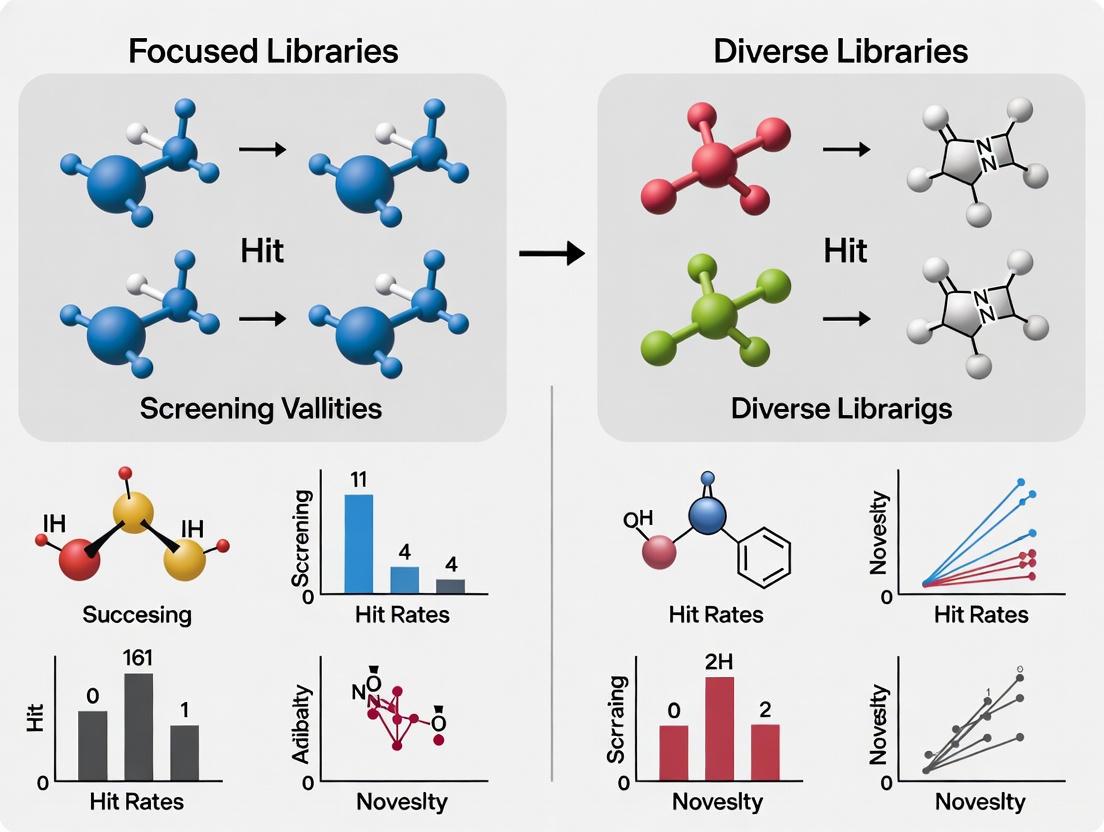
Hit identification is a critical, foundational stage in drug discovery, and the choice of screening library profoundly impacts the campaign's success.
Focused vs. Diverse Libraries for Hit Identification: A Strategic Guide for Drug Discovery
Abstract
Hit identification is a critical, foundational stage in drug discovery, and the choice of screening library profoundly impacts the campaign's success. This article provides a comprehensive comparison of focused and diverse chemical libraries, examining their underlying principles, strategic applications, and comparative efficacy. Drawing on current methodologies—including DNA-encoded libraries (DELs), High-Throughput Screening (HTS), and target-focused design—we explore how to select and optimize the right library type for specific target classes and project goals. We also address common challenges like false positives and chemical space limitations, offering troubleshooting and optimization strategies. Finally, we synthesize key performance metrics and discuss how emerging technologies like machine learning are shaping the future of hit discovery, providing actionable insights for researchers and drug development professionals to enhance efficiency and success rates.
Defining the Battlefield: Core Principles of Focused and Diverse Libraries
What is a Focused Library? Targeting Protein Families with Precision
Defining the Focused Library in Modern Drug Discovery
In the landscape of early drug discovery, a focused library is a strategically designed collection of compounds assembled with a specific protein target or protein family in mind [1]. Unlike diverse libraries which aim for broad coverage of chemical space, focused libraries leverage existing knowledge—such as structural data, sequence information, or known ligand characteristics—to create compounds predicted to interact with particular therapeutic targets [1] [2]. This targeted approach operates on the premise that screening fewer, but more rationally selected, compounds increases the probability of identifying viable starting points for drug development [1].
The fundamental principle underlying focused libraries is that similar targets often share binding site characteristics that can be exploited by chemically related compounds [1]. For protein families with abundant structural data (like kinases), focused library design frequently utilizes structural information about the target binding sites. When structural data is scarce, chemogenomic models incorporating sequence and mutagenesis data can predict binding site properties, while ligand-based approaches enable scaffold hopping from known active compounds [1].
Focused vs. Diverse Libraries: A Comparative Analysis
Table 1: Key Characteristics of Focused and Diverse Libraries
| Parameter | Focused Libraries | Diverse Libraries |
|---|---|---|
| Design Principle | Target-based or target-family-based design [1] | Structural diversity optimization [2] |
| Typical Size | Smaller (typically 100-500 compounds) [1] | Larger (often 500,000+ compounds) [3] |
| Information Requirement | Requires prior knowledge of target structure, sequence, or ligands [1] | Requires no prior target knowledge [2] |
| Primary Application | Targets with known active chemotypes (kinases, GPCRs, ion channels) [2] | Targets with few known actives or phenotypic assays [2] |
| Hit Rate | Generally higher [1] [2] | Generally lower [1] |
| Chemical Space Coverage | Narrow but deep exploration of relevant regions [1] | Broad but shallow exploration of diverse regions [2] |
The comparative efficacy of these approaches is substantiated by experimental evidence. One comprehensive study demonstrated that 89% of kinase-focused libraries and 65% of ion channel-focused libraries yielded improved hit rates compared to their diversity-based counterparts [2]. This performance advantage stems from the strategic enrichment of compounds with structural features predisposed to interact with specific target families.
Methodological Approaches to Focused Library Design
Structure-Based Design
When protein structural data is available (through X-ray crystallography, cryo-EM, or homology modeling), structure-based design enables precise targeting of binding sites. For kinase targets, this approach has been systematically implemented by docking minimally substituted scaffolds into representative kinase structures encompassing various conformational states (active/inactive, DFG-in/DFG-out) [1]. This evaluation identifies scaffolds capable of binding multiple kinases through conserved interactions, such as the hydrogen bond donor-acceptor pair that mimics ATP binding in the hinge region [1].
Ligand-Based Design
In the absence of structural target information, ligand-based methods utilize known active compounds as templates for similarity searching or scaffold hopping [1]. This approach generates new chemotypes that maintain the essential pharmacophoric features required for target binding while exploring novel chemical space.
Machine Learning-Driven Design
Machine learning algorithms can distinguish the physicochemical properties of compounds likely to modulate specific target classes. For challenging targets like protein-protein interactions (PPIs), decision tree models have identified two critical molecular descriptors: specific molecular shapes and a privileged number of aromatic bonds [4]. These models enable computational profiling of compound libraries to enrich for PPI inhibitors, with one tool (PPI-HitProfiler) correctly identifying 70% of experimental hits while removing 52% of inactive compounds [4].
Table 2: Focused Library Design Strategies for Different Target Classes
| Target Family | Primary Design Strategy | Key Structural Features Targeted |
|---|---|---|
| Kinases | Structure-based design [1] | Hinge region, DFG motif, invariant lysine, hydrophobic pockets [1] |
| GPCRs & Ion Channels | Chemogenomic models [1] | Binding sites predicted from sequence and mutagenesis data [1] |
| Protein-Protein Interactions | Machine learning profiling [4] | Molecular shape, aromatic bond count, hydrophobicity [4] |
| Proteases | Structure-based or ligand-based design [1] | Active site, specificity pockets, allosteric sites [1] |
Experimental Validation: Case Studies and Outcomes
Kinase-Focused Library Success
BioFocus' kinase-focused library development exemplifies the rigorous experimental validation process. Their methodology involved:
- Panel Selection: Curating a representative panel of kinase crystal structures covering diverse conformational states (PIM-1, MEK2, P38α, AurA, JNK, FGFR, HCK) [1]
- Scaffold Evaluation: Docking minimally substituted scaffolds without constraints to assess binding potential across multiple kinases [1]
- Substituent Selection: Designing substituents to target specific pockets (hydrophilic groups for solvent-exposed regions, hydrophobic groups for lipophilic pockets) [1]
- Library Synthesis: Synthesizing focused libraries typically comprising 100-500 compounds to explore structure-activity relationships [1]
This approach yielded substantial success, contributing to more than 100 patent filings and nine published co-crystal structures in the Protein Data Bank, and directly facilitated the discovery of several clinical candidates [1].
PPI-Focused Library Validation
For the challenging p53/MDM2 protein-protein interaction, a machine learning-designed focused library identified four novel inhibitors [4]. The validation workflow included:
- Model Training: Using known PPI inhibitors and regular drugs to establish a global PPI inhibitor profile [4]
- Library Profiling: Applying the PPI-HitProfiler tool to compound collections [4]
- Experimental Screening: Testing the computationally prioritized compounds in biological assays [4]
- Hit Confirmation: Validating true positives through dose-response and counter-screens [4]
The Scientist's Toolkit: Essential Research Reagents
Table 3: Key Research Reagent Solutions for Focused Library Applications
| Reagent/Resource | Function in Focused Library Research |
|---|---|
| Protein Family Panels | Representative structures or sequences for evaluating scaffold potential across target families [1] |
| Validated Chemical Probes | Well-characterized tool compounds for assay development and target validation [5] |
| Specialized Assay Technologies | Target-specific detection methods (TR-FRET, AlphaScreen, SPR, ASMS) [3] |
| Annotation Databases | Curated bioactivity data (ChEMBL, PubChem) for ligand-based design [5] |
| Structural Databases | Protein Data Bank resources for structure-based design [1] |
| Computational Profiling Tools | Software like PPI-HitProfiler for library enrichment [4] |
Visualizing Focused Library Design and Screening Workflows
Focused Library Development Workflow illustrates the systematic process from target identification through confirmed hits, highlighting the three primary design strategies.
Efficacy Comparison Pathway contrasts the screening outcomes between diverse and focused library approaches, demonstrating the efficiency advantages of focused libraries.
Focused libraries represent a sophisticated tool in the hit identification arsenal, particularly valuable for well-characterized target families with established active chemotypes. The experimental evidence consistently demonstrates their advantage in generating higher hit rates and richer structure-activity relationship data compared to diversity-based screening [1] [2]. However, the optimal hit identification strategy often integrates both approaches—using diverse libraries for novel target classes or phenotypic screens, while deploying focused libraries for target families with established pharmacology [2]. As structural and bioactivity databases expand, and machine learning methods become more sophisticated, the precision and effectiveness of focused library design will continue to accelerate the discovery of actionable chemical matter for therapeutic development.
What is a Diverse Library? Maximizing Exploration of Chemical Space
In the field of drug discovery, a Diverse Library is a strategically assembled collection of chemical compounds designed to cover a broad range of chemical space—the multi-dimensional domain defined by all possible molecular structures, properties, and functionalities. The primary goal of such a library is to maximize the probability of identifying initial "hit" compounds that bind to a biological target during the screening process, which forms the crucial foundation for developing new therapeutic drugs [6]. The rationale for using diverse libraries is rooted in the principle that broad coverage of chemical space increases the likelihood of encountering novel chemical scaffolds, pharmacophores, and mechanisms of action, particularly when targeting novel or challenging biological pathways [6]. This approach stands in contrast to focused libraries, which are curated with compounds known or predicted to interact with a specific target or target family. Within the broader thesis of efficacy comparison, the debate centers on whether a "wide net" cast by diverse libraries or a "precision spear" offered by focused libraries delivers more actionable starting points for drug development campaigns.
Core Principles: The Anatomy of a Diverse Chemical Library
Effective design of a diverse chemical library is governed by several key principles that ensure its utility in hit identification.
Strategic Diversity over Mere Quantity: Optimal diversity does not mean including every possible compound, but involves the strategic selection of compounds that provide the broadest coverage of chemical space while avoiding those with unfavorable physicochemical properties. Computational tools, such as diversity analysis algorithms, are essential in achieving this balance [6].
Emphasis on Quality and Drug-Likeness: The quality of compounds significantly impacts screening outcomes. A well-curated library prioritizes high-purity compounds with well-characterized structures and appropriate physicochemical properties. This minimizes false positives and ensures hits are more likely to have favorable pharmacokinetic and toxicological profiles, thereby reducing attrition rates in later development stages [6]. Frameworks like the "rule of three" (molecular weight <300 Da, ≤3 hydrogen-bond donors/acceptors, etc.) are often used in fragment-based library design to ensure chemical tractability [7].
Functional Diversity versus Structural Diversity: A paradigm shift is emerging from purely structural to functional diversity. Research has shown that structurally dissimilar compounds can sometimes make identical protein interactions (functional redundancy), while structurally similar fragments can have diverse functional activity [7]. Therefore, a library selected for functional diversity—the ability to make a wide range of novel interactions with protein targets—can recover substantially more information about new protein targets than a similarly sized library selected only for structural diversity [7].
Comparative Analysis: Diverse vs. Focused Libraries in Hit Identification
The choice between diverse and focused libraries is strategic, with each offering distinct advantages and limitations depending on the project goals and target knowledge.
Table 1: Comparative Overview of Diverse and Focused Libraries in Hit Identification
| Aspect | Diverse Library | Focused Library |
|---|---|---|
| Primary Objective | Explore novel chemical space and discover new scaffolds [6] | Target specific protein families or pathways with known chemotypes [7] |
| Target Applicability | Ideal for novel targets with limited prior knowledge [6] | Best for well-validated targets with existing ligand information |
| Hit Rate Expectation | Generally lower, but hits can be more novel [7] | Potentially higher, but hits may be chemically similar |
| Risk of Functional Redundancy | Can be high if based on structural diversity alone [7] | Lower, as libraries are pre-filtered for specific interactions |
| Lead Novelty | High; increased chance of identifying new intellectual property [6] | Moderate; may operate in established chemical territory |
| Typical Size | Can range from tens of thousands to hundreds of thousands of compounds [8] | Often smaller, containing hundreds to a few thousand compounds |
The most significant finding from recent research is the distinction between structural and functional diversity. One study using interaction fingerprints from crystallographic screens of 10 diverse protein targets demonstrated that structurally diverse fragments can be functionally redundant, often making the same interactions [7]. Conversely, the study showed that a small, functionally diverse selection of fragments provided more information about unseen targets than a similarly sized structurally diverse library [7]. This suggests that the greatest efficacy in hit identification may come from libraries curated for functional diversity, a parameter that can be optimized using historical structural data on protein-fragment interactions.
Experimental Protocols and Data for Library Evaluation
Evaluating the efficacy of a diverse library requires robust experimental protocols and quantitative metrics. The following workflow and data illustrate how this assessment is performed, particularly in the context of fragment-based screening.
Experimental Workflow for Assessing Functional Diversity
Key Experimental Methodology
A seminal study utilized structural data from fragment screens of 10 unrelated protein targets against 520 fragments [7]. The core methodology involved:
- X-ray Crystallographic Screening: Each target was screened against most fragments in the library using facilities like XChem, generating full data on what bound and how, as well as which fragments did not bind [7].
- Interaction Fingerprint (IFP) Calculation: For each protein-fragment co-crystal structure, interaction fingerprints were calculated. These recorded the interactions between fragment atoms and protein residues (residue IFP) or protein atoms (atomic IFP) [7].
- Fragment Ranking: Fragments were ranked based on the number of novel interactions they formed with the protein targets. This ranking allowed for the identification of the most functionally diverse selections [7].
Table 2: Quantitative Comparison of Fragment Selection Strategies
| Fragment Selection Strategy | Key Performance Insight | Data Source |
|---|---|---|
| Functionally Diverse Selection | "Substantially increase the amount of information recovered for unseen targets" [7] | Interaction fingerprint analysis of 10 protein targets [7] |
| Structurally Diverse Selection | "Do not necessarily exhibit any more functional diversity than randomly selected libraries" [7] | Comparison of ECFP2 molecular similarity vs. residue IFP similarity [7] |
| Social Fragments | Higher chemical tractability and availability of analogues for fast follow-up [7] | Library design principles from major research institutions [7] |
The Scientist's Toolkit: Essential Reagents and Solutions
Building and screening a diverse library relies on a suite of specialized reagents, computational tools, and physical resources.
Table 3: Essential Research Reagents and Tools for Diverse Library Work
| Tool / Reagent | Function / Purpose |
|---|---|
| Enamine REAL Library | A source of billions of "virtual" compounds that can be synthesized on demand, providing access to novel chemical space for building bespoke diverse libraries [8]. |
| DNA-Encoded Libraries (DELs) | Technology that allows for the affinity-based screening of incredibly large libraries (billions of compounds) by tagging each molecule with a DNA barcode, greatly expanding explorable chemical space [9]. |
| RDKit (in KNIME) | An open-source cheminformatics toolkit used to execute diversity algorithms, such as the MaxMin picker, for selecting a structurally diverse subset of compounds from a larger collection [8]. |
| Molecular Fingerprints (ECFP, MACCS) | Numerical representations of molecular structure used for computational similarity assessment and diversity analysis during library design [7]. |
| Pan-Assay Interference Compounds (PAINS) Filters | Computational filters used to identify and remove compounds with functional groups known to cause false-positive results in biochemical assays, thus improving library quality [8]. |
| Protein Data Bank (PDB) | A repository of 3D protein structures used to design functionally diverse libraries, for example, by analyzing pharmacophores that commonly bind protein hot spots [7]. |
The definition of a diverse library is evolving from a collection emphasizing broad structural coverage to one optimized for functional coverage. While diverse libraries remain indispensable for interrogating novel biology and discovering breakthrough therapeutics, the emerging evidence strongly indicates that functional diversity is a superior predictor of a library's ability to deliver informative hits [7]. The future of library design lies in the intelligent integration of computational prediction, advanced synthesis capabilities (e.g., DELs, REAL libraries), and—crucially—the mining of existing experimental data, particularly 3D structural information on protein-ligand interactions [7]. This will enable the construction of next-generation "functionally efficient" libraries that maximize the exploration of chemical space and increase the odds of discovering actionable chemical matter for hit identification research.
In the pursuit of new therapeutic agents, drug discovery strategies are often guided by one of two competing philosophies: designing libraries around "Privileged Structures" or aiming for "Maximum Diversity." The choice between these approaches fundamentally shapes the hit identification process, with significant implications for efficiency, cost, and the biological relevance of the compounds found. This guide provides an objective comparison of these strategies to inform the design and selection of screening libraries for research.
The following table summarizes the foundational principles, advantages, and limitations of each design philosophy.
| Aspect | Privileged Structures | Maximum Diversity |
|---|---|---|
| Core Philosophy | Uses biologically pre-validated molecular scaffolds to increase the probability of discovering bioactive compounds [10]. | Maximizes structural variety to broadly explore chemical space and uncover novel chemotypes [11]. |
| Molecular Design | Often incorporates heterocycles (e.g., benzopyran, pyrimidine) known to interact with biopolymers [10] [12]. | Aims for a "flat distribution" of diverse chemotypes without bias toward specific motifs [11]. |
| Primary Strength | Higher hit rates and biological relevancy for target classes known to bind the privileged scaffold [10]. | Excellent coverage of chemical space; potential to identify hits for unpredictable or novel targets [11]. |
| Key Limitation | May overlook novel chemotypes outside known privileged scaffolds, potentially limiting innovation. | Can be less efficient, with lower hit rates and a higher resource burden for screening and validation [11]. |
| Typical Application | Focused libraries for target families (e.g., GPCRs, kinases); hit-to-lead optimization [12]. | Initial screening for targets with limited tractability or when seeking first-in-class molecules [11]. |
Experimental Performance and Supporting Data
The theoretical strengths and weaknesses of these philosophies are borne out in experimental data. The table below summarizes key performance metrics from published studies.
| Experiment / Platform | Library Design | Key Performance Metrics | Interpretation & Context |
|---|---|---|---|
| Privileged Substructure-based DOS (pDOS) [10] | Libraries built around privileged substructures (e.g., benzopyran, pyrimidine). | Discovery of bioactive small molecules with "exceptional specificity" for their targets. | Demonstrates the ability of privileged structures to efficiently navigate toward biologically relevant chemical spaces. |
| DNA-Encoded Libraries (DELs) [12] | Libraries often utilizing privileged heterocycles (triazines, benzimidazoles, etc.) as cores or building blocks. | Production of "strong inhibitors (IC50 < 1 μM)" and numerous lead candidates. | The high proportion of successful, potent hits containing heterocycles underscores the efficiency of the privileged structure approach in DEL design. |
| HTS-Oracle AI Platform [13] | Prioritization from a "chemically diverse library" of 1,120 compounds. | 8.4% hit rate (29 hits from 345 candidates), an eightfold improvement over conventional HTS. | Combines a diverse library with an AI filter, showing that diversity, when intelligently prioritized, can yield high hit rates. |
| Benchmark Set Analysis [11] | Comparison of large commercial "Chemical Spaces" (combinatorial) vs. enumerated libraries. | Combinatorial spaces provided more compounds similar to bioactive queries and offered "unique scaffolds." | Large, diverse combinatorial libraries excel at finding analogs close to known bioactive molecules, supporting a "maximum diversity" strategy for hit expansion. |
Detailed Experimental Protocols
To contextualize the data above, here are the detailed methodologies from two key experiments:
HTS-Oracle AI Screening Platform [13]:
- Library: A chemically diverse library of 1,120 small molecules.
- AI Prioritization: A retrainable, deep learning platform integrated transformer-derived molecular embeddings (ChemBERTa) with classical cheminformatics features in a multi-modal ensemble framework.
- Experimental Validation: The top 345 AI-prioritized candidates were screened experimentally using temperature-related intensity change (TRIC).
- Hit Confirmation: Identified hits were orthogonally validated using Microscale Thermophoresis (MST), ELISA, and molecular dynamics simulations.
Privileged Substructure-based Diversity-Oriented Synthesis (pDOS) [10]:
- Library Design: Construction of polyheterocyclic compound libraries by incorporating privileged substructures (e.g., benzopyran, pyrimidine, oxopiperazine) into rigid core skeletons.
- Screening: Bioactive small molecules were discovered from the pDOS-derived libraries.
- Target Identification: The target biomolecules for the bioactive compounds were identified using a method called "fluorescence difference in two-dimensional gel electrophoresis."
Workflow and Decision Pathways
The typical research and development workflows for each philosophy are distinct, as illustrated in the following diagrams.
Privileged Structures Workflow
Maximum Diversity Workflow
The Scientist's Toolkit: Essential Research Reagents and Solutions
The execution of either strategy relies on a suite of specialized tools and reagents.
| Tool / Reagent | Function | Relevance to Design Philosophy |
|---|---|---|
| DNA-Encoded Library (DEL) [12] | An innovative high-throughput screening technology that uses DNA barcodes to track synthesis and identify binders. | Central to both; enables the affordable creation and screening of ultra-large libraries (millions to billions), making maximum diversity practical and allowing for focused, privileged-structure libraries. |
| Heterocyclic Building Blocks [12] | Molecular fragments containing rings with atoms like nitrogen, oxygen, or sulfur. | The fundamental components of privileged structure libraries and key elements for introducing diversity and drug-like properties in diverse libraries. |
| DNA-Compatible Chemistry [12] | Chemical reactions that are compatible with the presence of DNA tags (avoiding harsh conditions). | A critical enabling technology for constructing high-quality DELs of either type, as it limits the reactions available for library synthesis. |
| Benchmark Sets (e.g., from ChEMBL) [11] | Curated sets of bioactive molecules used to assess the coverage and relevance of a compound collection. | Used to objectively evaluate and compare the performance of "maximum diversity" libraries and commercial chemical spaces. |
| AI/ML Prioritization Tools (e.g., HTS-Oracle) [13] | Platforms that use machine learning to prioritize compounds from large libraries for experimental testing. | Particularly valuable for triaging massive diverse libraries to focus resources on the most promising candidates, thereby improving efficiency and hit rates. |
The choice between "Privileged Structures" and "Maximum Diversity" is not a matter of one being universally superior. Instead, the optimal strategy is dictated by the specific research goal.
Choose "Privileged Structures" when working on well-established target families (e.g., kinases, GPCRs), when resource efficiency is a priority, or during hit-to-lead optimization to improve potency and properties [10] [12]. This is a focused, efficiency-driven approach.
Choose "Maximum Diversity" when pursuing unprecedented or "undruggable" targets, when seeking first-in-class chemical matter, or when the goal is to broadly map structure-activity relationships for a completely new target [11]. This is an exploratory, breadth-driven approach.
A modern and powerful strategy is to harness the strengths of both. Researchers can initially screen a highly diverse library to identify novel hit matter, and then use privileged structures derived from those hits or known for the target class to design focused libraries for systematic optimization [10] [12]. This hybrid approach leverages the innovation potential of diversity with the efficiency of biologically relevant design.
The drug discovery process relies heavily on strategic guidelines to navigate the vast and complex landscape of potential therapeutic compounds. Among the most influential guiding principles are the Rule of 5 (Ro5) for drug-like compounds and the Rule of 3 (Ro3) for molecular fragments, which serve as critical filters for predicting compound behavior based on fundamental physicochemical properties. These rules exist within a broader strategic framework that contrasts focused libraries (collections designed around specific target families or properties) against diverse libraries (broad collections maximizing structural variety) for hit identification research. The efficacy of each approach depends heavily on the stage of discovery and the nature of the biological target. Focused libraries, built using property-based rules like Ro5 and Ro3, typically yield higher hit rates for their intended targets and provide immediately interpretable structure-activity relationships [1]. In contrast, diverse screening collections aim for broad structural coverage to identify unexpected leads for novel targets, though they often generate lower initial hit rates and require screening larger compound numbers [14]. This guide objectively compares how Ro5 and Ro3 serve as foundational principles for library design, examining their scientific basis, experimental applications, and relative performance in identifying promising therapeutic starting points.
Understanding the Rule of 5 for Drug-like Compounds
Definition and Historical Context
The Rule of 5 (Ro5) was formulated by Christopher A. Lipinski and colleagues at Pfizer in 1997 through retrospective analysis of compounds that had successfully entered Phase II clinical trials, most of which were orally administered drugs [15] [16]. The rule emerged from the observation that most orally active drugs are relatively small and moderately lipophilic molecules, with four key physicochemical parameters determining their drug-likeness and likelihood of satisfactory absorption and permeability. The "Rule of Five" derives its name from the multiples of five that appear in its key thresholds [15].
The Four Key Parameters and Their Thresholds
The Rule of 5 states that poor absorption or permeability is more likely when a compound violates more than one of the following criteria [15] [16]:
- Molecular weight (MW) < 500 Daltons
- Octanol-water partition coefficient (Log P) < 5
- Hydrogen bond donors (HBD) ≤ 5
- Hydrogen bond acceptors (HBA) ≤ 10
These specific thresholds were determined to cover approximately 90% of the successfully developed oral drugs in the studied dataset [16]. The rules primarily predict a drug's pharmacokinetic behavior in the human body, particularly its absorption, distribution, metabolism, and excretion (ADME) properties, though they do not predict pharmacological activity [15].
Applications and Limitations in Modern Drug Discovery
The Ro5 has profoundly influenced drug discovery strategies over the past two decades, serving as a crucial triage tool for eliminating compounds with unfavorable ADME characteristics early in the development process [17]. However, the rule has significant limitations, including its primary focus on passive diffusion as the absorption mechanism while ignoring transporter-mediated uptake [15]. Additionally, natural products frequently violate Ro5 yet demonstrate excellent bioavailability and bioactivity, highlighting the rule's lack of universality [16]. The pharmaceutical industry has observed a concerning trend toward strict application of Ro5 as an inflexible filter rather than a guideline, potentially limiting chemical diversity and eliminating promising candidates that fall outside these parameters [16]. Contemporary drug discovery increasingly explores chemical space beyond Ro5, particularly for challenging targets like protein-protein interactions, with macrocycles and PROTACs representing important drug classes that routinely violate these traditional rules [16].
Understanding the Rule of 3 for Fragment-like Compounds
Definition and Emergence from Fragment-Based Drug Discovery
The Rule of 3 (Ro3) was introduced in 2003 by Congreve, Carr, Murray, and Jhoti as a set of guidelines for designing fragment libraries in the emerging field of fragment-based drug discovery (FBDD) [18] [16]. Whereas Ro5 addresses properties of drug-sized molecules, Ro3 specifically defines the physicochemical space for much smaller molecular fragments that serve as starting points for drug development. The "Rule of Three" name reflects both its relationship to Ro5 and the fact that most of its parameters have thresholds of three or less [16].
The Key Parameters and Their Thresholds
The Rule of 3 proposes that fragments should ideally possess the following properties [18] [16]:
- Molecular weight (MW) < 300 Daltons
- Octanol-water partition coefficient (CLogP) ≤ 3
- Hydrogen bond donors (HBD) ≤ 3
- Hydrogen bond acceptors (HBA) ≤ 3
- Rotatable bonds ≤ 3
These stricter criteria ensure fragments maintain high ligand efficiency (biological activity per heavy atom) and provide ample opportunity for structural optimization while retaining favorable physicochemical properties [18].
Applications and Controversies in Fragment Library Design
Ro3 guides the construction of fragment libraries for screening against therapeutic targets, with the premise that smaller, simpler fragments provide better starting points for optimization into drug candidates [18]. However, several aspects of Ro3 remain controversial within the FBDD community. Significant ambiguity exists in how hydrogen bond acceptors are defined and counted, particularly regarding whether to include all nitrogen and oxygen atoms [19]. Some studies suggest that commercial fragment libraries contain too many compounds near the upper MW limit of 300 Da rather than a balanced distribution across the 100-300 Da range [19]. Evidence indicates that fragments violating Ro3, particularly those with higher molecular complexity, can still produce valid hits and crystal structures, suggesting the rules should not be applied too rigidly [18]. Despite these controversies, Ro3 has become widely adopted as a standard for fragment library design, with the number of hydrogen bond donors generally considered more critical than acceptors due to its stronger negative correlation with solubility and permeability [19].
Direct Comparison: Rule of 5 vs. Rule of 3
Quantitative Parameter Comparison
The following table provides a direct comparison of the key physicochemical parameters between the Rule of 5 for drugs and the Rule of 3 for fragments:
| Physicochemical Parameter | Rule of 5 (Drugs) | Rule of 3 (Fragments) |
|---|---|---|
| Molecular Weight (MW) | < 500 Da | < 300 Da |
| Octanol-Water Partition Coefficient (LogP/CLogP) | < 5 | ≤ 3 |
| Hydrogen Bond Donors (HBD) | ≤ 5 | ≤ 3 |
| Hydrogen Bond Acceptors (HBA) | ≤ 10 | ≤ 3 |
| Rotatable Bonds | Not specified | ≤ 3 |
| Primary Application Context | Oral bioavailability prediction | Fragment library design |
| Discovery Stage | Lead optimization & development | Hit identification |
| Chemical Space Coverage | Drug-like chemical space | Fragment-like chemical space |
Strategic Application in Library Design
The differential application of these rules significantly impacts library design strategies and outcomes:
Rule of 5 Application: Focused libraries designed using Ro5 principles typically contain compounds with proven drug-like properties, resulting in higher hit rates for conventional targets and reduced attrition in later development stages [1]. These libraries are particularly valuable for target families with well-understood binding requirements, such as kinases, GPCRs, and ion channels [1].
Rule of 3 Application: Fragment libraries adhering to Ro3 principles enable screening of smaller, simpler compounds, providing superior coverage of chemical space with fewer compounds and producing hits with higher ligand efficiency [18]. These libraries are especially valuable for novel targets with limited structural information and for tackling challenging target classes like protein-protein interactions [18] [16].
Experimental evidence indicates that focused libraries designed using these property-based rules generally achieve higher hit rates compared to diverse screening collections. For example, target-focused libraries typically produce hit rates substantially above those observed with diverse libraries, while also providing immediately interpretable structure-activity relationships that accelerate hit-to-lead optimization [1].
Experimental Protocols and Methodologies
Property Measurement Techniques
Researchers employ established experimental protocols to measure the key physicochemical properties defined by Ro5 and Ro3:
Molecular Weight Determination: Typically determined using mass spectrometry techniques, particularly LC-MS (Liquid Chromatography-Mass Spectrometry), which provides accurate mass measurements for compound characterization and purity assessment [14].
Lipophilicity (LogP/CLogP) Measurement: Experimentally determined using shake-flask methods followed by HPLC analysis to measure partition between octanol and water buffers. Computational methods (CLogP) calculate values based on molecular structure and fragment contributions [16].
Hydrogen Bond Donor/Acceptor Assessment: Primarily determined through computational analysis of molecular structure, counting all oxygen and nitrogen atoms with available lone pairs as potential hydrogen bond acceptors, and OH and NH groups as donors [19]. Experimental verification can be obtained through NMR spectroscopy and crystal structure analysis [18].
Solubility and Permeability Assessment: High-throughput solubility assays measure equilibrium solubility in aqueous buffers using UV spectroscopy, while permeability is assessed using artificial membrane assays like PAMPA (Parallel Artificial Membrane Permeability Assay) or cell-based models like Caco-2 monolayers [17].
Library Screening and Hit Validation Workflows
The following diagram illustrates the experimental workflow for screening and validating hits from focused libraries designed using Ro5 and Ro3 principles:
Diagram Title: Screening Workflow for Ro3 and Ro5 Libraries
This workflow highlights key differences in screening approaches: fragment libraries typically require sensitive biophysical methods like NMR spectroscopy and surface plasmon resonance (SPR) to detect weak binding affinities, while focused Ro5 libraries can be screened using conventional high-throughput biochemical assays [1] [18]. Similarly, hit validation for fragments emphasizes determining ligand efficiency and developing initial structure-activity relationships, whereas Ro5 hit validation focuses more comprehensively on potency, selectivity, and ADME properties [1].
Essential Research Reagents and Solutions
The following table details key research reagents and solutions essential for implementing experimental protocols related to Ro5 and Ro3 compound screening:
| Research Reagent/Solution | Function/Application | Example Specifications |
|---|---|---|
| Maybridge HTS Libraries | Pre-plated screening collections for hit identification; include Rule of 5 compliant compounds for focused screening | 96-well or 384-well plates; 1 μmol or 0.25 μmol dry film; >51,000 compounds [14] |
| Fragment Screening Libraries | Specialized collections for FBDD; typically Rule of 3 compliant fragments | MW < 300; CLogP ≤ 3; HBD/HBA ≤ 3; ~30,000 chemical fragments [14] |
| SPR Biosensors | Surface plasmon resonance chips for detecting fragment binding interactions | Gold film with carboxylated matrix; captures protein-ligand binding kinetics [1] |
| LC-MS Systems | Compound characterization, purity assessment, and metabolic stability testing | UHPLC coupled with quadrupole/time-of-flight MS; accurate mass measurement [14] |
| PAMPA Plates | Parallel Artificial Membrane Permeability Assay for passive permeability prediction | 96-well format with artificial membrane; predicts gastrointestinal absorption [17] |
The Rule of 5 and Rule of 3 represent complementary rather than competing frameworks in contemporary drug discovery. Ro5 continues to provide valuable guidance for optimizing compounds toward developable oral drugs, while Ro3 offers a strategic approach for identifying efficient starting points in fragment-based campaigns. Research demonstrates that focused libraries designed using these property-based rules typically achieve higher hit rates for their intended targets compared to diverse screening collections [1]. However, the most successful discovery strategies employ both approaches contextually rather than as rigid filters, recognizing that certain target classes require exploration beyond traditional physicochemical space. As drug discovery advances into challenging areas like protein-protein interactions and targeted protein degradation, the intelligent application of these rules—understanding both their power and limitations—remains essential for efficiently identifying quality starting points and optimizing them into viable clinical candidates.
The initial phase of drug discovery, hit identification, focuses on finding chemical starting points that interact with a therapeutic target. This process has been transformed by technologies that enable the efficient synthesis and screening of vast molecular collections. The strategic choice between using focused libraries, designed around known active chemotypes, and diverse libraries, designed to cover broad swathes of chemical space, is a central consideration for research efficiency and success [2] [1] [20]. While high-throughput screening (HTS) of large, diverse compound collections has been a mainstay in the pharmaceutical industry, its high costs and resource demands have prompted the development of more efficient paradigms [2] [9]. This guide objectively compares three foundational sources of synthetic compounds—traditional combinatorial chemistry, DNA-encoded libraries (DELs), and commercially available focused/diverse libraries—within the context of this strategic choice, providing supporting data and experimental protocols to inform research decisions.
Combinatorial chemistry comprises chemical synthetic methods that allow for the simultaneous preparation of tens to thousands or even millions of compounds in a single process, dramatically accelerating the production of molecular libraries for screening [21]. A key innovation was the split-and-pool synthesis method, where solid support beads are divided, reacted with different building blocks, and then recombined in iterative cycles, enabling the exponential generation of compound diversity from a limited number of building blocks [22] [21].
DNA-encoded libraries (DELs) represent a powerful convergence of combinatorial chemistry and molecular biology. In a DEL, each small molecule in a library is covalently linked to a unique DNA barcode that records its synthetic history [23] [24]. This allows billions of compounds to be pooled and screened in a single tube against a protein target through affinity-based selection. The identity of binding molecules is subsequently decoded via polymerase chain reaction (PCR) and next-generation sequencing (NGS), requiring minimal amounts of target protein and breaking the traditional "cost-per-well" model of HTS [22] [9] [24].
Commercially available compounds, sourced from vendors, form the basis of many corporate screening collections. These can be assembled as diverse libraries to maximize structural variety and coverage of chemical space or as focused libraries tailored to specific target families like kinases or GPCRs [1] [25]. The design of these libraries is a critical factor in the success of a screening campaign [2].
Table 1: Core Characteristics of Compound Sources for Hit Identification
| Feature | Combinatorial Chemistry (Traditional) | DNA-Encoded Libraries (DELs) | Commercially Available Compounds |
|---|---|---|---|
| Typical Library Size | Thousands to millions [21] | Millions to billions [22] [24] | Thousands to millions [25] |
| Key Screening Method | High-Throughput Screening (HTS) [21] | Affinity Selection + NGS [23] [24] | HTS, Virtual Screening [25] |
| Screening Efficiency | Lower; cost-per-well model [2] | Very High; single-tube screening [9] | Lower; cost-per-well model [2] |
| Protein Consumption | High | Very Low (microgram quantities) [24] | High |
| Chemical Space Coverage | Moderate to High, but can be biased | Extremely Broad [26] | Dependent on library design (Focused vs. Diverse) [20] |
| Hit Rate | Variable | Can identify low-affinity binders [9] | Higher for focused libraries [1] |
Table 2: Efficacy Comparison: Focused vs. Diverse Library Strategies
| Parameter | Focused Library Approach | Diverse Library Approach |
|---|---|---|
| Rationale | Leverage prior knowledge of target structure or known ligands [1] | Similar property principle; broad coverage increases chance of finding novel hits [2] [20] |
| Ideal Use Case | Targets with abundant structural/ligand data (e.g., kinases, GPCRs) [2] [1] | Phenotypic screens; novel targets with few known ligands [2] |
| Typical Hit Rate | Higher [1] | Lower |
| Hit Quality | Hits often have discernable SAR from the start [1] | Can yield novel, unexpected scaffolds (scaffold hopping) [20] |
| Chemical Space | Explores a constrained, target-relevant region | Aims for broad scaffold diversity [20] |
Experimental Protocols and Workflows
DEL Synthesis and Screening Protocol
The following workflow is commonly used for creating and screening DELs via the dominant split-and-pool method.
Diagram: DEL Split-and-Pool Synthesis & Screening
Detailed Methodology:
Library Synthesis (Split-and-Pool):
- Start: The process begins with a solid support (e.g., beads) linked to a DNA "headpiece" [21] [24].
- Split: The support is divided into equal portions in separate reaction vessels.
- React: Each portion is coupled with a unique building block (e.g., via amide coupling, Suzuki reaction). This chemical step is immediately followed by a DNA ligation step that attaches a unique barcode corresponding to the added building block [24] [26].
- Pool: All portions are pooled together and thoroughly mixed.
- Repeat: The split-react-pool cycle is repeated for each round of diversification. With just three cycles of 100 building blocks each, a library of 1 million (100^3) distinct compounds can be created [24].
- Key Consideration: Reactions must be high-yielding and use DNA-compatible conditions (aqueous solvent, mild pH, moderate temperature) to minimize truncated products that carry an incorrect DNA code [26].
Affinity Selection & Hit Identification:
- The entire DEL is incubated with a purified, immobilized target protein in a single tube [9] [24].
- Unbound compounds are removed through extensive washing.
- Bound compounds are eluted, and their DNA barcodes are amplified via PCR and sequenced using NGS [22] [23].
- Statistical analysis of barcode enrichment identifies hit structures, which are then resynthesized without the DNA tag ("off-DNA") for validation in biochemical and biophysical assays [9] [26].
Design of a Kinase-Focused Library
This protocol outlines the structure-based design of a target-focused library, using kinases as an example [1].
Diagram: Focused Library Design Workflow
Detailed Methodology:
- Target Analysis: Collect and analyze all available structural data for the kinase target or kinome sub-family. This includes X-ray crystal structures (from the Protein Data Bank) in different conformations (e.g., active/DFG-in, inactive/DFG-out) [1].
- Scaffold Selection: Choose a core scaffold predicted to interact with key conserved regions, such as the kinase hinge binding region, often featuring a hydrogen bond donor-acceptor pair. Alternative scaffolds targeting allosteric sites (e.g., DFG-out binders) are also considered [1].
- Computational Docking: Dock minimally substituted versions of the scaffold into a panel of representative kinase structures to evaluate its binding mode and potential for broad or selective kinase inhibition [1].
- Substituent Selection: Based on docking poses, select substituents (R-groups) to append to the scaffold that are predicted to interact favorably with specific pockets (e.g., hydrophobic back pocket, solvent-exposed front pocket). The selection includes "privileged" groups known to be important for kinase binding [1].
- Library Synthesis and Screening: Synthesize a library of 100-500 compounds using parallel synthesis methods. Screen the library against the target kinase, with the resulting hit clusters typically showing clear structure-activity relationships (SAR) for efficient follow-up [1].
The Scientist's Toolkit: Essential Research Reagents and Solutions
Table 3: Key Reagents and Materials for Hit Identification Experiments
| Reagent / Solution | Function in Experiment |
|---|---|
| Solid Support (e.g., functionalized beads) | Foundation for solid-phase combinatorial and split-and-pool DEL synthesis; enables facile filtration and washing [21] [24]. |
| DNA Headpiece & Encoding Oligonucleotides | Provides the initial attachment point and source of unique barcodes for recording synthetic history in DEL construction [24] [26]. |
| DNA-Compatible Building Blocks | Chemical reagents (e.g., carboxylic acids, boronic acids, amines) used in DEL synthesis; must be soluble and reactive in aqueous conditions [26]. |
| DNA Ligase | Enzyme critical for DEL synthesis; covalently links DNA barcodes to the growing oligonucleotide chain after each chemical step [24]. |
| Immobilized Target Protein | Protein of interest (e.g., biotinylated and bound to streptavidin beads) used for affinity selection during DEL screening [9]. |
| Next-Generation Sequencing (NGS) Platform | Core technology for decoding the DNA barcodes of enriched hits after DEL selection; enables ultra-high-throughput analysis [22] [23]. |
| Fragment Library (for FBS) | A collection of 500-5000 low molecular weight compounds (<300 Da) used in Fragment-Based Screening to efficiently probe chemical space [25]. |
| Biophysical Assay Kits (e.g., SPR, BLI, TSA) | Essential for validating initial hits from any method; confirms binding affinity and specificity to the target [25]. |
The choice between combinatorial chemistry, DELs, and commercially available compounds is not a matter of identifying a single superior technology, but of selecting the right tool for the specific research context. The strategic dichotomy between focused and diverse libraries runs through all these technologies. Focused libraries, whether designed in-house via combinatorial chemistry or purchased commercially, provide an efficient, knowledge-driven path to higher hit rates for well-characterized target classes. In contrast, diverse libraries and particularly DELs offer unprecedented access to unexplored chemical space, making them indispensable for novel and intractable targets. DEL technology, with its massive scale and minimal resource consumption, has firmly established itself as a powerful addition to the hit identification toolbox [22] [9]. Ultimately, a successful hit identification strategy often involves a synergistic combination of these approaches, leveraging their complementary strengths to increase the probability of discovering high-quality, actionable chemical matter for drug development.
Strategic Deployment: When and How to Use Each Library Type
In the challenging landscape of early drug discovery, the identification of robust chemical starting points remains a critical hurdle. The traditional paradigm of screening vast, diverse compound libraries in high-throughput assays has increasingly been supplemented by a more targeted approach: the use of focused screening libraries. These collections are strategically designed or assembled with specific protein targets or protein families in mind, predicated on the hypothesis that they will yield higher hit rates and more tractable hit clusters compared to diverse sets [1]. This guide provides an objective comparison of focused library efficacy across four major target classes—kinases, GPCRs, ion channels, and proteases—framed within the broader thesis of focused versus diverse library screening for hit identification. By synthesizing quantitative performance data and detailing experimental methodologies, we aim to equip researchers with the evidence needed to make informed screening decisions.
Comparative Performance of Focused Libraries
The value proposition of a focused library is quantifiably demonstrated through its hit rate and the chemical quality of its hits. The following table summarizes key metrics and characteristics for libraries targeting four major gene families.
Table 1: Performance Comparison of Focused Libraries Across Major Target Classes
| Target Class | Reported Library Size | Reported/Typical Hit Rate | Key Design Strategies | Notable Advantages |
|---|---|---|---|---|
| Kinases | ~6,000 compounds [27] | High hit rates reported [27] | Hinge-binding, DFG-out, invariant lysine binding, scaffold docking [1] | High structural knowledge; access to diverse binding modes; proven success [1] |
| GPCRs | 62,500 - 1.3 billion compounds [28] [29] | Higher hit rates vs. diverse sets [1] | Ligand similarity (Tanimoto ≥0.85), positive sample machine learning (GPCR LLM) [28] [29] | Leverages vast ligand data; covers diverse GPCR-likeness; targets underexplored receptors [28] |
| Ion Channels | ~4,300 compounds [30] | Higher hit rates vs. diverse sets [1] | Ligand similarity (Tanimoto ≥0.85), pharmacophore analysis, virtual screening [27] [31] [30] | Addresses challenging screening physiology; can leverage ultra-large virtual libraries [31] |
| Proteases | 30,000 compounds (Serine Proteases) [32] | Information Not Available | Target-informed design for proteolytic enzymes [32] | Targets crucial roles in biological processes; structure-based design feasible [32] |
Detailed Analysis by Target Class
Kinase-Focused Libraries
Experimental Evidence and Protocols: A compelling case study demonstrating the efficacy of kinase-focused libraries involved the discovery of inhibitors for inositol hexakisphosphate kinase 2 (IP6K2). Researchers developed a time-resolved fluorescence resonance energy transfer (TR-FRET) assay to detect ADP formation [33]. They screened a kinase-focused library of 4,727 compounds at a concentration of 10 µM. This targeted approach successfully identified novel hit compounds for IP6K2, which were validated through dose-response curves and an orthogonal HPLC-based assay [33]. The success of this campaign was underpinned by a rational design strategy; the researchers first identified structural conservation between the nucleotide-binding sites of IP6Ks and protein kinases, justifying the use of a kinase-focused set [33].
Design Methodology: Kinase-focused library design is sophisticated, often utilizing a panel of representative kinase structures (e.g., PIM-1, MEK2, p38α) to evaluate potential scaffolds [1]. Design strategies extend beyond traditional ATP-competitive (hinge-binding) scaffolds to include compounds that target inactive conformations (DFG-out binders) and other allosteric sites, thereby increasing the diversity of chemotypes and mechanisms of action that can be discovered [1].
GPCR-Focused Libraries
Experimental Evidence and Protocols: The design of GPCR-focused libraries often relies on ligand-based computational methods due to historical challenges in obtaining structural data. A standard protocol involves curating a reference set of known active molecules from databases like ChEMBL, followed by a similarity search against a vendor's compound collection using 2D molecular fingerprints and a Tanimoto similarity threshold (e.g., ≥0.85) [28]. The resulting compound set is then filtered using medicinal chemistry rules (e.g., Lipinski's Rule of Five, PAINS filters) to ensure drug-likeness [28]. A novel approach, GPCRSPACE, utilizes a large language model (LLM) architecture trained with a positive sample machine learning strategy, which requires only known active compounds and avoids the need for negative sample labeling, thereby reducing false negatives [29]. This method has been reported to generate libraries with superior synthesizability, structural diversity, and GPCR-likeness compared to existing chemical datasets [29].
Screening Workflow: The following diagram illustrates the primary strategies for constructing and screening a GPCR-focused library.
Ion Channel-Focused Libraries
Experimental Evidence and Protocols: Ion channel drug discovery faces unique challenges, including the complexity of functional assays and the historical unders exploitation of these targets [31] [30]. Focused libraries offer a path to overcome these hurdles. The design of Life Chemicals' Ion Channel Focused Library, for instance, followed a ligand-based protocol: approximately 50,000 reference compounds with reported activity were obtained from ChEMBL, followed by a similarity search against the HTS collection (Tanimoto ≥ 0.85) and subsequent filtering for drug-like properties [30].
Virtual Screening Advancements: Notably, ion channel research is increasingly benefiting from virtual screening (VS) of ultra-large chemical libraries, a method that can be used to create highly targeted focused sets. One review highlights that libraries like the Enamine REAL Space, containing billions of "make-on-demand" molecules, can be computationally prioritized for synthesis and testing [31]. The methodology involves structure-based approaches like molecular docking against the growing number of ion channel structures solved by cryo-EM, as well as ligand-based methods like quantitative structure-activity relationship (QSAR) modeling [31]. The primary advantage is the ability to cost-effectively explore a vast chemical space that is intractable for conventional experimental high-throughput screening, significantly increasing the likelihood of discovering novel chemotypes [31].
Protease-Focused Libraries
While the provided search results contain less specific experimental data for protease-focused libraries compared to other target classes, their importance and availability are confirmed. ChemDiv's catalog, for example, features several relevant libraries, including a Serine Proteases Inhibitors Library of ~32,000 compounds and a Cysteine Proteases Library of ~7,800 compounds [32]. The general design principle for such libraries is target-informed design, leveraging the substantial structural and mechanistic knowledge of proteolytic enzymes to design or select compounds that interact with active sites or allosteric pockets [32] [1].
The Scientist's Toolkit: Essential Research Reagents
Successful screening campaigns rely on a suite of specialized reagents and computational tools. The following table details key resources relevant to working with focused libraries.
Table 2: Key Research Reagent Solutions for Focused Library Screening
| Reagent / Resource | Function / Description | Application Context |
|---|---|---|
| TR-FRET Kinase Assay (e.g., Adapta) | Homogeneous assay measuring ADP formation from kinase reaction using fluorescence resonance energy transfer [33]. | High-throughput screening for kinase inhibitors; used in the IP6K2 case study [33]. |
| GPCR LLM (GPCRSPACE) | A large language model architecture using a positive sample machine learning strategy to generate GPCR-focused compound libraries [29]. | In silico design of novel GPCR-targeting compounds with high GPCR-likeness and synthesizability [29]. |
| Ultra-Large Virtual Libraries (e.g., Enamine REAL) | Databases of billions of "make-on-demand" molecules for virtual screening [31]. | Structure-based and ligand-based virtual screening for ion channels and other targets to explore vast chemical space [31]. |
| Cryo-EM Ion Channel Structures | High-resolution structural data of human ion channels, increasingly available in the Protein Data Bank [31]. | Enables structure-based drug design and molecular docking campaigns for ion channel targets [31]. |
| Fragment Collections (e.g., Maybridge) | Libraries of low molecular weight compounds for fragment-based drug discovery (FBDD) [27]. | Complementary screening approach to identify low-affinity but high-efficiency binders as starting points. |
| Validated Focused Libraries (e.g., SoftFocus) | Commercially available, pre-designed libraries for specific target families like kinases, GPCRs, and ion channels [1]. | Off-the-shelf solution for screening campaigns, with a proven history of leading to patent filings and clinical candidates [1]. |
The experimental data and comparative analysis presented in this guide strongly support the thesis that focused libraries offer a powerful and efficient strategy for hit identification against well-characterized target families. The key advantage is the consistent report of higher hit rates compared to diverse libraries, which translates to more efficient use of screening resources and the generation of hits with more immediate structure-activity relationships [1]. The choice of library design—whether structure-based, ligand-based, or a novel AI-driven approach—should be dictated by the available knowledge of the target. As structural biology and computational methods continue to advance, the design and application of focused libraries will become even more precise, further solidifying their role as an indispensable tool in the modern drug discovery arsenal.
Phenotypic screening has re-emerged as a powerful strategy in drug discovery for identifying novel therapeutic agents based on their modulation of cellular or disease phenotypes rather than specific molecular targets. Within this paradigm, the choice of screening library—diverse or focused—profoundly impacts the quality, interpretability, and efficiency of discovery campaigns. This guide objectively compares the performance of annotated focused libraries against diverse screening collections, providing researchers with data-driven insights for hit identification.
Library Design and Strategic Foundations
Defining the Library Types
The fundamental distinction between library types lies in their design philosophy and composition:
- Diverse Libraries: These are collections designed to cover a broad swath of chemical space without bias toward specific biological targets. The primary goal is structural diversity, with the assumption that this will translate to diverse biological effects [34].
- Annotated Focused Libraries: These are strategically curated collections enriched with compounds having known biological activities or designed to target specific protein families or pathways [5]. Examples include kinase-focused libraries, GPCR-targeted collections, and chemogenomic libraries populated with chemical probes, tools, and drugs [1] [35].
Design Principles of Focused Libraries
The construction of high-quality focused libraries follows several key principles:
- Target-Focused Design: For well-characterized target families like kinases, libraries can be designed using structural information (e.g., X-ray crystallography) to create scaffolds that interact with conserved binding motifs, such as the ATP-binding hinge region of kinases [1].
- Ligand-Based Design: When structural data is limited, focused libraries can be built using known ligands for a target through "scaffold hopping" strategies to identify novel chemotypes with similar binding properties [1].
- Biological Annotation: Modern focused libraries incorporate compounds with extensive bioactivity annotation, including approved drugs, chemical probes with defined mechanisms of action, and compounds targeting specific pathways [36] [5]. This annotation transforms these libraries from mere compound collections into biological hypothesis-testing tools.
- Quality and Drug-Likeness: Focused libraries typically undergo rigorous curation to eliminate compounds with undesirable molecular features (e.g., reactive functional groups, toxicophores) and to maintain favorable physicochemical properties that enhance their potential as starting points for drug discovery [1] [6].
Comparative Performance Data: Focused vs. Diverse Libraries
Direct comparisons of screening outcomes reveal significant differences in the performance of focused versus diverse libraries. The table below summarizes key performance metrics from published screening campaigns.
Table 1: Performance Comparison of Focused vs. Diverse Libraries in Screening Campaigns
| Performance Metric | Diverse Libraries | Annotated Focused Libraries | Experimental Context |
|---|---|---|---|
| Typical Hit Rate | Generally lower (often 1-2%) | Substantially higher (often 3-10 fold increase) [1] | Multiple target classes including kinases, ion channels, GPCRs [1] |
| Mechanistic Insight | Limited at initial hit stage | Immediate preliminary insights via bioactivity annotations [5] [35] | Phenotypic screening with chemogenomic libraries [35] |
| SAR Data from Initial Hits | Often limited or scattered | Rich, discernable SAR from clustered hits [1] | Kinase-focused library screening [1] |
| Hit-to-Lead Timeline | Potentially protracted | Dramatically reduced timescale [1] | Case studies across multiple projects [1] |
| Biological Performance Diversity | Variable; may contain redundancies [34] | Curated for performance diversity via profiling [34] | Cell morphology and gene expression profiling [34] |
Hit Rate and Lead Efficiency
The most consistently reported advantage of focused libraries is their significantly higher hit rates compared to diverse collections. Screening target-focused libraries typically yields hit rates 3 to 10 times greater than those observed with diverse libraries [1]. This efficiency translates directly to resource savings, as screening smaller compound sets (typically 100-500 compounds for focused libraries versus tens to hundreds of thousands for diverse collections) can produce more high-quality starting points [1].
Beyond mere hit rates, focused libraries demonstrate superior performance in generating "actionable" chemical matter—hits with properties amenable to optimization. For instance, the BioFocus SoftFocus libraries have contributed to more than 100 patent filings and directly enabled the discovery of multiple clinical candidates [1].
Biological Performance Diversity
While chemical diversity doesn't always translate to diverse biological effects [34], focused libraries can be specifically designed for biological performance diversity. One study used high-dimensional cell morphology and gene expression profiles to assess over 30,000 compounds, finding that compounds active in morphological profiling were significantly enriched for hits in high-throughput screening (HTS) assays [34].
Table 2: Biological Performance Assessment Through Morphological Profiling
| Profiling Characteristic | Known Bioactive Compounds (BIO Set) | Diversity-Oriented Synthesis (DOS) Set | Significance |
|---|---|---|---|
| Activity Rate in Cell Morphology Profiling | 68.3% | 37.0% | Profiling detects known bioactives [34] |
| Median HTS Hit Frequency (Active in Profiling) | 2.78% | Not reported | Higher than all tested compounds (1.96%) [34] |
| Median HTS Hit Frequency (Inactive in Profiling) | 0% | Not reported | Profiling inactives are HTS-depleted [34] |
| Application in Library Curation | Enrichment for bioactive compounds | Filtering of inert compounds | Builds performance-diverse libraries [34] |
Experimental Protocols for Library Evaluation
Protocol: Assessing Library Performance Diversity via Morphological Profiling
This protocol enables quantitative assessment of a library's biological performance diversity, adapted from the method used to evaluate over 30,000 compounds [34].
Materials:
- Compound libraries (DMSO stocks)
- U-2 OS osteosarcoma cell line (or other relevant cell types)
- Cell painting stains: Syto14 (nuclei), Phalloidin (actin), Concanavalin A (ER), WGA (Golgi and plasma membrane), MitoTracker (mitochondria)
- High-content imaging system (e.g., automated microscope)
- Image analysis software (e.g., CellProfiler)
Procedure:
- Cell Treatment: Seed U-2 OS cells in 384-well plates and treat with compounds at a single concentration (e.g., 10 µM) for 48 hours. Include DMSO controls.
- Staining: Simultaneously stain cells with the six fluorescent markers to distinguish multiple cellular compartments and organelles.
- Image Acquisition: Using automated microscopy, capture high-content images from each well across all fluorescence channels.
- Feature Extraction: Analyze images to quantify 812 morphological features describing various aspects of cell morphology, texture, and organelle distribution.
- Activity Scoring: Calculate the multidimensional perturbation value (mp value) for each compound compared to DMSO controls. Compounds with significant differences (P < 0.05) are considered active in profiling.
- Diversity Assessment: Cluster compounds based on their morphological profiles and assess the distribution across phenotypic clusters to determine performance diversity.
Interpretation: Libraries with compounds distributed across multiple phenotypic clusters exhibit high performance diversity, while those clustering in few regions indicate redundant biological activities [34].
Protocol: Phenotypic Screening with Annotated Focused Libraries
This general protocol outlines the application of annotated focused libraries in phenotypic screening campaigns.
Materials:
- Annotated focused library (e.g., Phenotypic Screening Library from Enamine, ChemoGenomic Annotated Library from ChemDiv) [36] [35]
- Phenotypic assay system (e.g., disease-relevant cell model, reporter system)
- Relevant detection reagents for phenotypic readout
- Laboratory automation equipment for screening
Procedure:
- Library Selection: Choose an annotated library matching your phenotypic context. For example, select a library enriched for immunomodulatory compounds for inflammation models [32].
- Assay Implementation: Screen the library in your phenotypic assay at physiologically relevant concentrations (typically 1-10 µM).
- Hit Identification: Identify compounds that significantly modulate the phenotype of interest.
- Mechanistic Analysis: Interrogate the annotations of hit compounds to generate hypotheses about mechanisms and targets involved in the phenotype.
- Secondary Screening: Validate hits in orthogonal assays and use structurally similar but inactive compounds (where available) to confirm specificity [5].
Interpretation: The biological annotations of screening hits provide immediate starting points for understanding the mechanisms driving the observed phenotype, potentially accelerating target identification [5] [35].
Table 3: Key Research Reagent Solutions for Phenotypic Screening
| Resource Category | Example Products | Key Features & Applications | Supplier Examples |
|---|---|---|---|
| Annotated Focused Libraries | Phenotypic Screening Library (5,760 compounds) [36], ChemoGenomic Annotated Library [35] | Approved drugs, bioactive compounds, known mechanisms; ideal for initial mechanistic insight | Enamine, ChemDiv |
| Target-Class Focused Libraries | Kinase Libraries, GPCR Libraries, Ion Channel Libraries [1] [32] | Target-specific design; when hypothesis involves specific protein family | BioFocus (SoftFocus), ChemDiv |
| Specialized Phenotypic Libraries | CNS BBB Library, Anticancer Library, Immunomodulatory Library [32] | Disease-area focused; curated for relevant physicochemical properties | Various suppliers |
| Profiling Tools | Cell Painting Kits, Multiplexed Assay Panels | Assess biological performance diversity; mechanism of action studies | Multiple vendors |
| Data Resources | PubChem, ChEMBL, Commercial Annotation Databases | Bioactivity data mining; library design and hit interpretation | Public and commercial |
The comparative data presented in this guide demonstrates that annotated focused libraries and diverse libraries serve complementary but distinct roles in phenotypic screening. Focused libraries excel in scenarios where higher hit rates, richer initial SAR, and accelerated mechanistic insight are priorities. Their annotations provide immediate starting points for understanding the biological mechanisms underlying phenotypic hits, potentially shortening the often-lengthy target identification phase [1] [5] [35].
Diverse libraries maintain value for truly exploratory research where target hypotheses are absent, as their broad coverage of chemical space can reveal completely novel mechanisms [34]. However, the emerging approach of using biological performance diversity rather than purely chemical diversity to design screening collections offers a promising middle ground [34].
For research teams aiming to maximize efficiency in phenotypic screening, an integrated strategy that begins with annotated focused libraries for mechanistic insight, followed by targeted expansion using performance-diverse collections, represents a powerful paradigm for modern drug discovery.
Hit identification is a critical, expensive, and time-consuming initial step in early-stage small-molecule drug discovery [37]. DNA-Encoded Library (DEL) technology has emerged as a transformative approach that enables the screening of millions to billions of compounds in a single, pooled experiment, dramatically accelerating this process while reducing costs [37]. The core innovation of DEL technology lies in the combination of combinatorial synthesis with DNA barcoding, where each small molecule in the library is covalently tagged with a unique DNA sequence that serves as an amplifiable identification record [37] [38]. This fundamental architecture allows researchers to screen vast chemical spaces against therapeutic targets of interest and subsequently decode the hits through high-throughput sequencing of the enriched DNA barcodes.
The integration of machine learning (ML) with DEL screening has further potentiated the technology's impact, creating a powerful synergy that extends beyond traditional screening limitations [37]. The massive datasets generated from DEL campaigns—capturing both binding and non-binding compounds—provide ideal training grounds for ML models to learn complex structure-activity relationships [37]. These models can then perform virtual screening of readily accessible, drug-like chemical libraries in an ultra-high-throughput fashion, creating an efficient cycle of experimental data generation and computational prediction that accelerates the identification of novel chemical matter for therapeutic targets [37].
DEL Technology: Core Principles and Workflow
Library Construction and Design Strategies
DEL construction employs sophisticated split-and-pool synthetic strategies that systematically assemble diverse chemical building blocks in a combinatorial fashion [38]. Each synthetic step is accompanied by the addition of a corresponding DNA barcode that records the synthetic history of the compound. Supported by an expanding repertoire of DNA-compatible chemical reactions, this approach facilitates efficient exploration of vast chemical space during library synthesis [38]. The design of DEL libraries varies significantly based on intended application, with strategic considerations including:
- Diversity-Oriented Libraries: Designed to cover broad chemical space with maximal structural variety, increasing the probability of identifying novel scaffolds against unexplored targets [39].
- Focused Libraries: Incorporate known privileged scaffolds or structural motifs tailored to specific protein classes (e.g., kinases, GPCRs, E3 ligases) [38].
- Covalent DELs (CoDELs): Specifically integrate diverse electrophilic warheads to target nucleophilic residues in protein binding sites, enabling discovery of covalent inhibitors [38].
The physicochemical properties of DEL libraries significantly influence the quality of resulting hits. Comparative analyses reveal substantial variability in drug-likeness across different DELs. For example, in screenings against Casein kinase 1α/δ (CK1α/δ), one billion-member drug-like DEL (HG1B) yielded 48% and 46% of binders complying with Lipinski's Rule of Five for CK1α and CK1δ respectively, while other libraries showed substantially lower fractions of drug-like hits [37].
Screening and Hit Identification Methodologies
DEL screening follows a well-established workflow that leverages the power of molecular biology to identify binders from immense compound pools. The process begins with incubating the protein target with the pooled DEL under controlled conditions, followed by rigorous washing steps to remove non-specifically bound compounds [37]. For covalent DEL screens, additional denaturing washes (e.g., with SDS buffer) or thermal treatments are implemented to eliminate non-covalent binders, ensuring selection of irreversible covalent modifiers [38].
After affinity selection, bound compounds are eluted and their DNA barcodes are amplified via PCR before being sequenced using next-generation sequencing (NGS) platforms [38]. Bioinformatic analysis of sequencing data identifies enriched barcodes corresponding to potential binders, with enrichment scores calculated relative to control selections [37]. Strategic screening designs employing competition with known inhibitors (e.g., BAY6888 for CK1α/δ) further enable stratification of binders into different categories:
- Orthosteric Binders: Enriched in protein-only conditions but not in protein-plus-inhibitor conditions, indicating competition with the native ligand [37].
- Allosteric Binders: Enriched in both protein-only and protein-plus-inhibitor conditions, suggesting binding at distinct sites [37].
- Cryptic Binders: Enriched only in protein-plus-inhibitor conditions, potentially indicating stabilization of unusual conformational states [37].
Table 1: Key Research Reagent Solutions in DEL Technology
| Reagent/Resource | Function and Importance in DEL Workflow |
|---|---|
| DNA-Compatible Building Blocks | Chemical reagents designed for combinatorial synthesis without damaging DNA barcodes; determines library diversity and quality [38]. |
| DNA Barcoding System | Short DNA sequences that encode synthetic history; enables amplification and identification of hits [37] [38]. |
| Immobilized Protein Targets | Therapeutic proteins fixed to solid supports to facilitate selection and washing steps [37]. |
| Next-Generation Sequencing Platform | High-throughput DNA sequencing for barcode decoding and hit identification [38]. |
| Positive Control Inhibitors | Known binders used in competitive selection experiments to stratify binder types [37]. |
| Covalent Warheads | Electrophilic groups incorporated into CoDELs to target nucleophilic residues [38]. |
Comparative Analysis: Focused vs. Diverse Library Strategies
Experimental Framework for Efficacy Comparison
A comprehensive comparative assessment of DEL efficacy was conducted using three distinct libraries screened against two therapeutic targets, Casein kinase 1α (CK1α) and Casein kinase 1δ (CK1δ) [37]. This experimental design provides unique insights into how library composition influences hit identification outcomes:
- Library Profiles: The study employed three DELs with different characteristics: a 10-million member peptide-like DEL (MS10M), a 1-billion member drug-like DEL (HG1B), and an 11-million member diversity-oriented synthesis DEL (DD11M) [37].
- Target Selection: CK1α and CK1δ represent well-characterized drug targets with broad serine/threonine protein kinase activity and demonstrated therapeutic potential, enabling meaningful comparison of library performance [37].
- Selection Conditions: Proteins were screened in presence and absence of a potent inhibitor (BAY6888) to enable stratification of binders into orthosteric, allosteric, and cryptic categories [37].
- Validation Framework: Identified hits were subsequently validated using biophysical binding assays to confirm binding affinities and mechanisms of action [37].
This robust experimental framework allowed direct comparison of library performance across multiple dimensions, including number of identified binders, binding affinities, drug-like properties, and chemical space coverage.
Quantitative Performance Metrics
Table 2: Comparative Performance of Focused vs. Diverse DEL Libraries
| Performance Metric | Focused/Drug-like Library (HG1B) | Diversity-Oriented Library (DD11M) | Peptide-like Library (MS10M) |
|---|---|---|---|
| Library Size | 1 billion members [37] | 11 million members [37] | 10 million members [37] |
| Orthosteric Binders for CK1α | 444,000 [37] | 156,000 [37] | 3,200 [37] |
| Orthosteric Binders for CK1δ | 432,000 [37] | 58,000 [37] | 3,500 [37] |
| Drug-like Binders (Lipinski Compliance) | 48% (CK1α), 46% (CK1δ) [37] | Lower fraction (specific data not provided) [37] | Lower fraction (specific data not provided) [37] |
| Chemical Space Coverage | Targeted coverage of drug-like space [37] | Broad coverage of diverse chemotypes [37] | Limited to peptide-like space [37] |
| Hit Confirmation Rate | 10% of predicted binders confirmed in biophysical assays [37] | Not separately reported [37] | Not separately reported [37] |
The data reveals striking differences in library performance. The billion-member drug-like library (HG1B) identified substantially more orthosteric binders for both CK1α and CK1δ compared to the diversity-oriented (DD11M) and peptide-like (MS10M) libraries [37]. Furthermore, the HG1B library yielded a significantly higher fraction of binders with drug-like properties, as measured by compliance with Lipinski's Rule of Five [37]. This suggests that targeted library design focusing on drug-like chemical space can dramatically enhance both the quantity and quality of DEL screening outputs.
Machine Learning Integration and Virtual Screening
The combination of DEL screening data with machine learning represents a powerful paradigm shift in hit identification [37]. In the comparative study, screening results from the three DELs were used to train five different ML models, including both traditional methods (Random Forest, Support Vector Machine, Extra Gradient Boosting) and deep learning approaches (Multi-layer Perceptron, ChemProp) [37]. These models were then applied to virtual screening of a blind assessment set of 140,000 compounds from the Broad Compound Collection [37].
The results demonstrated the critical importance of training data quality and composition on ML model performance. Models trained on the larger, more drug-like HG1B library data showed superior generalizability and predictive power, successfully identifying genuine binders from the external compound collection [37]. Experimental validation confirmed that 10% of predicted binders and 94% of predicted non-binders were correct, including the discovery of two nanomolar binders (187 and 69.6 nM) [37]. This highlights how focused libraries generating high-quality screening data can empower more effective machine learning models for virtual screening.
Advanced DEL Applications and Specialized Methodologies
Covalent DELs (CoDELs) for Challenging Targets
Covalent DNA-encoded libraries represent a specialized advancement expanding DEL applications to previously challenging target classes [38]. CoDELs adopt an "electrophile-first" strategy, incorporating diverse electrophilic warheads as building blocks during library synthesis [38]. This approach enables targeting of nucleophilic residues in protein binding sites, particularly cysteine, but recently expanded to lysine, tyrosine, arginine, and glutamic acid residues [38]. The screening methodology for CoDELs requires modifications to standard protocols, typically involving denaturing washes or thermal treatments to eliminate non-covalent binders and selectively identify irreversible covalent modifiers [38].
Recent innovations integrate CoDEL technology with activity-based protein profiling (ABPP) to map electrophile-reactive proteins across the proteome, guiding target selection for CoDEL screening [38]. This combined ABPP-CoDEL strategy was demonstrated in the discovery of tyrosine-selective covalent inhibitors using sulfonyl triazole probes, identifying ligands for multiple endogenous proteins in human cell lysates [38]. Similarly, proteomic profiling with fully-functionalized chemical tags has been employed to identify potential protein targets for focused DELs with privileged structures [38].
DELs for Novel Therapeutic Modalities
Beyond conventional small molecule inhibitors, DEL technology has been successfully applied to discover novel therapeutic modalities, including proteolysis-targeting chimeras (PROTACs) and molecular glues [38]. Specially designed DEL platforms have been constructed to identify compounds capable of inducing protein-protein interactions or targeted protein degradation [38]. These applications demonstrate the versatility of DEL technology in addressing increasingly complex therapeutic challenges beyond traditional occupancy-driven pharmacology.
Several DEL-derived hits have progressed into clinical trials, underscoring the translational potential of this technology [38]. Success stories include venetoclax (a BCL-2 inhibitor for chronic lymphocytic leukemia) and vemurafenib (a BRAF inhibitor for melanoma), both discovered using fragment-based methods related to DEL approaches [39]. The continued expansion of DNA-compatible chemistry reactions and library design strategies promises to further enhance the impact of DELs across therapeutic areas.
The comparative analysis of DEL library strategies yields clear strategic implications for hit identification campaigns. Focused, drug-like libraries consistently demonstrate advantages in generating higher quality hits with improved drug-like properties and higher confirmation rates in secondary assays [37]. The billion-member drug-like library (HG1B) outperformed both diversity-oriented and peptide-focused libraries in terms of absolute binder numbers, drug-likeness of hits, and utility for training predictive machine learning models [37].
However, diverse libraries maintain value for exploring novel chemical space and identifying unconventional chemotypes, particularly for targets with limited prior chemical matter [39]. The optimal library selection depends on project goals, target class, and available follow-up capabilities. For well-precedented target families with established screening paradigms, focused libraries offer efficiency and higher probabilities of success. For novel or challenging targets with limited chemical starting points, diverse libraries provide greater exploration potential despite potentially lower confirmation rates.
The integration of DEL screening with machine learning represents the most significant advancement, creating a virtuous cycle where experimental data improves computational predictions that in turn guide more focused experimental efforts [37]. As DEL technology continues to evolve—with expansions in covalent targeting, novel therapeutic modalities, and increasingly sophisticated library design—its role as a cornerstone of modern hit identification seems assured. The strategic combination of appropriately focused libraries with machine learning-powered virtual screening presents a powerful paradigm for accelerating early drug discovery while improving the quality of resulting chemical matter.
High-Throughput Screening (HTS) represents a foundational pillar in early drug discovery, enabling the rapid experimental testing of thousands to millions of chemical compounds against biological targets to identify novel starting points for therapeutic development [40]. The composition of screening libraries—ranging from highly focused sets to extensively diverse collections—profoundly influences the success and direction of hit identification campaigns. This guide objectively compares the established workflows, scale, and performance of HTS utilizing diverse chemical libraries against emerging alternative hit identification technologies. The central thesis examines whether broad, diverse libraries, which aim to maximize chemical space coverage, provide superior efficacy in generating quality hits for further optimization compared to more focused strategies. We present supporting experimental data, detailed methodologies, and analytical frameworks to equip researchers in making evidence-based decisions for their discovery pipelines.
Established HTS Workflows and Key Experimental Protocols
The standard HTS workflow is a multi-stage process that integrates laboratory automation, miniaturized assays, and sophisticated data analysis. The following section details the core components and their established protocols.
Core HTS Workflow Components
Detailed Experimental Protocols for Key Stages
Assay Development and Validation for Diverse Libraries Robust assay design is critical for successful HTS implementation. Biochemical assays frequently employ enzymatic targets (e.g., kinases, proteases) with detection methods including fluorescence, luminescence, or mass spectrometry [40]. Cell-based assays provide more physiological context but introduce additional complexity. Key validation steps include:
- Miniaturization Compatibility: Assays are adapted to 384-well or 1536-well formats, reducing reagent consumption and costs while maintaining data quality [40].
- Statistical Robustness Assessment: The Z'-factor is calculated to quantify assay quality, with values >0.5 considered excellent for screening [40].
- Control Implementation: Positive controls (known inhibitors/activators) and negative controls (DMSO vehicle) are included to monitor assay performance and stability [40].
Primary Screening and Hit Identification In standard HTS campaigns, compounds from diverse libraries are typically tested at a single concentration (usually 1-10 µM) in a high-throughput format [41]. The hit identification criteria must be established prior to screening:
- Activity Thresholds: For concentration-response endpoints (IC50, Ki), cutoffs typically range from 1-25 µM for conventional HTS, though some studies employ higher cutoffs (up to 100 µM) to enhance structural diversity [41].
- Ligand Efficiency (LE) Considerations: While commonly used in fragment-based screening (LE ≥ 0.3 kcal/mol/heavy atom), LE is rarely employed as a primary hit criterion in traditional HTS, despite its value in identifying quality starting points [41].
Hit Confirmation and Validation Cascades Putative hits from primary screens undergo rigorous confirmation to eliminate false positives:
- Dose-Response Analysis: Compounds are retested in concentration-response format to determine potency (IC50, EC50, Ki) [41] [40].
- Orthogonal Assays: Different assay technologies confirm activity through alternative detection methods [41].
- Counter-Screening: Specificity is assessed against related targets or promiscuity panels, with 116 of 421 analyzed studies implementing counter-screens [41].
- Biophysical Validation: For structurally-enabled targets, direct binding is confirmed via methods like surface plasmon resonance (SPR) or crystallography [41].
Quantitative Performance and Scale of HTS with Diverse Libraries
HTS Performance Metrics and Industry Standards
Table 1: Key Performance Metrics for HTS with Diverse Libraries
| Performance Indicator | Typical Range | Industry Benchmark | Supporting Data |
|---|---|---|---|
| Library Size | 10^4 - 10^6 compounds | Pharmaceutical collections: >1 million compounds [40] | European Lead Factory: 500,000 compounds [42] |
| Screening Throughput | 10,000 - 100,000 compounds/day | Ultra-HTS: >300,000 compounds/day [40] | Standard HTS: <100,000 compounds/day [40] |
| Hit Rates | 0.001% - 1% [43] | Conventional HTS: ~0.15% [43] | Virtual Screening: 6.7-7.6% [43] |
| Hit Potency Range | 1-25 µM (most common) [41] | Fragment screens: 100-500 µM [41] | 136/421 studies used 1-25 µM cutoff [41] |
| Assay Miniaturization | 384-well to 1536-well formats | 1536-well: 1-2 µL volumes [40] | uHTS enables screening of >315,000 compounds/day [40] |
| Validation Stringency | 74/421 studies included binding validation [41] | 283/421 included secondary assays [41] | 116/421 included counter-screens [41] |
Market Landscape and Adoption Trends
The HTS market continues to expand, reflecting its entrenched position in discovery workflows. The global HTS market is projected to grow from $22.98 billion in 2024 to $25.49 billion in 2025, reflecting a compound annual growth rate (CAGR) of 10.9% [44]. By 2029, the market is expected to reach $36 billion, demonstrating sustained investment and adoption [44]. North America dominates the market, accounting for approximately 50% of global growth, supported by well-established biomedical research infrastructure and significant R&D investment [45]. The largest application segment is target identification, valued at $7.64 billion, underscoring HTS's fundamental role in early discovery [45].
Comparative Analysis with Alternative Hit Identification Technologies
Objective Performance Comparison
Table 2: Technology Comparison for Hit Identification
| Parameter | HTS (Diverse Libraries) | DNA-Encoded Libraries (DELs) | Virtual Screening (AI/ML) |
|---|---|---|---|
| Chemical Space Coverage | 10^4 - 10^6 compounds [40] | Up to 10^12 compounds [46] | 16 billion synthesis-on-demand compounds [43] |
| Screening Duration | Days to weeks [40] | Single-tube, days [46] | Computational scoring followed by targeted synthesis [43] |
| Protein Consumption | High (concentration-dependent) [40] | Low (nanogram scale) [46] | None (in silico) [43] |
| Capital Investment | High (automation, robotics) [40] | Moderate (library synthesis, sequencing) [46] | High (computational infrastructure) [43] |
| Hit Rate | 0.001% - 1% [43] | Varies by target and library | 6.7% (internal projects), 7.6% (academic collaborations) [43] |
| Functional Information | Direct activity readout [40] | Binding affinity only [46] | Predicted binding, requires experimental validation [43] |
| Key Limitations | Cost, infrastructure, false positives [40] | DNA-compatible chemistry constraints [46] | Requires 3D structure or homology model [43] |
Case Study: AstraZeneca's HTS Evolution
AstraZeneca's decade-long analysis of screening data reveals critical insights for optimizing diverse library utilization [47]. Their findings demonstrate that hit rates in large, single-concentration HTS screens correlate with molecular weight of screened compounds. Despite significant industry investment in reducing average molecular weight of compound collections, screening concentrations may not have been adequately adjusted to detect these potentially superior starting points [47]. This highlights the importance of aligning screening parameters with library design principles. The analysis further indicates that modern compound collections have substantially improved in quality, with better adherence to lead-like properties and reduced prevalence of problematic structural motifs [47].
Implementation Guide: Research Reagent Solutions
Table 3: Essential Research Reagents and Tools for HTS Implementation
| Reagent/Technology | Function | Implementation Example |
|---|---|---|
| Automated Liquid Handlers | Precise nanoliter dispensing for assay miniaturization | Enables 1536-well formats, reducing reagent consumption [40] |
| Multimode Plate Readers | Detection of various signal types (fluorescence, luminescence, absorbance) | PerkinElmer EnVision Nexus system for HTS applications [44] |
| Microplates (384-/1536-well) | Assay miniaturization platform | Standardized formats for automated screening systems [40] |
| Compound Management Systems | Automated storage and retrieval of library compounds | Maintains compound integrity and enables rapid plate replication [40] |
| Cheminformatics Software | Library design, filtering, and hit triage | Removes problematic compounds (PAINS, REOS filters) [48] |
| Quality Control Assays | Counterscreening and hit validation | Identifies assay interference compounds and promiscuous binders [41] [40] |
| Label-Free Detection Technologies | Binding assays without modification of target or ligand | Surface plasmon resonance (SPR) for binding confirmation [45] |
Decision Framework and Future Outlook
The decision framework above illustrates that HTS with diverse libraries remains the preferred approach when balanced chemical space coverage and direct functional activity readouts are required. Emerging data suggests that integration of multiple technologies may yield superior outcomes. For instance, computational prescreening of ultra-large chemical libraries (billions of compounds) followed by targeted synthesis and experimental testing demonstrates hit rates substantially exceeding traditional HTS (6.7-7.6% vs. 0.001-1%) [43]. Furthermore, innovations in DNA-encoded library technology now enable screening of trillion-member libraries against cellular targets, potentially bridging the gap between biochemical binding and cellular activity [46]. These advances suggest a future state where HTS may be deployed more strategically for functional confirmation of hits identified through complementary technologies that access broader chemical space.
High-Throughput Screening with diverse libraries maintains a crucial position in the hit identification landscape, offering direct functional assessment of hundreds of thousands to millions of compounds with well-established workflows and infrastructure. The quantitative data presented demonstrates that while HTS hit rates are typically lower than emerging computational approaches, it provides direct evidence of functional activity that pure binding technologies lack. The evolving landscape suggests an increasingly integrated future, where HTS serves as a validation pillar within hybrid workflows that leverage the complementary strengths of diverse library HTS, DEL screening, and AI-driven virtual screening. This integrated approach enables researchers to maximize coverage of chemical space while maintaining confidence in functional activity, ultimately accelerating the delivery of quality chemical starting points for drug development programs.
The initial phase of drug discovery, hit identification, is critical for establishing a pipeline of viable lead compounds. This process relies heavily on the strategic screening of chemical libraries, each designed with a specific philosophical approach. The core challenge lies in selecting the right library strategy to maximize the probability of success while managing resources effectively. The three predominant paradigms—diverse libraries, focused libraries, and fragment-based libraries—offer complementary strengths and weaknesses. Diverse libraries aim for broad coverage of chemical space, focused libraries leverage prior knowledge to target specific proteins or families, and fragment-based libraries utilize small, efficient molecules to probe binding sites deeply. Rather than existing in isolation, these approaches are increasingly integrated in a synergistic manner. This guide provides a comparative analysis of these strategies, underpinned by experimental data and current methodologies, to inform decision-making for researchers and scientists in early drug discovery.
Library Profiles: Strategic Objectives and Design Principles
Each library type is engineered with distinct objectives, governing its design principles, composition, and ideal application scenarios. The following table summarizes the core characteristics of each approach.
Table 1: Strategic Comparison of Library Types for Hit Identification
| Feature | Diverse Libraries [2] [20] | Focused Libraries [2] [1] | Fragment Libraries [49] [50] |
|---|---|---|---|
| Primary Objective | Maximize coverage of relevant chemical space to find multiple starting points. | Increase hit rate for a specific target or target family. | Identify efficient, low-molecular-weight binders to serve as optimization anchors. |
| Design Principle | Optimize structural and pharmacophore diversity. | Utilize structural data (e.g., X-ray, docking) or knowledge of known active chemotypes. | Prioritize small size, solubility, and 3D shape diversity; often follows the "Rule of 3". |
| Typical Size | Large (tens to hundreds of thousands of compounds). | Small to medium (hundreds to a few thousand compounds). | Small (a few hundred to two thousand compounds). |
| Chemical Space | Broad and heterogeneous. | Narrow, centered around known actives or predicted binders. | Extensive coverage per molecule due to low complexity. |
| Ideal Application | Phenotypic assays, novel targets with few known actives. | Well-studied target classes (e.g., kinases, GPCRs, ion channels). | Challenging targets (e.g., PPI interfaces), "undruggable" targets, structure-based discovery. |
Diverse Libraries
Diversity-based library design is employed for targets with few known active chemotypes or for phenotypic assays where the mechanism of action is unknown [2]. The goal is to maximize the chance of finding multiple promising chemical scaffolds across a wide range of biological assays by optimizing biological relevance and compound diversity [2]. The term "diversity" can be ambiguous, as it can be based on various chemical descriptors (e.g., fingerprint-based, shape-based) or biological descriptors (e.g., bioactivity profiles), which can yield contrasting results [2]. A key challenge is that structural similarity does not always guarantee similar bioactivity [2].
Focused Libraries
Focused libraries, in contrast, are designed for well-studied targets or target families with abundant structural or ligand data [1]. These libraries are built around active chemotypes and leverage knowledge of the binding mode to develop ligands with desirable properties [2] [1]. For example, a kinase-focused library may be designed around scaffolds that interact with the hinge region of the kinase or alternative binding modes like the DFG-out conformation [1]. This approach typically results in higher hit rates compared to diverse screening, with one study reporting improved hit rates in 89% of kinase-focused and 65% of ion channel-focused libraries [2]. However, focused libraries may not effectively sample diverse chemical space, which can be a limitation if certain chemotypes need to be avoided [2].
Fragment Libraries
Fragment-based drug discovery (FBDD) uses very small molecules (typically ≤ 20 heavy atoms) that follow the "Rule of Three" (MW ≤ 300, HBD ≤ 3, HBA ≤ 3, cLogP ≤ 3) [49] [50]. Despite their weak initial affinities, fragments bind efficiently, forming high-quality interactions and are ideal for targeting small, cryptic binding pockets [49]. A key advantage is that a small library of 1,000-2,000 fragments can cover a vast chemical space more effectively than much larger HTS libraries of drug-like molecules [49] [50]. Modern fragment library design emphasizes not only diversity but also three-dimensional (3D) character, assessed by metrics like the fraction of sp3-hybridized carbons (Fsp3), plane of best fit (PBF), and principal moment of inertia (PMI), to avoid overly planar compounds and improve the chances of finding selective leads [50] [51].
Comparative Efficacy: Quantitative Performance Data
The strategic value of each library approach is ultimately quantified by its performance in real-world screening campaigns. The table below consolidates key performance metrics from published studies and commercial implementations.
Table 2: Comparative Performance Metrics in Screening Campaigns
| Performance Metric | Diverse Libraries | Focused Libraries | Fragment Libraries |
|---|---|---|---|
| Typical Hit Rate | Low (often <1%) [20] | Higher than diverse libraries [1] | Variable, but hit rates can be used to assess target druggability [49] |
| Reported Hit Rate (Case Study) | N/A | 89% of kinase-focused libraries showed improved hit rates vs. diverse [2] | 9.4% pilot screen hit rate against Adenosine A2a receptor [52] |
| Typical Hit Potency | Micromolar (µM) to nanomolar (nM) range. | Micromolar (µM) to nanomolar (nM) range. | High micromolar (µM) to millimolar (mM) range [49]. |
| Ligand Efficiency (LE) | Standard for hit compounds. | Standard for hit compounds. | High (>0.3 is desirable) [52]. |
| Case Study Result | N/A | Over 100 client patent filings and multiple clinical candidates from SoftFocus libraries [1]. | 19 promising hits with LEs >0.3 identified from 960 fragments screened against Adenosine A2a receptor [52]. |
| Key Advantage | Identifies novel chemotypes; suitable for novel targets. | Higher hit rates; provides immediate SAR. | High efficiency; suitable for "undruggable" targets like PPI and KRAS [49]. |
Experimental Protocols for Library Screening
The evaluation of each library type relies on distinct experimental protocols, tailored to their unique characteristics and the nature of the biological target.
High-Throughput Screening (HTS) of Diverse & Focused Libraries
HTS is the workhorse for screening large diverse and focused libraries. The process involves testing hundreds of thousands of compounds in parallel using automated, miniaturized assays [2].
- Assay Types: Biochemical assays (measuring enzyme activity) or cell-based phenotypic assays.
- Workflow: A compound library is plated in high-density microtiter plates. Assay reagents are dispensed automatically, and a signal (e.g., fluorescence, luminescence) is measured to identify "hits" that modulate the target's activity.
- Hit Triage: A critical step due to assay noise and artifacts. Hits from the primary screen are confirmed through dose-response experiments and counter-screens to rule out false positives [2].
- Data Management: Statistical methods and software packages (e.g., HTS-Corrector, HTS navigator) are essential for data normalization, error detection, and correction of systematic errors that can arise from plate-based readouts [2].
Fragment-Based Screening (FBS) Protocols
Because fragments bind weakly, their identification requires sensitive, biophysical methods that do not rely on functional activity.
- Key Biophysical Techniques:
- Surface Plasmon Resonance (SPR): Measures binding in real-time without labels.
- Nuclear Magnetic Resonance (NMR): Detects binding through changes in the chemical shift of the protein or fragment.
- X-ray Crystallography: Provides atomic-resolution structures of the fragment bound to the target, offering an unparalleled starting point for optimization.
- Thermal Shift Assays: Monitor the stabilization of the protein upon ligand binding.
- Orthogonal Validation: It is standard practice to confirm fragment hits using two orthogonal methods [49].
- Case Study – GPCR FBS: A 2024 case study on the Adenosine A2a receptor (a GPCR) highlights an advanced workflow. The receptor was stabilized using polymer-encapsulated nanodiscs (PoLiPa technology) to maintain its native structure. A Spectral Shift binding assay was used to screen 960 fragments, identifying 125 initial hits. These were winnowed down via dose-response studies to 19 high-quality hits with good ligand efficiency [52].
Emerging Protocol: Affinity Selection with Self-Encoded Libraries
A groundbreaking 2025 protocol, Self-Encoded Libraries (SELs), bypasses the limitations of both HTS and DNA-encoded libraries (DELs). SELs allow for the barcode-free screening of hundreds of thousands of small molecules in a single affinity selection experiment [53] [54].
- Library Synthesis: Combinatorial libraries are synthesized on solid-phase beads using a wide range of standard chemical reactions, avoiding the water- and DNA-compatibility constraints of DELs.
- Affinity Selection: The library is panned against an immobilized target protein, and binders are isolated.
- Hit Decoding: Instead of a DNA barcode, hits are identified through tandem mass spectrometry (MS/MS). Their fragmentation spectra are automatically annotated against a virtual library using custom software (SIRIUS-COMET), achieving a 66-74% correct recall rate [53] [54].
- Application: This platform has been successfully benchmarked against carbonic anhydrase IX, discovering nanomolar binders, and was used to find potent inhibitors of Flap Endonuclease 1 (FEN1), a DNA-binding protein inaccessible to DEL technology [53].
SEL Affinity Selection Workflow
The Scientist's Toolkit: Essential Research Reagents & Solutions
Successful screening campaigns depend on a suite of specialized reagents, technologies, and computational tools.
Table 3: Essential Research Reagents and Solutions for Library Screening
| Tool / Reagent | Function/Description | Application Context |
|---|---|---|
| PoLiPa Nanodiscs [52] | Polymer Lipid Particles that provide a detergent-free, native-like membrane environment for stabilizing membrane proteins like GPCRs. | Fragment-based screening of challenging membrane protein targets. |
| Spectral Shift Assay [52] | A binding assay that monitors ligand-induced changes in the fluorescence emission profile of a dye-tagged protein. | Label-free binding confirmation and primary screening in FBS. |
| SIRIUS-COMET Software [53] [54] | Computational tool for automated structure annotation of small molecules from MS/MS fragmentation data without reference spectra. | Hit decoding in Self-Encoded Library (SEL) technology. |
| Rule of 3 (Ro3) Compound Set [49] [50] | A curated collection of fragments adhering to MW ≤ 300, cLogP ≤ 3, HBD ≤ 3, HBA ≤ 3, and other criteria. | Building a high-quality, drug-like fragment library. |
| 3D-Enriched Fragment Subset [50] [51] | A fragment library selected for high Fsp3, PBF, and PMI metrics to ensure non-planar, 3D molecular shapes. | Targeting shallow binding pockets and improving selectivity prospects. |
| Covalent Fragment Library [50] [55] | A focused set of fragments containing electrophilic moieties (e.g., acrylamides) designed to form covalent bonds with target proteins. | Screening for irreversible inhibitors, often with prolonged duration of action. |
Integrated Screening Strategies: A Practical Workflow
The most powerful modern approaches synergistically combine multiple library types. The following workflow diagram and explanation outline a sequential, integrated strategy.
Integrated Library Screening Strategy
Initial Probing with Fragments: For a novel target, begin with a fragment screen. This efficiently maps the bindable "hot spots" on the target and provides high ligand-efficiency starting points, even against challenging target classes like protein-protein interactions [49]. The success of drugs like sotorasib (targeting KRASG12C) and venetoclax (targeting BCL-2) originated from fragments [49].
Expansion via Diverse Libraries: If a rapid starting point is needed or if fragment hits are scarce, a diverse library screen can be run in parallel. This broad search identifies novel chemotypes that might be missed by other methods and can provide backup series with different intellectual property space [20] [55].
Optimization with Focused Libraries: Once a promising chemotype is identified (from fragment elaboration or a diverse screen), a focused library can be designed. This library systematically explores the structure-activity relationships (SAR) around the core scaffold, incorporating knowledge from structural biology to improve potency and selectivity [1]. This step efficiently advances a hit to a lead candidate.
Utilizing Emerging Technologies: For targets that are intractable to conventional methods, such as DNA-binding proteins, the integrated use of Self-Encoded Libraries provides a powerful alternative, enabling the screening of massive, drug-like chemical spaces without the constraints of barcoding [53] [54].
Focused, diverse, and fragment-based libraries are not mutually exclusive tools but rather complementary components of a modern drug discovery arsenal. Diverse libraries offer breadth, focused libraries provide direction and efficiency, and fragment-based libraries deliver depth and efficiency in probing binding sites. The emerging paradigm of Self-Encoded Libraries further breaks down technological barriers, allowing for the screening of vast chemical spaces against previously inaccessible targets. The most successful hit identification strategies will be those that synergistically combine these approaches, leveraging their respective strengths in an iterative manner. By understanding the comparative performance, underlying protocols, and essential tools associated with each library type, researchers can design more intelligent and effective screening campaigns, ultimately accelerating the journey from target to lead.
Navigating Pitfalls and Enhancing Library Performance
DNA-encoded libraries (DELs) have emerged as a transformative technology in early drug discovery, enabling the affinity-based screening of billions to trillions of small molecules in a single experiment. This approach offers unprecedented access to vast chemical spaces at a fraction of the cost and time required for traditional high-throughput screening (HTS). However, the practical application of DEL technology is fraught with characteristic challenges that can compromise screening outcomes and hit identification efficacy. The core challenges center on three interconnected fronts: the prevalence of false positives/negatives, limitations in chemical tractability imposed by DNA-compatibility requirements, and the inherent biases introduced by the DNA tag itself.
This guide objectively examines these challenges within the context of a broader thesis on efficacy comparison between focused and diverse library designs. We synthesize recent experimental findings and provide structured data to inform researchers' strategic decisions in DEL-based screening campaigns.
False Positives and Negatives: Prevalence and Mitigation
The False Negative Problem: Systematic Underdetection of Binders
A 2025 systematic study revealed that false negatives represent a widespread, underappreciated problem in DEL screening. Using a focused NADEL library screened against PARP enzymes, researchers discovered that identified hits represented only a fraction of the actual active compounds in the library. For each confirmed hit, numerous false negatives occurred—active compounds that failed to be detected through standard sequencing enrichment analysis [56].
Table 1: Experimental Evidence of False Negatives in DEL Screening
| Experimental Finding | Impact on Screening Efficacy | Validation Method |
|---|---|---|
| Isolated hits containing A45/A96 building blocks showed cross-target activity regardless of selection source [56] | Differences in sequence enrichment across targets did not correlate with true target selectivity | Biochemical inhibition assays (500-1000 nM compound concentration) |
| 32 out of 34 synthesized hit molecules (94%) exhibited >50% inhibition of targets [56] | Confirmed high validation rate of detected hits, suggesting undetected binders likely exist among non-enriched sequences | Target inhibition assays at 10 μM compound concentration |
| DNA-conjugation linker identified as factor contributing to underdetection [56] | Linker presence can sterically hinder binding interactions, leading to false negatives | Comparative analysis of linker effects on binding detection |
The presence of the DNA-conjugation linker emerged as a significant factor contributing to false negatives. In some cases, the linker sterically impeded productive binding interactions, causing otherwise active compounds to go undetected during selection [56]. This effect was particularly pronounced for targets with deep binding pockets where linker constraints prevented optimal ligand positioning.
False Positives and DEL-Specific Artifacts
False positives in DEL screening frequently arise from several sources:
- Non-specific binders: Compounds with hydrophobic or charged characteristics that bind promiscuously
- DNA-binding molecules: Compounds that interact with the DNA tag rather than the protein target
- Sequence-specific binders: Molecules that recognize particular DNA sequences in the coding region
- Target-independent enrichment: Compounds that survive washing steps due to aggregation or other non-specific effects
Counter-selection strategies using off-target proteins or DNA-coated beads have proven effective in mitigating these effects. The integration of machine learning approaches has also shown promise in distinguishing true binders from artifacts based on enrichment patterns [37].
Chemical Tractability and DNA-Compatibility
The Constrained Chemical Toolbox
DEL synthesis faces fundamental constraints because all chemical transformations must occur under conditions that preserve DNA integrity. This requirement eliminates many synthetic methodologies common in traditional medicinal chemistry, particularly those involving strong acids/bases, high temperatures, heavy metals, or reactive species that degrade nucleic acids [57].
Table 2: DNA-Compatible Reaction Classes for DEL Synthesis
| Reaction Category | Common Transformations | Typical DNA-Compatible Conditions |
|---|---|---|
| Building Block Connecting | Amide coupling, Suzuki cross-coupling, reductive amination, sulfonylation [26] | Aqueous/organic solvent mixtures, room temperature, pH 6-8 |
| Functional Group Interconversion | Nitro reduction, alcohol oxidation, deprotection [57] | Mild reducing/oxidizing agents, enzymatic transformations |
| Heterocycle Formation | Benzimidazole synthesis, tetrazole formation, pyrazole cyclization [57] | Cyclative condensations under mild heating (≤60°C) |
| Photoredox Catalysis | C-H functionalization, decarboxylative coupling [57] | Visible light irradiation, aqueous-compatible photocatalysts |
Recent advances have significantly expanded the available reaction repertoire, including:
- SeNEx chemistry: Selenium-nitrogen exchange for heterocycle formation [57]
- C-H activation: Direct functionalization of C-H bonds under DNA-compatible conditions [57]
- On-DNA cycloadditions: [3+2] and other cycloadditions for complex ring systems [57]
- Micellar-promoted transformations: Surfactant-enabled reactions in aqueous media [57]
Impact on Library Design and Diversity
The constraints of DNA-compatible chemistry directly influence library design strategies and the resulting chemical space coverage:
The DOSEDO approach (Diversity-Oriented Synthesis Encoded by Deoxyoligonucleotides) represents one strategy to overcome these limitations by incorporating structurally diverse skeletons with varying exit vectors prior to DNA conjugation [26]. This approach achieves structural diversity beyond what is possible by varying appendages alone.
Focused vs. Diverse Libraries: Experimental Comparisons
Efficacy in Hit Identification
Recent comparative studies provide insights into the performance characteristics of focused versus diverse DEL designs:
Table 3: Machine Learning Validation Study Across DEL Types [37]
| Library Characteristic | Focused/Diverse DEL | Peptide-like DEL | Billion-Member Diverse DEL |
|---|---|---|---|
| Library Size | 11 million members | 10 million members | 1 billion members |
| Orthosteric Binders Identified for CK1α | 156,000 | 3,200 | 444,000 |
| Orthosteric Binders Identified for CK1δ | 58,000 | 3,500 | 432,000 |
| Fraction of Drug-like Binders (Lipinski's Rules) | Intermediate | Lower | 48% (CK1α), 46% (CK1δ) |
| ML Model Performance | Variable based on chemical space overlap with target | Lower prediction accuracy | Higher generalizability |
This comprehensive evaluation of three distinct DELs screened against casein kinase targets revealed that library composition significantly influences hit identification success. The billion-member diverse DEL identified substantially more orthosteric binders and produced a higher fraction of compounds with drug-like properties compared to more focused libraries [37].
Experimental Protocols for DEL Screening Validation
Protocol 1: Orthosteric Binder Identification with Competition [37]
- Protein Preparation: Immobilize target protein using affinity tags (His-tag, biotin)
- Selection Conditions:
- Protein-only condition
- Protein with potent inhibitor (competitive displacement)
- Beads-only control (background subtraction)
- DEL Incubation: incubate library with immobilized target (2-24 hours)
- Washing: Remove non-binders with buffer washes
- Elution: Recover bound ligands (heat denaturation or pH shift)
- PCR Amplification: Amplify DNA barcodes from eluted fractions
- Sequencing: Next-generation sequencing of amplified tags
- Data Analysis: Identify compounds enriched in protein-only condition but not in competitive condition
Protocol 2: False Negative Assessment Through Hit Validation [56]
- DEL Selection: Standard affinity selection against target proteins
- Hit Identification: Conventional enrichment analysis
- Compound Synthesis: Off-DNA synthesis of hits and non-hits from similar structural families
- Biochemical Assays: Testing synthesized compounds for target binding/inhibition
- Cross-comparison: Evaluate whether non-enriched compounds show activity
Emerging Solutions and Technological Advances
Machine Learning Integration
The integration of machine learning with DEL screening has emerged as a powerful approach to address inherent technology limitations. A 2025 comprehensive assessment evaluated 15 different DEL-ML combinations, revealing that models trained on DEL data could successfully identify binders from virtual libraries with confirmation rates of approximately 10% for predicted binders and 94% for predicted non-binders [37].
Key insights from DEL-ML integration:
- Chemical diversity in training data is more critical than model complexity
- Model generalizability outperforms raw accuracy metrics
- Cross-library training enhances prediction robustness
- Negative data (non-binders) provides valuable learning signals
Alternative Screening Platforms
Recent technological innovations offer potential pathways to overcome inherent DEL limitations:
Barcode-Free Self-Encoded Libraries (SELs) utilize tandem mass spectrometry for compound identification, eliminating DNA-related biases and enabling screening against nucleic acid-binding targets inaccessible to conventional DELs [58]. This approach has successfully identified nanomolar binders for challenging targets like flap endonuclease 1 (FEN1).
Covalent DELs (CoDELs) incorporate targeted electrophilic warheads to engage nucleophilic residues (cysteine, lysine, tyrosine), enabling the discovery of irreversible inhibitors for challenging target classes [59]. This approach has been successfully integrated with activity-based protein profiling (ABPP) to identify susceptible targets for covalent modification.
Cellular DEL Screening enables selection in biologically relevant environments. Vipergen's YoctoReactor and related technologies facilitate screening in intact cells, bridging the gap between purified protein assays and physiological conditions [46].
The Scientist's Toolkit: Essential Research Reagents
Table 4: Key Research Reagents for DEL Screening
| Reagent/Category | Function in DEL Workflow | Specific Examples |
|---|---|---|
| Affinity Tags | Target immobilization for selection | Biotin, poly-histidine (His-tag), GST, FLAG tag [60] |
| DNA-Compatible Building Blocks | Library synthesis with diverse functionalities | Fmoc-amino acids, boronic acids, aldehydes, amines [26] |
| Coupling Reagents | DNA-compatible conjugation chemistry | PdCl2(dppf)·CH2Cl2 (Suzuki coupling), DSC (hydroxyl activation) [26] |
| Solid Supports | Immobilization during selection | Streptavidin-coated beads, magnetic beads, nickel-NTA resin [60] |
| Validation Assays | Hit confirmation and characterization | Surface plasmon resonance (SPR), biochemical inhibition, cellular activity [56] |
The comparative analysis of DEL screening challenges reveals that both focused and diverse library designs offer complementary strengths. Focused libraries typically provide higher hit rates within targeted chemical spaces, while diverse libraries access broader structural motifs and potentially novel chemotypes. The optimal strategy depends heavily on target characteristics and project goals.
Technological innovations in DNA-compatible chemistry, machine learning integration, and alternative screening platforms are rapidly addressing fundamental DEL limitations. As these advancements mature, they promise to enhance the reliability and applicability of DEL technology across increasingly challenging target classes, including protein-protein interactions, nucleic acid-binding proteins, and complex cellular systems.
Researchers should consider a holistic approach that combines strategic library design with robust validation protocols and emerging computational methods to maximize screening success. The continued evolution of DEL technology will likely further blur the distinction between focused and diverse approaches through intelligent design strategies that incorporate synthetic accessibility, lead-like properties, and structural diversity.
In the pursuit of novel therapeutic agents, hit identification serves as the crucial foundation of the drug discovery pipeline. For years, the prevailing strategy involved screening vast, diverse compound libraries in high-throughput assays, operating on the principle that quantity maximizes the chance of success. However, the costly and often inefficient nature of this approach has prompted a paradigm shift. The industry is increasingly moving towards the use of smaller, more intelligently assembled compound collections where quality and drug-likeness are prioritized over sheer quantity [1]. This guide objectively compares the efficacy of two principal strategies: the use of target-focused libraries versus diverse libraries for hit identification, providing supporting data and methodological details to inform research decisions.
Library Design: Focused vs. Diverse Approaches
The core distinction between library strategies lies in their design philosophy and intended application.
Target-Focused Compound Libraries are collections designed or selected to interact with a specific protein target or a protein family (e.g., kinases, GPCRs, ion channels) [1]. Their design leverages structural information, chemogenomic models, or data from known ligands to create compounds with a higher probability of binding to the target of interest. The premise is that fewer compounds need to be screened to obtain viable hits, and these hits often exhibit higher potency and clearer structure-activity relationships (SAR) from the outset [1].
Diverse Compound Libraries aim for broad coverage of chemical space to identify novel scaffolds for targets with limited prior knowledge. While this approach can uncover unexpected chemical starting points, it often requires screening hundreds of thousands to millions of compounds and can be susceptible to high false-positive rates from compounds with undesirable molecular features [1] [6].
The following table summarizes the fundamental differences in their design and outcomes.
Table 1: Core Characteristics of Focused and Diverse Screening Libraries
| Feature | Target-Focused Library | Diverse Library |
|---|---|---|
| Design Principle | Rational, knowledge-based design | Broad coverage of chemical space |
| Basis for Selection | Target structure, ligand data, gene family | Chemical diversity and drug-likeness |
| Typical Library Size | Small (100 - 500 compounds) [1] | Large (often >100,000 compounds) |
| Primary Application | Targets with known structural or ligand data | Novel targets with limited prior knowledge |
| Key Advantage | Higher hit rates, richer initial SAR | Potential for novel scaffold discovery |
Efficacy Comparison: Experimental Data and Hit Rates
A critical analysis of virtual screening results published between 2007 and 2011, encompassing over 400 studies, provides quantitative evidence for the performance of targeted approaches [41]. While this data focuses on virtual screening, the underlying principle of selecting compounds for a specific purpose aligns with the philosophy of focused libraries.
The data demonstrates that targeted screening methods consistently yield higher hit rates than traditional HTS with diverse libraries. The hit rates for target-focused virtual screening campaigns can be dramatic, with some examples exceeding 30%, as shown in the case studies below [1].
Table 2: Quantitative Comparison of Hit Identification Campaigns
| Screening Strategy | Library Size Screened | Hit Rate | Typical Hit Potency (IC50/ Ki) | Ligand Efficiency (LE) |
|---|---|---|---|---|
| High-Throughput Screening (Diverse Library) | >100,000 compounds | Often <0.1% [1] | Variable, often high micromolar | Not routinely used as a primary filter |
| Virtual Screening (Target-Focused) | 1,000 - 100,000 compounds [41] | 1 - 5% (common) [41] | Low to mid-micromolar (1-50 μM) [41] | Not routinely used as a primary filter [41] |
| Target-Focused Library (Kinase Case Study) | ~500 compounds | 8 - 33% [1] | Potent and selective hits obtained | Emphasized in design |
| Fragment-Based Screening | <1,000 compounds | Low (% inhibition) but high with LE metric | High micromolar to millimolar | ≥ 0.3 kcal/mol/HA (key filter) [41] |
The performance of target-focused libraries is further illustrated by real-world success stories. For example, the commercially available SoftFocus libraries have contributed to over 100 patent filings and multiple clinical candidates [1]. Specific kinase-focused libraries have achieved remarkable hit rates:
- p38α MAP Kinase: A 500-compound library yielded a 33% hit rate.
- CHK1 Kinase: Screening of 384 compounds resulted in a 17% hit rate.
- Aurora A Kinase: A 477-compound library produced an 8% hit rate [1].
These hit rates are substantially higher than those typically achieved by screening large diverse collections. Furthermore, hits from focused libraries often arrive with discernable SAR, facilitating a more efficient and rapid transition to lead optimization [1].
Experimental Protocols for Focused Library Screening
The superior performance of focused libraries is predicated on rigorous experimental design and validation. Below is a generalized workflow for a target-focused library screening campaign, from library design to hit validation.
Diagram: Workflow for a target-focused screening campaign.
Detailed Methodologies
Library Design & Curation
- For Kinase-Targeted Libraries (Structural Approach): A representative panel of kinase structures (e.g., PIM-1, MEK2, p38α) is selected based on protein conformation (active/inactive, DFG-in/DFG-out) [1]. Proposed scaffolds are computationally docked into these structures without constraints. Scaffolds are selected based on their ability to form key interactions, such as hydrogen bonds with the hinge region or interactions with allosteric pockets. Substituents are then chosen to access specific lipophilic and solvent-exposed regions, often incorporating privileged structures known to be important for kinase binding [1].
- For Targets with Scarce Structural Data (Ligand-Based Approach): If high-quality ligand data is available, focused libraries can be developed via scaffold hopping [1]. This involves using the known ligands as templates to identify novel chemical scaffolds that maintain the essential pharmacophoric features but offer improved properties or novelty.
Primary Screening Assay
- Protocol: Compounds from the focused library are tested in a single-point concentration assay (e.g., 10 µM) to measure percentage inhibition or activation of the target [41]. Assays are typically biochemical (e.g., fluorescence polarization, time-resolved fluorescence resonance energy transfer (TR-FRET)) or biophysical (e.g., surface plasmon resonance).
- Hit Identification Criteria: A pre-defined threshold for activity is set, commonly ranging from 50% to 80% inhibition for a compound to be considered a primary hit [41].
Hit Confirmation & Validation
- Dose-Response Assays: Primary hits are re-tested in a concentration series to determine potency (IC50, EC50, Ki, or Kd) [41].
- Counter-Screening & Selectivity: Compounds are screened against related targets (e.g., other kinases in the same family) and unrelated targets to assess selectivity and rule out pan-assay interference compounds [41]. This is a critical step to eliminate false positives and identify selectively potent hits.
- Orthogonal Binding Assays: Confirmation of direct binding to the target using an orthogonal method, such as isothermal titration calorimetry (ITC) or X-ray crystallography, provides the highest level of validation [1] [41].
The Scientist's Toolkit: Essential Research Reagents and Solutions
The following table details key materials and solutions essential for conducting a successful hit identification campaign using a focused library.
Table 3: Essential Research Reagents for Hit Identification Screening
| Item | Function in Screening |
|---|---|
| Curated Target-Focused Library | A collection of 100-500 compounds designed with a specific protein target or family in mind, used for the primary screen to increase the probability of finding quality hits [1]. |
| Validated Protein Target | A purified, active preparation of the therapeutic target (e.g., kinase, protease, GPCR) used in biochemical or biophysical assays. |
| Biochemical Assay Kits | Optimized reagent kits (e.g., for ATPase, protease, or polymerase activity) that enable rapid and robust primary screening in a high-throughput format. |
| Positive/Negative Controls | Known potent inhibitors and inactive compounds used to validate the performance and dynamic range of each screening assay. |
| Cellular Assay Systems | Engineered cell lines expressing the target of interest, used for secondary functional assays to confirm target engagement and activity in a more physiologically relevant context. |
| Biophysical Validation Tools | Instruments and reagents for ITC, SPR, or X-ray crystallography to confirm direct binding and characterize the binding mode of hit compounds [1] [41]. |
The compelling quantitative data and experimental evidence confirm that a curated, quality-driven approach to library design significantly outperforms a strategy based on pure quantity. Target-focused libraries, built upon a foundation of structural and ligand knowledge, consistently deliver higher hit rates, more potent compounds, and richer structure-activity relationships than large diverse libraries. This leads to a more efficient and cost-effective discovery process, reducing the time and resources required to advance from hit identification to lead optimization. For researchers and drug development professionals, the critical role of curation is no longer a matter of debate but a cornerstone of modern, successful hit identification research.
The fundamental goal of early drug discovery is to efficiently explore vast chemical spaces to identify actionable chemical matter against therapeutic targets. For decades, the dominant paradigm in library design has prioritized structural diversity, selecting compounds based on dissimilarity in their molecular frameworks or physicochemical properties [7]. This approach, inherited from high-throughput screening (HTS) traditions, operates on the premise that structural differences inherently lead to diverse biological activities [7]. However, the direct linkage between structural dissimilarity and functional variation is now being critically reexamined.
Emerging evidence reveals a critical limitation of structurally diverse libraries: structurally dissimilar compounds can exploit the same interactions and thus be functionally similar, while structurally similar fragments may have diverse functional activity [7]. This observation has catalyzed a paradigm shift toward functional diversity in library design. Functional diversity prioritizes the variety of interactions that compounds can make with biological targets, fundamentally focusing on covering protein binding site information rather than merely maximizing chemical scaffold differences [7]. This comparative analysis examines the experimental evidence, practical methodologies, and performance metrics of both approaches, providing a framework for researchers to optimize their hit identification strategies.
Theoretical Foundations: From Chemical Structure to Biological Function
The Structural Diversity Paradigm
Structural diversity relies on computational metrics to maximize dissimilarity between library members. Common implementation strategies include:
- Molecular Fingerprints: Using ECFP, MACCS, or USRCAT fingerprints to compute structural similarity, often with maximin-derived algorithms (like the RDKit MaxMin picker) to select the most diverse fragments [7].
- Clustering Approaches: Grouping fragments based on structure or functional groups, then selecting representatives from each cluster [7].
- Rule-Based Filtering: Adhering to guidelines like the "rule of three" (molecular weight <300 Da, ≤3 hydrogen-bond donors/acceptors, ≤3 rotatable bonds, ClogP ≤3) to ensure fragment-like properties [7].
The primary advantage of structural diversity is its computational efficiency and straightforward implementation with commercially available compounds. However, its fundamental limitation lies in the imperfect correlation between structural dissimilarity and functional variation [7].
The Functional Diversity Framework
Functional diversity moves beyond structural metrics to directly optimize for interaction variety. The core hypothesis is that ranking fragments by the number of novel interactions they make with protein targets enables more efficient exploration of binding sites [7]. This approach requires empirical data on protein-ligand interactions, typically derived from:
- Structural Characterization: Using X-ray crystallography (e.g., XChem facilities) to determine three-dimensional structures of fragments bound to multiple targets [7].
- Interaction Fingerprints: Calculating protein-ligand interaction fingerprints (IFPs) between fragment atoms and protein residues (residue IFP) or protein atoms (atomic IFP) [7].
- Novelty Scoring: Ranking fragments based on their contribution of previously unobserved interactions across targets [7].
Functional diversity acknowledges that limited biological functions exist in nature compared to the vast number of chemically distinct molecules, making comprehensive functional coverage achievable with smaller, smarter libraries [61].
Experimental Comparison: Functional vs. Structural Diversity
Key Performance Metrics
Table 1: Quantitative Comparison of Library Design Performance
| Performance Metric | Structurally Diverse Libraries | Functionally Diverse Libraries |
|---|---|---|
| Information Recovery | Baseline for unseen targets | Substantially increased vs. structural diversity [7] |
| Target Coverage Efficiency | Functional redundancy observed; structurally diverse fragments often make overlapping interactions [7] | Reduced redundancy; maximizes novel interaction potential [7] |
| Library Size Requirement | Larger libraries needed for comprehensive coverage | Smaller libraries can give significantly more information [7] |
| Hit Rate Considerations | Prioritizes frequently hitting fragments regardless of information diversity | Prioritizes fragments providing diverse binding information [7] |
| Data Dependency | Requires only compound structures | Requires structural binding data from multiple targets [7] |
Experimental Evidence and Case Studies
Groundbreaking research examining 10 diverse protein targets screened against 520 fragments demonstrated that structurally diverse libraries do not necessarily exhibit more functional diversity than randomly selected libraries [7]. This finding challenges a fundamental assumption underlying decades of library design.
In a direct comparison, functionally diverse selections of fragments substantially increased the amount of information recovered for unseen targets compared to structurally diverse selections [7]. This suggests that functional diversity provides superior forecasting of library performance against novel targets.
The power of functional diversity is further illustrated by branching cascade synthesis approaches, where simple substrates follow different reaction pathways to generate structural diversity, which in turn delivers inhibitors of both tubulin polymerization and the Hedgehog signaling pathway from the same collection [62]. This demonstrates how functional diversity in screening results from intentional structural diversity in library synthesis.
Methodological Protocols for Functional Diversity Assessment
Protein-Ligand Interaction Fingerprinting
Objective: To quantify and compare the functional diversity of fragment libraries based on their interaction patterns with protein targets.
Experimental Workflow:
- Fragment Screening: Screen library against multiple diverse protein targets using X-ray crystallography to obtain structural data on binding modes [7].
- Interaction Calculation: For each protein-fragment structure, calculate interaction fingerprints (IFPs) that record specific interactions between fragment atoms and protein residues/atoms [7].
- Novelty Assessment: Across all targets, identify fragments that contribute novel interaction patterns not observed with other library members [7].
- Library Ranking: Rank fragments based on their novelty contribution, selecting those providing the most unique interaction profiles for the final library [7].
This methodology enables the design of small, functionally efficient libraries that yield more information about new protein targets than similarly sized structurally diverse libraries [7].
De Novo Branching Cascades for Diversity Generation
Objective: To synthesize compound libraries with enhanced structural diversity that translates to functional diversity in biological screening.
Experimental Workflow:
- Scaffold Diversity Phase: Employ branching cascade reactions where simple primary substrates follow different reaction pathways to generate distinct molecular frameworks under varied conditions [62].
- Scaffold Elaboration Phase: Introduce further complexity to generated scaffolds by creating chiral centers and incorporating new hetero- or carbocyclic rings [62].
- Library Assembly: Build a compound collection representing multiple different scaffolds with controlled molecular properties [62].
- Functional Assessment: Screen against diverse biological targets (e.g., tubulin polymerization, Hedgehog signaling) to identify bioactive molecules across structural classes [62].
This approach highlights how strategic structural diversity intentionally designed to probe different binding environments results in enhanced functional diversity [62].
Diagram 1: Branching Cascade Approach for Functional Diversity. This workflow generates structural diversity through cascading reactions, which translates to functional diversity in biological screening.
Diagram 2: Functional Diversity Assessment Workflow. This protocol uses structural binding data to quantify and rank fragments by their novel interaction potential.
The Scientist's Toolkit: Essential Research Reagents and Solutions
Table 2: Key Research Reagents for Functional Diversity Studies
| Reagent/Solution | Function in Experimental Protocol |
|---|---|
| Diverse Protein Targets | Provides structural and functional variety for assessing interaction diversity; typically 10+ unrelated proteins recommended [7] |
| Fragment Libraries | Starting compound collections (~500+ fragments) adhering to "rule of three" for screening [7] |
| Crystallization Solutions | Enables structural determination of protein-fragment complexes via X-ray crystallography [7] |
| Interaction Fingerprint Algorithms | Computationally records specific protein-ligand interactions from 3D structures [7] |
| DNA-Encoded Libraries (DELs) | Enables screening of billions of compounds through DNA barcoding and affinity selection [9] [46] |
| Branching Cascade Reaction Components | Simple substrates (e.g., N-phenyl hydroxylamine, acetylenedicarboxylates) that form diverse scaffolds under different conditions [62] |
Integration with Modern Screening Technologies
DNA-Encoded Libraries (DELs)
DEL technology represents a powerful platform for implementing functional diversity principles at scale. Key advantages include:
- Ultra-High Throughput: Screening up to 10¹² compounds in a single tube through affinity selection, dramatically increasing accessible chemical space [46].
- Binding-Based Selection: Direct identification of binders rather than functional modulators, aligning with functional diversity's focus on interaction variety [46].
- Cost Efficiency: Reusable libraries with minimal incremental cost per target, enabling broader functional assessment [46].
Recent innovations like Vipergen's YoctoReactor platform improve DEL synthesis fidelity, while in-cell DEL screening bridges the gap between biochemical binding and cellular relevance [46].
Fragment-Based Drug Design (FBDD)
FBDD naturally aligns with functional diversity principles due to fragments' simplicity and high ligand efficiency. Functionally diverse fragment libraries maximize the probability of identifying complementary interactions for different regions of binding sites [7]. This approach is particularly valuable for difficult targets like protein-protein interactions where traditional HTS often fails.
The comparative evidence indicates that functional diversity represents a superior paradigm for library design when the objective is comprehensive exploration of protein binding sites or identification of chemically diverse starting points for optimization. Structurally diverse libraries demonstrate significant functional redundancy, with dissimilar compounds often making identical interactions [7].
However, structural diversity maintains value in contexts where synthetic accessibility or novel chemotype exploration are priorities, particularly when implemented through innovative strategies like de novo branching cascades [62]. The optimal approach often integrates both principles: using structural diversity to ensure synthetic tractability and coverage of underexplored chemical space, while applying functional diversity metrics to minimize redundancy and maximize information recovery.
Future directions will likely focus on machine learning integration to predict functional diversity from structural data alone, expanded structural databases of protein-ligand interactions, and hybrid library designs that balance both structural and functional diversity considerations. As these approaches mature, functional diversity metrics are poised to become standard tools in the hit identification workflow, enabling more efficient translation of screening efforts to viable drug leads.
DNA-encoded library (DEL) technology has revolutionized early drug discovery by enabling the efficient screening of vast chemical spaces—often encompassing billions to trillions of compounds—against biological targets. A fundamental challenge in DEL screening lies in accurately distinguishing true target binders from non-specific background interactions. This challenge becomes particularly pronounced when pursuing two advanced applications: the identification of covalent binders and the execution of physiologically relevant in-cell screenings.
This guide objectively compares specialized workflow optimizations designed to address these challenges. We focus on two pivotal methodological comparisons: the use of denaturing washes versus standard wash conditions for covalent binder identification, and in-cell screening contrasted with traditional purified protein approaches. These optimizations are analyzed within the broader thesis of employing focused versus diverse library strategies for hit identification, examining how tailored workflows can significantly enhance the efficacy of both library types.
Denaturing Washes for Covalent Binder Identification
Rationale and Workflow Comparison
Covalent DNA-encoded libraries (CoDELs) incorporate electrophilic warheads designed to form irreversible bonds with nucleophilic residues (e.g., cysteine, lysine) in protein targets. While this strategy can yield high-selectivity, potent inhibitors, a key challenge is that standard affinity-based selections cannot differentiate between strong non-covalent binders and true covalent binders.
The implementation of a denaturing wash step is a critical workflow modification to address this. This process introduces stringent buffer conditions—typically containing ionic detergents like Sodium Dodecyl Sulfate (SDS)—after the initial affinity selection. These conditions disrupt non-covalent protein-ligand interactions, washing away peptides and non-covalently bound library members. Only compounds that have formed a covalent bond with the target protein remain for subsequent PCR amplification and sequencing [59].
The workflow logic and key differentiator of the denaturing wash protocol are illustrated below:
Experimental Protocol for Denaturing Washes
The following step-by-step protocol is adapted from established CoDEL screening methodologies [59]:
Immobilization and Incubation: Immobilize the purified target protein on solid-support beads. Incubate with the CoDEL (typically containing diverse electrophilic warheads like acrylamides or sulfonyl fluorides) in an appropriate binding buffer for 1-2 hours to allow covalent bond formation.
Standard Washes: Perform 3-5 wash cycles with a standard aqueous buffer (e.g., PBS or Tris-buffered saline) to remove the bulk of unbound and weakly associated library members.
Denaturing Washes: Perform 2-3 wash cycles with a denaturing SDS buffer (e.g., 1% SDS in PBS). Optionally, a thermal treatment step can be incorporated at this stage to further denature the protein and disrupt any residual non-covalent interactions.
Elution and DNA Processing: Elute the DNA tags from the protein-bound compounds. Purify the eluted DNA and prepare it for high-throughput sequencing via PCR amplification.
Hit Identification: Use bioinformatic analysis of the sequenced DNA barcodes to identify enriched covalent binders. These hits must be synthesized off-DNA and validated in secondary biochemical and mass spectrometry-based assays to confirm covalent modification.
Key Research Reagent Solutions
Table 1: Essential Reagents for Covalent DEL Screening with Denaturing Washes
| Reagent / Solution | Function / Purpose |
|---|---|
| Covalent DEL (CoDEL) | Library features electrophilic warheads (e.g., Michael acceptors, sulfonyl fluorides) to target nucleophilic amino acid residues [59]. |
| SDS Denaturing Buffer | A critical reagent that disrupts hydrogen bonding and hydrophobic interactions, removing non-covalent binders to selectively enrich for covalent compounds [59]. |
| Immobilized Target Protein | Purified protein target bound to beads or another solid support to facilitate rigorous wash steps. |
| PCR Reagents & NGS Platform | For amplification and sequencing of the DNA barcodes attached to enriched compounds for hit identification. |
In-Cell DEL Screening
Rationale and Workflow Comparison
Traditional DEL screens use purified proteins in a biochemical setting, which can lack the physiological context of the native cellular environment. This can lead to hits that are inactive in cells due to factors like poor membrane permeability, off-target binding, or incorrect protein folding.
In-cell DEL screening represents a transformative advancement by performing the entire affinity selection process inside living cells [46]. This method identifies binders to endogenous targets in their native cellular context, including membrane proteins like GPCRs, and inherently selects for compounds with cell-permeability. A notable platform implementing this is Vipergen's Cellular Binder Trap Enrichment (cBTE) [46].
The core workflow difference from a traditional screen is the use of intact cells over purified protein, as shown below:
Experimental Protocol for In-Cell Screening
The following protocol is based on demonstrated methodologies for profiling cell surfaces and intracellular targets [46] [63]:
Cell Preparation: Culture adherent or suspension cells under standard physiological conditions. Ensure high cell viability throughout the process.
DEL Incubation: Incubate the DEL with intact cells in a suitable cell culture medium for a predetermined time (e.g., several hours) to allow library members to penetrate cells and bind to their targets.
Stringent Washes: Wash the cells extensively with buffer to remove all unbound and non-specifically associated DEL members. This is a critical step to reduce background.
Cell Lysis and Tag Isolation: Lyse the cells to release the target-bound DEL compounds. Recover the DNA tags associated with these binders.
Sequencing and Data Analysis: Amplify the recovered DNA via PCR and perform high-throughput sequencing. Bioinformatic analysis identifies enriched binders specific to the cell type used. As highlighted in a 2024 study, this approach can generate distinct small-molecule binding profiles for different cell types, aiding in biomarker and target identification [63].
Key Research Reagent Solutions
Table 2: Essential Reagents for In-Cell DEL Screening
| Reagent / Solution | Function / Purpose |
|---|---|
| Viable Cell Culture | Provides the physiologically relevant screening environment with endogenously expressed, properly folded targets in a native cellular context [46] [63]. |
| Cell Culture Medium | Maintains cell viability and health during the incubation period with the DEL. |
| Cell Lysis Buffer | A detergent-based buffer to disrupt cells and release protein-bound DEL members for DNA tag recovery. |
| cBTE Platform (Vipergen) | A proprietary technology that facilitates the identification of binders within a cellular environment [46]. |
Comparative Performance Data
The table below synthesizes experimental data and characteristics for the two optimized DEL workflows, providing a direct comparison of their performance and applications.
Table 3: Quantitative and Qualitative Comparison of Optimized DEL Workflows
| Parameter | Standard DEL with Denaturing Washes (for Covalent Binders) | In-Cell DEL Screening |
|---|---|---|
| Primary Application | Identification of irreversible covalent inhibitors [59]. | Discovery of cell-permeable ligands against endogenous, native-state targets [46]. |
| Key Workflow Differentiator | Post-incubation SDS buffer wash to remove non-covalent binders [59]. | Affinity selection performed inside living cells [46]. |
| Target Requirement | Purified, often immobilized, protein. | Live, viable cells expressing the target endogenously or recombinantly. |
| Physiological Relevance | Low: Limited to isolated protein target. | High: Includes cellular context like membrane permeability, off-target binding, and native protein complexes [46]. |
| Hit Validation Emphasis | Confirm covalent modification (e.g., via mass spectrometry). | Confirm functional cellular activity and target engagement. |
| Reported Library Size | Up to billions of compounds in CoDELs [59]. | Demonstrated with libraries of hundreds of millions to billions of compounds [46]. |
| Compatible Library Chemotypes | DNA-compatible compounds with electrophilic warheads (cysteine, lysine, tyrosine-reactive) [59]. | Cell-permeable compounds; identifies natural product-inspired scaffolds and macrocycles [46]. |
The choice between a denaturing wash protocol for covalent discovery and an in-cell screening approach is not a matter of superiority but of strategic alignment with the project's goals and target biology.
The denaturing wash workflow is the definitive method for leveraging CoDELs to target non-catalytic cysteine residues and other nucleophilic amino acids. It provides a direct path to discovering irreversible inhibitors with potential for high selectivity and sustained efficacy, making it ideal for well-defined, purified protein targets where covalent engagement is desired [59].
Conversely, in-cell DEL screening represents a paradigm shift towards target-agnostic discovery in a physiologically relevant environment. It is particularly powerful for identifying starting points for "undruggable" targets that are difficult to purify, such as membrane proteins or complex multi-protein assemblies. This method inherently selects for cell-permeable compounds, de-risking later stages of lead development [46] [63].
Within the broader thesis of hit identification research, these workflows can be applied to both focused and diverse libraries. Focused libraries, built around specific privileged structures or warheads, can be powerfully honed using these techniques to find highly specific binders. Meanwhile, ultra-diverse libraries benefit from the massive screening depth and the reduced false-positive rates these optimized workflows provide, ensuring that hits are not only potent but also mechanistically relevant (covalent) or physiologically viable (cell-active). The integration of these advanced DEL workflows, combined with emerging AI-driven analysis as seen in platforms like Nurix's DEL-AI [64], is setting a new standard for efficiency and success in modern drug discovery.
The integration of DNA-encoded libraries and machine learning has emerged as a transformative paradigm in early drug discovery, enabling rapid identification of novel binders for therapeutic targets. This approach addresses critical limitations of traditional methods by combining the vast experimental scale of DEL screening—which can encompass billions of compounds—with the predictive power of ML models to navigate complex chemical spaces [37] [65]. The efficacy of this DEL-ML pipeline hinges on multiple factors, including the chemical diversity of training libraries, the algorithm selection for model development, and the experimental protocols for validation [37]. This guide provides a comparative analysis of current DEL-ML methodologies, platforms, and their performance in hit identification research, with particular focus on the strategic choice between focused and diverse library approaches.
DEL-ML Technology Landscape
DNA-encoded library technology revolutionizes hit finding by enabling the synthesis and screening of combinatorial libraries containing billions of small molecules in a single, pooled experiment [65]. Each compound is tagged with a unique DNA barcode that serves as an amplifiable identifier during affinity selection against protein targets [66]. Following selection, next-generation sequencing decodes the enriched barcodes, generating massive datasets of putative binders [37] [66].
The synergy with machine learning emerges from these large-scale datasets, which train models to recognize structural patterns correlating with binding affinity [65]. Early DEL-ML implementations primarily used binary classification models trained on aggregated "disynthon" data to distinguish binders from non-binders [66]. Contemporary approaches have evolved to include regression models that predict continuous enrichment values and foundation models pre-trained on proprietary datasets encompassing over five billion compounds screened across hundreds of targets [67] [66]. These advancements enable virtual screening of readily accessible chemical libraries with increasingly accurate predictions of binding activity.
Table 1: Key DEL-ML Platform Comparisons
| Platform/Approach | Developer/Institution | Core Technology | Library Size | Novel Capabilities |
|---|---|---|---|---|
| DEL Foundation Model | Nurix Therapeutics | Protein sequence-based prediction | 5B+ compounds | Predicts binders from sequence alone (50% similarity threshold) |
| No-Code DEL-ML Platform | Deep Forest Sciences | No-code workflow with ensemble ML | Not specified | Automated pipeline from DEL data to hit prediction |
| DEL + ML Pipeline (Academic) | Broad Institute | Multi-model comparison (RF, SVM, XGB, MLP, ChemProp) | 1B+ compounds | Systematic assessment of 15 DEL-ML combinations |
| Uncertainty-Aware Regression | Academic Research | Poisson negative log-likelihood loss | 5.6M compounds | Denoising of DEL count data, SAR visualization |
Comparative Performance Analysis
Experimental Data and Efficacy Metrics
Rigorous comparative studies provide critical insights into DEL-ML performance. A comprehensive assessment screening three DELs of different sizes and chemical compositions against Casein kinase 1α/δ demonstrated that 10% of ML-predicted binders (80 out of 808 compounds) were confirmed in biophysical assays, including two nanomolar binders (187 and 69.6 nM) [37]. Importantly, 94% of predicted non-binders (83 out of 88) were correctly classified, highlighting the pipeline's utility in filtering out true negatives [37]. This study evaluated five ML models—Random Forest, Support Vector Machine, Extra Gradient Boosting, Multi-layer Perceptron, and ChemProp—across fifteen DEL-ML combinations [37].
Cross-library comparisons revealed significant performance variations linked to chemical diversity and library composition. The HitGen OpenDEL (HG1B), with 1 billion drug-like members, yielded the highest fraction of binders complying with Lipinski's Rule of Five (48% for CK1α), outperforming smaller, more specialized libraries [37]. This underscores how library design directly impacts downstream ML efficacy, with diverse libraries providing broader chemical space coverage for model training.
Table 2: DEL-ML Performance Metrics Across Experimental Studies
| Study/Target | DEL Characteristics | ML Approach | Validation Results | Key Findings |
|---|---|---|---|---|
| Casein kinase 1α/δ [37] | 3 DELs (1B, 11M, 10M compounds) | 5 models (RF, SVM, XGB, MLP, ChemProp) | 10% hit rate (80/808); 94% non-binder accuracy (83/88); 2 nanomolar binders | Chemical diversity in training data crucial for model generalizability |
| Nurix DEL-AI Platform [67] | 5B+ compounds across hundreds of targets | DEL Foundation Model | Virtual screening outputs "closely aligned" with experimental results | Successful prediction for targets with only 50% sequence similarity to training set |
| Soluble Epoxide Hydrolase/SIRT2 [66] | 5.6M compound triazine library | Uncertainty-aware regression (Poisson NLL) | Effective denoising of DEL data; improved SAR visualization | NLL loss outperformed MSE loss and KNN baselines on noisy data |
Focused vs. Diverse Library Strategies
The strategic choice between focused and diverse libraries represents a critical decision point in DEL-ML pipeline design, with significant implications for hit identification efficacy.
Focused libraries are designed around specific biological targets or target classes with known active chemotypes, such as kinases or GPCRs [2] [55]. These libraries typically yield higher initial hit rates—up to 89% for kinase-focused libraries compared to diversity-based counterparts [2]. The Selvita kinase library exemplifies this approach, comprising 2,000 small molecules with maximal structural diversity within a specific target class [55]. Focused designs benefit from known structure-activity relationships and binding mode information, enabling more efficient exploration of relevant chemical space [2].
Diverse libraries aim for broad coverage of chemical space, optimized for biological relevance and scaffold diversity [2] [20]. This approach is particularly valuable for targets with few known actives or phenotypic assays where multiple starting points are desirable [2]. The Selvita diverse library encompasses over 250,000 compounds with wide variety of chemical structures and favorable drug-like properties [55]. While potentially yielding lower initial hit rates, diverse libraries facilitate scaffold hopping and identification of novel chemotypes that might be missed with focused approaches [20].
The emerging DEL-ML paradigm suggests a hybrid approach: using diverse libraries for initial model training to capture broad structure-activity relationships, followed by focused virtual screening of readily synthesizable, drug-like molecules for experimental validation [37]. This strategy leverages the strengths of both approaches while mitigating their respective limitations.
Experimental Protocols and Methodologies
DEL Screening and Data Processing
DEL screening begins with immobilization of the target protein, incubation with the DEL, and removal of non-binders through washing steps [66]. Remaining binders are eluted, with their DNA barcodes amplified by PCR and identified via next-generation sequencing [66]. The resulting sequencing reads are processed into counts for each barcode, which are normalized to control conditions to calculate enrichment values [66].
A critical challenge in DEL data processing involves addressing assay noise and sparse count data. Denoising strategies include "disynthon aggregation," which examines subfragments of DEL compounds to lower noise [65] [66]. More recent approaches employ custom negative log-likelihood loss functions that explicitly model the Poisson statistics of the sequencing process, effectively denoising DEL data while preserving information about individual molecules [66]. The enrichment z-score calculation approximates the DNA sequencing process as random sampling, quantifying enrichment levels while accounting for sequencing depth and library sizes [65].
Machine Learning Workflows
DEL-ML implementations follow structured workflows encompassing data preparation, model training, and virtual screening. The Broad Institute's pipeline exemplifies this process: (1) DEL screening against targets under multiple selection conditions; (2) data preparation focusing on orthosteric binders; (3) ML model development using balanced training sets; (4) prediction of hits from blind assessment sets; and (5) experimental validation [37].
No-code platforms like Prithvi streamline this workflow through modular primitives: visualizing DEL data in 3D feature cubes; denoising using disynthon aggregation; featurizing data for ML; hyperparameter tuning; ensemble model training with Random Forests and Graph Convolutional Neural Networks; and inference on vendor catalogs with hit clustering for chemical diversity [65].
Foundation models represent the cutting edge, with systems like Nurix's DEL-AI platform trained on massive proprietary datasets encompassing over five billion compounds screened across hundreds of targets [67]. These models learn generalizable structure-activity relationships, enabling prospective binder prediction from protein sequence alone—even for sequences with only 50% similarity to training data [67].
Research Reagent Solutions
Table 3: Essential Research Reagents and Platforms for DEL-ML
| Reagent/Platform | Type | Key Features | Application in DEL-ML |
|---|---|---|---|
| HitGen OpenDEL | DNA-Encoded Library | 1B+ drug-like compounds | Provides diverse training data for ML models [37] |
| MilliporeSigma DEL | DNA-Encoded Library | 10M peptide-like compounds | Specialized library for specific target classes [37] |
| DOS-DEL | DNA-Encoded Library | 11M diversity-oriented synthesis compounds | Expanded scaffold diversity for screening [37] |
| Prithvi Platform | No-Code ML Platform | Automated DEL-ML workflow | Enables biologists/chemists to build models without coding [65] |
| Broad CC (Compound Collection) | Small Molecule Library | 140K in-house compounds | Blind assessment set for model validation [37] |
| Selvita Compound Libraries | Screening Libraries | 253K+ diverse/focused/fragment compounds | Experimental validation of predicted hits [55] |
The integration of machine learning with DNA-encoded library technology represents a paradigm shift in hit identification, demonstrating quantifiable success in predicting novel binders with experimental validation. Current evidence suggests that hybrid approaches leveraging both diverse training libraries and focused screening strategies optimize the efficacy of DEL-ML pipelines. As the field evolves, key differentiators will include the implementation of uncertainty-aware modeling to address data noise, the development of specialized foundation models trained on proprietary datasets, and the creation of accessible platforms that democratize DEL-ML analysis for non-computational researchers. The strategic selection between focused and diverse library approaches should be guided by target knowledge, desired novelty of chemical matter, and available computational resources, with emerging evidence favoring diverse training data for model generalizability over mere accuracy metrics.
Head-to-Head: Measuring Success and Value in Hit Identification
In the landscape of early drug discovery, the selection of a compound library is a foundational decision that significantly influences the success of hit identification campaigns. The primary dichotomy in this selection lies between diverse libraries, designed to cover a broad swath of chemical space, and focused libraries, which are intentionally tailored around specific protein targets or target families [1]. The efficacy of these libraries is measured by three critical metrics: hit rate (the proportion of compounds tested that show desired activity), potency (the strength of the compound's activity, often measured by IC50, Ki, etc.), and scaffold diversity (the variety of unique core structures among the hits) [41]. This guide objectively compares the performance of focused versus diverse libraries against these metrics, providing researchers with a data-driven basis for library selection.
Quantitative Performance Comparison
The table below summarizes the comparative performance of diverse and focused libraries based on aggregated data from retrospective screening campaigns and published case studies.
Table 1: Comparative Performance of Focused vs. Diverse Compound Libraries
| Metric | Diverse Libraries | Focused Libraries | Supporting Data & Context |
|---|---|---|---|
| Typical Hit Rate | Generally lower, variable | Substantially higher (e.g., 55% reported) [68] | Screening a biodiversity-focused subset (19% of HTS deck) identified 50-80% of all bioactive compounds [69]. |
| Typical Hit Potency | Broad range, often high micromolar | More consistent, often low micromolar to sub-micromolar [68] | In a virtual screen of a 140M compound library for CB2 antagonists, 2 of 6 hits were sub-micromolar [68]. |
| Scaffold Diversity of Hits | High (primary goal) | Lower, but can be designed for | A biodiversity-based method (DiGS) increased both hit rate and the number of unique chemical scaffolds among hits [69]. |
| Key Strengths | Discovers novel chemotypes; ideal for unexplored targets. | Higher efficiency; richer initial SAR; better target engagement rationale. | Focused libraries are designed to interact with a specific target or family, yielding higher hit rates [1]. |
| Ideal Use Case | Phenotypic screening, novel target classes with few known ligands. | Target-based screening, well-characterized target families (e.g., Kinases, GPCRs). | Focused libraries are designed for specific target families like kinases, GPCRs, and ion channels [27] [1]. |
Experimental Protocols for Performance Evaluation
Protocol for Focused Library Screening (Structure-Based Virtual Screening)
The following workflow details a protocol for screening an ultra-large, focused on-demand library, which achieved a 55% experimentally validated hit rate for Cannabinoid Type II (CB2) receptor antagonists [68].
- Library Enumeration: Generate a virtual combinatorial library using reliable synthetic chemistry (e.g., SuFEx click chemistry for sulfonamide-functionalized triazoles and isoxazoles). Building blocks are retrieved from vendor databases, and the library is enumerated using combinatorial chemistry software [68].
- Receptor Model Preparation & Benchmarking:
- Use a high-resolution crystal structure of the target protein.
- Account for binding site flexibility using algorithms (e.g., ligand-guided receptor optimization) to generate multiple refined structural models (e.g., for agonist- and antagonist-bound states).
- Benchmark the models using diverse sets of high-affinity ligands and decoys. Use receiver operating characteristic (ROC) area under curve (AUC) values to select the best-performing models. These models can be combined into a 4D screening model to account for multiple receptor conformations [68].
- Virtual Ligand Screening (VLS):
- Perform molecular docking of the virtual library into the prepared receptor models.
- Conduct an initial screening pass with a standard docking effort. Save compounds with binding scores better than a set threshold.
- Re-dock the top-scoring compounds (e.g., 340,000) with a higher docking effort for more comprehensive conformational sampling.
- From each model, select the top-ranked compounds (e.g., 10,000) for further analysis [68].
- Compound Selection & Triage:
- Cluster the top-ranked compounds based on their chemical scaffold to ensure diversity.
- Filter compounds for novelty compared to known ligands.
- Prioritize compounds based on docking score, predicted binding poses (e.g., formation of key hydrogen bonds with residues like T114, S285 for CB2), and synthetic tractability [68].
- Synthesis & Experimental Validation:
- Synthesize the selected compounds, prioritizing those with accessible building blocks and straightforward chemistry.
- Test synthesized compounds in functional assays (e.g., CB2 antagonism assay) and binding assays (e.g., radioligand binding) to determine potency (Ki) and affinity [68].
Diagram Title: Focused Library Screening Workflow
Protocol for Diverse Library Screening (Biodiversity-Based Selection)
This protocol employs the Diverse Gene Selection (DiGS) algorithm, which leverages existing bioactivity data to maximize the biologic diversity of a screening subset, outperforming chemical diversity-based selection in both hit rate and scaffold diversity [69].
- Data Compilation: Assemble a database of compound-target interactions from internal and public sources (e.g., ChEMBL, BindingDB), focusing on dose-response data (IC50, Ki, EC50) [69].
- Gene Coverage Calculation:
- For each plate in the HTS collection, identify all compounds and their associated experimentally confirmed protein targets.
- Map these targets to their corresponding gene symbols.
- Calculate the "gene coverage" for each plate, defined as the number of unique genes modulated by the compounds on that plate [69].
- Plate Ranking and Selection:
- Rank all available HTS plates based on their gene coverage score.
- Select the top N plates using a greedy selection algorithm to maximize the cumulative number of unique genes targeted by the entire subset [69].
- Screening and Analysis:
- Screen the selected biologically diverse plate subset against the new target of interest.
- Compare the hit rate and the number of unique chemical scaffolds identified to those from a chemically diverse subset of the same size [69].
The Scientist's Toolkit: Key Research Reagents and Solutions
The table below lists essential tools and materials utilized in the design and screening of compound libraries, as referenced in the experimental protocols.
Table 2: Research Reagent Solutions for Library Screening
| Item Name | Function / Description | Relevance to Library Type |
|---|---|---|
| On-Demand REAL Libraries | Ultra-large virtual libraries (billions of compounds) designed for rapid synthesis upon selection. | Focused Screening: Enables exploration of vast chemical space around a "superscaffold" for a specific target [68]. |
| Target-Focused Libraries | Pre-designed libraries for specific target families (e.g., Kinases, GPCRs, PPIs). | Focused Screening: Provides a pre-selected, target-relevant set of compounds, streamlining the screening process [27] [55] [1]. |
| Fragment Libraries | Small collections (1,000-5,000) of low molecular weight compounds (<300 Da). | Fragment-Based Screening: A subtype of focused screening; identifies efficient binders for optimization [55] [70]. |
| DNA-Encoded Libraries (DELs) | Vast libraries (millions to billions) where each compound is tagged with a unique DNA barcode. | Diverse & Focused Screening: Allows for ultra-high-throughput affinity-based screening of enormous chemical spaces [70]. |
| Bioactivity Databases (ChEMBL) | Public databases containing curated bioactivity data for drug-like molecules. | Biodiversity Selection: Critical for algorithms like DiGS that select compounds based on their historical target modulation profile [71] [69]. |
| CETSA (Cellular Thermal Shift Assay) | A method for validating direct target engagement of hits in intact cells. | Hit Validation: Confirms mechanistic binding for hits from any library type, strengthening the validity of hits post-screening [72]. |
The choice between focused and diverse libraries is not a matter of absolute superiority but strategic alignment with project goals. Focused libraries demonstrate a clear advantage in efficiency, yielding higher hit rates and more potent compounds against well-defined targets, particularly those within characterized families like kinases and GPCRs [68] [1]. Conversely, diverse libraries, especially those selected for biological diversity, are indispensable for probing novel biology, phenotypic screening, and maximizing the discovery of structurally unique scaffolds [69].
The emerging trend is a move away from purely chemical diversity towards biological diversity—selecting compounds based on their known capacity to interact with a wide array of biological targets. This approach, exemplified by the DiGS algorithm, has been shown to outperform traditional chemical diversity in both hit rate and scaffold diversity, offering a powerful hybrid strategy [69]. Ultimately, integrating computational pre-enrichment (e.g., virtual screening, biodiversity selection) with robust experimental validation provides the most reliable path to high-quality hits in modern drug discovery.
This guide objectively compares the performance of target-focused libraries against diverse screening sets in early drug discovery. The data demonstrates that focused libraries, designed with specific protein targets or families in mind, consistently deliver higher hit rates and generate chemical matter with clearer structure-activity relationships (SAR), directly leading to more efficient patent filings and progression into clinical development [1]. The following sections provide a direct performance comparison, detailed experimental protocols from successful campaigns, and an analysis of the key reagents that enable this efficacy.
Performance Comparison: Focused vs. Diverse Libraries
The table below summarizes quantitative performance data for focused screening libraries in comparison to traditional high-throughput screening (HTS) of diverse compound sets.
| Performance Metric | Target-Focused Libraries | Diverse Libraries (HTS) | Supporting Context |
|---|---|---|---|
| Typical Hit Rate | Significantly higher [1] | Lower | Focused libraries are designed to enrich for bioactive compounds, increasing the probability of success [1]. |
| Patent Output | >100 patent filings from one library series (SoftFocus) [1] | Not explicitly quantified | High-quality, patentable hits with clear SAR facilitate robust intellectual property [1]. |
| Structural Validation | 9 co-crystal structures in PDB [1] | Less frequent | Provides atomic-level insight for rational optimization [1]. |
| Lead Identification Efficiency | Reduces hit-to-lead timescales [1] | Can be protracted | Potent and selective starting points streamline the discovery pipeline [1]. |
| SAR from Primary Screen | Discernible structure-activity relationships in hit clusters [1] | Often requires follow-up screening | Focused design around a core scaffold yields interpretable data immediately [1]. |
| Clinical Candidates | Contributed to several clinical candidates [1] | Standard approach | Demonstrates the ability to generate chemically tractable, optimizable leads [1]. |
Experimental Protocols: How Focused Libraries Are Built and Screened
The superior performance of focused libraries stems from rigorous, target-informed design strategies. The following protocols detail the general methodology and a specific application for kinase targets.
General Workflow for Target-Focused Library Design
This protocol outlines the overarching strategy for designing a target-focused library, which can be applied to many protein families [1].
1. Hypothesis and Target Analysis:
- Input: Analyze available structural data (X-ray co-crystals), mutagenesis data, and sequence information for the target or target family.
- Action: Define the key molecular interactions required for binding (e.g., hydrogen bond donors/acceptors, hydrophobic pockets).
- Output: A "pharmacophore hypothesis" or a chemogenomic model of the binding site.
2. Scaffold Selection and Validation:
- Input: The binding site hypothesis from Step 1.
- Action: Identify core molecular scaffolds capable of making the key interactions. This can be done via:
- Output: A validated core scaffold with defined vectors for chemical diversification.
3. Substituent Selection and Library Enumeration:
- Input: The validated scaffold and knowledge of the binding sub-pockets.
- Action: Select substituents (R1, R2, etc.) to probe the specific size, shape, and chemical environment of each sub-pocket. The selection aims to balance diversity with predicted favorable interactions.
- Output: A virtual library of all possible scaffold-substituent combinations.
4. Final Compound Selection and Synthesis:
- Input: The enumerated virtual library.
- Action: Apply drug-like property filters (e.g., Lipinski's Rule of 5) and synthetic feasibility criteria to select a final subset of 100-500 compounds for synthesis [1].
- Output: A physically available target-focused library ready for biological screening.
Case Study Protocol: Kinase-Focused Library Design
Kinases are a well-established therapeutic target family. This protocol details a specific, sophisticated approach to designing a kinase-focused library [1].
1. Construct a Representative Kinase Structure Panel:
- Rationale: Account for the binding site plasticity and diverse ligand-binding modes across the kinome.
- Action: Group public kinase crystal structures by protein conformation (e.g., active/inactive, DFG-in/DFG-out) and ligand binding mode. Select one representative structure from each group. A published example used 7 structures, including PIM-1 (2C3I), MEK2 (1S9I), and p38α (1WBS) [1].
2. Scaffold Docking and Evaluation:
- Action: Dock minimally substituted versions of candidate scaffolds into the representative kinase panel without constraints.
- Analysis: Evaluate docked poses for the ability to make key interactions (e.g., hinge-region hydrogen bonds) and to adopt multiple binding modes. Scaffolds are accepted or rejected based on their predicted ability to bind multiple kinases.
3. Define Sub-Pocket Requirements:
- Action: For each kinase in the panel, analyze the docked pose of the scaffold to predict the ideal size and chemical nature (hydrophobic, hydrophilic) of substituents for each available sub-pocket (e.g., solvent-exposed region, hydrophobic back pocket).
- Synthesis: Combine the requirements across the entire panel to generate a comprehensive description for each substituent position. Where conflicting requirements arise (e.g., a small hydrophobe vs. a large polar group for the same pocket), deliberately sample both options to ensure broad coverage and potential for selectivity [1].
4. Library Synthesis and Validation:
- Action: Synthesize the final library compounds and validate their activity through biochemical kinase assays. Successful libraries using this approach have yielded co-crystal structures (e.g., PDB: 2C3I) and contributed to clinical candidates [1].
Diagram of Focused Library Design Workflow
The Scientist's Toolkit: Key Reagents & Solutions for Focused Library Research
The table below catalogues essential research reagents and solutions critical for executing the experimental protocols described above.
| Tool / Reagent | Function / Application | Case Study Example |
|---|---|---|
| Protein Data Bank (PDB) Structures | Provides atomic-resolution coordinates of protein targets and protein-ligand complexes for structure-based design and docking [1]. | Kinase library design used specific PDB codes (e.g., 2C3I, 1S9I) to represent different conformational states [1]. |
| SoftFocus & Similar Focused Libraries | Commercially available or custom-synthesized compound collections pre-designed for specific target families (e.g., kinases, GPCRs, ion channels) [1]. | The SoftFocus library series is a prime example, leading to over 100 patent filings and clinical candidates [1]. |
| DNA-Encoded Libraries (DELs) | Ultra-large libraries (billions of compounds) where each molecule is tagged with a DNA barcode, enabling affinity-based selection against purified targets [9] [70]. | Used to identify tractable chemical matter for difficult targets, increasingly delivering leads for optimization [9]. |
| Fragment Libraries | Small (MW <300), low-complexity molecules used in Fragment-Based Drug Discovery (FBDD) to efficiently probe chemical space and identify high-quality starting points [70]. | Hit rates of 3-10% are common. Fragments often yield leads with superior ligand efficiency and optimized properties [70]. |
| SureChEMBL / Patent Databases | Public databases of patented compounds used for assessing chemical novelty, freedom-to-operate, and for inspiring scaffold design based on known active chemotypes [73]. | Allows researchers to evaluate the drug-likeness and patent landscape of compounds, informing library design strategy [73]. |
| Virtual Screening Software | Computational tools (docking, QSAR, similarity search) used to triage and select compounds from large virtual libraries for synthesis or purchase [41] [20]. | Enables the "in silico" design and prioritization of compounds before resource-intensive synthesis and screening [1] [20]. |
The experimental data and case studies presented provide a clear efficacy comparison: target-focused libraries offer a qualitatively and quantitatively superior strategy for initial hit identification compared to traditional diverse HTS. The key differentiator is the leveraging of prior knowledge—whether structural, sequence-based, or ligand-derived—to create a biased screening set. This bias results in higher hit rates, more interpretable SAR, and a direct path to generating robust intellectual property in the form of patents [1].
While diverse libraries remain valuable for exploring truly novel biology or targets of completely unknown function, the focused approach significantly de-risks and accelerates the early drug discovery pipeline. The success of platforms like SoftFocus and the emergence of powerful technologies like DELs underscore a permanent shift in the industry towards smarter, more knowledge-driven screening paradigms. For research teams operating with constrained budgets and timelines, deploying a well-designed focused library is one of the most efficient strategies to identify actionable chemical matter with a high potential for progression into clinical development.
Within early drug discovery, hit identification represents a critical bottleneck where the choice of screening methodology can profoundly impact the probability of success. This guide provides a direct objective comparison between two foundational technologies: traditional High-Throughput Screening (HTS) and the more recent DNA-Encoded Libraries (DEL). The central thesis of this research context is the efficacy comparison of focused versus diverse libraries for hit identification. HTS often operates with smaller, more "focused" libraries constrained by physical compound storage, whereas DELs leverage combinatorial synthesis to access unprecedented "diverse" chemical space. This analysis will juxtapose their operational paradigms, quantitative performance in cost and throughput, and suitability for different target classes, providing scientists and drug development professionals with the data necessary to inform their strategic screening decisions.
The core distinction between HTS and DELs stems from their fundamental approach to encoding and screening chemical compounds.
High-Throughput Screening (HTS)
HTS is an established cornerstone of early drug discovery. It involves screening chemical libraries, typically containing 10^4 to 10^6 unique compounds, against biological assays in a miniaturized format using automated robotic systems [46]. Each compound is stored individually in a separate well (e.g., on 384 or 1536-well plates) and tested against the target. Hit identification is based on functional readouts such as fluorescence, luminescence, or other phenotypic changes [46]. While effective, HTS requires substantial investment in infrastructure for compound management, robotic liquid handlers, and assay development.
DNA-Encoded Libraries (DELs)
DELs represent a paradigm shift, using DNA barcodes to track the identity of chemical compounds. In this technology, small molecules are synthesized with covalently attached DNA tags that record their synthetic history [46] [74]. Libraries are constructed using split-and-pool combinatorial methods, allowing for the creation of collections containing up to 10^12 unique molecules [46]. Screening is performed in a pooled format; the entire library is incubated with a purified protein target in a single tube, and binders are identified through affinity selection. After selection, the DNA tags of bound ligands are amplified via PCR and sequenced, with bioinformatic analysis revealing enriched compounds [46] [74].
Table 1: Fundamental Operational Differences Between HTS and DELs
| Feature | High-Throughput Screening (HTS) | DNA-Encoded Libraries (DELs) |
|---|---|---|
| Screening Format | Individual compounds in multi-well plates | Pooled library in a single tube |
| Readout Mechanism | Functional activity (e.g., fluorescence) | Binding affinity (via DNA sequencing) |
| Library Synthesis | Compounds synthesized & stored individually | Combinatorial "split-and-pool" synthesis with DNA recording |
| Key Technological Driver | Automation & robotics | DNA-compatible chemistry & NGS |
The following workflow diagrams illustrate the distinct processes for each technology.
Diagram 1: The HTS workflow requires individual physical handling of each compound in multi-well plates for functional assay readouts.
Diagram 2: The DEL workflow uses a pooled affinity selection process, with hits identified by sequencing their DNA barcodes.
Quantitative Comparison: Cost, Throughput, and Chemical Space
The fundamental operational differences between HTS and DELs translate into stark quantitative advantages for DELs in library size and cost, while HTS retains the advantage of providing direct functional data.
Table 2: Direct Quantitative Comparison of HTS and DEL Performance
| Parameter | High-Throughput Screening (HTS) | DNA-Encoded Libraries (DELs) | Comparison Factor (DEL vs. HTS) |
|---|---|---|---|
| Typical Library Size | 10^4 - 10^6 compounds [46] [75] | Up to 10^12 compounds [46] [75] | >10,000x larger |
| Screening Throughput | ~50,000 compounds/week [75] | ~1 billion compounds/week (in a single tube) [75] | ~20,000x faster |
| Screening Cost | ~$1,100 per compound (library synthesis) [76] | ~$0.0001 per compound [77] | >10,000x cheaper |
| Total Campaign Cost | Millions of USD [46] [78] | ~$150,000 for an 800M compound library [76] | ~10-100x cheaper |
| Protein Consumption | High (per individual assay) | Low (nanogram-scale for entire screen) [46] | Substantially lower |
| Primary Readout | Functional activity | Binding affinity | N/A |
| Key Limitation | Cost & physical compound management | DNA-compatible chemistry & lack of functional data [46] | N/A |
The data in Table 2 demonstrates that DELs offer an overwhelming advantage in terms of accessible chemical space and cost-efficiency for identifying binders. The cost differential is particularly dramatic, with DEL screening costing a fraction of a cent per compound compared to HTS, making the exploration of vast chemical spaces economically feasible [77] [76]. Furthermore, DEL screening requires only nanogram quantities of protein, a significant benefit for targets that are difficult to express and purify [46].
However, a critical distinction lies in the nature of the readout: HTS identifies compounds with functional activity (e.g., inhibitors, agonists), while DELs identify mere binders. These binders may not always possess functional activity, necessitating follow-up biochemical assays to confirm the desired biological effect—a limitation not inherent to HTS [46].
Experimental Protocols and Methodologies
Detailed HTS Protocol
A typical HTS campaign for a biochemical inhibition assay follows a highly standardized and automated protocol.
- Assay Development and Miniaturization: A robust biochemical assay is developed and optimized for a miniaturized format (e.g., 384 or 1536-well plates). Key parameters like Z'-factor are calculated to confirm assay quality and suitability for automation.
- Library Reformating and Dispensing: The compound library, stored in stock solution plates, is thawed and reformatted using automated liquid handlers. Nanoliters to microliters of each compound are dispensed into the assay plates. Controls (positive, negative, vehicle) are included on each plate.
- Reagent Addition and Incubation: The target protein and substrate are added to the assay plates using non-contact dispensers or pintools. Plates are sealed, briefly centrifuged, and incubated under optimal conditions for the reaction to proceed.
- Signal Detection: The reaction is stopped if necessary, and the signal (e.g., fluorescence, luminescence) is read using a plate reader.
- Data Analysis: Raw signal data is processed to calculate percentage inhibition or activity for each well. Hit compounds are identified based on a predefined activity threshold (e.g., >50% inhibition). Hit lists are generated for confirmation.
Detailed DEL Selection Protocol
The DEL screening process is fundamentally different, relying on affinity capture and sequencing.
- Target Immobilization: The purified protein target (e.g., with a His-tag or biotin tag) is immobilized on a solid support, most commonly magnetic beads. The coated beads are blocked to reduce nonspecific binding.
- Library Incubation and Binding: The entire DEL is dissolved in a selection buffer and incubated with the target-bound beads. The mixture is gently agitated to allow binding equilibrium.
- Washing: Non-binding and weakly-binding library members are removed through a series of stringent buffer washes. The number and stringency of washes are optimized to minimize background while retaining specific binders.
- Elution: Specifically bound ligands are eluted from the target. This can be achieved by denaturing the protein (e.g., with heat), cleaving a labile linker, or using a competitive elution with a known high-affinity ligand.
- DNA Recovery and Amplification: The DNA tags from the eluted compounds are purified. The encoding regions are amplified by PCR to generate sufficient material for sequencing. Unique Molecular Identifiers (UMIs) may be incorporated at this stage to correct for PCR amplification bias [79].
- Next-Generation Sequencing (NGS) and Data Analysis: The PCR products are sequenced using NGS. The resulting millions of sequence reads are decoded and mapped back to the corresponding chemical structures. Compounds are ranked based on enrichment, calculated from their frequency in the selected sample compared to a control (e.g., a no-target selection) [74] [79].
The Scientist's Toolkit: Essential Research Reagents and Solutions
Successful implementation of HTS and DEL technologies relies on a suite of specialized reagents, instruments, and computational tools.
Table 3: Essential Research Reagents and Solutions for HTS and DELs
| Category | Item/Solution | Function and Importance in Screening |
|---|---|---|
| Core Library & Chemistry | HTS Compound Collection | Physical collection of individually synthesized compounds; quality and diversity directly determine screening success. |
| DEL Building Blocks (BBs) | Chemical starting points (e.g., 175,000+ available) for combinatorial DEL synthesis; diversity is key [76]. | |
| DNA-Compatible Chemistry | Toolbox of chemical reactions (e.g., IEDDA, photoredox) that proceed in aqueous buffer without damaging DNA tags [76]. | |
| Assay & Selection | Tagged Protein Target | Soluble, purified protein with affinity tag (e.g., His-tag, biotin) for immobilization during DEL selection or HTS assay. |
| Streptavidin Magnetic Beads | Workhorse solid support for immobilizing biotinylated protein targets during DEL affinity selections. | |
| Detection & Analysis | Automated Liquid Handlers (e.g., firefly, mosquito) | Critical for accuracy and reproducibility in HTS assay dispensing and DEL workflow steps [78]. |
| Next-Generation Sequencer | Instrument for decoding the identity of enriched compounds by reading the DNA barcodes after a DEL selection. | |
| DEL Informatics Software (e.g., DELi) | Open-source or proprietary platforms for decoding NGS data, performing enrichment analysis, and managing library design [79]. |
The comparative analysis reveals that HTS and DELs are complementary rather than directly competing technologies, each with a distinct profile of strengths and limitations.
HTS remains indispensable for screening scenarios that require a functional readout from the outset. It is the preferred method when the target biology is well-understood and can be reconstituted in a biochemical or cellular assay, and when the available compound library is sufficiently diverse and high-quality.
DEL technology excels in its ability to explore an unprecedentedly vast chemical space at a minimal cost per compound, making it particularly powerful for identifying starting points for "undruggable" targets, such as those involved in protein-protein interactions [46]. Its primary output is a binder, which serves as a high-quality lead for subsequent medicinal chemistry optimization.
The future of hit identification lies in the strategic integration of both platforms. A powerful emerging strategy is to use DELs for primary screening to identify potent binders from massive chemical spaces, followed by validation through HTS-style functional assays [46] [78]. Furthermore, the convergence of DEL with Artificial Intelligence (AI) is creating a new paradigm. The massive, information-rich datasets generated by DEL screenings are ideal for training machine learning models. These models can then be used to virtually screen even larger chemical spaces or to design novel compounds with optimized properties, creating a powerful, iterative cycle of design-make-test-analyze that accelerates the entire drug discovery process [77] [80]. For the modern drug discovery professional, understanding the nuanced strengths of each technology enables a more rational and effective approach to initial hit identification.
In the competitive landscape of hit identification for drug discovery, DNA-encoded library (DEL) technology has emerged as a powerful platform for screening massive chemical space against therapeutic targets. While much attention is given to library design and selection strategies, the post-selection validation process often determines whether a screening campaign will yield actionable chemical matter. The transition from DNA-tagged hits to confirmed small molecule binders represents a critical bottleneck where valuable discoveries can be overlooked without rigorous experimental approaches. This guide examines the crucial steps of off-DNA resynthesis and orthogonal assay implementation, comparing methodological alternatives and providing researchers with practical frameworks for hit confirmation.
The Critical Need for Off-DNA Validation in DEL Campaigns
When conducting traditional DEL hit confirmation after affinity selection, PCR/sequencing, and data analysis, researchers typically assume a "one-to-one" relationship between the DNA tag and the chemical structure of the attached small molecule. However, this assumption presents significant risks because library synthesis often yields complex mixtures of intended products, intermediates, and byproducts [81]. The DNA tag encodes the history of on-DNA library production rather than guaranteeing a single pure final product.
The consequences of this complexity were demonstrated in a receptor-interacting-protein kinase 2 (RIP2) DEL campaign, where initial off-DNA synthesis based on the DNA barcode yielded an inactive compound (IC50 > 50 μM). Further investigation revealed that the true active was a bis-adduct side product not explicitly encoded by the DNA barcode but present in the original library mixture, which exhibited potent activity (IC50 = 6 nM) [81]. This case underscores how the extreme sensitivity of DEL selections, combining PCR amplification and high-throughput sequencing, can detect binders present only as minor components in the final library mixture.
Table 1: Common Challenges in DEL Hit Validation
| Challenge | Impact on Validation | Potential Consequence |
|---|---|---|
| Synthetic Mixtures | DNA barcode may not represent pure final product | Overlooking true active components |
| Tag Interference | DNA tag can influence target binding | False positives/negatives in affinity selection |
| Truncated Products | Incomplete reactions during library synthesis | Mismatch between encoded and actual structure |
| Byproduct Formation | Unexpected side reactions during synthesis | Active compounds not represented in DNA code |
Off-DNA Resynthesis: Methodologies and Protocols
Traditional Off-DNA Resynthesis Approach
The conventional approach to DEL hit confirmation involves synthesizing putative binders without their DNA tags using standard medicinal chemistry techniques. This method follows a straightforward workflow: decode DNA sequence to determine chemical structure → design synthetic route → synthesize compound off-DNA → test binding and activity in biochemical assays [81]. While this approach benefits from established organic synthesis methodologies conducted in organic solvents, it carries significant limitations. The synthesis conditions do not mimic original library production where reagents and building blocks are generally used in large excess in aqueous media [81]. Furthermore, the synthetic route might not follow the exact sequence or chemistry of the original on-DNA library production, potentially yielding compounds that differ from what was actually screened.
Library "Recipe" Strategy with Cleavable Linkers
To bridge the gap between on-DNA and off-DNA chemistry, researchers have developed an innovative approach using cleavable linkers and library "recipe" strategies [81]. This method employs the original library synthesis conditions using the DNA headpiece as a handle for synthesis and purification, but incorporates specialized linkers that allow release of the small molecule from the DNA tag.
Two cleavable linkers have been specifically developed for this application: a photocleavable linker (nitrophenyl-based) and an acid-labile linker (tetrahydropyranyl ether) [81]. The photocleavable linker offers particular advantages due to its mild cleavage conditions (UV irradiation at 365 nm for 1 hour at 4°C in aqueous methanol) that avoid damage to DNA or the small molecule [81]. The cleaved product bears minimal "scar" (a hydrogen atom), closely mimicking the DNA attachment point for the investigated molecules.
Table 2: Comparison of Off-DNA Resynthesis Methodologies
| Parameter | Traditional Off-DNA Synthesis | Recipe Approach with Cleavable Linkers |
|---|---|---|
| Synthesis Conditions | Organic solvents, standard medicinal chemistry | Aqueous media, mimics original DEL conditions |
| Building Block Usage | Standard stoichiometry | Large excess, mimics library production |
| Product Profile | Single target compound | Mixture including intermediates/byproducts |
| DNA Tag Handling | No DNA in final product | DNA removed after resynthesis using cleavable linker |
| Validation Method | Biochemical assays | Affinity selection mass spectrometry (AS-MS) |
Experimental Protocol: On-DNA Resynthesis with Photocleavable Linker
The following protocol details the cleavable linker approach for off-DNA hit validation [81]:
Linker Installation: Begin with a DNA headpiece functionalized with a photocleavable linker (3-(9-Fmoc)amino-3-(2-nitrophenyl)propionic acid)
Library Recipe Recreation: Follow exact library synthesis conditions using documented building blocks and reaction sequences
- For the RIP2 case study: Installation of 3-formyl-5-iodobenzoic acid using DMT-MM acylation conditions
- Suzuki cross-coupling with (4-chloroquinolin-7-yl)boronic acid using Pd(PPh3)4 protocol
- Reductive alkylation with benzo[d]thiazol-5-amine using sodium cyanoborohydride
Quality Control: Perform on-DNA quality control to characterize the actual product mixture
Cleavage: Release small molecules from DNA headpiece using UV irradiation at 365 nm for 1 hour at 4°C in aqueous methanol
Analysis: Identify released compounds using analytical methods (LC-MS) and assess binding
This protocol successfully identified the true RIP2 binders (compounds 11 and 12) through direct AS-MS evaluation, confirming the bis-adduct side product as the driving force behind the affinity selection [81].
Workflow for Recipe-Based Hit Validation
Orthogonal Assays: Confirming Target Engagement
The Principle of Orthogonal Validation
Orthogonal validation involves cross-referencing results with data obtained using non-antibody-based methods or fundamentally different detection mechanisms [82]. This approach provides an additional level of detail to support initial findings and identifies effects or artifacts specific to the primary detection method. In the context of DEL hit validation, orthogonal strategies confirm that observed activity stems from genuine target engagement rather than assay-specific interference.
Affinity Selection Mass Spectrometry (AS-MS)
AS-MS serves as a powerful orthogonal method to validate binding interactions without reliance on DNA tags. In the RIP2 case study, researchers applied AS-MS directly to the mixture of compounds released from the photocleavable linker, confirming high binding (58-70% relative binding activity) for both the anticipated product and the bis-adduct side product [81]. This approach validated both compounds as true binders and revealed critical direction for structure-activity relationship studies.
Fluorescence Polarization Detection in Microfluidic Droplets
Recent advances have enabled off-DNA DEL screening using fluorescence polarization (FP) detection in microfluidic systems [83]. This approach separates the DEL member from its DNA tag for subsequent in-droplet FP detection of target binding, eliminating DNA tag interference.
The experimental protocol involves:
- Probe Preparation: Known ligands coupled to fluorescein (FAM) reporter
- Droplet Formation: Encapsulation of DEL beads, target protein, and FP probe in microfluidic droplets
- Photocleavage: UV-induced release of library members from host beads into droplets
- Incubation: ~12 minutes for binding interactions
- Detection: Laser-induced FP measurement at 6000 Hz droplet rate
- Sorting: Selection of droplets exhibiting FP <4σ below mean FP of unoccupied droplets [83]
This platform achieved robust statistical quality (Z' = 0.56 for DDR1 kinase) and identified known receptor tyrosine kinase inhibitor pharmacophores, including azaindole- and quinazolinone-containing monomers from a 67,100-member solid-phase DEL [83].
Cell-Based Orthogonal Approaches
For targets where biochemical assays may not fully capture cellular context, cell-based orthogonal methods provide critical validation. These approaches include:
- Transcriptomic analysis via RNA sequencing to confirm expected expression changes
- In situ hybridization to validate protein expression and localization patterns
- Genomic profiling using publicly available databases (CCLE, BioGPS, Human Protein Atlas) to confirm expression patterns observed with antibody-based methods [82]
Table 3: Orthogonal Assay Platforms for Hit Validation
| Assay Platform | Detection Principle | Advantages | Typical Applications |
|---|---|---|---|
| Affinity Selection MS | Direct physical measurement of binding | Label-free, detects binding stoichiometry | Primary hit validation, Kd determination |
| Fluorescence Polarization | Measurement of molecular rotation speed | Homogeneous format, real-time kinetics | Competition binding studies, fragment screening |
| Surface Plasmon Resonance | Detection of mass changes on biosensor surface | Label-free, kinetic parameters | Binding mechanism studies, kon/koff determination |
| Cellular Thermal Shift Assay | Thermal stabilization of target proteins | Cellular context, endogenous targets | Target engagement in cells |
| Bio-layer Interferometry | Interference pattern shift from molecular binding | Label-free, crude samples possible | Rapid screening, impurity-tolerant detection |
Integrated Workflow for Comprehensive Hit Validation
Comprehensive Hit Validation Workflow
The Scientist's Toolkit: Essential Research Reagents
Table 4: Key Research Reagent Solutions for Hit Validation
| Reagent/Tool | Function | Application Notes |
|---|---|---|
| Photocleavable Linker | Enables light-triggered release of small molecules from DNA | Nitrophenyl-based; minimal scar after cleavage [81] |
| Acid-Labile Linker | Acid-triggered release of small molecules from DNA | Tetrahydropyranyl ether-based [81] |
| Fluorescence Polarization Probes | Report on target binding via molecular rotation | FAM-labeled known ligands for competition assays [83] |
| DNA Headpiece | Foundation for on-DNA synthesis | Short sequence of duplex DNA stabilized by synthetic hairpin [81] |
| Microfluidic Droplet System | Miniaturized screening platform | Enables single-bead screening with FP detection [83] |
| Next-Generation Sequencing | Decodes enriched DNA tags from selections | Identifies putative binders from DEL screens [24] |
The validation of DEL hits through rigorous off-DNA resynthesis and orthogonal assays represents a critical pathway toward actionable chemical matter in drug discovery. The traditional approach of off-DNA synthesis based solely on DNA barcode interpretation risks overlooking valuable active compounds present in complex library mixtures. The implementation of cleavable linker strategies that recreate original library "recipes" provides a more comprehensive approach to identifying true binders, including unexpected byproducts and intermediates that contribute to binding signals.
Similarly, the application of multiple orthogonal assays with different detection mechanisms—particularly those that separate the small molecule from its DNA tag before assessment—strengthens confidence in hit validation. As DEL technology continues to evolve, integrating these robust validation approaches will maximize the return on investment in library synthesis and screening campaigns, ultimately delivering higher quality starting points for drug development programs.
The combination of recipe-based resynthesis with cleavable linkers and multiple orthogonal binding assays creates a powerful framework for distinguishing genuine binders from artifacts, providing medicinal chemists with confirmed starting points that have a substantially higher probability of progression through the drug discovery pipeline.
In the landscape of modern drug discovery, hit identification serves as the critical foundation upon which successful therapeutic development programs are built. Researchers and project leaders consistently face a fundamental strategic decision: whether to employ target-focused compound libraries or diverse screening collections in their initial campaigns. This choice profoundly influences both the immediate efficiency of the discovery process and the long-term economic viability of research programs. Target-focused libraries are collections of compounds specifically designed or selected to interact with an individual protein target or a family of related targets, such as kinases, GPCRs, or ion channels [1]. In contrast, diverse libraries aim to cover broad swathes of chemical space without prior bias toward specific biological targets. The economic implications of this decision extend throughout the drug development pipeline, affecting screening costs, hit-to-lead timelines, and downstream attrition rates. This guide provides an objective comparison of these approaches, supported by experimental data and practical methodologies, to inform resource allocation decisions in pharmaceutical research and development.
Quantitative Comparison: Economic and Performance Metrics
Direct comparisons between focused and diverse screening approaches reveal significant differences in their performance characteristics and economic profiles. The tables below synthesize key quantitative findings from implemented screening campaigns.
Table 1: Performance Metrics Comparison Between Focused and Diverse Libraries
| Performance Metric | Target-Focused Libraries | Diverse Libraries |
|---|---|---|
| Typical Hit Rate | Higher hit rates observed compared to diverse sets [1] | Lower overall hit rates |
| Hit Cluster Quality | Hit clusters usually exhibit discernable structure-activity relationships [1] | More scattered structure-activity relationships |
| Chemical Starting Points | Provides potent and selective molecular starting points [1] | Novel scaffolds but potentially less optimized |
| SAR Information | Facilitates immediate follow-up of hits [1] | Requires additional rounds for SAR development |
| Target Requirements | Requires some understanding of target or target family [1] | Applicable when little target knowledge exists [20] |
Table 2: Economic and Operational Considerations
| Economic Factor | Target-Focused Libraries | Diverse Libraries |
|---|---|---|
| Screening Costs | Lower due to fewer compounds screened [1] [6] | Higher due to mass screening requirements [1] |
| Hit-to-Lead Timeline | Dramatically reduced timescales [1] | Extended optimization periods |
| Library Size | Typically 100-500 compounds [1] | Often 1-10 million compounds in corporate collections [20] |
| Resource Efficiency | Maximizes efficiency of screening platforms [6] | Resource-intensive screening processes |
| Design Requirements | Requires structural information or known ligands [1] | Requires diversity analysis and coverage optimization [20] |
The economic advantage of focused libraries stems primarily from their targeted design, which enables researchers to screen fewer compounds while obtaining higher quality hits with more immediate follow-up potential. One analysis of virtual screening results published between 2007-2011 found that only approximately 30% of studies reported a clear, predefined hit cutoff, highlighting the importance of strategic planning in hit identification campaigns [41].
Experimental Protocols and Methodologies
Target-Focused Library Design and Screening
The implementation of successful target-focused screening campaigns follows methodical protocols that leverage existing structural or ligand information.
Protocol 1: Structure-Based Focused Library Design
This approach requires structural data about the target protein, commonly applied to kinase, protease, or nuclear receptor targets where crystallographic data are abundant [1].
- Target Analysis: Identify a representative subset of protein structures when designing for a protein family. For example, in kinase-focused library design, BioFocus grouped public domain crystal structures according to protein conformations and ligand binding modes, selecting one structure from each group (typically 5-7 total) to account for binding site plasticity [1].
- Scaffold Docking: Dock minimally substituted versions of potential scaffolds without constraints into the representative structures. Scaffolds are evaluated based on their predicted ability to bind multiple targets in either active or inactive states [1].
- Side Chain Selection: Analyze binding pockets across the target family to determine optimal substituent characteristics. For conflicting requirements between different targets (e.g., kinase 1 prefers small hydrophobes while kinase 2 prefers large, flexible polar groups in the same pocket), deliberately sample both side chain types within the library [1].
- Library Assembly: Design compounds around a single core scaffold with 2-3 attachment points for substituents. Typically synthesize 100-500 compounds to explore the design hypothesis efficiently while maintaining drug-like properties [1].
- Screening and Validation: Screen the focused library against the therapeutic target using appropriate assays. Validate hits through secondary assays, counter-screens, and where possible, co-crystal structure determination (e.g., PDB codes 2R3A, 2R3G, 3F2A) [1].
Protocol 2: Ligand-Based Focused Design
This methodology applies when high-quality ligand data are available but structural information is scarce, offering a pathway for "scaffold hopping" from one ligand class to another [1].
- Ligand Set Curation: Compile known active compounds against the target with validated potency data.
- Molecular Descriptor Calculation: Generate molecular fingerprints or shape-based descriptors for known actives.
- Similarity Searching: Use computational similarity methods (e.g., molecular equivalence numbers, shape-based overlays) to identify compounds with similar properties from larger collections [20].
- Diversity Enhancement: Intentionally include compounds with alternative scaffolds that maintain key pharmacophore elements but offer novel chemical equity.
- Experimental Testing: Screen the selected compounds and analyze hit rates compared to random diverse subsets.
Diverse Library Design and Screening
Diverse screening approaches follow different experimental protocols optimized for broad coverage of chemical space.
Protocol 3: Diverse Subset Selection and Screening
This approach is particularly valuable when little is known about the target or when pursuing phenotypic screening initiatives [20].
- Descriptor Selection: Choose appropriate molecular descriptors including physicochemical properties, topological indices, fingerprint-based descriptors derived from 2D connection tables, or 3D conformations [20].
- Diversity Analysis: Apply subset selection methods such as dissimilarity-based compound selection (calculating pairwise similarities), clustering, or partitioning schemes (e.g., cell-based, sphere exclusion) [20].
- Scaffold Diversity Assessment: Classify compounds by molecular frameworks or chemotypes to ensure representation of different scaffold classes, addressing biases in existing screening collections [20].
- Multiobjective Optimization: Balance diversity with other molecular properties including drug-likeness, lead-likeness, and predicted ADMET characteristics using methods such as Pareto ranking [20].
- Sequential Screening Implementation: Begin with a small representative diverse set, derive initial structure-activity information, then use this knowledge to select more focused sets in subsequent screening rounds [20].
Visualizing Screening Strategies and Decision Pathways
The following workflow diagrams illustrate key processes and decision points in selecting and implementing screening approaches for hit identification.
Diagram 1: Screening Strategy Decision Workflow
Diagram 2: Target-Focused Library Design Process
The Scientist's Toolkit: Essential Research Reagents and Solutions
Successful implementation of screening campaigns requires careful selection of research reagents and tools. The following table details key resources referenced in the literature.
Table 3: Essential Research Reagents and Solutions for Screening Campaigns
| Reagent/Resource | Function/Application | Considerations |
|---|---|---|
| Target-Focused Libraries (e.g., SoftFocus [1]) | Collections designed for specific target families (kinases, ion channels, GPCRs) | Higher hit rates; require structural or ligand information for design |
| Diverse Screening Collections | Broad coverage of chemical space for novel target identification | Essential when target knowledge is limited; lower hit rates but broader potential |
| DNA-Encoded Libraries (DELs) | Technology for hit identification through selection-based approaches [9] | Increasing role in discovery strategy; requires specialized platform for implementation |
| Fragment Libraries | Low molecular weight compounds for fragment-based screening [41] | High ligand efficiency; typically screened at high concentrations |
| Cell Painting Assay Kits | High-dimensional phenotypic profiling for untargeted screening [84] | Measures hundreds to thousands of cellular features; challenges in hit identification from complex data |
| Curated Compound Collections | Pre-filtered compounds with drug-like properties and known purity [6] | Reduces false positives and attrition; requires regular quality controls |
The comparative analysis of focused versus diverse screening approaches reveals distinct economic and operational profiles that recommend specific applications for each strategy. Target-focused libraries demonstrate clear advantages in cost efficiency, hit rates, and timeline reduction when sufficient target knowledge exists, making them the preferred choice for well-characterized target families like kinases, GPCRs, and ion channels. Conversely, diverse screening collections maintain their value for novel targets with limited prior knowledge and for phenotypic screening approaches where the mechanism of action is not predetermined. The most effective screening strategy often involves a hybrid approach, beginning with diverse screening for novel targets and transitioning to focused approaches as structural and ligand knowledge accumulates. Resource allocation decisions should consider both immediate screening costs and long-term optimization requirements, recognizing that focused libraries typically reduce downstream expenditures through higher-quality starting points with more straightforward structure-activity relationship development. As drug discovery continues to evolve, the strategic integration of both approaches, along with emerging technologies like DNA-encoded libraries and advanced phenotypic profiling, will maximize the economic efficiency and scientific output of hit identification campaigns.
Conclusion
The choice between focused and diverse libraries is not a binary one but a strategic decision dictated by the target biology, available structural information, and project resources. Focused libraries offer higher hit rates for well-characterized target families and provide immediate structure-activity relationships, while diverse libraries and transformative technologies like DELs enable the exploration of vast chemical space for novel or challenging targets. The future of hit identification lies in integrated, intelligent approaches. The synergy of DEL screening with machine learning for data analysis, the design of functionally diverse libraries over merely structurally diverse ones, and the continuous curation of screening collections for quality will be paramount. These advanced strategies, combined with a nuanced understanding of each library's strengths, will significantly enhance the efficiency and success of drug discovery, accelerating the delivery of new therapeutics to patients.
References
- 1. The Design and Application of Target-Focused Compound ... [https://pmc.ncbi.nlm.nih.gov/articles/PMC3182092/]
- 2. Data-driven approaches used for compound library design ... [https://pmc.ncbi.nlm.nih.gov/articles/PMC6018726/]
- 3. High Throughput Screening [https://axcelead-us.com/high-throughput-screening/]
- 4. Designing Focused Chemical Libraries Enriched in Protein ... [https://journals.plos.org/ploscompbiol/article?id=10.1371/journal.pcbi.1000695]
- 5. Composition and applications of focus libraries to phenotypic ... [https://pmc.ncbi.nlm.nih.gov/articles/PMC4109565/]
- 6. The Importance of a Well-Curated Compound Library in Hit ... [https://www.evotec.com/sciencepool/the-importance-of-a-well-curated-compound-library-in-hit-identification]
- 7. Fragment Libraries Designed to Be Functionally Diverse ... [https://pmc.ncbi.nlm.nih.gov/articles/PMC9421645/]
- 8. Design of the Global Health chemical diversity library v2 for ... [https://pmc.ncbi.nlm.nih.gov/articles/PMC10752525/]
- 9. Selecting Approaches for Hit Identification and Increasing ... [https://www.sciencedirect.com/science/article/pii/S2472555222066734]
- 10. Privileged structures: efficient chemical "navigators" toward ... [https://pubmed.ncbi.nlm.nih.gov/25310802/]
- 11. A Benchmark Set of Bioactive Molecules for Diversity Analysis ... [https://pmc.ncbi.nlm.nih.gov/articles/PMC12421692/]
- 12. Privileged heterocycles for DNA-encoded library design ... [https://www.sciencedirect.com/science/article/abs/pii/S0223523422009813]
- 13. HTS-Oracle: A Retrainable AI Platform for High-Confidence ... [https://pmc.ncbi.nlm.nih.gov/articles/PMC12330558/]
- 14. High-Throughput Screening (HTS) for Drug Discovery [https://www.thermofisher.com/us/en/home/industrial/pharma-biopharma/drug-discovery-development/screening-compounds-libraries-hit-identification/high-throughput-screening-drug-discovery.html]
- 15. Lipinski's rule of five [https://en.wikipedia.org/wiki/Lipinski%27s_rule_of_five]
- 16. Twenty years of the Rule of Five [https://www.galchimia.com/twenty-years-of-the-rule-of-five/]
- 17. The Rule of Five for Non-Oral Routes of Drug Delivery [https://pmc.ncbi.nlm.nih.gov/articles/PMC3074025/]
- 18. The 'rule of three' for fragment-based drug discovery [https://www.nature.com/articles/nrd3926-c1]
- 19. Rule of five versus rule of three [http://practicalfragments.blogspot.com/2013/09/rule-of-five-versus-rule-of-three.html]
- 20. New directions in library design and analysis [https://www.sciencedirect.com/science/article/abs/pii/S1367593108000380]
- 21. Combinatorial chemistry [https://en.wikipedia.org/wiki/Combinatorial_chemistry]
- 22. Forty years of combinatorial technology [https://www.sciencedirect.com/science/article/pii/S1359644622002781]
- 23. Recent advances in DNA-encoded libraries [https://pubs.rsc.org/en/content/articlelanding/2025/cc/d5cc02904j]
- 24. Synthesis of DNA Encoded Libraries for Drug Discovery [https://www.vipergen.com/synthesis-of-dna-encoded-libraries-for-drug-discovery/]
- 25. Hit Identification - Creative Biostucture Drug Discovery [https://drug-discovery.creative-biostructure.com/hit-identification-p20]
- 26. Diversity-oriented synthesis encoded by ... [https://www.nature.com/articles/s41467-023-40575-5]
- 27. Focused Screening Libraries for Drug Discovery | Thermo Fisher Scientific - US [https://www.thermofisher.com/us/en/home/industrial/pharma-biopharma/drug-discovery-development/screening-compounds-libraries-hit-identification/high-throughput-screening-drug-discovery/focused-screening-libraries-drug-discovery.html]
- 28. GPCR Focused Library [https://lifechemicals.com/screening-libraries/targeted-and-focused-screening-libraries/gpcr-screening-libraries/gpcr-focused-library]
- 29. A New GPCR Real Expanded Library Based on Large ... [https://pubmed.ncbi.nlm.nih.gov/39288965/]
- 30. Ion Channel Focused Library (Fingerprint Similarity) [https://lifechemicals.com/screening-libraries/targeted-and-focused-screening-libraries/ion-channel-screening-libraries/ion-channel-focused-library-(fingerprint-similarity)]
- 31. Targeting ion channels with ultra-large library screening for hit ... [https://pmc.ncbi.nlm.nih.gov/articles/PMC10796734/]
- 32. Focused and targeted libraries [https://www.chemdiv.com/catalog/focused-and-targeted-libraries/]
- 33. Use of Protein Kinase Focused Compound Libraries for the ... [https://pmc.ncbi.nlm.nih.gov/articles/PMC6148399/]
- 34. Toward performance-diverse small-molecule libraries for ... [https://pmc.ncbi.nlm.nih.gov/articles/PMC4121832/]
- 35. ChemoGenomic Annotated Library for Phenotypic Screening [https://www.chemdiv.com/catalog/sets/chemogenomic-annotated-library-for-phenotypic-screening/]
- 36. Phenotypic Screening Library [https://enamine.net/compound-libraries/bioactive-libraries/phenotypic-screening-library]
- 37. Evaluation of DNA encoded library and machine learning ... [https://www.nature.com/articles/s44386-025-00007-4]
- 38. Recent advances in DNA-encoded libraries: From covalent ... [https://www.sciencedirect.com/science/article/pii/S0959440X25001812]
- 39. Fragment-based drug discovery | Medicinal Chemistry Class... | Fiveable [https://fiveable.me/medicinal-chemistry/unit-7/fragment-based-drug-discovery/study-guide/zUep197ERjLmGNH6]
- 40. High-Throughput Screening - Drug Discovery [https://www.technologynetworks.com/drug-discovery/articles/high-throughput-screening-principles-applications-and-advancements-405121]
- 41. Hit Identification and Optimization in Virtual Screening [https://pmc.ncbi.nlm.nih.gov/articles/PMC3772997/]
- 42. An updated HTS compound library for innovative drug ... [https://www.sciencedirect.com/science/article/pii/S1359644621002063]
- 43. AI is a viable alternative to high throughput screening [https://www.nature.com/articles/s41598-024-54655-z]
- 44. 2025 High Throughput Screening (HTS) Industry Trends ... [https://www.openpr.com/news/4125058/2025-high-throughput-screening-hts-industry-trends-report]
- 45. High Throughput Screening (HTS) Market Size 2025-2029 [https://www.technavio.com/report/high-throughput-screening-market-industry-analysis]
- 46. The Advantages of Using DNA-Encoded Libraries (DELs ... [https://www.vipergen.com/the-advantages-of-using-dna-encoded-libraries/]
- 47. Increasing the delivery of next generation therapeutics from ... [https://www.sciencedirect.com/science/article/abs/pii/S1367593115000423]
- 48. Selecting, Acquiring, and Using Small Molecule Libraries for ... [https://pmc.ncbi.nlm.nih.gov/articles/PMC4687755/]
- 49. Fragment‐based drug discovery—the importance of high ... [https://pmc.ncbi.nlm.nih.gov/articles/PMC9627785/]
- 50. Comprehensive analysis of commercial fragment libraries - PMC [https://pmc.ncbi.nlm.nih.gov/articles/PMC8942207/]
- 51. Comparative analysis of molecular 3D metrics in fragment ... [https://www.sciencedirect.com/science/article/pii/S1359644625001564]
- 52. Hit identification for membrane protein drug discovery [https://www.drugtargetreview.com/article/158267/advancements-in-hit-identification-for-membrane-protein-drug-discovery/]
- 53. Barcode-free hit discovery from massive libraries enabled ... [https://www.nature.com/articles/s41467-025-65282-1]
- 54. Going Barcode-Free: Screening Massive Small Molecule ... [https://bright-giant.com/2025/11/04/barcode-free-screening-for-drug-discovery/]
- 55. Compound Libraries [https://selvita.com/drug-discovery/small-molecules/expertise-areas/chemistry/compound-libraries]
- 56. Widespread false negatives in DNA-encoded library data [https://pubs.rsc.org/en/content/articlehtml/2025/sc/d5sc00844a]
- 57. DNA-compatible chemistry for DNA-encoded libraries and ... [https://www.sciencedirect.com/science/article/abs/pii/S2589597425001789]
- 58. Barcode-free hit discovery from massive libraries enabled ... [https://pmc.ncbi.nlm.nih.gov/articles/PMC12559350/]
- 59. Recent advances in DNA-encoded libraries: From covalent ... [https://www.sciencedirect.com/science/article/abs/pii/S0959440X25001812]
- 60. The power of DNA-encoded chemical libraries in the battle ... [https://pubs.rsc.org/en/content/articlehtml/2025/ra/d5ra00016e]
- 61. Functional versus chemical diversity: is biodiversity ... [https://www.sciencedirect.com/science/article/pii/S0165614702020072]
- 62. De novo branching cascades for structural and functional ... [https://www.nature.com/articles/ncomms7516]
- 63. Profiling cells with DELs: Small molecule fingerprinting of ... [https://www.sciencedirect.com/science/article/pii/S2472555224000339]
- 64. Nurix Therapeutics Presents Data at the AACR 2025 ... [https://ir.nurixtx.com/news-releases/news-release-details/nurix-therapeutics-presents-data-aacr-2025-annual-meeting]
- 65. No-Code DEL-ML (DNA-Encoded Library Machine ... [https://deepforestsci.com/blog/5]
- 66. Machine learning on DNA-encoded library count data ... [https://pmc.ncbi.nlm.nih.gov/articles/PMC10830332/]
- 67. Nurix Debuts Foundation Model to Predict Novel Binders ... [https://www.biopharmatrend.com/news/nurix-debuts-foundation-model-to-accelerate-small-molecule-drug-discovery-1224/]
- 68. Virtual Screening of a Chemically Diverse “Superscaffold ... [https://pmc.ncbi.nlm.nih.gov/articles/PMC12034570/]
- 69. a new perspective in screening set selection [https://www.sciencedirect.com/science/article/abs/pii/S1359644613000408]
- 70. what is compound libraries for drug discovery [https://www.vipergen.com/revolutionizing-research-with-chemical-libraries/]
- 71. A precise comparison of molecular target prediction methods [https://pubs.rsc.org/en/content/articlehtml/2025/dd/d5dd00199d]
- 72. Top 5 Drug Discovery Trends 2025 Driving Breakthroughs [https://www.pelagobio.com/cetsa-drug-discovery-resources/blog/drug-discovery-trends-2025/]
- 73. Exploring SureChEMBL from a drug discovery perspective [https://www.nature.com/articles/s41597-024-03371-4]
- 74. DNA-Encoded Chemical Libraries: A Comprehensive Review ... [https://pmc.ncbi.nlm.nih.gov/articles/PMC8369695/]
- 75. High-power screening (HPS) empowered by DNA- ... [https://www.sciencedirect.com/science/article/pii/S0165614721001978]
- 76. AI Takes on DNA-encoded Chemical Libraries [https://enamine.net/blog/ai-takes-on-dna-encoded-chemical-libraries]
- 77. AI meets DEL: Is this the most powerful combo in modern ... [https://www.receptor.ai/news-and-blogs/ai-meets-del-is-this-the-most-powerful-combo-in-modern-drug-discovery]
- 78. DNA-Encoded Library (DEL) Screening [https://www.sptlabtech.com/applications/dna-encoded-library-del-screening]
- 79. Open-Source DNA-Encoded Library informatics Package for ... [https://pmc.ncbi.nlm.nih.gov/articles/PMC11888370/]
- 80. Computational approaches streamlining drug discovery [https://www.nature.com/articles/s41586-023-05905-z]
- 81. DNA-Encoded Library Hit Confirmation: Bridging the Gap ... [https://pmc.ncbi.nlm.nih.gov/articles/PMC8274064/]
- 82. Hallmarks of Antibody Validation: Orthogonal Strategy [https://www.cellsignal.com/about-us/approach-validation-principles/orthogonal-data?srsltid=AfmBOorIO8mK05rYFqsvF5aNnT0m1y49L-mB3Z6JCqZM0fozGBmN7ukB]
- 83. Off-DNA DNA-Encoded Library Affinity Screening - PMC [https://pmc.ncbi.nlm.nih.gov/articles/PMC6957756/]
- 84. Comparison of Approaches for Determining Bioactivity Hits ... [https://www.sciencedirect.com/science/article/pii/S2472555222066709]