Data Quality and Standardization in Chemoinformatics: Foundational Principles, Methodologies, and Best Practices for Robust Research
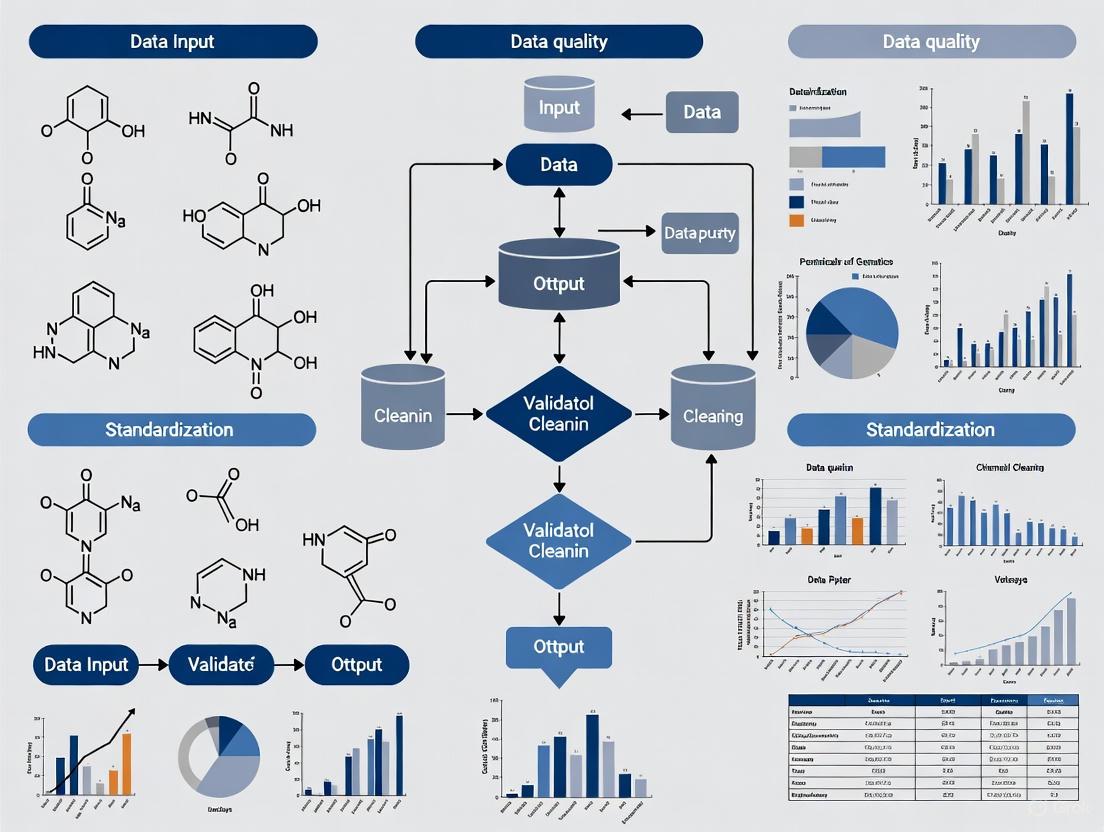
This article addresses the critical challenge of data quality and standardization in chemoinformatics, a field pivotal to accelerating drug discovery and materials science.
Data Quality and Standardization in Chemoinformatics: Foundational Principles, Methodologies, and Best Practices for Robust Research
Abstract
This article addresses the critical challenge of data quality and standardization in chemoinformatics, a field pivotal to accelerating drug discovery and materials science. It provides researchers and drug development professionals with a comprehensive framework covering the foundational sources of data inconsistency, practical methodologies for standardization and pipelining, strategies for troubleshooting common issues, and rigorous approaches for model validation and benchmarking. By synthesizing current best practices and emerging trends, the content aims to equip scientists with the knowledge to enhance the reliability, reproducibility, and impact of their computational research, ultimately fostering more efficient and successful R&D outcomes.
The Data Quality Imperative: Understanding the Core Challenges in Chemical Information
The Impact of Poor Data Quality on Predictive Modeling and Drug Discovery
Technical Troubleshooting Guides
Troubleshooting Guide 1: Resolving Inaccurate Predictive Model Outputs
Problem: A predictive model for compound toxicity is generating unreliable and inaccurate predictions, leading to failed experimental validation.
Explanation: Inaccurate model outputs are frequently caused by underlying data quality issues. The model's predictions are only as reliable as the data it was trained on. Inconsistencies, errors, or biases in the source data will be learned and amplified by the model [1] [2].
Solution: A systematic approach to diagnose and rectify data quality problems.
Step 1: Audit Training Data Provenance and Completeness
- Action: Trace the training data back to its original source. Check for documentation on how the data was generated, including experimental protocols and units of measurement.
- Check for: Missing values, incomplete experimental context (e.g., assay conditions), or a dataset that lacks both positive (active) and negative (inactive) compounds, which is crucial for robust model training [3] [4].
- Fix: Prioritize data from sources that practice rigorous manual curation and provide full provenance. Impute missing values carefully or consider removing entries with excessive missing data.
Step 2: Check for Entity Disambiguation Errors
- Action: Scrutinize the dataset for inconsistent representations of the same chemical or biological entity.
- Check for: A single protein target referred to by multiple names or identifiers, or a small molecule represented by different stereochemical or salt forms that are not standardized [1] [4].
- Fix: Reconcile all entities to authoritative constructs. Use standardized identifiers (e.g., InChIKeys for compounds, UniProt IDs for proteins) to cluster identical entities before retraining the model [1].
Step 3: Validate Data Consistency and Normalization
- Action: Ensure that all numerical data, particularly bioactivity measurements (e.g., IC50, Ki), are on a consistent scale and in the same units.
- Check for: Mixed units (e.g., nM vs. µM) or data extracted from different assay types that are not comparable.
- Fix: Apply thorough data normalization. Convert all measurements to a standard unit. This process often requires human expertise to correctly interpret and reconcile data from scientific literature and patents [1].
Prevention: Implement a robust data governance framework that enforces FAIR (Findable, Accessible, Interoperable, Reusable) data principles from the point of data generation [4] [2].
Troubleshooting Guide 2: Addressing Failure to Reproduce Published Results
Problem: Your team cannot reproduce the results of a key published study or an earlier internal experiment.
Explanation: The inability to reproduce results is often rooted in ambiguous or incorrect metadata, rather than a failure of experimental technique. This includes incomplete descriptions of chemical structures, biological materials, or experimental procedures [4] [5].
Solution: A forensic analysis of the methods and materials described.
Step 1: Verify Chemical Structure and Purity
- Action: Re-examine the chemical structure of the compound used, paying close attention to stereochemistry, hydration, or salt forms that may have been incorrectly reported or interpreted.
- Check for: Errors in structure-identifier mapping, such as an incorrect CAS Registry Number (CAS RN) associated with a structure [4].
- Fix: Source the compound from a reputable supplier and confirm its identity and purity via analytical methods (e.g., NMR, LC-MS) before use. Consult multiple databases to resolve discrepancies.
Step 2: Scrutinize Biological Reagents and Assay Conditions
- Action: Confirm the identity and passage number of cell lines, the construct and expression system for recombinant proteins, and all critical buffer components.
- Check for: Cell line misidentification or contamination, which is a common issue. Also, check for vague descriptions of assay conditions (e.g., "room temperature," "standard buffer").
- Fix: Use authenticated, low-passage cell lines from reliable repositories. Document all assay conditions in exhaustive detail, including pH, temperature, incubation times, and solvent concentrations.
Step 3: Evaluate Data Interpretation and Visualization
- Action: Critically assess the figures and data representations in the original publication.
- Check for: Unclear or inconsistent use of arrow symbols in pathway diagrams, which can be interpreted in multiple ways (e.g., conversion, translocation, activation, inhibition) [6].
- Fix: Reach out to the corresponding author of the publication to request clarification on ambiguous methodological details or data representations.
Prevention: Maintain detailed, standardized electronic lab notebooks (ELNs) that capture every aspect of an experiment, enabling flawless replication.
Data Quality Assurance Framework
The following workflow outlines a comprehensive process for ensuring data quality, from initial profiling to ongoing governance.
Quantitative Impact of Poor Data Quality
The table below summarizes the tangible costs and operational impacts of data quality issues in drug discovery.
| Data Quality Issue | Impact on Predictive Modeling | Operational & Financial Cost |
|---|---|---|
| Inconsistent Entity Representation (e.g., multiple names for one protein) | Reduces model accuracy; creates false independent observations [1] | Wasted resources on testing misidentified compounds; delays in project timelines |
| Lack of Negative Data (e.g., reporting only active compounds) | Leads to models with poor selectivity and high false-positive rates [3] | Pursuit of non-viable lead compounds, increasing late-stage failure costs |
| Propagated Identifier Errors (e.g., incorrect CAS RN-structure links) | Generates fundamentally flawed training data, producing misleading predictions [4] | Costs of flawed research based on incorrect data; estimated average of $12.9M annually for companies [7] |
| Non-Standardized Units & Measurements | Makes data from different sources incompatible, reducing usable dataset size [1] | Time spent manually reconciling data; impedes automated data integration and analysis |
Frequently Asked Questions (FAQs)
Q1: What are the most common data quality issues in public chemical databases? The most frequent issues include incorrect associations between chemical structures and their identifiers (like CAS RNs), errors in representing stereochemistry, the propagation of errors from one database to another (data crosstalk), and a lack of clarity regarding data provenance and licensing [4]. These errors can be subtle but have a significant impact on predictive models.
Q2: How does poor data quality specifically impact AI and machine learning in drug discovery? AI/ML models are entirely dependent on their training data. Poor quality data leads to models that are inaccurate, unreliable, and prone to bias. For example, a model trained without carefully curated negative data (inactive compounds) will struggle to distinguish between active and inactive compounds in virtual screening [3] [8]. Furthermore, errors in chemical structures can lead the model to learn incorrect structure-activity relationships.
Q3: What is the difference between data quality assurance and data quality control? Data Quality Assurance (QA) is a proactive process focused on preventing data errors by establishing standards, protocols, and training. It is process-oriented. In contrast, Data Quality Control (QC) is a reactive process that involves detecting and correcting errors in existing datasets through activities like auditing, validation, and cleansing [9]. A robust data strategy requires both.
Q4: What are FAIR data principles and why are they important? FAIR stands for Findable, Accessible, Interoperable, and Reusable. These principles provide a framework for managing data to ensure it can be easily located, accessed, integrated, and reused by humans and machines. Adopting FAIR principles is crucial for accelerating drug discovery as it enhances data sharing, improves reproducibility, and ensures that data assets can be fully leveraged for future research [4] [2].
Q5: Our models are performing well on validation tests but failing in real-world applications. What could be wrong? This is often a sign of model overfitting or a data representativeness problem. Your training data may not adequately reflect the diversity of chemical space or biological contexts encountered in real-world scenarios. The training data might contain biases or lack critical negative examples, causing the model to perform poorly on novel, external compounds [3] [2]. Re-auditing the training data for coverage and bias is essential.
Standardized Experimental Protocol for Data Generation
Protocol: Validated Compound Bioactivity Data Generation
1. Objective: To generate accurate, reproducible, and well-annotated bioactivity data for a compound library against a specific protein target, ensuring fitness for use in predictive modeling.
2. Materials:
- Compound Library: Pre-formatted in DMSO, with confirmed identity and purity (e.g., >95% by LC-MS).
- Protein Target: Purified recombinant protein, with sequence and storage buffer fully documented.
- Assay Reagents: Substrate, co-factors, and detection reagents. Lot numbers for all critical reagents must be recorded.
- Equipment: Liquid handling robot, microplate reader, and data analysis software.
3. Procedure:
- Step 1: Plate Map Generation. Create a detailed electronic plate map that defines the location of each test compound, positive controls (known inhibitor), and negative controls (DMSO only). Include on-plate replicates for statistical robustness.
- Step 2: Assay Execution.
- Dilute the protein and compounds in the reaction buffer to the working concentrations.
- Using automated liquid handling, transfer compounds and then initiate the reaction by adding the protein/substrate mixture.
- Incubate the plate under defined conditions (temperature, time).
- Measure the signal according to the assay's detection method (e.g., fluorescence, absorbance).
- Step 3: Data Capture.
- Raw signal data from the plate reader is automatically uploaded to a database.
- The plate map file is electronically linked to the raw data file.
- Step 4: Data Analysis & Normalization.
- Calculate percent inhibition for each well using the mean of positive and negative controls on the same plate.
- Fit dose-response curves to generate IC50 values.
- All data transformation steps and calculation formulas must be documented and version-controlled.
4. Required Metadata & Documentation: This protocol must generate the following metadata to ensure data quality and reproducibility:
- Chemical Structure: Standardized InChI and SMILES strings for each compound.
- Sample Purity: Analytical data confirming compound purity and identity.
- Assay Buffer: Exact composition, pH, and preparation method.
- Control Data: Raw values for positive and negative controls on each plate.
- Data Processing Scripts: Versioned code used for curve fitting and IC50 calculation.
The Predictive Modeling Process: From Data to Insight
The following diagram illustrates the end-to-end workflow for building predictive models in drug discovery, highlighting critical data quality checkpoints.
| Tool / Resource Category | Specific Examples | Function & Relevance to Data Quality |
|---|---|---|
| Curated Public Databases | CAS BioFinder [1], ChEMBL [4], DSSTox/CompTox Chemicals Dashboard [4] | Provide pre-curated, high-quality chemical and bioactivity data with provenance, serving as reliable sources for model training. |
| Data Standardization Tools | Standardizer software, InChI/SMILES validators | Convert diverse data representations into consistent, standardized formats (e.g., canonical tautomers, neutral forms), ensuring data interoperability. |
| Automated Curation & FAIRification Platforms | Polly platform [2] | Use machine learning to automate the process of making data FAIR (Findable, Accessible, Interoperable, Reusable), crucial for handling large datasets. |
| Chemical Identifier Resolvers | PubChem Identifier Exchange Services, NCBI Utilities | Help resolve and cross-reference different chemical identifiers (e.g., names, CAS RN, structures) to ensure entity consistency. |
| Data Governance & Quality Frameworks | FAIR Data Principles [4] [2], Data Quality Pillars (Accuracy, Completeness, etc.) [9] | Provide the strategic foundation, policies, and metrics for maintaining high data quality across an organization. |
Molecular representations like SMILES, InChI, and MOL files serve as fundamental digital languages for chemistry, enabling data exchange, storage, and analysis in chemoinformatics. However, inconsistencies in these identifiers pose significant challenges for data integrity, affecting quantitative structure-activity relationship (QSAR) modeling, drug discovery, and chemical hazard assessment [10] [11]. This technical support guide addresses common pitfalls and provides troubleshooting methodologies to enhance data quality and standardization, which is crucial for reliable chemoinformatics research.
Frequently Asked Questions (FAQs)
1. Why does the same molecule generate different SMILES or InChI strings in different databases? Inconsistencies often arise from the use of different software tools and structure standardization rules across databases. Studies have shown that the consistency between systematic chemical identifiers and their corresponding MOL representation varies greatly between data sources (37.2% to 98.5%) [10]. When different chemistry business rules or normalization approaches are applied for data integration, the same structure can be represented by different identifiers.
2. My database search using an InChIKey failed to find a known compound. What could be wrong? InChIKey generation can vary between software due to differences in handling undefined stereochemistry, chiral flags, or input formats. For example, a molecule generated different InChIKeys from Marvin software versus the IUPAC standard due to an unset chiral flag in the MOL file [12]. Using non-standard InChI options can also produce different keys. Always ensure your input structure is properly defined and use standard, well-documented settings for identifier generation.
3. Why does my SMILES string fail to parse or generate an invalid structure? SMILES strings can contain syntax errors, valence errors, or kekulization failures. Common problems include unmatched parentheses, unclosed rings, or atoms with uncommon valence states [13]. For example, the pipe character ("|") is not a valid character in a SMILES string and will cause parsing to fail [14]. Always validate SMILES strings with a parsing tool before use in databases or applications.
4. How are salts and charged molecules handled inconsistently in InChI?
InChI handles protonation and charged species differently depending on the functional groups involved. For example, penicillin G potassium salt uses the /p layer to indicate proton removal, while chloramine-T adjusts the formula and /h layer instead [15]. This inconsistency arises from algorithmic treatment of different chemical functionalities and can lead to confusion when comparing ionic species.
5. What is the impact of these inconsistencies on chemoinformatics research? Identifier inconsistencies directly impact QSAR prediction accuracy, chemical hazard and risk assessments, and can cause problems in chemical ordering and analytical standard identification [11]. When merging data from multiple sources, these inconsistencies can lead to incorrect structure-activity relationships and reduced model reliability.
Troubleshooting Guides
Guide 1: Diagnosing and Resolving SMILES Inconsistencies
Problem: SMILES strings for the same compound are not matching across different databases or software tools.
Investigation Protocol:
- Standardize Input Structures: Begin by applying consistent structure standardization rules to all compounds. This includes normalization of tautomers, neutralization of charges, and unambiguous stereochemistry representation [10].
- Generate Canonical SMILES: Use a reliable cheminformatics toolkit (e.g., RDKit, Open Babel) with consistent parameters to generate canonical isomeric SMILES from the standardized structures.
- Validate SMILES Syntax: Use a validating SMILES parser to check for and categorize errors. The workflow below outlines a diagnostic procedure adapted from manual validation techniques [13].
Diagram: SMILES Validation Workflow. A systematic approach to diagnose common SMILES string errors.
- Compare Parent Structures: For advanced troubleshooting, compare the parent structures (ignoring stereochemistry) by removing stereochemical descriptors. This can help determine if the core connectivity is consistent.
Solution: Implement a consistent structure standardization protocol before generating any SMILES strings. For database curation, use automated validation scripts to flag and manually review compounds with syntax or valence errors.
Guide 2: Addressing InChI and InChIKey Generation Discrepancies
Problem: Different software tools generate different InChI or InChIKey identifiers for the same molecular structure.
Investigation Protocol:
- Verify Input Structure Integrity: Ensure the input MOL file contains complete and correct stereochemical information. Check that the chiral flag is properly set, as this is a common source of discrepancy [12].
- Use Standard InChI Generation: Always generate standard InChI using the official IUPAC software or tools that adhere strictly to its specifications. Avoid non-standard options unless specifically required.
- Cross-Validate with Multiple Tools: Generate InChI/InChIKey using different reputable tools (e.g., RDKit, Open Babel, ChemAxon) and compare results. Inconsistency indicates a problem with the input structure or software configuration.
- For Salts and Charged Molecules: Carefully analyze the InChI layers (particularly
/q,/p, and/f) to understand how charges and protons are being handled. Be aware that different protonation states of the same functional group may be treated differently [15].
Solution: For database indexing, always generate InChIKeys from standardized MOL files using a single, well-defined software configuration. If using RDKit, ensure you're using the latest version and consider known issues with specific structures [16]. For structures with undefined stereochemistry, explicitly define stereo centers or use consistent flags.
Guide 3: Identifying and Correcting Database Cross-Reference Errors
Problem: Chemical structures linked via cross-references between databases (e.g., PubChem, ChEBI, DrugBank) have inconsistent representations.
Investigation Protocol:
- Extract Cross-Referenced Compounds: Obtain pairs of compounds that are linked via cross-references between the databases of interest.
- Convert to Standard InChI: Generate Standard InChI strings from the MOL files of both structures in each pair, using the same software and version [10].
- Compare InChI Strings: Perform exact string matching of the full InChIs and the InChIKeys (first 14 characters representing the connectivity).
- Analyze Discrepancies: For inconsistent pairs, examine the specific differences:
- Compare with stereochemistry ignored (using the FICTS standardization rules or similar) [10]
- Check for differences in tautomeric representation
- Identify charge and protonation state variations
- Detect isotopic labeling differences
Solution: When merging data from multiple sources, regenerate systematic identifiers starting from the MOL representation after applying consistent, well-documented chemistry standardization rules. Prefer structure-based matching (using standardized InChI) over literal identifier matching for data integration tasks.
Experimental Protocols and Data
Quantitative Analysis of Identifier Consistency
Research has quantified the consistency of systematic identifiers within and between chemical databases. The table below summarizes key findings from a study analyzing major chemical resources [10].
Table 1: Consistency of Systematic Chemical Identifiers Within Databases
| Database | MOL-InChI Consistency | MOL-SMILES Consistency | MOL-IUPAC Consistency | Notes |
|---|---|---|---|---|
| DrugBank | 98.2% | 99.9% | 99.7% | 6,506 compounds analyzed |
| ChEBI | 89.3% | 92.3% | 88.0% | 21,367 compounds analyzed |
| HMDB | 100.0% | 100.0% | 90.5% | 8,534 compounds analyzed |
| PubChem | 100.0% | 100.0% | 94.1% | Subset of 5M+ compounds |
Table 2: Impact of Structure Standardization on Cross-Database Consistency
| Standardization Applied | Minimum Consistency | Maximum Consistency | Observation |
|---|---|---|---|
| With Stereochemistry | 25.8% | 93.7% | Wide variation in MOL representation of cross-referenced compounds |
| Without Stereochemistry | 47.6% | 95.6% | Significant improvement in consistency after removing stereo information |
Standardization Protocol for Consistent Identifier Generation
Based on the FICTS rules developed by the NCI/CADD group, apply the following standardization steps before generating any systematic identifiers [10]:
- Remove small organic fragments (F)
- Ignore isotopic labels (I)
- Neutralize charges (C)
- Generate canonical tautomers (T)
- Ignore stereochemistry information (S) - Apply only for non-stereosensitive applications
Implementation code outline:
The Scientist's Toolkit
Table 3: Essential Research Reagent Solutions for Molecular Representation Work
| Tool/Resource | Type | Primary Function | Application in Troubleshooting |
|---|---|---|---|
| RDKit | Cheminformatics Library | Molecular manipulation, property calculation, file conversion | Generate canonical SMILES, validate structures, convert between formats [17] |
| Open Babel | Chemical File Conversion Tool | Format translation, descriptor calculation | Batch conversion of chemical files, compare outputs from different tools [17] |
| InChI Software (IUPAC) | Reference Standard | Generate standard InChI/InChIKey | Provide benchmark identifiers for comparison [12] |
| PartialSMILES Parser | Validation Library | SMILES syntax validation | Diagnose specific SMILES parsing errors (syntax, valence, kekulization) [13] |
| FICTS Standardization Rules | Chemistry Standardization Protocol | Structure normalization | Preprocess structures before identifier generation to ensure consistency [10] |
| COD/CSD Databases | Curated Structure Databases | Source of validated molecular geometries | Reference data for validating molecular representations [18] |
Methodologies for Data Quality Assessment
Database Quality Control Protocol
For maintaining high-quality chemical databases, implement this systematic validation procedure:
- Structure-Identifier Consistency Check: Verify that all systematic identifiers (SMILES, InChI, IUPAC) correspond to the same MOL structure by converting all to Standard InChI and performing exact matching [10].
- Cross-Database Validation: For compounds with cross-references to external databases, compare the InChIKeys to identify inconsistent representations and correct the erroneous entries.
- Automated Error Flagging: Implement automated scripts to flag compounds with:
- Invalid SMILES syntax
- InChIKeys that don't match the structure
- Significant discrepancies with cross-referenced compounds
- Regular Revalidation: Schedule periodic database revalidation to maintain data quality as standardization methods and software tools evolve.
This comprehensive approach to identifying and resolving molecular representation inconsistencies will significantly enhance the reliability of chemoinformatics research and drug development workflows.
The Critical Role of Stereochemistry and Tautomerism in Data Ambiguity
Troubleshooting Guides
Guide 1: Resolving Tautomerism-Related Compound Registration Errors
Problem: During database registration, a new compound is flagged as a duplicate of an existing entry, but the structures appear different when viewed. This often leads to failed registration attempts and confusion about compound uniqueness.
Explanation: This is a classic symptom of tautomerism, where a single compound can exist as multiple, readily interconverting structural isomers [19]. Database lookup tools often normalize these different forms to a single canonical structure. If your submitted compound is a different tautomer of an already registered structure, the system will identify it as a duplicate [20].
Solution:
- Confirm Tautomeric Relationship: Use chemoinformatics toolkits (e.g., CACTVS, OpenEye) to enumerate possible tautomers of your submitted structure. Compare the canonical tautomer of your compound with that of the alleged duplicate [19] [20].
- Verify "Sameness" Experimentally (if critical): For crucial compounds, confirm the tautomeric relationship analytically. As demonstrated in a large-scale study, purchase the samples and analyze them via ¹H and 13C NMR spectroscopy. The NMR spectra of different tautomers of the same compound will be identical, confirming they are the same "stuff in the bottle" [19].
- Standardize Before Submission: Implement a pre-registration standardization step that converts all structures to a consistent, canonical tautomeric form. This prevents future duplication issues [21] [22].
Guide 2: Addressing Inconsistent Biological Screening Data for Stereoisomers
Problem: Screening data for a compound is inconsistent between different tests or collaborator sites. One test shows high activity, while another shows low or no activity, and the cause cannot be traced to obvious experimental error.
Explanation: This frequently occurs with chiral compounds. If a screening library uses a racemic mixture (a 50/50 mix of both enantiomers), the observed biological activity is an average of the activities of the two individual enantiomers [23]. One enantiomer (the eutomer) may be highly active, while the other (the distomer) may be inactive or even antagonistic. Slight variations in the composition of the screened material can lead to significant differences in the readout.
Solution:
- Chiral Resolution: Separate the racemic mixture into its pure enantiomers using chiral chromatography or asymmetric synthesis [23].
- Test Enantiomers Individually: Screen each pure enantiomer separately to determine their individual activities and potencies. This provides a clear structure-activity relationship (SAR) and eliminates ambiguity [23].
- Audit Screening Libraries: Review the composition of your compound libraries. Prefer libraries that supply stereoisomers as separate, defined entries rather than as racemic mixtures to ensure consistent and interpretable screening results [23].
Guide 3: Correcting Invalid Stereochemical Descriptors in Computed InChI Keys
Problem: After processing a chemical structure through an informatics pipeline, the generated InChI Key lacks stereochemical descriptors, even though the original structure had defined stereocenters.
Explanation: The standard InChI algorithm involves a normalization process that can remove certain types of stereochemical information. This includes converting relative stereochemistry to absolute or handling double bonds with undefined stereochemistry ("either" bonds) based on atom coordinates [22]. If the structure was not drawn with precise coordinates or used "either" bonds, the canonicalization step may generate an InChI Key that does not fully represent the intended stereochemistry.
Solution:
- Use the Original Connection Table: For database registration, treat the original connection table (e.g., from an MOL or SDF file) as the primary source of structural truth, not the InChI or InChI Key [22].
- Validate Cross-Representations: Use validation tools like the Chemical Validation and Standardization Platform (CVSP) to cross-validate that the InChI, SMILES, and connection table all represent the same stereochemistry [22].
- Employ Non-Standard InChI: For internal workflows where loss of stereo information is detrimental, consider using a "non-standard" InChI option that preserves this information, acknowledging that this will reduce interoperability with public databases [22].
Frequently Asked Questions (FAQs)
FAQ 1: How prevalent is tautomerism in real-world chemical databases, and why does it matter for drug discovery?
Tautomerism is not a rare edge case; it is a widespread phenomenon. A large-scale analysis of over 100 million unique chemical structures found that more than two-thirds are capable of tautomerism, with the potential to generate hundreds of millions of distinct tautomeric forms [20].
The impact on drug discovery is significant [21] [24]:
- Data Inconsistency: Different tautomers may be registered as distinct compounds in databases, fracturing associated bioassay data and misleading machine learning models.
- Resource Waste: Organizations may inadvertently request assays for multiple tautomeric forms of the same compound, leading to duplicated efforts and increased costs [21].
- Pharmacological Effects: Different tautomers can have different binding affinities and metabolic pathways. For example, the antibiotic erythromycin exists in three tautomeric forms, but only the ketonic form is active, necessitating larger doses to be effective [24].
FAQ 2: Can tautomerism and stereochemistry interact, and what are the consequences?
Yes, tautomerism and stereochemistry can interact, leading to complex and sometimes unexpected consequences [20]:
- Loss of Chirality: The migration of a double bond during tautomerism can eliminate a chiral center, effectively causing racemization.
- Creation of New Stereocenters: Conversely, tautomerism can create new chiral centers or E/Z double-bond stereochemistry.
- Altered Properties: This interconversion can change a molecule's shape, hydrogen-bonding pattern, and surface, thereby affecting its computed properties, database registration, and predicted biological activity.
FAQ 3: What are the best practices for standardizing chemical structures to minimize data ambiguity?
To ensure high-quality, unambiguous chemical data, implement the following best practices:
- Adopt a Canonical Tautomer Form: Establish and consistently use a single, rule-based canonical tautomer for all compounds in your database. This is crucial for reliable searching and machine learning [21].
- Validate All Representations: Cross-validate connection tables, SMILES strings, and InChI identifiers against each other to catch inconsistencies using tools like the Chemical Validation and Standardization Platform (CVSP) [22].
- Treat Stereoisomers as Distinct Entities: Register and manage individual stereoisomers as separate compounds. Develop and use chiral analytical methods (e.g., chiral HPLC) early in the discovery process to monitor and control stereochemical integrity [23].
Experimental Protocols
Protocol: Experimental Verification of Tautomer Identity via NMR Spectroscopy
Objective: To determine whether two commercially available samples, which are suspected to be different tautomers of the same chemical compound, are indeed the same substance ("stuff in the bottle") [19].
Background: Tautomeric equilibria can be influenced by solvent, temperature, and concentration. NMR spectroscopy provides a direct method to analyze the actual composition of a sample in solution. If two samples are different tautomers of the same compound, their NMR spectra will be identical because they exist in the same equilibrium mixture under the given conditions [19].
Materials:
- Research Reagent Solutions:
Methodology:
- Sample Preparation: Precisely weigh 2-5 mg of each commercial sample into separate, clean vials. Dissolve each sample in 0.6 mL of the same deuterated solvent. Transfer each solution to a separate, labeled NMR tube [19].
- Data Acquisition:
- Acquire standard ¹H NMR spectra for both samples using the NMR spectrometer. Ensure acquisition parameters (temperature, number of scans, pulse sequence) are identical for both samples.
- Acquire ¹³C NMR spectra for both samples to compare the carbon skeletons.
- Data Analysis:
- Compare the ¹H and ¹³C NMR spectra of the two samples.
- If the spectra are superimposable, the two samples are the same compound, existing in an identical equilibrium of tautomers in the chosen solvent.
- If the spectra are markedly different, the samples are likely different chemical compounds, and the initial tautomer hypothesis is incorrect.
Workflow Diagram:
Data Presentation
Table 1: Impact of Tautomerism on Compound Uniqueness in a Large Commercial Database
The following data summarizes a study of the Aldrich Market Select (AMS) database, which identified numerous cases of the same chemical being sold as different products due to tautomerism [19].
| Database Analyzed | Tautomer Pairs/Triplets Identified | Experimental Analysis | Experimental Confirmation Rate |
|---|---|---|---|
| Aldrich Market Select (AMS) (~6M samples) | 30,000 cases of multiple products being different tautomers | 166 purchased pairs/triplets analyzed by ¹H/¹³C NMR | Essentially all prototropic transforms were confirmed. Some ring-chain transforms were too "aggressive." |
Table 2: Prevalence and Impact of Tautomerism and Stereochemistry
This table consolidates data on the prevalence of tautomerism and the regulatory and practical implications of stereochemistry.
| Concept | Metric | Impact/Regulatory Guidance |
|---|---|---|
| Tautomerism Prevalence | >66% of 103.5M unique structures [20] | Creates ~680M tautomeric forms; causes registration duplicates and data fragmentation [19] [20]. |
| Stereochemistry in Screening | Racemate screening shows averaged activity [23] | Can mask true activity of a single enantiomer; requires chiral resolution for accurate SAR [23]. |
| Regulatory Guidance (ICH/FDA/EMA) | Requires stereochemical composition identification [23] | Mandates chiral analytical methods and justification for developing racemates over single enantiomers [23]. |
Standardization Workflow
Diagram: Chemical Data Standardization Workflow
The following diagram outlines a standardized workflow for processing chemical structures to minimize ambiguities related to tautomerism and stereochemistry, suitable for populating a high-quality chemical registration system.
Technical Support Center
Troubleshooting Guides
This section addresses common technical challenges faced when integrating chemical and biological data, providing root cause analyses and step-by-step solutions.
Problem 1: Inconsistent Molecular Structure Representations
- Symptoms: Failed structure searches, incorrect similarity calculations, errors in predictive model outputs.
- Root Cause: The same molecule can be represented in different ways (e.g., varying tautomeric forms, stereochemistry assignments, or salt forms) across data sources [25] [26]. Legacy data may have been generated using outdated or incorrect representation rules.
- Solution:
- Standardize Structures: Implement a consistent structural standardization workflow using tools like RDKit, ChemAxon JChem, or Schrodinger LigPrep [26]. This process should include:
- Aromatization of rings.
- Removal of counterions and salts, if required for the analysis.
- Standardization of specific chemotypes and functional groups.
- Validation of stereochemistry.
- Handle Tautomers: Apply consistent tautomer representation rules, such as those established by Sitzmann et al., to choose the most populated tautomer [26].
- Manual Verification: For complex molecules or a representative sample of the dataset, perform manual checks to identify errors that automated tools may miss [26].
- Standardize Structures: Implement a consistent structural standardization workflow using tools like RDKit, ChemAxon JChem, or Schrodinger LigPrep [26]. This process should include:
Problem 2: Discrepant or Non-Reproducible Bioactivity Data
- Symptoms: Large activity value variances for the same compound-target pair, poor-performing QSAR models, inability to confirm published results.
- Root Cause: Data originates from different laboratories using varied assay technologies (e.g., tip-based vs. acoustic dispensing), experimental conditions, or data processing protocols [26]. Subtle experimental variations can significantly influence the measured response.
- Solution:
- Identify Duplicates: Process the dataset to find chemical duplicates (identical compounds) and compare their reported bioactivities [26].
- Analyze Variability: For duplicate entries, calculate the mean and standard deviation of the activity values. Establish a threshold for acceptable variance based on the assay type.
- Curate the Data: Decide on a consolidation strategy. This could involve:
- Taking the mean or median of the activity values.
- Applying a weighted average based on the perceived reliability of the data source or assay method.
- Flagging or removing extreme outliers for further investigation [26].
- Document Metadata: Always record key experimental metadata (e.g., assay type, target information, measurement units) to provide context for the integrated data.
Problem 3: Heterogeneous and Incompatible Analytical Data Formats
- Symptoms: Inability to open or read data files from different instruments, loss of metadata during format conversion, hindered data assembly for multi-technique analysis.
- Root Cause: Analytical instruments from various vendors use proprietary data formats for techniques like chromatography (HPLC, UHPLC), mass spectrometry (MS), and spectroscopy (NMR, IR) [27]. This heterogeneity obstructs the assembly of interrelated datasets.
- Solution:
- Select a Standardized Format: Convert proprietary data into a standardized, non-proprietary format to ensure long-term accessibility and interoperability. Consider using open standards or actively maintained proprietary platforms that support a wide range of vendor formats [27].
- Leverage Data Platforms: Utilize platforms like the ACD/Labs Spectrus Platform, which natively supports over 150 proprietary analytical data formats, acting as a bridge between different vendor systems [27].
- Prioritize Metadata-Rich Formats: When converting data, choose formats that preserve the original metadata (e.g., experimental parameters, processing steps) to maintain data provenance and reproducibility [27].
Frequently Asked Questions (FAQs)
Q1: What are the primary types of heterogeneity we encounter in chemoinformatics data?
You will typically face three main types of heterogeneity [28] [29]:
- Format Heterogeneity: Data comes in different file and encoding formats (e.g., vendor-specific instrument formats, JSON, XML, CSV, SD-files) [30] [27].
- Semantic Heterogeneity: The same term can have different meanings, or different terms can mean the same thing across datasets. For example, "IC50" might be defined or measured differently in various labs [28] [26].
- Structural Heterogeneity: Data spans structured (e.g., database tables), semi-structured (e.g., XML, JSON), and unstructured (e.g., text in scientific literature) forms [29].
Q2: Our QSAR models are underperforming. Could integrated data quality be the issue?
Yes, this is a common cause. The accuracy of QSAR models is highly dependent on the quality of the underlying data [26]. To diagnose and fix this:
- Curate Chemical Structures: Ensure all molecular structures are correct and standardized. Errors in structures directly lead to errors in calculated descriptors and model predictions [26] [31].
- Curate Bioactivity Data: Identify and resolve discrepancies in activity data for chemical duplicates, as datasets with many inconsistent duplicates can lead to over-optimistic or inaccurate models [26].
- Check for Data Balance: Ensure your dataset includes both active and inactive (negative data) compounds, as this is essential for training reliable classification models [25].
Q3: What is the difference between data standardization and data normalization/harmonization?
These are two critical, distinct steps in data preparation [27]:
- Data Standardization homogenizes data from different sources into a consistent technical format. For example, converting all molecular structures into a single notation like SMILES or InChI, or converting all chromatographic data files into a unified format like AnIML or Allotrope [32] [27].
- Data Normalization/Harmonization translates the data content itself into an agreed-upon ontology or vocabulary. This ensures semantic consistency, for instance, mapping all terms for "dimethyl sulfoxide" to a standard identifier like "DMSO" across all assay data [27].
Q4: How can we prepare heterogeneous data for AI/ML applications?
AI/ML places a premium on well-curated, standardized data [25] [27]. Follow these steps:
- Engineer Your Data: Perform thorough data curation, standardization, and normalization as described in the previous FAQs [26].
- Choose Machine-Readable Formats: Use flexible, widely compatible formats like JSON or domain-specific standards like Chemical Markup Language (CML), which are well-suited for AI/ML workflows and cloud-based platforms [27].
- Implement Robust Metadata Management: Ensure all data is accompanied by rich, structured metadata to guarantee data provenance and reproducibility, which is critical for interpreting AI/ML outputs [27].
Experimental Protocols for Data Integration
Protocol 1: Integrated Chemical and Biological Data Curation Workflow
This protocol provides a detailed methodology for curating chemogenomics data prior to integration and model development, based on established best practices [26].
- Objective: To verify the accuracy, consistency, and reproducibility of both chemical structures and bioactivity data in a chemogenomics dataset.
Materials:
- Raw dataset of chemical structures and associated bioactivities.
- Cheminformatics software (e.g., RDKit, ChemAxon JChem, Knime with chemistry plugins).
- Access to chemical databases (e.g., PubChem, ChEMBL, ChemSpider) for verification.
Procedure:
- Chemical Structure Curation:
- Remove Incompatible Compounds: Filter out inorganic, organometallic compounds, mixtures, and large biologics if the subsequent analysis tools are not equipped to handle them [26].
- Structural Cleaning: Use software to detect and correct valence violations, extreme bond lengths/angles, and other structural errors [26].
- Standardization: Aromatize rings, normalize chemotypes, and standardize tautomeric forms to a consistent representation [26].
- Stereochemistry Verification: Check the correctness of stereocenters by comparing to similar compounds in trusted databases like PubChem or ChemSpider [26].
- Biological Data Curation:
- Identify Chemical Duplicates: Find all instances of the same compound in the dataset.
- Compare Bioactivities: For each set of duplicates, compare the reported bioactivity values (e.g., IC50, Ki).
- Resolve Discrepancies: Apply a pre-defined rule to consolidate multiple activity values (e.g., calculate the mean or median) or flag entries with high variance for further review [26].
- Validation:
- Manually inspect a representative or "suspicious" subset of the curated data to verify the automated process.
- If a crowd-curated platform like ChemSpider is available, leverage community expertise for verification [26].
- Chemical Structure Curation:
The following workflow diagram illustrates the key steps and decision points in this protocol:
Protocol 2: Standardization of Analytical Data for AI/ML
- Objective: To homogenize analytical data (e.g., from NMR, LC/MS) from diverse instrument sources into a standardized, machine-readable format suitable for AI/ML pipelines.
Materials:
- Raw analytical data files in various proprietary vendor formats.
- Data standardization tool (e.g., ACD/Labs Spectrus Platform, custom scripts with vendor SDKs, format converters).
- A target standardized data format (e.g., AnIML, Allotrope, JSON).
Procedure:
- Inventory Data Sources: Catalog all analytical techniques and instrument vendors from which data will be integrated.
- Select a Target Format: Choose a data format based on needs for longevity, metadata completeness, and AI/ML compatibility. JSON is often preferred for its flexibility and compatibility with modern AI/ML platforms, while domain-specific formats like AnIML offer high fidelity for analytical data [27].
- Convert Data: Use the chosen tool to batch-convert proprietary data files into the target standardized format. Ensure the conversion process preserves critical metadata (e.g., instrument parameters, acquisition date, processing methods) [27].
- Validate and Assemble: Check a sample of converted files for accuracy and completeness. Then, assemble the standardized datasets from multiple techniques (e.g., NMR, LC/UV/MS) to create a unified data resource for analysis [27].
The Scientist's Toolkit: Research Reagent Solutions
The following table details key resources and tools essential for tackling heterogeneous data integration in chemoinformatics.
| Item | Function & Application |
|---|---|
| RDKit | An open-source toolkit for cheminformatics used for structural standardization, descriptor calculation, and machine learning [26]. |
| ChemAxon JChem | A commercial software suite that includes tools for structure standardization, tautomer normalization, and chemical database management [26]. |
| Knime Analytics Platform | A visual programming platform with extensive chemistry extensions (e.g., RDKit, CDK) used to build customizable, automated data curation workflows [26]. |
| PubChem | A public database of chemical compounds and their biological activities, useful for verifying chemical structures and finding related bioactivity data [32] [26]. |
| ChEMBL | A manually curated database of bioactive molecules with drug-like properties, providing high-quality data for building predictive models [32] [26]. |
| AnIML (Analytical Information Markup Language) | An XML-based standard designed for storing and sharing analytical data, helping to overcome instrument vendor format heterogeneity [27]. |
| Allotrope Framework | A suite of standards, including the Allotrope Data Format (ADF) and Ontology, for managing complex laboratory data throughout its lifecycle, improving interoperability [27]. |
| JSON (JavaScript Object Notation) | A lightweight, human-readable data format that is highly flexible and widely used for data exchange in AI/ML workflows [27]. |
Data Integration Standards and Formats
The table below summarizes key data formats and standards relevant to chemoinformatics, highlighting their primary use cases and types.
| Format/Standard | Primary Use Case | Type |
|---|---|---|
| SMILES | Linear string representation of molecular structures; ideal for database storage and fast searching [32]. | Open Standard |
| InChI | Standardized, non-proprietary identifier for molecular structures; ensures global uniqueness for data exchange [25] [32]. | Open Standard |
| AnIML | Storing and sharing data from a wide range of analytical techniques using XML [27]. | Open Standard |
| Allotrope Data Format (ADF) | Managing complex laboratory data from analytical instruments within a standardized framework [27]. | Consortium-based Standard |
| JCAMP-DX | Storing and exchanging spectral data [27]. | Open Standard |
| JSON | Data interchange format particularly well-suited for AI/ML workflows and web-based applications [27]. | Open Standard |
The Evolution from Proprietary Systems to Open Science and FAIR Principles
Technical Support Center
Frequently Asked Questions (FAQs)
Q1: What are the FAIR Principles and why are they critical for modern chemoinformatics?
The FAIR Principles are a set of guiding criteria to make data Findable, Accessible, Interoperable, and Reusable by both humans and machines [33]. They are critical for modern chemoinformatics because the field is grappling with a data deluge and issues of data quality and reproducibility. Adhering to FAIR principles ensures that chemical data from different sources can be integrated and trusted, which is foundational for building reliable machine learning models and enabling collaborative open science [3] [34]. Initiatives like the Open Science Framework (OSF) provide robust, user-friendly tools to help researchers implement these principles effectively [34].
Q2: My ML model for toxicity prediction performs poorly on new compound series. What could be wrong?
This is a common problem often traced to data quality and applicability domain issues. The model may have been trained on low-quality, inconsistent data. For instance, a recent study found almost no correlation between IC50 values for the same compounds tested in the "same" assay by different groups [35]. Furthermore, the model's applicability domain—the chemical space where it can make reliable predictions—may not cover your new series.
- Troubleshooting Checklist:
- Audit Training Data: Verify the source and experimental consistency of your training data. Prefer data from standardized, high-throughput experiments over data manually curated from dozens of disparate publications.
- Define Applicability Domain: Implement methods to systematically analyze the relationship between your training data and the new compounds. This helps identify when a prediction is being made outside the model's reliable scope [35].
- Test Locally vs. Globally: Evaluate if a series-specific (local) model would outperform your current global model. The OpenADMET initiative is generating datasets to enable such comparisons [35].
Q3: How can I make my proprietary research data FAIR without compromising intellectual property?
You can implement FAIR principles for proprietary data without public disclosure. The key is to ensure data is FAIR for authorized users within your organization or consortium.
- Recommended Actions:
- Rich Internal Metadata: Use descriptive titles, detailed metadata, and standard ontologies within your internal data management systems. This fulfills the "Findable" and "Interoperable" pillars internally [34].
- Clear Access Protocols: Use access permission controls on collaborative platforms. You can make project components public (e.g., protocols) while keeping sensitive data private but accessible under clear terms, thus addressing "Accessibility" [34].
- Non-Proprietary Formats: Store data in standardized, non-proprietary file formats (e.g., CSV, TXT) with comprehensive documentation. This ensures "Interoperability" and "Reusability" for future projects, even if the data remains internal [34].
Q4: What are the biggest challenges in transitioning from proprietary software to open-source/open science platforms?
The transition faces several challenges, including resource disparities and motivational conflicts. Industry dominates key AI research elements—computing power, large datasets, and skilled researchers—and may lack motivation to create public scientific goods, instead prioritizing proprietary control to maintain competitive advantage [36]. For individual researchers, challenges include:
- Lack of Computational Resources: Access to large-scale GPU clusters and high-performance computing is often limited in academia [36].
- Data Silos and Standardization: Proprietary systems often use closed formats, hindering interoperability.
- High Implementation Costs & Skill Gaps: Integrating new open platforms with existing infrastructure and training staff requires significant investment [37].
Troubleshooting Guides
Problem: Inconsistent Molecular Representation Causing Data Interoperability Failures
- Symptoms: Errors when sharing files between different software, failure to accurately represent complex chemistry (stereochemistry, metal complexes), poor performance of ML models.
- Background: Molecular notations like SMILES and InChI are widely used but have limitations in consistently representing complex chemical information, which is critical for data interoperability and predictive modeling [3].
- Solution:
- Standardize Input: For data exchange, use the non-proprietary InChI identifier. For database storage and ML, SMILES is common but ensure generation is standardized using a tool like RDKit [3] [38].
- Validate Structures: Always include a structure validation step in your preprocessing workflow using toolkits like RDKit to correct errors and ensure consistency [38].
- Use Multiple Representations: For machine learning, do not rely on a single representation. Experiment with molecular graphs, fingerprints, and descriptors to find the most robust representation for your specific task [35] [38].
- Prevention: Adopt and document a standard operating procedure (SOP) for molecular representation and structure validation in your lab or organization.
Problem: Failure to Reproduce Literature-Based QSAR Model Predictions
- Symptoms: A published QSAR model performs poorly when applied to your in-house compounds, or you cannot recreate the model's published performance metrics.
- Background: Many published models are trained on public data aggregated from various sources, which can suffer from inconsistent experimental protocols, uncurated negative data, and reporting biases [3] [35].
- Solution:
- Scrutinize the Training Data: Investigate the source and composition of the model's training data. Check if it includes well-balanced positive and negative data, which is essential for reliability [3].
- Replicate Assay Conditions: If possible, compare the biological assay conditions used to generate your internal data with those from the literature. Key differences here are often the root cause.
- Generate High-Quality, Local Data: The most reliable solution is to build your own models using high-quality, consistently generated experimental data from relevant assays, similar to the approach taken by OpenADMET [35].
- Escalation: If reproduction is critical, contact the model's original authors for clarification on data preprocessing, hyperparameters, and applicability domain.
Experimental Protocols & Data Standards
Detailed Methodology for a High-Quality ADMET Data Generation Campaign
This protocol is designed to generate consistent, high-quality data for building robust machine learning models, addressing common data quality issues.
1. Objective: To systematically generate absorption, distribution, metabolism, excretion, and toxicity (ADMET) data for a diverse library of 10,000 compounds against a panel of key avoidome targets (e.g., hERG, CYP450s) [35].
2. Experimental Workflow:
- Compound Curation: Select compounds from commercial libraries and in-house collections to ensure chemical diversity and drug-like properties. Standardize all structures using RDKit and confirm purity (>95% by HPLC) [38].
- Assay Development: Establish standardized, high-throughput assays for each ADMET endpoint. Use a single, consistent protocol for each target across all compounds to minimize inter-assay variability [35].
- Data Generation:
- Run all assays in triplicate with appropriate controls (positive, negative, vehicle) on each plate.
- Include reference compounds with known activity in every run to monitor for assay drift.
- Record raw data and calculated activity values (e.g., IC50) in a centralized database.
- Data Processing:
- Apply quality control checks; flag and repeat outliers.
- Curate a dataset that includes both active and inactive compounds, as negative data is crucial for training discriminatory models [3].
3. FAIR Data Packaging:
- Findable: Assign a Digital Object Identifier (DOI) to the final dataset. Register it in a public repository like OSF with rich metadata (research field, tags, resource type) [34].
- Accessible: Provide a clear README file with access instructions. Use OSF's permission controls to manage access if needed [34].
- Interoperable: Save data in standard, non-proprietary formats (e.g., CSV). Include a data dictionary explaining all variables, units, and the standardized assay protocols [34].
- Reusable: Attach an open license (e.g., Creative Commons) to the dataset. Document all methodologies, analysis scripts, and the version of the chemical toolkits used [34].
Data Quality Metrics for Cheminformatics
The following table summarizes key metrics to assess data quality, a common source of problems in chemoinformatics.
| Metric | Description | Target Benchmark | Tool/Method for Assessment |
|---|---|---|---|
| Structure Validity | Percentage of molecules with chemically valid, interpretable structures. | >99.5% | RDKit, Open Babel [38] |
| Assay Reproducibility | Correlation (e.g., R²) of IC50 values for control compounds across different experimental batches. | R² > 0.9 | Internal quality control protocols [35] |
| Data Consistency | Uniformity in molecular representation (e.g., SMILES, InChI) and units of measurement across the dataset. | 100% | Standardized data preprocessing pipelines [38] |
| Negative Data Inclusion | Proportion of datasets that include confirmed inactive compounds alongside active ones. | Should be standard practice | Manual curation, literature review [3] |
Workflow Visualization: Implementing FAIR in Cheminformatics
The diagram below outlines a logical workflow for implementing FAIR principles in a typical chemoinformatics research cycle, from data generation to model sharing.
The Scientist's Toolkit: Key Research Reagent Solutions
This table details essential resources for conducting robust, data-driven chemoinformatics research.
| Item | Function | Relevance to Open Science & FAIR |
|---|---|---|
| RDKit | An open-source toolkit for cheminformatics, used for descriptor calculation, structure manipulation, and machine learning [38]. | Promotes interoperability and reproducibility through open-source, standardized algorithms. |
| Open Science Framework (OSF) | A free, open-source platform for managing, sharing, and documenting research projects and data throughout the entire project lifecycle [34]. | Directly enables FAIRness by providing infrastructure for persistent identifiers, metadata, and access control. |
| PubChem/ChEMBL | Large, public databases of chemical molecules and their biological activities [3]. | Key examples of open data resources that accelerate research through data sharing and reuse. |
| FAIR Data Steward | A professional specializing in data governance, quality, and lifecycle management to ensure data is accurate and compliant with standards [33]. | Critical for the successful implementation of FAIR principles within a research team or organization. |
| Hugging Face (Science Hub) | A platform hosting a vast number of open-source pre-trained models and datasets, including scientific models [36]. | Fosters model transparency, reproducibility, and community-driven development in scientific AI. |
Building a Robust Data Foundation: Standardization Protocols and Cheminformatics Pipelines
Implementing Automated Validation and Standardization with Tools like CVSP
Troubleshooting Guides and FAQs
Frequently Asked Questions (FAQs)
Q1: What is the primary purpose of the Chemical Validation and Standardization Platform (CVSP)? CVSP is a freely available internet-based platform designed to validate and standardize chemical structure datasets from various sources. It processes chemical structure files through tested validation and standardization protocols to ensure that data released into public databases is pre-validated, thereby improving data quality and homogeneity for exchange between online databases [39] [40] [41].
Q2: What common data quality issues does CVSP help to resolve? CVSP detects a myriad of issues that can exist with chemical structure representations online. These include inconsistencies between connection tables (in MOL/SDF files) and associated identifiers like SMILES and InChI, problems with atoms and bonds (e.g., query atoms and bonds), valences, stereochemistry, and the presence of chemically suspicious molecular patterns [39] [41].
Q3: The standalone CVSP website was taken down. Where can I now access its functionality?
The original standalone CVSP website was taken offline in November 2018. However, its core functionality and evolved ruleset have been integrated into the ChemSpider deposition system available at deposit.chemspider.com. The original codebase also remains available on GitHub [40].
Q4: What are the different severity levels of issues identified by CVSP? CVSP categorizes identified issues into three levels of severity to help users prioritize review:
- Error: Indicates a critical issue that very likely requires correction.
- Warning: Highlights a potential problem that should be reviewed.
- Information: Provides informational messages about the data for user awareness [41].
Q5: Why is cross-validating connection tables with SMILES and InChIs important? Often, the connection table (e.g., within an SDF file) is the primary source of structural data, while SMILES and InChIs are derived from it. Errors can occur during these derivations or through incorrect manual association. Cross-validation ensures that all representations of the same molecule are consistent, preventing the propagation of incorrect data [41].
Troubleshooting Common Issues
Issue 1: Inconsistent Stereochemistry Representation
- Problem: Stereochemical information (e.g., chiral centers, double bond geometry) is lost or incorrectly interpreted when converting between file formats or generating identifiers.
- Solution: CVSP includes validation of stereo chemistry. It is crucial to ensure that the original connection table accurately represents the intended stereochemistry. Be aware that standard InChI normalization can convert relative stereo to absolute and does not distinguish between undefined and explicitly marked "unknown" sp3 stereo, which can lead to information loss upon conversion [41].
Issue 2: Validation Errors with Organometallics or Special Structures
- Problem: The validation tool flags errors for organometallic compounds or other structures with non-standard bonding.
- Solution: Current exchange formats and standards, including InChI, have incomplete support for structures like organometallics. CVSP uses predefined molecular patterns to flag such chemically suspicious structures for manual review. This is an expected outcome, and careful manual curation is required for these complex structures [41].
Issue 3: Data Rejection during Database Deposition
- Problem: A dataset prepared for deposition to a database like ChemSpider is rejected due to quality issues.
- Solution: Prior to deposition, process your chemical structure files using the validation and standardization rules available in the ChemSpider deposition system (which incorporates the CVSP legacy). This pre-validation step helps identify and allow you to correct issues related to structure representation, identifier consistency, and more, leading to a higher acceptance rate [40] [41].
Experimental Protocols and Methodologies
Protocol: Large-Scale Dataset Validation using CVSP
This protocol outlines the methodology for using CVSP to validate and standardize a chemical dataset, as described in its foundational research [39] [41].
1. Principle The platform validates and standardizes chemical structure representations according to sets of systematic rules. It detects issues using pre-defined or user-defined dictionary-based molecular patterns and assigns a severity level to each identified issue [39].
2. Key Reagents and Solutions
| Research Reagent / Solution | Function in the Experiment |
|---|---|
| SDF (Structure-Data File) Input | The standard form of submission for collections of chemical data. It contains the connection tables and associated data fields [39]. |
| Cheminformatics Toolkits (Indigo, OpenEye) | The underlying computational engines that power the CVSP's structure processing, validation, and standardization capabilities [41]. |
| Pre-defined Molecular Pattern Dictionary | A set of rules identifying chemically suspicious structures (e.g., certain functional groups, bonding patterns) that require manual review [39]. |
| Standardization Ruleset | A systematic set of procedures (e.g., for aromatization, neutralization) applied to structures to produce a homogeneous representation [39]. |
3. Procedure
- Step 1: Data Submission. Submit the chemical dataset in SDF file format to the platform.
- Step 2: Field Mapping. Map the data fields within the SDF (e.g., SMILES, InChI, chemical names) to predefined CVSP fields for cross-validation.
- Step 3: Automated Processing. The CVSP automatically processes each record through its validation and standardization pipelines.
- Step 4: Results Review. The platform generates a report where issues are categorized by severity (Information, Warning, Error). The user is conveniently informed of the need to browse and review subsets of their data based on these categories [39].
4. Expected Outcome A processed dataset where structures have been standardized, and a detailed validation report is provided. This allows researchers to identify, review, and correct problematic structures before public deposition or further analysis [39].
5. Workflow Diagram
The Scientist's Toolkit: Essential Materials for Chemical Data Validation
| Item | Brief Explanation of Function |
|---|---|
| CVSP / ChemSpider Deposition | The core platform for automated validation and standardization of chemical structure files using systematic rules [39] [40]. |
| SDF (Structure-Data File) Format | The standard file format for submitting collections of chemical structures and associated properties for validation [39]. |
| SMILES Strings | A line notation for encoding molecular structures; used for cross-validation against the connection table in the SDF file [39] [32]. |
| InChI Identifiers | A standardized, non-proprietary identifier for chemical substances; used for cross-validation and as a consistent identifier across databases [39] [32]. |
| Pre-defined Validation Rules | A dictionary of molecular patterns that are chemically suspicious, used to automatically flag records for manual review [39]. |
| Cheminformatics Toolkits (e.g., Indigo, OpenEye) | Software libraries that provide the underlying algorithms for handling chemical structures, performing calculations, and executing standardization rules [41]. |
In cheminformatics, data pipelines form the industrial backbone, automating the collection, processing, and analysis of chemical data from diverse sources like lab experiments, computational simulations, and public databases [42]. Effective data pipelining is critical for managing the vast volumes of chemical data generated in fields like drug discovery and materials science [42]. This technical support guide addresses common pipeline challenges, focusing on the crucial decisions between ETL (Extract, Transform, Load) and ELT (Extract, Load, Transform), as well as batch versus real-time processing, all within the overarching framework of ensuring data quality and standardization.
Understanding ETL and ELT: Which Pattern to Choose?
The choice between ETL and ELT determines when and where your data transformations occur, impacting flexibility, performance, and infrastructure costs.
ETL (Extract, Transform, Load) is the traditional approach where data is transformed before loading into the target data warehouse. This process is ideal for scenarios requiring strict data governance and when working with smaller datasets that can be efficiently processed on external servers [43].
ELT (Extract, Load, Transform) reverses this sequence, loading raw data directly into the target system (like a cloud data platform) and performing transformations within that destination. ELT has gained popularity due to optimized cloud compute costs, the simplicity of modern data platforms like Snowflake and Databricks, and its ability to handle raw, unstructured data effectively [43].
Decision Matrix: ETL vs. ELT
| Criteria | ETL | ELT |
|---|---|---|
| Transformation Sequence | Transform before loading | Load before transforming |
| Ideal Workload | Pre-defined, structured data | Exploratory analysis, raw/unstructured data |
| Infrastructure Demand | High on transformation engine | High on target data warehouse |
| Data Governance | Strong, as data is cleaned before storage | Can be lower, raw data is stored |
| Best for | Compliance-sensitive environments, pre-aggregated reporting | Agile environments, data science exploration |
For most modern cheminformatics workloads involving large-scale, exploratory data analysis, ELT is generally the recommended approach as it offers greater flexibility to researchers [43].
Batch vs. Real-Time Processing: Selecting the Right Paradigm
Choosing the correct processing mode is fundamental to meeting your project's timeliness requirements without introducing unnecessary complexity.
Batch Processing involves collecting and processing data in discrete chunks at scheduled intervals (e.g., daily or hourly). It is efficient for handling large volumes of data where immediate insight is not critical [42] [43].
Real-Time Processing (or Streaming) handles data continuously, as it arrives, enabling immediate analysis and decision-making. This is powered by technologies like change data capture (CDC) and stream-processing platforms [43].
Decision Matrix: Batch vs. Real-Time Processing
| Criteria | Batch Processing | Real-Time Processing |
|---|---|---|
| Data Flow | Periodic, in large chunks | Continuous, record-by-record or in micro-batches |
| Latency | High (hours/days) | Low (milliseconds/seconds) |
| Complexity & Cost | Lower | Significantly higher |
| Ideal Cheminformatics Use Cases | Daily lab instrument data sync, periodic QSAR model retraining, generating routine reports | High-throughput screening (HTS) analysis, real-time reaction monitoring, live dashboarding of active experiments |
| Technical Examples | Apache Airflow, AWS Batch, Cron jobs | Apache Kafka, Striim, AWS Kinesis |
Recommendation: Stick to batch processing unless your project has a definitive, time-sensitive requirement for real-time data. Real-time pipelines are complex to build, maintain, and troubleshoot [44] [45].
Common Data Quality Issues & Troubleshooting Guide
Data quality is the cornerstone of reliable cheminformatics research. Here are common root causes of pipeline issues and how to resolve them.
FAQ: Troubleshooting Common Pipeline Problems
Q1: Why does my pipeline fail immediately after a code update?
- Root Cause: A bug was introduced in the new version of the pipeline code [46].
- Solution: Use version control software like Git to compare the new production code with a prior stable version. Revert to the last working version and implement a robust CI/CD (Continuous Integration/Continuous Deployment) process with automated testing for data logic [47] [46].
Q2: Why is my pipeline stuck in a "queued" state and not executing?
- Root Cause: An infrastructure error, such as maxed-out memory, exceeded API call limits, or a failure in the underlying cluster (e.g., Apache Spark) [46].
- Solution: Check your infrastructure's resource utilization and quotas. Implement an observability platform to monitor memory, CPU, and API usage. For orchestrated pipelines, verify the health of your scheduler (e.g., Airflow) [47] [46].
Q3: Why is the molecular structure data in my database incorrect or nonsensical?
- Root Cause: This is often a data loss issue during the digitalization of chemical structures. Common file formats (like MOL, SMILES) or algorithms can fail to capture essential information like stereochemistry, special bond types (dative bonds in complexes), or correctly interpret abbreviations (e.g., "L" for ligand) [48].
- Solution:
- Validate at the Source: Use chemical drawing tools that enforce validation rules.
- Implement Parsing Checks: Add data quality checks in your pipeline to flag structures with missing stereochemistry or invalid valences.
- Standardize Abbreviations: Maintain and enforce a controlled vocabulary for structural abbreviations used in your organization [48].
Q4: Why did multiple pipeline jobs fail overnight without an obvious system error?
- Root Cause: A "ghost in the machine" scenario, or more likely, a scheduling change that caused jobs to run out of order or a permission issue preventing data access [46].
- Solution: Audit the orchestration logs for schedule changes. Verify that the service accounts running the pipelines have the correct read/write permissions on all source and target systems [46].
Q5: How can I ensure my data meets regulatory standards throughout the pipeline?
- Root Cause: Lack of built-in governance and lineage tracking.
- Solution: Choose ETL/ELT frameworks that embed strong controls, including field-level access control for sensitive data, immutable audit logs, and end-to-end lineage tracking from raw source to final report [47].
Essential Tools & Research Reagent Solutions
The "research reagents" for building robust cheminformatics pipelines are the software and platforms that handle data movement, transformation, and orchestration.
The Scientist's Toolkit: Key Pipeline Components
| Tool Category | Function | Example "Reagents" |
|---|---|---|
| Orchestration | Schedules, manages, and monitors workflow execution. | Apache Airflow, Dagster, Prefect [44] [47] |
| Data Integration | Core ETL/ELT engine for moving and transforming data. | Fivetran (SaaS), Airbyte (Open Source), Talend (Hybrid) [44] |
| Stream Processing | Ingests and processes continuous data streams. | Apache Kafka, Kafka Streams, AWS Kinesis [44] [43] [45] |
| Chemical Data Management | Standardized handling and representation of molecular data. | RDKit, ChemDraw, SMILES/InChI parsers [48] [49] |
| Observability | Provides visibility into pipeline health and data quality. | IBM Databand, Prometheus, Grafana [47] [46] |
Visual Guide: Pipeline Architecture & Decision Flow
To synthesize the concepts, the following diagrams illustrate a high-level pipeline architecture and the logical decision process for choosing the right pipeline design.
Cheminformatics Data Pipeline Architecture
Pipeline Design Decision Flowchart
Best Practices for Data Standardization and Normalization of Analytical Data
Technical Support Center
Troubleshooting Guides
Guide 1: Addressing Poor AI/ML Model Performance with Chemical Data
Problem: Machine learning models for property prediction (e.g., solubility, toxicity) show poor accuracy and fail to generalize on new compounds.
Diagnosis & Solution: This typically stems from issues in data preprocessing and molecular representation. Systematically check your data pipeline.
Step 1: Verify Molecular Representation Integrity
Step 2: Assess Data Quality for Negative Data
- Problem: Models trained only on "active" or "successful" compounds lack the ability to identify "inactive" or "invalid" patterns, reducing predictive reliability [25].
- Solution: Curate a balanced dataset that includes both positive and negative data (e.g., both toxic and non-toxic compounds). Actively source negative data from public repositories or historical screening data [25].
Step 3: Evaluate Feature Engineering Strategy
Prevention: Implement a standardized data preprocessing workflow that includes automated data validation checks before model training [51].
Guide 2: Correcting Technical Variation in Multi-Omics Time-Course Experiments
Problem: In mass spectrometry-based temporal studies (e.g., metabolomics, proteomics), technical noise and batch effects obscure genuine biological signals related to time or treatment.
Diagnosis & Solution: The chosen normalization method may be removing biological variance along with technical noise [52].
Step 1: Evaluate Quality Control (QC) Samples
- Problem: Inconsistency in QC samples indicates strong technical variation that needs correction [52].
- Solution: Use QC samples to guide normalization. Methods like LOESS based on QC (LOESSQC) are designed for this purpose.
Step 2: Select a Robust Normalization Method
- Problem: An overly aggressive normalization method is masking the time-dependent biological variance you are trying to study [52].
- Solution: Based on recent 2025 research, select methods proven to preserve time-related variance:
- Caution: Machine learning-based methods like SERRF can sometimes over-correct and mask treatment-related variance; always validate results against biological expectations [52].
Step 3: Validate Normalization Effectiveness
- Problem: Inability to determine if normalization worked.
- Solution: Compare the variance explained by time and treatment factors before and after normalization. A successful normalization will increase the relative contribution of these biological factors to the total model variance [52].
Prevention: Plan the experiment with a sufficient number of pooled QC samples injected at regular intervals throughout the acquisition sequence [52].
Frequently Asked Questions (FAQs)
FAQ 1: What is the fundamental difference between data standardization and data normalization in our context?
- Data Standardization refers to ensuring data is stored and represented in consistent, structured formats (e.g., using SMILES/InChI for molecular structures, or standard file formats like JSON) to enable interoperability and integration across different systems and AI/ML models [53] [54]. It's about the format and structure.
- Data Normalization is a mathematical preprocessing step that adjusts the values in your dataset to a common scale to reduce the impact of technical variation and make features comparable. Examples include PQN for mass spectrometry data or Min-Max scaling for AI model inputs [52] [50]. It's about the numerical values.
FAQ 2: Which molecular representation (SMILES, InChI, molecular graph) is best for my AI-driven drug discovery project?
The choice depends on your model's needs and the task [38]:
- SMILES: A compact, text-based representation ideal for database storage and certain AI models, especially those using Natural Language Processing (NLP) architectures. However, it can be ambiguous for complex structures [38] [25].
- InChI: A standardized, non-proprietary identifier excellent for unambiguous data exchange and linking compounds across different databases. It is less commonly used as a direct model input [25].
- Molecular Graph: Directly represents atoms as nodes and bonds as edges. This is often the best choice for modern Graph Neural Networks (GNNs) as it most naturally captures the structural topology of a molecule [38].
FAQ 3: Our virtual screening hits often fail in experimental validation. How can cheminformatics improve this?
This is a common issue often related to compound quality and bias in the screening library. Apply cheminformatics filters before screening to prioritize molecules with a higher probability of success [38] [37]:
- Use "molecular filters" to remove compounds with undesirable structural motifs that may produce assay artifacts or have known toxicity issues [38].
- Filter based on physicochemical properties (e.g., Lipinski's Rule of Five) to ensure "drug-likeness" [38] [37].
- Perform "chemical space mapping" to ensure your screening library is diverse and covers areas relevant to your target, increasing the chance of finding novel hits [38].
Table 1: Comparison of Common Data Normalization Methods for Mass Spectrometry-Based Omics
| Normalization Method | Underlying Assumption | Best For (Omics Type) | Key Advantage | Key Limitation |
|---|---|---|---|---|
| Probabilistic Quotient (PQN) [52] | Overall intensity distribution is similar across samples. | Metabolomics, Lipidomics, Proteomics (time-course) | Robust to dilution effects; preserves time-related variance. | Requires a reliable reference spectrum (e.g., from QC or median sample). |
| LOESS (QC-based) [52] | Technical variation can be modeled as a function of injection order. | Metabolomics, Lipidomics (with QC samples) | Effectively corrects for run-order dependent drift. | Requires a sufficient number of evenly spaced QC samples. |
| Median Normalization [52] | The median feature intensity is constant across samples. | Proteomics | Simple and computationally efficient. | Can be skewed by a large number of changing compounds. |
| SERRF [52] | Systematic errors can be learned and removed using Random Forests on QC data. | Metabolomics (with extensive QC) | Powerful correction for complex, non-linear batch effects. | Can overfit and remove biological variance; performance varies by dataset. |
| Z-Score [50] | Data should have a mean of 0 and standard deviation of 1. | Input for AI/ML models (e.g., ANN) | Standardizes features for models sensitive to input scale. | Removes original data distribution; not typically used for MS omics batch correction. |
Table 2: Essential Research Reagent Solutions for a Robust Cheminformatics Pipeline
| Item / Tool | Function / Purpose | Key Considerations for Use |
|---|---|---|
| RDKit [38] | Open-source toolkit for cheminformatics; used for SMILES conversion, descriptor calculation, fingerprint generation, and molecular modeling. | The Swiss-army knife for cheminformatics; essential for data preprocessing and feature extraction for AI models. |
| Chemical Databases (e.g., PubChem, ChEMBL, ZINC15) [38] [25] | Public repositories for chemical structures, properties, and bioactivity data. | Critical for data collection, model training, and sourcing both positive and negative data. Always check data quality and provenance. |
| QC Samples (Pooled) [52] | A quality control sample created by mixing small aliquots of all study samples; injected at regular intervals during MS data acquisition. | Essential for monitoring instrument stability and for guiding advanced normalization methods (LOESSQC, SERRF). |
| KNIME / PipelinePilot [38] | Visual workflow platforms for data integration, analysis, and automation. | Allows building reproducible, documented, and scalable data preprocessing and analysis pipelines without extensive coding. |
| FASTQC [55] | A quality control tool for high-throughput sequence data (e.g., genomic). | While for bioinformatics, it exemplifies the critical need for raw data QA. An analogous step (e.g., MS QC metrics) is non-negotiable. |
Experimental Protocols & Workflows
Objective: To transform raw, heterogeneous chemical data from various sources into a clean, structured, and feature-rich dataset suitable for training robust AI/ML models.
Materials:
- Hardware: Standard computer workstation or cloud computing instance.
- Software: Cheminformatics toolkit (e.g., RDKit, Open Babel), data analysis environment (e.g., Python/R, KNIME).
- Input Data: Chemical structures in any common format (e.g., SDF, SMILES, InChI).
Procedure:
- Data Collection & Initial Preprocessing:
- Gather chemical data from databases (PubChem, DrugBank), literature, and experimental results.
- Remove duplicate entries and correct obvious errors in identifiers or properties.
- Standardize formats: Convert all molecular structures into a consistent representation (e.g., canonical SMILES) using RDKit [38].
Molecular Representation & Feature Extraction:
- Convert the standardized structures into the representation required by your AI model (e.g., SMILES for NLP models, molecular graphs for GNNs, fingerprints for classical ML) [38].
- Calculate molecular descriptors (e.g., molecular weight, logP, polar surface area) and generate molecular fingerprints (e.g., Morgan fingerprints) using RDKit. These serve as the input features (X) for the model [38].
Feature Engineering & Normalization:
Data Structuring for AI:
- Partition the processed data into training, validation, and test sets.
- Structure the data into the specific input format required by the chosen ML framework (e.g., NumPy arrays, PyTorch tensors).
Integration with AI Model:
- Train the selected model (e.g., Neural Network, Random Forest) using the preprocessed and structured training data.
- Use the validation set to tune hyperparameters and avoid overfitting.
Postprocessing & Analysis:
- Analyze the model's predictions on the test set.
- Perform an iterative refinement process, which may involve going back to adjust preprocessing steps, feature selection, or the model architecture itself to improve performance [38].
Objective: To identify the most robust normalization method that minimizes technical variation while preserving biological signal in a multi-omics time-course experiment.
Materials:
- Datasets: Raw, unnormalized feature intensity tables from metabolomics, lipidomics, and/or proteomics experiments, ideally generated from the same cell lysates.
- Metadata: A sample metadata file detailing treatment groups, time points, and sample injection order.
- Software: R or Python statistical environment with packages for normalization (e.g.,
limmain R).
Procedure:
- Data Preparation:
- Perform initial preprocessing (peak picking, alignment, compound identification) using standard software (e.g., Compound Discoverer for metabolomics, MS-DIAL for lipidomics).
- Apply filtering and missing value imputation as required.
Apply Normalization Methods:
- Apply a suite of normalization methods to each omics dataset. The suite should include:
- Probabilistic Quotient (PQN)
- LOESS (and LOESSQC if QC samples are available)
- Median Normalization
- Quantile Normalization
- SERRF (if extensive QC data is available)
- Apply a suite of normalization methods to each omics dataset. The suite should include:
Evaluate Effectiveness via QC Samples:
- For each normalized dataset, calculate the relative standard deviation (RSD) or coefficient of variation (CV) of the features in the QC samples.
- A good normalization method will significantly reduce the RSD/CV of QC features, indicating improved technical consistency.
Evaluate Preservation of Biological Variance:
- Perform Principal Component Analysis (PCA) or Analysis of Variance (ANOVA) on the normalized data.
- Key Metric: Assess how much of the total variance in the data is explained by the factors of interest (e.g., Time and Treatment) after normalization. A robust method should preserve or enhance this biological variance [52].
Method Selection:
- Select the normalization method that best improves QC consistency without disproportionately reducing the variance explained by time and treatment factors. Based on recent 2025 findings, PQN is a strong candidate across multiple omics types [52].
Workflow Visualization
Data Standardization and Normalization Workflow
Frequently Asked Questions
Q1: Why is my chemical structure registry failing to distinguish between different salt forms? This failure often occurs due to an incomplete parent compound matching rule. Implement a canonicalization protocol that strips counterions after identifying the parent neutral molecule, but retains the salt as a separate, searchable descriptor in the metadata.
Q2: How should we handle racemic mixtures versus specific stereoisomers in database records? Database fields must explicitly capture stereochemistry. Represent racemic mixtures as a mixture of R and S entries or use a specific "racemate" flag. For specific stereoisomers, ensure the connection table unambiguously defines the chiral centers using appropriate descriptors, preventing erroneous matches between different stereochemical forms.
Q3: What is the best practice for representing solvates and hydrates in a standardized format? Model solvates as co-crystals rather than covalent modifications. Use a dedicated data field to list the solvent molecules and their stoichiometry relative to the primary compound. Avoid incorporating solvent atoms into the main molecule's connection table to maintain the integrity of the parent structure.
Q4: Our automated structure checker is flagging valid structures as errors. How can we refine the rules? This typically indicates overly restrictive valency or geometry checks. Review and calibrate the allowed ranges for bond lengths, angles, and atom valencies against a curated dataset of known, valid structures. Implement a tiered alert system that distinguishes between critical errors (e.g., pentavalent carbon) and unusual but possible configurations.
Troubleshooting Guides
Issue: Inconsistent Tautomer Representation Across Databases Problem: The same compound is represented by different tautomeric forms in various data sources, leading to failed lookups and inaccurate property calculations. Solution:
- Define a Standard Tautomer: Establish a business rule for a "standard" or "reference" tautomer, typically the thermodynamically most stable form in aqueous solution.
- Implement a Tautomer Normalization Tool: Integrate a canonicalization algorithm that converts all input structures into this standard tautomeric form before storage or comparison.
- Protocol: Upon data entry, the system must automatically generate the canonical tautomer and store it in a dedicated field. Searches should then be performed against this canonicalized representation.
Issue: Ambiguous Stereochemistry in Legacy Data Problem: Older database entries or data imported from patents often have unspecified stereocenters, creating uncertainty in compound identity and activity. Solution:
- Data Triage: Categorize records into "specified" (all stereocenters defined), "partially specified," and "unspecified."
- Handling Protocol:
- For new entries, reject structures with undefined stereocenters critical for activity.
- For legacy data, flag records with ambiguous stereochemistry. Initiate a verification project where these compounds are prioritized for experimental (e.g., chiral HPLC) or computational re-analysis to resolve the ambiguity.
- Database Update: Once resolved, update the connection table with the correct stereochemical descriptors.
Issue: Incorrect Salt and Solvate Filtering in Substructure Searches Problem: Substructure searches unintentionally retrieve salts and solvates when only the parent core structure is requested. Solution:
- Pre-Search Filtering: Implement a pre-search step where the query is analyzed. If the query does not explicitly include a salt or solvent, the search should be run against a pre-processed version of the database that contains only the parent (desalted) structures.
- Result Annotation: The results should clearly indicate if a matching parent structure is available in the database as a salt or solvate, with links to these specific forms.
The Scientist's Toolkit: Research Reagent Solutions
| Item | Function |
|---|---|
| InChI Key Generator | Generates a standardized identifier for chemical substances, crucial for linking different representations of the same molecule across databases. |
| Structure Canonicalization Software | Converts a chemical structure into a unique, canonical representation, enabling accurate duplicate detection and substructure searching. |
| Stereochemistry Analysis Tool | Automatically identifies and assigns stereochemical descriptors (R/S, E/Z) to chiral centers and double bonds in a molecule. |
| Salt Stripping Utility | Programmatically removes counterions to reveal the parent neutral compound, essential for core structure comparison and property prediction. |
| Standardized Solvent List | A controlled vocabulary of common solvents and solvates used for consistent annotation of solvated crystal structures. |
| Rule-Based Validation System | Checks structural integrity by applying rules on atom valency, bond types, and functional groups to flag chemically impossible structures. |
Data Presentation: Stereochemistry Representation Standards
Table 1: Common Stereochemical Descriptors and Their Applications
| Descriptor | Data Format | Typical Use Case | Example |
|---|---|---|---|
| R/S | Text (Absolute Configuration) | Defining tetrahedral chiral centers around a single atom. | (R)-limonene, (S)-ibuprofen |
| E/Z | Text (Geometric Isomerism) | Describing configuration at a double bond based on priority of substituents. | (E)-stilbene, (Z)-oleic acid |
| CIP Priority | Algorithmic Rules | A set of rules (Cahn-Ingold-Prelog) used to assign R/S and E/Z descriptors. | Used to determine the priority of atoms/groups attached to a chiral center or double bond. |
| Atropisomer | Text/Specialized Notation | Describing chirality resulting from restricted rotation around a single bond, common in biaryls. | BINOL, some drug molecules like vancomycin |
| Axial/Helical | Text/Specialized Notation | Describing chirality in molecules with a helical structure or axial chirality. | P- or M-helicene |
Table 2: Salt and Solvate Representation in Major Chemical Databases
| Database | Salt Handling | Solvate Handling | Parent Compound Isolation |
|---|---|---|---|
| PubChem | Components are separated; salt information is stored in the "Deposited" record. | Solvent molecules are stored as separate components within the substance record. | A standardized ("standardized") parent compound is often available. |
| ChEMBL | A "salt removal" filter is available for searches; the parent structure is the primary search target. | Solvates are generally removed to yield the parent structure for bioactivity data. | Bioactivity data is typically associated with the parent structure. |
| Cambridge Structural Database (CSD) | The full crystallographic unit, including counterions, is preserved and searchable. | The complete crystal structure, including solvent molecules, is stored and can be analyzed. | The parent molecule can be extracted via specialized queries for analysis. |
Experimental Workflow for Structure Standardization
Standardization Workflow
Decision Process for Ambiguous Stereochemistry
Stereochemistry Resolution
FAQs and Troubleshooting Guides
FAQ: Core Concepts
Q1: What is the role of data preprocessing in AI-driven drug discovery? Data preprocessing converts raw chemical data into a structured, machine-readable format, serving as the foundation for all subsequent AI models. High-quality, standardized data is critical for accurate predictions in tasks like compound screening and efficacy prediction. The principle of "garbage in, garbage out" is a fundamental challenge, as AI models will fail with poor-quality input data [56].
Q2: Why are SMILES strings used, and what are their limitations? SMILES (Simplified Molecular Input Line Entry System) strings are a compact, linear text representation of a molecule's structure, making them ideal for database storage and use in Chemical Language Models (CLMs) [57] [25]. However, their limitations include non-univocity (a single molecule can have multiple valid SMILES representations) and challenges in accurately representing complex chemical information like stereochemistry and metal complexes [57] [25].
Q3: What are the key data quality principles for AI drug discovery? Adhering to the FAIR data principles—ensuring data is Findable, Accessible, Interoperable, and Reusable—is essential for building a robust foundation for AI [58]. A Data Quality Framework (DQF) further ensures data integrity, completeness, consistency, timeliness, and accessibility throughout its lifecycle [59].
Troubleshooting Guide: Common SMILES Processing Errors
This guide addresses frequent issues encountered when working with SMILES strings in computational chemistry toolkits.
Problem 1: "Explicit valence" error when parsing SMILES
- Error Message:
Explicit valence for atom # 1 Br, 2, is greater than permitted[60]. - Description: This occurs when the SMILES string describes a chemical structure where the number of bonds assigned to an atom exceeds its expected valence, making the structure chemically impossible [60].
- Solution:
- Manually inspect the SMILES string for obvious errors, such as incorrect bond orders or missing charges.
- For charged molecules like tribromide (
Br[Br-]Br), verify that all formal charges are correctly specified [60]. - Use a chemical drawing tool to visualize the structure from the SMILES and check for validity.
Problem 2: SMILES string is not recognized as a molecule
- Error Message:
No column in spec compatible to “RDKITMolValue”, SdfValue or SmilesValue[61]. - Description: In workflow tools like KNIME, SMILES codes read from a CSV file are often stored as generic strings rather than being typed as molecular structures [61].
- Solution:
Problem 3: Unhelpful or missing error location in SMILES
- Error Message: Vague error messages that do not pinpoint the location of the invalid token [62].
- Description: Some parser versions may fail to include the position of the offending character, making debugging difficult [62].
- Solution:
- Ensure you are using the latest stable version of your chemistry toolkit, as this issue is often addressed in updates [62].
- If the error persists, systematically test sub-sections of a long SMILES string to isolate the problematic segment.
Problem 4: Repeated errors when pasting SMILES with stereochemistry
- Error Message: Multiple "Uncaught Exception" pop-ups when pasting SMILES containing stereochemistry symbols like
@[63]. - Description: This can be caused by software bugs related to buffer management when rendering structures, often triggered by stereochemical information [63].
- Solution:
- Update your software to the latest version, as this is typically a bug that is fixed by the developer [63].
- If updating doesn't work, check if the data source includes any invisible or non-standard characters that could interfere with parsing.
Data Augmentation and Advanced Preprocessing
Data augmentation artificially inflates the size and diversity of training datasets, which is particularly beneficial in low-data scenarios common in drug discovery [57]. The table below summarizes novel SMILES augmentation strategies beyond standard enumeration.
Table 1: Advanced SMILES Augmentation Strategies for Generative AI [57]
| Augmentation Strategy | Description | Key Advantage | Typical Perturbation Probability (p) |
|---|---|---|---|
| Token Deletion | Randomly removes tokens from the SMILES string. Can be done with validity checks or by protecting key tokens (e.g., ring/branch symbols). | Creates novel molecular scaffolds; enhances structural diversity [57]. | 0.05, 0.15, 0.30 |
| Atom Masking | Replaces randomly selected atoms with a dummy token ([*]). A variant masks entire pre-defined functional groups. |
Improves learning of physicochemical properties in low-data regimes [57]. | 0.05, 0.15, 0.30 |
| Bioisosteric Substitution | Replaces pre-defined functional groups with one of their top bioisosteres from databases like SwissBioisostere. | Preserves biological activity while introducing chemical diversity; incorporates medicinal chemistry knowledge [57]. | 0.05, 0.15, 0.30 |
| Self-Training | A trained Chemical Language Model generates synthetic SMILES, which are then used to augment the training set for the next training phase. | Leverages the model's own learning to create novel, valid training examples [57]. | Temperature sampling (e.g., T=0.5) |
Experimental Protocol: Implementing SMILES Augmentation
Methodology for Data Augmentation in Chemical Language Models (CLMs) [57]
- Data Preparation: Extract a training set from a reliable source like ChEMBL [57].
- Augmentation Technique Selection: Choose one or more strategies from Table 1.
- Parameter Configuration:
- Set the augmentation fold (e.g., 3-, 5-, or 10-fold) to determine how many times the original dataset size is increased.
- Set the perturbation probability (p) for deletion, masking, and substitution.
- Model Training: Train the CLM (e.g., a Recurrent Neural Network with LSTM) on the augmented SMILES strings.
- Validation and Sampling: Use the trained model to generate new SMILES strings (e.g., 1000 per repeat). Evaluate the output based on:
- Validity: Percentage of generated strings that correspond to chemically valid molecules.
- Uniqueness: Percentage of non-duplicated molecules.
- Novelty: Percentage of generated molecules not found in the training set [57].
The following workflow diagram illustrates the process of preprocessing and augmenting SMILES data for training a generative model.
Diagram 1: SMILES Preprocessing and Augmentation Workflow.
Table 2: Key Resources for Data Preprocessing in Chemoinformatics
| Resource Name | Type | Primary Function in Preprocessing |
|---|---|---|
| RDKit | Open-Source Cheminformatics Toolkit | Parsing, validating, and canonicalizing SMILES strings; calculating molecular descriptors and fingerprints [60] [62] [61]. |
| ChEMBL | Open-Access Bioactivity Database | Provides a source of high-quality, curated SMILES strings and bioactivity data for training and benchmarking AI models [57] [25]. |
| SwissBioisostere | Specialized Database | Supplies validated bioisosteric replacements for functional groups, enabling knowledge-based data augmentation [57]. |
| PubChem | Public Chemical Database | Offers a vast repository of chemical structures and properties for data validation and enrichment [25]. |
| Laboratory Information Management System (LIMS) | Data Management Software | Centralizes and structures raw experimental data, ensuring consistency and making it AI-ready by enforcing FAIR principles [58]. |
Troubleshooting Common Data Issues and Optimizing for AI/ML Workflows
Identifying and Correcting Invalid Structures and Representation Errors
Why Do Invalid Chemical Structures and Representation Errors Occur?
Invalid structures and representation errors in chemoinformatics typically arise from issues in data entry, file handling, and a misunderstanding of the specific rules that govern different chemical representation formats [64] [65]. Common problems include valency violations, incorrect stereochemistry, inconsistent handling of tautomers, and the use of non-standardized or non-canonical representations for the same molecule [25] [65]. These errors can propagate through databases and computational models, leading to flawed analysis, failed experiments, and irreproducible research [25].
Troubleshooting Guide: Common Structure Errors and Fixes
The table below outlines frequent issues, their impact, and step-by-step correction protocols.
| Error Type | Common Manifestations | Impact on Research | Step-by-Step Correction Protocol |
|---|---|---|---|
| Valency & Atom Violations [64] | Pentavalent carbon atoms, hypervalent nitrogen [65]. | Renders a molecule chemically impossible; invalidates all subsequent property predictions and database searches [64]. | 1. Sketch the structure in a molecular editor with valence check enabled [66].2. Audit the source file (e.g., SDF, MOL) for incorrect bond orders or atomic numbers [67].3. Re-generate the canonical representation (e.g., SMILES, InChI) using a trusted cheminformatics library to normalize the structure [65]. |
| Stereochemistry Errors [25] | Missing or incorrectly assigned tetrahedral centers (R/S), undefined double-bond geometry (E/Z) [65]. | Incorrectly identifies stereoisomers; leads to failed synthesis and invalid bioactivity data, as enantiomers can have vastly different pharmacological effects. | 1. Verify stereochemical information in the original data source or experimental record.2. Use a standardized file format (V2000 MOL/SDF) that explicitly encodes stereochemistry [65].3. Employ canonicalization software that recognizes and correctly represents chiral centers [65]. |
| Tautomeric & Formal Charge Ambiguity [25] [65] | A nitro group represented as N(=O)=O vs. N+[O-]; different representations of the same tautomer [65]. | Creates duplicate entries for the same compound; causes inconsistencies in chemical searches and Structure-Activity Relationship (SAR) analysis [65]. | 1. Define and adhere to a standard representation rule for your dataset (e.g., always use the charge-separated form) [65].2. Utilize the InChI format, which can normalize certain tautomeric representations, for comparison [65].3. Apply structure standardization tools before adding compounds to a database to ensure consistency [65]. |
| File Format & Encoding Issues [67] | Use of proprietary, non-standard file formats; corruption during data exchange; incorrect use of generic formats like CSV without standardized columns [67]. | Prevents data sharing and reuse; causes errors when importing data into analysis software; leads to loss of critical metadata [67]. | 1. Prefer open, community-standard formats (e.g., SDF, SMILES, InChI) over proprietary ones for long-term storage [67] [65].2. Validate files against their formal specifications (e.g., using XSD for XML-based formats like AnIML) [67].3. For CSV files, include a header row with clearly defined units and a README file explaining the data structure [67] [65]. |
Experimental Protocol: Standardizing a Chemical Dataset
This detailed methodology ensures a dataset is free from representation errors and ready for cheminformatics analysis.
Objective: To clean, standardize, and validate a chemical dataset (e.g., from a CSV file or SDF archive) to ensure all structures are chemically valid and consistently represented.
The Scientist's Toolkit: Essential Materials & Reagents
| Item | Function & Application |
|---|---|
| Cheminformatics Software Suite (e.g., ICM Chemist Pro, StarDrop, or open-source tools like RDKit) | Provides a unified environment for structure visualization, editing, property calculation, and file format conversion [66] [65]. |
| Chemical Database (e.g., PubChem, ChEMBL) | Serves as a reference for verifying chemical structures and associated properties [32] [25]. |
| Standardized File Formats (e.g., SDF for 2D/3D, SMILES/InChI for text-based storage) | Ensures data interoperability and prevents errors when exchanging information between different software platforms [67] [65]. |
| Structure Standardization Toolkit (e.g., canonical SMILES generators, tautomer normalization tools) | Automates the process of converting diverse structure representations into a consistent, canonical form for accurate duplicate detection and analysis [65]. |
Methodology:
Data Acquisition and Auditing:
- Obtain the raw chemical dataset from its source (e.g., an internal synthesis log, public database like ChEMBL, or exported CSV from an Electronic Lab Notebook) [66] [65].
- Perform an initial audit to identify obvious issues like missing structures, invalid property values, and inconsistent units. Document all qualifiers (e.g., ">", "<") and how they will be handled [65].
Structure Validation and Cleaning:
- Import the data into your cheminformatics software.
- Run a structure validation routine to flag valency errors, unusual atom types, and stereochemistry warnings [66].
- Manually inspect and correct any invalid structures identified by the automated checks.
Structure Standardization and Canonicalization:
- Apply a standardization protocol to the entire dataset. This includes normalizing functional groups (e.g., nitro groups), removing explicit hydrogens according to your standard, and handling aromaticity in a consistent model [65].
- Generate a canonical representation (e.g., a canonical SMILES string or an InChI key) for each compound. This ensures each unique molecule has a single, unique identifier, making it easy to find and merge duplicates [64] [65].
Data Curation and Aggregation:
- Identify and handle duplicate compounds based on their canonical identifiers.
- For duplicates with multiple property measurements, aggregate the data using an appropriate method (e.g., geometric mean for IC₅₀ values spanning orders of magnitude) [65].
- Transform data into modeling-friendly units where needed (e.g., convert IC₅₀ to pIC₅₀) while retaining the original raw values [65].
Final Verification and Archiving:
- Export the cleaned and standardized dataset into an open, standard file format for archiving and sharing (e.g., a CSV with a canonical SMILES column, or a standardized SDF file) [67] [65].
- Crucially, create a README file that documents all the steps performed, the standardization rules applied, and the definitions of the data columns [65].
The following workflow diagram visualizes the multi-step standardization protocol.
Frequently Asked Questions (FAQs)
Q1: What is the most common pitfall when preparing chemical data for machine learning? The most common pitfall is using non-canonical structure representations, where the same molecule has multiple different SMILES strings or structural representations [65]. This confuses the model, as it treats the same chemical entity as different compounds. Always canonicalize your structures before modeling to ensure a one-to-one relationship between a molecule and its representation [64] [65].
Q2: SMILES or InChI—which should I use for storing structures in a database? Both have advantages. SMILES is compact and more human-readable, making it good for quick inspection [65]. InChI is designed to be a unique, standardized identifier; the same molecule will always generate the same InChI string, which is superior for duplicate detection and data exchange [32] [65]. For maximal robustness, consider storing both the canonical SMILES and the InChIKey in your database.
Q3: How should I handle "negative" or inactive data in my models? Including high-quality negative (inactive) data is essential for building reliable predictive models, such as those used in virtual screening [25]. It helps the model distinguish between active and inactive compounds. The challenge is curating such datasets, as inactive data is often under-reported. Seek out dedicated databases of screened compounds or carefully define inactivity thresholds from your own experimental data [25].
Q4: Our team uses different software. How can we ensure consistent chemical structures? Establish and document a standard operating procedure (SOP) for structure representation [65]. This SOP should define rules for standardizing structures (e.g., how to represent tautomers, formal charges) and mandate the use of open, standardized file formats (e.g., SDF, SMILES, InChI) for all data exchange to avoid issues with proprietary formats [67] [65].
Strategies for Handling Missing Data, Duplicates, and Experimental Outliers
FAQs on Data Quality in Chemoinformatics
Q1: Why is data quality a particular concern in chemoinformatics research? Data quality is the foundation of reliable models in chemoinformatics. The field relies on computational tools to manage and analyze chemical data for tasks like drug discovery and materials science [25]. Issues like missing values, duplicates, and outliers can distort statistical analyses, lead to inaccurate predictive models, and ultimately compromise the validity of scientific conclusions [68] [69]. For example, a model trained on data with unhandled duplicates or missing values may fail to accurately predict the biological activity of a new compound, wasting valuable research resources [70] [25].
Q2: What is the difference between MCAR, MAR, and MNAR missing data? Understanding why data is missing is crucial for selecting the right handling strategy. The types are defined as follows [70] [71] [72]:
- MCAR (Missing Completely at Random): The missingness is random and unrelated to any observed or unobserved data. An example is a data point lost due to a sensor failure.
- MAR (Missing at Random): The probability of data being missing depends on other observed variables but not the missing value itself. For instance, in a dataset, the missingness of a 'ReactionYield' value might be linked to the observed 'CatalystType'.
- MNAR (Missing Not at Random): The missingness is related to the value of the missing data itself. For example, a compound's low solubility might be the reason its solubility value was not recorded.
Q3: How do duplicates typically occur in research data, and what is their impact? Duplicate records are often created during initial data entry. Overworked staff may create new records rather than searching for existing ones, a process that accounts for 92% of patient identification errors in one study [73]. The financial impact is significant, with poor data quality costing U.S. businesses $3.1 trillion annually [73]. In chemoinformatics, duplicates in compound libraries can lead to biased model training and skewed statistical results [68].
Q4: How are outliers different from anomalies? While sometimes used interchangeably, outliers and anomalies have distinct focuses [69]:
- Outliers are individual data points that deviate significantly from the overall pattern in a dataset, such as a compound with an unusually high reaction yield.
- Anomalies typically refer to patterns or instances that deviate from normal behavior, like a sudden spike in experimental failure rates from a specific lab instrument.
Q5: What are the common causes of outliers in experimental data? Outliers can arise from several sources [69]:
- Measurement Errors: Human error, faulty instruments, or incorrect data entry.
- Data Processing Errors: Mistakes occurring during data cleaning or transformation.
- Natural Variations: Inherent, real variation in the data, such as a genuinely novel chemical behavior.
- Sampling Errors: When a sample does not accurately represent the population.
- Experimental Errors: Unique participant responses or specific, unplanned experimental conditions.
Troubleshooting Guides
Guide 1: Handling Missing Data
1. Diagnosis: The first step is to identify and quantify missing data. In Python, you can use the following code with the pandas library [72]:
2. Strategy Selection: The appropriate method depends on the amount and type of missing data. The following table summarizes the primary strategies [70] [71] [72]:
| Strategy | Description | Best For | Chemoinformatics Consideration |
|---|---|---|---|
| Deletion | Removing rows or columns with missing values. | Small amounts of MCAR data where removal won't cause significant bias. | Use with caution; even small datasets of unique compounds can be valuable. |
| Simple Imputation | Replacing missing values with a statistic like mean, median, or mode. | Simple, quick fixes for MCAR/MAR data with low missingness. | Can reduce variance and distort relationships between molecular structure and activity. |
| K-Nearest Neighbors (KNN) Imputation | Estimating missing values based on the values of the 'k' most similar data points. | Datasets with strong inter-feature relationships. | Powerful for chemical data where similar compounds (neighbors) are expected to have similar properties. |
| Multiple Imputation (MICE) | Creating multiple imputed datasets to account for the uncertainty in the imputation process. | MAR data and complex datasets with multiple, interdependent missing values. | A robust method that provides more reliable standard errors for predictive models in drug discovery. |
3. Implementation Protocol: KNN Imputation This is a more advanced method that can capture complex relationships in the data [72].
- Principle: A missing value in a given compound is imputed using the average value from its 'k' most chemically similar neighbors in the dataset.
- Procedure:
- Normalize Data: Ensure all features (e.g., molecular descriptors) are on the same scale.
- Select 'k': Choose the number of neighbors (a common starting point is k=5).
- Impute: Use a computational tool to perform the imputation.
- Sample Code (Python using Scikit-learn):
Guide 2: Managing Duplicate Records
1. Diagnosis: Identify duplicates by searching for records with identical or highly similar key identifiers. In a chemical compound dataset, this could be a standard identifier like SMILES or InChI [25].
2. Strategy Selection: Matching algorithms have evolved in sophistication. The choice depends on data quality and needs [73].
| Algorithm Type | How It Works | Pros & Cons |
|---|---|---|
| Deterministic | Looks for exact matches between fields. | Pro: Simple, fast. Con: Misses variations (e.g., "Acetaminophen" vs "Paracetamol"). |
| Probabilistic / Fuzzy Matching | Uses weighted scoring and similarity measures (e.g., Levenshtein distance) to handle typos and variations. | Pro: Catches more complex duplicates. Con: Requires tuning of weights and thresholds. |
| AI-Powered | Uses machine learning to identify duplicates, tolerating multiple simultaneous discrepancies. | Pro: Highest accuracy, simulates human judgment. Con: More complex to implement. |
3. Implementation Protocol: Fuzzy Matching for Compound Names This protocol helps identify duplicates where compound names have typographical or naming convention differences.
- Principle: Calculate the string similarity between key fields (e.g., compound name) across all records. Pairs with a similarity score above a defined threshold are flagged as potential duplicates.
- Procedure:
- Standardize Data: Convert text to the same case and remove extra spaces.
- Calculate Similarity: Use an algorithm like Levenshtein distance (or "edit distance") to compute the difference between strings.
- Set Threshold: Define a minimum similarity score (e.g., 0.9 on a scale from 0 to 1) to flag a potential duplicate.
- Review and Merge: Manually review flagged pairs and merge the duplicate records, retaining one canonical entry.
Guide 3: Detecting and Handling Experimental Outliers
1. Diagnosis: Visualize your data using box plots or scatter plots to identify points that lie far outside the main distribution.
2. Strategy Selection: Various statistical and proximity-based techniques can be used for outlier detection [69].
| Technique | Principle | Use Case |
|---|---|---|
| Interquartile Range (IQR) | A data point is an outlier if it is below (Q1 - 1.5IQR) or above (Q3 + 1.5IQR). | A simple, non-parametric method good for initial, robust screening. |
| Z-Score | A data point is an outlier if its Z-score (number of standard deviations from the mean) is above a threshold (e.g., 3). | Works well for data that is normally distributed. |
| Isolation Forest | An ensemble method that isolates observations by randomly selecting a feature and then a split value. Outliers are easier to isolate. | Efficient for high-dimensional datasets. |
3. Implementation Protocol: IQR Method The IQR method is a robust and commonly used technique for detecting outliers.
- Principle: It uses the spread of the middle 50% of the data to define fences; points outside these fences are considered outliers.
- Procedure:
- Calculate Quartiles: Find the first quartile (Q1, 25th percentile) and third quartile (Q3, 75th percentile) of your data.
- Compute IQR: IQR = Q3 - Q1.
- Define Fences:
- Lower Fence = Q1 - 1.5 * IQR
- Upper Fence = Q3 + 1.5 * IQR
- Identify Outliers: Any data point below the Lower Fence or above the Upper Fence is a potential outlier.
- Sample Code (Python with Pandas):
The Scientist's Toolkit: Research Reagent Solutions
In the computational world of chemoinformatics, "research reagents" are often software libraries, databases, and algorithms. The following table details key tools for ensuring data quality [25] [37].
| Tool / Solution | Function | Relevance to Data Quality |
|---|---|---|
| SMILES/InChI | Standardized string notations for representing chemical structures. | Provides a consistent format for representing compounds, which is fundamental for accurate duplicate detection and database searching [25]. |
| Python (Pandas, Scikit-learn) | Programming languages and libraries for data manipulation, analysis, and machine learning. | The primary environment for implementing the diagnostic scripts, imputation methods (e.g., KNNImputer), and outlier detection protocols described in this guide [70] [72]. |
| RDKit | An open-source toolkit for chemoinformatics. | Used for handling chemical data, generating molecular descriptors, and performing substructure searches, which can aid in identifying and validating chemical compounds [37]. |
| MICE Algorithm | A statistical method for multiple imputation. | Crucial for handling missing data in a robust way that accounts for uncertainty, leading to more reliable predictive models in drug discovery [71] [72]. |
| Probabilistic Matching Algorithms | Algorithms that use weighted scoring to identify duplicate records. | Essential for detecting non-exact duplicate entries in chemical databases, such as compounds with slight variations in name or descriptor values [73]. |
| Chemical Databases (e.g., PubChem, ChEMBL) | Public repositories of chemical molecules and their biological activities. | Provide high-quality, curated reference data that can be used to validate and cross-check internal datasets for consistency and completeness [25]. |
Overcoming Data Integrity Hurdles in Chemical Data Migration Projects
Troubleshooting Guides
Guide 1: Handling Standardization Errors in Chemical Structures
Problem: Migrated chemical structures display incorrect stereochemistry, tautomers, or salt forms, leading to inaccurate search results and scientific interpretation [74].
Solution:
- Pre-Migration Standardization: Implement an automated, rules-based chemical standardization workflow before migration begins. This ensures all structures adhere to predefined corporate business rules [74].
- Validate Standardization: Run a post-migration check on a sample of structures. Use a tool to generate a canonical representation (like InChIKey) for the same compound from both source and target systems and compare them [74].
- Manual Review: For any discrepancies found, conduct a manual review by a chemist to verify the correct structural representation and update the standardization rules if necessary [75].
Guide 2: Resolving Duplicate Compound Records
Problem: The new database contains multiple records for the same molecular entity, cluttering the database and compromising data integrity [74].
Solution:
- Define Duplication Rules: Before migration, clearly define what constitutes a duplicate in your new system. Rules can be based on exact structure match, or can ignore certain aspects like salts or isotopes, depending on business needs [74].
- Execute Duplicate Search: Use cheminformatics toolkits to perform a duplicate search based on the agreed rules across the entire dataset slated for migration [74].
- Merge Strategy: For sets of duplicates, define a strategy to merge information. This could involve keeping the record with the most complete associated data or creating a new composite record. This process should be automated but require manual validation for complex cases [75].
Problem: Data merged from different legacy systems (e.g., an internal database and a commercial compound library) shows inconsistencies in data fields, formats, and identifiers [76].
Solution:
- Data Mapping: Create a comprehensive mapping between every field in the legacy sources and the new target system. Document this thoroughly [77].
- Transform Data: In the migration script, include transformation logic to convert legacy data formats and values to the new, unified standard. For example, standardize all concentration units to molar (M) [75].
- Reconcile Conflicts: Where the same compound exists in multiple sources with conflicting property data, engage business experts (scientists) to determine the single version of truth before migration [76].
Guide 4: Addressing Post-Migration Data Validation Failures
Problem: After migration, user reports or automated scripts identify records with missing fields, invalid data types, or structures that fail to load [74].
Solution:
- Isolate Failed Records: Identify all records that failed the validation check and isolate them in a temporary holding table.
- Root Cause Analysis: Categorize the errors (e.g., "missing required field," "invalid SMILES string") to identify patterns [77].
- Batch Correction: If possible, write a correction script to fix a whole category of errors (e.g., populating a missing field with a default value where scientifically appropriate). For complex errors, particularly with structures, manual correction is required [74].
- Re-import: Once corrected, re-import the validated records into the production system.
Frequently Asked Questions (FAQs)
Q1: What are the most critical steps to ensure data integrity before migration even begins? The most critical pre-migration steps are Data Profiling and Business Rule Definition [74] [75]. You must first analyze your legacy data to understand its quality, structure, and the types of errors present. Concurrently, you must define clear, documented business rules for chemical representation (e.g., how to handle salts, stereochemistry) and data quality. These rules guide the entire cleansing and transformation process [74].
Q2: Our legacy data is of poor quality. Should we migrate everything? No, migrating low-quality data can significantly impact the performance and accuracy of the new system [78]. The business should lead a prioritization effort to decide which datasets are critical. A Data Quality Rules (DQR) process can help triage issues; for some data, it may be better to leave it in the legacy archive rather than pollute the new system [76].
Q3: How much time should we allocate for testing and validation? Allocate a significant portion of your project timeline for iterative testing and validation [77]. This is not a one-off event. Plan for multiple rounds of testing, including a User Acceptance Test (UAT) where future end-users validate the data. Unforeseen complexities often only become apparent during the actual data move, so a contingency for re-work is essential [78] [77].
Q4: What is the single most common cause of data migration failure? A common root cause is insufficient planning and underestimating complexity, often due to a lack of early business involvement [78] [76]. Relying solely on technical teams without engaging scientific domain experts to interpret data semantics and define "correctness" leads to migrated data that is technically sound but scientifically unreliable [76].
Table 1: Common Data Migration Challenges and Impact on Chemical Data
| Challenge | General Impact | Specific Impact in Chemical Context | Recommended Mitigation [78] [74] |
|---|---|---|---|
| Data Quality | Poor analytics, reporting errors | Incorrect SAR, failed experiments, wasted resources | Pre-migration profiling, data cleansing, and standardization |
| Compatibility Issues | Data corruption, transfer failures | Loss of stereochemistry, incorrect structure representation | Pre-migration compatibility assessment and data mapping |
| Data Loss | Loss of business intelligence, incomplete records | Loss of unique synthetic compounds or associated bioactivity data | Robust backup strategy and comprehensive migration testing |
| Cost & Timeline Overtuns | Financial strain, rushed processes, compromised accuracy | Incomplete data curation, insufficient validation | Realistic budgeting, contingency planning, phased approach |
Table 2: Key Phases of a Successful Chemical Data Migration
| Phase | Core Activities | Key Outcomes & Artifacts |
|---|---|---|
| 1. Planning & Assessment | Define goals, identify stakeholders, inventory and profile legacy data [74] [75]. | Project plan, data inventory report, initial risk log. |
| 2. Data Curation | Develop business rules, clean data, standardize structures, resolve duplicates [74]. | Documented business rules, a cleansed and standardized dataset. |
| 3. Migration Execution | Extract, Transform, Load (ETL) data, using automated scripts with monitoring [77]. | Migrated data in the target system, migration logs, error reports. |
| 4. Validation & Support | Validate data integrity, conduct UAT, onboard users, provide ongoing support [74]. | Validation report, trained user base, long-term support plan. |
The Scientist's Toolkit: Essential Reagents for Data Migration
Table 3: Key Research Reagent Solutions for Data Migration
| Item | Function in the Migration "Experiment" |
|---|---|
| Business Rules Document | The protocol for the migration; defines how chemical structures and data should be represented and handled [74]. |
| Standardization Workflow | The purification step; automatically corrects and normalizes chemical structures to a consistent standard [74]. |
| Data Quality Rules (DQR) Process | The quality control assay; a formal process for identifying, prioritizing, and resolving data issues with business input [76]. |
| Main Stage Table (MST) | The intermediate storage vessel; a temporary database table that holds immutable source data for processing, logging, and control [77]. |
| Validation Scripts | The analytical instrument; automated checks that verify data completeness and correctness after each migration step [74] [77]. |
Experimental Protocols & Workflows
Workflow 1: Chemical Data Migration Pathway
Workflow 2: Data Quality Rules (DQR) Process
Troubleshooting Guide: Common Data Format Issues
FAQ 1: How do I choose between a general-purpose format like JSON and a domain-specific standard for my chemoinformatics data?
Your choice depends on the data's complexity and its intended use in the AI/ML pipeline. JSON provides excellent interoperability, while domain-specific formats preserve rich, technique-specific metadata that is often critical for scientific interpretation [27].
- Problem: Researchers experience information loss when converting complex analytical data into simple JSON structures, losing technical metadata essential for reproducibility.
- Solution: Implement a hybrid strategy. Use JSON for data interchange and high-level metadata, but maintain links to the original, rich domain-specific files (e.g., AnIML, .spectrus) for deep analysis [27].
- Experimental Protocol:
- Extract: From your raw domain-specific file (e.g., a mass spectrometry result), programmatically extract the core numerical data array and key experimental parameters (e.g., instrument, date).
- Structure: Create a JSON object with keys for
experimental_parameters,core_data_array, and apath_to_raw_file. - Validate: Use JSON Schema to validate the structure of your created JSON file to ensure consistency for ML ingestion.
- Link: Ensure the
path_to_raw_fileis a persistent identifier that allows retrieval of the original data for validation.
Table: Data Format Selection Guide
| Format Type | Best Use Case | Key Advantage | Primary Limitation |
|---|---|---|---|
| JSON (General-purpose) | Data interchange, web APIs, configuration for AI/ML pipelines [27] [79]. | Human-readable, language-agnostic, universal parser support [79]. | Can be verbose; may not capture full scientific metadata richness [27]. |
| Domain-Specific (e.g., AnIML, .spectrus) | Storing raw, technique-specific analytical data (NMR, MS, Chromatography) [27]. | Preserves detailed experimental metadata and provenance [27]. | Can be proprietary; requires specialized libraries or software to read [27]. |
| Columnar (e.g., Parquet) | Storing and rapidly querying large, tabular feature datasets for ML [79]. | High compression; efficient for column-based operations [79]. | Not suitable for complex hierarchical or non-tabular scientific data. |
FAQ 2: My ML model training is slow due to large JSON files containing spectral data. How can I improve performance?
JSON's text-based, verbose nature can cause bottlenecks with large datasets common in chemoinformatics, such as spectral arrays [27].
- Problem: I/O bottlenecks during training from reading and parsing large JSON files containing mass spectrometry or chromatographic data.
- Solution: Adopt a format-agnostic storage workflow. Store data in a universal, efficient format, then convert on-demand for specific training frameworks [80].
- Experimental Protocol:
- Universal Storage: Generate and store your dataset once in a generic, structured format like JSON Lines (JSONL) using a standard schema [80].
- On-Demand Formatting: Use a conversion tool or script to pull this generic dataset and reformat it for your specific training framework (e.g., TRL, GRPO) at runtime, without regenerating the source data [80].
- Leverage Binary Formats: For the core numerical data within your JSON, consider encoding large arrays as binary blobs (e.g., Base64-encoded) or replacing them with references to more efficient binary files (like HDF5) to reduce JSON size and parsing time [27].
FAQ 3: How can I ensure data standardization and interoperability across different instruments and proprietary software in my lab?
The diversity of proprietary instrument data formats is a major obstacle to building unified AI/ML datasets [27].
- Problem: Heterogeneous data from different HPLC, GC-MS, and NMR instruments impedes centralized data management and analysis [27].
- Solution: Utilize a platform or data format that natively supports a wide range of proprietary and open analytical data formats, acting as a standardization layer [27].
- Experimental Protocol:
- Inventory Formats: Catalog all proprietary data formats generated by instruments in your lab.
- Select a Bridge Platform: Choose a software platform or data processor (e.g., ACD/Labs Spectrus, open-source tools) that lists explicit support for your required instrument formats [27].
- Convert and Ingest: Use the platform's tools to read proprietary formats and convert them into a standardized, queryable data structure.
- Export for AI/ML: From this standardized structure, export cleansed and homogenized data in a suitable format (like JSON) for your AI/ML models, ensuring all data follows the same schema.
FAQ 4: What is the most effective way to structure JSON files for complex chemical data to make them AI/ML-ready?
Effective structuring is key to making chemical data interpretable by ML models. Poor structure leads to poor model performance.
- Problem: Unstructured or inconsistently structured JSON leads to errors in data ingestion and feature extraction for AI/ML pipelines.
- Solution: Use a structured JSON prompting approach, organizing information as key-value pairs, arrays, and nested objects to eliminate ambiguity [81].
- Experimental Protocol:
- Define a Schema: Before generating JSON, define a JSON Schema that specifies required keys, data types, and nested structures for your chemical data (e.g.,
molecule_identifier,descriptors,spectral_data). - Use Structured Nesting: Create a logical hierarchy. For example, nest a
calculated_propertiesobject within the main molecule object. - Example Structure:
- Validation: Always validate output JSON files against your schema before using them for model training.
- Define a Schema: Before generating JSON, define a JSON Schema that specifies required keys, data types, and nested structures for your chemical data (e.g.,
The Scientist's Toolkit: Essential Research Reagents & Solutions
Table: Key Tools for Data Standardization and Management
| Tool / Solution Name | Function | Relevance to Data Standardization |
|---|---|---|
| RDKit | Open-source cheminformatics toolkit [25] [38]. | Calculates molecular descriptors, handles molecular representations (SMILES, InChI), and filters chemical libraries, creating consistent input features for AI/ML [38]. |
| Spectrus Platform | Proprietary data format and platform [27]. | Acts as a bridge, supporting over 150 proprietary analytical instrument formats and converting them into a standardized, accessible format for data aggregation and AI/ML [27]. |
| JSON Schema | Vocabulary for validating JSON structure [81]. | Ensures all JSON data files adhere to a predefined structure, guaranteeing consistency and quality for AI/ML ingestion [81]. |
| AnIML/Allotrope | Domain-specific data standards (XML-based) [27]. | Provide standardized, vendor-neutral formats for storing rich analytical instrument data with full metadata context, addressing the heterogeneity problem [27]. |
| HuggingFace Hub | Platform for datasets and models [80]. | Enables sharing of datasets in a generic format, which can be pulled and reformatted on-demand for various training frameworks, preventing format lock-in [80]. |
Workflow Diagram: From Raw Data to AI-Ready Formats
This workflow visualizes the recommended process for managing and converting heterogeneous chemical data into AI-ready formats, balancing domain-specific and general-purpose standards.
Ensuring Regulatory Compliance and Data Traceability in R&D
FAQs
1. What is data traceability and how does it differ from data lineage?
Data traceability ensures accountability and compliance by tracking who accessed or modified data, when, and for what purpose across its entire lifecycle. It focuses on governance and creates a complete audit trail. In contrast, data lineage provides a visual diagram of how data flows and transforms across systems, showing its journey from origin to destination without the detailed access logs [82] [83].
2. Why is data traceability critical for regulatory compliance in chemoinformatics R&D?
Robust data traceability helps you navigate various regulations (like GDPR or HIPAA), simplify audits, and prove compliance by providing transparent records of your data's origin, transformations, and access history. This is especially important in drug discovery where you must demonstrate the integrity and provenance of your chemical data and research findings [83].
3. What are common mistakes to avoid when implementing a traceability system?
Common pitfalls include:
- Waiting for a perfect solution, which delays project progress and valuable data collection [84].
- Aiming for 100% traceability from the start, which can be overwhelming; instead, focus on critical areas first [84].
- Settling for point solutions like audits, which only offer a snapshot instead of the continuous visibility needed [84].
- Relying on non-standard or proprietary systems, which create data silos and hinder interoperability with partners and regulators [85].
4. How can we ensure data quality through traceability?
Data traceability supports data quality by enabling efficient root cause analysis. When a data issue is identified, you can quickly trace back through the data's lifecycle to pinpoint the origin of the problem, such as an incorrect transformation or unauthorized modification, reducing data downtime significantly [83].
Troubleshooting Guides
Issue 1: Inconsistent Molecular Data Slowing Research
Problem: Data from different sources (e.g., internal assays, public databases like PubChem) uses inconsistent formats (SMILES, InChI, MOL files), leading to errors in analysis and modeling [25].
Solution:
- Diagnose: Audit your data ingestion points. Identify all sources and the specific molecular notation used by each.
- Standardize: Implement a centralized metadata management system that enforces a standard molecular representation (e.g., mandating the use of standard InChI for data exchange) for all new data [25] [82].
- Remediate: Create and run data transformation scripts to convert legacy data into the standardized format. Document this process thoroughly for audit purposes [82].
- Validate: Use automated validation rules within your data pipeline to check for format compliance on all incoming data [83].
Issue 2: Difficulty Proving Data Integrity for an Audit
Problem: When an auditor questions a specific result, you cannot quickly provide evidence of the underlying data's origin and the transformations it underwent.
Solution:
- Implement Audit Trails: Ensure your data systems are configured to automatically log every action taken on the data, including who accessed it, what changes were made, and when [82].
- Leverage Pipeline Traceability: Use tools that combine data lineage with operational logs. This allows you to show not just the data's path, but also the execution history of each processing step [82].
- Execute a Trace: For the questioned result, use your traceability platform to trace the data backwards from the final result, through all transformations, back to its original sources. This documented path serves as your evidence [83].
Issue 3: Lack of Supplier Data for Sustainability Compliance
Problem: You cannot prove that raw materials in your R&D pipeline were sourced from suppliers that meet regulatory sustainability goals (e.g., EU Deforestation Regulation) [85].
Solution:
- Identify Critical Data: Determine the specific supplier and material attributes required for compliance (e.g., farm location, certification status) [84].
- Collect Primary Data Early: Start collecting this data directly from your suppliers now, even if your processes are not fully mature. Build relationships to secure their cooperation [84].
- Adopt Event-Based Traceability: Implement a system based on global standards (like GS1 EPCIS) that records "what," "why," "when," and "where" at each step of the supply chain, creating a verifiable, non-alterable record [85].
Data Traceability Implementation Metrics
The table below outlines key metrics to track when implementing a data traceability framework.
| Metric Category | Specific Metric | Target Goal |
|---|---|---|
| Data Quality | Data Downtime (time data is incorrect/unavailable) [83] | Reduce by >50% |
| Operational Efficiency | Time for Root Cause Analysis [83] | Reduce to minutes instead of days |
| Process Efficiency | Number of Redundant Data Transformations [82] | Identify and eliminate 90% of duplicates |
| Compliance | Audit Preparation Time [83] | Reduce by >75% |
Experimental Protocol: Establishing a Traceable Chemoinformatics Workflow
This protocol describes a methodology for building a traceable data pipeline for a virtual screening experiment, ensuring data quality and regulatory compliance.
1. Objective: To create a reproducible and auditable workflow for screening chemical compounds from public databases against a target protein.
2. Research Reagent Solutions & Essential Materials
| Item Name | Function / Description |
|---|---|
| Public Chemical Database (e.g., PubChem, ChEMBL) | Source of chemical compounds for screening. Provides initial molecular structures in standardized formats (e.g., SMILES, InChI) [25]. |
| Standardized Molecular Representation (e.g., InChI) | A non-proprietary identifier that provides a standardized representation of molecular structure, critical for data interoperability and avoiding errors in representation [25]. |
| Molecular Modeling Software | Software used for the molecular docking simulation, predicting how a compound binds to the target protein. |
| Metadata Repository | A centralized system (e.g., within a data catalog) to store context about the data, such as its structure, format, and relationships [82]. |
| Audit Log System | A system that automatically records all actions taken on the data throughout the workflow, including user accesses and modifications [82]. |
3. Step-by-Step Methodology:
Step 1: Data Acquisition & Provenance Logging
- Download the initial compound dataset from a public database like PubChem [25].
- Traceability Action: Automatically log the source database, download timestamp, query parameters, and the exact version of the dataset. Store the original molecular structures (e.g., SMILES strings) without modification.
Step 2: Data Standardization & Curation
- Convert all molecular structures into a standardized and canonical format (e.g., standard InChI) to ensure consistency [25].
- Traceability Action: Record the standardization script used, its version, and the checksums of the data before and after the transformation. This documents any change to the original data.
Step 3: Molecular Docking Simulation
- Run the docking simulation using your modeling software.
- Traceability Action: The audit log should capture the user who launched the job, the exact software and version used, all input parameters, and the start/end timestamps [82].
Step 4: Results Analysis and Reporting
- Analyze the docking results to identify hit compounds.
- Traceability Action: The final report should be linked back to the complete lineage of the data. Using traceability tools, you can map how the final list of hits was derived from the specific analysis of the simulation results, which in turn came from the standardized compounds, which originated from the original database query [82] [83].
4. Data Traceability Diagram:
Ensuring Predictive Power: Model Validation, Benchmarking, and Chemical Space Analysis
The Importance of Rigorous Benchmarking for QSAR and Machine Learning Models
Frequently Asked Questions (FAQs)
1. What is the main purpose of benchmarking in QSAR and machine learning? Benchmarking is essential to evaluate, validate, and compare the performance of different quantitative structure-activity relationship (QSAR) models and machine learning (ML) algorithms [86]. Its primary purpose is to ensure that models are not only predictive but also interpretable and reliable for making decisions in drug discovery and chemical safety assessment. Rigorous benchmarking helps researchers understand a model's decision-making process, particularly for complex "black box" models like modern neural networks, and ensures that the patterns they learn are chemically meaningful [86].
2. Why is data quality so critical for building robust QSAR models? The performance and robustness of any ML-based QSAR model are fundamentally limited by the quantity and quality of its training data [35] [87]. Poor data quality, which can include experimental noise, inconsistencies between different data sources, and hidden biases in chemical space, leads to models with poor generalization and unreliable predictions [86] [87]. A model's success depends more on high-quality data and meaningful molecular representation than on the complexity of the algorithm itself [35].
3. What are some common performance metrics for regression and classification QSAR models? Choosing the right evaluation metric is crucial for accurately assessing model performance.
For Regression Models (e.g., predicting continuous values like toxicity LD50):
- Root-Mean-Square Error (RMSE): The square root of the average squared differences between predicted and actual values. It is sensitive to outliers and is in the same units as the target variable [88] [89].
- Mean Absolute Error (MAE): The average of the absolute differences between prediction and reality. It is more robust to outliers than RMSE [88] [89].
- R-squared (R²): Represents the proportion of the variance in the dependent variable that is predictable from the independent variables [88] [89].
For Classification Models (e.g., active/inactive):
- Accuracy: The proportion of correct predictions out of all predictions. Can be misleading for imbalanced datasets [90] [89].
- Precision and Recall: Precision measures how many of the positive predictions are actually correct. Recall (or Sensitivity) measures how many of the actual positive cases were correctly identified [90] [88].
- F1-score: The harmonic mean of precision and recall, providing a single metric that balances both concerns [90] [88].
- Area Under the ROC Curve (AUC): Measures the model's ability to distinguish between classes across all possible classification thresholds. A value of 1 indicates perfect classification, while 0.5 is no better than random guessing [90] [88] [89].
4. How can I assess if my model's predictions are interpretable and not just a black box? Interpretability can be evaluated using synthetic benchmark datasets where the "ground truth" contributions of atoms or fragments are pre-defined [86]. For instance, you can create a dataset where a property is simply the count of nitrogen atoms. After training a model, you use an interpretation method (like LRP or SHAP) to see if it correctly identifies nitrogen atoms as the most important features. Quantitative metrics can then measure how well the interpretation method retrieves these known patterns [86].
5. What is a model's Applicability Domain (AD) and why is it important? The Applicability Domain (AD) defines the chemical space within which the model's predictions are considered reliable [87]. A model should only be used to make predictions for new compounds that are structurally similar to the compounds it was trained on. Predicting compounds outside of the AD can lead to large, unpredictable errors. Defining the AD is a critical step in knowledge-based validation and is essential for the practical use of QSAR models in regulatory contexts [35] [87].
Troubleshooting Guides
Problem 1: Poor Model Performance and Low Robustness
Symptoms:
- High prediction errors (e.g., high RMSE/MAE) on the test set.
- Model performs well on training data but poorly on validation or test data (overfitting).
- Performance is unstable when the model is retrained on different data splits.
Diagnosis and Solutions:
| Step | Diagnosis | Solution |
|---|---|---|
| 1. Data Quality Check | The dataset may contain hidden biases, high experimental noise, or incorrect labels. | Implement ML-assisted data filtering. As demonstrated in acute toxicity modeling, use a machine learning method to identify and separate chemicals favorable for regression (CFRM) from those that are not (CNRM). Build your primary model on the high-quality CFRM set [87]. |
| 2. Applicability Domain Check | The test compounds may be structurally too different from the training set. | Define your model's Applicability Domain. Calculate the structural similarity of new compounds to the training set. Only trust predictions for compounds that fall within a defined similarity threshold. This prevents unreliable extrapolations [87]. |
| 3. Data Splitting Strategy | Random splitting may have placed overly similar compounds in both training and test sets, giving an over-optimistic performance estimate. | Use cluster-based or time-based splits. Split the data so that structurally similar compounds (identified via clustering) are kept together in the same set. This provides a more realistic estimate of a model's performance on truly novel compounds [35]. |
Experimental Protocol: ML-Assisted Data Filtering This protocol is adapted from a study on predicting chemical acute toxicity [87].
- Data Collection: Compile a large dataset of chemicals with their associated experimental property (e.g., LD50).
- Model Training: Train a preliminary machine learning model (e.g., a random forest) on the entire dataset.
- Prediction and Analysis: Use the model to predict the training data and analyze the errors. Calculate a confidence score or an error threshold for each prediction.
- Filtering: Separate the dataset into two groups:
- Chemicals Favorable for Regression Models (CFRM): Compounds for which the preliminary model made predictions with high confidence and low error.
- Chemicals Not Favorable for Regression Models (CNRM): Compounds that led to high prediction errors or low confidence.
- Final Model Building: Build your final, robust regression model using only the CFRM dataset. For the CNRM set, consider developing a separate classification model to predict toxicity intervals.
Problem 2: Model Predictions Are Not Chemically Interpretable
Symptoms:
- Interpretation methods (e.g., feature importance, atom contributions) highlight chemically irrelevant structures.
- The model fails to retrieve known structure-activity relationships (SAR) from the data.
Diagnosis and Solutions:
| Step | Diagnosis | Solution |
|---|---|---|
| 1. Benchmark Interpretation | The interpretation method itself may be unreliable or unsuitable for the model architecture. | Use benchmark datasets with known ground truth. Test your interpretation method on a synthetic dataset where the structure-property relationship is pre-defined (e.g., activity depends on the presence of a specific functional group). This validates the interpretation method's ability to retrieve true patterns [86]. |
| 2. Correlated Features | The model may use a surrogate feature that is correlated with the true predictive feature, leading to misleading interpretations. | Investigate feature correlation. If the model prioritizes one of two correlated features (e.g., Nitrogen and Oxygen count), retraining might lead to the other being selected. Analyze the chemical context to understand which feature is more likely to be the true cause [86]. |
Experimental Protocol: Creating a Benchmark for Interpretation This protocol is based on the work of benchmarks for interpreting QSAR models [86].
- Define a Simple Rule: Choose a simple, additive molecular property to model. Examples include:
- N dataset: The property is the number of nitrogen atoms in the molecule.
- N-O dataset: The property is the number of nitrogen atoms minus the number of oxygen atoms.
- Amide dataset: The property is the number of amide groups.
- Create the Dataset: Select a diverse set of compounds from a source like ChEMBL. For each compound, calculate the property based on your pre-defined rule. This value becomes the "activity".
- Train and Interpret: Train your QSAR model on this dataset. Then, apply your interpretation method (e.g., an ML-agnostic method that calculates atom contributions).
- Quantitative Evaluation: Compare the calculated atom contributions against the "ground truth" (e.g., a contribution of 1 for nitrogen atoms, 0 for others). Use metrics to measure how well the interpretation method retrieves the expected pattern.
Problem 3: Choosing the Wrong Evaluation Metric
Symptoms:
- A model shows high accuracy but fails to identify critical positive cases (e.g., toxic compounds).
- It is difficult to compare your model's performance with those reported in the literature.
Diagnosis and Solutions:
| Step | Diagnosis | Solution |
|---|---|---|
| 1. Imbalanced Data | Using accuracy for a highly imbalanced dataset (e.g., 95% inactive, 5% active compounds). | Use precision, recall, and F1-score. For imbalanced classification tasks, the F1-score provides a better balance. If missing a positive is very costly, focus on maximizing recall [90] [88]. |
| 2. Regression Assessment | Relying solely on a single metric like R², which doesn't reveal the magnitude of errors. | Report multiple metrics. Always report RMSE and MAE alongside R². RMSE indicates the average prediction error, while MAE is more robust to outliers [88] [87] [89]. |
Performance Metrics at a Glance
The table below summarizes key metrics for evaluating machine learning models.
| Task | Metric | Formula | When to Use |
|---|---|---|---|
| Regression | Mean Absolute Error (MAE) | ( \frac{1}{N} \sum|yj-\hat{y}j| ) | When you need a robust, interpretable measure of average error [88] [89]. |
| Root Mean Squared Error (RMSE) | ( \sqrt{\frac{1}{N} \sum(yj-\hat{y}j)^2} ) | When large errors are particularly undesirable and should be penalized more [88] [89]. | |
| R-squared (R²) | ( 1 - \frac{\sum (yj - \hat{y}j)^2}{\sum (y_j - \bar{y})^2} ) | To measure the proportion of variance in the target variable that is explained by the model [88] [89]. | |
| Classification | Accuracy | ( \frac{TP+TN}{Total} ) | Only when the class distribution is balanced [90] [89]. |
| Precision | ( \frac{TP}{TP+FP} ) | When the cost of false positives is high (e.g., in virtual screening to avoid false leads) [90] [88]. | |
| Recall (Sensitivity) | ( \frac{TP}{TP+FN} ) | When the cost of false negatives is high (e.g., in toxicity prediction to avoid missing a hazardous compound) [90] [88]. | |
| F1-Score | ( 2 \times \frac{Precision \times Recall}{Precision + Recall} ) | When you need a single score that balances both Precision and Recall [90] [88]. | |
| AUC-ROC | Area under the ROC curve | To evaluate the overall ranking performance of a binary classifier across all thresholds [90] [88]. |
The Scientist's Toolkit: Essential Research Reagents & Solutions
This table lists key computational tools and resources for benchmarking studies in chemoinformatics.
| Tool / Resource | Type | Primary Function in Benchmarking |
|---|---|---|
| RDKit | Open-source Cheminformatics Library | Molecular standardization, descriptor calculation, fingerprint generation, and molecular visualization [38] [91]. |
| ChEMBL | Public Chemical Database | Source of high-quality, curated bioactivity data for building and testing models [86] [25]. |
| scikit-learn | Open-source ML Library | Provides a unified interface for hundreds of ML algorithms and evaluation metrics (e.g., RMSE, F1-score) [90] [88]. |
| DeepChem | Open-source Deep Learning Library | Provides implementations of graph neural networks and other deep learning models tailored for chemical data [86] [91]. |
| Synthetic Benchmark Datasets | Custom Data | Datasets with pre-defined structure-activity relationships (e.g., atom-based contributions) to validate model interpretation [86]. |
| Applicability Domain (AD) Method | Computational Method | A defined algorithm (e.g., based on molecular similarity) to identify the scope of reliable predictions [87]. |
Workflow Diagram: Rigorous QSAR Model Benchmarking
The diagram below outlines a comprehensive workflow for developing and rigorously benchmarking a QSAR model, integrating the troubleshooting steps and tools described above.
Troubleshooting Guides & FAQs
How can data leakage and duplication in benchmarks affect my model's performance, and how do I check for it?
Data leakage and duplication cause models to memorize rather than generalize, producing unrealistically high performance during validation that fails to translate to real-world applications.
The Problem: A 2024 audit of the widely used LIT-PCBA benchmark revealed severe data integrity failures, including:
- Data Leakage: Specific ligands in the "unseen" query set also appeared in the training and validation sets [92].
- Rampant Duplication: Thousands of inactive compounds were duplicated across training and validation sets, and many more were repeated within individual splits [92].
- Structural Redundancy: For some targets, over 80% of query ligands were near-duplicates of other compounds in the set, making true generalization impossible to assess [92].
Diagnostic Steps:
- Check for Exact Duplicates: Standardize all SMILES strings in your dataset (training, validation, and test) and remove duplicates. Be aware that the same molecule can have multiple valid SMILES representations [93].
- Check for Leakage Across Splits: Perform an exact match check for molecules appearing in more than one data split (e.g., a molecule in the training set that is also in the test set).
- Check for Structural Analog Leakage: Calculate pairwise molecular similarities (e.g., using Tanimoto similarity on fingerprints) between your training and test sets. A high prevalence of near-identical molecules (>0.9 similarity) indicates the model may be solving a trivial problem [92].
Solution: Always use benchmark datasets that enforce strict, non-overlapping splits, ideally based on molecular scaffolds, to ensure chemical diversity and prevent information leakage. Scrutinize audit reports for benchmarks before using them.
What are the consequences of incorrect chemical structure representation?
Invalid or inconsistent chemical structures introduce noise and errors, meaning your model is learning from flawed data, which compromises all subsequent results.
The Problem:
- Invalid Structures: Some benchmark datasets, like the MoleculeNet BBB dataset, contain SMILES strings with chemically impossible structures, such as uncharged tetravalent nitrogen atoms, which cannot be parsed by standard toolkits like RDKit [94].
- Inconsistent Representation: The same molecule can be represented in different forms (e.g., protonated acid, anionic carboxylate, or salt). If not standardized, the model may treat these as distinct entities [94].
- Undefined Stereochemistry: Molecules with undefined stereocenters are ambiguous. Different stereoisomers can have vastly different biological activities, making it unclear what is being modeled [94].
Diagnostic Steps:
Solution: Implement a rigorous chemical structure curation pipeline before any modeling begins. The workflow below outlines a robust standardization procedure based on established methodologies [93]:
How much noise is introduced by combining data from multiple assays, and how can I mitigate it?
Combining data from different experimental sources is a major source of noise, as the same compound tested in different assays can yield significantly different results.
The Problem: A study analyzing Ki and IC50 values from the ChEMBL database found that for minimally curated data, the differences in potency measurements for the same compound across assays were substantial. Agreement within a 0.3 pChEMBL unit threshold (a common estimate of experimental error) was only 44-46% for Ki and IC50 values, respectively [95].
Diagnostic Steps:
- Identify Assay Sources: Check the metadata of your dataset to see how many original assays it aggregates.
- Analyze Variance: If multiple measurements exist for the same compound, analyze their variability.
Solution: Apply rigorous assay metadata curation. The same study showed that extensive curation could improve agreement within 0.3 pChEMBL units to 66-79% [95]. The following protocol can significantly reduce inter-assay variability:
Table 1: Impact of Data Curation on Assay Noise [95]
| Curation Level | Metric Type | Median Absolute Error (MAE) | Fraction of Pairs with Difference > 0.3 | Fraction of Pairs with Difference > 1.0 |
|---|---|---|---|---|
| Minimal | IC50 | 0.33 | 0.54 | 0.12 |
| Maximal | IC50 | 0.18 | 0.34 | 0.06 |
| Minimal | Ki | 0.36 | 0.56 | 0.18 |
| Maximal | Ki | 0.40 | 0.62 | 0.43 |
Why is the dynamic range of my benchmark dataset important?
An unrealistic dynamic range can make a model look artificially skilled or, conversely, make a useful model appear to perform poorly. The benchmark's dynamic range should reflect the real-world context where the model will be applied [94].
The Problem: The ESOL (aqueous solubility) dataset in MoleculeNet spans over 13 orders of magnitude. Simple models can achieve good performance on this benchmark by correctly predicting the extreme, easy cases. However, this does not reflect the typical challenge in pharmaceutical research, where solubilities of drug-like compounds usually fall within a much narrower range (e.g., 1 to 500 µM, spanning 2.5-3 logs) [94].
Diagnostic Steps:
- Plot the distribution of your experimental endpoint values (e.g., IC50, solubility).
- Compare this distribution to the dynamic range encountered in your specific application domain (e.g., typical potencies of screening hits vs. optimized leads).
Solution: When building or selecting a benchmark, ensure its dynamic range is relevant to your specific problem. For tasks like classifying active/inactive compounds, also verify that the chosen activity cutoff (e.g., IC50 < 200nM) is scientifically justified and reflects a realistic scenario [94].
My benchmark dataset has undefined stereochemistry. Is this a problem?
Yes, undefined stereochemistry adds significant ambiguity and can severely confound your model.
The Problem: Many datasets contain molecules with undefined stereocenters. For example, in the MoleculeNet BACE dataset, 71% of molecules have at least one undefined stereocenter, with some molecules having up to 12 [94]. Different stereoisomers of the same molecule can have potencies that differ by a thousand-fold or more. If you don't know which stereoisomer you are modeling, you cannot build a reliable or interpretable structure-activity relationship [94].
Diagnostic Steps:
- Use a cheminformatics toolkit to analyze each molecule in your dataset and count the number of undefined stereocenters.
- For datasets used in classification, be especially wary of mixtures (racemic compounds) where the experimental activity is an average of the activities of the individual stereoisomers.
Solution: The ideal solution is to use benchmark datasets consisting only of achiral molecules or chirally pure compounds with fully defined stereocenters [94]. If this is not possible, acknowledge this limitation as a major source of uncertainty in your model's predictions.
The Scientist's Toolkit: Key Research Reagent Solutions
Table 2: Essential Tools for Data Curation and Benchmarking
| Tool / Resource Name | Function | Brief Explanation |
|---|---|---|
| RDKit | Cheminformatics Toolkit | An open-source toolkit for cheminformatics used for parsing SMILES, standardizing structures, calculating descriptors, and more [95] [93]. |
| PubChem PUG API | Structure Retrieval | A programming interface used to retrieve chemical structures and standardized SMILES from identifiers like CAS numbers [93]. |
| ChEMBL | Bioactivity Database | A manually curated database of bioactive molecules with drug-like properties, providing high-quality experimental data [95]. |
| Data Quality Framework (DQF) | Data Governance | A structured set of standards and processes to ensure data accuracy, consistency, and completeness throughout its lifecycle [59]. |
| Applicability Domain (AD) | Model Evaluation | A concept used in QSAR modeling to identify the region of chemical space where the model's predictions are reliable [93]. |
Frequently Asked Questions (FAQs)
1. What is scaffold splitting, and why is it better than a random split? Scaffold splitting is a method where molecules are grouped based on their core molecular structure, known as the Bemis-Murcko scaffold [96]. This core is obtained by iteratively removing side chains and monovalent atoms [96]. In contrast to a random split, which often places chemically similar molecules in both the training and test sets, scaffold splitting ensures that molecules sharing the same core scaffold are assigned exclusively to either the training set or the test set [96]. This prevents an overly optimistic performance assessment and provides a more realistic estimate of a model's ability to predict the properties of novel, structurally distinct compounds [97] [96].
2. My model's performance dropped significantly with a scaffold split. Does this mean the model is bad? Not necessarily. A drop in performance when moving from a random split to a scaffold split is expected and indicates that your previous evaluation was likely over-optimistic [96]. Scaffold splitting creates a more challenging and realistic test by ensuring your model is evaluated on chemically distinct scaffolds not seen during training [97]. A model that maintains reasonable performance under a scaffold split is likely to be more robust and generalize better to new chemical matter in prospective applications.
3. What are the main challenges or limitations of using scaffold splitting? A key challenge is that strict scaffold splitting can sometimes be too stringent [96]. Two molecules with highly similar structures might be assigned different Bemis-Murcko scaffolds and end up in different sets, making prediction of the test molecule relatively straightforward [96]. Furthermore, this method can lead to imbalanced set sizes, as entire large scaffolds are assigned to one set, potentially leaving the test set with very few samples for some tasks [97]. It also does not account for activity cliffs, where minute structural changes lead to large property differences.
4. Are there alternatives to scaffold splitting? Yes, several other chemistry-aware splitting methods exist:
- Clustering-based splits (e.g., Butina): Molecules are clustered based on the similarity of their molecular fingerprints. All molecules in a cluster are assigned to the same set [96].
- Time-based splits: Data is split based on the date the compounds were tested or registered. This simulates a real-world scenario where models predict future compounds based on past data [96].
- Locality-Sensitive Hashing (LSH): A method applicable in privacy-preserving, federated learning settings that can approximate similarity-based splitting without sharing raw data [97].
Troubleshooting Guides
Problem: Training and Test Set Sizes Are Highly Variable
- Symptoms: Significant fluctuation in the number of compounds in the training and test sets across different runs or cross-validation folds.
- Causes: This is an inherent property of scaffold splitting and other group-based methods. The dataset may contain a few very large scaffolds and many small ones. When a large scaffold is assigned to the test set, it can consume a disproportionate share of the data [96].
- Solutions:
- Monitor the Split Ratios: Always report the final sizes of your training and test sets. Do not assume a fixed ratio like 80/20 will be maintained [97].
- Use a Shuffled Group Split: Implement a method like
GroupKFoldShufflefrom scikit-learn, which allows for grouping by scaffold while introducing variability across cross-validation folds [96]. - Combine Small Scaffolds: Strategically bin smaller, similar scaffolds to create more balanced partitions.
Problem: Poor Model Performance on the Scaffold-Split Test Set
- Symptoms: The model performs well on the training data but poorly on the test set, with low accuracy or high error metrics.
- Causes: The test set scaffolds are too dissimilar from the training set scaffolds, and the model has failed to learn generalizable patterns. This could also indicate that the dataset has multiple activity cliffs or that the model is overfitting.
- Solutions:
- Analyze Chemical Space Similarity: Calculate the similarity between each test set molecule and its nearest neighbors in the training set. This can help confirm if the sets are truly dissimilar [96].
- Incorporate More Data: If possible, increase the size and chemical diversity of your training data.
- Consider a Hybrid Approach: For very sparse data, a task-oriented split or a less stringent clustering method might be more appropriate to ensure each task has sufficient data in the training set [97].
Problem: Handling Invalid or Ambiguous Chemical Structures
- Symptoms: Cheminformatics toolkits (like RDKit) fail to parse some SMILES strings in the dataset, or stereochemistry is not clearly defined.
- Causes: Benchmark datasets often contain errors, such as uncharged tetravalent nitrogens or molecules with undefined stereocenters [94]. This makes it impossible to consistently generate the correct scaffold.
- Solutions:
- Standardize Structures: Apply a rigorous chemical standardization protocol to all molecules before calculating scaffolds [94].
- Validate and Clean Data: Check for and correct invalid SMILES. Decide on a strategy for handling molecules with undefined stereochemistry, such as excluding them or using a representative enantiomer [94].
Comparison of Dataset Splitting Methods
The table below summarizes key characteristics of different dataset splitting strategies.
| Splitting Method | Key Principle | Advantages | Disadvantages | Best For |
|---|---|---|---|---|
| Random Split | Assigns compounds to sets randomly. | Simple to implement; maintains label distribution. | High risk of data leakage; over-optimistic performance estimates [96]. | Initial prototyping where speed is critical. |
| Scaffold Split | Groups molecules by Bemis-Murcko scaffold [96]. | Realistic estimate of generalizability to novel chemotypes [97]. | Can be overly stringent; may create imbalanced sets [97] [96]. | Estimating performance on truly novel chemical series. |
| Clustering Split | Groups molecules by fingerprint similarity (e.g., Butina). | More continuous view of chemical space than scaffold split. | Computationally expensive; similar issues with set balance as scaffold split [97]. | Ensuring generalizability across chemical neighborhoods. |
| Time Split | Splits data based on a timestamp (e.g., registration date). | Best simulates a real-world prospective application [96]. | Requires timestamp data; may not be possible with many public datasets [96]. | Prospective validation and model deployment planning. |
Experimental Protocol: Implementing a Scaffold Split
This section provides a detailed methodology for performing a scaffold split using common cheminformatics tools.
1. Generate Molecular Scaffolds
- Input: A list of molecular structures in SMILES format.
- Procedure: For each SMILES string, use a toolkit like RDKit to generate the Bemis-Murcko scaffold.
- Remove all side chains and monovalent atoms iteratively until no more can be removed.
- The resulting core structure is the scaffold [96].
- Output: A list of scaffold SMILES strings, one for each input molecule.
2. Assign Groups Based on Scaffolds
- Procedure: Assign a unique group identifier (e.g., an integer) to every molecule that shares an identical scaffold SMILES string. Molecules with the same scaffold will be in the same group and must be kept together in the same data split [96].
3. Split the Data Using Grouped Splitting Methods
- Tool: Use the
GroupShuffleSplitorGroupKFoldclasses from scikit-learn. - Procedure:
- Provide the feature vectors (e.g., molecular fingerprints), the target values (e.g., IC50), and the group labels from Step 2.
- The splitter will ensure that all molecules with the same group label are assigned to the same set (training or test).
- Code Example Snippet: Based on methodology described in [96].
Workflow for Evaluating Dataset Splits
The following diagram illustrates a recommended workflow for implementing and evaluating a scaffold split, highlighting key decision points and checks.
The Scientist's Toolkit: Essential Research Reagents
The table below lists key computational tools and concepts essential for implementing robust dataset splits in chemoinformatics.
| Item Name | Function / Purpose | Relevance to Scaffold Splitting |
|---|---|---|
| RDKit | An open-source cheminformatics toolkit. | Used to parse SMILES, generate Bemis-Murcko scaffolds, and create molecular fingerprints [96]. |
| Scikit-learn | A core library for machine learning in Python. | Provides the GroupShuffleSplit and GroupKFold classes essential for executing the scaffold split [96]. |
| Bemis-Murcko Scaffold | A method for defining a core molecular structure. | The fundamental grouping criterion for the split; defines the "chemical group" for each molecule [96]. |
| Morgan Fingerprints | A circular fingerprint representing a molecule's atomic environment. | Used as molecular descriptors and for calculating chemical similarity between training and test sets [96]. |
| GroupKFoldShuffle | A modified splitting method that allows for shuffling with groups. | Enables cross-validation with scaffold groups while introducing randomness across folds [96]. |
Comparative Analysis of Predictive Tools for Physicochemical and Toxicokinetic Properties
Troubleshooting Guide: Resolving Common Predictive Modeling Issues
This guide addresses frequent challenges researchers encounter when using predictive tools for physicochemical and toxicokinetic properties, framed within the critical context of data quality and standardization in chemoinformatics.
FAQ 1: Why do my model predictions perform well on internal tests but fail with external compounds?
- Problem: Model generalizability is poor despite high internal validation metrics.
- Root Cause: This often stems from data quality issues and representation errors in the training set. Inaccurate chemical structures (e.g., incorrect stereochemistry, tautomeric forms, or valence violations) or inconsistent bioactivity measurements lead to models that learn artifacts instead of true structure-property relationships [26].
- Solution:
- Implement a Chemical Curation Workflow: Before modeling, process structures with tools like RDKit or Chemaxon Standardizer to detect and correct valence violations, normalize tautomers, and standardize stereochemistry representation [26].
- Check for Structural Duplicates: Identify and consolidate records for the same compound. Conflicting bioactivities for identical structures can reveal data entry errors or significant experimental variability [26].
- Assess Data Domain: Use chemical similarity metrics to ensure your external test compounds lie within the chemical space of your training data. Models cannot reliably extrapolate to entirely new chemotypes.
FAQ 2: How can I improve the accuracy of my aqueous solubility predictions?
- Problem: Predictions for properties like aqueous solubility are inaccurate and do not align with experimental observations.
- Root Cause: Aqueous solubility depends on both the solute's affinity for water and the stability of its crystal lattice. Many models fail to account for solid-state interactions [98] [99].
- Solution:
- Curate High-Quality Training Data: Use datasets that clearly specify the experimental conditions, such as temperature, pH, and the crystalline form of the compound [98]. Inconsistent data is a major source of error.
- Incorporate Negative Data: For machine learning models, include data on compounds with low solubility or undesirable properties to improve the model's ability to discriminate and enhance generalizability [25].
- Model Selection: Explore neural network-based QSPR models, which have been successfully applied to solubility prediction and can capture complex, non-linear relationships [98].
FAQ 3: My virtual screening hits are consistently inactive in experimental assays. What is wrong?
- Problem: Computational hits from virtual screening fail to show activity in laboratory validation.
- Root Cause: The issue often lies in the biological data quality used for training the predictive model. Data from different sources may have inconsistencies due to variations in assay technologies (e.g., tip-based vs. acoustic dispensing) or experimental protocols [26].
- Solution:
- Curate Bioactivity Data: Scrutinize the source of your bioactivity data (e.g., ChEMBL, PubChem). Be aware of subtle experimental details that can introduce noise [26].
- Use Consensus Predictions: Do not rely on a single model. Employ multiple algorithms (e.g., Random Forest, Deep Learning) or tools and prioritize compounds consistently identified as active across them.
- Apply Reality Checks: Use predictive models to estimate ADMET properties early on. A compound might bind to the target but have poor solubility or permeability, explaining the experimental failure [32] [99].
FAQ 4: How do I handle tautomers and stereochemistry in my dataset for QSAR modeling?
- Problem: The same molecule is represented in multiple ways, confusing the model and fragmenting data.
- Root Cause: Lack of a standardized protocol for representing chemical structures.
- Solution:
- Standardize Tautomers: Apply empirical rules (e.g., as implemented in RDKit or Chemaxon) to represent all molecules in a consistent, canonical tautomeric form [26].
- Verify Stereochemistry: Manually check a subset of complex molecules with multiple stereocenters, as automatic tools can make errors that are obvious to a trained chemist [26].
- Use Unique Identifiers: Leverage standard representations like the International Chemical Identifier (InChI) to uniquely identify and compare molecules, ensuring data consistency [32].
Experimental Protocols for Robust Model Development
Protocol 1: Integrated Chemical and Biological Data Curation Workflow
A standardized pre-processing protocol is essential for building reliable predictive models [26].
- Chemical Structure Curation:
- Tools: RDKit, Chemaxon Standardizer, or Schrodinger LigPrep.
- Steps:
- Remove inorganic, organometallic compounds, and mixtures if the descriptor calculation method cannot handle them.
- Perform structural cleaning: Check for valence violations, extreme bond lengths/angles.
- Standardize tautomers and normalize specific chemotypes (e.g., nitro groups, azides).
- Aromatize rings according to consistent rules.
- Verify and standardize stereochemistry assignment.
- Biological Data Curation:
- Steps:
- Identify and process chemical duplicates (multiple entries for the same compound). Compare their reported bioactivities.
- Flag entries with significant activity discrepancies (e.g., >1 log unit in pKi) for further investigation or removal.
- Annotate data with metadata about the assay type and technology to account for systematic variations.
- Steps:
- Final Validation:
- Manually inspect a random sample of curated compounds and their data to catch errors that automated workflows may have missed [26].
Protocol 2: Developing a Neural Network Model for logP Prediction
This protocol outlines the steps for predicting the octanol-water partition coefficient (logP), a key physicochemical property [98].
- Data Collection:
- Source a large, diverse dataset of experimental logP values from a reliable database like PubChem or ChEMBL [32].
- Descriptor Calculation:
- Calculate molecular descriptors or fingerprints. Common choices include E-state indices, topological indices, or descriptors from quantum chemical calculations [98].
- Data Splitting:
- Randomly split the curated data into training (~70-80%), validation (~10-15%), and hold-out test sets (~10-15%).
- Model Training:
- Construct a standard three-layer, feed-forward neural network.
- Use the training set to adjust the network weights and the validation set to prevent overfitting by stopping the training when validation error is minimized.
- Model Evaluation:
- Assess the final model's performance on the unseen hold-out test set using metrics like Root Mean Square Error (RMSE) and R².
- For a critical test, compare its performance against established methods like CLOGP or KOWWIN using an independent, external test set [98].
Comparative Analysis of Predictive Tools and Databases
Table 1: Comparison of Public Chemical Databases for Predictive Modeling
| Database | Key Features | Primary Use in Modeling | Data Quality Considerations |
|---|---|---|---|
| PubChem [32] | Comprehensive collection of chemical structures, properties, and bioactivities. | Large-scale virtual screening and data mining. | Implements a structural standardization workflow; contains data from diverse sources, requiring careful curation [26]. |
| ChEMBL [25] [32] | Manually curated database of bioactive molecules with drug-like properties. | Building high-quality QSAR and machine learning models for drug discovery. | Contains curated information on compound activities and target interactions; generally high quality but still requires verification [26]. |
| ChemSpider [32] | Crowd-sourced database of chemical structures from multiple sources. | Structure verification and resolver for chemical naming. | The crowd-curated approach can yield high-quality data; useful for verifying suspect structures from other sources [26]. |
| ToxCast [100] | One of the largest toxicological databases, from the U.S. EPA's high-throughput screening program. | Developing AI-driven models for toxicity prediction and next-generation risk assessment. | Provides a rich source of in vitro bioactivity data for predicting in vivo toxicity endpoints [100]. |
Table 2: Comparison of Predictive Modeling Approaches for Key Properties
| Property | Modeling Challenge | Established Tools/Methods | Emerging Approaches |
|---|---|---|---|
| logP (Lipophilicity) [98] [99] | Accurate prediction for complex or novel chemotypes. | CLOGP (fragment-based), KOWWIN (atom/fragment contribution). | Neural network models (e.g., ALOGPS) using E-state indices or molecular properties on large, diverse datasets [98]. |
| Aqueous Solubility [98] [99] | Accounting for crystal lattice energy and polymorphic forms. | QSPR models based on structural descriptors. | Neural network models trained on large, curated datasets; methods that integrate predictions of solute-water and solute-solute interactions [98]. |
| Toxicity [100] | Translating in vitro data to in vivo outcomes; model interpretability. | Conventional QSAR using molecular fingerprints. | AI-based models using ToxCast data; graph neural networks; semi-supervised learning to tackle data sparsity; explainable AI (XAI) for insight into toxicity mechanisms [100]. |
| pKa [99] | Predicting multiple pKa values for polyprotic molecules. | Methods based on Hammett substituent constants. | Software programs using quantum mechanical calculations and machine learning to predict multiple pKa values for diverse organic chemicals [99]. |
Essential Research Reagent Solutions
Table 3: Key Software and Tools for the Cheminformatics Workbench
| Tool / Resource | Function | Relevance to Predictive Modeling |
|---|---|---|
| RDKit [91] | An open-source cheminformatics toolkit. | Provides key functionalities for descriptor calculation, molecular visualization, fingerprint generation, and chemical structure standardization [91]. |
| DeepChem [91] | A machine learning library for drug discovery and quantum chemistry. | Facilitates predictive modeling of molecular properties using deep learning architectures [91]. |
| Chemprop [91] | A message-passing neural network for molecular property prediction. | Excels at predicting molecular properties like solubility and toxicity by directly learning from molecular graphs [91]. |
| IBM RXN [91] | A cloud-based AI platform for chemical synthesis. | Used for predicting chemical reaction outcomes and retrosynthetic pathways, aiding in the design of synthesizable compounds [91]. |
| ADMET Predictors | Commercial and open-source software suites (e.g., from Schrödinger). | Enable virtual screening of compounds for Absorption, Distribution, Metabolism, Excretion, and Toxicity (ADMET) properties before synthesis [91]. |
Workflow Visualization
Data Curation and Modeling Workflow
AI-Driven Toxicity Prediction Pathway
Assessing Model Applicability Domain and Performance on Novel Chemical Space
Technical Support Center: Troubleshooting Guides and FAQs
Frequently Asked Questions (FAQs)
FAQ 1: What is an Applicability Domain (AD), and why is it critical for QSAR models in drug discovery? The Applicability Domain (AD) defines the chemical space within which a Quantitative Structure-Activity Relationship (QSAR) model is considered reliable. It is critical because a model's predictions for compounds outside this domain are unreliable. This is a fundamental data quality issue; using a model beyond its AD is like using an uncalibrated instrument. For instance, a study evaluating tissue-specific QSAR models found that most had minimal coverage of military and industrial chemicals, meaning their predictions for these compounds were highly uncertain [101]. Properly defining the AD is essential for trustworthy predictions in chemoinformatics.
FAQ 2: My model performs well on test sets but fails to identify active compounds in a prospective screen. What could be wrong? This common issue often stems from a mismatch between the chemical space of your training data and the novel compounds you are screening. If your model was trained on a chemically narrow dataset (e.g., mostly lead-like molecules), its applicability domain may not extend to the diverse structures in your screening library. This is a direct consequence of poor data standardization in the initial model development. To fix this, analyze the chemical space of your training set versus your screening library using PCA or descriptor-based methods to identify areas of poor coverage [101]. Retrain your model with a more diverse and standardized dataset that better represents the chemical space you wish to explore.
FAQ 3: How can I quantitatively define the Applicability Domain of my model? You can define the AD using several quantitative methods based on the structural descriptors of your training set. Common approaches are summarized in the table below [101] [102].
Table: Methods for Defining Model Applicability Domain
| Method | Description | Key Consideration |
|---|---|---|
| Range-Based | Defines a bounding box for descriptor values in the training set. Simple to implement. | May fail to capture complex, multi-dimensional relationships in chemical space. |
| Distance-Based | Uses measures like leverage or Euclidean distance to compute the similarity of a new compound to the training set. | Requires setting a threshold for acceptable similarity. |
| Leverage | A specific distance-based method that identifies if a new compound is an outlier based on the model's descriptor space. | Computationally efficient and commonly used. |
FAQ 4: What are the best molecular descriptors for mapping chemical space and assessing AD? The "best" descriptor depends on your specific application, but descriptors that are interpretable and capture key structural features are highly valuable. While many options exist, substructure-based descriptors are particularly well-suited for this task. For example, the DompeKeys (DK) descriptor set uses 1064 curated SMARTS strings to encode chemical features at different hierarchical levels, from specific functional groups to simple pharmacophoric points [103]. This hierarchical structure allows for effective chemical space mapping and makes it easier for medicinal chemists to interpret why a compound might fall outside the model's AD, linking directly to structural features.
FAQ 5: How does data quality impact the performance of generative AI models in exploring novel chemical space? Data quality is the foundation for effective generative AI in drug discovery. These models learn patterns from existing data; if that data is incomplete, inconsistent, or biased, the generated molecules will reflect those flaws. Key data quality issues include inaccurate data (e.g., incorrect biological activity labels), incomplete data (e.g., missing key assay results), and stale data (e.g., not reflecting the latest synthetic feasibility criteria) [104] [105]. Poor data quality can steer generative models toward chemically unrealistic molecules, compounds with poor drug-like properties (ADMET), or structures that are not synthetically accessible, ultimately limiting their ability to produce valuable "beautiful molecules" [106].
Troubleshooting Guides
Issue 1: Poor Model Performance on Novel Chemical Scaffolds
- Problem: Your QSAR or machine learning model, which showed high validation accuracy, performs poorly when predicting the activity of compounds with scaffolds not represented in the training data.
- Background: This is a classic symptom of a model being applied outside its Applicability Domain (AD). The model has likely learned features specific to the training scaffolds and cannot generalize to new structural classes [101].
- Solution:
- Conduct a Chemical Space Analysis: Compare the training set and the novel scaffold set using Principal Component Analysis (PCA) based on a comprehensive set of molecular descriptors (e.g., DompeKeys, ECFP) [103] [101].
- Visualize the Discrepancy: The generated diagram below illustrates this diagnostic workflow.
- Revise the Training Data: Actively seek out or generate data for the underrepresented chemical regions. If this is not possible, apply a higher uncertainty threshold to predictions for novel scaffolds or refrain from using the model for them.
Issue 2: High Error in Property Predictions for a Specific Functional Group
- Problem: Your model consistently makes poor predictions for molecules containing a specific functional group (e.g., primary anilines, a known structural alert).
- Background: This indicates a bias or a gap in the training data related to that specific chemical feature. The model has not learned the correct structure-property relationship for that moiety [103].
- Solution:
- Identify the Problematic Feature: Use interpretable descriptors like DompeKeys to flag all molecules in your dataset that contain the suspect functional group [103].
- Audit the Data Subset: Check the quality and distribution of the experimental data for these flagged compounds. Look for inconsistencies, missing values, or a narrow range of values that prevents the model from learning accurately.
- Data Correction and Enrichment: Curate and standardize the existing data for this group. If the data is sparse, prioritize experimental testing or data acquisition to fill this gap.
Table: Checklist for Investigating Functional Group-Based Prediction Errors
| Step | Action | Expected Outcome |
|---|---|---|
| 1 | Use substructure search (e.g., with DK Level 2 SMARTS) to isolate compounds with the group. | A definitive list of all affected molecules in your dataset. |
| 2 | Statistically compare the experimental property values for this subset against the rest of the dataset. | Identification of a data bias or a significantly different mean/range of values. |
| 3 | Manually check the original data sources for the subsetted compounds. | Identification of data entry errors or inconsistencies in measurement protocols. |
| 4 | Enrich the dataset with more high-quality data points for the problematic group. | A more balanced model that can generalize across a wider chemical space. |
Issue 3: Low Synthesizability of AI-Generated Molecules
- Problem: Molecules generated by your AI model are theoretically valid and predicted to be active but are deemed non-synthesizable by expert medicinal chemists.
- Background: Many generative AI models are optimized for predicted activity and basic drug-likeness but lack accurate constraints for synthetic feasibility. This reflects a data quality issue where the "cost" of synthesis is not standardized or encoded in the training process [106].
- Solution:
- Incorporate Synthetic Complexity Scores: Integrate a synthesizability score (e.g., Synthetic Accessibility Score) as a direct penalty or filter in the generative model's objective function [106].
- Implement Reinforcement Learning with Human Feedback (RLHF): Allow expert chemists to score generated molecules for synthesizability. Use this feedback to fine-tune the generative model, aligning its output with practical synthetic chemistry knowledge [106].
- Use Retrospective Analysis: Test the model's ability to generate known, easily synthesizable drugs as a validation step before prospective deployment.
Experimental Protocols
Protocol 1: Chemical Space Coverage Analysis for Applicability Domain Assessment
This protocol provides a step-by-step methodology to evaluate whether a set of novel compounds (e.g., military/industrial chemicals) falls within the Applicability Domain of existing QSAR models, as performed in recent research [101].
- Objective: To quantify the overlap between the chemical space of a target compound set and the chemical space used to train a QSAR model.
Materials:
- Software: Open-source R or Python packages (e.g.,
scikit-learn,RDKit). - Input Data:
- List of SMILES for the training set of the QSAR model.
- List of SMILES for the target compounds to be assessed.
- Software: Open-source R or Python packages (e.g.,
Procedure:
- Calculate Molecular Descriptors: For all compounds in both lists, compute a set of 2D and 3D molecular descriptors (e.g., molecular weight, logP, topological indices, etc.). The study by [101] used 210 chemical descriptors.
- Handle Missing Data: Remove any compounds for which descriptor calculation fails or is incomplete.
- Perform Principal Component Analysis (PCA):
- Combine the descriptor sets from both the training and target compounds.
- Standardize the data (mean-centering and scaling to unit variance).
- Perform PCA to reduce the dimensionality of the descriptor space.
- Visualize and Quantify:
- Create a scatter plot of the first two principal components (PC1 vs. PC2), color-coding points by their source (training vs. target).
- Calculate the convex hull of the training set compounds in the PCA space.
- Quantify the percentage of target compounds that fall within the convex hull of the training set. A low percentage indicates poor coverage and high prediction uncertainty for the target set.
Expected Output:
- A PCA score plot visualizing the chemical space of both datasets.
- A quantitative percentage value for the coverage of the target chemicals by the model's AD.
Table: Key Chemical Descriptors for Space Analysis
| Descriptor Category | Example Descriptors | Function in AD Analysis |
|---|---|---|
| Constitutional | Molecular Weight, Atom Count | Describes basic size and composition of molecules. |
| Topological | Kier & Hall Indices, Zagreb Index | Encodes information about molecular branching and shape. |
| Electronic | Partial Charges, Dipole Moment | Characterizes charge distribution and reactivity. |
| Geometrical | Principal Moments of Inertia, Molecular Volume | Describes the 3D shape and dimensions of the molecule. |
Protocol 2: Implementing a Hierarchical Descriptor System for Enhanced Interpretability
This protocol outlines how to use the DompeKeys (DK) descriptor set to gain a multi-level, interpretable understanding of a molecule's structure for better AD assessment [103].
- Objective: To map a chemical structure at different levels of complexity, from specific pharmacophores to potential toxicophores, facilitating intuitive interpretation of chemical space and model decisions.
Materials:
- Software: Access to the DompeKeys web interface or its underlying SMARTS patterns [103].
- Input: A molecular structure in SMILES or SDF format.
Procedure:
- Structure Input: Submit your molecular structure to the DK analysis protocol.
- Hierarchical Matching: The system will match the structure against its 1064 curated SMARTS strings across five levels:
- Level 0: Complex, well-defined structures (e.g., amino acids, drug fragments).
- Level 1: Specific ring systems (e.g., pyridine, imidazole).
- Level 2: Functional groups with chemical environment (e.g., aromatic primary amine).
- Level 3: Generic functional groups (e.g., amine, amide).
- Level 4: Simple pharmacophoric points (e.g., H-bond donor, sp2 carbon).
- Result Interpretation: Review the output, which details all the structural features identified at each level. This provides a comprehensive profile explaining the molecule's position in chemical space.
The Scientist's Toolkit: Research Reagent Solutions
Table: Essential Resources for Applicability Domain and Chemical Space Analysis
| Item | Function | Relevance to Data Quality & Standardization |
|---|---|---|
| DompeKeys (DK) Descriptor Set [103] | A set of 1064 hierarchically organized, curated SMARTS patterns for mapping chemical features. | Provides a standardized, interpretable vocabulary for describing chemical structures, directly addressing data representation issues. |
Open-Source R/Python Packages (e.g., RDKit, scikit-learn) [101] |
Libraries for calculating molecular descriptors, performing PCA, and other chemoinformatic analyses. | Enforces reproducible and standardized computational workflows, a cornerstone of data quality. |
| Chemical Databases (e.g., ChEMBL, PubChem) [3] | Public repositories of chemical structures and associated bioactivity data. | The quality and standardization of data sourced from these repositories directly impact model reliability. |
| Synthetic Accessibility Predictors (e.g., SAScore) [106] | Algorithms that estimate the ease of synthesizing a proposed molecule. | Acts as a critical data quality filter for generative AI outputs, ensuring practical utility. |
| Applicability Domain Algorithms (e.g., Leverage, PCA-based Convex Hull) [101] [102] | Mathematical definitions to bound the reliable chemical space of a model. | A direct tool for quantifying and managing the uncertainty inherent in model predictions due to data limitations. |
Conclusion
The journey toward robust and reliable chemoinformatics research is fundamentally built on the pillars of data quality and standardization. As synthesized from the four intents, success requires a holistic approach: a deep understanding of foundational data challenges, the systematic application of standardization methodologies, proactive troubleshooting of data issues, and rigorous validation of predictive models. The future of biomedical research hinges on the ability to create FAIR (Findable, Accessible, Interoperable, Reusable) chemical data ecosystems. Embracing open science principles, advanced data pipelining, and community-agreed benchmarks will be crucial for accelerating drug discovery, improving the prediction of compound safety and efficacy, and ultimately delivering better therapeutics to patients. The integration of AI and machine learning will further amplify these needs, making high-quality, standardized data not just a best practice, but the very currency of innovation.
References
- 1. How Predictive Models Empower Drug Discovery [https://www.cas.org/industries/drug-discovery/challenges/how-predictive-models-empower-drug-discovery]
- 2. Addressing Data Quality Challenges in Drug Discovery [https://www.elucidata.io/blog/the-challenges-of-data-quality-in-drug-discovery-managing-complexity-for-better-innovations]
- 3. From molecules to data: the emerging impact of ... [https://jcheminf.biomedcentral.com/articles/10.1186/s13321-025-00978-6]
- 4. Three pillars for ensuring public access and integrity ... [https://pmc.ncbi.nlm.nih.gov/articles/PMC11954203/]
- 5. Troubleshooting: About [https://www.chem.rochester.edu/notvoodoo/pages/troubleshooting.php]
- 6. Arrows in Biology: Lack of Clarity and Consistency Points to ... [https://pmc.ncbi.nlm.nih.gov/articles/PMC6007777/]
- 7. Data Standardization: The Ultimate Guide to Why It Matters ... [https://improvado.io/blog/data-standardization-guide]
- 8. The Role of AI in Drug Discovery: Challenges, Opportunities ... [https://pmc.ncbi.nlm.nih.gov/articles/PMC10302890/]
- 9. The Guide to Data Quality Assurance: Ensuring Accuracy ... [https://www.6sigma.us/six-sigma-in-focus/data-quality-assurance/]
- 10. Consistency of systematic chemical identifiers within and ... [https://pmc.ncbi.nlm.nih.gov/articles/PMC3539895/]
- 11. Getting the SMILES right: identifying inconsistent chemical ... [https://www.sciencedirect.com/org/science/article/pii/S2754700023000408]
- 12. Different InChiKeys for the same molecule [https://forum.chemaxon.com/5/14230/different-inchikeys-for-the-same-molecule/]
- 13. Diagnosing problems with SMILES [https://baoilleach.blogspot.com/2022/06/diagnosing-problems-with-smiles.html]
- 14. Failed parsing SMILES · rdkit rdkit · Discussion #5844 [https://github.com/rdkit/rdkit/discussions/5844]
- 15. InChI issue with organic salts, inconsistent approach? [https://chemistry.stackexchange.com/questions/154085/inchi-issue-with-organic-salts-inconsistent-approach]
- 16. Wrong InChIKey generation · Issue #2770 · rdkit/rdkit [https://github.com/rdkit/rdkit/issues/2770]
- 17. A Beginner's Guide to Handling Chemical Files and Their ... [https://neovarsity.org/blogs/comprehensive-guide-chemical-file-conversion]
- 18. Validation and extraction of molecular-geometry ... [https://pmc.ncbi.nlm.nih.gov/articles/PMC5297913/]
- 19. Experimental and Chemoinformatics Study of Tautomerism in a Database of Commercially Available Screening Samples - PMC [https://www.ncbi.nlm.nih.gov/pmc/articles/PMC5129033/]
- 20. Tautomerism in large databases | Journal of Computer ... [https://link.springer.com/article/10.1007/s10822-010-9346-4]
- 21. From data to drug candidates [https://www.drugdiscoverytrends.com/from-data-to-drug-candidates-optimizing-informatics-for-ml-and-genai/]
- 22. The Chemical Validation and Standardization Platform (CVSP) [https://jcheminf.biomedcentral.com/articles/10.1186/s13321-015-0072-8]
- 23. Part 9: Stereochemistry in Drug Discovery and Development [https://chiralpedia.com/blog/part-9-stereochemistry-in-drug-discovery-and-development/]
- 24. What impact does tautomerism have on drug discovery and ... [https://pmc.ncbi.nlm.nih.gov/articles/PMC11390299/]
- 25. the emerging impact of chemoinformatics in chemistry - PMC [https://pmc.ncbi.nlm.nih.gov/articles/PMC12333164/]
- 26. A Practical Guide to Chemogenomics Data Curation - PMC [https://pmc.ncbi.nlm.nih.gov/articles/PMC5657146/]
- 27. Standardization of Analytical Data: Best Practices [https://www.acdlabs.com/resource/standardization-of-analytical-data-best-practices/]
- 28. Heterogeneous data integration: Challenges and ... [https://www.sciencedirect.com/science/article/pii/S2352340924008175]
- 29. What is Heterogeneous Data? [https://www.dremio.com/wiki/heterogeneous-data/]
- 30. 4 Frequently Answered Questions about Data Integration ... [https://www.adeptia.com/blog/data-integration-4-faqs]
- 31. Cheminformatics: Revolutionizing Scientific Decision-Making [https://www.20visioneers15.com/post/cheminformatics]
- 32. Cheminformatics: an in-depth guide for beginners [https://neovarsity.org/blogs/cheminformatics-beginners-guide]
- 33. A Guide to the FAIR Principles [https://www.openscience.eu/article/infrastructure/guide-fair-principles]
- 34. Making Your Research Data FAIR with OSF: A Practical ... [https://www.cos.io/blog/making-research-data-fair]
- 35. Time For a New Adventure - Practical Cheminformatics [https://patwalters.github.io/Time-For-a-New-Adventure/]
- 36. Open science falling behind in the era of artificial intelligence [https://pmc.ncbi.nlm.nih.gov/articles/PMC12328315/]
- 37. Chemoinformatics in the Real World: 5 Uses You'll Actually ... [https://www.linkedin.com/pulse/chemoinformatics-real-world-5-uses-ljqef/]
- 38. How Cheminformatics is Used in Drug Discovery in 2025? [https://neovarsity.org/blogs/how-cheminformatics-is-used-in-drug-discovery]
- 39. The Chemical Validation and Standardization Platform (CVSP): large-scale automated validation of chemical structure datasets - PubMed [https://pubmed.ncbi.nlm.nih.gov/26155308/]
- 40. Chemical Validation and Standardization Platform (CVSP) – ChemSpider Blog [https://blogs.rsc.org/chemspider/2018/11/30/chemical-validation-and-standardization-platform-cvsp/]
- 41. The Chemical Validation and Standardization Platform (CVSP): large-scale automated validation of chemical structure datasets - PMC [https://pmc.ncbi.nlm.nih.gov/articles/PMC4494041/]
- 42. Cheminformatics Data Pipelining Tutorial Part 1 [https://neovarsity.org/blogs/cheminformatics-data-pipeline-tutorial-0]
- 43. Types of Data Integration: ETL vs ELT and Batch vs Real- ... [https://www.striim.com/blog/data-integration/]
- 44. Batch, Real-time, or Hybrid? A Real-World Guide to ETL Tools in 2025 | by Remis Haroon | Medium [https://medium.com/@remisharoon/batch-real-time-or-hybrid-a-real-world-guide-to-etl-tools-in-2025-f3361ae82d9a]
- 45. Real-Time ETL Tools: Evolve from Batch ETL to Streaming [https://www.integrate.io/blog/real-time-etl/]
- 46. A list of the 13 most common pipeline data issues ... [https://www.ibm.com/think/insights/data-issues]
- 47. ETL Frameworks in 2025 for Future-Proof Data Pipelines | Integrate.io [https://www.integrate.io/blog/etl-frameworks-in-2025-designing-robust-future-proof-data-pipelines/]
- 48. The real reason for junk chemical data - Cheminformatics 2.0 [https://cheminf20.org/2011/05/17/the-real-reason-for-junk-chemical-data/]
- 49. Machine learning in chemoinformatics and drug discovery [https://pmc.ncbi.nlm.nih.gov/articles/PMC6078794/]
- 50. Investigating the impact of data normalization methods on ... [https://www.sciencedirect.com/science/article/pii/S2210670724003962]
- 51. Developing robust workflows for data science and analytics [https://myadlm.org/cln/articles/2025/julyaugust/developing-robust-workflows-for-data-science-and-analytics]
- 52. Evaluation of normalization strategies for mass spectrometry ... [https://pmc.ncbi.nlm.nih.gov/articles/PMC12214035/]
- 53. Standardization of Analytical Data: Best Practices [https://www.europeanpharmaceuticalreview.com/whitepaper/246391/analytical-data/]
- 54. Standardization of Analytical Data: Best Practices [https://www.scientific-computing.com/white-paper/standardization-analytical-data-best-practices]
- 55. What Is Data Quality Assurance in Bioinformatics? [https://ranchobiosciences.com/2025/04/bioinformatics-and-quality-assurance-data/]
- 56. Why AI in drug discovery fails due to bad data [https://www.linkedin.com/posts/stefvangrieken_youd-be-surprised-how-many-ai-projects-in-activity-7384544403069239296-zCRl]
- 57. Going beyond SMILES enumeration for data augmentation in ... [https://pubs.rsc.org/en/content/articlehtml/2025/dd/d5dd00028a]
- 58. How to Avoid Data Pitfalls in AI Drug Discovery [https://www.labkey.com/ai-drug-discovery-pitfalls/]
- 59. Data Quality Frameworks guide for pharma & life sciences [https://www.ideagen.com/thought-leadership/blog/data-quality-frameworks-dqf-guide]
- 60. Chem.MolFromSmiles() throws an error when converting ... [https://github.com/rdkit/rdkit/issues/8444]
- 61. RDKIT from molecule note does not recognize my smiles ... [https://forum.knime.com/t/rdkit-from-molecule-note-does-not-recognize-my-smiles-codes/79869]
- 62. The SMILES and SMARTS parsers stopped including bad ... [https://github.com/rdkit/rdkit/issues/8674]
- 63. openmolecules.org Forum: Bug Reports » SMILES Code [https://openmolecules.org/forum/index.php?t=msg&th=687&start=0&]
- 64. 2.1: Chemical Representations on Computer Part I [https://chem.libretexts.org/Courses/University_of_Arkansas_Little_Rock/ChemInformatics_(2017)%3A_Chem_4399_5399/2.1%3A_Chemical_Representations_on_Computer_Part_I]
- 65. How should I prepare and store my data for ... [https://optibrium.com/knowledge-base/blog-how-should-i-prepare-and-store-my-data-for-cheminformatics-applications/]
- 66. ICM User's Guide: Cheminformatics Tutorials [https://www.molsoft.com/icmpro/cheminformatics-tutorials.html]
- 67. Data Format Standard | NFDI4Chem Knowledge Base [https://knowledgebase.nfdi4chem.de/knowledge_base/docs/format_standards/]
- 68. How Dirty, Duplicate Data Prevents Businesses from Being ... [https://www.dataversity.net/articles/how-dirty-duplicate-data-prevents-businesses-from-being-data-driven/]
- 69. What makes Outlier Detection a Crucial Step in Robust ... [https://www.usdsi.org/data-science-insights/what-makes-outlier-detection-a-crucial-step-in-robust-data-analysis]
- 70. 5 Effective Strategies to Handle Missing Values in Data ... [https://www.analyticsvidhya.com/blog/2021/10/handling-missing-value/]
- 71. Strategies for Handling Missing Values in Data Analysis [https://www.dasca.org/world-of-data-science/article/strategies-for-handling-missing-values-in-data-analysis]
- 72. A Comprehensive Guide to Handling Missing Data in ... [https://medium.com/@adnan.mazraeh1993/certainly-212c21c25408]
- 73. Duplicate Record Rate Statistics: 32 Key Facts Every Data ... [https://www.landbase.com/blog/duplicate-record-rate-statistics]
- 74. Chemical Data Migration best practices - Stage 4 [https://chemaxon.com/blog/chemical-data-migration-best-practices-stage-4-post-migration-validation-and-support]
- 75. Best Practices for Migrating Legacy Chemical Data [https://sbnsoftware.com/blog/best-practices-for-migrating-legacy-chemical-data/]
- 76. How to Create a Data Quality Rules Process for ... [https://www.dataqualitypro.com/blog/data-quality-rules-for-data-migration-john-morris]
- 77. Chemical Data Migration best practices - Stage 3 [https://chemaxon.com/blog/chemical-data-migration-best-practices-stage-3-data-migration]
- 78. 9 Data Migration Challenges (+ How to Mitigate Them) [https://www.tredence.com/blog/data-migration-challenges]
- 79. Pickle, JSON , or Parquet: Unraveling the Best Data ... | Medium Format [https://medium.com/@reza.shokrzad/pickle-json-or-parquet-unraveling-the-best-data-format-for-speedy-ml-solutions-10c3f7bf4d0c]
- 80. One Dataset, Many Formats ... - DEV Community [https://dev.to/lukehinds/one-dataset-many-formats-deepfabrics-approach-to-training-format-flexibility-m30]
- 81. Prompt: The Ultimate Guide to Perfect JSON Outputs - MPG ONE AI [https://mpgone.com/json-prompt-guide/]
- 82. Data Traceability: Tutorial, Best Practices & Example [https://www.pantomath.com/data-pipeline-automation/data-traceability]
- 83. Data Traceability 101: Benefits, Challenges, And ... [https://www.montecarlodata.com/blog-data-traceability-101/]
- 84. 5 Strategies to Overcome Common Traceability Mistakes [https://trustrace.com/knowledge-hub/5-strategies-to-overcome-common-traceability-mistakes]
- 85. How to know if your traceability meets regulatory and ... [https://wholechain.com/blog/how-to-know-if-your-traceability-efforts-will-actually-meet-regulatory-requirements-and-sustainability-goals]
- 86. Benchmarks for interpretation of QSAR models [https://jcheminf.biomedcentral.com/articles/10.1186/s13321-021-00519-x]
- 87. Machine learning-assisted data filtering and QSAR models ... [https://www.sciencedirect.com/science/article/abs/pii/S0304389423006271]
- 88. Performance Metrics in Machine Learning [Complete Guide] [https://neptune.ai/blog/performance-metrics-in-machine-learning-complete-guide]
- 89. Evaluation Metrics in Machine Learning [https://www.geeksforgeeks.org/machine-learning/metrics-for-machine-learning-model/]
- 90. Evaluation metrics and statistical tests for machine learning [https://www.nature.com/articles/s41598-024-56706-x]
- 91. Why Cheminformatics is Important for Organic Chemists in ... [https://neovarsity.org/blogs/cheminformatics-for-organic-chemists]
- 92. Data Leakage and Redundancy in the LIT-PCBA Benchmark [https://arxiv.org/html/2507.21404v1]
- 93. Comprehensive benchmarking of computational tools for ... [https://jcheminf.biomedcentral.com/articles/10.1186/s13321-024-00931-z]
- 94. We Need Better Benchmarks for Machine Learning in Drug ... [http://practicalcheminformatics.blogspot.com/2023/08/we-need-better-benchmarks-for-machine.html]
- 95. Matched pairs demonstrate robustness against inter-assay ... [https://pmc.ncbi.nlm.nih.gov/articles/PMC11748845/]
- 96. Some Thoughts on Splitting Chemical Datasets [http://practicalcheminformatics.blogspot.com/2024/11/some-thoughts-on-splitting-chemical.html]
- 97. Splitting chemical structure data sets for federated privacy ... [https://jcheminf.biomedcentral.com/articles/10.1186/s13321-021-00576-2]
- 98. Prediction of physicochemical properties based on neural ... [https://www.sciencedirect.com/science/article/abs/pii/S0169409X03001170]
- 99. Physicochemical Property Prediction [https://www.solutions.bocsci.com/physicochemical-prediction.htm]
- 100. AI-based toxicity prediction models using ToxCast data [https://www.sciencedirect.com/science/article/pii/S0300483X25001891]
- 101. Evaluating applicability domain of acute toxicity QSAR ... [https://www.sciencedirect.com/science/article/abs/pii/S0378427424020538]
- 102. Chemoinformatics: Achievements and Challenges, a ... [https://pmc.ncbi.nlm.nih.gov/articles/PMC6273366/]
- 103. “DompeKeys”: a set of novel substructure-based descriptors ... [https://jcheminf.biomedcentral.com/articles/10.1186/s13321-024-00813-4]
- 104. 10 Common Data Quality Issues (And How to Solve Them) [https://firsteigen.com/blog/10-common-data-quality-issues-and-how-to-solve-them/]
- 105. 9 Common Data Quality Problems and How to Fix Them [https://www.ovaledge.com/blog/data-quality-problems]
- 106. In Search of Beautiful Molecules: A Perspective on Generative ... [https://pmc.ncbi.nlm.nih.gov/articles/PMC12458704/]