Cell Painting and Morphological Profiling: A Comprehensive Guide for Phenotypic Screening in Drug Discovery
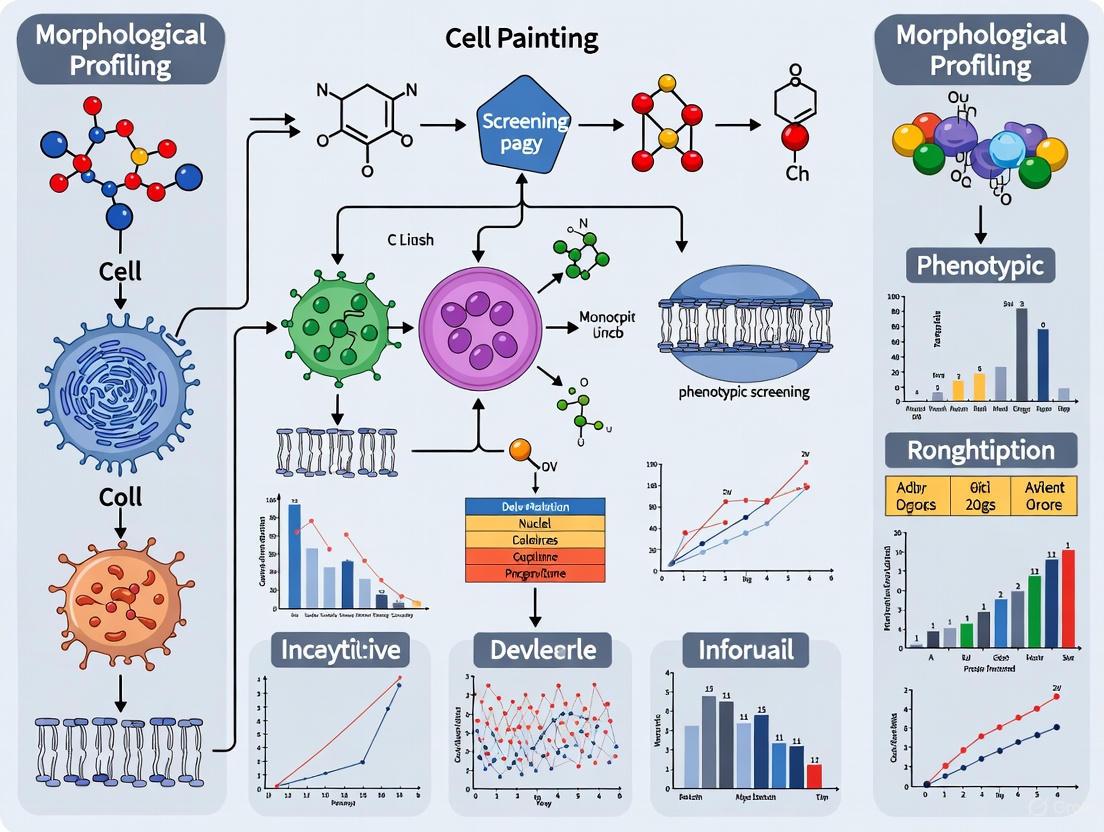
This article provides a comprehensive overview of morphological profiling using the Cell Painting assay, an image-based high-content screening method that quantifies hundreds of cellular features to capture phenotypic changes.
Cell Painting and Morphological Profiling: A Comprehensive Guide for Phenotypic Screening in Drug Discovery
Abstract
This article provides a comprehensive overview of morphological profiling using the Cell Painting assay, an image-based high-content screening method that quantifies hundreds of cellular features to capture phenotypic changes. Tailored for researchers and drug development professionals, it covers foundational principles, from the assay's role in phenotypic drug discovery to its ability to decipher compound mechanism of action (MoA). It details methodological advancements and diverse applications, including integration with other -omics data. The guide also addresses critical troubleshooting and optimization strategies for cross-laboratory reproducibility and explores validation studies and comparative analyses with other profiling technologies, positioning Cell Painting as a powerful New Approach Methodology (NAM) for chemical risk assessment and therapeutic development.
Unlocking Cellular Phenotypes: The Foundations of Cell Painting and Image-Based Profiling
What is Cell Painting? Defining the Multiplexed Fluorescent Assay
Cell Painting is a high-content, image-based assay used for morphological profiling, which captures a wide array of cellular phenotypes in response to genetic, chemical, or environmental perturbations [1]. By using a multiplexed panel of fluorescent dyes to label different cellular components, the assay allows researchers to extract thousands of quantitative morphological features from images, creating a rich, high-dimensional profile for each sample [2] [3]. As the most affordable high-dimensional profiling technique with single-cell resolution [4], it has become a powerful tool in drug discovery, functional genomics, and disease mechanism research [1] [5].
Core Principles of the Cell Painting Assay
The Concept of Morphological Profiling
Morphological profiling is based on the principle that cellular morphology is a direct reflection of cellular state and function [6]. The Cell Painting assay quantitatively captures this morphology, moving beyond traditional screening that typically measures only one or two predefined features [3]. This approach allows for unbiased discovery, as it doesn't require prior knowledge of which specific morphological features will be affected by a perturbation [3]. The resulting profiles serve as a "fingerprint" that can characterize various biological conditions, enabling researchers to detect subtle phenotypes that might be missed in targeted assays [1] [3].
Multiplexed Fluorescent Staining
The assay employs six fluorescent dyes that stain eight cellular compartments across five fluorescence channels, effectively "painting" the cell for comprehensive visualization [1] [4]. This multiplexing strategy provides a holistic view of cellular architecture by targeting functionally diverse organelles.
Table: Cell Painting Dyes and Their Cellular Targets
| Fluorescent Dye | Cellular Target | Stained Components |
|---|---|---|
| Hoechst 33342 [5] | DNA | Nucleus [7] |
| SYTO 14 green fluorescent nucleic acid stain [5] | RNA | Nucleoli, cytoplasmic RNA [5] |
| Phalloidin/Alexa Fluor 568 conjugate [5] | F-actin | Actin cytoskeleton [7] |
| Wheat-germ agglutinin/Alexa Fluor 555 conjugate [5] | Golgi and plasma membrane | Golgi apparatus, plasma membrane [7] |
| Concanavalin A/Alexa Fluor 488 conjugate [5] | Endoplasmic reticulum | Endoplasmic reticulum [7] |
| MitoTracker Deep Red [5] | Mitochondria | Mitochondria [7] |
Detailed Experimental Methodology
Standardized Cell Painting Workflow
The Cell Painting protocol follows a systematic workflow from cell preparation to data analysis, typically spanning two weeks for cell culture and image acquisition, plus an additional 1-2 weeks for feature extraction and data analysis [2].
Cell Painting Experimental Workflow
Step 1: Cell Plating and Perturbation
Cells are plated into multi-well plates (typically 96- or 384-well format) at an appropriate confluency [7]. They are then subjected to perturbations, which can be:
- Chemical: Treatment with small molecules, compounds, or drugs [1]
- Genetic: CRISPR knockout, RNA interference (RNAi), or gene overexpression [8]
- Disease Modeling: Use of patient-derived cells or disease-specific cell lines [1]
Step 2: Staining and Fixation
After perturbation, cells are fixed (chemically preserved), permeabilized, and stained with the multiplexed dye panel [7]. The staining protocol has been optimized through iterations, with the most recent update published in 2023 [4].
Step 3: Image Acquisition
Images are captured using a high-content screening (HCS) imaging system or high-throughput fluorescence microscope [7]. These systems are designed to rapidly image multi-well plates, capturing multiple sites per well across all five fluorescence channels [8].
Step 4: Image Analysis and Feature Extraction
Automated image analysis software identifies individual cells and cellular components through segmentation [1]. From each cell, approximately 1,500 morphological features are extracted [2] [3], including:
- Size and shape measurements of cellular structures
- Intensity of staining in different compartments
- Texture patterns within organelles
- Spatial relationships between different cellular components
- Correlations between stains across channels [3]
Key Research Reagents and Solutions
Table: Essential Materials for Cell Painting Experiments
| Item | Function/Role | Implementation Example |
|---|---|---|
| Cell Lines | Model systems for perturbations | U2OS osteosarcoma cells commonly used for clear phenotypes [8] |
| Fluorescent Dyes | Label specific cellular compartments | Image-iT Cell Painting Kit provides pre-measured reagents [7] |
| Multi-Well Plates | Platform for high-throughput experimentation | 96- or 384-well imaging plates [7] |
| Fixation Reagents | Preserve cellular morphology | Formaldehyde or similar cross-linking agents [2] |
| Permeabilization Agents | Enable dye access to intracellular targets | Detergents like Triton X-100 [2] |
| High-Content Imager | Automated image acquisition | Systems like CellInsight CX7 or ImageXpress Confocal HT.ai [7] [5] |
| Image Analysis Software | Feature extraction and quantification | CellProfiler, IN Carta, or MetaXpress software [1] [5] |
Applications in Phenotypic Screening Research
Drug Discovery and Development
Cell Painting has been widely adopted by pharmaceutical companies including Recursion Pharmaceuticals, Bayer, and AstraZeneca to enhance various stages of drug development [1].
- Mechanism of Action (MOA) Identification: By comparing morphological profiles of cells treated with uncharacterized compounds to those treated with compounds of known mechanism, researchers can infer MOA for novel compounds [1] [3].
- Lead Optimization and Compound Prioritization: Cell Painting helps identify compounds with desired phenotypic effects and flag those with potential toxicity concerns [1] [7].
- Drug Repurposing: The assay can identify phenotypic signatures of disease and screen existing drug libraries to find those that revert diseased cells to a healthy state [3].
Functional Genomics
Cell Painting enables large-scale functional characterization of genes through morphological profiling of genetic perturbations [1].
- Gene Function Annotation: By clustering genes that induce similar morphological changes when perturbed, researchers can infer functional relationships and assign putative functions to uncharacterized genes [3].
- Variant Impact Characterization: Comparing profiles induced by wild-type versus variant alleles reveals the functional impact of genetic variants, with applications in understanding cancer drivers and genetic diseases [1] [3].
- Genetic Interaction Mapping: Performing Cell Painting on cells with multiple genetic perturbations can reveal genetic interactions and synthetic lethality [3].
Disease Modeling and Signature Reversion
The ability of Cell Painting to capture disease-relevant phenotypes makes it valuable for disease modeling and therapeutic screening [1].
- Disease Signature Identification: Comparing morphological profiles of healthy versus diseased cells reveals consistent phenotypic signatures of disease states [3].
- Phenotype-Based Screening: Once a disease signature is established, researchers can screen for compounds that revert the disease signature toward the healthy state [3].
- Personalized Medicine: Using patient-derived cells, the assay could potentially help identify personalized treatment strategies based on morphological responses [1].
Current Landscape and Evolving Methodologies
The Cell Painting community has made significant efforts toward creating shared, FAIR (Findable, Accessible, Interoperable, and Reusable) data resources [4].
- Cell Painting Gallery: A publicly available collection hosted by Amazon Web Services containing 688 terabytes of image and numerical data as of May 2024 [4].
- JUMP Cell Painting Dataset: The largest publicly available Cell Painting dataset, profiling over 116,000 compounds and 16,000+ genes in U2OS cells [4] [8].
- Recursion (RxRx.ai) and Image Data Resource (IDR): Additional sources of publicly available Cell Painting datasets [4].
Integration with Machine Learning and Deep Learning
Advanced computational methods are being increasingly applied to enhance Cell Painting data analysis [4].
- Traditional Machine Learning: Used for clustering compounds and genes based on morphological similarity and identifying phenotypic hits [1].
- Deep Learning: Neural networks can improve various aspects of the pipeline, including image quality, object segmentation, feature extraction, and classification tasks [4].
- Representation Learning: Methods that learn compact representations of morphological profiles can enhance analysis efficiency and biological interpretability [4].
Limitations and Future Directions
Despite its powerful applications, Cell Painting has certain limitations that guide ongoing methodological development [1].
- Data Complexity: The high dimensionality of the data requires sophisticated computational tools for analysis and interpretation [1].
- Biological Interpretation: Translating morphological changes into specific biological mechanisms can be challenging and may require integration with other data types [1].
- Fixed Cell Limitation: Standard Cell Painting requires cell fixation, preventing live-cell imaging and dynamic observations [6]. Emerging techniques aim to enable similar profiling in live cells [6].
- Protocol Optimization: Ongoing work focuses on optimizing staining protocols, imaging parameters, and analysis pipelines to improve data quality and reproducibility [4].
Cell Painting represents a significant advancement in phenotypic screening, providing a comprehensive, unbiased method for quantifying cellular responses to perturbations. As the field continues to evolve with larger public datasets, improved computational methods, and integration with other profiling technologies, its impact on biological discovery and drug development is expected to grow substantially.
The Rise of Phenotypic Drug Discovery (PDD) and the Need for Unbiased Profiling
Phenotypic Drug Discovery (PDD) has experienced a major resurgence over the past decade, with evidence revealing that a majority of first-in-class medicines originate from this approach [9]. Unlike target-based drug discovery (TDD), which focuses on modulating pre-selected molecular targets, PDD identifies compounds based on their therapeutic effects in realistic disease models without requiring a predefined target hypothesis [10] [9]. This empirical, biology-first strategy has expanded the "druggable target space" to include unexpected cellular processes and novel mechanisms of action (MoA) [9].
Modern PDD combines original concepts with advanced tools and strategies, particularly high-content imaging techniques that capture systems-level responses in individual cells [10] [11]. Among these, Cell Painting has emerged as a powerful, unbiased morphological profiling assay that enables researchers to decipher the mechanism of action of compounds, their toxicity profiles, and other biological effects by capturing comprehensive phenotypic changes in cells [10]. This technical guide explores the central role of Cell Painting in contemporary phenotypic drug discovery, providing detailed methodologies, applications, and future directions for researchers and drug development professionals.
The Scientific Foundations of Cell Painting
Core Principles and Historical Development
Cell Painting is a microscopy-based cell labeling strategy introduced in 2013 to optimize and standardize image-based profiling [10]. The fundamental premise is that changes in cellular morphology and organization can indicate functional perturbations, and compounds with similar MoAs will produce similar phenotypic profiles [12]. Rather than measuring a few predefined features as in traditional high-content screening (HCS), Cell Painting leverages rich information in images to identify similarities or differences among biological samples in a relatively unbiased manner [10].
The approach builds on a key finding from 2004 when Perlman et al. demonstrated that images could be used to group drug treatments with similar impacts on cell morphology, rather than tailoring assays to specific phenotypes [10]. This insight, combined with advances in automated sample preparation and microscopy, helped launch the field of image-based profiling [10].
The Cell Painting Workflow
The standard Cell Painting workflow involves multiple coordinated steps from sample preparation to data analysis:
Research Reagent Solutions for Cell Painting
Table 1: Essential reagents and materials for Cell Painting assays
| Cellular Component | Staining Reagent | Function in Assay |
|---|---|---|
| Nuclear DNA | Hoechst 33342 | Labels nucleus, enables segmentation and nuclear morphology analysis |
| Endoplasmic Reticulum | Concanavalin A, Alexa Fluor 488 conjugate | Visualizes ER structure and distribution |
| Nucleoli & Cytoplasmic RNA | SYTO 14 green fluorescent nucleic acid stain | Reveals RNA-containing structures |
| F-actin cytoskeleton | Phalloidin, Alexa Fluor 568 conjugate | Labels actin filaments and cytoskeletal organization |
| Golgi apparatus & Plasma membrane | Wheat germ agglutinin (WGA), Alexa Fluor 555 conjugate | Marks Golgi complex and plasma membrane contours |
| Mitochondria | MitoTracker Deep Red | Visualizes mitochondrial network and distribution |
Cell Painting Experimental Protocol and Methodologies
Standard Cell Painting Protocol
The Cell Painting protocol has undergone several iterations, with version 3 representing the current optimized standard developed by the JUMP-CP Consortium [10]. The detailed methodology encompasses the following critical steps:
Cell Culture and Plating: Plate cells into appropriate labware (typically 384-well plates) at optimal density. For U2OS cells, the JUMP-CP Consortium recommends specific densities to ensure monolayer growth without overlap [10]. For HCT116 colorectal cancer cells, a density of 1,000 cells per well in 384-well plates has been used successfully [13].
Perturbation Introduction: Treat cells with chemical or genetic perturbations (e.g., small molecules, RNAi, CRISPR/Cas9). Standard incubation times have traditionally been 48 hours, though recent evidence suggests earlier timepoints (e.g., 6 hours for Sf9 insect cells, shortly later for U2OS) may better capture primary effects while minimizing secondary changes [14].
Staining and Fixation: Fix cells followed by multiplexed staining with the standard six dyes. The updated v3 protocol from the JUMP-CP Consortium has quantitatively optimized staining reagents, experiment, and imaging conditions using a positive control plate of 90 compounds covering 47 diverse mechanisms of action [10].
Image Acquisition: Acquire high-content images using automated microscopy systems. The JUMP-CP optimization effort standardized imaging parameters across platforms to ensure reproducibility [10].
Image Analysis: Process images using automated analysis pipelines (e.g., CellProfiler, deep learning-based approaches) to extract morphological features [10]. Typical analyses measure 1,000+ morphological features including size, shape, texture, and intensity properties at single-cell resolution.
Data Processing and Normalization: Apply quality control measures and batch effect corrections to generate standardized morphological profiles [10].
Advanced Protocol: Cell Painting PLUS (CPP)
The recently developed Cell Painting PLUS (CPP) assay significantly expands the multiplexing capacity through iterative staining-elution cycles [12]. This advanced methodology enables:
- Iterative Staining: Sequential staining, elution, and re-staining of fixed cells using an optimized elution buffer (0.5 M L-Glycine, 1% SDS, pH 2.5) that efficiently removes signals while preserving cellular morphology [12].
- Enhanced Multiplexing: Incorporation of at least seven fluorescent dyes labeling nine different subcellular compartments, including the addition of lysosomal staining [12].
- Spectral Separation: Imaging each dye in separate channels rather than merging signals, thereby improving organelle-specificity of phenotypic profiles [12].
Table 2: Comparison of Standard Cell Painting vs. Cell Painting PLUS
| Parameter | Standard Cell Painting | Cell Painting PLUS |
|---|---|---|
| Maximum compartments visualized | 8 | 9+ |
| Typical imaging channels | 5 | 7+ |
| Signal separation | Intentional merging in channels (RNA+ER, Actin+Golgi) | Individual channel acquisition |
| Lysosomal staining | Not included | Included |
| Workflow complexity | Single staining procedure | Iterative staining-elution cycles |
| Customizability | Fixed dye set | Flexible dye selection |
| Information density | High | Enhanced |
Cell Line Selection Considerations
Dozens of cell lines have been used successfully in Cell Painting experiments, with selection often dependent on research goals [10]. Key considerations include:
- Morphological Properties: Flat cells that rarely overlap are ideal for image-based assays [10].
- Biological Relevance: The JUMP-CP Consortium uses U2OS cells due to availability of large-scale data and Cas9-expressing clones [10].
- Phenoactivity vs. Phenosimilarity: Cell lines optimal for detecting compound activity (phenoactivity) may differ from those predicting MoA (phenosimilarity) [10].
- Experimental Goals: HCT116 colorectal cancer cells have been used successfully for MoA studies of 196 small molecules, identifying 18 distinct phenotypic clusters [13].
Applications and Validation in Drug Discovery
Success Stories in Phenotypic Drug Discovery
Cell Painting has contributed to several notable successes in drug discovery, often enabling the identification of compounds with novel mechanisms of action:
- Cystic Fibrosis: Target-agnostic compound screens identified correctors that enhance CFTR folding and membrane insertion (e.g., tezacaftor, elexacaftor), combined with potentiator ivacaftor in approved therapies addressing 90% of CF patients [9].
- Spinal Muscular Atrophy: Phenotypic screens identified small molecules that modulate SMN2 pre-mRNA splicing (e.g., risdiplam), resulting in approved oral disease-modifying therapy with an unprecedented drug target and MoA [9].
- HCV Treatment: Phenotypic screening revealed the importance of NS5A protein and its small-molecule modulators (e.g., daclatasvir), key components of direct-acting antiviral combinations [9].
- Cancer Therapeutics: Cell Painting has identified compounds affecting diverse pathways including mTOR/PI3K inhibitors, spindle poisons, and transcriptional CDK blockers based on characteristic morphological profiles [13].
Predictive Performance and Integration with Other Technologies
Cell Painting demonstrates significant complementarity with other profiling technologies for predicting compound bioactivity:
Table 3: Predictive performance of different profiling modalities for compound bioactivity
| Profiling Modality | Assays Predicted (AUROC >0.9) | Unique Strengths | Key Applications |
|---|---|---|---|
| Chemical Structure (CS) | 16 (6%) | Virtual screening, no wet lab required | Cheminformatics, molecular property prediction |
| Gene Expression (L1000) | 19 (7%) | Transcriptional responses | Mechanism of action prediction |
| Cell Painting (Morphology) | 28 (10%) | Direct visualization of phenotypic effects | Phenotypic screening, toxicity assessment |
| Combined CS + Morphology | 31 (11%) | Enhanced predictive power | Comprehensive compound prioritization |
| All Three Modalities | 21% of assays | Maximum coverage | Integrated drug discovery |
The data reveals that morphological profiles from Cell Painting can predict the largest number of assays individually (28 vs. 19 for gene expression and 16 for chemical structures) [15]. Critically, the prediction abilities show significant complementarity, with each modality capturing different biologically relevant information [15].
AI and Machine Learning Applications
Advanced computational methods are expanding Cell Painting applications:
- Anomaly Detection: AI approaches using Isolation Forest and Normalizing Flows can identify bioactive compounds as statistical anomalies from negative controls, capturing subtle phenotypic changes [16].
- Hit Identification: These methods successfully identify compounds with known MoAs (insulin receptor, PI3 kinase, MAP kinase pathways) while maintaining detection of non-cytotoxic phenotypes [16].
- Enhanced Diversity: AI-driven approaches identify structurally diverse hit compounds, expanding the chemical space for drug discovery [16].
Future Directions and Implementation Considerations
Emerging Innovations
The field of morphological profiling continues to evolve with several promising directions:
- Temporal Resolution: Time-resolved Cell Painting enables assessment of phenotypic progression, with evidence that early timepoints (e.g., 6 hours) better capture primary physiological effects before secondary changes dominate [14].
- Integrated Multi-Omics: Combining Cell Painting with transcriptomic, proteomic, and chemical structural data provides complementary insights for comprehensive compound characterization [15].
- Large-Scale Consortia: Initiatives like the JUMP-Cell Painting Consortium (profiling >135,000 compounds and genetic perturbations) and OASIS Consortium (benchmarking phenomics with transcriptomics and proteomics) are generating public datasets and standardized approaches [10] [12].
- Expanded Applications: Beyond drug discovery, Cell Painting is being applied to toxicology assessment of industrial chemicals, with bioactivity profiles for >1,000 chemicals available through the U.S. EPA CompTox Chemicals Dashboard [12].
Implementation Guidelines
For research teams implementing Cell Painting, several practical considerations emerge from recent studies:
- Experimental Design: Include diverse reference compounds covering multiple MoAs, use appropriate sample sizes (e.g., 8 replicate wells per compound with positional randomization), and implement rigorous batch control [13].
- Timepoint Selection: Consider shorter incubation times (6-24 hours) to capture primary effects, unless specifically studying slower processes like differentiation [14].
- Cell Line Selection: Choose cell lines based on research goals, considering the trade-off between phenotypic activity detection and MoA prediction accuracy [10].
- Data Integration: Combine morphological profiles with chemical structures and other omics data where possible to maximize predictive power and biological insight [15].
Cell Painting has established itself as a cornerstone technology in modern phenotypic drug discovery, providing an unbiased, information-rich approach to compound characterization and mechanism of action studies. Its ability to capture comprehensive morphological profiles enables researchers to expand the druggable target space, identify polypharmacology, and prioritize compounds based on phenotypic effects rather than limited target-based assumptions. As the field advances with improvements in multiplexing capacity, temporal resolution, and computational analysis, Cell Painting is poised to play an increasingly central role in accelerating drug discovery and improving success rates for identifying first-in-class therapeutics.
Cell Painting is a high-content, multiplexed image-based assay designed for comprehensive morphological profiling of cellular states [5]. By using a suite of fluorescent reagents to "paint" various organelles and cellular components, the assay captures a detailed representation of cell morphology in a single, scalable experiment [7] [10]. This technique enables researchers to quantify subtle changes in cellular architecture induced by genetic or chemical perturbations, making it particularly valuable for drug discovery, functional genomics, and toxicology studies [10] [5].
The power of Cell Painting lies in its ability to generate high-dimensional morphological profiles from stained cells. Through automated image analysis software, approximately 1,500 measurements can be extracted from each cell based on changes in size, shape, texture, and fluorescence intensity across the stained compartments [7]. This rich data capture allows researchers to study diverse biological phenomena including dynamic protein organization, cell viability, proliferation, toxicity, and DNA damage responses [7].
The Standard Cell Painting Dye Panel
The foundational Cell Painting assay employs six well-characterized fluorescent dyes that collectively label eight major cellular compartments across five fluorescence imaging channels [10] [4]. This specific combination was strategically selected to provide comprehensive coverage of fundamental cellular structures while maintaining practicality for high-throughput screening [10].
Table 1: The Standard Cell Painting Dye Panel and Cellular Targets
| Cellular Structure | Fluorescent Dye | Excitation/Emission | Staining Localization |
|---|---|---|---|
| Nucleus | Hoechst 33342 | Not specified in sources | Nuclear DNA [10] [5] |
| Nucleoli & Cytoplasmic RNA | SYTO 14 green fluorescent nucleic acid stain | Not specified in sources | Nucleoli and cytoplasmic RNA [10] |
| Endoplasmic Reticulum | Concanavalin A, Alexa Fluor 488 conjugate | Not specified in sources | Endoplasmic reticulum [10] [5] |
| Mitochondria | MitoTracker Deep Red | Not specified in sources | Mitochondria [10] [5] |
| F-actin Cytoskeleton | Phalloidin, Alexa Fluor 568 conjugate | Not specified in sources | Actin cytoskeleton [10] [5] |
| Golgi Apparatus & Plasma Membrane | Wheat Germ Agglutinin (WGA), Alexa Fluor 555 conjugate | Not specified in sources | Golgi apparatus and plasma membrane [10] [5] |
This standardized panel creates a comprehensive morphological snapshot where the nucleus serves as a reference point for cellular organization; the nucleoli and RNA indicate transcriptional activity; the endoplasmic reticulum reflects protein synthesis and processing; mitochondria reveal metabolic status; the actin cytoskeleton shows structural integrity and shape; and the Golgi/plasma membrane complex illustrates secretory functions and cellular boundaries [7] [5]. The original selection of these dyes was guided by several practical considerations: they are relatively inexpensive, commercially available, compatible with standard fluorescence microscope filters, and can be used with live or fixed cells without requiring antibody-based staining [10].
Experimental Protocol for Cell Painting
Cell Culture and Perturbation
The Cell Painting workflow begins with plating cells into multi-well plates, typically 96- or 384-well formats optimized for high-content screening [7] [5]. While the assay has been successfully adapted to numerous cell types, U2OS osteosarcoma cells are frequently employed in large-scale studies because they exhibit clearly distinguishable phenotypes, grow in a monolayer that minimizes overlap, and have existing Cas9-expressing clones available for genetic screening [8] [10]. Following attachment, cells are subjected to perturbations—either chemical (small molecules, compounds) or genetic (CRISPR, RNAi, ORF overexpression)—for a specified duration, typically 24-48 hours, to induce morphological changes [7].
Staining and Imaging Protocol
After perturbation, cells undergo fixation, permeabilization, and staining using the standardized six-dye panel [7]. The staining protocol requires no cell-type-specific adjustments for most human-derived cell lines, though image acquisition and cell segmentation parameters may need optimization for different morphological characteristics [17]. Imaging is performed using high-content screening (HCS) systems capable of automated acquisition from multi-well plates [7]. These systems capture five fluorescence channels (plus optional brightfield) from multiple sites within each well to ensure adequate cell sampling and statistical power [7] [8]. A complete Cell Painting experiment generates substantial data, with the largest public dataset (JUMP-CP) comprising over 688 terabytes of images and analytical data as of May 2024 [4].
Table 2: Research Reagent Solutions for Cell Painting
| Reagent Category | Specific Examples | Function in Assay |
|---|---|---|
| Cell Painting Kits | Image-iT Cell Painting Kit | Pre-optimized reagent combinations for staining exactly 2 or 10 multi-well plates [7] |
| Individual Dyes | Hoechst 33342, MitoTracker Deep Red, SYTO 14, Concanavalin A, Phalloidin, WGA | Individual components for custom assay development or protocol modifications [7] |
| Cell Lines | U2OS, A549, MCF7, HepG2, HTB-9, ARPE-19 | Biologically diverse human-derived cells validated for Cell Painting [17] |
| Analysis Software | CellProfiler, SPACe, IN Carta, Columbus | Open-source and commercial platforms for image segmentation and feature extraction [7] [18] |
Data Analysis and Morphological Profiling
Image Processing and Feature Extraction
Following image acquisition, automated analysis pipelines segment individual cells and their subcellular compartments, then extract quantitative morphological features [7] [18]. The open-source CellProfiler software is widely used for this purpose, though newer platforms like SPACe offer significantly faster processing times (approximately 10× faster) while maintaining analytical accuracy [18]. These tools generate single-cell profiles containing hundreds to thousands of measurements describing size, shape, intensity, and texture patterns for each cellular structure [7] [8]. The resulting high-dimensional data undergoes normalization and batch effect correction to account for technical variations across experiments, plates, and well positions [19].
Applications in Phenotypic Screening
The morphological profiles generated through Cell Painting serve as powerful fingerprints for classifying cellular responses to perturbations [10]. In drug discovery, these profiles can identify a compound's mechanism of action (MoA) by comparing its morphological impact to reference compounds with known targets [10]. The JUMP Consortium has demonstrated this approach at massive scale, screening over 116,000 chemical compounds and 22,000 genetic perturbations to create public reference maps of morphological phenotypes [8] [4]. Cell Painting also predicts drug toxicity, characterizes gene function, and elucidates disease pathophysiology—including differentiating between healthy, sporadic, and genetic disease states in patient-derived fibroblasts [7] [10].
The Cell Painting research community has established substantial public resources to accelerate methodological development and biological discovery. The Cell Painting Gallery, hosted on Amazon Web Services (AWS) Open Data Registry, provides free access to 688 terabytes of image and numerical data from multiple landmark studies [4]. This includes the JUMP dataset (cpg0016)—the largest publicly available Cell Painting resource—featuring morphological profiles for over 116,000 chemical compounds and 22,000 genetic perturbations in human U2OS cells [8] [4]. Additional datasets enable researchers to explore protocol variations, cross-cell-line comparisons, and different imaging systems [8]. These resources collectively support the development of advanced analytical methods, including the recent cpDistiller algorithm that corrects for technical artifacts while preserving biological signals using contrastive and domain-adversarial learning [19].
Morphological profiling represents a powerful approach in modern biological research, enabling the quantitative capture of complex cellular states from images. Within this field, Cell Painting has emerged as a premier high-content, image-based assay for comprehensive phenotypic screening [5]. This technique uses multiplexed fluorescent dyes to label multiple cellular components simultaneously, creating a detailed morphological "fingerprint" that can reveal subtle changes induced by genetic or chemical perturbations [20]. The core premise is that changes in a cell's morphological appearance can indicate underlying functional perturbations, making morphological profiling particularly valuable for drug discovery, toxicology, and basic research where the mechanism of action may be unknown [21] [22].
The transition from qualitative image observation to quantitative data extraction represents a fundamental shift in how researchers approach cellular imaging. By applying automated image analysis and feature extraction, scientists can now detect subtle phenotypic changes that might be invisible to the human eye, enabling more objective and comprehensive profiling of cellular responses [5]. This data-rich approach has been successfully applied to profile thousands of chemical compounds and genetic perturbations, generating public datasets that serve as valuable resources for the research community [21].
Core Concepts and Experimental Workflows
The Cell Painting Assay Fundamentals
Cell Painting employs a carefully selected panel of fluorescent dyes to label key cellular compartments, typically using up to six dyes that target eight distinct structures [5] [20]. The standard dye panel includes:
- Nuclear DNA stained with Hoechst 33342
- Endoplasmic reticulum labeled with Concanavalin A/Alexa Fluor 488 conjugate
- Mitochondria visualized with MitoTracker Deep Red
- Nucleoli and cytoplasmic RNA stained with SYTO 14
- F-actin cytoskeleton, Golgi apparatus, and plasma membrane labeled with Phalloidin/Alexa Fluor 568 conjugate and wheat-germ agglutinin/Alexa Fluor 555 conjugate [5] [20]
This comprehensive labeling strategy enables researchers to capture a holistic view of cellular morphology and organization. The resulting images provide information about multiple organelles simultaneously, creating a rich dataset that reflects the integrated state of the cell [5].
Experimental Workflow for Cell Painting
The standard Cell Painting workflow follows a systematic process that integrates wet-lab procedures with computational analysis:
Figure 1: Core workflow for Cell Painting assays, showing the sequence from cell preparation to data analysis.
- Cell Plating: Cells are plated in multiwell plates (typically 384-well format) and allowed to adhere and grow [5].
- Perturbation: Cells are treated with chemical compounds, genetic perturbations (e.g., RNAi, CRISPR/Cas9), or other experimental conditions [5] [21].
- Staining: After an appropriate incubation period, cells are fixed and stained with the Cell Painting dye cocktail [5] [20].
- Image Acquisition: High-content imaging systems capture multiple images per well across all fluorescent channels, often including multiple fields of view and Z-planes [5].
- Image Analysis: Automated software identifies individual cells and subcellular compartments [5] [23].
- Feature Extraction: Morphological measurements are quantified for each cell [5] [23].
- Data Analysis: Extracted features are processed to create morphological profiles and identify patterns [5].
Recent advancements have expanded this standard workflow. The Cell Painting PLUS (CPP) assay enables iterative staining and elution cycles, allowing researchers to label nine or more subcellular compartments using seven fluorescent dyes, all imaged in separate channels to improve organelle-specificity [21]. This approach provides even greater morphological detail while maintaining the high-throughput capacity essential for screening applications.
Essential Research Reagents and Materials
Table 1: Core reagents and materials for Cell Painting assays
| Component | Function | Examples & Specifications |
|---|---|---|
| Fluorescent Dyes | Label specific cellular compartments | Hoechst 33342 (nucleus), MitoTracker Deep Red (mitochondria), Concanavalin A/Alexa Fluor 488 (ER), Phalloidin/Alexa Fluor 568 (F-actin), WGA/Alexa Fluor 555 (Golgi, plasma membrane) [5] [20] |
| Cell Lines | Biological system for profiling | U2OS, A549 (commonly used adherent lines) [20] |
| Multiwell Plates | Experimental format for high-throughput | 384-well plates (standard) [5] [20] |
| Fixation Agent | Preserve cellular morphology | Paraformaldehyde (typical concentration: 4%) [21] |
| Imaging System | Image acquisition | High-content imagers (e.g., ImageXpress Confocal HT.ai) [5] |
| Image Analysis Software | Feature extraction and analysis | CellProfiler, IN Carta, Harmony, IKOSA Cell Painting App [5] [23] [20] |
Image Analysis and Feature Extraction Methods
From Pixels to Quantitative Features
The conversion of raw images into quantitative morphological features involves multiple computational steps. Initially, image segmentation identifies and delineates individual cells and their subcellular components [23]. Following segmentation, feature extraction algorithms quantify hundreds to thousands of morphological measurements for each cell, creating a comprehensive phenotypic profile [5] [23].
Advanced analysis platforms like the IKOSA Cell Painting App can extract up to 1,917 distinct features from each cell, providing an exceptionally detailed view of cellular morphology [23]. These measurements capture diverse aspects of cellular organization, enabling researchers to detect even subtle phenotypic changes.
Categories of Morphological Features
Table 2: Major categories of morphological features extracted in Cell Painting assays
| Feature Category | Description | Specific Measurements | Biological Significance |
|---|---|---|---|
| Intensity Features | Quantify fluorescence intensity distributions | Mean intensity, standard deviation, median intensity | Reflect abundance and distribution of labeled components [5] |
| Shape Features | Describe geometric properties | Area, perimeter, eccentricity, form factor | Capture overall cellular and organelle morphology [5] [24] |
| Texture Features | Characterize spatial patterns of intensity | Haralick features, granularity measurements | Indicate subcellular patterning and organization [5] |
| Spatial Relationships | Quantify relative positions and distances | Distances between organelles, proximity measurements | Reveal organizational relationships between cellular components [5] |
Computational Approaches for Feature Extraction
Traditional image analysis relies on hand-crafted feature extraction, where specific algorithms quantify predefined morphological properties [5] [25]. More recently, deep learning approaches have emerged that can automatically learn relevant features directly from image data without requiring predefined measurement protocols [24] [22].
Variational autoencoders (VAE) and other deep learning architectures can compress high-dimensional image data into lower-dimensional latent representations that capture morphologically relevant information [24]. These methods can identify subtle patterns that might be missed by traditional feature extraction approaches, potentially revealing novel biological insights.
Data Analysis and Applications in Drug Discovery
From Features to Biological Insights
The analysis of morphological profiles involves several computational steps to transform raw feature measurements into biologically interpretable results. The process typically includes quality control, data normalization, dimensionality reduction, and pattern recognition [5] [22]. Dimensionality reduction techniques such as principal component analysis (PCA) or more advanced nonlinear methods help visualize and interpret the high-dimensional data [24].
Morphological profiles serve as distinctive "barcodes" that reflect the biological state of cells under different experimental conditions [5]. By comparing these profiles, researchers can cluster compounds with similar mechanisms of action, identify novel bioactive molecules, and detect off-target effects [20] [22].
Analysis Workflow and Data Interpretation
Figure 2: Data analysis workflow from raw images to biological interpretation.
Applications in Drug Discovery and Toxicology
Cell Painting and morphological profiling have become valuable tools across multiple domains:
- Target Identification and Validation: Morphological profiles can help elucidate mechanisms of action for novel compounds, facilitating target identification [20] [22].
- Compound Screening and Hit Prioritization: AI-driven platforms like Ardigen phenAID use morphological profiling to identify active compounds with up to 40% more accurate hit identification compared to conventional methods [22].
- Toxicity Assessment: Morphological signatures can reveal early indicators of cytotoxicity or stress responses before overt cell death occurs, enabling early elimination of toxic candidates [22].
- Chemical Biology: Large-scale public datasets, such as those generated by the JUMP-Cell Painting Consortium, profile over 135,000 chemical and genetic perturbations, serving as resources for the research community [21].
Large-scale initiatives like the OASIS Consortium are now working to integrate morphological profiling with other omics technologies (transcriptomics, proteomics) to develop more comprehensive chemical safety assessment tools [21] [22].
Advanced Protocols and Methodological Extensions
Detailed Cell Painting PLUS Protocol
The Cell Painting PLUS (CPP) protocol expands the standard method through iterative staining cycles [21]:
Initial Staining Cycle:
- Fix cells with 4% paraformaldehyde
- Stain with initial dye panel (e.g., nuclear, ER, RNA markers)
- Image each dye in separate channels
- Apply elution buffer (0.5 M L-Glycine, 1% SDS, pH 2.5) to remove dyes while preserving morphology
Subsequent Staining Cycles:
- Re-stain with additional dyes (e.g., mitochondrial, lysosomal markers)
- Image each dye separately
- Repeat elution and staining as needed for additional markers
Image Registration and Analysis:
- Align images from different cycles
- Extract features from each channel separately
- Combine data into comprehensive morphological profiles
This approach enables researchers to study nine or more subcellular compartments with improved specificity compared to standard Cell Painting, where some signals are necessarily merged in the same imaging channels [21].
AI-Enhanced Morphological Profiling
Advanced deep learning methods are transforming morphological feature extraction. The Morpho-VAE framework combines supervised and unsupervised learning to extract morphological features that optimally distinguish different biological states [24]. This approach has demonstrated superior performance in capturing discriminative morphological features compared to traditional methods like PCA [24].
AI platforms can now predict compound bioactivity and mechanism of action by comparing morphological profiles to extensive reference databases [22]. These systems leverage deep learning models to identify subtle phenotypic patterns that correlate with specific biological activities, accelerating the drug discovery process.
Automated morphological feature extraction represents a powerful paradigm for quantifying cellular states in high-content screening. Cell Painting and related methodologies have established a robust framework for generating comprehensive morphological profiles that capture subtle aspects of cellular biology. The integration of advanced computational methods, including deep learning and AI, continues to enhance our ability to extract biologically meaningful information from cellular images.
As these technologies evolve and datasets expand, morphological profiling is poised to become increasingly central to drug discovery, toxicology, and basic biological research. The ongoing development of more multiplexed approaches like Cell Painting PLUS, combined with increasingly sophisticated analysis platforms, promises to further accelerate our understanding of how chemical and genetic perturbations influence cellular morphology and function.
Cell Painting is an imaging-based high-throughput phenotypic profiling (HTPP) method that uses multiplexed fluorescent dyes to label major organelles and cellular components, generating rich morphological data for untargeted biological investigation [10] [5]. The assay operates on the fundamental principle that changes in cellular morphology reflect underlying functional perturbations, enabling researchers to capture a comprehensive "phenotypic fingerprint" of cell state under various chemical, genetic, or environmental conditions [12] [26]. Unlike targeted assays that measure specific expected responses, Cell Painting provides an unbiased, systems-level view of cellular effects, making it particularly valuable for discovering unexpected biological activities [27]. This capability has positioned Cell Painting as a powerful tool across multiple domains, including mechanism of action (MoA) elucidation, functional genomics, and toxicity screening.
The standard Cell Painting protocol utilizes six fluorescent dyes to label eight cellular components: nuclear DNA (Hoechst 33342), cytoplasmic RNA and nucleoli (SYTO 14), endoplasmic reticulum (Concanavalin A), actin cytoskeleton (Phalloidin), Golgi apparatus and plasma membrane (Wheat Germ Agglutinin), and mitochondria (MitoTracker Deep Red) [10] [5]. High-content imaging captures these stained structures, followed by computational extraction of hundreds to thousands of morphological features representing size, shape, texture, intensity, and spatial relationships [26]. The resulting multidimensional profiles enable quantitative comparison of phenotypic states across experimental conditions.
Table: Core Cellular Components Visualized in Cell Painting
| Cellular Component | Staining Dye | Key Morphological Features |
|---|---|---|
| Nuclear DNA | Hoechst 33342 | Nuclear size, shape, texture, intensity |
| Cytoplasmic RNA & Nucleoli | SYTO 14 | Nucleolar count, size, RNA distribution |
| Endoplasmic Reticulum | Concanavalin A | Reticular structure, organization, extent |
| Actin Cytoskeleton | Phalloidin | Filament organization, stress fibers, cortex |
| Golgi Apparatus & Plasma Membrane | Wheat Germ Agglutinin | Golgi compactness, membrane morphology |
| Mitochondria | MitoTracker Deep Red | Network structure, fragmentation, distribution |
Mechanism of Action (MoA) Elucidation
Fundamental Principles and Workflow
Cell Painting enables MoA elucidation by comparing the morphological profiles of compounds with unknown mechanisms to reference compounds with well-characterized targets [28] [26]. The underlying premise is that compounds sharing similar mechanisms of action will induce similar phenotypic changes in cells, creating recognizable "phenotypic fingerprints" that can be clustered computationally [10]. This approach has proven particularly valuable for classifying compounds that interact with multiple targets or whose precise mechanisms are unknown, situations where traditional target-based assays often fall short [10].
The standard workflow for MoA elucidation begins with treating cells with reference compounds spanning diverse mechanisms alongside test compounds with unknown targets. After Cell Painting staining and image acquisition, computational analysis extracts morphological profiles and applies dimensionality reduction techniques to enable similarity comparisons [28]. Compounds clustering together in the resulting phenotypic space are predicted to share biological targets or pathways [27]. This approach has successfully identified novel MoAs for environmental chemicals and repurposed compounds, including the discovery that pyrene, a environmental chemical, exhibits glucocorticoid receptor modulating activity based on its phenotypic similarity to known glucocorticoids [27].
Experimental Protocol for MoA Deconvolution
Cell Culture and Treatment:
- Seed appropriate cell lines (U2OS, A549, or disease-relevant models) in 384-well plates at optimized densities (typically 3,000-5,000 cells/well) [27]
- After 24 hours, treat cells with reference compounds (covering diverse MoA classes) and test compounds in concentration-response format (typically 8-point half-log dilutions) [27]
- Include vehicle controls (0.5% DMSO) and appropriate positive controls for assay validation
- Incubate for 24-48 hours based on desired phenotypic development time
Staining and Imaging:
- Fix cells with paraformaldehyde (4% for 20 minutes) followed by permeabilization (0.1% Triton X-100 for 15 minutes)
- Apply Cell Painting dye cocktail: Hoechst 33342 (DNA), Concanavalin A-Alexa Fluor 488 (ER), SYTO 14 (RNA/nucleoli), Phalloidin-Alexa Fluor 568 (actin), Wheat Germ Agglutinin-Alexa Fluor 555 (Golgi/plasma membrane), MitoTracker Deep Red (mitochondria) [5]
- Acquire images using high-content imaging system (e.g., ImageXpress Confocal HT.ai) with 20x or 40x objective, capturing multiple fields per well to ensure adequate cell numbers [5]
Image Analysis and Profile Generation:
- Process images using CellProfiler or similar software for illumination correction, cell segmentation, and feature extraction [26]
- Extract 1,000+ morphological features per cell across intensity, texture, shape, and spatial domains
- Aggregate single-cell data to well-level profiles using robust averaging methods
- Apply quality control metrics to exclude poor-quality wells or imaging artifacts
Similarity Analysis and MoA Prediction:
- Perform batch effect correction using control-based normalization methods
- Calculate similarity distances between compound profiles using cosine similarity or correlation metrics [29]
- Apply dimensionality reduction (t-SNE, UMAP) for visualization and cluster analysis
- Implement k-nearest neighbor classification to predict MoA based on reference compound proximity [30]
Functional Genomics Applications
Genetic Perturbation Screening
Cell Painting has emerged as a powerful tool for functional genomics, enabling systematic characterization of gene function through morphological profiling of genetic perturbations [29]. By applying CRISPR-based knockout, RNA interference, or ORF overexpression and measuring resulting phenotypic changes, researchers can infer gene function and identify novel regulators of cellular pathways [10] [29]. The JUMP-Cell Painting Consortium has pioneered large-scale efforts in this domain, creating a publicly available dataset of approximately 3 million images from cells treated with matched chemical and genetic perturbations targeting 160 genes [29]. This resource enables direct comparison of chemical and genetic perturbation effects, facilitating the mapping of compound-gene relationships.
A key advantage of morphological profiling in functional genomics is its ability to capture subtle phenotypic changes that might be missed in binary viability or reporter assays [29]. Different types of genetic perturbations (CRISPR knockout vs. ORF overexpression) targeting the same gene often produce opposing phenotypic effects, creating recognizable "mirror" profiles that strengthen functional annotations [29]. Additionally, genes involved in the same biological pathway frequently cluster together in phenotypic space, enabling pathway discovery and validation.
Experimental Protocol for Genetic Perturbation Profiling
Genetic Perturbation Introduction:
- For CRISPR-Cas9 knockout: Transduce cells with lentiviral vectors expressing guide RNAs targeting genes of interest, include non-targeting guides as controls
- For ORF overexpression: Transduce cells with lentiviral vectors expressing open reading frames, include empty vector controls
- Select appropriate cell models (U2OS and A549 commonly used for adherence and morphological properties) [29]
- Include selection markers (puromycin, blasticidin) for stable cell line generation when necessary
- Maintain parallel unperturbed controls for baseline morphological comparison
Experimental Design Considerations:
- Implement multiple replicates (至少4 biological replicates recommended) to ensure statistical power [27]
- Utilize randomized plate layouts to mitigate position effects
- Include reference perturbations with known phenotypic effects for quality control
- For temporal studies, profile phenotypes at multiple time points (24h, 48h, 72h) to capture dynamic responses [29]
Staining, Imaging and Analysis:
- Follow standard Cell Painting staining protocol as described in Section 2.2
- Acquire images with consistent settings across all plates to enable cross-plate comparisons
- Process images with CellProfiler, extracting comparable feature sets to chemical perturbation profiles
- Apply specialized batch correction methods to account for technical variation across experimental runs
- Implement similarity metrics to identify genetic perturbations with related phenotypic impacts [29]
Table: Comparison of Genetic Perturbation Modalities in Cell Painting
| Parameter | CRISPR Knockout | ORF Overexpression | RNA Interference |
|---|---|---|---|
| Phenotypic Strength | Moderate to strong | Weaker signal | Variable |
| Direction of Effect | Loss-of-function | Gain-of-function | Partial knockdown |
| Technical Reproducibility | High with careful gRNA design | Moderate, dependent on expression level | Variable, transient effect |
| Detection Rate | Higher fraction retrieved [29] | Lower fraction retrieved [29] | Intermediate |
| Complementary Information | Identifies essential genes | Reveals dosage-sensitive genes | Useful for partial inhibition studies |
Toxicity Screening and Hazard Assessment
Principles and Implementation
Cell Painting has been widely adopted for toxicological screening and chemical hazard assessment due to its ability to detect diverse cytotoxic and subcytotoxic effects across multiple cellular compartments [27] [26]. Regulatory agencies including the U.S. Environmental Protection Agency (EPA) have incorporated Cell Painting into tiered testing strategies for rapid bioactivity screening of industrial chemicals and environmental compounds [27]. The assay's sensitivity to subtle morphological changes enables detection of chemical effects below overt cytotoxicity thresholds, providing early indicators of potential hazard [27].
In toxicity applications, concentration-response screening identifies a Phenotype Altering Concentration (PAC) for each compound, which is typically higher than potency values from targeted assays but lower than cytotoxicity thresholds [27]. This PAC can be used for in vitro to in vivo extrapolation (IVIVE) to estimate Administered Equivalent Doses (AEDs) for comparison with human exposure predictions [27]. Bioactivity-exposure ratios derived from this approach help prioritize chemicals requiring further investigation. The untargeted nature of Cell Painting is particularly valuable for environmental chemicals, which may have incompletely characterized hazards and diverse mechanisms of toxicity [27].
Experimental Protocol for Tiered Toxicity Screening
Compound Library Preparation:
- Select compound libraries representing chemicals of regulatory concern (e.g., ToxCast library) [27]
- Prepare stock solutions in DMSO at maximum soluble concentrations (typically 20 mM)
- Create concentration-response series (8-point half-log dilutions recommended) using acoustic dispensing systems [27]
- Include well-characterized reference toxicants with known mechanisms (e.g., dexamethasone, etoposide, staurosporine) for assay validation [27]
Cell-Based Screening:
- Utilize physiologically relevant cell models (U2OS, HepG2, or primary cells when available)
- Plate cells in 384-well format (3,000 cells/well in 40 μL media for U2OS) [27]
- After 24 hours, treat with compound dilutions using automated dispensing systems (e.g., LabCyte Echo 550)
- Maintain 0.5% DMSO concentration across all test wells for consistency
- Incubate for 48 hours to allow phenotypic development
Staining, Imaging and Analysis:
- Perform Cell Painting staining following standard protocols
- Acquire images using high-content imagers, capturing sufficient cells per well for statistical power
- Extract morphological features using CellProfiler or similar software
- Calculate PAC using statistical approaches comparing treatment profiles to vehicle controls
- Apply machine learning classifiers trained on reference toxicants to predict toxicity mechanisms [26]
Data Interpretation and Risk Assessment:
- Compare PAC values to targeted assay potencies and cytotoxicity measures
- Perform IVIVE to convert PAC to AED using physiological modeling [27]
- Calculate bioactivity-exposure ratios by comparing AED to human exposure estimates
- Group chemicals with similar phenotypic profiles for read-across and category formation [27]
Table: Toxicity Screening Metrics and Applications
| Metric | Definition | Application in Risk Assessment |
|---|---|---|
| Phenotype Altering Concentration (PAC) | Lowest concentration producing statistically significant morphological change | Point of departure for bioactivity assessment |
| Administered Equivalent Dose (AED) | Human equivalent dose derived from PAC via IVIVE | Comparison to human exposure estimates |
| Bioactivity-Exposure Ratio (BER) | Ratio of AED to predicted human exposure | Chemical prioritization (BER < 1 indicates potential concern) |
| Morphological Similarity Score | Quantitative measure of profile similarity to reference toxicants | Mechanism-based grouping and read-across |
Advanced Methodologies and Future Directions
Technological Innovations
Recent advances in Cell Painting methodology have significantly expanded its applications and capabilities. The development of Cell Painting PLUS (CPP) introduces iterative staining-elution cycles that enable multiplexing of at least seven fluorescent dyes labeling nine different subcellular compartments, including the plasma membrane, actin cytoskeleton, cytoplasmic RNA, nucleoli, lysosomes, nuclear DNA, endoplasmic reticulum, mitochondria, and Golgi apparatus [12]. This approach provides greater organelle-specificity and diversity in phenotypic profiles by imaging each dye in separate channels, overcoming the spectral overlap limitations of traditional Cell Painting [12].
Live Cell Painting methodologies using dyes such as acridine orange enable dynamic, real-time measurement of cellular responses, capturing phenotypic changes that might be missed in fixed-endpoint assays [31]. This approach preserves cell viability and enables longitudinal studies of phenotypic development, particularly valuable for understanding temporal patterns of toxicity and compound effects [31].
Computational methods continue to evolve, with deep learning approaches increasingly applied directly to raw images rather than extracted features [29]. The JUMP-Cell Painting Consortium's release of over 3 million images with matched chemical and genetic perturbations provides an unprecedented resource for developing and benchmarking these computational methods [29]. New analytical frameworks like Equivalence Scores provide scalable, efficient metrics for comparing treatment effects across large datasets [30].
Research Reagent Solutions
Table: Essential Research Reagents for Cell Painting Applications
| Reagent Category | Specific Examples | Function and Application Notes |
|---|---|---|
| Fluorescent Dyes | Hoechst 33342, SYTO 14, Concanavalin A-Alexa Fluor 488, Phalloidin-Alexa Fluor 568, Wheat Germ Agglutinin-Alexa Fluor 555, MitoTracker Deep Red | Multiplexed staining of cellular compartments; dye concentrations and combinations can be optimized for specific cell types [5] |
| Cell Lines | U2OS, A549, HepG2, MCF-7, iPSC-derived cells | Selection depends on application: U2OS optimal for general profiling, HepG2 for metabolism-mediated toxicity, iPSCs for disease modeling [10] |
| Image Analysis Software | CellProfiler, IN Carta, Harmony | Feature extraction and segmentation; CellProfiler is open-source with extensive customization options [26] |
| High-Content Imagers | ImageXpress Confocal HT.ai, Yokogawa CV8000 | Automated imaging systems with environmental control; confocal capability reduces out-of-focus light for improved segmentation [5] |
| Liquid Handling Systems | LabCyte Echo 550 acoustic dispenser | Non-contact dispensing for compound libraries; enables precise nanoliter-volume transfers for concentration-response studies [27] |
| Data Analysis Platforms | Python/R workflows with specialized packages (e.g., CytoMorph, PyCytominer) | Morphological profile processing, batch correction, and similarity analysis [30] [26] |
Cell Painting has established itself as a transformative technology for morphological profiling, with demonstrated applications in MoA elucidation, functional genomics, and toxicity screening. Its ability to capture comprehensive phenotypic information in an untargeted manner provides unique insights into cellular responses to chemical and genetic perturbations. The continuing evolution of both experimental protocols—such as Cell Painting PLUS and live-cell implementations—and computational分析方法 ensures that morphological profiling will remain at the forefront of drug discovery, functional genomics, and toxicological assessment. As public datasets expand and machine learning approaches become more sophisticated, Cell Painting's integration with other omics technologies will further enhance its utility in biological discovery and chemical risk assessment.
From Protocol to Practice: Methodological Advances and Diverse Applications of Cell Painting
Cell Painting is a high-content, image-based assay designed for morphological profiling of cellular states. By using a multiplexed panel of fluorescent dyes to label multiple organelles, it allows researchers to capture a vast array of morphological features in an unbiased manner. This technique transforms cellular appearance into quantitative, high-dimensional data that can reveal subtle phenotypic changes induced by genetic or chemical perturbations [10] [3]. The assay's power lies in its ability to provide a systems-level view of cell biology, making it invaluable for phenotypic screening in drug discovery, functional genomics, and toxicology studies [7] [32].
First published in 2013 and subsequently optimized, the Cell Painting protocol has become the community standard for image-based profiling [10] [33]. It enables the detection of complex phenotypic patterns that might be missed by target-specific assays, allowing researchers to group compounds with similar mechanisms of action, identify novel gene functions, and characterize disease-specific phenotypes [3]. The protocol generates approximately 1,500 morphological measurements per cell, creating a rich phenotypic fingerprint for each experimental condition [7]. This extensive profiling capability, combined with relatively low cost per data point compared to other profiling techniques, has established Cell Painting as a powerful tool for exploring biological questions without predetermined hypotheses [3].
The Scientist's Toolkit: Essential Reagents and Equipment
Core Staining Reagents
The standard Cell Painting assay employs six fluorescent stains to label eight cellular components across five imaging channels. The following table details the essential staining reagents and their specific functions in the assay:
| Stain Name | Cellular Target | Function in Assay |
|---|---|---|
| Hoechst 33342 | DNA (Nucleus) | Labels the nuclear compartment for segmentation and analysis of nuclear morphology [10] |
| Concanavalin A | Endoplasmic Reticulum | Visualizes the endoplasmic reticulum network using a conjugated fluorophore [10] |
| SYTO 14 | Nucleoli & Cytoplasmic RNA | Highlights nucleolar organization and RNA distribution in the cytoplasm [10] [33] |
| Phalloidin | F-actin (Cytoskeleton) | Labels filamentous actin structures to reveal cytoskeletal organization [10] [33] |
| Wheat Germ Agglutinin | Golgi & Plasma Membrane | Stains Golgi apparatus and plasma membrane architecture [10] [33] |
| MitoTracker Deep Red | Mitochondria | Visualizes mitochondrial network structure and distribution [10] [33] |
Equipment and Software Requirements
Successful execution of the Cell Painting protocol requires specialized instrumentation and computational tools for image acquisition, processing, and data analysis:
- High-Content Screening (HCS) System: An automated microscope capable of imaging multi-well plates (typically 96- or 384-well format) with at least five fluorescence channels and environmental control for live-cell imaging if needed [7]. These systems are specifically designed for maximum speed and throughput.
- Liquid Handling Equipment: Automated dispensers or washers to ensure consistent reagent addition and washing steps across all wells, minimizing technical variability [33].
- Image Analysis Software: Tools such as CellProfiler for classical feature extraction or deep learning frameworks (e.g., ResNet) for modern image analysis [10] [32]. CellProfiler enables segmentation of individual cells and measurement of thousands of morphological features.
- Data Processing Infrastructure: Computational resources capable of handling large datasets, which can reach terabytes for a single experiment, including storage, processing power, and specialized analysis pipelines [7] [4].
The following diagram illustrates the complete Cell Painting workflow, from experimental design to data interpretation:
Detailed Step-by-Step Protocol
Experimental Planning and Cell Seeding (Days 1-2)
Proper experimental design is crucial for generating robust, reproducible morphological profiles. The following parameters must be carefully considered before beginning wet-lab work:
- Cell Line Selection: Choose appropriate cell lines based on experimental goals. U2OS (osteosarcoma) and A549 (lung carcinoma) are commonly used because they grow in flat, non-overlapping monolayers ideal for imaging [10] [29]. Different cell lines vary in sensitivity to specific mechanisms of action, so selection should align with biological questions [10].
- Plate Format and Coating: Use 96- or 384-well imaging-optimized plates with optical bottoms. Plate cells at appropriate density to reach 50-70% confluency at time of fixation, typically ranging from 1,000-5,000 cells per well depending on cell type and well size [7] [33].
- Controls and Replicates: Include appropriate controls in each plate:
- Negative controls: Untreated or vehicle-treated cells
- Positive controls: Compounds with known morphological impacts
- Technical replicates: Multiple wells with identical treatments
- Blank wells: Cell-free wells for background subtraction
- Perturbation Design: Plan chemical or genetic perturbations with appropriate concentrations and time points. For compound screening, include a range of concentrations to assess dose-dependent effects. Standard treatment duration is 24-48 hours [7] [29].
Staining and Fixation Protocol (Day 3)
The staining process uses a carefully optimized combination of dyes to comprehensively label cellular structures. The following table details the updated staining protocol based on the JUMP-Cell Painting Consortium's recommendations (Cell Painting v3) [33]:
| Step | Reagent | Concentration | Incubation | Notes |
|---|---|---|---|---|
| Fixation | Formaldehyde | 1.6-3.7% | 20-30 min RT | Prepare fresh from paraformaldehyde or use stabilized formaldehyde |
| Permeabilization | Triton X-100 | 0.1-0.5% | 15-30 min RT | Can be combined with some stains |
| Nuclei Stain | Hoechst 33342 | 1-5 µg/mL | 30 min RT | Protect from light; can be added with other stains |
| ER Stain | Concanavalin A-Alexa Fluor 488 | 25-100 µg/mL | 30 min RT | Binds to glycoproteins in ER |
| RNA/Nucleoli | SYTO 14 | 50-500 nM | 30 min RT | Labels nucleoli and cytoplasmic RNA |
| Actin Stain | Phalloidin (Alexa Fluor 555, 568, or 594) | 1:1000-1:500 | 30 min RT | High affinity for F-actin |
| Golgi/PM | Wheat Germ Aggglutinin (Alexa Fluor 647) | 1-5 µg/mL | 30 min RT | Labels Golgi and plasma membrane |
| Mitochondria | MitoTracker Deep Red | 50-250 nM | 30 min RT | Requires live cells; add before fixation |
| Storage | PBS + preservative | - | At 4°C | Image within 2 weeks for best results |
Note: RT = Room Temperature; All staining steps followed by 2-3 washes with PBS or culture medium
Key improvements in Cell Painting v3 include reduced stain concentrations for cost savings while maintaining signal quality, and simplified staining procedures to enhance reproducibility across laboratories [33]. The protocol has been quantitatively optimized using a control plate of 90 compounds covering 47 diverse mechanisms of action to ensure robust phenotypic detection [10].
Image Acquisition (Days 3-4)
Image acquisition transforms the stained cellular samples into quantitative digital data. This process requires careful optimization of imaging parameters:
- Microscope Configuration: Use a high-content screening system with at least five fluorescence channels. Both widefield and confocal systems are appropriate, with confocal preferred for thicker samples like spheroids or when maximum sensitivity is required [7].
- Channel Specifications: Configure each channel with appropriate excitation/emission filters:
- Hoechst/DAPI channel: Nucleus (DNA)
- FITC/GFP channel: Concanavalin A (ER)
- TRITC/DSRed channel: Phalloidin (F-actin)
- Cy5 channel: Wheat Germ Agglutinin (Golgi/plasma membrane)
- Cy5/Cy7 channel: MitoTracker Deep Red (mitochondria)
- Site Selection and Z-Stacking: Acquire multiple fields per well (typically 9-25 sites) to ensure statistical robustness. For most cell lines growing in monolayers, single-plane imaging is sufficient, but Z-stacking (3-5 slices with 1-2µm spacing) may be beneficial for irregular surfaces or 3D cultures [7].
- Quality Control: During acquisition, monitor for focus stability, even illumination across the field of view, and absence of saturation or excessive background. Implement automated focus maintenance and quality assessment algorithms when available.
Image Processing and Data Analysis (Days 5-14)
The computational phase extracts quantitative morphological profiles from the acquired images, typically requiring 1-2 weeks for completion:
- Image Preprocessing: Correct for technical artifacts including illumination correction, background subtraction, and compensation for spectral bleed-through between channels [33] [19].
- Cell Segmentation: Identify individual cells and their subcellular compartments using segmentation algorithms. Tools like CellProfiler [3], Cellpose [33], or deep learning-based approaches can delineate nuclei, cytoplasm, and whole-cell regions.
- Feature Extraction: Measure ~1,500 morphological features for each cell, including:
- Size and shape: Area, perimeter, eccentricity, form factors
- Intensity characteristics: Mean, median, and total intensity per channel
- Texture features: Haralick textures, granularity patterns, spatial correlations
- Inter-organelle relationships: Colocalization, relative positions, and spatial organization [7] [3]
- Data Normalization and Batch Correction: Apply robust normalization strategies to minimize technical variance:
- Within-plate normalization: Using control wells to account for position effects
- Batch effect correction: Methods like cpDistiller specifically address batch, row, and column effects in Cell Painting data [19]
- Data aggregation: Create well-level profiles by averaging features across all cells in a well, often using median values to reduce outlier influence
Data Analysis and Interpretation
Morphological Profiling Applications
The quantitative profiles generated through Cell Painting enable diverse biological applications through specialized analytical approaches:
- Mechanism of Action Identification: Cluster compounds based on profile similarity to group those sharing biological targets or pathways. Similar morphological impacts suggest shared mechanisms of action, enabling drug repurposing and polypharmacology assessment [10] [32].
- Functional Genomics: Characterize gene function by clustering genetic perturbations (CRISPR knockouts, RNAi, overexpression) based on their morphological consequences. This approach can identify novel gene functions and genetic interactions [10] [29].
- Disease Phenotyping: Identify disease-specific morphological signatures by comparing patient-derived cells to healthy controls. This application has successfully differentiated disease states, such as Parkinson's disease fibroblasts from healthy controls [7] [10].
- Bioactivity Prediction: Train machine learning models to predict compound bioactivity across diverse targets using morphological profiles as input. Recent studies demonstrate that Cell Painting data can achieve an average ROC-AUC of 0.744 across 140 diverse assays [32].
- Toxicity Assessment: Detect compound-induced cytotoxicity and specific toxicological patterns through characteristic morphological changes, enabling early safety assessment in drug discovery [10].
Addressing Technical Challenges
Cell Painting data presents specific analytical challenges that require specialized approaches:
- Batch Effect Correction: Technical variations between experimental batches can obscure biological signals. Methods like cpDistiller use contrastive and domain-adversarial learning to correct for batch, row, and column effects while preserving biological heterogeneity [19].
- Dimensionality Reduction: The high-dimensional nature of morphological profiles (1,500+ features) necessitates dimensionality reduction techniques like PCA, UMAP, or t-SNE for visualization and analysis [30].
- Profile Quality Assessment: Implement quality metrics to evaluate profile robustness, including replicate correlation, signal-to-noise ratios, and effect size measurements relative to controls [29] [33].
The Cell Painting protocol represents a powerful, standardized approach for morphological profiling that enables comprehensive characterization of cellular states. Its ability to capture thousands of morphological features in an unbiased manner makes it particularly valuable for phenotypic drug discovery, functional genomics, and disease modeling. The optimized workflow presented here—from experimental design through data analysis—provides researchers with a robust framework for implementing this technology.
As the field advances, several areas continue to evolve. The integration of deep learning approaches directly from image pixels promises to extract more biologically relevant features beyond traditional hand-crafted measurements [29] [32]. Furthermore, the creation of large public datasets like the Cell Painting Gallery (688 TB as of May 2024) provides unprecedented resources for method development and comparison [4]. The ongoing development of specialized computational tools for effect correction and data interpretation will further enhance the utility of Cell Painting across diverse biological applications.
When properly executed with attention to technical details and quality control, Cell Painting generates rich morphological profiles that offer unique insights into cellular responses to genetic and chemical perturbations, accelerating biological discovery and therapeutic development.
Cell Painting has emerged as a foundational technology in phenotypic drug discovery, enabling researchers to capture the morphological state of cells in an untargeted, high-throughput manner. The assay uses multiplexed fluorescent dyes to label key cellular components, followed by high-content imaging and automated image analysis to generate high-dimensional morphological profiles [5] [10]. These profiles serve as distinctive "barcodes" that can reveal the biological impact of chemical or genetic perturbations, even when those effects are too subtle for human observation [5]. The evolution of the Cell Painting protocol from its initial conception to the JUMP-Cell Painting (JUMP-CP) optimized version represents a significant advancement in standardizing and scaling this powerful technology for broader scientific application, ultimately aiming to "make cell images as computable as genomes and transcriptomes" [34].
The Original Cell Painting Protocol (2013)
The Cell Painting protocol was first formally described by Gustafsdottir et al. in 2013 at the Broad Institute [10]. It was designed as a cost-effective, single assay capable of capturing a wide spectrum of biologically relevant phenotypes with high throughput. The original assay utilized six fluorescent stains to label eight distinct cellular components or organelles, imaged across five channels due to intentional spectral overlapping of some dyes [10].
Table 1: Staining Scheme of the Original Cell Painting Protocol (2013)
| Cellular Component | Fluorescent Dye | Imaging Channel |
|---|---|---|
| Nuclear DNA | Hoechst 33342 | Channel 1 (e.g., DAPI) |
| Endoplasmic Reticulum | Concanavalin A, Alexa Fluor 488 conjugate | Channel 2 (e.g., FITC/GFP), combined with RNA |
| Cytoplasmic RNA & Nucleoli | SYTO 14 green fluorescent nucleic acid stain | Channel 2 (e.g., FITC/GFP), combined with ER |
| F-actin Cytoskeleton | Phalloidin, Alexa Fluor 568 conjugate | Channel 3 (e.g., TRITC), combined with Golgi/PM |
| Golgi Apparatus & Plasma Membrane | Wheat Germ Agglutinin (WGA), Alexa Fluor 555 conjugate | Channel 3 (e.g., TRITC), combined with Actin |
| Mitochondria | MitoTracker Deep Red | Channel 4 (e.g., Cy5) |
This strategic dye combination maximized the information density while maintaining cost-effectiveness and throughput, establishing Cell Painting as a versatile tool for morphological profiling in both academic and industry research [5] [10].
The JUMP-Cell Painting Consortium and the Drive for Optimization
The establishment of the JUMP-Cell Painting Consortium marked a pivotal moment in the protocol's evolution. This large-scale collaboration between the Broad Institute, numerous pharmaceutical companies, and non-profit partners was funded to address a major bottleneck in drug discovery: determining the mechanism of action of potential therapeutics [34] [35]. The consortium aimed to create an unprecedented public dataset to validate and scale up image-based drug discovery, generating morphological profiles for over 116,000 unique compounds and thousands of genetic perturbations in human U2OS osteosarcoma cells [35] [36]. The scale of this endeavor necessitated a rigorous, quantitatively optimized, and highly reproducible version of the Cell Painting protocol, leading to the development of version 3 [37] [10].
Cell Painting Protocol Version 3: Key Optimizations
The JUMP-CP optimized version 3 of the protocol (Cimini et al. 2023) represents the first comprehensive, quantitative optimization of the assay [37] [10]. Unlike previous iterations based on empirical observation, the v3 protocol was systematically optimized using a positive control plate of 90 compounds covering 47 diverse mechanisms of action [10]. This data-driven approach refined key parameters:
- Staining Reagents: Concentrations and conditions for the dye panel were systematically optimized for reproducibility and dynamic range.
- Experimental Conditions: Factors such as cell culture duration and fixation methods were standardized.
- Imaging Parameters: Acquisition settings were harmonized to ensure consistent image quality across large-scale datasets and different imaging systems.
This optimization effort was critical for ensuring that the massive, multi-institutional JUMP-CP dataset would be robust, comparable, and suitable for training the next generation of artificial intelligence models for drug discovery [35].
Comparative Analysis: Protocol Evolution
The progression from the original protocol to the JUMP-optimized v3 reflects a journey from a powerful conceptual assay to a standardized, industrial-grade tool.
Table 2: Evolution of the Cell Painting Protocol
| Aspect | Original Protocol (2013) | JUMP-CP Optimized v3 (2023) |
|---|---|---|
| Development Basis | Empirical design and established staining techniques | Quantitative optimization using a defined set of 90 compounds with diverse MoAs |
| Primary Goal | Demonstrate feasibility and broad phenotypic capture | Ensure reproducibility, robustness, and scalability for large consortium projects |
| Dyes & Channels | 6 dyes imaged in 5 channels with intentional merging | Optimized dye concentrations and imaging conditions based on performance data |
| Cell Line Usage | Dozens of cell lines used successfully | U2OS selected as a standard for large-scale genetic and chemical perturbation screens [10] |
| Defining Publication | Gustafsdottir et al., 2013 [10] | Cimini et al., 2023 (Nature Protocols) [37] |
| Impact | Launched a new field of image-based profiling | Enabled the creation of a massive, public reference dataset (JUMP-CP) [35] |
Experimental Workflow of the JUMP-CP Optimized Assay
The standard workflow for conducting a Cell Painting assay, as refined by the JUMP-CP consortium, involves a series of coordinated steps from cell preparation to data analysis. The following diagram illustrates this integrated experimental and computational pipeline.
The Scientist's Toolkit: Key Research Reagents
The Cell Painting assay relies on a specific set of reagents to comprehensively label the cell's architecture. The following table details the core dyes used in the standard JUMP-CP panel and their cellular targets.
Table 3: Essential Reagents for Cell Painting
| Reagent Solution | Function in the Assay | Subcellular Structure Labeled |
|---|---|---|
| Hoechst 33342 | Binds to DNA in the nucleus | Nucleus |
| Concanavalin A, Alexa Fluor 488 | Binds to mannose/glucose residues on glycoproteins | Endoplasmic Reticulum |
| SYTO 14 | Stains RNA-rich regions | Nucleoli and Cytoplasmic RNA |
| Phalloidin, Alexa Fluor 568 | Binds to filamentous actin (F-actin) | Actin Cytoskeleton |
| Wheat Germ Agglutinin (WGA), Alexa Fluor 555 | Binds to N-acetylglucosamine and sialic acid on glycoproteins/membranes | Golgi Apparatus and Plasma Membrane |
| MitoTracker Deep Red | Accumulates in mitochondria based on membrane potential | Mitochondria |
Beyond JUMP-CP: Recent Innovations and Future Directions
The evolution of Cell Painting continues beyond the standardized v3 protocol. Recent research has focused on increasing multiplexing capacity, improving specificity, and adapting the assay for more dynamic biological questions.
- Cell Painting PLUS (CPP): A significant innovation published in 2025, CPP uses iterative staining-elution cycles to label at least nine subcellular compartments, including lysosomes, each in a separate imaging channel [12]. This eliminates the spectral overlap of standard Cell Painting, greatly enhancing organelle-specificity and profile diversity [12].
- Time-Resolved Cell Painting: Evidence suggests that earlier assessment of phenotypes (e.g., at 6 hours post-treatment) can capture more robust primary effects of compounds before secondary and downstream phenotypic alterations like cell death occur, providing a more immediate depiction of primary compound actions and increasing throughput [14].
- AI-Driven Hit Identification: The rich, high-dimensional data generated by Cell Painting is now being mined with advanced AI and anomaly detection models, such as Isolation Forest and Normalizing Flows, to identify bioactive compounds based on any significant morphological shift from the control state, uncovering novel mechanisms of action [16].
The following diagram summarizes the key milestones in the ongoing evolution of the Cell Painting protocol, highlighting the journey from its inception to current innovations.
The evolution of the Cell Painting protocol from its initial conception to the JUMP-CP optimized version underscores a broader shift in biomedical research toward data-rich, unbiased phenotypic screening. The systematic optimization and standardization led by the JUMP-CP Consortium have transformed Cell Painting from a specialized assay into a robust, scalable platform capable of generating public reference datasets on an unprecedented scale [37] [35] [10]. As innovations like Cell Painting PLUS and AI-driven analysis continue to emerge, the protocol's capacity to decipher the mechanisms of action of chemical and genetic perturbations will only deepen, further solidifying its role as an indispensable tool in modern drug discovery and functional genomics.
In the fields of drug discovery and toxicology, imaging-based high-throughput phenotypic profiling (HTPP) has emerged as a powerful approach for capturing how chemical or genetic perturbations affect cellular states. This methodology operates on the fundamental premise that changes in a cell's morphology and internal organization can serve as reliable indicators of functional perturbations, enabling researchers to identify compounds with similar modes of action (MoA) based on similar phenotypic profiles [12]. Among these HTPP methods, the Cell Painting (CP) assay has become a cornerstone technique, utilizing a standardized panel of multiplexed fluorescent dyes to label key cellular compartments such as the nucleus, endoplasmic reticulum, mitochondria, Golgi apparatus, and actin cytoskeleton [5] [20].
Despite its widespread adoption, the traditional Cell Painting assay faces several inherent limitations that constrain its application and informative value. The technique typically relies on a fixed set of dyes and is generally limited to imaging in four to five channels on standard high-content imaging systems [12] [38]. This spectral limitation forces the merging of signals from distinct organelles within the same imaging channel—a common practice where RNA and endoplasmic reticulum (ER) or actin and Golgi signals are captured together [12] [20]. While this optimization allows for cost-effective screening, it inevitably compromises organelle-specificity in the resulting phenotypic profiles [12]. Furthermore, the standardized nature of the assay offers limited flexibility for customization to address specific research questions that might require staining additional organelles or employing different dye combinations [38]. These constraints highlighted a clear need for innovation in multiplexed morphological profiling, leading to the development of Cell Painting PLUS (CPP), a significant methodological advancement that substantially expands multiplexing capacity while improving phenotypic resolution [12].
The Cell Painting PLUS (CPP) Assay: Core Innovation
The Cell Painting PLUS (CPP) assay represents a transformative evolution in phenotypic profiling, introducing a novel iterative staining-elution cycle that overcomes the multiplexing limitations of the original Cell Painting method. Developed to enhance the versatility available in HTPP methods, CPP provides researchers with additional options for addressing mode-of-action specific research questions with greater precision and flexibility [12].
Key Technological Advancement: Iterative Staining-Elution Cycles
The cornerstone of the CPP innovation is its ability to perform multiple rounds of staining and elution on the same fixed cells. This process enables the sequential application and removal of fluorescent dyes, allowing for the multiplexing of at least seven distinct fluorescent dyes that collectively label nine different subcellular compartments and organelles [12] [39]. The compartments visualized include the plasma membrane, actin cytoskeleton, cytoplasmic RNA, nucleoli, lysosomes, nuclear DNA, endoplasmic reticulum, mitochondria, and Golgi apparatus [12]. This represents a significant expansion over the traditional Cell Painting method, which typically visualizes six to eight structures using five to six dyes [5] [20].
A critical enabler of this iterative process is the development of an optimized elution buffer (0.5 M L-Glycine, 1% SDS, pH 2.5) that efficiently removes staining signals while preserving the detailed morphology of subcellular compartments and organelles [12]. This buffer was specifically designed to eliminate the signals of all dyes except for the Mito dye, which can then serve as a reference channel for combining individual image stacks from multiple staining cycles into a single registered dataset [12]. The development and optimization of this elution buffer involved extensive testing of various buffer components and parameters, including pH, reducing agents, chaotropic agents, temperatures, and elution times, with specific optimal compositions available for each dye to guide implementation and customization in other laboratories [12].
Workflow and Experimental Protocol
The CPP experimental protocol builds upon the foundation of traditional Cell Painting but introduces crucial modifications to enable iterative staining. The following diagram illustrates the core workflow of the CPP assay:
Detailed Step-by-Step Methodology
Cell Culture and Perturbation: Plate cells (e.g., MCF-7/vBOS breast cancer cell line) in multiwell plates (typically 384-well format) and treat with chemical compounds or genetic perturbations of interest [12] [5].
Fixation: Fix cells with paraformaldehyde (PFA) to preserve cellular morphology by cross-linking proteins and other cellular components [12] [20].
First Staining Cycle: Apply the first set of fluorescent dyes targeting specific subcellular compartments. The specific dye combinations can be customized based on research needs.
Sequential Imaging: Image each dye separately in individual channels using high-content imaging systems. This approach ensures spectral signal separation and eliminates issues related to emission bleed-through that can compromise staining specificity [12].
Controlled Elution: Treat the fixed cells with the optimized elution buffer (0.5 M L-Glycine, 1% SDS, pH 2.5) to remove the previously applied dyes. The elution conditions are carefully controlled to preserve cellular morphology while efficiently removing fluorescent signals [12].
Second Staining Cycle: Apply the next set of fluorescent dyes, which may include dyes targeting additional organelles not visualized in the first cycle, such as lysosomes [12].
Repeat Imaging and Elution: Repeat the sequential imaging and elution steps as needed to capture all desired cellular structures. The mitochondrial dye signal is typically preserved throughout cycles to serve as a registration reference [12].
Image Registration and Analysis: Combine individual image stacks from multiple staining cycles into a single registered dataset using the preserved mitochondrial channel as a reference. Subsequently, extract quantitative morphological features using automated image analysis software [12].
This protocol emphasizes the importance of conducting imaging within 24 hours after staining to ensure robustness of phenotypic profiling data, as some dyes (particularly LysoTracker and Concanavalin A) show signal intensity variations over longer time periods [12].
Comparative Analysis: CPP vs. Traditional Cell Painting
The CPP assay delivers substantial improvements over traditional Cell Painting across multiple parameters, from multiplexing capacity to data quality and experimental flexibility. The following table provides a detailed quantitative comparison between the two methods:
Table 1: Comprehensive Comparison Between Cell Painting and Cell Painting PLUS
| Parameter | Traditional Cell Painting | Cell Painting PLUS (CPP) |
|---|---|---|
| Maximum Dyes | 6 dyes [5] [20] | ≥7 dyes (with potential for more) [12] |
| Compartments Labeled | 6-8 compartments [5] [20] | 9+ compartments (including lysosomes) [12] |
| Imaging Channels | 4-5 channels (with merged signals) [12] | Individual channels for each dye [12] |
| Organelle Specificity | Compromised due to channel merging [12] | High due to separate imaging [12] |
| Customization Flexibility | Limited to standard dye set [12] | Highly customizable dye selection [12] |
| Signal Crosstalk | Present due to spectral overlap [12] | Minimized through sequential imaging [12] |
| Key Innovation | Standardized multiplexed staining [20] | Iterative staining-elution cycles [12] |
| Lysosome Inclusion | Not typically included [20] | Specifically included [12] |
| Data Robustness Period | Not specified | Within 24 hours post-staining [12] |
Analytical Advantages Gained Through CPP
The separate imaging of each dye in individual channels provides a fundamental improvement in organelle-specificity of the phenotypic profiles. Unlike traditional Cell Painting where merged signals from different organelles can obscure specific morphological changes, CPP enables precise attribution of phenotypic alterations to particular cellular compartments [12]. This separate imaging approach also effectively addresses challenges related to emission bleed-through and cross-excitation between channels, which are particularly problematic for dyes with overlapping spectral properties such as the RNA and DNA dyes used in the assay [12].
Furthermore, the inclusion of lysosomal staining as a standard component of the CPP panel adds a biologically significant compartment that is typically absent in traditional Cell Painting. Lysosomes serve as crucial indicators of cellular stress, metabolic activity, and specific toxicity pathways, thereby expanding the biological relevance of the morphological profiles generated [12]. The iterative staining approach also provides researchers with unprecedented customization flexibility, allowing the selection and combination of various fluorescent dyes tailored to specific research questions, including the potential incorporation of antibodies for specific protein targets [12].
Research Reagent Solutions for CPP Implementation
Successful implementation of the Cell Painting PLUS assay requires specific reagent solutions optimized for the iterative staining-elution process. The following table details essential materials and their functions in the CPP workflow:
Table 2: Essential Research Reagents for Cell Painting PLUS Implementation
| Reagent Category | Specific Examples | Function in CPP Workflow |
|---|---|---|
| Elution Buffer Components | 0.5 M L-Glycine, 1% SDS, pH 2.5 [12] | Efficiently removes dye signals while preserving morphology [12] |
| Nuclear Stains | Hoechst 33342 [5] [20] | Labels nuclear DNA; typically imaged in first cycle [12] |
| Mitochondrial Stains | MitoTracker Deep Red [5] [20] | Labels mitochondria; often used as registration reference [12] |
| ER Stains | Concanavalin A/Alexa Fluor 488 conjugate [5] [20] | Labels endoplasmic reticulum; shows signal stability issues after Day 2 [12] |
| RNA Stains | SYTO 14 green fluorescent nucleic acid stain [5] [20] | Labels nucleoli and cytoplasmic RNA; shows emission bleed-through [12] |
| Actin/Golgi Stains | Phalloidin/Alexa Fluor 568 conjugate, WGA/Alexa Fluor 555 [5] [20] | Labels F-actin cytoskeleton, Golgi apparatus, plasma membrane [5] |
| Lysosomal Stains | LysoTracker dyes [12] | Labels lysosomes; requires live-cell staining in traditional methods but adapted for CPP [12] |
| Fixation Reagents | Paraformaldehyde (PFA) [12] [20] | Preserves cellular morphology by cross-linking cellular components [12] |
The dye concentrations and corresponding exposure times used in CPP were carefully optimized to balance cost considerations with total imaging time while maintaining an optimal signal intensity range. Notably, the dye concentrations in CPP are similar to those used in the original or recently updated Cell Painting protocols, indicating comparable screening costs per single dye used [12]. The primary additional reagent cost in CPP stems from the inclusion of the lysosomal dye, though this may decrease as alternative lysosomal dyes compatible with fixed-cell staining become available [12].
Applications in Drug Discovery and Toxicological Research
The enhanced multiplexing capacity and improved organelle specificity of CPP make it particularly valuable for addressing complex research challenges in drug discovery and regulatory toxicology. The methodology enables more precise mechanism-of-action (MoA) deconvolution for novel compounds by providing more detailed and compartment-specific phenotypic responses [12]. In toxicity assessment, the inclusion of additional organelles such as lysosomes and the improved resolution of others allows for earlier detection of compound-induced cellular stress and more comprehensive safety profiling [12] [22].
The application of CPP in profiling reference chemicals across biologically diverse cell types demonstrates how the assay can capture cell-type-specific responses while maintaining consistent protocol implementation [12]. Furthermore, the technology aligns with large-scale consortium efforts such as the JUMP-Cell Painting Consortium and the OASIS Consortium, which aim to create public datasets linking morphological profiles to genetic and chemical perturbations [12] [22]. These initiatives highlight the growing importance of high-content morphological profiling in building community resources for drug discovery and toxicological assessment.
Future Directions and Implementation Considerations
While CPP represents a significant advancement in phenotypic profiling, researchers should consider several factors when implementing this technology. The requirement for multiple rounds of staining and imaging increases the total experimental time compared to traditional Cell Painting, though this is offset by the substantial gain in information content [12]. The need for extended imaging sessions also demands careful planning for larger screening campaigns, though the use of automated imaging systems can mitigate this challenge.
The customizable nature of CPP presents both an opportunity and a consideration—while researchers can tailor the dye panel to specific biological questions, this requires validation and optimization of new dye combinations and their compatibility with the elution buffer [12]. Future developments in the field will likely focus on expanding the palette of compatible dyes, further optimizing elution conditions to preserve a broader range of epitopes, and potentially integrating antibody-based staining for specific protein targets within the iterative cycling framework [12].
As with traditional Cell Painting, computational infrastructure remains crucial for handling the large multidimensional image datasets generated by CPP, particularly when implemented at scale [12] [38]. The integration of artificial intelligence and deep learning approaches for image analysis will further enhance the extraction of biologically meaningful insights from these rich datasets [22]. As the methodology continues to evolve, CPP is positioned to expand the frontiers of phenotypic profiling, enabling researchers to address increasingly complex biological questions with unprecedented morphological resolution.
Morphological profiling represents a paradigm shift in phenotypic screening, enabling the systematic quantification of cellular states. By capturing subtle, multivariate changes in cell morphology, this approach provides a rich data source for predicting the mechanism of action (MoA) of chemical compounds and their potential toxicological profiles. The Cell Painting assay has emerged as a cornerstone technique in this domain, employing multiplexed fluorescent dyes to visualize multiple organelles simultaneously and extract hundreds of quantitative morphological features [2] [5]. This high-content profiling method allows researchers to identify biologically relevant similarities and differences among samples based on complex morphological profiles, creating a powerful framework for classifying compounds by their biological activity and toxicity mechanisms [40].
The integration of morphological profiling within drug discovery pipelines addresses critical challenges in compound development, including high attrition rates and the limitations of target-centric approaches. By providing a holistic view of cellular responses to perturbations, morphological profiling enables the detection of subtle phenotypes that might be missed in conventional single-target assays [2]. This comprehensive perspective is particularly valuable for identifying off-target effects, understanding compound toxicity, and grouping chemicals into functional pathways based on shared phenotypic responses rather than structural similarities alone [40].
Core Technology: The Cell Painting Assay
Assay Principle and Workflow
Cell Painting is a high-content, image-based morphological profiling assay that uses a panel of six fluorescent dyes to label eight broadly relevant cellular components, creating a comprehensive representation of cellular architecture [2] [5]. The standardized protocol involves fixing and staining cells with multiplexed dyes that target specific organelles, followed by high-throughput microscopy to capture high-resolution images across five fluorescence channels [2]. Automated image analysis software then identifies individual cells and measures approximately 1,500 morphological features, including various measures of size, shape, texture, intensity, and spatial relationships between organelles [2] [5].
The fundamental premise of Cell Painting is that the morphological state of a cell reflects its underlying biological status, including metabolic activity, genetic and epigenetic state, and responses to environmental cues [5]. When cells are perturbed by chemical compounds or genetic manipulations, these changes manifest as alterations in morphology that can be quantified and compared to reference profiles. The resulting morphological profiles serve as multivariate signatures that can distinguish between different mechanisms of action and identify toxicological outcomes [40].
Standardized Staining and Imaging Protocol
The Cell Painting assay employs a carefully optimized staining protocol using six fluorescent dyes that collectively provide comprehensive coverage of cellular structures:
- Nuclei: Labeled with Hoechst 33342 [5]
- Mitochondria: Stained with MitoTracker Deep Red [5]
- Endoplasmic reticulum: Visualized with Concanavalin A conjugated to Alexa Fluor 488 [5]
- Nucleoli and cytoplasmic RNA: Stained with SYTO 14 green fluorescent nucleic acid stain [5]
- F-actin cytoskeleton, Golgi apparatus, and plasma membrane: Labeled with a combination of Phalloidin/Alexa Fluor 568 conjugate and Wheat Germ Agglutinin/Alexa Fluor 555 conjugate [5]
This multiplexed approach generates a five-channel image that, when combined, provides a detailed representation of overall cellular morphology. The entire process from cell culture to image acquisition typically takes approximately two weeks, with an additional 1-2 weeks required for feature extraction and data analysis [2].
MoA Prediction Through Morphological Profiling
Phenotypic Profiling for MoA Identification
Morphological profiling enables MoA prediction by comparing the phenotypic fingerprints of novel compounds to those with known mechanisms. The underlying principle is that compounds sharing similar MoAs will induce similar morphological changes in cells, creating recognizable clusters in high-dimensional feature space [5]. This approach has been successfully applied to group compounds into functional pathways and identify signatures of disease, providing a powerful alternative to target-based screening methods [2].
The process involves treating cells with reference compounds of known MoA to establish a phenotypic benchmark, then comparing unknown compounds against this reference set. Advanced machine learning algorithms and similarity metrics are employed to quantify the degree of morphological similarity between treatments, enabling confident MoA classification even for compounds with novel chemical scaffolds [40]. Studies have demonstrated that morphological profiles can distinguish between different mechanism classes with high accuracy, providing valuable insights for drug repurposing and lead optimization.
Experimental Protocol for MoA Prediction
A standardized experimental protocol for MoA prediction using Cell Painting involves several critical steps:
Cell Culture and Plating: Plate appropriate cell lines (e.g., U-2 OS, MCF7, HepG2, A549) in multiwell plates, typically 384-well format for high-throughput screening [40] [5].
Compound Treatment: Treat cells with test compounds across a range of concentrations, typically in 7-point concentration-response format, alongside DMSO vehicle controls and reference compounds with known MoAs [40].
Staining and Fixation: After an appropriate incubation period (typically 24-48 hours), stain cells using the standardized Cell Painting dye cocktail, then fix with paraformaldehyde [40].
Image Acquisition: Acquire high-content images using a confocal high-throughput microscope such as the ImageXpress Confocal HT.ai, capturing 5-9 sites per well to ensure adequate cell sampling [5].
Image Analysis and Feature Extraction: Use automated image analysis software (e.g., CellProfiler, IN Carta) to identify cellular components and extract ~1,500 morphological features per cell [2].
Data Analysis and Profile Comparison: Normalize data, perform quality control, and use multivariate statistical methods (e.g., clustering, machine learning) to compare morphological profiles of test compounds to reference sets for MoA classification [40].
Table 1: Key Morphological Features for MoA Prediction
| Feature Category | Specific Measurements | Biological Relevance |
|---|---|---|
| Intensity Features | Mean intensity per organelle, Correlation between channels | Changes in protein expression, organelle content |
| Texture Features | Haralick features, Gabor filters | alterations in spatial organization, distribution patterns |
| Shape Features | Area, perimeter, eccentricity, form factor | Structural changes, cytoskeletal reorganization |
| Spatial Features | Distance between organelles, radial distribution | Changes in cellular architecture, organelle positioning |
Toxicity Prediction Using Morphological Profiles
Identifying Toxicity Signatures
Morphological profiling provides a powerful platform for predicting chemical-induced toxicity by capturing characteristic phenotypic changes associated with toxicological mechanisms. The high-content nature of the data enables detection of subtle morphological alterations that precede more overt signs of toxicity, allowing for early identification of potentially hazardous compounds [41] [42]. By mapping these phenotypic responses within the Adverse Outcome Pathway (AOP) framework, researchers can link molecular initiating events to cellular key events and ultimately to adverse outcomes [41].
Cell Painting assays have demonstrated particular utility in identifying toxicity mechanisms such as acetylcholinesterase inhibition and p53 induction, which are associated with acute toxicity and DNA damage response, respectively [42]. The multivariate nature of morphological profiling allows for the detection of complex toxicity signatures that may involve multiple interconnected pathways, providing a more comprehensive safety assessment than traditional single-endpoint assays.
Experimental Protocol for Toxicity Screening
A comprehensive toxicity screening protocol using morphological profiling includes these key elements:
Cell Panel Selection: Employ multiple biologically diverse human-derived cell lines (e.g., U-2 OS, MCF7, HepG2, A549, HTB-9, ARPE-19) to capture tissue-specific toxicities and increase biological coverage [40].
Concentration-Response Design: Test compounds across a broad concentration range (typically 6-8 concentrations) to identify potency thresholds for morphological perturbations and establish therapeutic indices [40].
Phenotypic Feature Selection: Focus analysis on specific feature subsets most relevant to toxicological outcomes, such as mitochondrial morphology, nuclear size and texture, and cytoskeletal organization [40].
Benchmarking Against Reference Compounds: Include well-characterized toxicants (e.g., staurosporine, ionomycin) and negative controls (e.g., saccharin, sorbitol) to establish assay performance and validate toxicity signatures [40].
Multiparametric Analysis: Use machine learning classifiers trained on morphological features to predict toxicity endpoints, leveraging historical data from Tox21 10K compound library and other reference sets [42].
Table 2: Morphological Features Associated with Toxicity Mechanisms
| Toxicity Mechanism | Affected Cellular Components | Characteristic Morphological Changes |
|---|---|---|
| Mitochondrial Toxicity | Mitochondria | Fragmentation, network disruption, membrane potential changes |
| Genotoxic Stress | Nucleus, Nucleoli | Increased nuclear size, nucleolar fragmentation, micronuclei formation |
| Cytoskeletal Disruption | F-actin, Microtubules | Stress fiber formation, membrane blebbing, loss of cellular adhesion |
| ER Stress | Endoplasmic Reticulum | ER fragmentation, expansion, altered protein trafficking |
Advanced AI and Deep Learning Approaches
Deep Learning in Morphological Profiling
The integration of deep learning (DL) with morphological profiling has dramatically enhanced the predictive power and efficiency of MoA and toxicity assessment. Convolutional Neural Networks (CNNs) and other DL architectures can automatically extract relevant features from raw cellular images, capturing subtle patterns that may be missed by traditional feature extraction methods [41]. These approaches have demonstrated prediction accuracies exceeding 80% for various toxicity endpoints, in some cases approaching near-experimental accuracy [41].
Graph Neural Networks (GNNs) have emerged as particularly powerful tools for analyzing chemical-biological interactions, as they can simultaneously model molecular structures of compounds and their effects on cellular morphology [41]. This dual-capability enables more accurate prediction of structure-activity relationships and facilitates the identification of molecular initiating events in toxicity pathways.
Generative AI for In Silico Phenotypic Prediction
A groundbreaking advancement in the field is the development of MorphDiff, a generative AI model that predicts cellular morphological changes based on transcriptomic data [43]. This approach uses a diffusion model guided by gene expression profiles (L1000) to generate realistic post-perturbation cell images without requiring physical screening [43].
The MorphDiff workflow involves:
Training Phase: The model learns the relationship between gene expression patterns and resulting morphological changes from paired transcriptomic and image data.
Generation Phase: For new compounds with transcriptomic data, the model generates predicted morphological images using either gene-to-image (starting from noise) or image-to-image (transforming control images) approaches [43].
Analysis Phase: Generated images are analyzed using traditional feature extraction or deep learning embeddings to predict MoA and assess potential toxicity.
This approach has demonstrated remarkable fidelity, with over 70% of generated feature distributions being statistically indistinguishable from real experimental data [43]. For mechanism of action retrieval, MorphDiff's generated morphologies not only outperform prior image-generation baselines but also exceed retrieval accuracy using gene expression alone, approaching the performance achieved with real images [43].
AI-Powered Morphology Prediction
Implementation and Research Toolkit
Essential Research Reagents and Solutions
Successful implementation of morphological profiling for MoA and toxicity prediction requires carefully selected reagents and optimized protocols. The following table details key research reagent solutions essential for establishing robust Cell Painting assays:
Table 3: Research Reagent Solutions for Morphological Profiling
| Reagent Category | Specific Examples | Function in Assay |
|---|---|---|
| Fluorescent Dyes | Hoechst 33342, MitoTracker Deep Red, Concanavalin A/Alexa Fluor 488, SYTO 14, Phalloidin/Alexa Fluor 568, Wheat Germ Agglutinin/Alexa Fluor 555 | Multiplexed labeling of nuclei, mitochondria, ER, RNA, actin, Golgi, and plasma membrane [5] |
| Cell Lines | U-2 OS, MCF7, HepG2, A549, HTB-9, ARPE-19 | Biologically diverse models representing different tissues and pathways [40] |
| Reference Compounds | Staurosporine, ionomycin (cytotoxic controls); saccharin, sorbitol (negative controls); rotenone, chloroquine (phenotypic reference) | Assay validation, quality control, and reference profiles for MoA and toxicity [40] |
| Cell Culture Materials | DMEM + 10% HI-FBS + 1x PSG, TrypLE Select, CellCarrier-384 Ultra microplates | Standardized cell culture and screening platform [40] |
Workflow Integration and Best Practices
Integrating morphological profiling into drug discovery workflows requires careful planning and validation. The following diagram illustrates a comprehensive workflow for MoA and toxicity prediction:
MoA and Toxicity Screening Workflow
Key best practices for implementation include:
Assay Optimization: While the core staining protocol remains consistent across cell types, image acquisition settings and cell segmentation parameters typically require optimization for each cell line [40].
Quality Control: Implement rigorous quality control measures including z'-factor calculations, plate uniformity assessments, and monitoring of control compound responses [40].
Data Standardization: Apply careful normalization and batch correction to address technical variability while preserving biological signals.
Multiplexed Readouts: Consider combining Cell Painting with additional endpoints such as caspase activation for apoptosis detection to enhance toxicity prediction [40].
Cross-Validation: Validate findings across multiple cell lines and experimental batches to ensure robustness and generalizability of MoA and toxicity predictions [40].
Morphological profiling through Cell Painting and advanced AI methods represents a transformative approach for predicting compound mechanism of action and toxicity early in the drug discovery process. The multivariate nature of morphological data provides a systems-level view of compound effects, enabling more accurate classification of biological activity and identification of potential safety concerns. As deep learning and generative AI technologies continue to evolve, their integration with high-content morphological profiling promises to further accelerate the identification of safe and effective therapeutic compounds while reducing reliance on animal testing. The standardized protocols and experimental frameworks outlined in this guide provide researchers with a robust foundation for implementing these powerful technologies in their drug discovery workflows.
In the field of drug discovery, morphological profiling via the Cell Painting assay has emerged as a powerful tool for quantifying compound-induced changes in cellular anatomy. This high-content imaging technique captures microscopic images of cells stained with fluorescent dyes targeting key cellular components, generating rich morphological profiles that serve as a holistic readout of cellular state [44]. However, biological complexity cannot be fully captured by morphology alone. The integration of Cell Painting with transcriptomics and proteomics creates a multidimensional view of drug effects, connecting phenotypic changes with their underlying molecular mechanisms [45]. This multimodal approach is transforming phenotypic screening from a observational tool to a predictive science, enabling researchers to better understand mechanism of action (MoA), predict compound toxicity, and accelerate therapeutic development [46] [47].
The fundamental premise of multimodal integration lies in the complementary nature of these data types. While Cell Painting provides a detailed assessment of phenotypic consequences, transcriptomics reveals gene expression alterations, and proteomics captures subsequent protein-level changes [48]. Together, they form a more complete causal chain from molecular perturbation to phenotypic outcome. For drug discovery professionals, this integration offers unprecedented ability to deconvolve complex biological responses, identify novel therapeutic targets, and predict off-target effects earlier in the development pipeline [49].
Technical Foundations of Individual Modalities
Cell Painting Methodology
The Cell Painting assay employs a standardized panel of fluorescent dyes to label key cellular compartments, enabling quantitative morphological profiling. The standard staining protocol utilizes:
- Mitotracker Red CMXRos for mitochondria
- Phalloidin for filamentous actin
- Wheat Germ Agglutinin (WGA) for Golgi apparatus and plasma membrane
- Concanavalin A for endoplasmic reticulum
- Hoechst 33342 for nucleus
Image acquisition is typically performed using high-content confocal imaging systems such as the Yokogawa CellVoyager 8000, capturing five fluorescence channels [45]. Subsequent image analysis extracts morphological features using software platforms like CellProfiler or PerkinElmer Acapella, generating approximately 800 quantitative measurements per cell encompassing intensity, texture, shape, and spatial correlation patterns [45]. Well-level aggregation and normalization against DMSO controls yields a vector of Z-scores representing the compound's morphological profile [45].
Transcriptomic Profiling Techniques
Transcriptomic approaches measure gene expression changes in response to compound treatment. Bulk RNA-Seq provides a population-averaged view, while single-cell RNA-Seq (scRNA-seq) resolves cellular heterogeneity. The standard bulk RNA-Seq workflow for compound profiling includes:
- Cell lysis using buffers like Cells-To-Signal
- cDNA synthesis with unique barcoding for each sample
- Library preparation using kits such as Kapa HyperPlus
- High-throughput sequencing on platforms like Illumina NovaSeq
- Bioinformatic analysis including alignment with STAR and differential expression analysis with DESeq2 or limma [45]
For scRNA-seq, droplet-based technologies (10X Genomics Chromium) enable profiling of thousands of individual cells, revealing cell-to-cell variation in drug response [48].
Proteomic Assessment Methods
Proteomic profiling completes the picture by quantifying protein abundance and post-translational modifications. While mass spectrometry-based approaches dominate proteomics, in the context of multimodal profiling with Cell Painting, immunohistochemistry and high-content immunofluorescence are often employed to maintain single-cell resolution. These methods use antibody-based detection for specific protein targets, allowing parallel assessment of protein localization and abundance alongside morphological features.
Table 1: Core Methodologies in Multimodal Profiling
| Modality | Key Technologies | Primary Output | Resolution | Cost per Sample |
|---|---|---|---|---|
| Cell Painting | Confocal microscopy, CellProfiler | 800+ morphological features | Single-cell | $0.50-$1 [45] |
| Bulk Transcriptomics | RNA-Seq, DESeq2 | Gene expression Z-scores | Population | $6-$10 [45] |
| Single-cell Transcriptomics | 10X Genomics, Smart-seq2 | Cell-type specific expression | Single-cell | Higher than bulk |
| Proteomics | Immunofluorescence, Mass spectrometry | Protein abundance/localization | Varies | Varies |
Experimental Design for Multimodal Integration
Cross-Modality Learning Framework
Effective integration of Cell Painting with molecular profiling data requires specialized computational frameworks. Two primary approaches have emerged for cross-modality learning:
Contrastive Learning (CL): This method learns embeddings by maximizing agreement between paired Cell Painting and transcriptomics profiles from the same compound while minimizing agreement between unmatched pairs [45]. The resulting representation space clusters compounds with similar biological effects regardless of which modality is used for querying.
Bimodal Autoencoders (BAE): These architectures train encoder-decoder networks to reconstruct both input modalities, forcing the model to learn a shared representation that captures essential biological information common to both data types [45].
The practical implementation follows a cross-modality framework where representation learning utilizes both modalities during training, but inference for new compounds relies solely on Cell Painting data due to the lower cost and higher scalability of image-based profiling [45]. This approach acknowledges the real-world constraints in drug discovery, where transcriptomic and proteomic profiling may be reserved for later-stage compounds due to higher costs and greater technical requirements.
Workflow Integration Strategies
Successful multimodal studies require careful experimental planning to ensure data compatibility. Two primary integration strategies have emerged:
Sequential Profiling: The same biological system is profiled using different modalities in sequence, with careful maintenance of culture conditions and compound treatment protocols across assays.
Parallel Profiling: Splitting cell samples from the same treatment for simultaneous processing across different modalities, requiring appropriate normalization to account for platform-specific technical variations.
dot: Experimental Workflow for Multimodal Profiling
Data Integration and Computational Methods
Multimodal Representation Learning
The core computational challenge in multimodal integration is learning joint representations that capture shared biological signals across different data types. Contemporary approaches include:
Cross-modality Alignment: Models like PathOmCLIP use contrastive learning to align histology images with spatial gene expression data, creating a shared embedding space where similar biological states cluster together regardless of modality [50].
Foundation Models: Transformer-based architectures pretrained on large-scale single-cell datasets (e.g., scGPT trained on 33 million cells) demonstrate exceptional capability for cross-modal inference, enabling zero-shot cell type annotation and perturbation response prediction [50].
Tensor-Based Fusion: Advanced integration methods employ tensor factorization to simultaneously decompose multiple data matrices while preserving shared dimensions, effectively extracting latent factors that represent coordinated multimodal responses [50].
These methods enable "modality translation" where expensive or difficult-to-acquire data (transcriptomics) can be predicted from more accessible modalities (Cell Painting), a particularly valuable capability for large-scale compound screening [45].
Integration Pipelines and Platforms
Several specialized computational pipelines have been developed for multimodal data integration:
Smmit: An R-based pipeline specifically designed for integrating multi-sample single-cell multi-omics datasets, effectively removing batch effects while preserving biological information [51].
StabMap: Employs mosaic integration to align datasets with non-overlapping features, using shared cell neighborhoods as anchors rather than requiring identical feature spaces [50].
BioLLM: Provides a standardized framework for benchmarking foundation models on biological data, offering universal interfaces for model evaluation and deployment [50].
These tools address critical technical challenges in multimodal integration, including batch effect correction, missing data imputation, and scalable processing of high-dimensional datasets.
Table 2: Computational Methods for Multimodal Integration
| Method | Category | Key Features | Applicable Modalities |
|---|---|---|---|
| Contrastive Learning | Representation Learning | Maximizes agreement between matched pairs | Cell Painting + Transcriptomics [45] |
| Bimodal Autoencoders | Representation Learning | Shared latent space learning | Cell Painting + Transcriptomics [45] |
| scGPT | Foundation Model | 33M+ cell pretraining, zero-shot transfer | Transcriptomics + Epigenomics [50] |
| PathOmCLIP | Cross-modal Alignment | Histology-transcriptomics alignment | Imaging + Spatial Transcriptomics [50] |
| StabMap | Mosaic Integration | Non-overlapping feature alignment | Multiple omics with limited feature overlap [50] |
| Smmit | Integration Pipeline | Batch effect removal, multi-sample focus | Single-cell multi-omics [51] |
Applications in Drug Discovery
Mechanism of Action Elucidation
Multimodal profiling significantly enhances MoA determination by connecting morphological changes with their molecular drivers. In practice, compounds with shared MoAs cluster together in multimodal embedding spaces, enabling classification of novel compounds based on similarity to well-annotated references [45] [47]. For example, the EU-OPENSCREEN Bioactive compound collection profiling demonstrated that integrating Cell Painting with transcriptomics improved clustering quality for both compound replicates and different mechanisms of action [47]. This approach is particularly valuable for identifying novel biological activities for compounds with previously uncharacterized mechanisms.
Bioactivity Modeling and Target Prediction
Integrating Cell Painting with molecular profiling enhances prediction of compound bioactivity across diverse protein target families. Studies have demonstrated that contrastive learning embeddings outperform unimodal features in bioactivity multitask classification, achieving higher mean AUROC and RIPtoP-AUPRC across a range of targets [45]. The multimodal approach is especially powerful for predicting compound effects on targets that show strong transcriptomic signatures but subtle morphological phenotypes, effectively expanding the applicability domain of phenotypic screening.
Chemical Safety Assessment
The OASIS Consortium has pioneered the application of multimodal profiling for chemical safety assessment, integrating transcriptomics, proteomics, and Cell Painting to create more predictive, human-relevant toxicology models [46]. By comparing multimodal profiles of compounds with known toxicity signatures to new chemical entities, researchers can identify potential safety liabilities earlier in development. This approach supports the adoption of New Approach Methodologies (NAMs) in regulatory science, potentially reducing reliance on animal testing while improving human relevance [46].
Essential Research Tools and Reagents
Successful implementation of multimodal profiling requires careful selection of reagents and platforms. The following table summarizes key components for establishing integrated Cell Painting with transcriptomics/proteomics workflows:
Table 3: Essential Research Reagent Solutions for Multimodal Profiling
| Category | Specific Reagents/Platforms | Function | Example Use Cases |
|---|---|---|---|
| Cell Lines | U2OS (bone osteosarcoma), Hep G2 (hepatocellular carcinoma) | Standardized cellular models for profiling | EU-OPENSCREEN compound profiling [47] |
| Cell Staining | Mitotracker Red, Phalloidin, WGA, Concanavalin A, Hoechst | Multiplexed morphological profiling | Standard Cell Painting protocol [45] [44] |
| Image Acquisition | Yokogawa CellVoyager 8000, Confocal microscopes | High-content image acquisition | High-quality 5-channel imaging [45] |
| Image Analysis | CellProfiler, PerkinElmer Acapella | Feature extraction from images | Morphological profiling [45] |
| Transcriptomics | Cells-To-Signal lysis buffer, Kapa HyperPlus, Illumina NovaSeq | RNA library prep and sequencing | Bulk RNA-Seq profiling [45] |
| Single-cell Analysis | 10X Genomics Chromium, Smart-seq2 | Single-cell resolution transcriptomics | Cellular heterogeneity assessment [48] |
| Data Integration | scGPT, PathOmCLIP, Smmit | Multimodal data analysis | Cross-modality alignment [50] [51] |
Implementation Considerations and Challenges
Technical and Computational Requirements
Implementing robust multimodal profiling workflows presents several practical challenges:
Data Scalability: A single Cell Painting experiment can generate terabytes of image data, while transcriptomics adds substantial sequencing data, requiring significant computational infrastructure for storage and processing [44].
Batch Effects: Technical variation across platforms and experimental sessions can confound biological signals, necessitating careful experimental design and computational correction [51].
Cost Optimization: While Cell Painting is relatively affordable ($0.50-$1 per sample), transcriptomics remains more expensive ($6-$10 per sample), requiring strategic allocation of resources [45].
Methodological Best Practices
Based on published studies, several practices enhance multimodal integration:
Reference Standards: Include compounds with well-characterized mechanisms in each experiment to enable dataset alignment and quality control [47].
Cross-validation: Implement rigorous train-test splits that account for compound similarity to avoid overoptimistic performance estimates [45].
Modality-specific Quality Control: Apply appropriate QC metrics for each data type before integration, including image focus measures, RNA integrity numbers, and sequencing depth metrics [45] [48].
dot: Computational Architecture for Multimodal Integration
The integration of Cell Painting with transcriptomics and proteomics represents a paradigm shift in phenotypic screening, moving from observation to prediction and mechanism. Emerging methodologies are addressing current limitations while expanding applications:
Foundation Models: Pretrained on massive cellular datasets, these models are enabling zero-shot transfer learning across experimental contexts and prediction of cellular responses to novel compounds [50].
Spatial Multimodality: Techniques like PathOmCLIP are extending integration to spatial biology, aligning histology images with spatial transcriptomics to resolve tissue-level organization of drug responses [50].
Federated Learning: Platforms like DISCO and CZ CELLxGENE are enabling collaborative model training across institutions while preserving data privacy, accelerating method development [50].
For researchers implementing these approaches, the cross-modality learning framework offers a practical path forward: leveraging both modalities during method development while relying on Cell Painting alone for large-scale compound profiling [45]. This strategy balances comprehensive biological insight with practical constraints of screening scalability.
As multimodal profiling matures, it promises to transform drug discovery by providing more predictive, human-relevant models of compound activity. By connecting morphological phenotypes with their molecular determinants, this integrated approach accelerates target identification, mechanism elucidation, and safety assessment – ultimately increasing the efficiency and success rate of therapeutic development.
Ensuring Robust Profiling: Troubleshooting, Optimization, and Cross-Lab Reproducibility
In morphological profiling and Cell Painting phenotypic screening, the selection of an appropriate cell line is not merely a preliminary step but a critical determinant of experimental success. This decision directly impacts the ability to detect compound activity (phenoactivity) and group compounds with similar mechanisms of action (phenosimilarity) [52]. High-content microscopy offers a scalable approach to screen against multiple targets in a single pass, yet the biological context provided by the cell line significantly influences the richness and interpretability of the resulting morphological profiles [52] [3]. Without a strategic approach to cell line selection, researchers risk diminished assay sensitivity, reduced biological relevance, and compromised experimental reproducibility.
The following guide provides a systematic framework for selecting optimal cell lines within the context of phenotypic drug discovery, focusing on practical methodologies and data-driven decision-making to enhance the quality and impact of Cell Painting assays.
The Critical Role of Cell Lines in Morphological Profiling
Cell lines serve as the biological canvas upon which compound-induced phenotypes are expressed. Their genetic, proteomic, and morphological characteristics fundamentally shape the detection and interpretation of phenotypic responses [52] [53]. In Cell Painting assays, which multiplex six fluorescent dyes to reveal eight cellular components, the baseline morphological state of the cell line determines its ability to undergo detectable morphological changes when perturbed [3].
Different cell lines exhibit markedly different sensitivities to various mechanisms of action (MOAs). For instance, research has demonstrated that optimal cell line selection depends on both the task of interest and the distribution of MOAs within the compound library [52]. A cell line that excellently detects phenoactivity for one class of compounds may perform poorly for another, highlighting the need for task-specific selection [52]. This principle extends to cancer research, where genomic comparisons have revealed that commonly used cell lines may differ significantly from the tumours they are meant to model, suggesting that informed selection can bridge the gap between cell lines and physiological reality [53].
A Systematic Framework for Cell Line Selection
Define Experimental Objectives
The selection process must begin with a clear articulation of the research goals, as different objectives demand different cellular models:
- Phenoactivity Detection: Identifying compounds that induce measurable phenotypic changes relative to controls [52]
- Phenosimilarity Analysis: Grouping compounds with similar mechanisms of action based on shared phenotypic responses [52]
- Target Identification: Determining the cellular target or pathway affected by a compound [54]
- Disease Modeling: Recapitulating specific disease states for phenotypic screening [53]
Evaluate Cell Line Characteristics
Multiple cellular attributes must be considered when selecting cell lines for morphological profiling:
- Tissue Origin: Does the cell line originate from relevant tissue for the biological question? [52] [53]
- Genetic Background: What are the key genomic alterations (e.g., TP53 mutation status, copy number variations)? [53]
- Morphological Features: What is the baseline cellular morphology and how might it impact feature detection? [52] [55]
- Growth Properties: Adherent vs. suspension growth, doubling time, and saturation density [56]
- Biological Relevance: How well does the cell line model the physiological or disease context of interest? [53]
Implementation and Validation
After preliminary selection, implement a systematic validation workflow:
Quantitative Metrics for Cell Line Performance Evaluation
Systematic evaluation of cell line performance requires quantitative metrics that capture essential aspects of profiling quality. The following metrics should be calculated for each cell line under consideration:
Table 1: Key Performance Metrics for Cell Line Evaluation in Morphological Profiling
| Metric | Calculation Method | Interpretation | Optimal Range | ||
|---|---|---|---|---|---|
| Phenoactivity Score | Comparison of distance distributions between MOA and DMSO point clouds to DMSO centroid [52] | Measures ability to detect compounds with phenotypic effects | Higher values indicate greater sensitivity | ||
| Phenosimilarity Score | Comparison of tightness of MOA point cloud relative to nearest neighbor point clouds [52] | Quantifies ability to group compounds with similar MOAs | Higher values indicate better clustering by MOA | ||
| Feature Variance | Coefficient of variation across morphological features in control cells [52] | Assesses baseline morphological heterogeneity | Moderate values preferred (very low may indicate limited dynamic range) | ||
| Z' Factor | 1 - (3×(σsample + σcontrol)/ | μsample - μcontrol | ) [57] | Measures assay quality and robustness | >0.5 indicates excellent separation |
| MOA Coverage | Fraction of reference MOAs with detectable phenoactivity [52] | Assesses breadth of detectable mechanisms | Higher values preferred for diverse compound libraries |
Research has demonstrated that these metrics can reveal substantial differences between cell lines. For example, in a systematic evaluation of six cell lines across 3,214 compounds, OVCAR4 showed superior performance for phenoactivity detection for glucocorticoid receptor agonists (29/29 compounds detected) compared to HEPG2 (11/29 detected) [52]. Similarly, HEPG2's compact colonial growth pattern was associated with poor performance in producing phenotypic profiles that distinguish compound-induced phenotypes from control, highlighting how baseline morphology impacts profiling quality [52].
Experimental Protocol for Systematic Cell Line Evaluation
Cell Culture and Plating
- Culture Conditions: Maintain candidate cell lines in appropriate media (e.g., DMEM or RPMI) with necessary supplements [56]. Culture for at least two passages under consistent conditions before profiling.
- Plating Density: Plate cells in multi-well plates at densities that ensure 30-40% confluence at time of treatment, avoiding contact inhibition that alters morphology [57]. Optimize density for each cell line individually.
- Replication: Include at least 4 replicates for each treatment condition and 8-12 replicates for DMSO controls to ensure statistical power [52].
Compound Treatment and Staining
- Reference Compound Set: Treat with a diverse library of 30-50 reference compounds with annotated MOAs, spanning multiple target classes [52] [54]. Include compounds with known tubulin-targeting activity as they produce strong morphological profiles [54].
- Staining Protocol: Implement the Cell Painting assay using six fluorescent dyes (including markers for DNA, endoplasmic reticulum, Golgi apparatus, actin, and mitochondria) according to established protocols [3] [54].
- Imaging Parameters: Acquire images on a high-throughput microscope, sampling nine fields of view at 20× magnification for each well [52].
Image Analysis and Feature Extraction
- Segmentation: Use automated image analysis software to identify individual cells and cellular compartments [3].
- Feature Extraction: Extract approximately 1,500 morphological features describing size, shape, texture, intensity, and inter-organelle correlations for each cell [3] [54].
- Quality Control: Exclude images with poor segmentation, excessive debris, or technical artifacts from downstream analysis.
Data Analysis and Metric Calculation
- Profile Generation: Create population-level phenotypic profiles summarizing the shift from DMSO controls using appropriate statistical measures (e.g., signed KS statistics) [52].
- Distance Calculation: Compute distances between compound profiles and DMSO controls for phenoactivity assessment [52].
- Clustering Analysis: Perform hierarchical clustering or similar analysis to evaluate grouping of compounds with shared MOAs [52] [54].
Research Reagent Solutions for Cell Painting Assays
Table 2: Essential Reagents and Materials for Cell Painting and Morphological Profiling
| Reagent Category | Specific Examples | Function in Assay | Considerations |
|---|---|---|---|
| Cell Culture Media | DMEM, RPMI-1640 [56] | Supports cell growth and maintenance | Optimize formulation for each cell line; consider effects on morphology |
| Fluorescent Dyes | Cell Painting kit (6 dyes) [3] | Labels specific cellular compartments | Ensure compatibility with available filter sets; test staining intensity |
| Reference Compounds | Annotated bioactives (e.g., nocodazole) [52] [54] | Assay controls and performance benchmarks | Select compounds with diverse, well-characterized mechanisms of action |
| Cell Dissociation Reagents | Trypsin, Accutase, EDTA-based solutions [56] | Detaches adherent cells for passaging | Choose mild reagents to preserve surface proteins when needed |
| Microplates | 96-well or 384-well imaging plates [3] | Substrate for cell growth and imaging | Select plates with optical-quality bottoms for high-resolution microscopy |
Case Studies in Optimal Cell Line Selection
Selecting for Tubulin-Targeting Compound Identification
Research has demonstrated that morphological profiling using the Cell Painting assay can efficiently detect tubulin modulators [54]. In this application, cell lines with prominent cytoskeletal structures and susceptibility to microtubule disruption are preferred. The study found that small-molecule tubulin binders share similar CPA fingerprints across multiple cell types, enabling prediction and experimental validation of microtubule-binding activity [54]. This suggests that for targeted mechanism discovery, selection can be guided by the cellular prominence of the target pathway.
Multi-Cell Line Approach for Diverse Compound Libraries
When screening diverse compound libraries with unknown mechanisms, a single cell line may be insufficient. Research shows that using pairs of cell lines can increase MOA coverage compared to single lines [52]. For instance, while OVCAR4 was the single best-performing cell line for phenoactivity detection, combinations of OVCAR4 with other lines (such as A549) provided complementary detection capabilities [52]. This strategy is particularly valuable for primary screening of uncharacterized compound collections.
Avoiding Poorly Performing Cell Lines
Some cell lines exhibit inherent properties that diminish their utility in morphological profiling. HEPG2 cells, for example, tend to grow in highly compact colonies, making it difficult to distinguish alterations in organelles and reducing morphological variability [52]. Quantitative morphological analysis revealed that cell nearest-neighbor distance was a key feature distinguishing HEPG2 from other lines, explaining its poor performance in phenotypic profiling [52]. Such cell lines should be identified through systematic evaluation and avoided unless specifically required for biological relevance.
Optimal cell line selection should be viewed as an integral component of the overall phenotypic screening workflow rather than an isolated decision:
Strategic selection of cell lines for morphological profiling requires a systematic approach that aligns cellular characteristics with research objectives. By applying quantitative performance metrics, understanding the relationship between cellular features and profiling quality, and implementing rigorous experimental protocols, researchers can significantly enhance the value of their Cell Painting assays. The framework presented here enables informed decision-making in cell line selection, ultimately leading to more reproducible, biologically relevant, and impactful phenotypic screening outcomes in drug discovery and chemical biology.
The Cell Painting assay represents a powerful methodological approach in phenotypic screening, enabling the extraction of rich, high-content morphological profiles from perturbed cells. While high-throughput screens often utilize 384-well plates for their superior efficiency and reduced reagent costs, this format presents significant accessibility barriers for many academic laboratories due to the requirement for specialized, high-precision liquid handling equipment. This technical guide provides a comprehensive framework for the systematic transfer of the Cell Painting protocol from 384-well to more accessible 96-well formats. We detail necessary volumetric and spatial adaptations, validate methodological adjustments against profiling quality, and demonstrate that robust morphological profiling remains achievable without platform-specific automation. The protocol adaptations outlined herein democratize access to high-quality morphological profiling, enabling broader implementation across the drug discovery research community.
Morphological profiling, particularly through the Cell Painting assay, has emerged as a transformative methodology for unbiased phenotypic screening in drug discovery and functional genomics. The assay employs multiplexed fluorescent dyes to label eight broadly relevant cellular components, with automated image analysis extracting approximately 1,500 morphological features from each individual cell to produce rich, quantitative profiles suitable for detecting subtle phenotypic changes [3]. These profiles enable researchers to identify biologically relevant similarities and differences among samples, grouping compounds and genes into functional pathways based on phenotypic similarity [3].
The transition toward high-throughput screening in 384-well formats has been driven by compelling economic and practical factors: reduced reagent consumption, increased experimental density, and enhanced screening throughput. However, this format imposes substantial infrastructure requirements, including specialized liquid handlers with precision dispensing capabilities and high-content imaging systems with appropriate optical configurations for smaller well surfaces. For many research environments, particularly academic laboratories and smaller biotech companies, these capital and operational costs present prohibitive barriers to entry.
This whitepaper addresses these challenges by providing a validated, detailed pathway for implementing the Cell Painting assay in standard 96-well plates. This format utilizes equipment commonly available in cell biology laboratories, significantly lowering the technological barrier while maintaining the analytical rigor required for meaningful morphological profiling. The protocol transfer requires careful consideration of multiple parameters, including volumetric adjustments, staining kinetics, imaging optimization, and computational normalization, all of which are systematically addressed in the following sections.
The Cell Painting Assay: Core Principles and Applications
Assay Fundamentals and Biological Relevance
The Cell Painting assay is a morphological profiling protocol that employs six fluorescent dyes imaged across five channels to comprehensively visualize cellular architecture. The carefully selected dye combination reveals eight distinct cellular components or organelles: nucleus (DNA), nucleoli (DNA and RNA), cytoplasmic RNA, endoplasmic reticulum, Golgi apparatus, actin cytoskeleton, plasma membrane, and mitochondria [3]. This extensive labeling strategy enables the capture of a vast array of morphological features, providing a systems-level view of cellular state in response to genetic, chemical, or environmental perturbations.
Unlike conventional targeted assays developed to measure specific phenotypic readouts, Cell Painting adopts an unbiased profiling approach that quantifies hundreds of size, shape, texture, intensity, and spatial correlation features without prior biological hypotheses. This methodological framework enables discovery of unanticipated biological effects and mechanisms of action, making it particularly valuable for characterizing novel therapeutic compounds or unannotated genes [3]. The assay's ability to detect subtle phenotypes even in subpopulations of cells further enhances its utility for investigating heterogeneous cellular responses.
Research Applications in Drug Discovery
Morphological profiling with Cell Painting supports multiple critical applications throughout the drug discovery pipeline:
- Mechanism of Action Identification: Clustering small molecules by phenotypic similarity enables prediction of mechanisms of action for uncharacterized compounds based on similarity to well-annotated reference compounds [3].
- Functional Gene Annotation: Profiling cells following genetic perturbations (e.g., RNAi, CRISPR, or gene overexpression) allows grouping of genes into functional pathways based on shared phenotypic consequences [3].
- Disease Signature Reversion: Identifying phenotypic signatures associated with disease states and screening for compounds that revert these signatures to wild-type morphology represents a powerful approach for drug repurposing and novel therapeutic identification [3].
- Library Enrichment: Profiling diverse compound collections enables selection of optimized screening libraries that maximize phenotypic diversity while eliminating inactive compounds, improving screening efficiency [3].
Technical Considerations for Plate Format Transfer
Geometric and Volumetric Relationships
The transition between 384-well and 96-well plates requires careful consideration of the fundamental geometric differences between these formats. The table below summarizes the key dimensional relationships that inform protocol adaptation:
Table 1: Plate Format Geometric and Volumetric Comparisons
| Parameter | 96-Well Plate | 384-Well Plate | Scaling Factor |
|---|---|---|---|
| Well Spacing (Center-to-Center) | 9.0 mm | 4.5 mm | 2.0 |
| Typical Working Volume | 50-200 µL | 20-50 µL | ~3-4x |
| Well Bottom Surface Area | ~0.32 cm² | ~0.056 cm² | ~5.7x |
| Recommended Seeding Density | 5,000-20,000 cells/well | 1,000-5,000 cells/well | ~4-5x |
| Imaging Fields per Well | 4-9 (depending on magnification) | 1-4 (depending on magnification) | ~2-3x |
The surface area scaling factor of approximately 5.7x represents the most critical parameter for cell seeding calculations, as maintaining appropriate cell confluence is essential for reproducible morphological profiling. Similarly, the increased well volume in 96-well plates necessitates proportional scaling of reagent volumes, though concentration considerations may dictate nonlinear adjustments for specific staining components.
Liquid Handling Implications
The 96-well format offers distinct advantages for laboratories without advanced automation capabilities. The wider well spacing (9.0 mm vs. 4.5 mm) accommodates manual multichannel pipettes or basic automated liquid handlers without requiring specialized narrow-dispense tips or high-precision robotics. This significantly reduces both equipment costs and procedural complexity [58].
However, this format transfer introduces specific technical challenges. The increased reagent volumes raise per-experiment costs, though these remain manageable at the scale typical for academic research. Additionally, the larger imaging area per well increases image acquisition and storage requirements, though this is partially offset by the reduced total well count for equivalent experimental scale. Computational processing times similarly increase but remain feasible with modern high-performance computing resources.
Experimental Protocol: Cell Painting in 96-Well Format
Cell Seeding and Perturbation
- Plate Preparation: Use black-walled, clear-bottom 96-well plates to minimize well-to-well crosstalk during imaging and facilitate microscopic visualization.
- Cell Suspension Preparation: Harvest and count cells using standard methodologies, preparing a suspension at the appropriate density in complete growth medium.
- Cell Seeding: Seed cells at a density of 5,000-20,000 cells per well in a volume of 100-200 µL, optimizing for approximately 60-70% confluence at the time of fixation. This represents a 4-5x increase in absolute cell number compared to 384-well protocols while maintaining similar cellular density.
- Incubation: Allow cells to adhere and recover for 12-24 hours in standard culture conditions (37°C, 5% CO₂).
- Experimental Perturbation: Apply chemical compounds, genetic manipulations, or other experimental treatments according to experimental design. Include appropriate controls (vehicle, positive controls, etc.) distributed across the plate to account for positional effects.
Staining Protocol Adaptation
The following table details the specific reagent adaptations required for the 96-well format, with volumes representing a 3-4x increase over typical 384-well protocols while maintaining equivalent staining concentrations:
Table 2: Cell Painting Staining Protocol for 96-Well Format
| Step | Reagent | 96-Well Volume | Incubation Conditions | Function |
|---|---|---|---|---|
| Fixation | 16% Formaldehyde (methanol-free) | 50 µL (to achieve 4% final) | 20-30 min, room temperature | Crosslinking cellular structures |
| Permeabilization | 0.1% Triton X-100 in PBS | 100 µL | 10-15 min, room temperature | Membrane permeabilization |
| Blocking | 1% BSA in PBS | 100 µL | 30 min, room temperature | Reduce non-specific binding |
| Nuclear Stain | Hoechst 33342 (1:2000) | 50 µL | 30 min, room temperature | DNA labeling (nuclei) |
| RNA Stain | SYTO 14 Green (1:2000) | 50 µL | 30 min, room temperature | RNA labeling (nucleoli, cytoplasm) |
| Mitochondrial Stain | MitoTracker Deep Red (1:1000) | 50 µL | 30 min, room temperature | Mitochondria labeling |
| F-Actin Stain | Phalloidin (conjugated to Alexa Fluor 488, 1:200) | 50 µL | 30 min, room temperature | Actin cytoskeleton |
| ER Stain | Concanavalin A (conjugated to Alexa Fluor 647, 1:200) | 50 µL | 30 min, room temperature | Endoplasmic reticulum |
| Golgi Stain | Wheat Germ Agglutinin (conjugated to Alexa Fluor 555, 1:200) | 50 µL | 30 min, room temperature | Golgi apparatus, plasma membrane |
| Washes | PBS | 3 × 150 µL | Between staining steps | Remove unbound dye |
Following the final wash, add 100-200 µL of PBS or appropriate mounting medium to prevent drying during imaging. Seal plates with optically clear plate seals if storing before imaging.
Image Acquisition and Analysis
Image acquisition parameters must be optimized for the 96-well format:
- Microscope Configuration: Utilize a high-content imaging system equipped with appropriate objectives (typically 20x for standard profiling, 40x for higher resolution), motorized stage, and camera system.
- Channel Configuration: Establish filter sets aligned with the fluorescence spectra of the six dyes across five imaging channels [3].
- Site Selection: Acquire multiple non-overlapping fields per well (typically 4-9 fields for 96-well plates) to ensure adequate cell sampling while minimizing border effects.
- Image Analysis: Employ automated image analysis software (e.g., CellProfiler) to identify individual cells and measure approximately 1,500 morphological features across the five channels, including various measures of size, shape, texture, intensity, and spatial relationships [3].
Critical Experimental Design Considerations
Optimization and Validation Strategies
Successful implementation of Cell Painting in 96-well plates requires systematic optimization and validation:
- Confluence Optimization: Conduct preliminary experiments to identify the ideal seeding density that produces subconfluent monolayers (60-70% confluence) at the time of fixation, avoiding both overcrowding and sparse cultures that compromise profiling quality.
- Staining Kinetics: Validate that increased reagent volumes in 96-well plates do not alter staining patterns or intensities compared to established 384-well protocols, using reference compounds with known morphological effects.
- Plate Layout Considerations: Incorporate controls distributed throughout the plate to identify and correct for potential edge effects or positional biases more pronounced in 96-well formats.
- Reprodubility Assessment: Perform technical replicates across multiple plates and biological replicates across different experimental preparations to quantify and ensure protocol robustness.
Computational and Analytical Adaptations
The 96-well format necessitates specific computational considerations:
- Feature Extraction Normalization: Implement normalization strategies to account for potential well-to-well variability in staining intensity that may be more pronounced in manual 96-well protocols compared to highly automated 384-well workflows.
- Batch Effect Correction: When processing multiple 96-well plates, employ batch correction algorithms to remove non-biological technical variation while preserving biologically relevant morphological signatures.
- Quality Control Metrics: Establish quantitative quality control metrics based on control wells to ensure data quality across the larger imaging area characteristic of 96-well plates.
Research Reagent Solutions
The following table details essential materials and reagents required for successful implementation of Cell Painting in 96-well formats:
Table 3: Essential Research Reagents for 96-Well Cell Painting
| Reagent Category | Specific Products | Function in Protocol | Implementation Notes |
|---|---|---|---|
| Cell Culture Vessels | Black-walled, clear-bottom 96-well plates | Optically compatible platform for cell growth and imaging | Ensure sterilization compatibility and tissue culture treatment |
| Fluorescent Dyes | Hoechst 33342, SYTO 14, MitoTracker Deep Red, Phalloidin conjugates, Concanavalin A conjugates, WGA conjugates | Multiplexed labeling of cellular compartments | Validate dye lot consistency; protect from light during storage |
| Fixation Reagents | 16% Methanol-free formaldehyde | Preservation of cellular morphology without autofluorescence | Prepare fresh or use freshly opened aliquots |
| Permeabilization Agents | Triton X-100 | Enable intracellular dye access | Concentration critical for structure preservation |
| Blocking Reagents | Bovine Serum Albumin (BSA) | Reduce non-specific antibody binding | High-purity grade recommended |
| Liquid Handling Tools | Multichannel pipettes, reagent reservoirs | Precise reagent delivery across 96-well format | Calibrate regularly; consider electronic pipettes for reproducibility |
| Imaging Compatibility | PBS, antifade mounting media | Maintain fluorescence during image acquisition | Match refractive index to microscope objectives |
Workflow Visualization
The following diagram illustrates the complete experimental workflow for Cell Painting in 96-well format, highlighting key decision points and procedural steps:
Cell Painting 96-Well Workflow
This technical guide demonstrates that robust morphological profiling using the Cell Painting assay remains fully achievable upon transfer from 384-well to 96-well formats. While requiring adaptations in reagent volumes, cell seeding densities, and imaging strategies, the core profiling capability and biological information content remain intact. The accessibility of the 96-well format significantly lowers the barrier to implementation for laboratories without specialized high-throughput automation, enabling broader adoption of morphological profiling across the research community. This protocol adaptation maintains the ability to cluster compounds by mechanism of action, characterize genetic perturbations, and identify disease-relevant phenotypes—the cornerstone applications of morphological profiling in drug discovery and functional genomics [3]. Through careful attention to the technical considerations outlined herein, researchers can successfully implement this powerful profiling methodology using standard laboratory equipment, democratizing access to high-content phenotypic screening.
In morphological profiling, particularly in Cell Painting phenotypic screening, the rich biological signals captured through high-content imaging are often confounded by pervasive technical noise. Cell Painting uses multiplexed fluorescent dyes to label various cellular components, generating high-dimensional data that captures thousands of morphological features from each cell [3] [5]. However, the very scale and sensitivity that make this technology powerful also render it vulnerable to technical artifacts that can obscure true biological signals and compromise data integration [19] [59]. For researchers in drug discovery and basic biology, effectively managing these technical variations is not merely a preprocessing step but a fundamental requirement for deriving biologically meaningful conclusions.
The primary technical challenges in Cell Painting include batch effects (variations from different experimental runs, laboratories, or equipment), well-position effects (systematic variations based on a well's location on a plate), and broader quality control concerns affecting data reproducibility [19] [60]. These issues are particularly pronounced in large-scale collaborative efforts such as the Joint Undertaking for Morphological Profiling (JUMP) Cell Painting Consortium, which integrates data from multiple laboratories [59]. This guide provides a comprehensive technical framework for identifying, quantifying, and correcting these artifacts, enabling researchers to enhance the reliability of their morphological profiling data.
Understanding Technical Effects in Cell Painting
The Nature and Impact of Technical Variance
Technical effects in Cell Painting are non-biological variations introduced during experimental procedures, which can significantly impact downstream analysis and interpretation.
Batch Effects: Arise from variations across different laboratories, experimental batches, reagent lots, or microscope calibrations [19] [59]. Even within a single laboratory, unintentional changes in staining concentration, cell seeding density, or lamp intensity can introduce batch effects [59].
Well-Position Effects: Unique to plate-based assays like Cell Painting, these effects exhibit a gradient-influenced pattern where greater differences in row or column numbers lead to more pronounced technical variations [19]. These effects collectively constitute "triple effects" in CP data when combined with batch effects [19].
Quality Control Challenges: Encompass the reproducibility of biosignatures across experiments and the detection of aberrations in new Cell Painting data [60].
Table 1: Characterization of Major Technical Effects in Cell Painting
| Effect Type | Primary Sources | Pattern of Variation | Impact on Data |
|---|---|---|---|
| Batch Effects | Different labs, experimental batches, reagent lots, equipment | Group-based: samples processed together are more similar | Limits cross-study integration and reproducibility |
| Well-Position Effects | Edge effects, evaporation gradients, temperature variations across plates | Gradient-based: greater row/column differences create more pronounced effects | Introduces spatial biases that mimic biological signals |
| Quality Variance | Protocol deviations, technician variability, cell passage number | Random or systematic shifts from expected biosignatures | Reduces assay sensitivity and reliability of phenotypic profiling |
These technical effects present distinct challenges for correction. Batch effects require methods that can align data across discrete groups, while well-position effects need techniques sensitive to continuous spatial gradients [19]. The complex interaction between various technical effects can obscure true biological signals and complicate the characterization of CP data, making correction essential for reliable analysis [19].
Consequences for Biological Interpretation
Uncorrected technical effects severely limit the utility of Cell Painting data. They can lead to false positives in hit identification, inaccurate clustering of compounds or genes by mechanism of action, and erroneous conclusions in functional annotation [19] [59]. The problem is particularly acute when integrating publicly available datasets like the JUMP-CP collection with new internally generated data, as batch effects can dominate the analytical space, masking true biological relationships [59].
Quality Control Frameworks for Cell Painting
Establishing Robust QC Metrics
Effective quality control begins with establishing reproducible biosignatures for reference compounds and implementing systematic monitoring for aberrations in new experiments. An automated QC tool has been developed that learns the biosignature of reference treatments from historical data and builds a two-dimensional probabilistic quality control limit [60]. This limit then detects aberrations in new Cell Painting experiments, providing a sensitive, detailed, and easy-to-interpret mechanism to validate assay quality over time [60].
Key QC metrics for Cell Painting include:
- Reproducibility of reference compound biosignatures across experimental batches
- Signal intensity stability for each fluorescent dye over time
- Morphological feature variance in control populations
- Spatial uniformity across plate dimensions
Table 2: Key Quality Control Metrics and Their Implementation
| QC Metric | Measurement Approach | Acceptance Criteria | Corrective Actions |
|---|---|---|---|
| Reference Compound Biosignature | Comparison to historical profile using 2D prediction intervals | Profile within established QC limits | Investigate protocol deviations, reagent quality |
| Signal Intensity Stability | Fluorescence intensity tracking for each channel over time | Deviation < ±10% compared to baseline | Check dye concentrations, storage conditions, imaging parameters |
| Background Signal | Measurement in unstained controls | Below established threshold for each channel | Review washing steps, autofluorescence sources |
| Cell Segmentation Accuracy | Visual inspection of automated segmentation | >95% accurate cell identification | Adjust segmentation parameters, image quality |
Implementing the QC Workflow
The QC workflow begins with establishing reference biosignatures from historical data, then continuously monitoring new experiments against these references. The process involves both quantitative metrics and qualitative assessments to ensure robust profiling data.
Batch Effect Correction Methodologies
Computational Correction Approaches
Multiple computational methods have been adapted or specifically developed to address batch effects in Cell Painting data. A comprehensive benchmark study evaluated ten high-performing single-cell RNA sequencing batch correction methods using the JUMP Cell Painting dataset [59]. These methods represent diverse computational approaches, from linear models to neural network-based techniques.
Table 3: Comparative Performance of Batch Correction Methods for Cell Painting
| Method | Algorithm Type | Key Strengths | Limitations | Performance Rating |
|---|---|---|---|---|
| Harmony [59] | Mixture model | Consistently high performance across scenarios, computational efficiency | Requires batch labels | Excellent |
| Seurat RPCA [59] | Nearest neighbor with reciprocal PCA | Handles dataset heterogeneity, computationally efficient for large datasets | Requires batch labels | Excellent |
| Combat [59] | Linear model (Bayesian) | Established methodology, no need for recomputation with new data | Assumes batch effects are multiplicative/additive | Good |
| scVI [59] | Neural network (variational autoencoder) | Flexible representation learning, no recomputation needed | Complex implementation, requires substantial data | Good |
| MNN/fastMNN [59] | Nearest neighbor | Directly aligns similar cells across batches | Requires recomputation for new data, assumes shared cell states | Moderate |
| Scanorama [59] | Nearest neighbor | Handles large, heterogeneous datasets well | Requires recomputation for new data | Moderate |
| Sphering [59] | Linear transformation | Uses negative controls, no batch labels needed | Requires negative controls in every batch | Variable |
The benchmark study analyzed five scenarios with varying complexity, from batches prepared in a single lab over time to batches imaged using different microscopes in multiple labs [59]. Harmony and Seurat RPCA consistently ranked among the top three methods across all tested scenarios while maintaining computational efficiency [59].
Specialized Methods for Cell Painting
Recently, methods specifically designed for Cell Painting's unique challenges have emerged:
cpDistiller: Specifically designed to correct "triple effects" in CP data, including batch effects and well-position effects [19]. It employs a semi-supervised Gaussian mixture variational autoencoder (GMVAE) incorporating contrastive and domain-adversarial learning strategies to simultaneously correct technical effects while preserving biological signals [19].
CellPainTR: A Transformer-based model with Hyena operators that performs unified batch correction and representation learning [61]. It uses positional encoding via morphological-feature-embedding and a special source context token for batch correction, combined with a multi-stage training process with masked token prediction and supervised contrastive learning [61].
These specialized methods address the unique characteristics of Cell Painting data, which is denser and exhibits lower variability compared to single-cell RNA sequencing data [19]. Furthermore, they specifically target the gradient-influenced pattern of well-position effects, which contrast with the group-based patterns of typical batch effects [19].
Integrated Workflow for Technical Effect Management
Comprehensive Experimental Design and Analysis Pipeline
Successfully managing technical effects in Cell Painting requires an integrated approach spanning experimental design, quality control, and computational correction. The complete workflow ensures that biological signals are preserved while technical artifacts are minimized.
Implementing an effective batch effect correction and quality control strategy requires both wet-lab reagents and computational resources.
Table 4: Essential Research Reagents and Computational Tools
| Resource Category | Specific Examples | Function/Purpose | Implementation Considerations |
|---|---|---|---|
| Reference Compounds [60] | Annotated compounds with known mechanisms of action | Establish quality control benchmarks and assess biosignature reproducibility | Select compounds representing diverse phenotypic responses |
| Cell Painting Dyes [3] [21] | Hoechst 33342 (DNA), MitoTracker (mitochondria), Concanavalin A (ER), Phalloidin (actin), WGA (Golgi/plasma membrane) | Generate multidimensional morphological profiles | Validate dye concentrations and staining specificity for each cell line |
| Batch Correction Software [19] [61] [59] | cpDistiller, CellPainTR, Harmony, Seurat | Computational removal of technical effects while preserving biological variance | Select method based on data structure and technical effect types |
| Quality Control Tools [60] | 2D prediction interval algorithms, biosignature reproducibility metrics | Monitor assay performance and detect aberrations in new experiments | Establish baseline performance from historical data |
| Cell Lines [10] | U2OS, A549, MCF-7 | Provide cellular context for morphological profiling | Select based on biological question and morphological responsiveness |
Future Directions and Emerging Solutions
The field of technical effect management in Cell Painting continues to evolve rapidly. Several promising directions are emerging:
Advanced Staining Protocols: Methods like Cell Painting PLUS expand multiplexing capacity through iterative staining-elution cycles, improving organelle-specificity and potentially reducing technical variation [21].
Integration with Other Modalities: Combining Cell Painting with transcriptomic or proteomic data provides orthogonal validation of findings and helps distinguish technical artifacts from true biological signals [10].
Machine Learning Advancements: Self-supervised and semi-supervised approaches that require fewer labeled data are being developed specifically for morphological profiling data [19] [61].
Standardized Benchmarking: Efforts like the JUMP Consortium provide large-scale public datasets that enable rigorous benchmarking of new correction methods [59].
As these advancements mature, they will likely address current limitations in scaling Cell Painting for even larger compound libraries and more complex experimental designs, further solidifying its role in modern drug discovery and functional genomics [10] [38].
Effective management of batch effects and implementation of robust quality control measures are indispensable for realizing the full potential of Cell Painting in morphological profiling and phenotypic screening. By understanding the nature of technical effects, implementing appropriate QC frameworks, selecting suitable correction methodologies, and following integrated workflows, researchers can significantly enhance the reliability and biological relevance of their findings. The continuing development of specialized methods like cpDistiller and CellPainTR promises further improvements in tackling the unique technical challenges of high-content imaging data, accelerating discoveries in drug development and basic biological research.
Morphological profiling via the Cell Painting assay has emerged as a powerful tool in biological research and drug discovery for characterizing cellular states in an untargeted manner [3]. The assay employs multiplexed fluorescent dyes to label key cellular compartments, enabling high-content imaging and the extraction of hundreds to thousands of morphological features from each cell [5]. This rich phenotypic data can reveal subtle biological changes induced by chemical or genetic perturbations, supporting mechanism-of-action studies and functional genomics [29]. However, the analytical power of this method hinges on a critical technical foundation: the ability to generate specific, accurate, and stable measurements of distinct subcellular structures. Two intertwined challenges threaten this foundation—spectral crosstalk and signal instability—which can introduce significant artifacts into phenotypic profiles and compromise biological interpretation.
Spectral crosstalk, the phenomenon where the signal from one fluorescent dye is detected in the channel of another, poses a fundamental problem for profiling specificity. In conventional Cell Painting, the need for high-throughput efficiency has often led to the intentional merging of signals from different organelles in the same imaging channel (e.g., RNA and endoplasmic reticulum or actin and Golgi apparatus) [12]. This practice inherently limits organelle-specificity and can obscure subtle, compartment-specific phenotypes. Furthermore, unintended emission bleed-through and cross-excitation between channels can create misleading correlations in the extracted features [12]. Concurrently, temporal signal instability, particularly with environmentally sensitive dyes, can introduce non-biological variance that confounds the comparison of profiles from experiments conducted over time. This technical guide provides a detailed examination of these challenges and presents advanced methodological solutions, framed within the context of optimizing morphological profiling for more precise and reliable phenotypic screening.
Core Concepts: Defining Spectral Crosstalk and Signal Stability
The Nature and Impact of Spectral Crosstalk
In multiplexed fluorescence imaging, spectral crosstalk manifests in two primary forms: emission bleed-through and cross-excitation [12]. Emission bleed-through occurs when the emission spectrum of a dye extends into the detection range of a filter set intended for a different dye. Cross-excitation happens when a dye is unintentionally excited by a laser line meant for another marker. In the context of Cell Painting, both phenomena can cause the apparent morphology of one organelle to be influenced by the signal from another, thereby reducing the specificity of the resulting phenotypic profile.
The original Cell Painting assay, while robust and widely adopted, is inherently susceptible to this limitation due to its design. A typical setup uses five imaging channels to capture six dyes labeling eight cellular components, necessitating channel sharing [3]. This design represents a strategic trade-off, maximizing information density and throughput at the cost of organelle-specificity. For many applications, this trade-off is acceptable. However, when investigating subtle phenotypes or perturbations that affect specific organelles, this spectral crosstalk can mask the primary effects of interest or generate misleading profiles based on mixed-organelle signals.
The Critical Role of Signal Stability
Signal stability refers to the consistency of a dye's fluorescence intensity and localization over the timeframe between staining and image acquisition. It is a crucial, yet often overlooked, variable in ensuring the reproducibility of morphological profiling data. Factors affecting stability include the photochemical properties of the dye, the fixation method, the pH of the cellular compartment, and the longevity of the dye-target interaction [12].
Recent systematic investigations have revealed that while most Cell Painting dyes remain detectable for weeks, their staining intensities can vary significantly over shorter periods. For instance, in the Cell Painting PLUS (CPP) assay, the intensities of lysosomal and endoplasmic reticulum dyes were found to change noticeably as early as two days after staining [12]. This instability can be attributed to factors like pH-dependent fluorescence (highly relevant for lysosomal dyes in an acidic environment) or the slow equilibration of dye binding in fixed cells. Such temporal dynamics mean that the "same" biological state could yield different morphological profiles simply due to variations in the timing of image acquisition, introducing a major source of non-biological variance that can obscure true phenotypic changes.
Advanced Methodological Solutions
The Cell Painting PLUS (CPP) Assay: An Iterative Staining and Elution Approach
A groundbreaking solution to the problem of spectral crosstalk is the Cell Painting PLUS (CPP) assay [12]. This method expands the multiplexing capacity of the original assay by employing iterative cycles of staining, imaging, and dye elution. This process allows for the sequential application and imaging of at least seven fluorescent dyes in separate, dedicated channels, thereby eliminating the core issue of channel sharing and dramatically improving signal specificity.
Table 1: Key Characteristics of the Cell Painting PLUS Assay
| Aspect | Original Cell Painting | Cell Painting PLUS (CPP) |
|---|---|---|
| Multiplexing Capacity | Typically 6 dyes in 5 channels [3] | At least 7 dyes in 7 separate channels [12] |
| Spectral Crosstalk | Inherent due to channel sharing (e.g., RNA/ER, Actin/Golgi) [12] | Minimized via sequential, single-dye imaging [12] |
| Organelles Labeled | Nucleus, ER, RNA, Actin, Golgi, Mitochondria, Nucleoli [5] | All original, plus Lysosomes, with improved specificity [12] |
| Key Workflow Differentiator | Single staining and imaging round | Iterative staining-elution-imaging cycles |
| Signal Stability Consideration | Not explicitly highlighted in protocol | Imaging within 24 hours recommended for robustness [12] |
The core innovation enabling CPP is the development of an efficient and gentle dye elution buffer. This buffer must completely remove the fluorescent signal from one round of staining without damaging the cellular morphology that is to be imaged in subsequent rounds. The optimized CPP elution buffer (reported as 0.5 M L-Glycine, 1% SDS, pH 2.5) effectively strips all dyes except for the MitoTracker, which can be intentionally preserved to serve as a fiduciary marker for aligning image stacks from different cycles [12]. This approach provides unparalleled flexibility, allowing researchers to customize the set of dyes and even incorporate antibodies to address specific biological questions.
Experimental Protocol for Cell Painting PLUS
The following is a detailed methodology for implementing the CPP assay, based on the published approach [12].
Step 1: Cell Plating and Perturbation
- Plate cells (e.g., MCF-7) into multi-well plates suitable for high-content imaging.
- Treat cells with the chemical or genetic perturbations of interest.
- Incubate for the desired duration (note: recent evidence suggests earlier timepoints like 6h may capture more primary effects [14]).
Step 2: First Staining Cycle (Live-Cell Compatible Dyes)
- Stain cells with dyes that are compatible with live cells or require specific cellular conditions (e.g., MitoTracker Deep Red for mitochondria, LysoTracker for lysosomes).
- Perform high-content imaging, capturing each dye in its dedicated channel.
Step 3: Fixation and Subsequent Staining Cycles
- Fix cells with paraformaldehyde (PFA) to preserve morphology.
- Proceed with iterative staining rounds for other dyes (e.g., Hoechst for DNA, Concanavalin A for ER, Phalloidin for Actin, WGA for Golgi and membrane, SYTO 14 for RNA).
- After each staining round, image the cells in the appropriate channel.
Step 4: Dye Elution
- Between staining cycles, remove the staining solution.
- Apply the optimized elution buffer (0.5 M L-Glycine, 1% SDS, pH 2.5) to the cells.
- Incubate for the determined optimal time to remove the dye completely.
- Wash thoroughly with a suitable buffer (e.g., PBS) to neutralize the elution buffer and prepare cells for the next stain.
- Validate complete elution by re-imaging the channel before the next staining step.
Step 5: Image Registration and Analysis
- Use a stable signal from one cycle (e.g., the Mito dye preserved during elution) as a reference to align all image stacks into a single composite.
- Employ automated image analysis software to segment cells and extract features for each channel separately, generating a high-specificity phenotypic profile.
Diagram 1: CPP Iterative Staining Workflow
Optimizing Signal Stability: Protocols and Validation
To ensure signal stability, a systematic validation of each dye's performance under the specific experimental conditions is essential.
Protocol for Characterizing Signal Stability:
- Plate and Treat Cells: Use a standardized cell line and plate layout.
- Stain with CPP Dye Panel: Follow the established staining protocol.
- Image at Time Zero: Acquire images immediately after staining is complete. This serves as the baseline (T=0).
- Monitor Over Time: Re-image the same fields of view at pre-determined intervals (e.g., 6h, 24h, 48h, 72h) over several days. Maintain consistent environmental conditions (e.g., 4°C in the dark if stored).
- Quantify Intensity: Measure the mean fluorescence intensity for each dye in each channel over time.
- Analyze and Set Thresholds: Calculate the deviation from the T=0 baseline. Establish a stability threshold (e.g., ±10% deviation is acceptable) [12].
Table 2: Quantitative Signal Stability Profile for Example CPP Dyes
| Fluorescent Dye | Target Organelle | Signal Stability (Deviation from Day 0) | Recommended Max Time to Imaging |
|---|---|---|---|
| LysoTracker | Lysosomes | Decreases significantly after Day 2 [12] | Within 24 hours [12] |
| Concanavalin A | Endoplasmic Reticulum | Increases after Day 2, then plateaus [12] | Within 24 hours [12] |
| MitoTracker | Mitochondria | Remains sufficiently stable until Day 1 [12] | Within 24 hours [12] |
| Hoechst 33342 | Nuclear DNA | Remains sufficiently stable until Day 1 [12] | Within 24 hours [12] |
| Phalloidin | Actin Cytoskeleton | Remains sufficiently stable until Day 1 [12] | Within 24 hours [12] |
Based on such validation data, it is strongly recommended that imaging for the CPP assay be completed within a strict 24-hour window after staining to ensure the robustness and reproducibility of the phenotypic profiles [12]. This practice minimizes variance introduced by the dynamic nature of certain fluorescent signals.
The Scientist's Toolkit: Essential Research Reagents
Successful implementation of high-specificity morphological profiling relies on a carefully selected set of reagents. The following table details key solutions used in the advanced CPP assay.
Table 3: Research Reagent Solutions for Advanced Cell Painting
| Reagent / Solution | Function / Purpose | Example / Note |
|---|---|---|
| Iterative Elution Buffer | Removes fluorescent dyes between staining cycles while preserving cellular morphology. | 0.5 M L-Glycine, 1% SDS, pH 2.5; can be customized per dye [12] |
| LysoTracker Dyes | Labels acidic compartments such as lysosomes. | Requires live-cell staining; signal stability is time-sensitive [12] |
| MitoTracker Deep Red | Labels mitochondria. | Can be preserved through elution cycles to act as a registration marker [12] |
| Concanavalin A, Alexa Fluor Conjugate | Labels the endoplasmic reticulum by binding glycoproteins. | Signal may require time to equilibrate post-fixation [12] |
| Hoechst 33342 | Stain for nuclear DNA. | A standard, stable nuclear marker [3] |
| Phalloidin, Alexa Fluor Conjugate | Labels filamentous actin (F-actin) in the cytoskeleton. | A standard, stable cytoskeletal marker [3] |
| Wheat Germ Agglutinin (WGA), Alexa Fluor Conjugate | Labels the Golgi apparatus and plasma membrane. | Binds to glycoproteins and glycolipids [3] |
| SYTO 14 Green | Stain for nucleoli and cytoplasmic RNA. | Can show emission bleed-through; requires sequential imaging [12] |
The pursuit of specificity is paramount in elevating morphological profiling from a phenotypic screening tool to a precise instrument for biological discovery. The challenges of spectral crosstalk and signal instability, if unaddressed, fundamentally limit the resolution and reliability of the cellular profiles generated. The advanced methodologies detailed here, particularly the Cell Painting PLUS approach with its iterative staining and elution cycles, provide a robust framework for overcoming these limitations. By enabling the separate imaging of dyes in dedicated channels, CPP drastically reduces spectral crosstalk and increases the organelle-specificity of the extracted features. Furthermore, a disciplined, evidence-based approach to signal stability—characterizing dye performance and adhering to strict imaging timeframes—ensures that the resulting profiles are accurate and reproducible. As the field moves toward larger-scale projects like the JUMP-Cell Painting Consortium, which has generated images and profiles for millions of cellular perturbations [29], the adoption of these optimized protocols will be crucial. Integrating these solutions empowers researchers to capture more precise and informative phenotypic fingerprints, thereby enhancing the identification of disease signatures, the elucidation of gene function, and the discovery of novel therapeutic mechanisms of action.
Cell Painting is a high-content, image-based assay used for cytological profiling, which employs multiplexed fluorescent dyes to label and visualize multiple cellular components simultaneously [5]. By capturing the morphological state of a cell, it generates rich, high-dimensional data that can reveal the effects of genetic, chemical, or environmental perturbations [10] [62]. The standard assay uses up to six fluorescent dyes to label cellular components including the nucleus, endoplasmic reticulum, mitochondria, cytoskeleton, Golgi apparatus, plasma membrane, nucleoli, and cytoplasmic RNA [10] [5]. The workflow encompasses cell plating, perturbation introduction, staining, high-content imaging, and computational analysis to extract morphological profiles [5].
While Cell Painting offers powerful insights into cellular phenotypes, its implementation presents significant informatics challenges due to the vast quantity of rich information generated [62]. The three core data analysis hurdles researchers face are: cell and subcellular segmentation (accurately identifying cellular boundaries and organelles), feature extraction (converting images into quantitative morphological measurements), and data normalization (accounting for technical variability to enable robust comparisons). Overcoming these hurdles is essential for producing reliable, interpretable morphological profiles that can accurately capture the biological state of cells under various experimental conditions.
Segmentation: Identifying Cellular Components
The Segmentation Challenge
Segmentation represents the foundational first step in Cell Painting image analysis, where the goal is to accurately identify the boundaries of individual cells and their internal subcellular structures across multiple fluorescence channels. This process is complicated by biological factors like cell density, variation in cell and organelle morphology, and technical factors such as image noise, uneven illumination, and spectral overlap between dyes [63] [62]. The accuracy of segmentation directly impacts all downstream analyses, as errors in identifying cellular boundaries or organelles propagate through feature extraction and can lead to misleading biological interpretations.
Modern Segmentation Methodologies
Traditional segmentation approaches often rely on classical image processing techniques, such as thresholding and watershed algorithms, which can be sensitive to parameter choices and image quality. Recent advancements have introduced more robust methods:
AI-Based Segmentation with Cellpose: The SPACe (Swift Phenotypic Analysis of Cells) platform implements the AI-based Cellpose package and its pretrained generalist models for nuclear ("Nucleus") and cellular ("Cell") segmentation [18]. This deep learning approach typically provides more accurate and consistent segmentation across diverse cell types and imaging conditions compared to traditional methods.
Adaptive Thresholding for Subcellular Structures: Following whole-cell segmentation, SPACe applies an adaptive Otsu & MaxEntropy thresholding routine to identify specific subcellular structures like nucleoli ("Nucleoli") and mitochondria ("Mito") [18]. The cytoplasmic region ("Cyto") is mathematically defined by subtracting each nuclear region from its corresponding cell region.
Iterative Staining for Enhanced Specificity: The Cell Painting PLUS (CPP) assay addresses segmentation challenges related to spectral overlap through an innovative iterative staining-elution cycle approach [21]. By staining and imaging dyes separately rather than simultaneously, CPP significantly improves organelle-specificity and reduces signal crosstalk that can complicate accurate segmentation.
Table 1: Segmentation Approaches in Cell Painting Analysis
| Method | Key Features | Advantages | Implementation Examples |
|---|---|---|---|
| AI-Based (Cellpose) | Deep learning pretrained models; adaptable parameters | Handles diverse cell types; robust to noise | SPACe pipeline [18] |
| Adaptive Thresholding | Otsu & MaxEntropy algorithms; channel-specific parameters | Effective for high-contrast structures | Mitochondria and nucleoli identification [18] |
| Iterative Staining (CPP) | Sequential staining/imaging cycles; dye elution buffer | Reduces spectral crosstalk; improves specificity | Cell Painting PLUS assay [21] |
Feature Extraction: Quantifying Morphology
From Images to Quantitative Data
Following successful segmentation, feature extraction converts the identified cellular regions and subcellular structures into quantitative measurements that form the basis of morphological profiling. A typical Cell Painting experiment can generate hundreds to over a thousand morphological features per cell, capturing information about size, shape, texture, intensity, and spatial relationships between organelles [62] [5]. These measurements collectively create a high-dimensional phenotypic fingerprint for each cell, which can then be used to characterize the effects of perturbations.
Feature Categories and Extraction Methods
The quantitative features extracted from segmented images generally fall into several key categories:
Morphological Features: These include basic measurements of size (area, perimeter) and shape (eccentricity, form factor, solidity) for the whole cell, nucleus, and other organelles [18] [5]. Such features can reveal dramatic cellular changes such as cytoskeletal collapse or nuclear condensation.
Intensity-Based Features: These measurements capture the concentration and distribution of fluorescent dyes, including mean, median, and total intensity, as well as intensity variance within cellular compartments [5]. Intensity changes can indicate alterations in organelle mass, membrane potential, or metabolic activity.
Textural Features: Texture measurements quantify the patterns of pixel intensities within cellular regions using methods like Haralick features, which can detect more subtle organizational changes that might not affect overall shape or size [18].
Spatial and Relational Features: These advanced features capture the spatial relationships between different organelles, such as distances between nuclei and mitochondria, or the degree of colocalization between different cellular components [5].
The SPACe platform exemplifies modern feature extraction approaches, extracting more than 400 curated features from each segmented cellular object using the GPU-accelerated Pyradiomics library for efficient computation [18]. This represents a carefully selected subset of the potentially thousands of measurable parameters, balancing comprehensiveness with computational efficiency.
Data Normalization: Enabling Robust Comparisons
The Critical Role of Normalization
Normalization is the process of adjusting data derived from different sources to a common scale, enabling meaningful comparisons and reducing technical variations unrelated to the biological phenomena of interest [64]. In Cell Painting experiments, multiple sources of technical variability can obscure true biological signals, including plate-to-plate differences in cell plating density, fixation duration, imaging conditions, and well position effects (particularly "edge effects" in outer rows and columns) [64]. Effective normalization strategies are essential to mitigate these confounding factors.
Normalization Strategies and Methodologies
Several normalization approaches can be applied to Cell Painting data, each with distinct advantages and considerations:
Whole-Plate Normalization: This approach, often considered the standard choice, normalizes measurements within each plate individually using statistics derived from all samples on that plate [64]. The RobustMAD method is typically employed, which scales data by subtracting the median and dividing by the median absolute deviation, making it less sensitive to outliers than traditional z-score standardization [64].
Negative Control Normalization: This method normalizes each plate using only the negative control wells (e.g., DMSO-treated or untreated cells) present on that plate [64]. This approach requires a sufficient number of control wells (at least 16, preferably more) to form accurate estimates and is particularly valuable when plates contain systematic biases in treatment distributions.
Between-Plate Normalization: While intuitively appealing, normalizing across all plates simultaneously is generally not recommended due to the strong plate effects (technical variations between plates) that typically dominate over more subtle biological signals [64].
The choice of normalization strategy significantly impacts the ability to detect true biological patterns. As illustrated in Figure 1, whole-plate normalization often provides the best balance of technical artifact removal and biological signal preservation for most experimental designs [64].
Table 2: Normalization Methods for Cell Painting Data
| Method | Calculation | Best Use Cases | Limitations |
|---|---|---|---|
| Whole-Plate (RobustMAD) | scaled = (x - median) / mad | Standard screens with random treatment distribution; multiple plates | Requires similar active sample proportions across plates |
| Negative Control-Based | scaled = (x - mediancontrol) / madcontrol | Targeted screens; plates with biased treatment distributions | Requires ≥16 control wells; sensitive to control variability |
| Between-Plate | Global scaling across all plates | Theoretical ideal for combined analysis | Amplifies plate effects; not recommended in practice [64] |
Integrated Analysis Workflow and Tools
From Raw Images to Biological Insights
A complete Cell Painting analysis pipeline integrates segmentation, feature extraction, and normalization into a cohesive workflow that transforms raw images into biologically interpretable results. The overall process extends through dimensionality reduction, clustering, and biological interpretation, enabling researchers to identify patterns and draw meaningful conclusions from the high-dimensional morphological data.
Analysis Platforms and Computational Tools
Several software platforms are available to support Cell Painting analysis, each offering different capabilities and computational requirements:
SPACe (Swift Phenotypic Analysis of Cells): This open-source, Python-based platform provides a complete analysis pipeline from segmentation to feature extraction, offering approximately 10× faster processing than CellProfiler while maintaining comparable performance in downstream analyses [18]. SPACe is designed to run efficiently on standard desktop computers with consumer-grade GPUs, making high-quality Cell Painting analysis more accessible to labs without extensive computational resources.
CellProfiler: As one of the most established open-source tools for biological image analysis, CellProfiler offers extensive flexibility and customization but typically requires more computational resources and processing time, especially for large screening campaigns [18].
Commercial Solutions: Platforms like Revvity Signals Image Artist and Columbus provide integrated, user-friendly solutions that handle the entire analysis workflow, often with robust support and documentation but with associated licensing costs [62].
The selection of an analysis platform depends on multiple factors including dataset size, available computational resources, technical expertise, and specific research objectives. For most labs beginning with Cell Painting, starting with user-friendly tools like SPACe or commercial solutions can lower the barrier to implementing robust analysis pipelines.
Table 3: Computational Tools for Cell Painting Analysis
| Tool | Key Features | Computational Requirements | Performance |
|---|---|---|---|
| SPACe | Open-source; Cellpose integration; 400+ features | Standard PC with GPU; ~8.5 hours/plate | 10× faster than CellProfiler; equivalent MoA recognition [18] |
| CellProfiler | Established platform; highly customizable | High (clusters/cloud recommended); ~80 hours/plate | Gold standard; computationally intensive [18] |
| Commercial Platforms | Integrated workflows; user-friendly interfaces | Variable (often cloud-based) | Optimized for specific hardware; vendor-dependent [62] |
The Scientist's Toolkit: Essential Research Reagents and Materials
Successful implementation of Cell Painting assays requires careful selection and optimization of research reagents and materials. The following table details key components essential for establishing robust Cell Painting workflows:
Table 4: Essential Research Reagents and Materials for Cell Painting
| Category | Specific Examples | Function/Purpose | Considerations |
|---|---|---|---|
| Fluorescent Dyes | Hoechst 33342 (DNA), Concanavalin A/Alexa Fluor 488 (ER), SYTO 14 (RNA), Phalloidin/Alexa Fluor 568 (F-actin), Wheat Germ Agglutinin/Alexa Fluor 555 (Golgi/PM), MitoTracker Deep Red (mitochondria) [10] [5] | Label specific cellular compartments for morphological profiling | Spectral overlap requires careful filter selection; dye concentrations need optimization [63] |
| Cell Lines | U2OS (osteosarcoma), A549, MCF-7, HepG2, iPSC-derived cells [21] [10] | Provide cellular context for perturbation studies | Flat, non-overlapping cells ideal for imaging; different sensitivities to MoAs [10] |
| Staining & Fixation | Paraformaldehyde, dye-specific elution buffers (CPP: 0.5 M L-Glycine, 1% SDS, pH 2.5) [21] | Preserve cellular morphology; enable iterative staining | Fixation conditions affect dye penetration; elution buffers require optimization [21] |
| Imaging Systems | High-content imagers (e.g., ImageXpress Confocal HT.ai, CellInsight CX7 LZR Pro) [63] [5] | Automated multi-channel image acquisition | Confocal systems reduce out-of-focus light; spectral capabilities must match dye selection [63] |
Cell Painting has emerged as a powerful approach for morphological profiling in phenotypic drug discovery and basic biological research. While the assay generates rich, high-dimensional data, successfully extracting biological insights requires navigating three core computational challenges: accurate segmentation of cells and subcellular structures, comprehensive feature extraction to quantify morphological properties, and appropriate normalization to account for technical variability. Modern solutions like the SPACe analysis platform, AI-based segmentation tools, and robust normalization strategies have significantly improved the accessibility and reliability of Cell Painting data analysis. As these methodologies continue to evolve alongside advances in staining techniques such as Cell Painting PLUS, researchers are better equipped than ever to leverage morphological profiling for understanding cellular responses to genetic, chemical, and environmental perturbations.
Benchmarking and Validation: Assessing Cell Painting's Predictive Power and Place in the Omics Landscape
The adoption of high-throughput phenotypic profiling (HTPP) in basic research, drug discovery, and regulatory toxicology necessitates robust demonstrations of its reproducibility [12]. Cell Painting, a key HTPP method, uses multiplexed fluorescence microscopy to capture hundreds of morphological features from stained cellular components, generating high-dimensional data that can quantify subtle phenotypic changes induced by chemical or genetic perturbations [65] [3]. For this data to be reliable for identifying mechanisms of action (MoA), grouping bioactive compounds, and estimating toxicity potencies, the methodology must demonstrate both intra-laboratory (within a lab) and inter-laboratory (between labs) consistency [65]. Confidence in reproducibility is fundamental for the broader scientific and regulatory acceptance of Cell Painting as a complementary New Approach Methodology (NAM) to traditional toxicity tests [65]. This guide examines the experimental designs, key metrics, and protocols that underpin successful reproducibility studies in morphological profiling.
Key Experimental Designs for Assessing Reproducibility
Intra-Laboratory Consistency
Intra-laboratory consistency validates that an experimental protocol yields reliable results when repeated independently within the same lab. A 2025 study successfully adapted established 384-well Cell Painting protocols to a more accessible 96-well plate format, demonstrating high intra-laboratory consistency [65]. The core design involved:
- Multiple Biological Replicates: U-2 OS human osteosarcoma cells were exposed to 12 reference compounds across eight concentrations in four independent experiments. For each experiment, a new vial of cells was thawed and cultured separately, ensuring true biological replication [65].
- Robust Data Analysis: After staining and imaging, ~1,300 morphological features were extracted per cell. Data was normalized to vehicle controls, and a Mahalanobis distance was calculated for each treatment concentration to quantify its overall phenotypic divergence from the control. These distances were then modeled to determine a benchmark concentration (BMC) for each chemical [65].
- Consistency Metric: The primary measure of success was that the calculated BMCs for the compounds differed by less than one order of magnitude across the four independent experiments, confirming the protocol's reliability within the lab [65].
Inter-Laboratory Consistency
Inter-laboratory consistency, or reproducibility, is a stronger test of a method's robustness, showing that different labs can produce comparable results using the same protocol. This is often assessed through formal ring trials or by independently replicating a published study's findings.
The aforementioned 96-well plate study was itself an inter-laboratory consistency check, as it aimed to replicate the results from the U.S. Environmental Protection Agency's (EPA) 384-well plate HTPP platform [65]. The study found that for ten out of twelve compounds, the BMCs calculated in the independent lab were comparable to those published by the EPA, supporting the inter-laboratory reproducibility of the HTPP approach for hazard screening [65].
Quantitative Data and Consistency Metrics
The following tables summarize key quantitative findings from recent reproducibility studies.
Table 1: Summary of a 96-well Plate Intra-Laboratory Consistency Study [65]
| Experimental Parameter | Description |
|---|---|
| Cell Line | U-2 OS human osteosarcoma cells |
| Plate Format | 96-well plate |
| Number of Compounds | 12 phenotypic reference compounds |
| Number of Concentrations | 8 (half-log spacing) |
| Biological Replicates | 4 independent experiments |
| Morphological Features | ~1,300 extracted per cell |
| Key Consistency Result | Most benchmark concentrations (BMCs) differed by <1 order of magnitude across replicates |
Table 2: Inter-Laboratory Comparison of Cell Painting Results
| Comparison Aspect | Original Study (EPA) | Independent Replication | Consistency Outcome |
|---|---|---|---|
| Plate Format | 384-well [65] | 96-well [65] | Adaptation successful |
| Dosing Method | LabCyte Echo 550 acoustic dispenser [65] | Manual 12-channel pipette [65] | Different methods viable |
| Culture Medium | DMEM [65] | McCoy's 5a medium [65] | Comparable results achievable |
| BMC Concordance | Published BMCs for 12 compounds [65] | Calculated BMCs for same compounds [65] | 10 compounds had comparable BMCs |
Detailed Experimental Protocol for a Reproducibility Study
The protocol below is adapted from a 2025 study that demonstrated intra- and inter-laboratory consistency [65] and follows the established principles of the Cell Painting assay [3].
Cell Culture and Plating
- Cell Line: U-2 OS cells (ATCC HTB-96). Using cells within a low number of passages (e.g., <10) after thawing is recommended for consistency.
- Culture: Maintain cells in McCoy’s 5a medium supplemented with 10% FBS and 1% penicillin-streptomycin at 37°C and 5% CO₂. Note: The original EPA study used DMEM, showing that specific media can be adapted without compromising reproducibility [65].
- Seeding: Seed cells at a density of 5,000 cells per well in 100 µL of media into 96-well plates using a manual 12-channel pipette. Incubate for 24 hours before compound addition. Critical: Seeding density has been shown to significantly influence the Mahalanobis distance, and thus the derived BMCs, and must be carefully controlled [65].
Compound Treatment
- Compound Preparation: Prepare stock solutions of reference compounds in DMSO. Create a dilution series (e.g., 8 concentrations, half-log spaced).
- Exposure Medium: Prepare exposure medium by adding compound stock to culture medium at 0.5% v/v DMSO final concentration. Vehicle controls should contain 0.5% v/v DMSO only.
- Treatment: After 24 hours, remove the seeding medium from the plate and replace it with the exposure medium. Incubate the cells with compounds for 24 hours.
Staining and Fixation (Cell Painting Assay)
The following steps use the standard set of dyes to label key cellular compartments [3] [66]. All incubation steps should be performed in the dark.
- Live-cell Mitochondrial Staining (Optional): Incubate cells with MitoTracker Deep Red (e.g., 500 nM) in serum-free medium for 30 minutes at 37°C [66].
- Fixation: Fix cells with 3.2% paraformaldehyde (PFA) for 20 minutes at room temperature.
- Permeabilization: Wash cells and permeabilize with 0.1% Triton X-100 for 20 minutes at room temperature.
- Multiplexed Staining: Prepare a staining solution in a blocking buffer (e.g., 1% BSA in HBSS) containing the following dyes [65] [66]:
- Hoechst 33342 or similar: Labels nuclear DNA.
- Concanavalin A, conjugated to Alexa Fluor 488: Labels the endoplasmic reticulum.
- Wheat Germ Agglutinin (WGA), conjugated to Alexa Fluor 555: Labels the plasma membrane and Golgi apparatus.
- Phalloidin, conjugated to Alexa Fluor 568 or 555: Labels the actin cytoskeleton.
- SYTO 14: Labels cytoplasmic RNA and nucleoli.
- Incubate cells with the staining solution for 30 minutes at room temperature.
- Final Wash: Wash cells twice with HBSS and store plates in HBSS with a preservative (e.g., 0.05% NaN₃) at 4°C until imaging.
Image Acquisition and Analysis
- Imaging: Acquire images using a high-content imaging system (e.g., Opera Phenix, ImageXpress Micro Confocal) with a 20x objective. Acquire multiple fields of view per well to capture a sufficient number of cells [65] [66].
- Feature Extraction: Use image analysis software (e.g., Columbus, IN Carta) to segment cells and subcellular structures and extract morphological features. A typical analysis will yield ~1,500 features per cell, covering size, shape, texture, intensity, and spatial relationships [65] [3].
- Data Processing and BMC Calculation:
- Normalize the feature data to the vehicle control (DMSO) to account for plate-to-plate variation.
- Perform multivariate analysis, such as Principal Component Analysis (PCA), on the normalized features.
- Calculate the Mahalanobis distance for each treatment condition relative to the DMSO control cloud in the principal component space. This distance quantifies the magnitude of phenotypic perturbation.
- Model the concentration-response relationship using the Mahalanobis distances.
- Fit a curve (e.g., using a constant or Hill slope model) and calculate the Benchmark Concentration (BMC), typically defined as one standard deviation from the control mean response) [65].
Visualization of Workflows and Signaling
Experimental Workflow for Reproducibility Studies
The following diagram illustrates the end-to-end process of a typical Cell Painting reproducibility study.
Data Analysis Pipeline for Consistency Assessment
This diagram details the key computational steps for deriving a quantitative benchmark from morphological data.
The Scientist's Toolkit: Essential Reagents and Materials
Table 3: Key Research Reagent Solutions for Cell Painting
| Reagent / Material | Function in the Assay | Example |
|---|---|---|
| Fluorescent Dyes | Label specific organelles for visualization | Hoechst (DNA), Phalloidin (Actin), Concanavalin A (ER), WGA (Golgi/Membrane), MitoTracker (Mitochondria), SYTO 14 (RNA) [65] [3] [66] |
| Cell Lines | Cellular model system for perturbations | U-2 OS osteosarcoma, HCT116 colorectal cancer, MCF-7 breast cancer [65] [12] [67] |
| High-Content Imager | Automated microscopy for image acquisition | Opera Phenix (PerkinElmer), ImageXpress Micro Confocal (Molecular Devices), CellInsight CX7 (Thermo Fisher) [65] [67] [66] |
| Image Analysis Software | Segment cells and extract morphological features | IN Carta (Molecular Devices), Columbus (PerkinElmer), CellProfiler [65] [66] |
Factors Influencing Reproducibility and Best Practices
Achieving consistency in Cell Painting requires careful attention to several experimental parameters:
- Cell Seeding Density: A 2025 study identified a significant inverse relationship between cell seeding density and the resulting Mahalanobis distance, which can directly impact the calculated BMC [65]. Maintaining a consistent, optimized seeding density across all experiments is therefore critical.
- Assay Adaptations: Reproducibility can be maintained across technical variations, such as moving from a 384-well to a 96-well plate format or using manual pipetting instead of acoustic dispensers, provided the core staining and analysis principles are followed [65].
- Dye and Signal Specificity: Advanced methods like Cell Painting PLUS (CPP) use iterative staining and elution to image dyes in separate channels, improving organelle-specificity and reducing spectral crosstalk, which can enhance the robustness of phenotypic profiles [12].
- Data Analysis Rigor: Using a standardized data pipeline—from feature extraction to normalized Mahalanobis distance calculation and BMC modeling—is fundamental for generating comparable results across labs [65].
Demonstrating robust intra- and inter-laboratory reproducibility is a cornerstone for validating Cell Painting as a reliable method for phenotypic screening and toxicological hazard assessment. Recent studies confirm that with careful experimental execution, including control of critical factors like cell density and use of standardized protocols, consistent benchmark concentrations can be obtained across independent experiments and laboratories. This growing body of evidence supports the use of HTPP as a reproducible, information-rich New Approach Methodology that can confidently complement traditional toxicology tests in research and regulatory decision-making.
Morphological profiling represents a paradigm shift in phenotypic screening, enabling a data-driven approach to drug discovery by quantifying subtle changes in cellular appearance. At the forefront of this approach is the Cell Painting assay, a highly multiplexed microscopy technique that uses six fluorescent dyes imaged across five channels to illuminate eight broadly relevant cellular components or organelles [2] [3]. This method captures a wealth of quantitative data from microscopy images—extracting approximately 1,500 morphological features from each individual cell, including measures of size, shape, texture, intensity, and correlation patterns between cellular structures [2] [3]. The resulting morphological profiles serve as distinctive "fingerprints" that can identify biologically relevant similarities and differences among samples subjected to various chemical or genetic perturbations.
The power of morphological profiling lies in its unbiased nature. Unlike conventional screening assays that quantify a limited number of predefined features based on known biology, Cell Painting casts a wide net, capturing a comprehensive view of cellular state without requiring intensive, problem-specific assay development [3]. This makes it particularly valuable for identifying mechanisms of action (MOA) for uncharacterized compounds, discovering off-target effects, grouping compounds and genes into functional pathways, and identifying disease signatures [2]. The protocol, which requires approximately two weeks for cell culture and image acquisition plus an additional 1-2 weeks for feature extraction and data analysis, has been validated across multiple independent laboratories and institutions [2].
The Consortium Approach to Large-Scale Validation
The JUMP-Cell Painting Consortium
Established as a collaboration between the Broad Institute of MIT and Harvard, approximately ten pharmaceutical companies, and two non-profit research organizations, the JUMP-Cell Painting (JUMP-CP) Consortium aims to transform drug discovery through a data-driven approach based on cellular imaging, image analysis, and high-dimensional data analytics [34] [68] [35]. The primary objective of this initiative is to relieve a critical bottleneck in pharmaceutical pipelines: determining the mechanism of action of potential therapeutics before introduction into patients [34]. By coordinating assay procedures across all partners, the consortium ensures that future generated data will be well-matched and comparable, creating an unprecedented public resource that aims to make "cell images as computable as genomes and transcriptomes" [34].
The consortium has generated what is currently recognized as the world's largest public cell imaging dataset, comprising Cell Painting image-based profiles for over 116,000 unique compounds, CRISPR-Cas9 knockouts of 7,975 genes, and overexpression of 12,602 genes in human U2OS osteosarcoma cells [68] [35]. This monumental resource, totaling approximately 700 terabytes of data and containing billions of single-cell profiles, provides robust training data for novel artificial intelligence models essential for analyzing high-content, high-throughput morphological profiles [35]. The dataset, which includes matched chemical and genetic perturbations, serves as a comprehensive reference gallery that researchers can use to compare their own findings, validate novel results, and perform cross-dataset comparisons [35].
The EU-OPENSCREEN Consortium
The EU-OPENSCREEN Consortium, comprising four academic screening platforms across Europe (Leibniz Institute for Molecular Pharmacology in Germany, Fundación MEDINA in Spain, the Institute of Molecular and Translational Medicine at Palacký University Olomouc in Czechia, and the University of Santiago de Compostela in Spain), has recently released its first open-source Cell Painting dataset [69]. This initiative employed an extensive assay optimization process across multiple sites to achieve high data quality and reproducibility, treating cell lines with a carefully curated subset of compounds from the European Chemical Biology Library (ECBL) with known biological activities [69] [47].
A key achievement of this consortium has been the generation of a comprehensive morphological profiling resource using 2,464 EU-OPENSCREEN Bioactive compounds across both Hep G2 and U2 OS cell lines [47]. The data, captured using high-throughput confocal microscopes at four different imaging sites, are openly available to the scientific community under the FAIR principles (Findable, Accessible, Interoperable, and Reusable) [69]. The consortium has plans to scale up significantly, with intentions to generate further Cell Painting datasets using over 100,000 compounds from the EU-OPENSCREEN collections in 2025, which would yield one of the largest open-source Cell Painting datasets available globally [69].
Table 1: Key Characteristics of Cell Painting Consortia
| Characteristic | JUMP-Cell Painting Consortium | EU-OPENSCREEN Consortium |
|---|---|---|
| Primary Focus | Create world's largest public cell imaging dataset for drug discovery | Generate high-quality open-source morphological profiling data |
| Scale | ~116,000 compounds; ~20,000 genetic perturbations | Currently 2,464 compounds; Planning 100,000+ compounds in 2025 |
| Cell Lines Used | U2OS (osteosarcoma), A549 (lung carcinoma) | Hep G2, U2 OS |
| Data Accessibility | Publicly available via JUMP hub and partner platforms | Openly available under FAIR principles |
| Key Applications | MOA determination, toxicity prediction, drug repurposing | Compound bioactivity prediction, MOA exploration |
| Unique Strengths | Unprecedented scale, genetic & chemical perturbations matched | Multi-site reproducibility, carefully curated compound library |
Core Methodologies and Experimental Protocols
The Cell Painting Assay Protocol
The Cell Painting assay employs a standardized protocol that multiplexes six fluorescent dyes across five imaging channels to comprehensively label cellular components [2] [3]. The staining strategy enables the visualization of eight fundamental cellular structures, providing a rich morphological snapshot of cellular state.
Table 2: Cell Painting Staining Protocol and Cellular Components
| Dye | Imaging Channel | Cellular Component Labeled | Function in Profiling |
|---|---|---|---|
| Concanavalin A, Alexa Fluor 488 conjugate | Blue (Ex/Em: 386/440) | Endoplasmic Reticulum | Captures secretory network organization |
| Wheat Germ Agglutinin, Alexa Fluor 555 conjugate | Green (Ex/Em: 485/525) | Plasma Membrane, Golgi | Reveals cell shape and trafficking machinery |
| Phalloidin, Alexa Fluor 555 conjugate | Green (Ex/Em: 485/525) | Polymerized Actin | Shows cytoskeletal structure and dynamics |
| MitoTracker Deep Red | Red (Ex/Em: 650/670) | Mitochondria | Indicates energy metabolism and health |
| SYTO 14 Green Fluorescent Nucleic Acid Stain | Green (Ex/Em: 485/525) | Nucleoli | Reveals ribosome production and nucleolar organization |
| Hoechst 33342 | Ultraviolet (Ex/Em: 386/440) | Nucleus | Shows nuclear morphology and DNA content |
The experimental workflow begins with cells plated in multiwell plates, followed by perturbation with the treatments to be tested (chemical compounds or genetic manipulations). After perturbation, cells undergo fixation, staining with the multiplexed dye combination, and high-throughput automated microscopy [2]. Subsequent image analysis utilizes automated software such as CellProfiler to identify individual cells and measure approximately 1,500 morphological features per cell, creating rich, quantitative profiles suitable for detecting even subtle phenotypic changes [2] [3].
Consortium-Specific Methodological Adaptations
Both consortia have implemented rigorous optimization and standardization procedures to ensure data quality and cross-site reproducibility. The JUMP-CP Consortium established coordinated assay procedures across all partner sites to generate well-matched data, focusing particularly on standardizing cell culture conditions, staining protocols, and image acquisition parameters [34]. This coordination was essential given the unprecedented scale of the dataset and the multiple participating institutions. The consortium prioritized U2OS osteosarcoma cells for most perturbations, with additional work in A549 lung carcinoma cells, collecting data at multiple time points to capture dynamic phenotypic responses [35].
The EU-OPENSCREEN Consortium implemented an extensive assay optimization process across its four imaging sites to achieve high data quality and robustness comparable to other published Cell Painting datasets [69] [47]. This included meticulous standardization of confocal microscopy settings, cell passage procedures, and staining conditions across all participating sites. The consortium utilized Hep G2 hepatocarcinoma cells alongside U2 OS cells, providing insights into cell-type-specific morphological responses [47]. Their focus on compounds with known biological activities from the European Chemical Biology Library enabled direct correlation of morphological profiles with established mechanisms of action [47].
Key Research Applications and Workflows
Mechanism of Action Determination
One of the most powerful applications of Cell Painting data generated by these consortia is the determination of mechanisms of action for uncharacterized compounds. By comparing the morphological profiles of novel compounds against the extensive reference databases created by JUMP-CP and EU-OPENSCREEN, researchers can identify similar profiles induced by compounds with known targets or pathways [3] [35]. The underlying principle is that compounds affecting the same biological pathway often produce similar morphological changes, creating recognizable "fingerprints" in the high-dimensional feature space.
The JUMP-CP Consortium specifically designed its dataset to enable MOA prediction by including compound and gene pairs with established relationships, providing a ground-truth set for developing and validating computational models [35]. Similarly, the EU-OPENSCREEN Consortium demonstrated the ability to correlate morphological profiles with "several specific mechanisms of action and protein targets" using their bioactive compound set [47]. This approach is particularly valuable for triaging hits from phenotypic screens, where the molecular targets of active compounds are often unknown.
Functional Gene Characterization
Beyond chemical screening, both consortia have applied Cell Painting to systematically characterize gene function at a massive scale. The JUMP-CP dataset includes morphological profiles for CRISPR-Cas9 knockouts of 7,975 genes and overexpression of 12,602 genes, representing approximately 75% of the protein-coding genome [35]. This enables researchers to connect genes of unknown function to established biological pathways based on profile similarity and to identify the functional impact of genetic variants by comparing profiles induced by wild-type versus mutant versions of the same gene [3].
Analysis of the JUMP-CP genetic perturbation data revealed detectable morphological phenotypes for 70% of tested knockouts (5,546 genes) and 56% of overexpressed genes (7,031 genes), with many showing previously undetected functional relationships [35]. Interestingly, the consortium noted that many overlapping overexpressed and knocked-out gene pairs didn't produce inverse relationships as might be expected, highlighting the complexity of genetic regulation and the potential for morphological profiling to reveal non-obvious biological relationships [35].
Table 3: Essential Research Reagent Solutions for Cell Painting
| Reagent/Resource | Function | Application in Consortia |
|---|---|---|
| Multiplexed Fluorescent Dyes | Label multiple organelles simultaneously | Standardized staining panels across all sites [2] |
| High-Throughput Microscopy Systems | Automated image acquisition of multiwell plates | JUMP-CP: various systems; EU-OPENSCREEN: confocal microscopes [47] |
| CellProfiler Software | Open-source image analysis and feature extraction | Used by both consortia for extracting ~1,500 features/cell [2] |
| Curated Compound Libraries | Provide well-annotated chemical perturbations | JUMP-CP: 116,000+ compounds; EU-OPENSCREEN: Bioactive compounds [69] [35] |
| Genetic Perturbation Tools | CRISPR-Cas9 and overexpression systems | JUMP-CP: ~20,000 genetic perturbations [35] |
| Data Exploration Platforms | Web applications for data mining and visualization | JUMP-CP Data Explorer facilitates similarity searches [70] |
Impact and Future Directions
The large-scale validation efforts undertaken by the JUMP-CP and EU-OPENSCREEN consortia represent a transformative advancement in morphological profiling and its application to drug discovery. By generating standardized, high-quality, publicly accessible datasets of unprecedented scale, these initiatives have addressed the critical need for reference data in image-based perturbation studies, similar to the role that resources like The Cancer Genome Atlas (TCGA) and Genotype-Tissue Expression (GTEx) project have played in genomics and transcriptomics [35].
The impact of these resources extends beyond immediate applications in target identification and compound prioritization. The sheer volume of data generated—approximately 700 terabytes in the case of JUMP-CP—provides an essential foundation for training the next generation of artificial intelligence and machine learning algorithms for image analysis and pattern recognition [35]. As noted in the JUMP-CP publications, the primary benchmark dataset CPJUMP1 provides "robust training data for novel artificial intelligence models crucial for analyzing high-content high-throughput image-based morphological profiles" [35].
Looking forward, the true potential of these resources will be unlocked through integration with complementary data modalities. Both consortia recognize that morphological profiling captures one important dimension of cellular response, but combining these data with transcriptomic, proteomic, and chemogenetic information will provide a more comprehensive systems-level understanding of compound and genetic effects [35]. The planned expansion of the EU-OPENSCREEN dataset to over 100,000 compounds in 2025 will further enhance the utility of these public resources, providing even broader coverage of chemical space and biological responses [69].
As these datasets continue to grow and evolve, they will undoubtedly accelerate the development of novel therapeutics and deepen our understanding of fundamental biological processes. The consortium approach to large-scale validation has demonstrated that coordinated, multi-institutional efforts can overcome the technical and computational challenges associated with massive-scale phenotypic profiling, paving the way for increasingly sophisticated applications of image-based screening in both academic and industrial settings.
In the field of phenotypic drug discovery, comprehensively capturing the cellular response to genetic or chemical perturbations is paramount. Two high-throughput profiling assays have emerged as powerful tools for this purpose: Cell Painting, a morphological profiling assay, and L1000, a transcriptomic profiling technology. While both aim to characterize cell state, they probe fundamentally different layers of biological information. Cell Painting quantifies changes in cellular morphology using multiplexed fluorescent dyes, while L1000 measures changes in gene expression at the transcriptome level, albeit through a reduced-representation approach. Framed within the broader context of morphological profiling research, this whitepaper provides an in-depth technical comparison of these platforms, detailing their methodologies, comparative performance, and complementary nature in advancing drug discovery.
Core Technologies and Methodologies
Cell Painting: Morphological Profiling via Multiplexed Imaging
Cell Painting is a high-content, image-based assay designed to capture a vast array of morphological features in an unbiased manner. Its power lies in using a multiplexed staining strategy to make key cellular components visually distinct [3] [10].
- Staining and Imaging: The assay uses six fluorescent dyes to label eight major cellular compartments across five imaging channels. The standard dye set includes: Hoechst 33342 (DNA), concanavalin A (endoplasmic reticulum), SYTO 14 (nucleoli and cytoplasmic RNA), phalloidin (f-actin), wheat germ agglutinin (WGA) (Golgi apparatus and plasma membrane), and MitoTracker Deep Red (mitochondria) [10].
- Image Analysis and Feature Extraction: Following automated high-throughput microscopy, specialized software like CellProfiler identifies individual cells and extracts ~1,500 morphological measurements from each one. These features quantify aspects of size, shape, texture, intensity, and the spatial relationships between cellular structures [7] [3]. This process generates a high-dimensional morphological profile for each cell population, serving as a fingerprint for the applied perturbation.
L1000: Transcriptomic Profiling via Reduced Representation
The L1000 assay was developed by the LINCS Consortium to generate large-scale gene expression data in a cost-effective and high-throughput manner [71] [72]. Its design is predicated on the idea that the state of the entire transcriptome can be captured by measuring a carefully selected subset of genes.
- Direct Measurement and Computational Inference: The technology directly measures the mRNA abundance of 978 "landmark" genes, chosen to represent the diversity of biological pathways in human cells. Using a computational inference model based on linear regression, the expression of an additional 11,350 genes is predicted [71] [72]. In total, the assay provides information on about half of the protein-coding transcriptome.
- Bead-Based Hybridization Assay: The L1000 method is based on ligation-mediated amplification. Briefly, mRNA is captured from lysed cells, and cDNA is synthesized. This is followed by a ligation-mediated amplification step using gene-specific oligonucleotides that contain a unique barcode. The amplification products are then quantified by hybridization to differently colored Luminex beads. The fluorescence intensity associated with each bead color corresponds to the expression level of its respective landmark gene [71].
Table 1: Core Technology Comparison
| Feature | Cell Painting | L1000 |
|---|---|---|
| Profiling Modality | Morphological / Image-based | Transcriptomic / Gene Expression |
| Key Readout | ~1,500 morphological features (size, shape, texture, intensity) | Direct measurement of 978 "landmark" genes |
| Total Coverage | 8 cellular components / organelles | ~12,328 genes (978 measured + 11,350 inferred) |
| Technology Core | Multiplexed fluorescence microscopy & image analysis | Bead-based hybridization and ligation-mediated amplification |
| Single-Cell Resolution | Yes | No (population average) |
| Cost per Sample | Low | Very Low (~$2 per sample) [71] |
Experimental Workflows
The following diagrams illustrate the standard experimental workflows for each assay, highlighting key steps from sample preparation to data analysis.
Cell Painting Workflow
L1000 Workflow
Performance and Applications in Drug Discovery
Comparative Performance and Complementarity
A landmark study from the Broad Institute directly compared the capabilities of Cell Painting and L1000 by treating human A549 lung cancer cells with over 1,300 small molecules across six doses [73]. The key findings are summarized in the table below.
Table 2: Comparative Performance Metrics (Broad Institute Study)
| Performance Metric | Cell Painting | L1000 |
|---|---|---|
| Replicability (across doses) | 57% - 83% | 16% - 35% |
| Sensitivity to Batch Effects | Higher (but correctable) | Lower |
| Diversity of Captured Features | Captures more diverse cell states | Captures more independent molecular features |
| Mechanism of Action (MoA) Detection | 27% detected by both assays | |
| MoA Detected by Assay Only | 19% | 24% |
| Total MoA Coverage (Combined) | 69% | 69% |
| Example MoA Strengths | Aurora kinase, PLK, and BRD4 inhibitors | MAPK and heat shock protein inhibitors |
The data demonstrates that these assays provide complementary information. While Cell Painting was substantially more reproducible, L1000 captured a broader range of independent molecular features. Critically, each assay detected a significant fraction of mechanisms of action (MoAs) that the other missed. When combined, they provided the broadest coverage, detecting 69% of all assayed MoAs [73].
Primary Applications
- Mechanism of Action (MoA) Identification: Both platforms are used to cluster perturbations with similar functional effects. Cell Painting groups compounds based on phenotypic similarity, while L1000 groups them based on transcriptomic similarity. Their combined use increases confidence in MoA prediction [73] [3].
- Toxicology and Off-Target Effect Prediction: Morphological changes captured by Cell Painting can reveal cytotoxic or unexpected phenotypic effects. Similarly, L1000 expression signatures can indicate pathway-level stress responses or unintended biological activities [73].
- Functional Annotation of Genes: Perturbing genes (e.g., via CRISPR or RNAi) and profiling with either assay allows for the functional clustering of genes, helping to annotate uncharacterized genes or genetic variants [71] [10].
- Drug Repurposing: By comparing the profiles of existing drugs to disease signatures or to profiles of new compounds, researchers can identify potential new therapeutic indications [71].
The Scientist's Toolkit: Essential Research Reagents
Table 3: Key Reagent Solutions for Cell Painting and L1000 Assays
| Item | Function / Application |
|---|---|
| Image-iT Cell Painting Kit | A pre-optimized reagent kit containing the standard set of fluorescent dyes for the Cell Painting assay, simplifying sample preparation and ensuring consistency [7]. |
| Hoechst 33342 | A cell-permeable blue-fluorescent dye that binds preferentially to DNA in live or fixed cells, staining the nucleus [7] [10]. |
| Phalloidin (e.g., Alexa Fluor conjugate) | A high-affinity filamentous actin (F-actin) probe used to label the actin cytoskeleton, typically stained in the red or green channel [7]. |
| Wheat Germ Agglutinin (WGA) | A lectin that binds to N-acetylglucosamine and sialic acid residues, labeling the Golgi apparatus and plasma membrane [10]. |
| Concanavalin A | A lectin that binds to alpha-mannopyranosyl and alpha-glucopyranosyl residues, used to stain the endoplasmic reticulum [10]. |
| MitoTracker Deep Red | A cell-permeable, far-red-fluorescent dye that accumulates in active mitochondria, used for mitochondrial staining [10]. |
| SYTO 14 | A green-fluorescent nucleic acid stain that penetrates both live and dead cells, labeling nucleoli and cytoplasmic RNA [10]. |
| L1000 Profiling Reagents | Specialized oligonucleotide sets for ligation-mediated amplification and Luminex beads for the detection of the 978 landmark genes [71]. |
| CellProfiler Software | Open-source software for automated image analysis of Cell Painting data, enabling cell segmentation and feature extraction [3] [10]. |
Innovations and Future Directions
The fields of morphological and transcriptomic profiling continue to evolve rapidly. Key innovations highlight the growing synergy between these data modalities.
- Computational Integration and Translation: Advanced deep learning models are now bridging the gap between transcriptomics and morphology. For instance, MorphDiff, a transcriptome-guided latent diffusion model, uses L1000 gene expression profiles to simulate high-fidelity cell morphological responses to both drug and genetic perturbations [74]. This in-silico approach can predict morphological outcomes for unseen perturbations, accelerating the exploration of vast chemical and genetic spaces. In the reverse direction, deep learning models have been developed to transform L1000 profiles into full RNA-seq-like profiles, thereby increasing the utility of existing L1000 data [75].
- Large-Scale Public Resources: The availability of massive, publicly available datasets is powering these computational advances. The JUMP Cell Painting Gallery contains images from over 140,000 genetic and chemical perturbations [73] [76]. Similarly, the Connectivity Map hosts over 1.3 million L1000 profiles, enabling vast connectivity queries between genes, drugs, and diseases [71].
- Next-Generation Profiling Technologies: While L1000 is a proven technology, novel ultra-high-throughput RNA-seq methods like MERCURIUS DRUG-seq are emerging. These methods offer full transcriptome coverage (over 15,000 genes) with excellent reproducibility at a low cost, potentially addressing the inference limitations of L1000 [73] [72].
Cell Painting and L1000 represent two powerful, yet distinct, pillars of modern phenotypic profiling. Cell Painting offers a direct, reproducible window into phenotypic consequences with single-cell resolution, while L1000 provides a broader, if inferred, view of molecular pathway alterations. The evidence clearly demonstrates that they are not redundant but are highly complementary. A combined profiling approach maximizes the coverage of detectable biological mechanisms, providing a more holistic view of a perturbation's impact on the cell. The future of this field lies in the continued development of large-scale public datasets, the creation of sophisticated computational models that can translate between biological modalities, and the adoption of even more comprehensive and cost-effective profiling technologies. For researchers and drug development professionals, leveraging the synergistic power of morphological and transcriptomic profiling will be key to accelerating the discovery of novel therapeutics and deconvoluting complex biological mechanisms.
In morphological profiling and Cell Painting phenotypic screening research, a central goal is to quantitatively measure how chemical and genetic perturbations affect cellular state. The predictive performance of computational methods is paramount for accurately identifying active perturbations and matching those with similar biological mechanisms. This capability underpins critical applications in drug discovery, including Mechanism of Action (MoA) identification and functional gene annotation [77] [3]. This technical guide synthesizes current methodologies, benchmarks, and protocols for evaluating perturbation detection and matching performance, providing researchers with a framework for rigorous assessment of image-based profiling analyses.
Core Computational Tasks and Evaluation Framework
Task 1: Perturbation Detection
Perturbation detection involves identifying treatments that cause a statistically significant morphological change compared to negative controls. This serves as a fundamental filtering step before deeper analysis, ensuring downstream resources are focused on perturbations with genuine biological effects [77]. The task is equivalent to measuring the statistical significance of a perturbation's phenotypic signal.
Performance Metrics:
- Average Precision (AP): Measures a sample's ability to retrieve its technical replicates against a background of negative control samples using a similarity metric like cosine similarity [77].
- Fraction Retrieved: The proportion of perturbations with a statistically significant q-value (e.g., < 0.05) after false discovery rate correction, indicating reliably detectable effects [77].
Task 2: Perturbation Matching
Perturbation matching groups treatments that induce similar morphological changes, enabling MoA prediction for uncharacterized compounds or functional clustering of genes. This represents a more complex task than detection, as it requires the representation to capture specific biological similarities amidst technical noise [77] [78].
Performance Metrics:
- Recall/K-Ranking: Assesses the ability to retrieve perturbations with shared annotations (e.g., same protein target or MoA) from a reference database based on profile similarity [78].
- Cosine Similarity: A simple but widely used correlation-like metric to measure similarities between pairs of well-level aggregated profiles [77].
Table 1: Benchmark Performance of Perturbation Detection Across Modalities
| Perturbation Type | Cell Type | Time Point | Fraction Retrieved | Key Findings |
|---|---|---|---|---|
| Chemical Compounds | U2OS | 48h | ~65% | Strongest phenotypic signals [77] |
| CRISPR Knockout | U2OS | 48h | ~45% | Moderate detectability [77] |
| ORF Overexpression | U2OS | 48h | ~30% | Lowest detectability; susceptible to plate effects [77] |
| Chemical Compounds | A549 | 48h | ~60% | Cell-type dependent effects [77] |
Benchmarking Datasets and Experimental Design
The CPJUMP1 Consortium Dataset
The CPJUMP1 dataset serves as a foundational resource for benchmarking perturbation detection and matching methods. It was specifically designed with known relationships between genetic and chemical perturbations to provide ground truth for evaluation [77].
Key Characteristics:
- Scale: Approximately 3 million images and morphological profiles of 75 million cells [77].
- Perturbations: 160 genes and 303 compounds with annotated relationships, including pairs where a gene's product is a known target of specific compounds [77].
- Experimental Design: Includes both chemical and genetic (CRISPR knockout and ORF overexpression) perturbations across two cell types (U2OS and A549) at multiple time points [77].
- Unique Value: The only Cell Painting dataset with parallel execution of annotated genetic and chemical perturbations under diverse experimental conditions, enabling robust testing of matching algorithms [77].
Data Acquisition: Cell Painting Assay Protocol
The Cell Painting assay provides the foundational data for morphological profiling. The standard protocol involves:
Staining and Imaging:
- Cell Seeding: Plate cells in multi-well plates (typically 384-well) [79] [5].
- Perturbation: Treat cells with chemical compounds or genetic perturbations (e.g., CRISPR, RNAi) [5].
- Staining: Apply multiplexed fluorescent dyes: Hoechst 33342 (nucleus), Concanavalin A/Alexa Fluor 488 (ER), Phalloidin/Alexa Fluor 568 (F-actin), SYTO 14 (nucleoli/RNA), and MitoTracker Deep Red (mitochondria) [3] [5].
- Imaging: Acquire images using high-content screening systems across five channels corresponding to each dye [3] [5].
Feature Extraction:
- Classical Image Processing: Use software like CellProfiler to identify cells and subcellular structures, extracting ~1,500 morphological features (size, shape, intensity, texture) per cell [3] [59].
- Deep Learning Features: Employ self-supervised or weakly-supervised models to learn feature representations directly from pixels, potentially capturing more subtle phenotypic patterns [78] [80].
Representation Learning Methods for Improved Profiling
Weakly Supervised Learning (WSL)
Weakly supervised learning has emerged as a powerful strategy for learning representations of perturbation effects by modeling associations between images and treatments:
Architecture:
- Pretext Task: Train a classifier to distinguish all treatments from each other using single-cell images [78].
- Feature Extraction: Use the trained model's latent representations as morphological profiles that capture phenotypic outcomes [78].
- Batch Correction: Apply specialized methods to remove technical variation while preserving biological signals [78].
Performance Insights:
- WSL models simultaneously encode both phenotypic features and technical confounders in their latent representations [78].
- Models trained with "leave-cells-out" validation can achieve high classification accuracy but may leverage batch effects, while "leave-plates-out" validation provides more realistic performance estimates [78].
- After appropriate batch correction, both validation strategies can yield similar downstream performance in biological matching tasks [78].
Cross-Modal Contrastive Learning
CellCLIP represents an advanced framework applying cross-modal contrastive learning to Cell Painting data:
Innovations:
- Channel-Aware Encoding: Employs CrossChannelFormer architecture to process each microscopy channel separately, respecting their semantic independence [80].
- Text-Guided Perturbation Representation: Uses natural language encoders to represent diverse perturbation types (chemical and genetic) in a unified space [80].
- Many-to-One Handling: Incorporates multiple-instance learning techniques to account for multiple images per perturbation [80].
Advantages:
- Enables cross-perturbation class matching between chemical and genetic perturbations [80].
- Achieves state-of-the-art performance in retrieval tasks while reducing computational requirements [80].
- Provides a flexible framework for incorporating new perturbation types through natural language descriptions [80].
Table 2: Performance Comparison of Representation Learning Methods
| Method | Feature Type | Perturbation Detection | Perturbation Matching | Key Advantages |
|---|---|---|---|---|
| CellProfiler Features | Hand-crafted | Baseline | Baseline | Interpretable, established [3] |
| Weakly Supervised (WSL) | Learned | +15-20% | +20-25% | Captures subtle phenotypes [78] |
| CellCLIP | Learned (contrastive) | +25-30% | +30-35% | Unified genetic/chemical space [80] |
| Cell Painting CNN | Learned (supervised) | +20-25% | +25-30% | Optimized for cellular morphology [78] |
Advanced Methods for Perturbation Effect Prediction
MorphDiff: Transcriptome-Guided Morphology Prediction
MorphDiff addresses the challenge of predicting morphological responses to unseen perturbations using a diffusion model framework:
Architecture:
- Conditioning: Uses L1000 gene expression profiles as input to guide morphology generation [74].
- Latent Diffusion: Compresses cell morphology images into low-dimensional representations, then trains a diffusion model to generate these representations conditioned on transcriptomic data [74].
- Dual Operation Modes: Supports both generation from gene expression alone (G2I) and transformation of unperturbed morphology to perturbed states (I2I) [74].
Performance:
- Achieves MOA retrieval accuracy comparable to ground-truth morphology, outperforming baseline methods by 16.9% and gene expression-based approaches by 8.0% [74].
- Successfully predicts morphological changes for unseen perturbations across diverse datasets [74].
Batch Correction Methods for Robust Profiling
Technical variation introduced during experimental processing represents a significant challenge for both detection and matching tasks:
Top-Performing Methods:
- Harmony: Mixture-model based method that iteratively corrects embeddings while preserving biological variance [59].
- Seurat RPCA: Nearest neighbor-based method using reciprocal PCA, effective for datasets with heterogeneous cell states [59].
Evaluation Framework:
- Assess methods using both batch mixing metrics (e.g., LISI) and biological conservation metrics (e.g., replicate coherence) [59].
- Test across multiple scenarios: single laboratory batches, multiple laboratories with same microscope, and multiple laboratories with different microscopes [59].
Experimental Protocols for Method Benchmarking
Protocol 1: Benchmarking Perturbation Detection
Objective: Quantify a method's ability to identify perturbations that cause significant morphological changes.
Procedure:
- Data Preparation: Use CPJUMP1 or similar dataset with known positive and negative controls [77].
- Feature Extraction: Generate morphological profiles using the method under evaluation (classical or deep learning-based) [78].
- Similarity Calculation: For each treatment well, compute cosine similarity to all negative control wells [77].
- Replicate Retrieval: For each treatment, calculate average precision in retrieving its replicates against the negative control background [77].
- Statistical Testing: Perform permutation testing to obtain p-values for each treatment's average precision, then apply false discovery rate correction [77].
- Performance Calculation: Compute the fraction of perturbations with q-value < 0.05 (fraction retrieved) [77].
Protocol 2: Benchmarking Perturbation Matching
Objective: Evaluate a method's ability to group perturbations with shared mechanisms.
Procedure:
- Reference Set Construction: Create a database of profiles for perturbations with known annotations (e.g., MoA, gene target) [78].
- Query Set Preparation: Hold out a subset of perturbations for testing [78].
- Similarity Search: For each query, rank all reference perturbations by profile similarity [78].
- Performance Evaluation: Calculate metrics like recall@k for the retrieval of perturbations with shared annotations [78].
- Cross-Validation: Repeat with multiple train-test splits to ensure robustness [78].
Research Reagent Solutions and Computational Tools
Table 3: Essential Research Reagents and Computational Tools
| Resource | Type | Function in Benchmarking | Implementation Notes |
|---|---|---|---|
| CPJUMP1 Dataset | Data Resource | Benchmarking ground truth with known perturbation relationships | 160 genes, 303 compounds, 75M cells [77] |
| CellProfiler | Software | Traditional feature extraction for baseline comparisons | Extracts ~1,500 hand-crafted features [3] [59] |
| Cell Painting CNN | Model | Pre-trained feature extractor optimized for cellular morphology | Train on diverse data from multiple studies [78] |
| Harmony/Seurat | Software | Batch effect correction for cross-study comparisons | Critical for multi-laboratory data integration [59] |
| CellCLIP | Framework | Contrastive learning for cross-modal retrieval | Enables genetic/chemical perturbation matching [80] |
| MorphDiff | Model | Predicts morphology from gene expression for unseen perturbations | Uses L1000 transcriptomic data as condition [74] |
| Equivalence Scores | Metric | Multivariate treatment comparison using negative controls | Provides scalable analysis for large datasets [30] |
Benchmarking perturbation detection and matching represents a critical competency in morphological profiling research. The field has progressed from relying solely on hand-crafted features to employing sophisticated representation learning methods that significantly enhance predictive performance. The emergence of large, carefully annotated datasets like CPJUMP1 has enabled rigorous evaluation and development of increasingly powerful methods. Future advancements will likely focus on improving generalizability across cell types and experimental conditions, better integration of multimodal data (e.g., morphology + transcriptomics), and developing more interpretable models that not only predict but also illuminate the biological mechanisms underlying phenotypic changes.
Cell Painting is an imaging-based high-throughput phenotypic profiling (HTPP) method that has emerged as a powerful New Approach Methodology (NAM) for chemical hazard assessment. This whitepaper details the regulatory validation pathway of Cell Painting, highlighting its application in untargeted bioactivity screening of industrial chemicals and pharmaceuticals. By quantifying morphological changes across multiple cellular organelles, Cell Painting generates rich phenotypic profiles that serve as biomarkers of chemical perturbation. Framed within broader morphological profiling research, we present technical protocols, data analysis frameworks, and case studies from large-scale consortium efforts that establish Cell Painting as a cost-effective, mechanistically informative tool for screening-level chemical assessments and drug discovery pipelines.
Cell Painting is a high-content, multiplexed image-based assay used for cytological profiling wherein up to six fluorescent dyes label different cellular components, including the nucleus, endoplasmic reticulum, mitochondria, cytoskeleton, Golgi apparatus, and RNA [5]. The resulting morphological profiles comprise hundreds to thousands of quantitative feature measurements that capture the biological state of cells under chemical or genetic perturbation [12]. As a New Approach Methodology, Cell Painting offers a paradigm shift from targeted toxicity testing to untargeted phenotypic profiling, enabling mechanism-of-action identification and hazard prioritization for thousands of chemicals in a single screening campaign [81].
The fundamental premise of Cell Painting as a NAM rests on the assumption that changes in cellular morphology reflect underlying functional perturbations, and compounds with similar modes of action (MoA) produce similar phenotypic profiles [12]. This approach aligns with the 3Rs (Replacement, Reduction, and Refinement) principle by reducing reliance on traditional animal testing through sophisticated in vitro models. Regulatory applications are already emerging, with the U.S. Environmental Protection Agency (EPA) incorporating Cell Painting data from over 1,000 industrial chemicals into its CompTox Chemicals Dashboard [12] [81].
Technical Foundations of Cell Painting
Assay Workflow and Standardization
The Cell Painting assay follows a standardized, automated workflow that enables high-throughput screening:
Figure 1: The standardized Cell Painting workflow enables high-throughput morphological profiling for hazard assessment.
The protocol begins with plating cells into multi-well plates (typically 384-well format), followed by treatment with chemical or genetic perturbations [79]. After a suitable incubation period (commonly 24-48 hours), cells are stained with a panel of fluorescent dyes. High-content imaging systems capture multiple fluorescent channels, and automated image analysis software segments individual cells to extract quantitative morphological features [5]. Finally, computational analysis transforms these features into phenotypic profiles that can be compared across treatments.
Research Reagent Solutions and Dye Panels
The core reagent toolkit for Cell Painting consists of carefully selected fluorescent dyes that target specific cellular compartments. The standard dye panel enables comprehensive morphological profiling:
Table 1: Standard Cell Painting Dye Panel and Cellular Targets
| Cellular Compartment | Fluorescent Dye | Function in Profiling |
|---|---|---|
| Nuclear DNA | Hoechst 33342 | Labels nucleus; enables analysis of nuclear size, shape, and texture [5] |
| Nucleoli & Cytoplasmic RNA | SYTO 14 green fluorescent nucleic acid stain | Distinguishes RNA-rich regions; reveals changes in transcription and translation [5] |
| Endoplasmic Reticulum | Concanavalin A/Alexa Fluor 488 conjugate | Labels ER structure; indicates protein synthesis and cellular stress [5] |
| Mitochondria | MitoTracker Deep Red | Visualizes mitochondrial morphology; reflects metabolic state [5] |
| F-actin Cytoskeleton | Phalloidin/Alexa Fluor 568 conjugate | Reveals cytoskeletal organization; sensitive to cellular adhesion and shape changes [5] |
| Golgi Apparatus & Plasma Membrane | Wheat germ agglutinin/Alexa Fluor 555 conjugate | Labels glycosylated proteins; indicates secretory pathway integrity [5] |
Recent advancements have expanded this standard panel. The Cell Painting PLUS (CPP) assay uses iterative staining-elution cycles to multiplex at least seven fluorescent dyes that label nine subcellular compartments, including lysosomes and additional organelles not covered in the standard assay [12]. The CPP approach improves organelle-specificity by imaging each dye in separate channels, avoiding spectral overlap that can compromise profile specificity in traditional Cell Painting.
Advanced Methodologies: Expanding Multiplexing Capacity
Cell Painting PLUS (CPP) Assay Development
The Cell Painting PLUS (CPP) assay represents a significant methodological advancement that addresses key limitations of the standard protocol. By implementing iterative staining-elution cycles, CPP enables sequential labeling and imaging of at least seven fluorescent dyes across nine subcellular compartments: plasma membrane, actin cytoskeleton, cytoplasmic RNA, nucleoli, lysosomes, nuclear DNA, endoplasmic reticulum, mitochondria, and Golgi apparatus [12].
The critical innovation in CPP is the development of an optimized elution buffer (0.5 M L-Glycine, 1% SDS, pH 2.5) that efficiently removes dye signals while preserving subcellular morphologies for subsequent staining rounds [12]. This buffer composition was systematically optimized through extensive testing of various pH conditions, reducing agents, chaotropic agents, temperatures, and elution times. The elution process preserves cellular morphology while allowing complete signal removal for all dyes except the Mito dye, which can be used as a reference channel for image registration across multiple staining cycles [12].
Protocol Customization for Hazard Assessment
The flexibility of Cell Painting enables protocol customization to address specific research questions in hazard assessment. Key methodological considerations include:
- Cell type selection: U2OS osteosarcoma cells are commonly used in large-scale screens [81] [4], but more physiologically relevant models like HepaRG liver cells are increasingly employed for toxicity assessment [12].
- Dye panel optimization: Additional organelle-specific dyes can be incorporated to enhance mechanistic insights, such as lysosomal dyes for phospholipidosis screening.
- Time point selection: Multiple exposure time points (e.g., 24h and 48h) capture both early and delayed morphological responses [29].
- Concentration range: Typically, 8-12 concentrations with appropriate positive and negative controls enable robust concentration-response modeling [81].
Data Generation and Analysis Framework
Feature Extraction and Morphological Profiling
Cell Painting generates extensive multidimensional datasets through quantitative image analysis. Typical experiments extract 100-1000 features per cell across multiple cellular compartments, including:
- Morphometric features: Size, shape, and eccentricity measurements
- Intensity features: Mean, median, and total fluorescence intensity
- Texture features: Haralick, Zernike moments, and granularity patterns
- Spatial features: Organelle proximity and distribution within cells
These features are aggregated at the well level and normalized to plate controls to account for technical variability. Advanced profiling pipelines further process these data through feature selection, normalization, and dimensionality reduction to generate concise morphological profiles that serve as cellular "barcodes" for each perturbation [29].
Bioactivity Assessment and Point of Departure (POD) Determination
In regulatory contexts, Cell Painting data are used to derive quantitative points of departure (PODs) for chemical hazard assessment. The analytical framework involves:
- Plate quality control: Calculating standard deviation and coefficient of variation (CV) for each feature from control wells; plates with CV >25% are typically excluded [79].
- Feature pre-processing: Excluding unsuitable features and reducing readouts to a curated set of ~575 morphological features organized into 30 feature groups [79].
- Concentration-response modeling: Applying statistical approaches to determine compound concentrations at which significant morphological changes occur [81].
- POD calculation: Using the BMD (Benchmark Dose) methodology or similar approaches to determine the lowest concentration at which a treatment produces a statistically significant phenotypic change [79].
Table 2: Cell Painting Data Analysis Outputs for Hazard Assessment
| Analysis Type | Key Output | Regulatory Application |
|---|---|---|
| Phenotype Altering Concentration (PAC) | Lowest concentration with significant morphological change | Bioactivity screening and potency ranking [81] |
| In vitro to in vivo extrapolation (IVIVE) | Administered equivalent doses (AEDs) | Comparison to human exposure predictions [81] |
| Mechanism of Action Analysis | Profile similarity to reference compounds | Chemical grouping and read-across [81] |
| Feature Group POD | Organelle-specific potency values | Identification of sensitive cellular targets [79] |
Large-Scale Validation and Consortium Efforts
Substantial validation of Cell Painting as a NAM comes from large-scale consortium efforts that have generated publicly available datasets and benchmarking resources:
Figure 2: Consortium efforts and data resources establishing Cell Painting as a validated NAM for regulatory hazard assessment.
The JUMP (Joint Undertaking for Morphological Profiling) Cell Painting Consortium represents one of the largest validation efforts, involving 10 pharmaceutical companies, two non-profit institutions, and several supporting companies [29]. This consortium created the CPJUMP1 dataset containing approximately 3 million images and morphological profiles of 75 million single cells treated with carefully annotated chemical and genetic perturbations [29]. The dataset includes 160 genes and 303 compounds with known relationships, providing a benchmark for evaluating computational methods and profiling reproducibility.
The Cell Painting Gallery serves as a centralized public repository for Cell Painting datasets, hosting 688 terabytes of image and numerical data as of May 2024 [4]. This resource includes canonical datasets such as the JUMP dataset (136,000 chemical and genetic perturbations), the LINCS dataset (1,571 compounds across 6 doses), and multiple protocol optimization studies [4].
The OASIS Consortium represents the next phase of regulatory validation, using hepatotoxicity as a use case to benchmark Cell Painting data against traditional rat and human in vivo data [12]. This effort aims to increase confidence in the physiological relevance of cellular responses measured by Cell Painting.
Performance Benchmarks and Validation Metrics
Large-scale studies have established performance benchmarks for Cell Painting in hazard assessment contexts:
- Perturbation detection: Compounds generally produce stronger phenotypic signals than genetic perturbations (CRISPR knockout or ORF overexpression), with higher fraction retrieved values across experimental conditions [29].
- Mechanism identification: Characteristic morphological profiles have been identified for specific nuclear receptor modulators, particularly glucocorticoids and retinoids, in permissive cell types [81].
- Structural analogs: Structurally related chemicals typically produce similar phenotypic profiles, enabling read-across, though exceptions exist (e.g., diniconazole profiles differ from other conazoles) [81].
Regulatory Applications and Case Studies
Chemical Hazard Evaluation
In a seminal validation study, 1,201 chemicals from the ToxCast library were screened in concentration-response format using Cell Painting in human U-2 OS cells [81]. The study derived phenotype altering concentrations (PACs) for active chemicals and found that these PACs generally fell between lower-bound potencies from targeted assays and cytotoxic concentrations. Through in vitro to in vivo extrapolation (IVIVE), estimated administered equivalent doses (AEDs) for 18 of 412 chemicals overlapped with predicted human exposures, providing critical data for risk-based prioritization [81].
Novel Mechanism of Action Identification
Cell Painting has demonstrated particular utility in identifying novel mechanisms of action for chemicals with incomplete hazard characterization. In the ToxCast application, researchers leveraged phenotypic profile similarity to identify putative mechanisms, confirming through orthogonal assays that pyrene acts as a novel glucocorticoid receptor modulator [81]. This case study illustrates how Cell Painting can generate mechanistically testable hypotheses for chemicals with poorly characterized bioactivity.
Protocol Variants for Enhanced Screening
Different Cell Painting protocol implementations have been developed to address specific screening needs:
- JUMP-CP method: Used by the JUMP Consortium, optimized for large-scale genetic and chemical perturbation screening [79].
- EPA method: Developed for environmental chemical assessment, focusing on bioactivity profiling for hazard identification [79].
- Cell Painting PLUS (CPP): Recently developed expansion that increases multiplexing capacity and organelle specificity through iterative staining [12].
Cell Painting has established itself as a robust, information-rich NAM that supports next-generation chemical hazard assessment. The methodology generates multidimensional morphological profiles that capture subtle cellular responses to perturbations, providing a systems-level view of bioactivity that complements targeted assay approaches. Through large-scale consortium efforts, standardized protocols, and publicly available data resources, Cell Painting is transitioning from a research tool to a regulatory application.
Future developments will likely focus on increasing physiological relevance through more complex cellular models, enhancing multiplexing capacity via approaches like Cell Painting PLUS, and improving computational methods for profile interpretation and biological contextualization. As validation against traditional toxicity endpoints continues through efforts like the OASIS Consortium, Cell Painting is poised to become an integral component of integrated testing strategies for chemical safety assessment.
Conclusion
Cell Painting has firmly established itself as a robust and versatile technology for phenotypic profiling, fundamentally advancing drug discovery and chemical safety assessment. Over the past decade, foundational principles have been solidified through standardized protocols, while methodological innovations like Cell Painting PLUS continue to expand its capabilities. Crucially, extensive validation across consortia and independent laboratories has demonstrated its reproducibility and predictive power for determining a compound's mechanism of action and toxicity. The successful adaptation of the assay to different scales and formats further enhances its accessibility. Looking forward, the integration of Cell Painting with other -omics data types and the application of advanced machine learning to its rich image datasets promise a future where multidimensional cellular profiling accelerates the development of safer and more effective therapeutics and provides a comprehensive framework for understanding chemical hazards.
References
- 1. Cell painting [https://en.wikipedia.org/wiki/Cell_painting]
- 2. Cell Painting, a high-content image-based assay for ... [https://www.nature.com/articles/nprot.2016.105]
- 3. Cell Painting, a high-content image-based assay for ... [https://pmc.ncbi.nlm.nih.gov/articles/PMC5223290/]
- 4. Cell Painting Gallery: an open resource for image-based ... [https://pmc.ncbi.nlm.nih.gov/articles/PMC11466682/]
- 5. Cell painting, Phenotypic and Morphological Profiling [https://www.moleculardevices.com/applications/cell-imaging/cell-painting]
- 6. What is Cell Painting? [https://news.cuanschutz.edu/dbmi/what-is-cell-painting]
- 7. Cell Painting High-Content Image Assay [https://www.thermofisher.com/us/en/home/life-science/cell-analysis/cell-structure/cell-painting-assay.html]
- 8. Dataset Overview - Broad Institute [https://broadinstitute.github.io/jump_hub/explanations/data_description.html]
- 9. Phenotypic Drug Discovery: Recent successes, lessons ... [https://pmc.ncbi.nlm.nih.gov/articles/PMC9708951/]
- 10. Cell Painting: A Decade of Discovery and Innovation in ... [https://pmc.ncbi.nlm.nih.gov/articles/PMC11810604/]
- 11. Improving drug discovery with high-content phenotypic ... [https://pmc.ncbi.nlm.nih.gov/articles/PMC4844861/]
- 12. Cell Painting PLUS: expanding the multiplexing capacity of ... [https://www.nature.com/articles/s41467-025-58765-8]
- 13. Phenotypic profiling of small molecules using cell painting ... [https://journals.plos.org/plosone/article?id=10.1371/journal.pone.0334025]
- 14. Time resolved cell painting enables rapid assessment of ... [https://pubmed.ncbi.nlm.nih.gov/40645587/]
- 15. Predicting compound activity from phenotypic profiles and ... [https://www.nature.com/articles/s41467-023-37570-1]
- 16. AI-driven identification of hits from Cell Painting based ... [https://ardigen.com/ai-driven-identification-of-hits-from-cell-painting-based-screening/]
- 17. Phenotypic Profiling of Reference Chemicals across ... [https://www.sciencedirect.com/science/article/pii/S247255522206614X]
- 18. SPACe: an open-source, single-cell analysis of ... [https://www.nature.com/articles/s41467-024-54264-4]
- 19. Triple-effect correction for Cell Painting data with ... [https://www.nature.com/articles/s41467-025-62193-z]
- 20. What is Cell ? Painting [https://alitheagenomics.com/blog/what-is-cell-painting]
- 21. Cell Painting PLUS: expanding the multiplexing capacity of ... [https://pmc.ncbi.nlm.nih.gov/articles/PMC12022024/]
- 22. AI & Phenotypic | Ardigen Screening Morphological Profiling [https://ardigen.com/phenotypic-profiling-ardigen-phenaid/]
- 23. Automated Cell Painting Analysis: Rapid, Accurate, and ... [https://www.kolaido.com/cell-painting-assay/]
- 24. A deep learning approach for morphological feature ... [https://www.nature.com/articles/s41540-023-00293-6]
- 25. Different Morphological Operations in Image Processing [https://www.geeksforgeeks.org/computer-vision/different-morphological-operations-in-image-processing/]
- 26. Unleashing the potential of cell painting assays for ... [https://www.frontiersin.org/journals/toxicology/articles/10.3389/ftox.2024.1401036/full]
- 27. Application of Cell Painting for chemical hazard evaluation ... [https://pmc.ncbi.nlm.nih.gov/articles/PMC11917499/]
- 28. Cell Painting in Drug Discovery [https://www.evotec.com/solutions/drug-discovery-preclinical-development/discovery/cell-painting-in-drug-discovery]
- 29. Three million images and morphological profiles of cells ... [https://www.nature.com/articles/s41592-024-02241-6]
- 30. A scalable, data analytics workflow for image-based ... [https://www.sciencedirect.com/science/article/pii/S0169743924001722]
- 31. Image-Based Profiling in Live Cells Using Live Cell Painting [https://pubmed.ncbi.nlm.nih.gov/41080447/]
- 32. Cell Painting-based bioactivity prediction boosts high ... [https://www.nature.com/articles/s41467-024-47171-1]
- 33. Optimizing the Cell Painting assay for image-based profiling [https://www.nature.com/articles/s41596-023-00840-9]
- 34. JUMP-Cell Painting Consortium [https://jump-cellpainting.broadinstitute.org/]
- 35. What is JUMP-CP consortium? [https://alitheagenomics.com/blog/what-is-jump-cp-consortium]
- 36. News | JUMP-Cell Painting Consortium - Broad Institute [https://jump-cellpainting.broadinstitute.org/news]
- 37. JUMP Cell Painting protocol (v3) in press [https://jump-cellpainting.broadinstitute.org/news/jump-cell-painting-protocol-v3-press]
- 38. A more scalable alternative to cell painting in HCS [https://www.celtarys.com/science-highlights/cell-painting-high-content-screening.html]
- 39. Cell Painting PLUS: expanding the multiplexing capacity of ... [https://pubmed.ncbi.nlm.nih.gov/40274798/]
- 40. Phenotypic Profiling of Reference Chemicals Across ... [https://pmc.ncbi.nlm.nih.gov/articles/PMC9710725/]
- 41. Deep learning advances high-throughput toxicity screening ... [https://www.sciencedirect.com/science/article/abs/pii/S1001074225006205]
- 42. Prediction of chemical-induced acute toxicity using in vitro ... [https://pubmed.ncbi.nlm.nih.gov/39251042/]
- 43. Teaching AI to Predict What Cells Will Look Like Before ... [https://spectrum.ieee.org/genai-morphdiff-drug-discovery]
- 44. How AI and JUMP-Cell Painting are Shaping ... [https://ardigen.com/how-ai-and-jump-cell-painting-are-shaping-pharmaceutical-advances/]
- 45. Cross modality learning of cell painting and transcriptomics ... [https://www.nature.com/articles/s41598-025-05914-0]
- 46. The OASIS Consortium: Integrating Multi-Omics ... [https://hesiglobal.org/publication/the-oasis-consortium-integrating-multi-omics-technologies-to-transform-chemical-safety-assessment/]
- 47. Morphological profiling data resource enables prediction of ... [https://www.sciencedirect.com/science/article/pii/S2589004225007060]
- 48. Advances in single-cell omics and multiomics for high- ... [https://www.nature.com/articles/s12276-024-01186-2]
- 49. Single-cell technology for drug discovery and development [https://www.frontiersin.org/journals/drug-discovery/articles/10.3389/fddsv.2024.1459962/full]
- 50. Transformative advances in single-cell omics - PubMed Central [https://pmc.ncbi.nlm.nih.gov/articles/PMC12560279/]
- 51. A pipeline for integrating multiple single-cell multi-omics ... [https://www.sciencedirect.com/science/article/pii/S2001037025003423]
- 52. Selection of Optimal Cell Lines for High-Content ... [https://pmc.ncbi.nlm.nih.gov/articles/PMC10127200/]
- 53. Evaluating cell lines as tumour models by comparison of ... [https://www.nature.com/articles/ncomms3126]
- 54. Morphological profiling by means of the Cell Painting ... [https://www.sciencedirect.com/science/article/pii/S2451945621005237]
- 55. Quantitative methods to characterize morphological ... [https://pubmed.ncbi.nlm.nih.gov/22619183/]
- 56. A Beginner's Guide to Cell Culture: Practical Advice for ... [https://pmc.ncbi.nlm.nih.gov/articles/PMC10000895/]
- 57. Rational cell culture optimization enhances experimental ... [https://www.nature.com/articles/s41598-018-21050-4]
- 58. Efficient transferring from 96 to 384 plate - Hamilton (Venus) [https://labautomation.io/t/efficient-transferring-from-96-to-384-plate/6598]
- 59. Evaluating batch correction methods for image-based cell ... [https://www.nature.com/articles/s41467-024-50613-5]
- 60. Automated quality control tool for high-content imaging ... [https://www.sciencedirect.com/science/article/pii/S2472555223000114]
- 61. CellPainTR: Contrastive Batch Corrected Transformer for ... [https://openreview.net/forum?id=uo8PO6Ah59]
- 62. Phenotypic Drug Discovery with Cell Painting [https://revvitysignals.com/blog/phenotypic-drug-discovery-cell-painting]
- 63. Accelerating Drug Discovery with Expanded Cell Painting [https://www.thermofisher.com/blog/life-in-the-lab/accelerating-drug-discovery-with-expanded-cell-painting/]
- 64. How to Normalize Cell Painting Data - Carpenter-Singh Lab [https://carpenter-singh-lab.broadinstitute.org/blog/how-normalize-cell-painting-data]
- 65. replicating high-throughput phenotypic profiling in a ... [https://pmc.ncbi.nlm.nih.gov/articles/PMC12477089/]
- 66. High-Content Phenotypic Profiling with Cell Painting Assay [https://www.moleculardevices.com/en/assets/app-note/dd/img/high-content-phenotypic-profiling-using-the-cell-painting-assay]
- 67. Phenotypic profiling of small molecules using cell painting ... [https://pmc.ncbi.nlm.nih.gov/articles/PMC12571279/]
- 68. The World's Largest Public Cell Painting Dataset [https://ardigen.com/ardigen-supports-jump-cp-consortium-scaling-up-image-based-drug-discovery-with-the-worlds-largest-public-cell-painting-dataset/]
- 69. EU-OPENSCREEN Consortium Releases First Open- ... [https://www.eu-openscreen.eu/newsroom/eu-openscreen-news/ansicht/eu-openscreen-consortium-releases-first-open-source-cell-painting-dataset.html]
- 70. JUMP-CP Consortium Data Explorer & Cell Painting Data [https://ardigen.com/phenotypic-profiling-ardigen-phenaid/jump-cp-consortium/]
- 71. A Next Generation Connectivity Map: L1000 platform and the ... [https://pmc.ncbi.nlm.nih.gov/articles/PMC5990023/]
- 72. What is the L1000 gene expression profiling technology? [https://alitheagenomics.com/blog/what-is-the-l1000-gene-expression-profiling-technology]
- 73. Can Combining Cell Painting and L1000 Accelerate Drug ... [https://alitheagenomics.com/blog/can-combining-cell-painting-and-l1000-accelerate-drug-discovery]
- 74. Prediction of cellular morphology changes under ... [https://www.nature.com/articles/s41467-025-63478-z]
- 75. Transforming L1000 profiles to RNA-seq-like profiles with ... [https://bmcbioinformatics.biomedcentral.com/articles/10.1186/s12859-022-04895-5]
- 76. Cell Painting Gallery folder structure - Broad Institute [https://broadinstitute.github.io/cellpainting-gallery/data_structure.html]
- 77. Three million images and morphological profiles of cells ... [https://pmc.ncbi.nlm.nih.gov/articles/PMC11166567/]
- 78. Learning representations for image-based profiling of ... [https://www.nature.com/articles/s41467-024-45999-1]
- 79. Cell Painting Assay [https://www.evotec.com/solutions/drug-discovery-preclinical-development/cyprotex-adme-tox-solutions/toxicology/mechanistic-toxicity/cell-painting]
- 80. CellCLIP – Learning Perturbation Effects in Cell Painting ... [https://arxiv.org/html/2506.06290v3]
- 81. Application of Cell Painting for chemical hazard evaluation ... [https://pubmed.ncbi.nlm.nih.gov/37044265/]