BEAR Methodology: Revolutionizing Virtual Screening in Drug Discovery with Refinement and Rescoring
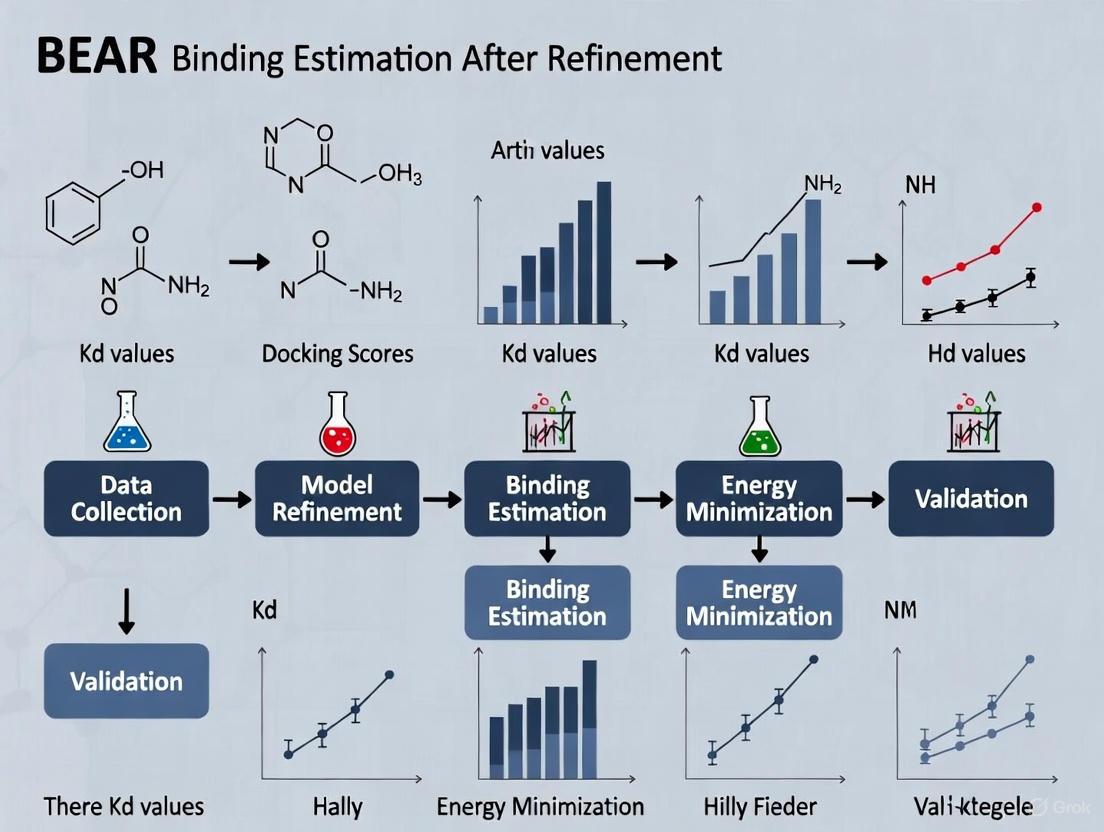
This article provides a comprehensive overview of the Binding Estimation After Refinement (BEAR) methodology, an innovative automated procedure that overcomes critical limitations in molecular docking for virtual screening.
BEAR Methodology: Revolutionizing Virtual Screening in Drug Discovery with Refinement and Rescoring
Abstract
This article provides a comprehensive overview of the Binding Estimation After Refinement (BEAR) methodology, an innovative automated procedure that overcomes critical limitations in molecular docking for virtual screening. Tailored for researchers, scientists, and drug development professionals, the content explores BEAR's foundational principles, its detailed workflow integrating molecular dynamics with MM-PBSA and MM-GBSA for binding free energy estimation, and practical strategies for implementation and optimization. The article further examines the method's validation through significant enrichment of known ligands and successful applications in identifying novel inhibitors, positioning BEAR as a powerful tool for improving the reliability and efficiency of selecting biologically active molecules in modern drug discovery pipelines.
Understanding BEAR: Overcoming the Fundamental Limitations of Molecular Docking
Molecular docking is a cornerstone of computational drug design, employed to predict how a small molecule (ligand) binds to a target protein and to estimate the strength of this interaction. However, its predictive accuracy is fundamentally limited by two intertwined challenges: the inadequacy of scoring functions and the generation of unreasonable ligand conformations. Scoring functions, which are mathematical models used to predict binding affinity, often struggle with accuracy and reliability, while conformational sampling algorithms can produce ligand poses that are physically implausible or chemically unreasonable [1] [2]. These limitations directly impede virtual screening (VS) and structure-based drug design by yielding both false positives and false negatives [3].
Within this context, the Binding Estimation After Refinement (BEAR) methodology was developed as an automated procedure to refine and rescore docked ligand complexes. By leveraging molecular dynamics (MD) simulation followed by more rigorous binding free energy estimates, BEAR aims to correct the deficiencies of standard docking approaches [3]. This application note details the core challenges in docking and provides explicit protocols for implementing the BEAR methodology to achieve more reliable results in drug discovery projects.
Understanding the Core Challenges
The Inadequacy of Scoring Functions
Scoring functions are typically categorized into physics-based, empirical, knowledge-based, and, more recently, machine learning (ML) or deep learning (DL)-based approaches [4]. Despite their different theoretical foundations, they share common shortcomings:
- Poor Correlation with Experimental Data: Many scoring functions fail to accurately predict binding free energies. A study on 19 protein-ligand complexes found that while docking programs could often produce poses close to the crystallographic structure (low RMSD), their scoring functions were less successful at estimating the actual free energy of binding [1] [5].
- Limited Treatment of Key Interactions: Conventional functions often use simplified terms for complex phenomena. They may inadequately account for critical effects such as solvent contributions, entropy, and hydrophobic interactions, which are essential for accurate binding affinity prediction [1] [5].
- Generalization Issues: DL-based scoring functions show promise but often exhibit significant challenges when applied to novel protein targets or binding pockets not represented in their training data, limiting their broad applicability [6].
Table 1: Categorization and Limitations of Common Scoring Function Types
| Type | Basis of Function | Key Advantages | Key Limitations |
|---|---|---|---|
| Physics-Based | Classical force fields (van der Waals, electrostatics) [4] | Strong theoretical foundation | Computationally intensive; often requires approximations [4] |
| Empirical | Weighted sum of energy terms fitted to experimental data [4] | Faster computation; simpler functions [4] | Dependent on quality and scope of training data |
| Knowledge-Based | Statistical potentials from known structures [4] | Good balance of speed and accuracy [4] | Potential bias from dataset composition |
| DL-Based | Complex patterns learned from large datasets [6] [4] | Can model complex, non-linear relationships | Poor generalization to unseen data; can produce physically implausible results [6] |
The Problem of Unreasonable Ligand Conformations
The generation of unreasonable ligand conformations is a direct consequence of the approximations used in conformational search algorithms. These algorithms, designed for computational efficiency, often undersample the complex conformational space of a flexible ligand.
- Steric Clashes and Invalid Chemistry: Many docking programs, including state-of-the-art DL models, can produce poses with significant steric clashes with the protein or internally within the ligand. Furthermore, some DL methods have been found to generate poses with invalid bond lengths or angles [6].
- Prioritizing RMSD over Physical Plausibility: The widespread use of Root-Mean-Square Deviation (RMSD) as the primary validation metric can be misleading. A pose may have a low RMSD compared to a crystal structure but still represent a physically unrealistic conformation that would be unstable in reality [1]. Evaluations show that some methods with high pose accuracy (RMSD ≤ 2 Å) can have suboptimal physical validity scores, indicating a trade-off between these two objectives [6].
The BEAR Methodology: A Refinement and Rescoring Solution
The BEAR procedure addresses these challenges through a post-docking refinement and rescoring pipeline. Its core principle is to use more computationally intensive but theoretically sound methods to improve the initial docking output.
The following diagram illustrates the automated BEAR procedure, which begins with initial docking poses and concludes with a refined, rescored list of complexes.
Key Advantages of the BEAR Approach
- Correction of Docking Deficiencies: BEAR is explicitly designed to overcome limitations like poor scoring function accuracy and unreasonable ligand conformations generated by standard docking programs [3].
- Flexibility and Customization: As BEAR relies on molecular dynamics, the entire procedure can be tailored to the end-user's needs in terms of computational time and the desired accuracy of results [3].
- Enhanced Virtual Screening Performance: In validation tests, applying BEAR resulted in a significant enrichment of known ligands among top-scoring compounds compared to the original docking results, thereby improving the success rate of identifying biologically active molecules [3].
Application Notes & Experimental Protocols
Protocol 1: Standard BEAR Refinement and Rescoring
This protocol is adapted from the original BEAR publication [3] and is used for the general refinement of docking hits.
I. Experimental Setup and Prerequisites
- Input Structures: A set of protein-ligand complexes generated from a molecular docking program (e.g., AutoDock Vina, Glide, GOLD).
- Software Requirements:
- An MD simulation package (e.g., AMBER, GROMACS, NAMD).
- A tool for MM-PBSA/MM-GBSA calculations (often integrated with MD packages).
- Scripts for trajectory analysis and clustering.
II. Step-by-Step Methodological Procedure
- Initial Docking: Perform virtual screening with your chosen docking program to generate an initial ranked list of ligand poses.
- System Preparation for MD:
- For each protein-ligand complex to be refined, prepare the system by solvating it in an explicit water box and adding ions to neutralize the system's charge.
- Molecular Dynamics Simulation:
- Energy-minimize the solvated system to remove steric clashes.
- Gradually heat the system to the target physiological temperature (e.g., 310 K) under constant volume.
- Equilibrate the system at constant pressure (e.g., 1 atm).
- Run a production MD simulation. The length can be tailored to available resources, but simulations of several nanoseconds are typical to achieve adequate sampling [3].
- Trajectory Analysis and Clustering:
- Save snapshots of the trajectory at regular intervals.
- Cluster the snapshots from the stable portion of the trajectory based on ligand conformation to identify representative structures for energy calculation.
- Binding Free Energy Estimation:
- For each representative cluster structure, calculate the binding free energy using MM-PBSA or MM-GBSA methods. This involves computing the average interaction energy, solvation free energy, and other relevant terms across the selected snapshots.
- Rescoring and Hit Selection:
- Rank the refined ligands based on the MM-PBSA/MM-GBSA binding free energy estimates.
- Compare the new rankings with the original docking results to identify corrected false positives and false negatives.
III. Research Reagent Solutions
Table 2: Essential Tools and Resources for BEAR Protocol Implementation
| Item Name | Function/Description | Example Solutions |
|---|---|---|
| Docking Software | Generates initial ligand poses and scores. | AutoDock Vina [6], Glide [6] [7], GOLD [1] [7] |
| MD Engine | Performs molecular dynamics simulation to relax and sample complex conformations. | AMBER, GROMACS, NAMD |
| Continuum Solvation Model | Calculates electrostatic and non-polar solvation free energy components for MM-PBSA/MM-GBSA. | APBS (for PBSA), tools within AMBER/GROMACS |
| Trajectory Analysis Toolkit | Used for clustering MD snapshots and extracting coordinates for energy calculations. | CPPTRAJ (AMBER), GROMACS analysis tools, MDAnalysis (Python) |
Protocol 2: Targeted Pose Refinement and Validation
This protocol is designed for cases where a specific, promising ligand pose requires validation and optimization, or when initial docking produces chemically unreasonable conformations.
I. Experimental Setup and Prerequisites
- This protocol shares the same software prerequisites as Protocol 1.
- Input Structure: A single protein-ligand complex pose of interest.
II. Step-by-Step Methodological Procedure
- Pose Selection: Identify the pose from initial docking that requires refinement (e.g., a top-scoring pose with apparent steric clashes or poor chemical geometry).
- Extended MD Sampling: Execute a longer MD simulation (tens to hundreds of nanoseconds) focused on this specific complex to enhance conformational sampling and allow the pose to relax into a more stable, physically reasonable state.
- Stability Analysis: Monitor the stability of the protein-ligand complex and key intermolecular interactions (e.g., hydrogen bonds, hydrophobic contacts) throughout the simulation using root-mean-square deviation (RMSD) and interaction analysis.
- Energy Estimation on Stable Frames: Apply MM-PBSA/MM-GBSA calculations on a set of snapshots from the stable simulation period to obtain a robust estimate of the binding free energy.
- Physical Validity Check: Use a tool like the PoseBusters toolkit [6] to validate the final refined pose against chemical and geometric consistency criteria, ensuring the absence of clashes and the presence of valid bond lengths and angles.
The challenges of poor scoring functions and unreasonable ligand conformations remain significant bottlenecks in molecular docking. The BEAR methodology provides a robust, automated framework to mitigate these issues by integrating higher-fidelity theoretical methods. The core strength of BEAR lies in its use of MD simulation to refine unreasonable conformations and generate an ensemble of structurally realistic models, followed by MM-PBSA/MM-GBSA to rescore binding affinity with a more physically detailed model than standard docking scores [3].
As the field progresses, hybrid approaches that combine traditional conformational searches with AI-driven scoring, as well as more sophisticated deep learning models trained on diverse data, show promise for improving generalizability [6]. However, for researchers requiring high-confidence binding mode and affinity predictions today, post-docking refinement protocols like BEAR represent a critical step for translating in silico docking results into biologically actionable insights for drug discovery.
Binding Estimation After Refinement (BEAR) is an automated computational procedure designed to overcome the limitations of molecular docking in virtual screening, primarily addressing poor scoring functions and the generation of unreasonable ligand conformations [3]. It serves as a post-docking refinement and rescoring step, utilizing molecular dynamics (MD) simulation followed by more rigorous binding free energy estimates to improve the selection of biologically active molecules from compound databases [3].
Application Notes
The BEAR methodology addresses a critical bottleneck in structure-based drug design. Traditional docking programs, while efficient for screening large libraries, often produce false positives and false negatives due to simplified scoring functions and inadequate treatment of protein-ligand complex flexibility [3]. BEAR directly corrects these limitations by introducing a dynamic refinement step.
Core Advantages and Applications
- Significant Enrichment: In validation tests, applying BEAR for rescoring resulted in a notable enrichment of known ligands among the top-ranking compounds compared to the original docking results. This directly enhances the probability of identifying true hits in a virtual screening campaign [3].
- Corrects Docking Errors: It is specifically designed to correct both false-positive and false-negative hits generated by initial docking screens, leading to more reliable candidate selection [3].
- Tailored to User Needs: Since the procedure relies on molecular dynamics simulations, the computational time and desired accuracy can be customized based on the project's requirements and available resources [3].
Experimental Protocols
The BEAR procedure follows a defined workflow that refines the output of a standard docking study.
Detailed BEAR Workflow Protocol
- Input Preparation: The protocol begins with the output structures from a virtual screening run performed using any standard docking program.
- Molecular Dynamics (MD) Simulation:
- Each docked protein-ligand complex is subjected to a molecular dynamics simulation.
- This step allows the complex to relax in a solvated environment, refining the ligand's pose and accounting for protein flexibility and explicit solvent effects, which are often neglected in docking.
- Binding Free Energy Estimation:
- From the MD simulation trajectories, binding free energies are calculated using more sophisticated methods.
- The primary methods employed are MM-PBSA (Molecular Mechanics Poisson-Boltzmann Surface Area) and MM-GBSA (Molecular Mechanics Generalized Born Surface Area).
- These methods provide a more physically realistic estimate of the binding affinity than standard docking scores.
- Rescoring and Hit Selection:
- The calculated MM-PBSA/GBSA free energies are used to rescore and re-rank the initially docked compounds.
- The final output is a refined list of potential hits, ranked by their estimated binding affinity, for further experimental validation.
Key Quantitative Findings from Validation
Table 1: Summary of BEAR Methodology Validation
| Metric | Performance | Context |
|---|---|---|
| Enrichment of Known Ligands | Significant improvement [3] | Comparison of hit lists before and after BEAR rescoring |
| Impact on False Positives/Negatives | Effective correction [3] | More reliable selection of biologically active molecules |
Table 2: Computational Methods Used in BEAR
| Component | Method/Tool | Primary Function |
|---|---|---|
| Initial Sampling | Docking Program (e.g., AutoDock, GOLD) | Generate initial protein-ligand complex poses |
| Refinement | Molecular Dynamics (MD) Simulation | Refine poses and account for flexibility/solvation |
| Rescoring | MM-PBSA & MM-GBSA | Calculate binding free energy estimates |
Workflow and Signaling Diagrams
The following diagram illustrates the logical flow and key stages of the BEAR methodology.
BEAR Methodology Workflow
The Scientist's Toolkit: Research Reagent Solutions
Table 3: Essential Computational Tools for BEAR Implementation
| Tool / Reagent | Function / Description |
|---|---|
| Molecular Docking Software | Generates the initial set of protein-ligand complex conformations for refinement. |
| Molecular Dynamics Engine | Software that performs the MD simulation to relax the docked complexes in a solvated environment. |
| MM-PBSA/GBSA Scripts | Tools or modules used to compute binding free energies from the MD simulation trajectories. |
| Ligand and Protein Preparation Tools | Programs used to properly format and optimize the 3D structures of the target protein and compound library prior to docking. |
Virtual screening (VS) is a cornerstone of modern computational drug discovery, enabling researchers to rapidly identify potential hit compounds from vast molecular libraries. However, the effectiveness of standard VS workflows is often hampered by the inherent approximations of molecular docking, leading to two significant challenges: the identification of false positives (inactive compounds predicted as active) and false negatives (active compounds incorrectly discarded). The Binding Estimation After Refinement (BEAR) methodology was developed as a post-docking processing tool to address these very limitations. By refining docking poses through molecular dynamics and applying more rigorous scoring functions, BEAR significantly improves the reliability of virtual screening outcomes, ensuring that valuable resources are allocated to the most promising candidates [3] [8].
The BEAR Workflow: From Docking to Refined Ranking
The BEAR procedure is an automated, multi-step protocol designed to correct the results of an initial virtual screen. Its core innovation lies in the structural refinement of docked complexes and the subsequent rescoring using methods that provide a more physically realistic estimation of binding affinity.
The following diagram illustrates the sequential, iterative stages of the BEAR workflow:
Diagram Title: BEAR Workflow for VS Refinement
As the workflow shows, BEAR begins with the top-ranking compounds from a standard docking screen. The key stages are:
- Pre-processing and Topology Building: Hydrogen atoms are added to the protein structure, and atomic charges for the docked ligands are calculated using the AM1-BCC method. Missing force-field parameters are assigned, with ligands parameterized using the Generalized Amber Force Field (GAFF) and the protein using the Amber ff03 force field [8].
- Conformational Refinement Cycle: This iterative step uses molecular mechanics (MM) and molecular dynamics (MD) to relax the initial docked pose. The entire protein-ligand complex undergoes an initial energy minimization, followed by a short MD simulation (typically 100 ps at 300 K) where the ligand is allowed to move, and a final re-minimization of the entire complex. This process helps the complex escape potential local energy minima derived from the docking calculation and sample more realistic binding poses [3] [8].
- Rescoring with MM-PB(GBA): The refined structures are then rescored using the Molecular Mechanics-Poisson Boltzmann (or Generalized Born) Surface Area method. This approach provides a more accurate estimation of the binding free energy by incorporating implicit solvation effects, which are often poorly handled by standard docking scoring functions [8].
Quantitative Validation of the BEAR Advantage
The BEAR methodology has been rigorously validated against multiple biological targets, demonstrating a consistent ability to correct virtual screening errors and improve enrichment of true active compounds.
Table 1: Benchmarking BEAR Performance on Different Targets
| Target Protein | Virtual Screening Context | Key Performance Metric | Result with Docking Alone | Result with BEAR Refinement |
|---|---|---|---|---|
| PfDHFR [8] | 14 known inhibitors seeded in NCI Diversity Set (1,720 compounds) | Enrichment of known inhibitors | Lower performance (AutoDock) | Superior identification and ranking of inhibitors |
| PfDHFR [8] | 201 known inhibitors seeded with 7,150 decoys (DUD dataset) | Enrichment Factor (EF) | Lower EF | Significantly higher EF |
| PfDHFR [8] | 201 known inhibitors seeded in 1.5 million compound library (ZINC) | Enrichment Factor (EF) in a large-library setting | Lower EF | Significantly higher EF |
| Aldose Reductase [8] | Diverse set of known inhibitors | Correlation with experimental binding affinity | Not reported | High correlation achieved after refinement |
| General Validation [3] | Multiple targets | Enrichment of known ligands | Original docking results | Significant enrichment after BEAR rescoring |
The data in Table 1 underscores BEAR's primary advantage: its ability to correct both false positives and false negatives. By refining the binding pose, BEAR can disqualify false positives that achieved a favorable docking score through unrealistic interactions. Conversely, by using a more accurate scoring function, it can identify true positives (correcting false negatives) that were poorly ranked by the initial docking score [3] [8].
Detailed Protocol for Implementing BEAR
This section provides a step-by-step protocol for applying the BEAR methodology to refine the results of a virtual screening campaign.
Prerequisites and Input Preparation
- Initial Docking Results: A set of top-ranking protein-ligand complexes generated by your molecular docking software of choice (e.g., AutoDock, Glide, GOLD).
- Protein Structure File: A PDB file of the target protein, preferably with crystallographic waters and cofactors removed from the binding site unless deemed critical.
- Ligand Structure Files: 3D structure files (e.g., MOL2, SDF) of the docked ligands, including assigned partial charges as required by the docking software.
Step-by-Step Procedure
Pre-processing:
- Use the
tleapmodule from AMBER to load the protein PDB file. Add missing hydrogen atoms assuming a standard physiological pH (e.g., 7.4). - For each ligand, calculate AM1-BCC charges using the
antechamberprogram. - Parameterize the ligand using the GAFF force field within
antechamber.
- Use the
Topology Building:
- Create topology and coordinate files for the protein, ligand, and the protein-ligand complex using
tleap. Assign the Amber ff03 force field to the protein.
- Create topology and coordinate files for the protein, ligand, and the protein-ligand complex using
Conformational Refinement Cycle:
- Energy Minimization: Perform a full minimization of the solvated complex using the
sanderorpmemdmodule. Apply 2,000 steps of minimization without positional restraints. - Molecular Dynamics Simulation: Conduct a short MD simulation of 100 ps in length at a temperature of 300 K. Apply positional restraints to the protein backbone and side chains, allowing only the ligand to move freely. Use a 2 fs time step and the SHAKE algorithm for bond constraints.
- Re-minimization: Perform a final full minimization of the refined complex (2,000 steps) to remove any residual strains.
- Energy Minimization: Perform a full minimization of the solvated complex using the
Rescoring with MM-PB/GBSA:
- Use the
MMPBSA.pyscript from AMBER tools on a set of snapshots extracted from the stable portion of the MD trajectory. - Calculate the binding free energy using both the Poisson-Boltzmann (MM-PBSA) and Generalized Born (MM-GBSA) models. The final binding free energy (ΔGbind) is calculated as: *ΔGbind = Gcomplex - (Gprotein + G_ligand)*
- Repeat this process for every ligand in the dataset.
- Use the
Result Analysis:
- Rank all compounds based on the calculated MM-PB/GBSA binding free energies (ΔG_bind).
- Compare this new ranked list with the original docking ranking. The top-scoring compounds from the BEAR analysis represent the refined virtual screening hits with a reduced rate of false positives.
Table 2: The Scientist's Toolkit - Essential Research Reagents & Software for BEAR
| Item Name | Category | Function in BEAR Protocol | Example / Source |
|---|---|---|---|
| AMBER Tools | Software Suite | Provides all necessary modules for simulation (tleap, sander/pmemd) and free energy calculation (MMPBSA.py). | ambermd.org [8] |
| Generalized Amber Force Field (GAFF) | Force Field | Defines parameters for bonds, angles, dihedrals, and non-bonded interactions for small organic molecules. | Distributed with AMBER [8] |
| Amber ff03 Force Field | Force Field | Defines parameters for protein atoms (amino acids). | Distributed with AMBER [8] |
| antechamber | Software Tool | Automates the process of setting up ligands for simulation: charge calculation (AM1-BCC) and GAFF parameterization. | Part of AMBER Tools [8] |
| Molecular Docking Software | Software | Generates the initial poses and rankings for the protein-ligand complexes that serve as BEAR's input. | AutoDock, Glide, GOLD, etc. [8] |
| Decoy Finder | Software Tool | (For Validation) Generates sets of inactive molecules (decoys) with similar properties to actives to test the screening protocol. | Universitat Rovira I Virgili [9] |
Discussion and Outlook
The BEAR methodology represents a critical bridge between high-throughput but approximate docking and computationally expensive free-energy perturbation methods. It offers a balanced compromise, providing a significant increase in accuracy without becoming prohibitively costly for the post-processing of hundreds to thousands of top docking hits [8].
Future developments in this area are likely to focus on increasing the throughput and automation of the refinement process. Furthermore, the integration of machine learning (ML) models trained to predict the outcome of refinement simulations could act as a fast pre-filter, guiding the application of full BEAR protocols to the most promising candidates and enabling the screening of even larger chemical spaces [10]. As shown in recent studies, ML can accelerate virtual screening by over 1,000-fold, and combining these approaches with physics-based refinement like BEAR presents a powerful future direction for the field [11] [10].
For researchers, incorporating BEAR or similar refinement and rescoring strategies into their standard virtual screening workflow is a highly recommended practice to mitigate the risks of experimental follow-up on false leads and to increase the overall odds of success in hit identification.
Molecular docking is a cornerstone of computational drug discovery, enabling the high-throughput prediction of how small molecules and biologics interact with target proteins. However, despite its widespread adoption, the technique is hampered by significant limitations in scoring accuracy and its treatment of molecular flexibility, which directly impact the reliability of predicted binding modes and virtual screening outcomes [12] [13]. The Binding Estimation After Refinement (BEAR) methodology was developed precisely to address these limitations through the incorporation of Molecular Dynamics (MD) simulations, providing a robust framework for post-docking refinement that significantly enhances the predictive power of structure-based drug discovery [3] [14].
This application note delineates the fundamental rationale for integrating MD simulations into post-docking workflows. We detail the specific shortcomings of docking that MD rectifies, provide explicit protocols for implementation within the BEAR context, and present quantitative evidence of its performance in refining complex molecular systems, with a particular emphasis on challenging targets like RNA-protein complexes and flexible peptides.
The Theoretical Imperative: Limitations of Docking Addressed by MD
Table 1: Key Limitations of Docking and Corresponding MD Solutions
| Docking Limitation | Molecular Dynamics Solution | Impact on Binding Mode Quality |
|---|---|---|
| Inaccurate Scoring Functions [12] [15] | MM-PBSA/MM-GBSA Free Energy Estimation [3] [16] | More accurate ranking of poses based on binding affinity; reduction of false positives. |
| Neglect of Full Flexibility (Rigid/Semi-flexible docking) [12] | Explicit Sampling of Protein, Ligand, and Solvent Dynamics [17] | Accurate modeling of induced-fit binding; resolution of steric clashes. |
| Poor Treatment of Solvation & Ions [12] | Simulation in Explicit Solvent with Physiological Ion Concentrations [12] [17] | Realistic modeling of water-mediated H-bonds, salt bridges, and electrostatic shielding. |
| Single-Conformation "Snapshot" [15] | Sampling of Thermodynamic Ensembles [12] [17] | Assessment of binding mode stability (via RMSD) and interaction persistence over time. |
| High Strain in Ligand Conformations [15] | Geometry Relaxation via Force Field [17] [16] | Identification and relaxation of physically implausible, high-energy ligand states. |
The integration of MD is not merely an incremental improvement but a fundamental necessity to overcome the physics-based simplifications inherent in high-throughput docking. Docking algorithms primarily function as rapid sampling and ranking tools, but their simplified energy functions cannot capture the intricate balance of enthalpic and entropic contributions that govern molecular recognition in an aqueous, dynamic environment [12] [13]. MD simulations, guided by sophisticated force fields, bridge this gap by providing a dynamic and physically realistic model of the biomolecular complex.
This is particularly critical for specific target classes:
- RNA-Protein Complexes: The highly charged RNA backbone and its structural flexibility make interactions heavily dependent on solvent and ion dynamics, which are poorly modeled in standard docking [12].
- Flexible Peptides: Linear peptides, such as histone tails, often bind to shallow protein pockets with extensive hydration networks. Their large conformational space and weak binding affinities present a formidable challenge for docking that is effectively addressed by MD refinement [17].
BEAR Methodology: A Protocol for MD-Based Refinement
The BEAR algorithm automates the post-docking refinement process through a defined sequence of MD simulations and subsequent free energy estimation [3] [16]. The workflow below outlines the core procedure.
Diagram Title: BEAR Post-Docking Refinement Workflow
Detailed Experimental Protocol
The following protocol is adapted from validated studies on the BEAR methodology [3] [16] and subsequent refinements for complex systems [17].
Step 1: System Preparation
- Structure Formatting: Convert docked poses from docking software (e.g., AutoDockVina) to a format compatible with MD suites (AMBER, GROMACS).
- Parameter Assignment:
- For the protein/RNA receptor: Use a standard force field (e.g., ff19SB for proteins, OL3 for RNA).
- For small molecule ligands: Generate parameters using the General AMBER Force Field (GAFF) with AM1-BCC partial charges via the
antechambertool [16].
- Solvation and Ions: Place the complex in a pre-equilibrated water box (e.g., TIP3P), ensuring a minimum buffer distance (e.g., 10-12 Å). Add physiological ions (e.g., 0.154 M NaCl) to neutralize the system's net charge and mimic biological ionic strength [12].
Step 2: Energy Minimization
- Objective: Remove steric clashes and bad contacts introduced during docking and solvation.
- Protocol: Perform 2000 steps of steepest descent minimization with positional restraints on the heavy atoms of the protein/RNA and ligand. This allows the solvent and ions to relax around the complex.
Step 3: Molecular Dynamics Simulation
- Objective: Sample the flexibility of the ligand and its local binding environment.
- Protocol:
- Restraints: Apply harmonic restraints (e.g., 5.0 kcal/mol/Ų) to the heavy atoms of the receptor, allowing only the ligand and solvent molecules to move freely.
- Conditions: Run a 100 ps simulation at 300 K in the NVT ensemble, using a Langevin thermostat and a 2 fs time step with bonds involving hydrogen constrained (SHAKE) [16].
- Enhanced Sampling (Optional): For particularly rugged energy landscapes, as in RNA complexes, consider enhanced sampling techniques like Thermal Titration MD (TTMD) [12] or Gaussian Accelerated MD (GaMD) to improve conformational sampling efficiency.
Step 4: Post-MD Minimization and Analysis
- Minimization: Perform a final 2000-step energy minimization of the entire, unrestrained system to relax the structure into the nearest local energy minimum.
- Trajectory Analysis:
- Calculate the root mean square deviation (RMSD) of the ligand heavy atoms relative to the initial docked pose to assess stability.
- Monitor the persistence of key interactions (H-bonds, hydrophobic contacts) over the simulation trajectory. A stable pose typically maintains an RMSD ≤ 2.0 Å and retains critical pharmacophoric interactions for >60% of the simulation time [15].
Step 5: Binding Free Energy Estimation
- Objective: Rescore the refined pose with a more accurate, physics-based method.
- Protocol: Extract snapshots from the stable portion of the trajectory (e.g., the final 50 ps) and calculate the binding free energy using the MM-PBSA or MM-GBSA methods. This provides a superior ranking metric compared to standard docking scores [3] [16].
Performance and Validation: Quantitative Evidence
Table 2: Performance of MD Refinement in Challenging Systems
| System / Challenge | Refinement Protocol | Key Performance Metric | Result |
|---|---|---|---|
| Histone Peptide-Reader Protein [17] | 6 different MD protocols with explicit hydration | Median improvement in ligand RMSD vs. experimental | 32% improvement over docked structures |
| P. falciparum DHFR (PfDHFR) Dataset [16] | BEAR (MD) vs. Simple Energy Minimization | Enrichment of known ligands | BEAR showed excellent performance, comparable to minimization but with more rigorous sampling |
| RNA-Peptide Complexes [12] | Thermal Titration MD (TTMD) | Successful identification of native binding modes | Correctly identified native poses among decoys for pharmaceutically relevant targets |
| General Virtual Screening [15] | Short MD (5-15 ns) for pose validation | Ligand RMSD stability & contact persistence | Stable poses defined by RMSD ≤ 2.0 Å and key contact persistence of 40-60% |
Validation studies consistently demonstrate that MD refinement significantly improves the quality of docked complexes. In one benchmark, the BEAR algorithm resulted in a significant enrichment of known ligands among top-scoring compounds compared to original docking results, directly addressing the problem of false positives and negatives in virtual screening [3] [14]. A separate study on flexible histone peptides achieved a median 32% improvement in the root mean squared deviation (RMSD) of the ligand when compared to experimental reference structures after MD refinement [17]. Furthermore, methods like TTMD have proven effective in refining RNA-peptide docking poses, correctly identifying native binding modes where standard docking fails [12].
The Scientist's Toolkit: Essential Research Reagents and Solutions
Table 3: Key Software and Computational Tools for MD Refinement
| Tool / Resource | Function in Workflow | Key Feature for Refinement |
|---|---|---|
| AMBER Suite [16] | MD Simulation & Free Energy Calculation | Integrated toolchain for antechamber, sander/pmemd, and MM-PBSA/GBSA calculations. |
| GROMACS [18] | MD Simulation | High-performance, GPU-accelerated engine suitable for large systems and long time scales. |
| g_mmpbsa [16] | Binding Free Energy Estimation | A popular tool compatible with GROMACS for calculating MM-PBSA/GBSA free energies. |
| HDOCK / HADDOCK [12] | RNA-Protein/Protein Docking | Specialized docking tools for generating initial poses for nucleic acid-protein complexes. |
| Molecular Operating Environment (MOE) [12] | Structure Preparation | Comprehensive suite for adding missing atoms, assigning protonation states, and energy minimization. |
| BEAR Algorithm [3] [16] | Automated Refinement Pipeline | An automated procedure that integrates minimization, short MD, and rescoring into a single workflow. |
Successful implementation of an MD refinement protocol requires access to adequate computational hardware. Studies validating these methods were run on clusters comprising multiple NVIDIA GPUs (e.g., from GTX980 to RTX4090), which are essential for achieving the necessary simulation throughput for virtual screening applications [12].
Molecular Dynamics is not an optional add-on but an essential component of a rigorous post-docking refinement strategy. The BEAR methodology and related protocols provide a structured, automated path to integrate MD, directly addressing the critical limitations of molecular docking—scoring inaccuracy, inadequate flexibility, and poor solvation treatment. The quantitative evidence from diverse target systems, from soluble enzymes to challenging RNA-protein complexes and flexible peptides, confirms that MD refinement consistently enhances structural accuracy and improves the enrichment of true binders. For researchers committed to achieving predictive reliability in structure-based drug design, the incorporation of MD-based refinement represents a necessary and high-value investment.
Implementing the BEAR Workflow: A Step-by-Step Guide to Refinement and Rescoring
Within the framework of Binding Estimation After Refinement (BEAR) methodology, the initial preprocessing stage is not merely a preliminary step but a fundamental determinant of the reliability of final binding affinity predictions [3]. The BEAR procedure enhances virtual screening outcomes by refining docked poses through molecular dynamics simulations and subsequent binding free energy estimates using MM-PBSA and MM-GBSA methods [3]. The accuracy of these advanced calculations is critically dependent on the quality of the initial structural models and their corresponding physicochemical parameters. This document provides detailed application notes and protocols for the three essential preprocessing components: protein preparation, AM1-BCC charge assignment, and topology building, with specific emphasis on their implementation within BEAR-based research workflows.
Protein Preparation Protocols
Proper protein preparation establishes the structural foundation for all subsequent computational analyses. This process ensures the protein model is structurally complete, energetically minimized, and ready for simulation.
Initial Structure Acquisition and Assessment
Protocol 1: Structure Retrieval and Validation
- Source Selection: Obtain protein structures from the Protein Data Bank (PDB). Prefer structures with high resolution (preferably <2.0 Å), low R-factors, and complete active site residues.
- Visual Inspection: Examine the structure using molecular visualization software (e.g., VIDA). Assess the binding pocket for missing residues, atom clashes, and unresolved loops [19].
- Component Identification: Identify and document all non-protein components including ligands, cofactors, essential water molecules, and ions. Decide which components to retain based on their potential role in ligand binding.
Protocol 2: Structure Editing and Cleaning
- Remove Extraneous Components: Delete detergent molecules, non-relevant solvent molecules, and redundant subunits not involved in binding. This can be done via text editing of PDB files or through graphical selection tools [19].
- Biological Unit Generation: Generate the biologically relevant oligomeric state using tools like SPRUCE, which automatically processes asymmetric units and builds biologically relevant complexes [19].
- Alternate Location Handling: Resolve disordered atoms by selecting the highest occupancy conformer or the conformer most consistent with the electron density.
Comprehensive Structure Preparation
Protocol 3: Hydrogen Addition and Protonation State Assignment
- Hydrogen Addition: Use specialized preparation tools (e.g., SPRUCE) to add hydrogen atoms. The tool should optimize proton positions considering local dielectric environment [19].
- Protonation States: Assign physiologically relevant protonation states to histidine, aspartic acid, glutamic acid, and lysine residues at the target pH (typically 7.4). Pay special attention to catalytic residues and those within hydrogen bonding distance of potential ligands.
- Tautomer Selection: For histidine residues and ligand functional groups, select the predominant tautomeric state based on molecular context and hydrogen bonding opportunities.
Protocol 4: Structural Completion and Refinement
- Missing Side Chains: Rebuild incomplete side chains using rotamer libraries, selecting the rotamer that minimizes steric clashes while maximizing favorable interactions.
- Chain Break Repair: Identify and cap chain breaks resulting from unresolved electron density using appropriate capping groups (e.g., acetyl for N-terminal, methylamide for C-terminal).
- Structural Optimization: Perform limited energy minimization to relieve steric clashes while maintaining the overall protein fold and crystallographic constraints.
Table 1: Protein Preparation Steps and Their Functional Significance
| Preparation Step | Key Actions | Impact on Downstream Analysis |
|---|---|---|
| Structure Assessment | PDB retrieval, visual inspection, component inventory | Ensures starting model quality and relevance to biological context |
| Component Editing | Removal of extraneous molecules, biological unit generation | Reduces computational complexity, focuses on relevant binding interface |
| Hydrogen Addition | Proton placement, protonation state assignment, tautomer selection | Creates physically accurate model of electrostatics at target pH |
| Structural Completion | Side chain building, chain break capping, loop modeling | Provides complete structural model without artifactual gaps |
| Energy Optimization | Constrained minimization, clash relief | Produces stable starting structure for dynamics simulation |
AM1-BCC Charge Assignment
Accurate partial atomic charge assignment is critical for modeling electrostatic interactions—a key component of ligand binding energetics. The AM1-BCC method provides an efficient balance between computational efficiency and physical accuracy suitable for high-throughput virtual screening.
Theoretical Foundation and Algorithm
The AM1-BCC approach combines semiempirical quantum mechanics with empirical corrections to efficiently approximate high-level quantum mechanical charges [20]. The methodology operates through a two-step process:
- AM1 Mulliken Charges: Calculation of initial partial atomic charges using the Austin Model 1 (AM1) semiempirical method, which captures the primary electronic structure features of the molecule.
- Bond Charge Correction: Application of parameterized bond charge corrections (BCCs) to the AM1 Mulliken charges to reproduce Hartree-Fock (HF/6-31G*) level electrostatic potentials [20].
This approach bypasses computationally expensive ab initio calculations while maintaining transferability across diverse chemical environments—a crucial requirement for virtual screening of compound libraries.
ABCG2: Next-Generation Parameterization
Recent optimization has yielded the ABCG2 parameter set, specifically tuned for compatibility with the GAFF2 force field and significantly improving solvation free energy predictions [20].
Protocol 5: AM1-BCC Charge Assignment Using ABCG2
- Input Preparation: Generate a 3D molecular structure with correct bond orders, hybridization states, and formal charges. Ensure the structure represents a relevant low-energy conformation.
- Charge Calculation: Execute the AM1-BCC protocol through the ANTECHAMBER module of AMBER tools. The updated BCC parameters in ABCG2 will be automatically applied [20].
- Validation: Compare calculated charges against known benchmarks for functional groups present in the molecule. For critical compounds, consider comparing with RESP charges derived from HF/6-31G* calculations.
Table 2: Performance Comparison of Charge Models for Solvation Free Energy Prediction (kcal/mol)
| Charge Model | Mean Unsigned Error (HFE) | Root Mean Square Error (SFE) | Functional Group Dependencies |
|---|---|---|---|
| Original AM1-BCC | 1.03 | Not reported | Significant errors for polar groups |
| ABCG2 (Optimized) | 0.37 | 0.65 | Balanced performance across diverse chemistries |
| RESP/HF/6-31G* | ~0.7-1.0 | Varies | Generally accurate but computationally expensive |
The exceptional performance of ABCG2 is evidenced by its significant reduction in mean unsigned error for hydration free energy (HFE) prediction from 1.03 kcal/mol to 0.37 kcal/mol, and its robust performance across diverse organic solvents with varying dielectric constants [20].
Integration with BEAR Methodology
Within the BEAR framework, accurate charge assignment during preprocessing directly enhances the quality of subsequent molecular dynamics simulations and MM-PBSA/GBSA calculations [3]. The optimization of electrostatic interactions through improved charge models reduces systematic errors in binding free energy estimates, leading to better discrimination between true binders and non-binders in virtual screening.
Topology Building
Molecular topology files provide a complete mathematical description of the molecular system, defining all atoms, bonds, angles, dihedrals, and non-bonded interaction parameters required for simulation.
Force Field Selection and Application
Protocol 6: Ligand Topology Generation
- Force Field Assignment: Apply GAFF2 parameters for small molecules, which include updated bonded parameters for improved geometry reproduction and refined non-bonded parameters for accurate interaction energies [20].
- Atom Typing: Assign appropriate GAFF2 atom types based on element type, hybridization, and chemical environment.
- Parameter Assignment: Extract bond, angle, dihedral, and improper dihedral parameters from GAFF2 parameter files. For missing parameters, utilize similar existing parameters or perform custom quantum mechanical calculations.
Protocol 7: Protein Topology Generation
- Force Field Selection: Use AMBER ff14SB or newer protein force fields, which provide accurate backbone and side chain torsion parameters.
- Residue Template Assignment: Apply predefined residue templates for standard amino acids, with custom parameterization for non-standard residues or post-translational modifications.
- Cross-term Compatibility: Ensure compatibility between protein and ligand force fields through consistent combining rules and parameter derivation methodologies.
Complex Assembly and Solvation
Protocol 8: Protein-Ligand Complex Construction
- Spatial Alignment: Position the prepared ligand within the binding site according to docking poses or experimental coordinates.
- Non-bonded Parameter Integration: Merge protein and ligand topology files, ensuring consistent atom numbering and exclusion rules.
- Solvation Box Placement: Center the complex in an appropriate periodic box (typically rectangular or truncated octahedral) with a buffer of at least 10Å between the solute and box edges.
- Counterion Addition: Add sufficient counterions to neutralize system charge, plus additional ions to match physiological salt concentration (e.g., 150mM NaCl).
Table 3: Research Reagent Solutions for Molecular Simulation
| Reagent/Software | Category | Function in Preprocessing |
|---|---|---|
| SPRUCE | Preparation Tool | Automated protein structure preparation including protonation, side chain building, and charge assignment [19] |
| ANTECHAMBER | Charge Tool | Automated charge assignment via AM1-BCC method with ABCG2 parameters [20] |
| GAFF2 | Force Field | Provides bonded and non-bonded parameters for small organic molecules [20] |
| AMBER ff14SB | Force Field | Accurate potential energy function for protein simulations |
| TIP3P | Water Model | Three-site transferable water model for aqueous solvation |
| AMBER Tools | Software Suite | Comprehensive collection of utilities for topology building and simulation setup |
Integrated Workflow for BEAR Methodology
The preprocessing steps described above form an integrated pipeline that prepares structural inputs for the subsequent BEAR refinement stages.
Protocol 9: End-to-End Preprocessing for BEAR
- Parallel Preparation: Simultaneously prepare the protein structure and ligand molecules using the protocols outlined above.
- Docking Pose Generation: Perform molecular docking of prepared ligands into the prepared protein binding site.
- Topology Generation for Complex: Create complete topology files for the protein-ligand complex, including solvent and ions.
- System Validation: Perform short energy minimization and molecular dynamics to verify system stability before proceeding to production BEAR simulations.
The preprocessing stage—encompassing rigorous protein preparation, accurate AM1-BCC charge assignment with the optimized ABCG2 parameters, and careful topology building—establishes the essential foundation for successful BEAR methodology implementation. Through the protocols detailed in this document, researchers can generate high-quality structural models and physicochemical parameters that enable the subsequent molecular dynamics refinement and binding free energy estimation to achieve their full predictive potential. Proper execution of these preprocessing steps directly addresses common limitations of docking-based virtual screening, facilitating the reliable identification of biologically active molecules in drug discovery campaigns [3].
The Iterative Refinement Cycle represents a core component of the BEAR (Binding Estimation After Refinement) methodology, addressing critical limitations in structure-based virtual screening. This protocol employs sequential energy minimization and constrained molecular dynamics to refine docked poses, followed by binding free energy estimation using MM-PB(GB)SA methods. By implementing this cyclic refinement process, researchers can significantly enhance the accuracy of binding affinity predictions, correct both false-positive and false-negative hits from initial docking screens, and achieve superior enrichment of biologically active compounds compared to standalone docking approaches [3] [8]. This application note provides detailed protocols and experimental frameworks for implementing these techniques within drug discovery pipelines.
Molecular docking, while invaluable in structure-based drug discovery, suffers from two fundamental limitations: the use of approximated scoring functions and inadequate sampling of ligand-target complexes [8]. These shortcomings inevitably lead to approximate results that require careful post-docking analysis. The BEAR methodology was developed specifically to address these challenges through an automated procedure that refines and rescores docked ligands using molecular dynamics simulations and more rigorous binding free energy estimates [3].
The iterative refinement cycle within BEAR serves as a computational bridge between rapid virtual screening and more accurate but resource-intensive free energy calculation methods. By implementing a targeted approach that focuses computational resources on refining promising candidates, this strategy represents a practical compromise that delivers significantly improved results without prohibitive computational costs [16] [8]. This is particularly valuable in academic settings and small companies where computational resources may be limited.
Theoretical Framework
The BEAR Workflow Architecture
The BEAR workflow integrates sequential computational techniques to progressively refine protein-ligand interactions. The complete process transforms crude docking poses into physically realistic complexes through systematic application of molecular mechanics and dynamics principles [8] [21].
Key Computational Components
| Component | Function | Theoretical Basis |
|---|---|---|
| Energy Minimization | Relieves steric clashes and strains in initial docked poses | Molecular mechanics force fields (AMBER ff03, GAFF) [8] |
| Constrained MD | Samples limited conformational space while maintaining binding pose | Newtonian mechanics with SHAKE algorithm for bond constraints [8] |
| MM-PB(GB)SA | Calculates binding free energies accounting for solvation effects | Continuum solvation models approximating electrostatic and non-polar contributions [3] [16] |
The theoretical foundation rests on the recognition that single, rigid docking poses inadequately represent the dynamic nature of protein-ligand interactions. By introducing limited flexibility through constrained dynamics and systematically relaxing the complexes, the method samples more physiologically relevant conformations while maintaining computational efficiency [8].
Experimental Protocols
Comprehensive Refinement Cycle Protocol
System Preparation and Parameterization
- Protein Preparation: Assign AMBER ff03 force field parameters and atomic charges to the receptor. Add hydrogen atoms using appropriate protonation states for ionizable residues based on physiological pH [8].
- Ligand Parameterization: Calculate atomic charges for docked molecules using AM1-BCC method. Assign atom types according to the Generalized Amber Force Field (GAFF). Use antechamber module to generate force field parameters and parmchk to identify missing parameters [16] [8].
- Topology Construction: Build separate topologies for ligand, protein, and ligand-protein complex to enable subsequent energy calculations [8].
Iterative Refinement Steps
Initial Energy Minimization
Constrained Molecular Dynamics
- Conduct 100 ps MD simulation at 300 K
- Apply positional restraints to protein heavy atoms (force constant: 2-5 kcal/mol/Ų)
- Allow full flexibility to ligand atoms
- Enable SHAKE algorithm for hydrogen-containing bonds
- Use time step of 2.0 fs
- Objective: Sample limited ligand conformational space while maintaining binding site architecture [8]
Final Re-minimization
- Perform additional 2000 steps of minimization without restraints
- Use identical parameters to initial minimization
- Objective: Relax the system after constrained MD and prepare for binding energy calculations [8]
Binding Affinity Estimation
- Extract multiple snapshots from the final minimization for binding free energy calculations
- Calculate binding free energies using both MM-PBSA and MM-GBSA methods
- Account for polar and non-polar solvation contributions
- Perform entropy estimates if computational resources permit (optional) [8]
Validation Assessment Protocol
Performance Evaluation Metrics
- Enrichment Factors: Calculate ability to prioritize known binders over decoys using directory of useful decoys (DUD) datasets [8]
- Binding Affinity Correlation: Compare calculated vs. experimental binding energies for benchmark systems
- Pose Prediction Accuracy: Assess RMSD of refined poses relative to crystallographic references
Comparative Analysis
- Execute parallel processing with and without refinement cycle
- Compare results against original docking scores
- Evaluate computational efficiency gains relative to more exhaustive methods [16]
Research Reagent Solutions
Essential Computational Tools
| Tool Category | Specific Solutions | Application in Protocol |
|---|---|---|
| Molecular Dynamics | AMBER, GROMACS | Energy minimization, constrained MD simulations [16] [8] |
| Binding Energy Calculation | MM-PBSA, MM-GBSA, g_mmpbsa | Binding free energy estimation post-refinement [16] |
| System Preparation | AutoDockTools, antechamber, acpype | Parameter assignment, topology generation [16] |
| Visualization & Analysis | PyMOL, VMD | Structural analysis, pose comparison, interaction mapping [16] |
Specialized Datasets
- Directory of Useful Decoys (DUD): Curated benchmarking datasets containing known binders and decoys for validation studies [16] [8]
- ZINC Database Lead-like Subset: ~1.5 million compounds for virtual screening validation [8]
Workflow Visualization
BEAR Refinement Cycle Diagram
Protocol Decision Pathway
Performance Benchmarking
Quantitative Assessment of Refinement Protocols
| Refinement Method | Compounds Processed | Comp. Time Reduction | Enrichment Improvement | Recommended Use Case |
|---|---|---|---|---|
| Complete BEAR | 201 inhibitors + 7,150 decoys [8] | Baseline | Significant enrichment vs docking [8] | High-priority targets, final hit selection |
| Minimization-Only | 201 positives + 7,145 negatives [16] | 42-fold vs BEAR [16] | Comparable to BEAR [16] | Large library pre-screening, resource-limited settings |
| Standard Docking | 1.5 million compounds [8] | Fastest | Reference baseline | Initial screening phase |
Validation Across Protein Targets
The refinement protocol has been validated across diverse biological systems:
- PfDHFR (Plasmodium falciparum dihydrofolate reductase): Successful enrichment of 201 known inhibitors from 7,150 decoys with significant improvement over docking alone [8]
- Aldose Reductase: Strong correlation between calculated binding free energies after refinement and experimental affinities across diverse inhibitor classes [8] [21]
- GPCR Targets (β2-adrenergic, A2A, D3, H1): Effective application to membrane protein targets with known crystal structures [21]
Advanced Applications
Challenging Target Scenarios
The refinement cycle provides particular value for challenging scenarios:
- Flexible Binding Sites: Systems requiring significant induced-fit adaptations
- Hydrated Binding Pockets: Targets where tightly-bound water molecules mediate key interactions [8] [21]
- Membrane Proteins: GPCRs and other membrane-embedded targets [21]
Integration with AI-Based Methods
Emerging opportunities exist for combining the physical rigor of the refinement cycle with machine learning approaches:
- AI-Enhanced Sampling: Using neural networks to guide conformational sampling [22]
- Hybrid Scoring Functions: Combining MM-PB(GB)SA with learned scoring functions [22]
- Pocket Prediction: Integrating binding site identification algorithms with refinement protocols [22]
The Iterative Refinement Cycle through energy minimization and constrained molecular dynamics represents a validated, computationally efficient approach for significantly enhancing virtual screening results within the BEAR framework. By implementing these protocols, researchers can achieve substantial improvements in binding pose accuracy and enrichment factors while maintaining practical computational requirements. The method's flexibility allows tailoring to specific project needs, from rapid minimization-based approaches for large libraries to complete refinement cycles for final candidate selection.
Molecular Mechanics/Poisson-Boltzmann Surface Area (MM/PBSA) and Molecular Mechanics/Generalized Born Surface Area (MM/GBSA) are end-point binding free energy calculation methods that strike a balance between computational efficiency and precision in drug discovery research. These methods have been widely employed in the estimation of binding free energies within biological systems, offering a middle ground between fast but inaccurate docking and accurate but computationally expensive approaches like free energy perturbation (FEP).
The core theoretical foundation of these methods involves decomposing the binding free energy (ΔG) into several components:
ΔG ≈ ΔHgas + ΔGsolvent - TΔS
Where ΔHgas represents the gas-phase enthalpy, ΔGsolvent denotes the solvation free energy, and -TΔS accounts for the entropic contribution to binding [23]. In practical implementation, the gas phase term is evaluated using molecular mechanics forcefields, while the solvation term is divided into polar and non-polar components. The polar component is approximated by numerically solving the Poisson-Boltzmann equation (MM/PBSA) or using the Generalized Born implicit solvent model (MM/GBSA), and the non-polar component is typically estimated as being linearly related to the molecule's solvent-accessible surface area (SASA) [23].
Integration with BEAR Methodology
The Binding Estimation After Refinement (BEAR) methodology represents an automated computational procedure designed to overcome limitations of docking procedures, such as poor scoring function performance and generation of unreasonable ligand conformations [3]. BEAR integrates molecular dynamics (MD) simulation with MM-PBSA and MM-GBSA binding free energy estimates as tools to refine and rescore structures obtained from docking virtual screenings.
This integration allows researchers to tailor the entire procedure to their specific needs in terms of computational time and desired accuracy of results [24]. Validation tests have demonstrated that binding estimation after refinement and rescoring results in significant enrichment of known ligands among top-scoring compounds compared with original docking results, making it particularly valuable for correcting both false-positive and false-negative hits in virtual screening [3].
Recent Methodological Advances
Formulaic Entropy Integration
A significant recent advancement in MM/P(G)BSA methods addresses the challenge of entropy calculation. Conventional entropy estimation methods like normal mode analysis (NMA) are computationally demanding and often omitted, despite their importance for accurate binding free energy calculations [25].
Recent research has introduced a formulaic entropy approach that can be computed from a single structure based on variations in polar and non-polar solvents accessible surface areas and the count of rotatable bonds in ligands [25]. Extensive benchmarking reveals that integrating this formulaic entropy systematically enhances the performance of both MM/PBSA and MM/GBSA without additional computational expenses.
Notably, MM/PBSA_S—including formulaic entropy but excluding dispersion—surpasses all other MM/P(G)BSA methods across a spectrum of datasets [25]. This advancement provides a valuable and practical enhancement to MM/P(G)BSA methods, optimizing binding free energy calculations for various biological systems.
Performance Across Biological Systems
Recent evaluations have expanded understanding of MM/PBSA and MM/GBSA performance across different biological targets. For RNA–ligand complexes, MM/GBSA based on short (5 ns) MD simulations with the YIL force field demonstrates particular effectiveness when using the GBn2 model with higher interior dielectric constants (εin = 12, 16, or 20) [26].
This configuration achieves the best correlation (Rp = -0.513), outperforming the best correlation (Rp = -0.317) offered by various docking programs [26]. However, MM/GBSA shows limitations in accurately predicting binding poses for RNA–ligand systems, achieving a best top-1 success rate of 39.3% in identifying near-native binding poses, which falls below the best results from docking programs like PLANTS (50%) [26].
Table 1: Performance Comparison of Binding Affinity Prediction Methods
| Method | Computational Time | Accuracy (RMSE) | Correlation (R) | Best Use Cases |
|---|---|---|---|---|
| Docking | <1 minute (CPU) | 2-4 kcal/mol | ~0.3 | Initial screening, pose prediction |
| MM/GBSA with Formulaic Entropy | Medium (GPU) | ~1 kcal/mol | Varies by system | Binding affinity refinement |
| MM/PBSA with Formulaic Entropy | Medium-High (GPU) | ~1 kcal/mol | Varies by system | High-accuracy affinity prediction |
| Free Energy Perturbation (FEP) | >12 hours (GPU) | <1 kcal/mol | >0.65 | Final validation, lead optimization |
| Deep Learning (DrugForm-DTA) | Minutes (GPU) | Comparable to experimental error | High on benchmarks | Large-scale screening without 3D structures |
Experimental Protocols
Standard MM/GBSA Calculation Workflow
The following protocol outlines the standard procedure for conducting MM/GBSA calculations, adaptable based on computational resources and accuracy requirements:
System Preparation
- Obtain the protein-ligand complex structure from docking or experimental sources
- Parameterize the ligand using appropriate tools (ANTECHAMBER, GAFF)
- Solvate the system in explicit water molecules using a solvent box
- Add ions to neutralize system charge
Molecular Dynamics Simulation
- Energy minimization: 5,000-10,000 steps of steepest descent
- System heating: Gradually heat from 0 to 300 K over 50-100 ps
- Equilibration: 100-500 ps NPT simulation with positional restraints on heavy atoms
- Production MD: 5-50 ns unrestrained simulation (dependent on system size and complexity)
Trajectory Processing and Frame Selection
- Remove water molecules and ions from trajectories
- Extract snapshots at regular intervals (every 100-200 ps)
- Ensure structural integrity of all snapshots
Free Energy Calculation
- Calculate gas-phase energy using molecular mechanics forcefields
- Compute polar solvation energy using Generalized Born model
- Determine non-polar solvation energy based on SASA
- Apply entropy correction using formulaic approach or normal mode analysis
BEAR-Based Virtual Screening Protocol
This protocol specifics the application of MM/PBSA and MM/GBSA within the BEAR framework for virtual screening:
Initial Docking
- Perform high-throughput docking of compound library against target
- Select top 100-1000 compounds based on docking scores
Structure Refinement
- For each compound, run short MD simulations (1-5 ns)
- Use explicit solvent model with appropriate boundary conditions
- Apply positional restraints on protein backbone initially, then release
Binding Affinity Estimation
- Extract 100-500 equally spaced snapshots from equilibrated trajectory
- Calculate MM/PBSA or MM/GBSA binding energies for each snapshot
- Compute average binding energy and statistical measures
Hit Identification
- Rank compounds based on calculated binding free energies
- Apply additional filters (pharmacophore, ADMET properties)
- Select top candidates for experimental validation
Case Study: FAK1 Inhibitor Identification
A recent study demonstrated the application of these methods for identifying novel FAK1 inhibitors [27]. The research employed a comprehensive workflow:
- Pharmacophore Modeling: Developed structure-based pharmacophore models from the FAK1-P4N complex
- Virtual Screening: Screened the ZINC database using the validated pharmacophore model
- Molecular Docking: Performed multi-level docking with AutoDock Vina and SwissDock
- MD Simulations and MM/PBSA: Conducted 100 ns MD simulations for top candidates followed by MM/PBSA calculations
This approach identified ZINC23845603 as a promising candidate showing strong binding and interaction features similar to the known ligand P4N, demonstrating the practical utility of these methods in drug discovery pipelines [27].
Table 2: Key Research Reagent Solutions for MM/PBSA and MM/GBSA Calculations
| Tool/Software | Function | Application Context |
|---|---|---|
| GROMACS | Molecular dynamics simulations | Trajectory generation for MM/PBSA |
| AMBER | Molecular mechanics/dynamics | Integrated MM/PBSA implementation |
| Pharmit | Pharmacophore modeling | Virtual screening preparation |
| AutoDock Vina | Molecular docking | Initial pose generation |
| APBS | Poisson-Boltzmann solver | Polar solvation energy calculation |
| MDTraj | Trajectory analysis | SASA calculation and frame processing |
| MODELLER | Protein structure modeling | Completing missing residues in PDB structures |
| BindingDB | Experimental affinity data | Method validation and benchmarking |
Workflow Visualization
MM-PBSA/GBSA in BEAR Workflow
MM/PBSA and MM/GBSA methods, particularly when enhanced with recent developments like formulaic entropy and integrated within the BEAR methodology, provide valuable tools for binding free energy calculations in drug discovery. While these methods have limitations in certain applications like binding pose prediction for RNA complexes, they offer a balanced approach between computational efficiency and accuracy that makes them suitable for virtual screening and lead optimization workflows.
The continuous refinement of these methods, including improved entropy calculations and system-specific parameterization, ensures their ongoing relevance in structure-based drug design. When applied appropriately with an understanding of their strengths and limitations, MM/PBSA and MM/GBSA can significantly enhance the efficiency and success rate of drug discovery pipelines.
Binding Estimation After Refinement (BEAR) is an automated computational procedure designed to correct and overcome the well-documented limitations of conventional molecular docking, which often include poor scoring function accuracy and the generation of unreasonable ligand conformations [3]. The methodology serves as a post-dressing filter for virtual screening results by employing molecular dynamics (MD) simulation followed by more rigorous binding free energy estimates. The defining feature of BEAR is its inherent flexibility; because the procedure relies on molecular dynamics, the end-user can systematically tailor the computational pathway to achieve a practical balance between the desired accuracy of results and the available computational time and resources [3]. This application note provides detailed protocols and data to guide researchers in making these critical, project-specific decisions.
BEAR Workflow and Customization Pathways
The BEAR procedure can be conceptualized in two primary phases: the initial docking stage and the core refinement and rescoring stage. The following workflow diagram illustrates the key steps and, crucially, the major decision points where you can adjust the protocol to manage the trade-off between computational expense and result accuracy.
Diagram 1: BEAR Workflow Decision Pathway. This diagram outlines the core BEAR procedure, highlighting the key parameters (simulation time, number of frames, and solvation model) that researchers can adjust to balance computational cost against the desired accuracy.
The logical flow begins with the initial docked poses, which are then subjected to molecular dynamics simulation to sample more realistic conformational states. The resulting trajectory is clustered to identify structurally similar families, from which representative frames are selected for the final and most computationally intensive step: the binding free energy calculation using Molecular Mechanics-Poisson Boltzmann Surface Area (MM-PBSA) or Molecular Mechanics-Generalized Born Surface Area (MM-GBSA) methods. The rescored ligands are then output as a final, refined ranking [3].
Quantitative Guidance for Protocol Tailoring
The core of tailoring the BEAR protocol lies in adjusting three primary parameters. The table below summarizes the impact of these choices on accuracy, computational time, and provides recommendations for different project scenarios.
Table 1: BEAR Parameter Optimization Guide for Project-Specific Tailoring
| Parameter | High-Accuracy Protocol | Balanced Protocol | Rapid-Screening Protocol | Primary Impact on Results |
|---|---|---|---|---|
| MD Simulation Time | 50-100 ns | 10-20 ns | 1-5 ns | Longer simulations improve conformational sampling and stability of energy estimates, reducing false positives [3]. |
| Number of Frames for MM-PBSA/GBSA | 500-1000 frames | 100-200 frames | 50-100 frames | A higher number of frames provides better statistical averaging but with linearly increasing computational cost. |
| Free Energy Method | MM-PBSA | MM-GBSA | MM-GBSA | MM-PBSA is generally more accurate but 2-3x more computationally expensive than MM-GBSA [3]. |
Recommended Protocols for Common Scenarios
- Late-Stage Virtual Screening (Top 100-500 Compounds): Use the High-Accuracy Protocol. The goal is maximal enrichment of true binders, justifying the computational expense. A long MD simulation (50-100 ns) with MM-PBSA on a large number of frames (500+) is recommended.
- Mid-Stage Virtual Screening (Top 500-2000 Compounds): The Balanced Protocol is ideal. It offers a good compromise, using moderate MD (10-20 ns) and MM-GBSA on 100-200 frames to improve accuracy over docking without prohibitive cost.
- Large Library Pre-Filtering (10,000+ Compounds): The Rapid-Screening Protocol is necessary. Short MD simulations (1-5 ns) and MM-GBSA on a minimal number of frames (50-100) can efficiently correct the worst docking errors and prioritize compounds for more refined analysis.
Experimental Protocol: Application of the Balanced BEAR Protocol
This section provides a detailed, step-by-step methodology for applying the Balanced BEAR protocol to refine the results of a virtual screen.
Step 1: Input Preparation and System Setup
- Input: A set of ligand-receptor complex structures from a molecular docking simulation of a compound library.
- System Solvation and Neutralization:
- Solvate the complex in a pre-equilibrated cubic TIP3P water box with a minimum 10 Å distance between the protein and the box edge.
- Add a physiological concentration of ions (e.g., 0.15 M NaCl) to the system. Neutralize the system's net charge by adding Na⁺ or Cl⁻ ions as needed.
- Force Field Assignment:
- Apply a modern protein force field (e.g., AMBER ff19SB or CHARMM36m).
- Assign ligand parameters using the GAFF2 force field. Generate partial charges using the AM1-BCC method.
Step 2: Molecular Dynamics Simulation and Trajectory Processing
- Energy Minimization:
- Minimize the solvent and ions with 5,000 steps of steepest descent while restraining the heavy atoms of the protein-ligand complex (force constant of 10 kcal/mol/Ų).
- Perform a full, unrestrained system minimization for 10,000 steps.
- System Heating:
- Heat the system from 0 K to 300 K over 100 ps in the NVT ensemble, using a Langevin thermostat with a collision frequency of 1.0 ps⁻¹. Restrain the solute heavy atoms.
- System Equilibration:
- Equilibrate the system density for 1 ns in the NPT ensemble at 1 atm pressure, using a Monte Carlo barostat. Gradually reduce the restraints on the solute heavy atoms to zero.
- Production MD:
- Run an unrestrained production simulation for 20 ns in the NPT ensemble at 300 K and 1 atm. Save atomic coordinates every 10 ps, resulting in a trajectory of 2,000 frames.
- Trajectory Processing:
- Post-process the trajectory to remove periodic boundary conditions.
- Align the trajectory to a reference structure (e.g., the protein backbone) to remove global rotation and translation.
Step 3: Conformational Clustering and Frame Selection
- Cluster Analysis:
- Perform a cluster analysis on the MD trajectory using the RMSD of the ligand's heavy atoms as the metric.
- Use an algorithm such as average linkage clustering with an RMSD cutoff of 1.5-2.0 Å.
- Frame Selection:
- From the resulting clusters, select the central structure (centroid) of the top 5-10 most populated clusters.
- This yields 100-200 frames for energy calculation, representing the most statistically relevant conformational states sampled during the MD.
Step 4: Binding Free Energy Calculation (MM-GBSA)
- Energy Calculation:
- For each of the selected frames, calculate the binding free energy (ΔGbind) using the MM-GBSA method with the igb=5 (GB-OBC1) implicit solvent model.
- The ΔGbind is computed as:
ΔG_bind = G_complex - (G_receptor + G_ligand), where G for each species is the sum of molecular mechanics energy (gas phase), solvation free energy, and entropy.
- Averaging and Ranking:
- Average the ΔGbind values calculated for all frames for a given ligand.
- Rank all ligands in the dataset from most favorable (most negative) to least favorable average ΔGbind.
The Scientist's Toolkit: Essential Research Reagents & Software
A successful BEAR implementation requires a suite of specialized software tools and resources.
Table 2: Key Research Reagent Solutions for BEAR Methodology
| Item / Resource | Category | Function / Purpose | Example Tools |
|---|---|---|---|
| Molecular Dynamics Engine | Software | Performs the energy minimization, equilibration, and production MD simulations to refine docked poses and sample conformations. | AMBER, GROMACS, NAMD, OpenMM |
| Continuum Solvation Model | Software/Algorithm | Calculates the polar and non-polar contributions to the solvation free energy in MM-PBSA/GBSA calculations. | MMPBSA.py (AMBER), g_mmpbsa (GROMACS) |
| Trajectory Analysis Suite | Software | Processes MD trajectories for clustering, frame extraction, and visualization. | CPPTRAJ (AMBER), MDTraj (OpenMM), GROMACS tools |
| Protein & Ligand Force Fields | Parameter Set | Provides the mathematical functions and parameters describing interatomic forces for biomolecules and small molecules. | AMBER ff19SB (Protein), GAFF2 (Ligand), CHARMM36m |
| High-Performance Computing (HPC) Cluster | Hardware | Provides the necessary parallel processing power to run MD simulations and energy calculations in a feasible timeframe. | Local HPC, Cloud Computing (AWS, Azure) |
Optimizing BEAR Performance: Practical Strategies for Enhanced Accuracy and Efficiency
Within the BEAR (Binding Estimation After Refinement) methodology, molecular dynamics (MD) simulations are employed to refine and rescore docked ligand poses, overcoming inherent limitations of docking procedures such as poor scoring functions and the generation of unreasonable ligand conformations [3]. The accuracy of these MD simulations is fundamentally governed by the force field (FF), an interatomic potential that describes the energetics and forces of the interacting atoms [28]. The chosen force field affects the simulation results, sometimes significantly, making its selection a critical step [28]. This application note outlines best practices for selecting appropriate force fields and determining simulation durations to ensure reliable results within the BEAR framework, ultimately facilitating a more reliable selection of biologically active molecules from compound databases [3].
Force Field Selection Criteria
Selecting a force field requires an intentional, judicious approach rather than using a randomly downloaded or software-distributed potential without documentation [28]. The following criteria should guide this selection process.
2.1 Evaluating Force Field Applicability and Limitations All force fields are approximations, and their performance is contingent on the choices made during their parameterization [28]. Before selection, researchers must ask several key questions [28]:
- System Composition: Is the force field designed for the specific elements (e.g., transition metals like Ru or Pt), molecule types (proteins, DNA, organic ligands), and phases (solid, liquid) in your system? [29] [28]
- Target Properties: For what properties was the force field parameterized and validated? A force field parameterized for combustion chemistry may perform poorly in predicting mechanical properties [30].
- Transferability: Force fields often have poor transferability. A model that works excellently for one application may be notably inaccurate for another [30].
2.2 Considerations for Complex Systems
- Transition Metals: Parameterizing a force field for complexes containing transition metals (e.g., Ru, Pt) is a complex task. The process typically involves [29]:
- Using ab initio/DFT software that works reliably for the metal atoms.
- Simulating interactions (e.g., running energy scans for bonds and angles) with DFT.
- Fitting the DFT results to the force field equations to obtain parameters.
- Mixed Environments: For systems where atoms of the same element exist in different environments (e.g., different oxidation states, or surface versus bulk atoms), treating them as separate species within the force field can improve accuracy [31]. However, this comes at the cost of decreased computational efficiency [31].
2.3 Reproducibility and Implementation True reproducibility requires true reproducibility of the force fields [28]. It is recommended to use electronically archived and distributed force field files from the original developers whenever possible, as manually reproducing parameters from publications can lead to errors and confuses the literature [28].
Table 1: Key Considerations for Force Field (FF) Selection
| Consideration | Description | Key Question |
|---|---|---|
| Applicability | Ensure the FF is designed for your system's elements and molecule types. | Is the FF validated for proteins, DNA, and my specific ligand chemistry? [29] [28] |
| Target Properties | Check the properties used for FF parameterization and validation. | Was the FF optimized for structural dynamics, binding energies, or other relevant properties? [30] [28] |
| Transferability | Be aware that FFs are often not transferable between different applications. | Can a FF trained on bulk materials accurately model surface interactions? [30] |
| Reproducibility | Use developer-approved, electronically archived parameter files. | Am I using the exact parameter set that was published and validated? [28] |
Force Field Optimization Methodologies
When a suitable pre-parameterized force field is not available, or when higher accuracy is required for a specific system, force field optimization is necessary. Recent advances have introduced highly efficient methods for this purpose.
3.1 Automated Optimization Frameworks Traditional parameter optimization methods like sequential one-parameter parabolic interpolation (SOPPI) can be time-consuming and prone to getting trapped in local minima [30]. Modern approaches leverage advanced algorithms and computational frameworks:
- Hybrid Metaheuristic Algorithms: Combining simulated annealing (SA) and particle swarm optimization (PSO) algorithms can lead to faster and more accurate parameter optimization for reactive force fields (ReaxFF) than traditional methods [30]. The introduction of a concentrated attention mechanism (CAM) that focuses on representative key data (e.g., optimal structures) can further improve accuracy [30].
- Differentiable Simulations: A groundbreaking framework employs end-to-end differentiable atomistic simulation using automatic differentiation (AD), as implemented in libraries like JAX [32]. This approach allows for the direct computation of analytical gradients of simulated properties with respect to force field parameters, enabling highly efficient optimization [32]. Studies have shown that AD can identify optimal parameters for both classical and machine-learned force fields in just 4-5 iterations [32].
3.2 Machine-Learned Force Fields (MLFF) MLFFs, as implemented in packages like VASP, construct force fields from ab-initio data [31]. Best practices for their training include [31]:
- Training Mode: Start with
ML_MODE = TRAIN. If no prior data exists (ML_ABfile), training starts from zero; otherwise, it continues from the existing database [31]. - Ab-initio Setup: Use well-converged DFT settings. Avoid setting
MAXMIX > 0, turn off symmetry (ISYM=0), and ensure a sufficiently high plane-wave cutoff (ENCUT) [31]. - System Decomposition: For complex systems (e.g., a crystal surface with a binding molecule), train components separately (e.g., crystal, then surface, then the combined system) to save computational resources [31].
The following diagram illustrates the core decision-making workflow for selecting and optimizing a force field for use in the BEAR methodology.
Simulation Duration and Stability
Determining the appropriate simulation duration is crucial for obtaining statistically meaningful results while managing computational cost. The duration is influenced by the need for proper equilibration and sufficient sampling of the phase space.
4.1 Molecular Dynamics Setup for Robust Sampling The MD parameters directly impact the stability and sampling efficiency of the simulation, which in turn influences the required duration.
- Time Step (POTIM): The integration time step must be decreased for systems containing light elements (e.g., hydrogen). As a rule of thumb, it should not exceed 0.7 fs for hydrogen-containing compounds and 1.5 fs for those with oxygen. For heavy elements like silicon, a time step of 3 fs may be acceptable [31].
- Ensemble Choice: For training machine-learned force fields, the NpT ensemble (ISIF=3) is preferred as cell fluctuations improve the robustness of the resulting force field. The NVT ensemble is also acceptable, particularly with a stochastic thermostat like Langevin for good ergodicity. Training in the NVE ensemble should be avoided to ensure adequate phase space exploration [31].
- Temperature Ramping: Gradually heating the system from a low temperature to about 30% above the desired application temperature helps the simulation explore a larger portion of the phase space, leading to more stable force fields [31].
4.2 Ensuring Adequate Sampling
- Phase Space Exploration: The force field is only applicable to the phases of the material for which it has been trained. Therefore, the simulation must be long enough to explore the relevant configurational space [31]. For binding free energy estimates within BEAR, this means the simulation must sample the bound and unbound states sufficiently.
- Convergence Monitoring: Simulation duration should not be predetermined but based on the convergence of key observables. Properties such as potential energy, root-mean-square deviation (RMSD), and binding free energy estimates (MM-PBSA/GBSA) should be monitored to establish when the system has equilibrated and when statistical sampling is adequate.
Table 2: Key Parameters for Molecular Dynamics Simulation Stability
| Parameter | Best Practice | Impact on Simulation & Duration |
|---|---|---|
| Time Step (POTIM) | ≤ 0.7 fs (H), ≤ 1.5 fs (O), ~3 fs (Si) [31] | A stable time step prevents energy drift, allowing for longer, valid simulations. |
| Simulation Ensemble | Prefer NpT for training; NVT with Langevin is acceptable [31] | Better phase space sampling can reduce the required simulation time for convergence. |
| Thermostat | Use stochastic thermostats (e.g., Langevin) for training [31] | Improves ergodicity, ensuring better sampling of configurations. |
| Temperature Protocol | Start low and ramp to ~30% above target temp [31] | Promotes exploration of phase space, creating a more robust model. |
Validation and Workflow Integration
A critical final step is the validation of the force field and its seamless integration into the BEAR protocol.
5.1 Force Field Validation After selection or optimization, the force field must be validated against known experimental or high-level computational data. This step is non-negotiable for building confidence in the simulation results [28].
- Property Comparison: Calculate key material properties (e.g., elastic constants, radial distribution functions, vibrational densities of state, binding energies) and compare them against experimental data or first-principles calculations [32] [28].
- Sensitivity Analysis: Running basic tests or small problems using a few candidate force fields can reduce the chance that an observed mechanism is an artifact of the chosen model [28].
5.2 Integration with the BEAR Workflow In the BEAR methodology, the refined force field is used in MD simulations to correct docking poses and generate more reliable binding free energy estimates via MM-PBSA and MM-GBSA [3]. The following diagram illustrates this integrated workflow.
The Scientist's Toolkit: Research Reagent Solutions
The following table details key software and algorithmic "reagents" essential for implementing the protocols described in this document.
Table 3: Essential Research Reagents for Force Field Applications
| Reagent / Solution | Type | Primary Function |
|---|---|---|
| VASP (MLFF) [31] | Software Package | Performs ab-initio calculations and constructs machine-learned force fields. |
| LAMMPS [28] | Software Package | A widely used molecular dynamics simulator for running simulations with classical force fields. |
| JAX-MD [32] | Software Library | Enables end-to-end differentiable atomistic simulations for rapid force field optimization. |
| SA+PSO+CAM [30] | Optimization Algorithm | A hybrid metaheuristic algorithm for automated, high-accuracy ReaxFF parameter optimization. |
| easyPARM [29] | Parameterization Code | A hybrid code for parameterizing force fields for complexes, combining Seminario method with GAFF/AMBER. |
| MM-PBSA/GBSA | Calculation Method | Used in the BEAR methodology to compute binding free energies from MD trajectories [3]. |
The BEAR (Binding Estimation After Refinement) methodology represents a significant advance in structure-based drug design by overcoming key limitations of standard molecular docking, such as poor scoring function performance and the generation of unreasonable ligand conformations [3]. This automated procedure refines docked ligand-receptor complexes through molecular dynamics (MD) simulation followed by MM-PBSA and MM-GBSA binding free energy estimates to rescore structures obtained from virtual screening [3] [33]. While BEAR significantly enriches known ligands among top-scoring compounds compared to original docking results, its computational demands present substantial challenges for researchers. The MD simulations and free energy calculations required for refinement are resource-intensive, creating a critical need for strategies that manage these costs without compromising the reliability of the results—a challenge particularly relevant in early research phases and for institutions with limited computational infrastructure.
Table 1: Comparison of Refinement Methods in Structure-Based Drug Design
| Method | Computational Cost | Typical Application | Key Benefits | Key Limitations |
|---|---|---|---|---|
| BEAR (Full MD/MM-PBSA) | Very High | Final lead optimization | High accuracy, accounts for flexibility | Requires significant resources [3] [33] |
| Post-Docking MM Minimization | Medium | Initial screening refinement | Fast, improves steric clashes | Limited conformational sampling [33] |
| Targeted MD (Ligand Only) | High | Intermediate refinement | Better than full MD, less costly | Misses protein flexibility [33] |
| Machine Learning Scoring | Low | Large library screening | Very fast, improving accuracy | Limited transferability [34] |
Strategic Approaches to Cost Management
Workflow Optimization and Triage Systems
Implementing a tiered refinement strategy represents one of the most effective approaches to managing computational costs in BEAR applications. This involves establishing a triage system where only the most promising compounds advance to increasingly resource-intensive stages of analysis. The process begins with rapid docking and scoring using conventional methods, followed by sequential application of cost-weighted refinement techniques. As noted in the BEAR methodology description, "the entire procedure can be tailored to the needs of the end-user in terms of computational time and the desired accuracy of the results" [3]. This inherent flexibility allows researchers to design workflows that balance computational constraints with scientific requirements.
For initial stages of virtual screening, researchers can employ shortened MD simulations or partial structure refinements focused only on the binding site region. The BEAR workflow itself incorporates an iterative three-step procedure based on Molecular Mechanics and Molecular Dynamics cycles, beginning with an initial MM energy minimization of the whole protein-ligand complex, followed by "a short MD simulation (100 ps) where only ligand is allowed to move, and a final re-minimization of the entire complex" [33]. This targeted approach significantly reduces computational requirements compared to extensive MD simulations of entire solvated systems.
Alternative Methodologies and Hybrid Approaches
Several alternative methodologies can serve as substitutes or complements to the full BEAR protocol while maintaining reasonable reliability. Machine learning-enhanced docking represents a promising approach, as "incorporating the state-of-the-art deep learning neural networks have shown to improve conformational search algorithms and develop better and more generalised scoring functions" [34]. These methods can provide rapid initial assessments that help prioritize compounds for more resource-intensive refinement.
The Moldrug algorithm offers another strategic alternative by exploring chemical space using structural modifications suggested by the CReM library and optimizing an adaptable fitness function with a genetic algorithm [35]. This approach can efficiently navigate lead optimization with controlled computational investment. For binding affinity assessment, methodologies like MM-GBSA generally offer a favorable balance between cost and accuracy compared to the more demanding MM-PBSA, particularly when applied to already-docked poses without additional MD simulation.
Table 2: Computational Cost Comparison of Free Energy Methods
| Method | Relative Computational Cost | Best Use Cases | Accuracy Considerations |
|---|---|---|---|
| MM-PBSA (Full Protocol) | Very High (10-100x) | Final validation, small compound sets | Highest theoretically, but requires careful parametrization [3] [33] |
| MM-GBSA (No MD) | Medium (2-5x) | Medium library post-docking | Good balance of speed/accuracy for ranking [3] |
| Machine Learning Scoring | Low (1x) | Initial large library screening | Rapid but variable reliability [34] |
| Conventional Docking Scoring | Very Low (0.1x) | Initial screening of very large libraries | Fast but limited accuracy [34] |
Experimental Protocol: Cost-Effective BEAR Implementation
Protocol for Tiered Virtual Screening with BEAR Refinement
This protocol describes a strategic implementation of BEAR methodology that maximizes efficiency while maintaining scientific rigor through a triage system.
Materials and Reagents:
- Computational Resources: High-performance computing cluster or cloud computing resources
- Software: AMBER MD Package, ANTECHAMBER for computing AM1-BCC atomic charges, molecular visualization software
- Input Structures: Prepared protein structures and compound libraries for screening
Procedure:
Initial Compound Triage (Days 1-2)
- Perform conventional molecular docking of entire compound library using multiple scoring functions
- Apply drug-likeness filters and chemical diversity selection
- Select top 5-10% of compounds based on consensus scoring for initial refinement
Rapid Refinement Cycle (Days 3-5)
- For selected compounds, implement a simplified BEAR protocol:
- Preprocessing: Add hydrogen atoms to the receptor and compute AM1-BCC atomic charges for ligands
- Perform limited MM minimization (100 steps) of entire complex
- Execute short MD simulation (50-100 ps) with only ligand atoms unrestrained
- Final MM minimization of entire complex (100 steps)
- Calculate MM-GBSA binding energies for refined complexes
- Select top 1-2% of compounds based on MM-GBSA scores for full refinement
- For selected compounds, implement a simplified BEAR protocol:
Comprehensive BEAR Refinement (Days 6-10)
- Implement full BEAR protocol for final compound selection:
- Extended MD simulation (500 ps - 1 ns) of solvated complexes
- Multiple trajectory sampling for conformational diversity
- Binding free energy calculation using both MM-PBSA and MM-GBSA
- Validate results through consistency checks and comparison with control compounds
- Implement full BEAR protocol for final compound selection:
Protocol for Integration with Machine Learning Pre-Screening
This protocol leverages machine learning methods to reduce the initial compound pool before applying BEAR refinement, significantly reducing computational burden.
Procedure:
Feature Preparation and Model Application
- Calculate molecular descriptors and features for entire compound library
- Apply pre-trained machine learning models for binding affinity prediction
- Use predictive scores to select 10-20% of library for initial docking
Focused Docking and Early Refinement
- Perform detailed docking of ML-selected compounds only
- Apply rapid MM minimization to correct steric clashes
- Use fast MM-GBSA without MD for initial binding assessment
Targeted BEAR Refinement
- Apply full BEAR protocol only to top candidates from previous step
- Focus MD simulation resources on most promising compounds
- Cross-validate results with experimental data when available
The Scientist's Toolkit: Essential Research Reagents and Computational Solutions
Table 3: Research Reagent Solutions for Cost-Effective BEAR Implementation
| Tool/Resource | Function | Cost-Saving Benefit |
|---|---|---|
| AMBER MD Package | Molecular dynamics and free energy calculations | Open-source version available; highly optimized code [33] |
| ANTECHAMBER | Parameter and charge assignment for small molecules | Automated parameterization reduces manual effort [33] |
| Machine Learning Scoring Functions | Rapid binding affinity prediction | Pre-screening reduces docking load by 80-90% [34] |
| Moldrug Algorithm | Chemical space exploration | Efficient lead optimization before expensive refinement [35] |
| MM-GBSA Method | Binding free energy estimation | Faster than MM-PBSA with maintained ranking accuracy [3] |
| Structure Preparation Tools | Protein and ligand preprocessing | Reduces MD instability and simulation failures [34] |
Validation and Reliability Assurance
When implementing cost-saving measures in BEAR applications, maintaining reliability requires systematic validation at each reduction step. Researchers should establish internal controls using compounds with known binding affinities to verify that abbreviated protocols maintain predictive value. Critical validation steps include:
- Consistency Checks: Compare results from truncated protocols with full BEAR implementations for a representative subset of compounds
- Experimental Correlation: Whenever possible, correlate computational predictions with experimental binding data to validate cost-reduced approaches
- Statistical Significance: Apply statistical measures to ensure ranking consistency between full and reduced protocols
The integration of molecular dynamics simulations as a post-processing step, as demonstrated in the Moldrug algorithm, highlights the value of combining efficient exploration with rigorous validation [35]. This approach provides "significant value in refining and validating proposed solutions" while managing computational resources effectively.
Managing computational costs in BEAR methodology requires strategic implementation rather than methodological compromise. By adopting tiered screening approaches, integrating machine learning pre-screening, and carefully selecting refinement protocols appropriate to each research stage, investigators can significantly reduce computational burdens while maintaining scientific rigor. The protocols and strategies outlined herein provide practical pathways for researchers to leverage the powerful BEAR methodology across diverse resource environments, accelerating drug discovery without sacrificing reliability. As computational methods continue to evolve, particularly through machine learning enhancements, the balance between cost and accuracy will further improve, making advanced binding estimation methodologies accessible to broader research communities.
Binding Estimation After Refinement (BEAR) is a novel automated computational procedure developed to correct and overcome the significant limitations of conventional molecular docking in virtual screening [3]. Standard docking procedures are often plagued by poor scoring functions and the generation of unreasonable ligand conformations, leading to high rates of false-positive and false-negative hits [8]. The BEAR methodology addresses these challenges through a sophisticated post-docking process that refines docking poses using molecular dynamics (MD) simulations and subsequently rescores the ligands based on more accurate binding free energy estimates, specifically MM-PBSA and MM-GBSA methods [3] [8]. This methodology has demonstrated striking performance improvements compared to standard docking screening methods, making it a reliable tool for drug discovery that is fast, modular, and automated [14]. The BEAR workflow can be applied to virtual screenings against any biological target with a known structure and any database of compounds, significantly enriching known ligands among top-scoring compounds compared to original docking results [3] [14].
BEAR Workflow and Experimental Protocol
The BEAR workflow follows a structured, automated procedure for refining and rescoring docked ligand poses. Figure 1 illustrates the sequential stages of this process, from initial docking output to final binding affinity estimation.
Detailed Step-by-Step Protocol
Table 1: BEAR Workflow Protocol Specifications
| Step | Description | Parameters | Software/Tools |
|---|---|---|---|
| Pre-processing | Hydrogen atoms added to protein; AM1-BCC charges calculated for docked molecules; missing force-field parameters assigned | N/A | AMBER modules [8] |
| Topology Building | Ligand atom types assigned via Generalized Amber Force Field (GAFF); protein atom types/charges assigned via Amber ff03 force field | GAFF for ligands; Amber ff03 for proteins [8] | AMBER modules [8] |
| Energy Minimization | Initial MM energy minimization of entire protein-ligand complex | 2000 steps without restraints; distance-dependent dielectric constant ε=4r; cutoff=12Å [8] | AMBER modules [8] |
| Molecular Dynamics | Short MD simulation with ligand allowed to move while protein may be restrained | 100 ps at 300 K; SHAKE on; time-step=2.0 fs [8] | AMBER modules [8] |
| Re-minimization | Final minimization of entire complex | 2000 steps without restraints; ε=4r; cutoff=12Å [8] | AMBER modules [8] |
| Binding Free Energy Calculation | Calculation using MM-PBSA and MM-GBSA methods | Variable interior/exterior dielectric constants; implicit solvent model [8] | AMBER modules [8] |
Key Metrics for Validation and Assessment
Performance Metrics for Pose Refinement
The assessment of pose refinement in BEAR involves multiple quantitative metrics that evaluate both the structural quality of refined complexes and their improvement over initial docking poses. Figure 2 illustrates the relationship between these key assessment metrics and the stages of the BEAR workflow where they are applied.
Validation Benchmarks and Performance
BEAR has undergone extensive validation across multiple biological targets to establish its performance metrics. Table 2 summarizes key quantitative results from these validation studies.
Table 2: BEAR Performance Metrics from Validation Studies
| Target Protein | Test Dataset | Performance Metrics | Comparison to Standard Docking |
|---|---|---|---|
| Plasmodium falciparum DHFR [8] | 14 known inhibitors seeded in 1,720 NCI diversity compounds | Significant enrichment of known inhibitors | Performance "clearly superior" to AutoDock [8] |
| DHFR (Directory of Useful Decoys dataset) [8] | 201 known inhibitors with 7,150 decoys | High enrichment factors (EFs) | "Significantly higher EFs compared to docking" [8] |
| General virtual screening setting [14] | Known inhibitors seeded into 1.5 million ZINC database compounds | Strikingly better identification of true inhibitors | "BEAR performance proved strikingly better" [14] |
| Aldose reductase [8] | Diverse inhibitor classes | High correlation between calculated and experimental free energies | Demonstrated accurate rescoring of different inhibitor classes [8] |
Table 3: Essential Research Reagents and Computational Solutions for BEAR Implementation
| Item/Resource | Function/Role in BEAR Protocol | Specifications/Alternatives |
|---|---|---|
| AMBER Software Suite [8] | Primary computational environment for MD simulations and energy calculations | Includes modules for minimization, MD, and MM-PBSA/GBSA calculations |
| Generalized Amber Force Field (GAFF) [8] | Assigns atom types and parameters for small molecules/drug-like compounds | Compatible with organic molecules; parameters derived from HF/6-31G* calculations |
| Amber ff03 Force Field [8] | Provides parameters for protein amino acids | Optimized for protein folding and dynamics simulations |
| Molecular Structure Files | Input structures of protein targets and ligand databases | PDB format for proteins; MOL2/SDF for ligands; require preprocessing |
| High-Performance Computing (HPC) Cluster | Enables parallel execution of MD simulations and energy calculations | Multiple nodes with high-speed interconnects; sufficient RAM per node |
| Visualization Software | Analysis of refined poses and ligand-protein interactions | VMD, PyMOL, or Chimera for structural analysis |
Critical Analysis and Interpretation Guidelines
Interpreting Binding Free Energy Results
When analyzing MM-PBSA and MM-GBSA results from BEAR, researchers should note that these methods provide relative binding affinities rather than absolute values. The methodology demonstrates strong correlation with experimental data, as evidenced in the aldose reductase validation where "calculated free energies of binding after refinement of ligand-protein complexes resulted to be highly correlated with experimental affinities" [8]. However, it is crucial to recognize that these values are most reliable for ranking compounds within the same chemical series against a specific target.
Assessing Pose Refinement Quality
The refinement aspect of BEAR addresses one of the fundamental limitations of standard docking: the generation of unreasonable ligand conformations [3]. Successful pose refinement should demonstrate improved geometric complementarity with the binding site and formation of physiochemically realistic interactions. The molecular dynamics component allows the ligand-protein complex to escape local energy minima, often resulting in conformational adjustments that lead to more accurate binding modes. Researchers should verify that refined poses maintain key interactions observed in crystallographic structures when available.
Contextualizing Virtual Screening Performance
The exceptional enrichment factors achieved by BEAR in validation studies [14] [8] establish it as a powerful tool for hit identification. However, researchers should recognize that performance can vary depending on target flexibility and the chemical diversity of screened compounds. For targets with highly flexible binding sites or those containing critical water molecules in the binding pocket, additional considerations may be necessary, as "such targets are particularly challenging for SBVS" [8].
The Binding Estimation After Refinement (BEAR methodology is an automated computational procedure developed to correct limitations inherent in standard molecular docking, such as poor scoring function performance and the generation of unreasonable ligand conformations [3]. By employing molecular dynamics (MD) simulation followed by MM-PBSA and MM-GBSA binding free energy estimates, BEAR refines and rescores structures obtained from virtual screening, leading to more reliable selection of biologically active molecules [3] [8]. However, successful implementation of BEAR depends on careful system setup and parameter selection to avoid common pitfalls that compromise convergence and result accuracy. This document addresses these critical technical challenges within the broader context of advancing BEAR methodology for drug discovery researchers.
The BEAR workflow consists of a sequential refinement process that transforms initial docking poses into accurately scored complexes through molecular mechanics and dynamics simulations [36] [8]. The following diagram illustrates this multi-stage procedure:
Figure 1: BEAR refinement and rescoring workflow. The procedure begins with initial docking poses and proceeds through sequential stages of pre-processing, energy minimization, molecular dynamics simulation, and final binding free energy calculation [36] [8].
Critical System Setup Parameters and Common Errors
Proper configuration of the BEAR simulation parameters is essential for achieving physically meaningful results. Incorrect parameterization represents the most frequent source of system setup errors.
Table 1: Essential BEAR Force Field Parameters and Assignment Sources
| Parameter Type | Assignment Source | Critical Considerations | Common Errors |
|---|---|---|---|
| Ligand Atom Types | Generalized Amber Force Field (GAFF) [8] | AM1-BCC charges must be calculated for docked molecules | Missing parameters for non-standard residues or novel chemotypes |
| Amino Acid Parameters | Amber ff03 Force Field [8] | Hydrogen atoms must be added to protein structure | Incorrect protonation states at physiological pH |
| Atomic Charges | AM1-BCC for ligands [8] | Charge calculation method consistency | Inaccurate partial charges for metal-coordinating ligands |
| Bonded Parameters | Parmcheck for missing parameters [36] | Proper torsion parameter assignment | Inadequate parameterization of modified nucleotides/cofactors |
Consequences of Parameterization Errors
Incorrect parameter assignment manifests as structural instability during molecular dynamics simulations, characterized by unnatural bond stretching, abnormal dihedral angles, or rapid energy increases. These artifacts directly compromise the structural refinement process, leading to inaccurate binding pose optimization and unreliable MM-PB(GB)SA results [8]. Validation studies on aldose reductase inhibitors demonstrated that proper parameterization enabled significant correlation between computed and experimental free energies (r² = 0.80 by MM-PBSA, r² = 0.73 by MM-GBSA) [36].
Convergence Issues in Molecular Dynamics Refinement
The MD simulation component of BEAR (100 ps at 300 K) is crucial for sampling realistic ligand-protein interactions but presents significant convergence challenges [36] [8].
Identifying and Addressing Sampling Inadequacy
Insufficient sampling occurs when the simulation timeframe fails to capture relevant conformational states, resulting in poor reproducibility of binding free energy estimates. Key indicators include:
- High variance in energy components across simulation snapshots
- Inconsistent hydrogen bonding patterns or ligand positioning
- Poor correlation between replicate simulations
Table 2: Troubleshooting Convergence Problems in BEAR MD Refinement
| Problem Indicator | Diagnostic Approach | Recommended Solution | Validation Study Reference |
|---|---|---|---|
| RMSD not plateauing | Plot backbone and ligand RMSD over time | Extend simulation to 200-500 ps | Pf-DHFR screening [36] |
| Energy drift | Monitor total energy trajectory | Reduce timestep to 1.0 fs, check SHAKE | Aldose reductase validation [36] |
| Inconsistent binding poses | Cluster trajectories, analyze intermolecular contacts | Increase sampling frequency, adjust temperature | GPCR applications [36] |
| Poor decoy discrimination | Calculate enrichment factors at different stages | Implement replica exchange or accelerated MD | Multiple target study [36] |
Experimental Protocol: BEAR Refinement and Rescoring
This section provides a detailed methodology for implementing the BEAR protocol, with specific attention to avoiding setup errors and convergence issues.
Pre-processing and System Preparation
Input Preparation: Begin with docking poses generated by standard docking programs (AutoDock or LibDock recommended) [36]. Ensure structures include complete connectivity information.
Hydrogen Addition: Add hydrogen atoms to the receptor structure using tools within the AMBER suite (Leap module) [36] [8]. Pay particular attention to:
- Histidine protonation states (epsilon, delta, or dual protonation)
- Correct orientation of hydroxyl and thiol groups
- Protonation of acidic/basic residues appropriate for physiological pH
Charge and Parameter Assignment:
Molecular Mechanics/Molecular Dynamics Refinement Cycle
Initial Energy Minimization:
- Perform 2000 steps of minimization without restraints
- Use distance-dependent dielectric constant ε = 4r
- Apply non-bonded cutoff of 12 Å
- Confirm energy decrease and stable gradient
Molecular Dynamics Simulation:
- Run 100 ps simulation at 300 K (tailorable to 200-500 ps for challenging systems)
- Allow ligand freedom while optionally restraining protein backbone
- Enable SHAKE constraint algorithm
- Use 2.0 fs timestep (reduce to 1.0 fs if instability occurs)
- Save snapshots at regular intervals (recommended 1-2 ps) for analysis
Final Minimization:
- Perform 2000 steps of minimization on the entire complex
- Use identical parameters to initial minimization
- Verify convergence through stable RMSD and energy values
Binding Free Energy Calculation with MM-PB(GB)SA
Snapshot Selection: Extract evenly spaced snapshots from the stabilized portion of the MD trajectory (typically last 50-80 ps) [8].
Energy Component Calculation:
- Calculate gas-phase energies using the sander module
- Compute desolvation energies using either:
- MM-PBSA: Numerical solution of the Poisson-Boltzmann equation
- MM-GBSA: Generalized Born approximation (faster but less accurate)
Entropy Estimation (optional):
- Normal mode analysis (accurate but computationally intensive)
- Quasiharmonic approximation (balance of efficiency and accuracy)
The relationship between these components in the free energy calculation is shown below:
Figure 2: MM-PB(GB)SA binding free energy components. The binding free energy is calculated as a sum of gas phase energies, solvation energies, and entropy contributions from the complex, receptor, and ligand [8].
Research Reagent Solutions
Successful implementation of BEAR requires specific software tools and parameters as detailed below.
Table 3: Essential Research Reagents and Computational Tools for BEAR Implementation
| Tool/Parameter | Function in BEAR | Implementation Notes | Validation Context |
|---|---|---|---|
| AMBER Suite | Provides modules (Leap, Antechamber, Sander, pbsa) for simulation | Essential for pre-processing and energy calculations [36] | All validation studies [36] [8] |
| AutoDock/LibDock | Generates initial docking poses for refinement | Compatible with various docking programs [36] | Pf-DHFR, GPCR studies [36] |
| GAFF Force Field | Describes ligand atom types and parameters | AM1-BCC charges must be calculated [8] | Aldose reductase, multiple targets [36] [8] |
| Amber ff03 Force Field | Describes protein parameters | Applied to amino acids in receptor [8] | GPCR applications [36] |
| MM-PBSA/MM-GBSA | Calculates binding free energy after refinement | More accurate than docking scores [3] [8] | Core BEAR validation [3] [36] |
Validation and Performance Optimization
The BEAR methodology has been rigorously validated across multiple biological targets, demonstrating consistent improvement over standard docking approaches [36]. Key performance metrics include:
- Enrichment factor improvement: BEAR significantly enriched known ligands in virtual screening compared to original docking results [3]
- Correlation with experimental data: For aldose reductase inhibitors, BEAR achieved r² = 0.80 between computed and experimental free energies [36]
- Challenge target performance: BEAR showed particular utility for flexible targets like GPCRs, where standard docking performed poorly [36]
For optimal performance, tailor the MD simulation length to target flexibility: 100 ps for rigid binding sites, 200-500 ps for highly flexible regions, and consider multiple receptor conformations for pronounced induced-fit systems [36].
BEAR in Action: Validation Metrics, Case Studies, and Comparative Advantages
The Binding Estimation After Refinement (BEAR) methodology is an automated computational procedure designed to overcome common limitations of molecular docking in virtual screening, such as poor scoring function accuracy and the generation of unreasonable ligand conformations [3]. This application note details the BEAR protocol and its validation, which demonstrated a significant enrichment of known ligands among top-ranking compounds compared to original docking results, enabling more reliable selection of biologically active molecules from compound databases [3].
Molecular docking is a cornerstone of structure-based drug design, yet its utility in virtual screening is often limited by the inaccuracies of scoring functions and the generation of sterically unfavorable ligand poses. The BEAR procedure addresses these shortcomings through a post-docking refinement process that integrates molecular dynamics simulations with more rigorous binding free energy estimates [3]. This hybrid approach corrects both false-positive and false-negative hits, thereby improving the likelihood of identifying truly active compounds. The method is notably flexible, allowing researchers to tailor the computational intensity and accuracy to their specific project needs and resources [3].
Experimental Protocol
The BEAR procedure follows a sequential workflow to refine and rescore docked ligand poses. The diagram below illustrates this automated process.
Step-by-Step Procedure
Step 1: Input Preparation
- Action: Load the output structures and scores from your initial molecular docking virtual screening.
- Details: Ensure all ligand-receptor complex structures are in a compatible format for molecular dynamics simulation. The BEAR validation used docking results from a virtual screening of compound databases [3].
Step 2: Molecular Dynamics Refinement
- Action: Perform molecular dynamics (MD) simulation on the top-ranking docked poses.
- Details:
- Objective: To sample more realistic ligand conformations and receptor flexibility, thereby overcoming limitations of static docking.
- Parameters: Simulation conditions (time, temperature, solvent) can be customized based on desired accuracy and available computational resources [3].
- Output: An ensemble of refined ligand-receptor structures for subsequent analysis.
Step 3: Binding Free Energy Calculation
- Action: Estimate binding affinities using Molecular Mechanics-Poisson Boltzmann Surface Area (MM-PBSA) and Molecular Mechanics-Generalized Born Surface Area (MM-GBSA) methods.
- Details:
- Apply these more physics-based scoring functions to the refined structures from MD simulation [3].
- These methods provide a more reliable estimation of binding energy compared to traditional docking scores.
Step 4: Rescoring and Hit Selection
- Action: Rerank all compounds based on the calculated MM-PBSA/MM-GBSA binding free energies.
- Details:
- Compare the new rankings with the original docking results.
- Select top-ranking compounds for experimental validation.
- The validation test demonstrated that this rescoring significantly enriches known ligands among the top hits [3].
Benchmarking and Validation
Quantitative Performance
The performance of the BEAR methodology was quantitatively assessed by its ability to enrich known ligands in the top-ranking portion of a virtual screening library. The table below summarizes key validation metrics.
Table 1: Benchmarking Results of BEAR Methodology
| Performance Metric | Original Docking | After BEAR Refinement | Improvement |
|---|---|---|---|
| Enrichment of Known Ligands | Baseline | Significant Enrichment | Substantial [3] |
| False Positive Correction | Not Reported | Effective Correction | Notable [3] |
| False Negative Correction | Not Reported | Effective Correction | Notable [3] |
| Computational Demand | Lower | Higher (User-Tailorable) | Increased but Flexible [3] |
Contextualizing Benchmarking
The BEAR validation highlights the critical importance of using unbiased benchmarking data sets, such as the Directory of Useful Decoys (DUD), for reliable virtual screening assessment [37]. These sets are designed with decoys that are physically similar but chemically distinct from ligands, preventing artificial enrichment based on gross physicochemical properties and ensuring a more meaningful evaluation of docking and refinement methods [38].
The Scientist's Toolkit: Research Reagent Solutions
Table 2: Essential Research Reagents and Computational Tools
| Item Name/Type | Function/Application | Specific Use in BEAR Protocol |
|---|---|---|
| Molecular Docking Software | Generates initial ligand poses and scores. | Provides the starting structures for BEAR refinement [3]. |
| Molecular Dynamics Package | Simulates the physical movements of atoms over time. | Performs the structural refinement of docked complexes [3]. |
| MM-PBSA/MM-GBSA Scripts | Calculates binding free energies from simulation trajectories. | Rescores refined complexes using more robust energy functions [3]. |
| Benchmarking Data Set (e.g., DUD) | Provides a validated set of ligands and decoys for testing. | Enables unbiased assessment of ligand enrichment performance [38]. |
| Compound Database | A library of molecules for virtual screening. | Source of test ligands and decoy molecules for validation [3]. |
The BEAR (Binding Estimation After Refinement) methodology provides a robust, automated solution for improving the results of virtual screening. By integrating molecular dynamics refinement with MM-PBSA/MM-GBSA rescoring, it significantly enriches known ligands in top-hit lists and corrects for both false positives and false negatives. The protocol is adaptable to the user's computational resources and accuracy requirements, making it a valuable tool for researchers and drug development professionals aiming to identify biologically active molecules from large compound databases more reliably.
Plasmepsin II (PM II), an aspartic protease crucial for hemoglobin degradation in Plasmepsin falciparum, is a validated drug target for antimalarial therapy [39] [40]. The functional redundancy among digestive vacuole plasmepsins presents a significant challenge, necessitating the identification of potent and selective inhibitors [39]. This application note details a successful discovery campaign that leveraged the BEAR (Binding Estimation After Refinement) methodology to identify novel PM II inhibitors with low nanomolar potency [3] [41]. The BEAR procedure overcomes limitations of standard docking by refining docked poses through molecular dynamics (MD) and rescoring them with more accurate MM-PBSA and MM-GBSA binding free energy estimates [3] [14]. This document outlines the integrated computational and experimental protocol, providing a framework for future antimalarial drug discovery efforts.
Background
Plasmepsin II as a Therapeutic Target
PM II is a key enzyme in the hemoglobin degradation pathway of P. falciparum, providing vital nutrients for parasite survival within the host erythrocyte [42] [40]. Its active site cleft exhibits significant structural differences from its human orthologs (e.g., cathepsin D), making selective inhibition a feasible goal [39]. The enzyme displays a characteristic aspartic protease fold with two catalytic aspartates (Asp34 and Asp214) that activate a water molecule for nucleophilic peptide bond scission [39] [40]. A distinguishing feature of PM II is its remarkable flap flexibility, involving a β-hairpin structure and a proline-rich loop (Ile290-Pro297) that can adopt open, partially open, or closed conformations to accommodate inhibitors of varying sizes [40] [43].
The BEAR Methodology
Traditional virtual screening often suffers from high false-positive rates due to the limited accuracy of docking scoring functions and the generation of unrealistic ligand conformations [3]. The BEAR procedure addresses these shortcomings through a fully automated workflow that:
- Processes initial docking results.
- Refines the top-ranked poses through molecular dynamics (MD) simulations.
- Rescores the refined complexes using more physically rigorous MM-PBSA and MM-GBSA methods to estimate binding free energies [3] [14]. This process significantly enriches true ligands among the top-ranking compounds, enabling the more reliable selection of biologically active molecules for experimental testing [3].
A Success Story: Discovery of Plasmepsin II Inhibitors
Application of the BEAR Workflow
In a landmark study, researchers applied the BEAR methodology to post-process the results of a large-scale docking screen of commercially available compounds against PM II [41]. The objective was to identify novel chemical scaffolds with inhibitory activity. The BEAR protocol was deployed on large-scale GRID computing infrastructures, enabling the efficient refinement and rescoring of a vast number of candidate compounds [41]. This post-processing step identified several promising chemical classes, including N-alkoxyamidines, guanidines, amides, ureas, and thioureas, which were prioritized based on their favorable predicted binding free energies and key molecular interactions with active site residues [41].
Experimental Validation & Key Results
From the BEAR-refined list, 30 representative compounds were selected for experimental validation using a FRET-based substrate degradation assay [41]. The results were striking: 26 of the 30 tested compounds demonstrated potent inhibitory activity against PM II, yielding a remarkable ~87% success rate [41]. The inhibitors exhibited IC₅₀ values spanning from 4.3 nM to 1.8 µM, confirming the ability of the BEAR methodology to identify potent, nanomolar-range inhibitors and effectively filter out false positives [41].
Table 1: Experimentally Validated PM II Inhibitors Identified via BEAR
| Chemical Class | Number of Active Compounds | IC₅₀ Range | Representative Potency |
|---|---|---|---|
| N-Alkoxyamidines | Not Specified | 4.3 nM - 1.8 µM | Low nanomolar |
| Guanidines | Not Specified | 4.3 nM - 1.8 µM | Low nanomolar |
| Amides | Not Specified | 4.3 nM - 1.8 µM | Low nanomolar |
| Ureas and Thioureas | Not Specified | 4.3 nM - 1.8 µM | Low nanomolar |
| Overall | 26 out of 30 | 4.3 nM - 1.8 µM | 4.3 nM (Best) |
Detailed Protocols
Protocol 1: Virtual Screening with BEAR Refinement
This protocol describes the integrated computational workflow for identifying PM II inhibitors.
Table 2: Key Research Reagents and Computational Tools
| Item | Function/Description | Specifications/Notes |
|---|---|---|
| PM II Structure (e.g., PDB: 1LF3) | Provides the 3D atomic coordinates of the target for docking. | Prefer structures with an open or partially open flap conformation for diverse inhibitor recognition [40]. |
| Compound Database | A library of small molecules for screening (e.g., commercially available compounds). | Ensure chemical diversity and drug-like properties. |
| Docking Software (e.g., AutoDock, GOLD) | Generates initial poses and rankings of compounds within the PM II active site. | Standard docking scoring functions are used for the initial ranking. |
| Molecular Dynamics (MD) Simulation Software (e.g., GROMACS, AMBER) | Refines the docked poses by simulating atomic movements in a solvated environment. | Allows the protein-ligand complex to relax and adopt more realistic conformations. |
| MM-PBSA/MM-GBSA Scripts | Rescores the refined complexes by estimating binding free energies. | More accurate than docking scores; accounts for solvation and entropy [3]. |
| High-Performance Computing (HPC) or GRID Infrastructure | Executes computationally intensive MD and rescoring steps. | Essential for processing large compound sets in a feasible timeframe [41]. |
Procedure:
- System Setup: Prepare the PM II protein structure (e.g., protonation states, addition of hydrogens) and the small molecule database.
- Initial Docking: Perform high-throughput docking of all database compounds into the PM II active site. Retain the top-ranked poses for further analysis.
- Pose Refinement via MD: Subject the top-ranked docked complexes to a molecular dynamics simulation in an explicit solvent. This step allows the protein flap and the ligand to sample more physi realistic conformations, correcting potential docking artifacts [3].
- Binding Free Energy Estimation: Extract snapshots from the stable MD trajectory and calculate the binding free energy for each complex using MM-PBSA and MM-GBSA methods [3] [41].
- Rescoring and Hit Selection: Re-rank all compounds based on the MM-PBSA/MM-GBSA scores. Select the top-ranking compounds, prioritizing those with consistent favorable interactions and belonging to promising chemical classes, for experimental validation.
The following workflow diagram illustrates this integrated process:
Protocol 2: Experimental Validation of Inhibitors
This protocol covers the experimental confirmation of computational hits using a FRET-based activity assay.
Materials:
- Recombinant PM II enzyme
- Test compounds (from computational screening)
- FRET substrate peptide (e.g., based on native α-globin sequence)
- Assay buffer (e.g., sodium acetate buffer, pH ~4.5-5.0, mimicking the acidic digestive vacuole)
- Microplate reader (fluorescence-capable)
Procedure:
- Enzyme Preparation: Dilute recombinant PM II to working concentration in the appropriate acidic assay buffer.
- Inhibitor Incubation: Pre-incubate the enzyme with a range of concentrations of the test compounds for a fixed time (e.g., 15-30 minutes).
- Reaction Initiation: Start the enzymatic reaction by adding the FRET substrate. The cleavage of the substrate by active PM II results in an increase in fluorescence.
- Fluorescence Monitoring: Measure the fluorescence signal over time (e.g., 30-60 minutes).
- Data Analysis: Calculate the rate of substrate hydrolysis for each inhibitor concentration. Determine the IC₅₀ value (concentration that inhibits 50% of enzyme activity) by fitting the dose-response data to an appropriate model [41].
The experimental validation cascade is summarized below:
The Scientist's Toolkit
Table 3: Essential Research Reagents for Plasmepsin II Drug Discovery
| Reagent/Tool | Function in Research |
|---|---|
| Recombinant PM II Enzyme | Essential for in vitro biochemical assays, including inhibitor IC₅₀ determination and substrate specificity studies. |
| FRET-Based Substrate | A peptide substrate whose cleavage results in a measurable fluorescence change, enabling high-throughput kinetic assays of PM II activity [41]. |
| Crystallized PM II-Inhibitor Complexes | Provide atomic-level structural data (e.g., PDB entries 1LEE, 1LF2, 4Z22) crucial for understanding binding modes and guiding structure-based drug design [40] [44]. |
| Selective Inhibitor Scaffolds | Chemical tools (e.g., hydroxyethylamines, 2-aminoquinazolin-4(3H)-ones, pepstatin analogues) used to probe PM II biology and validate its therapeutic potential [45] [44] [43]. |
| BEAR Software/Workflow | An automated computational procedure that refines docking results via MD and provides more reliable binding affinity estimates, dramatically improving virtual screening hit rates [3] [41]. |
The application of the BEAR methodology to the discovery of Plasmodium falciparum Plasmepsin II inhibitors stands as a definitive success story in computer-aided drug design. By moving beyond simple docking through molecular dynamics refinement and advanced rescoring, the researchers achieved an exceptional experimental hit rate of 87%, leading to the identification of multiple novel inhibitor chemotypes with nanomolar potency [41]. This case study validates BEAR as a powerful tool for mitigating the high false-positive rates typical of virtual screening and underscores its utility in targeting challenging proteins with flexible binding sites, such as PM II. The integrated computational and experimental protocols detailed herein provide a robust template for accelerating antimalarial drug discovery and can be readily adapted for other therapeutic targets.
Binding Estimation After Refinement (BEAR) is an advanced computational methodology in structure-based drug design that addresses critical limitations of standard molecular docking. While standard molecular docking is a widely used technique for predicting the binding conformation and affinity of small molecules within a target's binding site, it often treats the receptor as rigid and relies on empirical scoring functions that can be inaccurate [22]. These limitations are particularly problematic when exploring vast chemical spaces, such as multi-billion-compound libraries, where computational efficiency and prediction accuracy are paramount for identifying viable drug candidates.
The BEAR methodology represents a paradigm shift by integrating machine learning with structural refinement techniques to significantly enhance the prediction of protein-ligand interactions. This approach is particularly valuable for virtual screening of ultralarge chemical libraries, where it can reduce computational costs by more than 1,000-fold while maintaining high sensitivity in identifying true active compounds [10]. By leveraging conformal prediction frameworks and advanced classifiers, BEAR provides a more sophisticated and reliable framework for binding estimation compared to conventional docking protocols.
Key Methodological Differences
Fundamental Workflow Comparisons
Standard molecular docking and BEAR methodology differ substantially in their fundamental approaches to predicting protein-ligand interactions. Understanding these core differences is essential for researchers selecting appropriate virtual screening strategies.
Standard Molecular Docking typically employs a relatively straightforward workflow where ligands are systematically or stochastically sampled within a predefined binding site, with scoring functions ranking the predicted poses based on estimated binding affinities [22]. Common sampling algorithms include:
- Systematic methods: Exhaustively explore conformational space by rotating rotatable bonds at fixed intervals (e.g., Glide, FRED)
- Incremental construction: Builds ligands from fragments within the binding site (e.g., FlexX, DOCK)
- Stochastic methods: Use random sampling and probabilistic acceptance criteria (e.g., Monte Carlo in Glide, Genetic Algorithm in AutoDock, GOLD) [22]
These approaches typically treat the protein receptor as rigid, which represents a significant simplification of biological reality where proteins exhibit considerable flexibility upon ligand binding.
BEAR Methodology introduces a sophisticated machine learning-guided framework that enhances traditional docking through several key innovations:
- Machine learning pre-screening: A classification algorithm (e.g., CatBoost) is trained to identify top-scoring compounds based on molecular docking of a subset (e.g., 1 million compounds) to the target protein [10]
- Conformal prediction framework: This statistical approach allows researchers to control error rates when selecting compounds from multi-billion-scale libraries, dramatically reducing the number of compounds requiring explicit docking [10]
- Enhanced sampling: BEAR incorporates more sophisticated sampling of both ligand and receptor conformations, addressing the rigidity limitation of standard docking
The core advancement in BEAR is its ability to leverage machine learning predictions to focus computational resources on the most promising regions of chemical space, thereby enabling efficient screening of libraries containing billions of compounds that would be prohibitively expensive to screen exhaustively using standard docking protocols.
Performance Comparison: BEAR vs. Standard Docking
Table 1: Quantitative Performance Comparison Between BEAR and Standard Docking Protocols
| Performance Metric | Standard Docking | BEAR Methodology | Experimental Context |
|---|---|---|---|
| Computational Efficiency | 1x (baseline) | >1,000x improvement | Screening of 3.5 billion compounds [10] |
| Sensitivity | Varies by program: 59%-100% for pose prediction [46] | 0.87-0.88 | Identification of virtual actives [10] |
| Virtual Screening Enrichment | AUC: 0.61-0.92 EF: 8-40 folds [46] | Significantly higher hit rates | Experimental testing identified GPCR ligands [10] |
| Training Data Requirements | Not applicable | Optimal at 1 million compounds | Performance stabilized at this training size [10] |
| Error Control | Not inherent to method | Controlled via significance level (ε) | Mondrian CP framework [10] |
Table 2: Algorithm Performance in Structure-Based Virtual Screening
| Classifier | Molecular Descriptor | Average Precision | Computational Efficiency |
|---|---|---|---|
| CatBoost | Morgan2 fingerprints | Highest | Optimal balance of speed and accuracy [10] |
| Deep Neural Networks | CDDD descriptors | Moderate | Higher computational requirements [10] |
| RoBERTa | Transformer-based | Moderate | Significant computational resources needed [10] |
The performance advantages of BEAR are particularly evident when screening ultralarge chemical libraries. In application to G protein-coupled receptors (GPCRs), the BEAR methodology successfully identified ligands with multi-target activity tailored for therapeutic effect, demonstrating its practical utility in drug discovery campaigns [10]. The conformal prediction framework provides an additional advantage by allowing researchers to control the error rate of predictions, with significance levels (ε) typically set between 0.08-0.12 to achieve optimal efficiency while maintaining high sensitivity [10].
Experimental Protocols
BEAR Methodology Protocol
Step 1: Initial Training Set Docking
- Prepare the target protein structure using standard preparation protocols (e.g., removal of redundant chains, water molecules, addition of cofactors) [46]
- Select a diverse subset of 1 million compounds from the chemical library of interest
- Perform molecular docking of this training set against the prepared target using standard docking programs (e.g., GOLD, AutoDock, Glide)
- Define the "active" class based on the top-scoring 1% of compounds from the docking screen [10]
Step 2: Machine Learning Classifier Training
- Represent compounds using molecular descriptors (Morgan2 fingerprints recommended for optimal performance) [10]
- Train CatBoost classification algorithm on the labeled training set, using 80% for proper training and 20% for calibration
- Implement five independent classifiers to enhance robustness and reduce variance
- Validate classifier performance using appropriate metrics (sensitivity, precision, efficiency)
Step 3: Conformal Prediction on Ultralarge Library
- Apply trained classifiers to the entire multi-billion-compound library
- Calculate normalized p-values for each compound using the calibration sets
- Aggregate p-values from the five independent models by taking the median values
- Apply Mondrian conformal prediction framework to classify compounds into virtual active, virtual inactive, or uncertain categories [10]
- Set significance level (ε) based on desired balance between efficiency and error rate (typically 0.08-0.12)
Step 4: Final Docking and Experimental Validation
- Perform molecular docking only on the predicted virtual active set (typically ~10% of the full library)
- Select top-ranking compounds from this refined set for experimental validation
- Test predicted ligands using appropriate biological assays (e.g., binding assays for GPCR targets) [10]
Standard Docking Protocol for Virtual Screening
Step 1: Protein Preparation
- Obtain high-quality crystal structure of the target protein (preferably with resolution <2.5 Å) [46]
- Remove redundant chains, water molecules, and irrelevant cofactors
- Add essential cofactors (e.g., heme for cyclooxygenases) [46]
- Optimize hydrogen bonding networks and assign partial charges
Step 2: Binding Site Definition
- Identify the binding site based on known ligand coordinates from co-crystallized structures
- Define the binding site using grid boxes or spheres centered on reference ligands
- Ensure adequate padding (typically 10-15 Å) around expected ligand binding modes
Step 3: Library Preparation
- Prepare compound library in appropriate format (e.g., SDF, MOL2)
- Generate realistic 3D conformations and optimize geometry
- Assign correct protonation states for physiological conditions
- Filter compounds based on drug-like properties if desired
Step 4: Docking Execution
- Select appropriate docking program based on target characteristics:
- Glide: Recommended for high accuracy in pose prediction (100% success in COX studies) [46]
- GOLD: Genetic algorithm-based, suitable for flexible docking
- AutoDock: Good for balancing accuracy and computational efficiency
- Apply program-specific parameters optimized for the target
- Run docking simulations with appropriate computational resources
Step 5: Post-Processing and Hit Identification
- Analyze top-ranking poses for consistent binding interactions
- Cluster similar binding modes to identify consensus poses
- Apply additional filters (e.g., interaction patterns, physicochemical properties)
- Select compounds for experimental validation based on docking scores and interaction quality
Visualization of Workflows
BEAR Methodology Workflow
Standard Docking Workflow
The Scientist's Toolkit: Essential Research Reagents and Computational Solutions
Table 3: Essential Research Reagents and Computational Tools for BEAR and Docking Studies
| Tool/Category | Specific Examples | Function/Application | Relevance to Protocol |
|---|---|---|---|
| Docking Software | Glide, GOLD, AutoDock, FlexX, DOCK3.7 | Predict ligand binding modes and scores | Fundamental to both standard docking and BEAR initial training [46] [47] |
| Machine Learning Libraries | CatBoost, Deep Neural Networks, RoBERTa | Classify compounds likely to be high-ranking from docking | Core component of BEAR methodology [10] |
| Molecular Descriptors | Morgan2 fingerprints, CDDD, Transformer-based | Represent compounds for machine learning | Critical for ML performance in BEAR [10] |
| Chemical Libraries | Enamine REAL, ZINC15 | Sources of compounds for virtual screening | Ultralarge libraries (>70 billion compounds) enabled by BEAR [10] |
| Analysis Tools | ROC analysis, Enrichment Factors | Evaluate virtual screening performance | Performance validation for both methods [46] |
The comparative analysis between BEAR methodology and standard docking protocols reveals significant advantages of the machine learning-guided approach, particularly for navigating the vast chemical spaces accessible through modern make-on-demand compound libraries. The BEAR methodology's ability to reduce computational requirements by more than 1,000-fold while maintaining high sensitivity represents a transformative advancement for structure-based virtual screening [10].
Future developments in this field will likely focus on integrating more sophisticated artificial intelligence approaches, including geometric graph neural networks and unsupervised pre-training methods that can capture broader structural patterns with reduced reliance on limited binding data [22]. Additionally, the incorporation of molecular dynamics simulations for post-docking refinement addresses the critical limitation of receptor flexibility, potentially further enhancing the accuracy of binding predictions [22].
For researchers embarking on virtual screening campaigns, the choice between standard docking and BEAR methodology should be guided by the scale of the chemical library, available computational resources, and the desired balance between comprehensive sampling and efficiency. For libraries exceeding hundreds of millions of compounds, BEAR provides a practical and effective strategy for identifying novel bioactive compounds with tailored polypharmacology, as demonstrated by its successful application to therapeutically relevant GPCR targets [10].
Accurately predicting the binding affinity between a small molecule and its biological target is a fundamental challenge in computational drug discovery. The Binding Estimation After Refinement (BEAR) methodology represents a structured framework designed to address this challenge by integrating multiple computational techniques to enhance prediction accuracy and reliability. For researchers and drug development professionals, validating computational predictions against experimental data is a critical step before allocating resources to synthesis and biological testing. This Application Note provides a detailed protocol for assessing the correlation between BEAR's predictions and experimental binding affinities, a process essential for establishing trust in the model and guiding lead optimization campaigns effectively.
Background
The prediction of binding affinity continues to be a central focus in early computational drug discovery [48]. While physics-based simulation methods, such as Free Energy Perturbation (FEP), are widely trusted for directly modeling atomic-level physical interactions, they often come with high computational cost and are limited by the availability of high-quality protein structures [48]. Machine learning (ML) approaches offer a faster alternative but have historically suffered from a disconnect between their statistical parameters and the underlying physics of binding [48].
The BEAR methodology is conceptualized within this landscape, aiming to leverage the strengths of both approaches. Furthermore, the emerging capability to learn from censored experimental labels—threshold-based data rather than precise values—provides a mechanism to utilize incomplete datasets that are common in real-world pharmaceutical research, thereby enhancing the reliability of uncertainty quantification [49].
Comparative Analysis of Binding Affinity Prediction Methods
A critical understanding of the computational field is necessary to position the BEAR methodology. The table below summarizes the key characteristics of major contemporary approaches.
Table 1: Comparison of Binding Affinity Prediction Methods
| Method | Theoretical Basis | Typical Throughput | Key Strengths | Key Limitations |
|---|---|---|---|---|
| FEP/Physical Simulations | Molecular dynamics, statistical mechanics | Low (days-weeks) | High physical interpretability; trusted for congeneric series [48] | Very high computational cost; requires high-quality structure; target-dependent accuracy [48] |
| Structure-Based ML (e.g., PPI-Graphomer) | Pre-trained language models, graph neural networks | Medium-High | Integrates sequence and structural data; captures interface residue interactions [50] | Performance can be limited by training data availability |
| Ligand-Based QSAR | Statistical correlation, 2D molecular descriptors | Very High | Extremely fast; useful for high-throughput screening [10] | Relies on chemical similarity; often poor generalizability to novel scaffolds [48] |
| ML-Guided Docking (e.g., CatBoost/CP) | Machine learning classifiers, molecular docking | High (can screen billions) | Reduces docking burden by >1000-fold; efficient for ultralarge libraries [10] | Dependent on initial docking data for training; classifier performance is target-dependent [10] |
| BEAR Methodology | Hybrid; integrates multiple data types and refinement steps | Medium (protocol-dependent) | Aims for robust accuracy and uncertainty quantification; can leverage censored data | Requires careful validation, as detailed in this protocol |
Core Protocol: Validating BEAR Predictions Against Experimental Data
This section outlines a standardized procedure for correlating BEAR's predicted binding affinities (e.g., pIC50, pKi, or ΔG) with experimentally determined values.
Experimental Design and Workflow
The validation process follows a logical sequence from dataset preparation to final analysis, as illustrated below.
Diagram 1: BEAR validation workflow.
Materials and Reagents
Table 2: Essential Research Reagent Solutions for Validation
| Item Name | Specifications / Example Source | Critical Function in Protocol |
|---|---|---|
| Compound Library | Commercially available (e.g., Enamine REAL) or proprietary corporate collection. | Provides the small molecules for benchmarking; should encompass diverse chemotypes and activity ranges [10]. |
| Target Protein(s) | Purified, soluble protein with confirmed activity and structural integrity. | The biological macromolecule for which binding is measured; a high-resolution 3D structure is beneficial [48]. |
| Experimental Binding Assay Kit | e.g., Fluorescence Polarization (FP), Surface Plasmon Resonance (SPR), or Radioligand Binding Assay kit. | Generates the ground-truth experimental affinity data (Kd, Ki, IC50) for correlation [49]. |
| Censored Data Annotation Log | Internal laboratory information management system (LIMS). | Tracks compounds with inexact activity measurements (e.g., >10 µM, <100 nM) for improved uncertainty modeling [49]. |
| Computational Resource | High-performance computing (HPC) cluster or cloud computing platform. | Executes the computationally intensive BEAR prediction protocol for the entire dataset. |
Step-by-Step Procedure
Step 1: Curate the Benchmarking Dataset
- Select a structurally diverse set of compounds that are relevant to the target of interest. Ideally, this set should span a wide range of binding affinities (e.g., from nM to µM) to avoid bias in correlation metrics.
- Assemble all available experimental data for the selected compounds. Crucially, document the nature of each data point:
- Precise labels: Exact Kd, Ki, or IC50 values.
- Censored labels: Inexact measurements, such as ">10 µM" (right-censored) or "<1 nM" (left-censored) [49].
- Partition the data into a model training set and a held-out test set, ensuring that the test set is representative and not used in any model training or parameter tuning.
Step 2: Execute the BEAR Prediction Protocol
- Input Preparation: Prepare the molecular structures (e.g., SDF files) and, if applicable, the target protein structure (e.g., PDB file) in the required formats for the BEAR pipeline.
- Run Predictions: Execute the BEAR methodology on the entire benchmarking dataset (both training and test sets) to generate predicted binding affinities and, importantly, their associated prediction uncertainties [49].
- Output Recording: Record the predictions and uncertainty estimates in a structured database for subsequent analysis.
Step 3: Acquire Experimental Affinities (If Not Already Available)
- For compounds lacking high-confidence experimental data, conduct binding assays using a standardized, validated protocol (e.g., SPR or FP).
- Report all results, including censored values from compounds that fall outside the assay's dynamic range. Record all data with appropriate metadata (e.g., standard error, number of replicates).
Step 4: Perform Statistical Correlation Analysis
- Calculate Correlation Coefficients:
- Calculate the Pearson correlation coefficient (R) and its square (R²) to assess the strength of the linear relationship.
- Calculate the Spearman's rank correlation coefficient (ρ) to assess monotonic relationships, which are less sensitive to outliers.
- Compute Error Metrics:
- Root Mean Square Error (RMSE):
RMSE = sqrt( Σ(Predicted_i - Experimental_i)² / N ) - Mean Absolute Error (MAE):
MAE = Σ |Predicted_i - Experimental_i| / N - These metrics quantify the average magnitude of prediction error in the units of the affinity measurement.
- Root Mean Square Error (RMSE):
- Generate Bland-Altman Plots: Plot the difference between predicted and experimental values against their average. This visual tool helps identify any systematic bias (e.g., over-prediction for high-affinity compounds) and checks if the variability is consistent across the affinity range.
Data Interpretation and Reporting
A robust validation report should include the following elements:
- Summary Statistics Table: A clear presentation of the key correlation and error metrics for the test set.
- Scatter Plot: A plot of predicted versus experimental affinities, with a regression line and confidence intervals.
- Uncertainty Calibration Analysis: An assessment of whether the model's predicted uncertainties are realistic. For example, one should expect ~95% of the experimental data to fall within the 95% confidence intervals of the predictions [49].
- Domain Analysis: Commentary on the chemical space and target classes where BEAR performs well, and where its performance may degrade.
Troubleshooting and Technical Notes
- Poor Overall Correlation (Low R²): This often indicates a fundamental issue with the model or data. Verify the quality and consistency of the experimental data. Ensure the chemical space of the test set is reasonably covered by the model's training domain.
- Systematic Bias (Visible in Bland-Altman Plot): If predictions are consistently too high or too low, it may suggest a need for recalibration of the model's output function.
- High RMSE/MAE: Focus on the error in the context of the project's goals. An MAE of 1.0 pKi unit (~1.36 kcal/mol) is often considered a useful threshold for lead optimization. Errors larger than this may limit the practical utility for ranking compounds.
- Underestimated Uncertainties: If the model is overconfident, consider integrating methods that are explicitly designed for uncertainty quantification, such as ensemble techniques or models adapted for censored data, to provide more realistic error estimates [49].
Rigorous validation is the cornerstone of deploying any computational tool in a decision-making pipeline. The protocol outlined herein provides a comprehensive framework for assessing the performance of the BEAR methodology, ensuring that its predictions of binding affinity are both accurate and reliable. By systematically following these Application Notes, research scientists can establish a clear understanding of the strengths and limitations of BEAR, thereby enabling its more effective and confident application in accelerating drug discovery projects.
Conclusion
The BEAR methodology represents a significant advancement in computational drug discovery by systematically addressing the well-documented shortcomings of molecular docking through an automated, dynamic refinement process. By integrating molecular dynamics simulations with rigorous MM-PBSA and MM-GBSA binding free energy estimates, BEAR significantly enriches true ligands among top-ranking compounds, enabling more reliable selection of bioactive molecules from vast databases. Its proven success in identifying novel inhibitors for targets like plasmepsin II underscores its practical utility in real-world virtual screening campaigns. As the demand for efficient and accurate drug discovery tools intensifies, BEAR's flexible framework—tailorable to specific project needs for accuracy and computational resources—is poised to play an increasingly vital role. Future developments will likely focus on further automation, integration with machine learning approaches, and expanded validation across diverse protein families, solidifying its position as an indispensable tool for modern biomedical research and the development of new therapeutics.
References
- 1. The Consequences of Scoring Docked Ligand Conformations ... [https://pubmed.ncbi.nlm.nih.gov/17346861/]
- 2. Docking strategies for predicting protein-ligand interactions ... [https://pmc.ncbi.nlm.nih.gov/articles/PMC11583305/]
- 3. Binding estimation after refinement, a new automated ... [https://pubmed.ncbi.nlm.nih.gov/19207463/]
- 4. A comprehensive survey of scoring functions for protein ... [https://bmcbioinformatics.biomedcentral.com/articles/10.1186/s12859-024-05991-4]
- 5. The consequences of scoring docked ligand conformations ... [https://www.sciencedirect.com/science/article/abs/pii/S0223523407000402]
- 6. Decoding the limits of deep learning in molecular docking for ... [https://pubs.rsc.org/en/content/articlehtml/2025/sc/d5sc05395a]
- 7. Enrichment Studies for a Diverse Set of Pharmaceutically ... [https://pmc.ncbi.nlm.nih.gov/articles/PMC2547888/]
- 8. Refinement and Rescoring of Virtual Screening Results [https://www.frontiersin.org/journals/chemistry/articles/10.3389/fchem.2019.00498/full]
- 9. The Light and Dark Sides of Virtual Screening [https://pmc.ncbi.nlm.nih.gov/articles/PMC6470506/]
- 10. Rapid traversal of vast chemical space using machine ... [https://www.nature.com/articles/s43588-025-00777-x]
- 11. Efficient decoy selection to improve virtual screening using ... [https://jcheminf.biomedcentral.com/articles/10.1186/s13321-025-01107-z]
- 12. Post-Docking Refinement of Peptide or Protein-RNA ... [https://pmc.ncbi.nlm.nih.gov/articles/PMC11815843/]
- 13. Molecular docking as a tool for the discovery ... [https://www.nature.com/articles/s41598-023-40160-2]
- 14. BEAR, a Novel Virtual Screening Methodology for Drug ... [https://www.sciencedirect.com/science/article/pii/S2472555222077358]
- 15. Post-Docking Analysis and it's importance. [https://www.adventinformatics.com/post-docking-analysis-and-its-importance]
- 16. Standardization of virtual-screening and post-processing ... [https://pmc.ncbi.nlm.nih.gov/articles/PMC6269327/]
- 17. Efficient Refinement of Complex Structures of Flexible ... [https://www.mdpi.com/1422-0067/25/11/5945]
- 18. Automated cryo-EM structure refinement using correlation ... [https://pmc.ncbi.nlm.nih.gov/articles/PMC6424565/]
- 19. Protein and Ligand Preparation — Applications [https://docs.eyesopen.com/applications/szmap/tutorials/szmap_tutorial_prep.html]
- 20. A fast and high-quality charge model for the next generation ... [https://pmc.ncbi.nlm.nih.gov/articles/PMC7728379/]
- 21. https://public-pages-files-2025.frontiersin.org/journals/chemistry/ ... [https://public-pages-files-2025.frontiersin.org/journals/chemistry/articles/10.3389/fchem.2019.00498/xml]
- 22. Ten quick tips to perform meaningful and reproducible ... [https://pmc.ncbi.nlm.nih.gov/articles/PMC12064015/]
- 23. Exploring Protein–Ligand Binding-Affinity Prediction | Rowan [https://rowansci.com/blog/exploring-protein-ligand-binding-affinity-prediction]
- 24. Binding estimation after refinement, a new automated ... [https://scispace.com/papers/binding-estimation-after-refinement-a-new-automated-3sxnw6io33]
- 25. Enhancing MM/P(G)BSA Methods: Integration of Formulaic ... [https://pubmed.ncbi.nlm.nih.gov/40197754/]
- 26. Assessing the performance of MM/PBSA and MM/GBSA ... [https://pubs.rsc.org/en/content/articlelanding/2024/cp/d3cp04366e]
- 27. Structure-based identification of novel FAK1 inhibitors ... [https://www.nature.com/articles/s41598-025-23203-8]
- 28. Considerations for choosing and using force fields and ... [https://www.sciencedirect.com/science/article/abs/pii/S1359028613000788]
- 29. How to parameterize force field for a transition metal complex [https://mattermodeling.stackexchange.com/questions/8706/how-to-parameterize-force-field-for-a-transition-metal-complex]
- 30. An improved reactive force field parameter optimization ... [https://www.sciencedirect.com/science/article/abs/pii/S0927025625001193]
- 31. Best practices for machine-learned force fields [https://www.vasp.at/wiki/index.php/Best_practices_for_machine-learned_force_fields]
- 32. Force Field Optimization by End-to-end Differentiable ... [https://arxiv.org/html/2409.13844v1]
- 33. Workflow | Sunita Gupta BEAR [https://sunitabioinformatics.wordpress.com/bear-workflow/]
- 34. Ten quick tips to perform meaningful and reproducible ... [https://journals.plos.org/ploscompbiol/article?id=10.1371/journal.pcbi.1013030]
- 35. Moldrug algorithm for an automated ligand binding site ... [https://jcheminf.biomedcentral.com/articles/10.1186/s13321-025-01022-3]
- 36. BEAR, a Molecular Docking Refinement and Rescoring ... [https://www.scirp.org/journal/paperinformation?paperid=32857]
- 37. methods and data sets for Benchmarking ... ligand enrichment [https://pubmed.ncbi.nlm.nih.gov/25481478/]
- 38. Sets for Molecular Docking | Scilit Benchmarking [https://www.scilit.com/publications/f8f384a1e1285b57b44a1457f55c91fd]
- 39. Recent Advances in Plasmepsin Medicinal Chemistry and ... [https://pmc.ncbi.nlm.nih.gov/articles/PMC11670882/]
- 40. Plasmepsin II - an overview [https://www.sciencedirect.com/topics/pharmacology-toxicology-and-pharmaceutical-science/plasmepsin-ii]
- 41. Design and discovery of plasmepsin II inhibitors using an ... [https://pubmed.ncbi.nlm.nih.gov/19437467/]
- 42. Structure and inhibition of plasmepsin , a hemoglobin-degrading... II [https://pubmed.ncbi.nlm.nih.gov/8816746/]
- 43. (IUCr) Structures of plasmepsin from II in... Plasmodium falciparum [https://journals.iucr.org/paper?wd5259]
- 44. 4Z22: structure of plasmepsin from II ... Plasmodium Falciparum [https://www.rcsb.org/structure/4Z22]
- 45. Selective inhibitors of plasmepsin of II on... Plasmodium falciparum [https://link.springer.com/article/10.1134/S1068162008060034]
- 46. Benchmarking different docking protocols for predicting the ... [https://pmc.ncbi.nlm.nih.gov/articles/PMC10945300/]
- 47. A practical guide to large-scale docking [https://www.nature.com/articles/s41596-021-00597-z]
- 48. Why Are We Focused on Simulation-based Methods for ... [https://www.bio-itworld.com/news/2025/11/14/why-are-we-focused-on-simulation-based-methods-for-predicting-binding-affinity]
- 49. Enhancing uncertainty quantification in drug discovery with ... [https://www.sciencedirect.com/science/article/pii/S2667318525000042]
- 50. PPI-Graphomer: enhanced protein-protein affinity prediction ... [https://bmcbioinformatics.biomedcentral.com/articles/10.1186/s12859-025-06123-2]